 Hacker Cinema
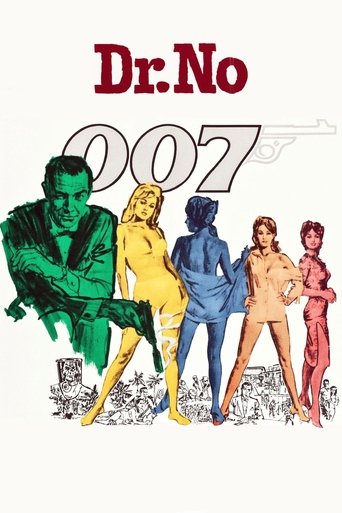
Dr. No
1962 · Film · 110 min
Part of James Bond Collection
Directed by Terence Young
Agent 007 battles mysterious Dr. No, a scientific genius bent on destroying the U.S. space program. As the countdown to disaster begins, Bond must go to Jamaica, where he encounters beautiful Honey Ryder, to confront a megalomaniacal villain in his massive island headquarters.
2 negative5 neutralfrom 7 commenters
Where to watch
No streaming data for this title.
7 comments on Hacker News
As much as I can't stand censorship / Amazon / etc., has anyone actually taken the time to vet this story before voicing their outrage?
A cursory search online reveals only a single source [1]. Additionally searching on Amazon Prime for Bond movies shows PLENTY of poster/cover art with Bond holding his quintessential Walther PPK including Dr. No [2] which was mentioned in the article.
So unless this was leaked by an intern or maybe its being AB tested in various regions, this seems like a big fat nothing. I mean why single out James Bond? Why not Terminator, Predator... basically every Schwarzenegger movie in existence with the exception of Jingle All the Way.
[1] https://www.mi6-hq.com/sections/articles/amazon-prime-2025-remove-guns-from-james-bond-key-art
[2] https://www.amazon.com/dp/B009GEPRZE
Until Fleming started writing the books with the films in mind, Bond was already a very different Bond.
The books are uneven, IMHO, but "Casino Royale", the first of Fleming's novels — written well before the "Dr. No" film — is enjoyable and will give you a very different Bond from what you are used to. Insecure, self-doubting, no "gadgets".... "Diamonds Are Forever" was perhaps my favorite of the books though.
(The film "Goldfinger" actually improved upon the plot of the original book in my opinion — in the book Goldfinger actually tries to steal the gold from Fort Knox.)
I thought Dr No was worse than the movie as well.
If I'm not mistaken, though, irc still works pretty well, and still provides what it always has, and could still function as the live chat aspect of a small community's technology stack. Moreover, in the event that the high-availability internet goes away, it will probably still work on a 90s-tech internet. If your packets are just conversational text, you really don't need a massive warp-speed pipe to make it work.
Likewise Usenet - yes, we abused it to get our alt.binaries (read: boobies), but that was strictly desperation. It still works fine on the fast internet, but again, will continue to work on a 90s internet, in the event that we lose the fast one.
Fast itself is really what's warping our perceptions of what is normal and acceptable. When was the last time you watched an old Connery Bond movie? My grandpa took me to see every Bond movie that existed at the time back in the 80s, the downtown cineplex threw a festival. I remember enjoying all of them at the time, nothing wrong with em.
I threw on Dr No a couple months ago and I swear, I could not get past about 30 minutes, the pacing was hellishly slow, to the point that wanted to climb into the screen and lob a bomb at his car myself out of sheer boredom. Had a similar experience trying to watch Three Days of the Condor.
Interestingly, I decided to rewatch the Lone Wolf and Cub movies after watching the Mandalorian, and they were just as fun as I remember. Some slow scenes, but good pacing with a decent body count:frame ratio.
I don't think we're so much yelling at clouds as wishing the clouds would slow down long enough for us to yell at em. I have my doubts that the pace can be maintained indefinitely, and they are not trying to bring it under control at all. What I expect next is a painful correction in which the laws of nature will come into play in a big way. Whee!
It was not product placement as we think of it today, i.e. paid product placement; sometimes filmmakers use products that the character would use without any other motivation, in order to add depth to the character. (Aston Martin didn't pay them, either.)
In 1962, pretty much the only watch that someone in Bond's role would have worn was a Rolex -- the whole idea of a waterproof dive watch was pretty novel at the time, since Rolex invented the idea in the 50s, and was already associated with intrepid adventurous types after Hillary wore one on Everest (again, because pretty much nothing else was up to the task).
I believe the Bond wore it Dr No on a NATO (nylon) strap, not leather; it's definitely a NATO in some of the later films, but shifts to the iconic bracelet eventually (e.g., certainly by the time Roger Moore wore one with an absurd magnet and unbelievable spinning saw in Live and Let Die a decade later).
Anyway, that site isn't a great reference. It's got some things wrong. The traditional story about the watch in that film is that they got to the beach scene without a watch for Connery, or without a proper one, and the scene was shot with Cubby Broccoli's watch to get at least the right brand in the shot. That story has been printed and repeated a shitload of times, but all the principals are long dead so I have no idea if it's been verified properly in recent times. (In Googling for references for this reply, I saw a new version of the story, which is that the watch was Connery's own; I've never read that before.)
> we are ruthless in killing experiments early that do not prove valuable.
Ed Catmull of Pixar calls new ideas "ugly babies." Ugly because they're covered in warts -- aspects that are easy to change, but that doubters seize on because they destroy value. For example, the script for the first Bond film, Dr. No, had an intelligent monkey for a villain. Babies because they don't have value in their current form, they need more work and iteration before they have value.
How does slack identify technologies that don't have value now, but whose problems are superficial and fixable?
Films have been speeding up for a century, in two ways. Editorial geography disappeared in the 1960s. Editorial geography example (not mine): Bogart gets phone call. Bogart gets up, walks out door. Bogart walks out door of building, gets into cab. Scene of Bogart in cab. Bogart gets out of cab, pays cabbie. Bogart walks into apartment building lobby. Pushes elevator button. Shot of elevator indicator coming down. Doors open. Bogart gets in. Shot of elevator indicator going up. Elevator doors open. Bogart gets out, walks down hall, rings doorbell. Lauren Bacall opens door. Bogart goes in. That's editorial geography. At one time, it was felt that audiences would get lost without such a sequence. Today, writers and directors would skip directly from the phone call to an interior shot of the apartment. Jean-Luc Godard's "Breathless" (1960) is said to have put an end to that.
Related to this is average shot length as a metric.[1][2] "2001" has an average shot length of 13 seconds. At the other extreme are the Bourne movies, which are now down to around 1.1 seconds per shot. James Bond movies have sped up over the years, with "Dr. No" at 7 seconds and "Die Another Day (2002)" at 2.4 seconds. This is an industry-wide trend.
Trailers are insane. Trailers routinely break the 1 second barrier today.
So there's been a speedup in two dimensions - removal of unnecessary context, and shorter shots. To a modern viewer, 2001 looks quite slow-paced.
With enough short shots, films can conceal the lack of a plot. (This is a problem with effects-heavy movies. After you leave the theater, you realize the plot made no sense. But it was a great effects demo reel.)
[1] http://www.cinemetrics.lv/database.php [2] http://unspokencinema.blogspot.com/2007/01/average-shot-length.html