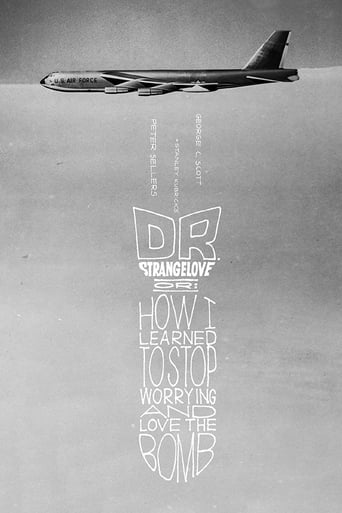
Dr. Strangelove or: How I Learned to Stop Worrying and Love the Bomb
1964 · Film · 95 min
Directed by Stanley Kubrick
After the insane General Jack D. Ripper initiates a nuclear strike on the Soviet Union, a war room full of politicians, generals and a Russian diplomat all frantically try to stop it.
64 positive2 negative1 mixed71 neutralfrom 138 commenters
Where to watch
No streaming data for this title.
164 comments on Hacker News
The time difference between today and Hackers is the same as when the film was released and the year 1964. That's the year films like Dr. Strangelove, Goldfinger and A Fistful of Dollars was released.
You (we) are old :)
They made a movie about Herman Kahn of the Rand Corporation, though. It was called “Dr. Strangelove or: How I Learned to Stop Worrying and Love the Bomb”.
Well, that might have been a movie about Edward Teller, or possibly John von Neumann. Nobody is quite sure.
One of the greatest films ever made is a comedy depicting the combination of psychosis, greed, and bigotry bringing about mass murder and nuclear holocaust, culminating with the characters planning orgies in a mineshaft.
If depicting _that_ is OK (and it is - Dr. Strangelove is one of the finest in the medium, not only in its commentary on war, but its commentary on film), how in tarnation can pretending to be step-siblings cross the line?
Banshees of Insherin is one of the funniest things I’ve ever seen. The understatedness is critical to the humor and story; it’s a juxtaposition of boring people in a boring town and the batshit plots that develop.
Other recent greats are maybe Poor Things, Challengers, and Conclave.
You wouldn’t mistake any for Shawshank, but that’s ok, it’s 30 years later. Shawshank is also qualitatively different from great movies in the mid 1960’s, like Dr. Strangelove or The Graduate.
I don't get why they bother changing the aspect ratio in the first place. What audience is saying, "I want a weird one-off version of the show in HD, please"?
Most of these shows were shot for 4:3. Directors framed for 4:3, lit for 4:3, blocked scenes for 4:3, and even built their special effects around 4:3. Stretching that work into widescreen feels a bit like deciding to colorize Citizen Kane, Dr. Strangelove, or The Man Who Shot Liberty Valance. It solves a problem no one actually has.
Viewers are already used to black bars, and we watch lower-resolution content constantly. Vertical phone clips shot by amateurs on TikTok, grainy GIFs, and IMAX footage down-scaled to fit our phone (and connection). Content that wasn't designed to fill the entire screen isn't the issue.
From what I've seen, most of these old shows end up on free or bargain streaming services packed with ads. I watched an episode of Highway to Heaven with my dad where they sped up the dialogue and trimmed pauses, squeezed the credits into a tiny picture-in-picture box, and still lopped off another minute so the episode ended mid-sentence. All of that was just to make room for extra commercial slots the original show was never designed to accommodate. Disgusting, really... though I suppose you get what you pay for.
Sticking with the original 4:3 and simply adding pillarbox bars is cleaner, simpler, and far more respectful -- and ultimately more enjoyable for the audience.
Relevant :
* "That Was A Mistake": Steven Spielberg Admits He Regrets Removing Guns From E.T. // https://screenrant.com/et-guns-removed-steven-spielberg-regret-response/
* 5 Worst Changes Star Wars Made From The Original Cuts // https://screenrant.com/worst-changes-star-wars-special-editions/
* 'Casablanca' gets colorized, but don't play it again, Ted | Interviews | Roger Ebert // https://www.rogerebert.com/interviews/casablanca-gets-colorized-but-dont-play-it-again-ted
Was there ever a cooler guy who could actually write? I don't think so.
Anyone who rates "Dr. Strangelove" as a great movie is OK by me.
It's similar on the surface. Another language, Effekt, does actually use interfaces for their effect declarations rather than having a separate `eff` declaration.
The difference comes in their use. There's two things of note. First, the implementation of an interface is static. It's known at compile time. For any given concrete type, there is at most one implementation of MovieApi. You're using the interface, then, to be generic over some number of concrete types, by way of only specifying what you need. Effect handlers aren't like this. Effect handlers can have many implementations, actually. This is useful in the case of ex. adding logging, or writing tests to simulate I/O without actually doing it, or just having different behavior at different places across the program / call stack...
eff MovieApi { def getPopularMovies(); } def main() { run { println("Alice's movies: ", getPopularMovies()); } with handler MovieApi { def getPopularMovies() = [ "Dr. Strangelove", "Lawrence of Arabia", "The End of Evangelion", "I Saw the TV Glow" ]; } run { println("Bob's movies: ", getPopularMovies()); } with handler MovieApi { def getPopularMovies() = [ "The Magic School Bus: Space Adventures", "Spy Kids 3-D: Game Over", "Twilight: Breaking Dawn: Part II" ]; } } Second, the effects of effect handlers are not functions. They're under no obligation to "return", and in fact, in many of the interesting cases they don't. The `resume` construct mentioned in the article is a very special construct: it is taking the "continuation" of the program at the place where an effect was performed and providing it to the handler for use. The invocation of resume(5) with a value looks much like a return(5), yes. But: a call to resume 1) doesn't have to happen and the program can instead continue after the handler i.e. in the case of an effectful exception, 2) doesn't have to be invoked and the call to resume can instead be packaged up and thunkified and saved to happen later, and 3) doesn't have to happen just once and can be invoked multiple times to implement fancy backtracking stuff. Though this last one is a gimmick and comes at the cost of performance (can't do the fast call stack memcpy you could do otherwise).
So to answer your question more briefly, effects differ from interfaces by providing 1) a decoupling of implementation from use and 2) the ability to encompass non-local control flow. This makes them not really compete with interfaces/classes even though the syntax may look similar. You'd want them both, and most effectful languages have them both.
There are many metrics that can be sampled, many challenges to normalization.
eg: https://ext.to/browse/?sort=seeds&order=desc&cat=1&q=2019
is a listing of 2019 movie torrents ranked by seeds (number of clients holding full copies of a torrent version).
A normalization challenge is to group torrent variations (1080p rips and 720p rips and WEB-DL's and BluRay and etc.) and tally up and rank interest in various films over time.
Clearly Ne Zha (2019), a Chinese Animation, Fantasy, Adventure movie was a global pirate star of that year .. should it be "normalized" by population of country of origin to smooth out the home team having a billion+ in population "bias" ?
One advantage of ranking films by year and pirate copies is it provides a pragmatic measure of "staying power"
https://ext.to/browse/?sort=seeds&order=desc&cat=1&q=1964
My Fair Lady, Dr Strangelove, Rudolph the Red-Nosed Reindeer, Mary Poppins, A Fistful of Dollars, and Goldfinger are still being hoarded 60 years after their release.
* https://www.themoviedb.org/movie/615453
* https://www.rottentomatoes.com/m/ne_zha
Probably from one of the crazies in Dr. Strangelove (the movie)
Because Dr. Strangelove beat them to the punch. You could make a hundred WWIII films and nothing would be as entertaining or horrifying as Kubrick's flick.
“Mein Führer, I can walk!”
My favourite movie of all time:
https://en.wikipedia.org/wiki/Dr._Strangelove
The writing and acting is superb and the same goes for the sets and camera work. Come to think of it, the only thing I dislike (and greatly so) is the trailer as it to me profoundly fails to communicate the atmosphere of the movie.
Dr Strangelove, the documentary version.
It was actually pro-facism. This isn’t the first time a movie was based on a book, where the movie was a dark comedy, by simply representing the argument in the book. Similar thing happened with Dr Strangelove, which was based on some crummy Cold War book.
Daniel Ellsberg, who had inside knowledge of US nuclear command and control procedures, described Dr Strangelove as pretty much a documentary.
I saw Dr strangelove on 35mm recently (the film stock was completely fucked but still what a treat). Great voice.
A slightly less cliche fact about James Earl Jones: his film debut was Kubrick's Dr. Strangelove, where he plays the bombardier on the B-52[1].
[1]: https://www.youtube.com/watch?v=QSbPqin3L6E
If you weren't aware of the reference, this comes from the full title of the 1964 movie _Dr. Strangelove_: https://en.wikipedia.org/wiki/Dr._Strangelove
For convenience, I asked ChatGPT to create this table, which summarizes how many times each movie has been mentioned in this conversation so far. It got a few counts wrong (as usual), but it still gives a good sense of the frequency. I hope it can be useful to someone:
| Movie | Number of Mentions | |-------------------------------------------|---------------------| | The Matrix | 9 | | Lord of the Rings Trilogy | 8 | | Pulp Fiction | 8 | | Alien | 7 | | Fight Club | 7 | | Ghostbusters | 6 | | Die Hard | 5 | | Back to the Future | 5 | | Inception | 5 | | Star Wars Trilogy (original) | 5 | | Groundhog Day | 5 | | Terminator 1 & 2 | 5 | | Jurassic Park | 4 | | The Thing | 4 | | The Fifth Element | 4 | | Monty Python and the Holy Grail | 4 | | Ghost in the Shell | 4 | | Interstellar | 4 | | Casablanca | 3 | | Office Space | 3 | | Shawshank Redemption | 3 | | The Godfather Trilogy | 3 | | The Blues Brothers | 3 | | Blade Runner | 3 | | Mad Max: Fury Road | 3 | | Unforgiven | 3 | | Total Recall (1990) | 3 | | The Crow | 3 | | The Princess Bride | 3 | | Akira | 3 | | The Big Lebowski | 3 | | Guardians of the Galaxy | 3 | | American Psycho | 3 | | Indiana Jones Trilogy | 3 | | Kiki’s Delivery Service | 2 | | Ratatouille | 2 | | A Clockwork Orange | 2 | | Mission Impossible (various) | 2 | | Casino Royale | 2 | | Skyfall | 2 | | Ferris Bueller's Day Off | 2 | | Star Trek: The Wrath of Khan | 2 | | Apocalypse Now | 2 | | The Shining | 2 | | Groundhog Day | 2 | | Donnie Darko | 2 | | Dune (2021) | 2 | | Gladiator | 2 | | Predator | 2 | | Seven/Se7en | 2 | | The Dark Knight | 2 | | Snatch | 2 | | Prometheus | 2 | | Schindler’s List | 2 | | The Wolf of Wall Street | 2 | | Dr. Strangelove | 2 | | Silence of the Lambs | 2 | | Kill Bill | 2 | | Real Genius | 2 | | Top Secret! | 2 | | Tenet | 2 | | Tinker Tailor Soldier Spy | 2 | | The Adjustment Bureau | 2 | | The Expanse | 2 | | Pulp Fiction | 2 |
Dr. Strangelove or how I learned to stop worrying and love the bomb
Casablanca
The first Sean Connery James Bond films, Casino Royale with Daniel Craig
The Matrix
Django Unchained
The Wolf of Wall street
> we have no idea at all what happens economically when machines are stronger, faster and just generally better than people.
John Henry would like a word. https://en.wikipedia.org/wiki/John_Henry_(folklore)
> In the long term we might plausibly find an economic equilibrium where humans are not worth feeding
https://en.wikipedia.org/wiki/Holodomor
> We might find (imo probably will find) that a human-free military is more effective
The premise of movies from Dr Strangelove to War Games: a military consisting of an array of automatically launched nuclear missiles.
The worry I have is not so much the idea of an AI going entirely rogue against humans as the much more mundane one of it being weaponized by humans against other humans. The desire to do that is so obvious and so strong, whether it's autonomous weapons or trying to replace all art with slop or doing AI-redlining to keep out "undesirables". It's just that that maps onto existing battle lines, which "apolitical" AI bros (both pro and anti "safety") don't want to engage with.
(We all understand that a hypothetical conscious AI would (a) have politics of its own and (b) be fairly unrecognizable to human politics, except being linked to whatever the AI deemed to be its self-interest, yes?)
Kubrick’s results were all over the map. He made maybe three great films:
Dr. Strangelove
Full Metal Jacket
A Clockwork Orange
A bunch of not bad films:
2001
Lolita
Barry Lyndon
The Shining
Spartacus
One real turd of a film:
Eyes Wide Shut
And a bunch of forgettable filler:
All the other films he made.
Compare this to the Anti-Kubrick, Clint Eastwood, who made:
Unforgiven
Mystic River
Million Dollar Baby
Letters From Iwo Jima
Gran Torino
And a bunch of okay films:
Pretty much everything else
And it’s pretty obvious that you don’t need to be an abusive taskmaster like Kubrick to make great art.
These are just my favorites, and in the order of which the popped into my mind.
- Office Space, 1999 (especially for people who work at offices) - The Matrix, 1999 - Fight Club, 1999 :)
Umm, what else? - Spirited Away, 2001 (and many others from Miyazaki) - Requiem for a Dream, 2000 (Very Heavy addiction-related film! I actually got watery eyes just by typing this, I've seen it too many times.) - Joker, 2019 - Full Metal Jacket, 1987 (and many others from Kubrick, such as Dr. Strangelove and The Shining) - Django Unchained, 2012 (and many others from Tarantino, at least Pulp Fiction) - Alien, 1979 - The Silence of the Lambs, 1991 - Saw, 2004
I made a bit longer list, so that I can share the link to my friends.
Actually there are many quirky ones which came to my mind, such as Borat, the South Park movie, Team America, Airplane! (alternatively titled Flying High!), Idiocracy and Hangover, but I wouldn't say these are in the must-see category. Actually I wouldn't even recommend these to most people, if I didn't know what kind of humor they like.
Most famous scene: I remember the argument with the bomb. But for me, the most memorable scene is the final one, when the surfer astronaut surfs away through outer space.
That scene, combined with the argumentative bomb, are reminiscent of the final scene of Dr. Strangelove, with Slim Pickens in his cowboy hat stradling the bomb, yee-ha-ing, and riding it to armageddon.
I saw this in a cinema when it came out, and loved it. It's astonishing that it cost only $60,000 to make. I mean sure, it wasn't exactly a cast of thousands; and the beach-ball alien was obviously cheap as chips ("It's your turn to feed the alien!"), but I had no trouble suspending belief. Maybe it was the drugs; I have no idea what I was taking back then.
I'm always amused by the joke "Of course Kubrick faked the moon landing, but being a perfectionist was only willing to film on location", when in reality he was nothing of the sort. A lot of his filming locations were within an hours travel from home. I suppose it makes sense, even without the 3 month break, FMJ would have been 11 months of filming.
The most immersion breaking part of Dr Strangelove for me is always the outside shot of the ground assault on the "American" base which architecturally is so obviously British it snaps me out of the film each time.
"Former" was portrayed so well by Peter Sellers as Group Capt. Lionel Mandrake/President Merkin Muffley/Dr. Strangelove
https://www.criterion.com/films/28822-dr-strangelove-or-how-i-learned-to-stop-worrying-and-love-the-bomb
Does anyone else find Kubrick's movies weirdly bloodless? They are technically excellent but they leave me completely unmoved, they have zero purchase on my emotions. Dr Strangelove not an exception.
The effect is a bit like Preacher and people without a soul. The movie shows me images and I see them, but almost like abstract art.
For the "Dr Strangelove" fans that haven't seen "Failsafe" I recommend watching it and "Seven Days in May". IMHO Larry Hagman provides a compelling performance as Henry Fonda's translator trying to get the translation and nuances of emotion from the Soviet premier.
All three were released in 1964 and provide different takes on the anxieties of the era. We used to joke a lot about having to hide under our desks (lived in the DC suburbs) during the air raid drills, lot of good that would do when the nukes dropped!
Celebrated in The Guardian:
https://www.theguardian.com/film/2024/jan/29/dr-strangelove-stanley-kubrick-anniversary
Is Dr Strangelove a caricature of Kissinger? I heard that in an Adam Curtis documentary.
“That was a documentary.” - Daniel Ellsberg talking about Dr Strangelove:
https://slate.com/culture/2017/12/the-doomsday-machine-daniel-ellsbergs-sobering-new-memoir-about-life-as-a-nuclear-war-planner.html
A satirical movie involving nuclear weapons and Peter Sellers plays three roles? Where have I heard that one before?
(actually, it looks like it is five years older than Dr. Strangelove? This looks like it could be turned into a very mean pubquiz trivia question, hahaha)
I was rewatching Stanley Kubrik movies, and just finished Dr. Strangelove. In there Gen. Ripper’s has a conspiracy theory about fluoridation. Then was odd to see a fluoridation related article on HN front page.
The fact that nuclear weapons are about deterrence means you don't want them to be secret. A secret nuclear weapon's primary use would be a revenge weapon. Or to blow up a city in a surprise attack. Neither of which is particularly "defensive".
There's a reason why we have arms treaties and try to be transparent about our nuclear capabilities. I know it's a movie but Dr. Strangelove is a great example of the thinking behind this.
I get that the point is to keep the balance of power in the favor of the US, but the practical outcome was letting Israel secretly develop a revenge/offensive nuclear bomb. If it got used potentially millions would die, and you can't even make the argument that it acts as a stabilizer via MAD.
> They made a mistake and got too greedy and make a subscription I barely paid attention to something that got too expensive...
That's the thing, in the past I I'd go months without watching anything on Netflix yet still pay them for it, so they were essentially getting a free $8 a month (or whatever) off me during that time.
Now the prices have gone up so much it doesn't make sense to keep subscribed for something I'm barely using, just so I can easily watch a single show that interests me once every three months or so.
The only streaming service that has makes some sense for me to pay for right now is Youtube's, since that's my goto for videos anyway, and it's nice not to have ads for those.
Additionally they also have a bunch of great older movies free to watch movies on Youtube, probably a better selection (of movies I care about) than Netflix right now (saw/rewatched Train to Busan, Little Shop of Horrors, Ghostbusters, It's a Mad, Mad, Mad, Mad World, Tropic Thunder, Fifth Element, Big Trouble in Little China, Dr. Strangelove, 12 Angry Men, Pee-wee's Big Adventure, The Truman Show, Air Force One, Dirty Work, and Dracula: Dead and Loving It recently).
It's always nice to see a list which includes movies I haven't watched or heard of. Alas I suspect many are hard to find now, the streaming services don't show much interest in picking up the classics.
My sub-list:
Film I'm pleasantly surprised to see in the top 10: Mulholland Dr.
Film I'm not going to complain about: 2001. It's impact can't be denied even if the last bit drags
Film I'm happy to see recognized: Yi Yi
Films I found underwhelming:
-- Melancholia
-- Tree of Life
Films I'd forgotten about that I now have to watch again:
-- Dr. Strangelove
-- Playtime
-- Yi Yi
-- 8 1/2
Film I would have ranked higher: The Third Man
>In the spring of 1961, when he was thirty,
Ellsberg drafted the top-secret operational plans for general nuclear war issued by McNamara to the Joint Chiefs of Staff...
Ellsberg believed that he was never charged with possessing the nuclear papers because senior government officials,
unaware that the documents had been washed away, feared that he would leak them...
"They were afraid that, if they charged me, I would release it all," he said,
referring to President Richard Nixon and his national-security adviser, Henry Kissinger.
----
I'm reminded of the satirical Cold War farce film when thinking of
Dr. Strangelove : https://en.wikipedia.org/wiki/Dr._Strangelove
Dr. Strangelove or: How I Learned to Stop Worrying and Love the Bomb : https://www.rottentomatoes.com/m/dr_strangelove
Dr. Strangelove or: How I Learned to Stop Worrying and Love the Bomb : https://www.imdb.com/title/tt0057012/
Another scary thing in that book is the delegation of use of nuclear weapons to relatively junior commanders - the public statement that only the US president can authorise the use of nuclear weapons being completely untrue at the time.
That is probably why Ellsberg referred to Dr Strangelove as a documentary...
If anyone has not read Ellsberg’s 2017 book “The Doomsday Machine”, I highly recommend it. It covers his work and knowledge regarding potential nuclear war within US policy which was the main reason he wanted to become a whistleblower. Within the book he discuses numerous problems with US command and control procedures for launching nuclear attacks and even calls the movie “Dr. Strangelove” a “documentary” (tongue in cheek) because of its satirical yet accurate highlighting of these issues. It’s a captivating, informative, and frightening book.
Thanks for asking! So the movie itself is framed as the reminiscing of the man of this story, we are seeing his memories. He uses so much clever cinemtography, like framing most shots through windows or bars to give it separation from the viewer, making us almost peeping toms into the most beautiful(might not be the right word, but you understand) part of someone's life. Things like never seeing the partners of the main characters, their explanation of where the significant other being so vague and thick with subtext ( I think I remember that they subtly indicate that their partners are also having an affair together, even though it's practically impossible.) serving this sense of isolation fcrom the rest off he world, kind of like only now is real - which fits with reminiscing , to me.
What I remember most is that the female lead had a few outfits that had multiple copies of it in different colors made, and during scenes they change from one to another without attention - just like memories will fudge details but keep the larger bits intact.
I had never thought of cinema like that, making choices that the audience just feels instead of catch consciously.
I don't remember the movie, but I know that there is a police interogation that was filmed 3 times, where once the cop doesn't know the truth, one where he does and one where he is purposefully neutral, and the scene mixes all three to make the spectator feel the same sense of confusion as someone does during an interogation.
Edit: or in Dr Strangelove, where the table is green like a poker table so the actors feel the absurdity, but you don't see it because it's black and white, so it only comes through through their acting.
In case anyone doesn't get the reference, this line is from Stanley Kubrick's 1964 nuclear war satire "Dr. Strangelove: Or How I Learned to Stop Worrying and Love the Bomb".
If you haven't seen the film, consider yourself one of today's lucky 10,000. https://xkcd.com/1053/. It's a masterpiece, go watch it.
I think Kubrick's movies are fantastic, deep, atmospheric, thought provoking. True art.
I have never made it all the way through one without falling asleep. 2001, Blade Runner, Dr. Strangelove.... Even movies loosely associated with Kubrick like A.I. cause me to nod off. I have to stop when I'm nodding off and come back later fresh in order to finish.
Maybe it would be different if I had seen them in theaters.
The russians did what the article described decades ago.
It’s almost as though they watched Dr Strangelove, and said “that’s a great idea; we’ll even keep it secret to improve its effectiveness as a deterrent, just like in the movie!”
After typing this, I realized that there's a great movie that captures this exactly: _Dr. Strangelove: Or I how I Learned to Stop Worrying and Love the Bomb_.
The eponymous character's boner-like n*zi salute, irrepressible when discussing nukes, reminds me of the irrepressible boner-like response that the most brilliant minds I know have to GPT-4.
Me included.
The other cultural touchstone the current vibe reminds me of is Saruman telling Gandalf about the inevitability of Sauron's reign. That same glitter in the eye: "We have work to do."
In the excellent (if rather terrifying) The Doomsday Machine: Confessions of a Nuclear War Planner Daniel Ellsberg describes going to see Dr Strangelove and basically concluding that a lot of the movie was pretty realistic - particularly the delegated use of nuclear weapons by a base commander without the approval of the President. This was actually possible for a long time even though publicly it was always said that only the President could authorise the use of nuclear weapons.
Was this guy inspiration to Kubrik for his Dr. Strangelove film? If so, which character in particular?
One real danger of putting all historical video media on streaming sites is that it makes it far too easy to introduce an Orwellian Ministry of Truth that is empowered to rewrite the past to make it conform to today's acceptable social norms, academic ideologies, government agendas and so on.
For example, one could make the argument that Alfred Hitchcock's entire library promotes negative stereotypes of women - and it's true, women in Hitchcock films are not the strong types, they're more often helpless victims who have to be rescued by male characters. This clearly, one could say, promotes negative female stereotypes which are damaging to young women so all those movies should be removed from streaming services.
One could continue in this manner, selectively pulling anime movies because they promote excessive violence and sexuality to a teenage audience, or war movies like Apocalypse Now and Dr Strangelove that portray military generals as clueless maniacs, or if the pendulum swings back to the social conservative end, pulling all horror movies that don't portray Christianity in a positive light or have too many Satanic themes, and on and on.
Keeping hard copies in your personal possession is one way around this, but since the copyrights and hence distribution rights are held by these conglomerates that don't want to get in trouble with some political group or other by making them available, nobody else can view them without going through pirate sites - a very unfortunate situation.
Only boring humans are just the product of the content they consume; interesting people have concerns about relationships with other humans, organisations, resources, threats and opportunities that come from being an entity living in a world full of things they don't control and things they'd quite like to control. It's also fairly easy to identify artists who have done nothing but look at other art.
Hayao Miyazaki once said "Almost all Japanese animation is produced with hardly any basis taken from observing real people, you know. It's produced by humans who can't stand looking at other humans. And that's why the industry is full of otaku!" While I'm not actually a huge fan of his work, it's easy to see where he's coming from when you see the likes of "In Another World with My Smartphone" or the hundreds of other trash light novel adaptations. They're clearly fiction being produced by people whose lives are nothing but consuming other fiction, and all they can do is reference that. They have nothing to say.
For another example, there's a huge number of 20th century war films. They weren't made because their creators had read a lot of Wikipedia articles about how destructive wars were becoming. The likes of Platoon are a product of mortal fleshbags who actually saw combat and genuinely feared for their lives. Dr. Strangelove was created by people who had a genuine belief that they were at risk of being annihilated in a nuclear fireball.
This is cool! You can actually get a hint for Kubrick‘s use of symmetry in his movies (except for „Dr. Strangelove“) Very nice!
In some previous article/thread on Dr. Strangelove someone mentioned it was his wife’s favorite movie.
The posted video mentions there’s only a single female role in the film, Tracy Reed as Miss Scott, General Turgidson's secretary and mistress.
> I wonder if the film could still work without some of the mein furher, involuntarily nazi salute stuff.
That part is funnier if you recognize that the main real life person that Dr Strangelove was a spoof of was Wernher von Braun. (For more insight into the joke, listen to Tom Lehrer's song about Wernher von Braun.)
Fun fact: Fail Safe was released the same year as Dr. Strangelove by the same studio. Directed by Sidney Lumet, it’s also about nuclear war. It’s a fine movie in its own right. From the Wikipedia:
> Fail Safe so closely resembled Peter George's novel Red Alert, on which Dr. Strangelove was based, that Dr. Strangelove screenwriter/director Stanley Kubrick and George filed a copyright infringement lawsuit. The case was settled out of court. The result of the settlement was that Columbia Pictures, which had financed and was distributing Dr. Strangelove, also bought Fail Safe, which had been an independently financed production. Kubrick insisted that the studio release his movie first.
Sterling Hayden, who plays General Ripper, kind of steals the show for me in Dr. Strangelove.
There are other top notch performances but I’ve always loved his scenes with Sellers as the RAF officer trying to reason with his madness.
The film is my favorite and George C. Scott deserves a ton of credit too. Slim Pickens is incredible as well. If there’s one character that is a bit over-the-top for me it’s Dr. Strangelove himself. It’s a close call but I wonder if the film could still work without some of the mein furher, involuntarily nazi salute stuff.
Dr Strangelove is my favorite film. Absolutely hilarious, and also a good satire on the actual views of some at the time.
Dr Strangelove was obviously about the absurdity of trying to plan for nuclear war, but the ending credit scene of nuclear bombs exploding while playing "We'll Meet Again" by Vera Lynne sounds like it might have influenced "The Atomic Cafe".
Interestingly, the detail in the linked document that made me think of a movie was the improvised lean-to shelter. One of the protagonists in the British film "When The Wind Blows" built one in his house while following a similar guide.
Ahh, but you're forgetting the most ludicrous idea from Dr Strangelove:
The secret automatically retaliating doomsday machine. In the movie, the Russians kept it secret in order to improve its effectiveness as a deterrent.
Of course, the USSR must have watched the film, because they secretly deployed exactly such a device!
I believe you hit the nail on the head with the whole problem of intent thing. I can enjoy reading antiquated works written in antiquated style, like Shakespeare, because I know that they were made in an effective way for the time. I get over it, I get used to it, I move on. Kind of similar to watching a black & white movie, for example Dr. Strangelove is one of my favorite movies of all time and it doesn't need to be colorized or remade. Even a movie made in B&W after color became standard, like Schindler's List, I can understand the effect the creators are going for. But if somebody came out with a movie where they did something wacky like invert all the colors for no apparent reason, I would find it annoying and distracting.
It does lead to a fun hypothetical. If Cormac McCarthy was a dead author from the nth century, and his writing style was the way everybody wrote in the nth century, I wouldn't hold it against him. I would probably be able to get used to it, and quit muttering "this son of a bitch" aloud every two pages. Although I still doubt I would be a huge fan, I likely would be more appreciative of his work than I am now. But it would be exactly the same work, the same letters on the page. Why should the context change make any difference at all?
So maybe that just makes me petty. But even if so, I can't argue myself into enjoying something I don't enjoy.
Indeed this is from the conclusion of Dr. Strangelove or: How I Learned to Stop Worrying and Love the Bomb (1964). It’s by far my favorite movie.
In the movie "Dr Strangelove", it's never mentioned, but General Buck Turgidson is seen carrying around a binder with the title "World Targets in Megadeaths". I assume that's a reference to those kinds of studies. It's a really great movie and a good distillation of how absurd the whole Cold War was.
I agree with some other commenters; this is a lot of cherry picking. You could just as easily compare Nosferatu (1922) with Blade (1998) with Twilight (2008) and ask why culture gets happier and less serious as time goes on, “aren’t we all becoming like Brave New World???” Comparing Adam West’s Batman with today’s Batman is just lazy. They’re apples and oranges at this point: different genres, different climates (today the more “fun” stuff is Marvel), different film technology. And if we want to get into it, it’s not “depression” that’s trendy; it’s realism. 60’s Batman dealt with all the same “dark” themes as current Batman: mafia, crime, trauma and grief, etc. But the visual portrayal was different because it was a “comic book” before comic books adaptations were commonplace blockbusters. That doesn’t mean all of 1960s cinema is somehow a comic book movie. Hello: Psycho (1960), Dr. Strangelove (1964), The Good, The Bad, and the Ugly (1966).
Different how? Like Lolita (1962) ? All the President's Men (1976)? Miss Saigon (1989, a play I admit, but a controversial one): https://en.wikipedia.org/wiki/Miss_Saigon_controversy
??
I don't even know what decade you're referring to. Movies, plays, and other forms of entertainment always had politics. Some of them (like Lolita) explicitly tried to court controversy.
Or do you mean like Disney movies, like how Peter Pan (1953 Disney cartoon) has great, "non political" songs like "What makes the red man red" ??
Like, you can't escape politics. Even when you're trying to be politically neutral (like a Disney cartoon aimed at children in the 1950s), these sorts of political issues just come up... because our base assumptions of life are in fact political.
Whether we court politics on purpose (Dr. Strangelove, Lolita), or accidentally (Peter Pan 1953, "What Makes the Red Man Red?"), these sorts of things have been going on since the dawn of movies and cartoons.
Lemme leave things off with this 1940s comic by Dr. Seuss: https://library.ucsd.edu/dc/object/bb3618599q/_2.jpg
Dr. Strangelove was openly political. It was made as a dark comedy precisely as a way of making its message transparent and enjoyable to the audience. Modern films are quite different.
You mean like the good ol' days when we had non-political movies like "Dr. Strangelove" ??
In my teens I spent a whole paycheck on the Stanley Kubrick DVD box set. In hindsight this was dumb but then again all of the films are amazing.
The set: Stanley Kubrick Collection (Lolita / Dr. Strangelove / 2001: A Space Odyssey / A Clockwork Orange / Barry Lyndon / The Shining / Full Metal Jacket) https://www.amazon.com/dp/6305440093/ref=cm_sw_r_apan_i_4XQ999X4XZC1T0K6HY3N?_encoding=UTF8&psc=1
Failsafe is based on the same novel that Dr. Strangelove was based on - but while the (imho vastly superior) Kubrick movie was a comedy, Failsafe is more a warning.
> The ways we could end up in a nuclear war are frightening to the point of madness.
Haven't read the book, but I watched Dr. Strangelove when I was young(er).
What made the movie great to me was that it made me realize that, although there is a nuclear "safety net", it was designed and controlled by humans — flawed humans who don't always behave rationally and who may not act in the best interests of humanity.
Inspired by recent events, I re-watched 'Dr. Strangelove or: How I Learned to Stop Worrying and Love the Bomb'. https://www.imdb.com/title/tt0057012/?ref_=fn_al_tt_1
Vladimir Putin watched the movie with Oliver Stone. Putin said not much has changed, except the situation is more dangerous today: https://www.youtube.com/watch?v=rdxls8uC4DA
Discussing the Ukraine war the other day, I brought up the movie and learned that people have no idea what MAD is. It is possible that the only thing more insane about the MAD doctrine is that people living under it have no idea they do. What a world we live in!
Probably. Unless they're missile silos that are housing nuclear weapons meant to be used as part of an automated nuclear response, US military bases are surprisingly low on the nuke priority list.
The eastern seaboard, communications hubs and centers of industry will go first.
It's easy to mop up the military bases once the command structure and supply lines have been annihilated (and defectors/equipment may come in handy post-war). If the aggressor survives the initial strike, they basically just needs to wait.
(That'd only happen if the mutually assured destruction mechanisms failed. They're set up to glassify the surface of the earth once the government collapses. Most military bases get melted during that wave, but then so does everything else.)
The craziest part is that the Russians actually built the doomsday machine from Dr Strangelove, and then kept its existence secret.
Game theoretically, that somehow made it a better deterrent, as sarcastically posited in the film.
At least they didn't do something really dumb, like set the launch codes to all zeros()
() yes, that was the actual launch code. They probably didn't sticky note it to the monitor though, at least at first.
As Jtsummers linked Wikipedia article explains, the term 'Think Tank' was originally applied to the RAND corporation, which was started by the Air Force in 1947 as an R&D organization within Douglas Aircraft, but soon became an independent company which was still largely funded by contracts from the US Department of Defense.
RAND was enormously influential in US and world politics and technology in the 1950s, 60s and 70s. People who worked at RAND included the nuclear strategist Herman Kahn, who wrote a horrifying book On Thermonuclear War and become one of the models for Dr. Strangelove (in that movie it's called the BLAND Corportation), Daniel Ellsberg, who leaked a copy of the Pentagon Papers secret history of the Vietnam War he found at RAND, and Paul Baran, who proposed a national packet switched computer network, which provided the technical foundations for the Arpanet and later the Internet.
The book The Wizards of Armageddon by Fred Kaplan tells the story of the early days at RAND.
http://www.fredkaplan.info/wizards.htm
Availble tech reports from RAND include some of Herman Kahn's early work:
https://www.rand.org/pubs/authors/k/kahn_herman.html
and Paul Baran's computer networking proposal, as well as some remarkably prescient essays on the social and political implications:
https://www.rand.org/pubs/authors/b/baran_paul.html
Reports like these (as well as the secret ones that are never released to the public) are the products of a think tank. Think tanks exist to produce these reports, and to support their authors and other spokespeople who publicize and advocate for them.
> If you’ve never seen M, make sure you don’t watch an older print!
This cannot be emphasized enough. I once watched an old print at a university cinema, it was an extremely disappointing experience (I already knew the restored version at the time). Entire scenes were missing, which made the plot very hard to follow even if you knew the restored version, the sound was incomprehensible at times, and it felt like the entire thing was over after 60 minutes.
The film is a masterpiece and feels extremely modern (just think of the scene were it (spoiler alert) becomes clear that the little girl has been raped and killed: it's simply a 2 second shot of a balloon animal she previously had and which is now caught in an overhead telephone line. Nothing more. You get chills watching it, as it captures everything: violence (why did she let go of it?), lost innocence, death, clinging to life.
You can also clearly "feel" the influence it had on other filmmakers, in particular Hitchcock and Kubrick. For example, there are some very detailed close-up shots of technical stuff which resemble the equipment close-up shots in "Dr. Strangelove". The performance of Peter Lorre is also very Kubrick-like: some may consider it over-the-top (like some consider Jack Nicholson's and Shelley Duvall's performances in "Shining" over-the-top), but it is certainly very interesting to watch.
> EDIT: Bigger bombs could be made, but the question of "how to deliver" the weapon to our enemies becomes a significant question. There's always the Dr. Strangelove approach of building an infinitely huge bomb in your own country, and hoping the bomb is big enough to blow up the world... but that was a joke / sarcastic movie and not an actual plan (I hope).
I could absolutely see a country planting too-big-to-drop nukes along potential invasion routes. Especially during the Cold War, but even now.
The Dr. Strangelove movie was excellent in its satire of this concept.
Its an insane concept, and no normal / rational human would ever dream of that argument. But the problem is that we are not all rational people.
The majority of the people in the movie are rational, it only took a couple of crazies to turn the whole situation into a darkly hilarious and apocalyptic turn of events.
---------
Spoilers for the old movie:
That's exactly the point of the doomsday device. The problem in the movie, is that the Russians didn't announce the existence of the doomsday device yet... they were __planning__ to inform the USA on Dimitri Kissov birthday next week. Which is... a comedic but somewhat believable reason to hold back on the announcement of such a weapon.
So the Russians were only crazy because they didn't inform the USA of the weapon yet. And it only took one crazy commander ("Precious Bodily Fluids") to go against the US President and start the nuclear war.
> a reminder that we are having some laughs in the service of the building of weapons of mass destruction and there’s something inherently problematic about that
I don't get it. The problem is with building weapons of mass destruction in the first place, not doing it and then finding humor in the situation.
Isn't it quite funny that a so-called "intelligent" species would expend so much energy, money and time to build a series of devices to annihilate itself? Surely it's at least a bit ironic?
Dr Strangelove is a comedy about exactly that, and its humor works. It seems when Kubrick started to work on that project he wanted to do a "serious" movie, but the more he learned about the whole system the more he found it utterly absurd, and he came to the conclusion that the only way to talk about it was to make a satire.
https://en.wikipedia.org/wiki/Dr._Strangelove#Dr._Strangelove
If a film director, albeit a very gifted one, could already see in 1964 how absurd that line of reasoning really was, no hindsight was really necessary.
That came later iirc - initially they were thinking of using them prior to running infantry in.
I think there are old public test videos where they actually did this kind of thing.
I also recall a group of scientists trying to elevate the understanding of the e-risk (pugwash conference?).
Basically people were becoming too comfortable with the idea of nuclear war because they knew how to “duck and cover” and had a little bomb shelter in the yard.
See this: https://youtu.be/IKqXu-5jw60
Dr. Strangelove is also worth watching for a satirical take from that time.
The doomsday device on Stanley Kubrick's Dr Strangelove is also a fictional cobalt type bomb, or as quoted [0] in the movie:
"If you take, say, fifty H-bombs in the hundred megaton range and jacket them with Cobalt-Thorium G, when they are exploded they will produce a doomsday shroud. A lethal cloud of radioactivity which will encircle the earth for ninety-three years!"
It's a fantastic movie that I highly recommend to anybody that hasn't seen it yet.
[0] https://en.wikipedia.org/wiki/Cobalt_bomb#In_popular_culture
The blueray 4k they released for Dr Strangelove looks amazing. Highly recommend watching it.
> podcast about fluoridation in tap water
This has been a staple of crazies since, what, the 50s? I'm reminded of the speech from the deranged general in Dr Strangelove: https://www.imdb.com/title/tt0057012/characters/nm0001330
You could fit that right into a modern rightwing podcast without it being out of place.
"It should come as no surprise that recent advances in big-data analytics and artificial intelligence have created strong incentives for enterprises to amass information about every measurable aspect of their businesses. And financial regulations now require organizations to keep records for much longer periods than they had to in the past. So companies and institutions of all stripes are holding onto more and more.
Studies show [PDF] that the amount of data being recorded is increasing at 30 to 40 percent per year. At the same time, the capacity of modern hard drives, which are used to store most of this, is increasing at less than half that rate. Fortunately, much of this information doesn’t need to be accessed instantly. And for such things, magnetic tape is the perfect solution.
Seriously? Tape? The very idea may evoke images of reels rotating fitfully next to a bulky mainframe in an old movie like Desk Set or Dr. Strangelove. So, a quick reality check: Tape has never gone away!"
If you want to learn more, just watch the movie Dr. Strangelove. It was marketed as a comedy, but people in the know consider it to be non-fiction:
https://en.wikipedia.org/wiki/Dr._Strangelove
General MacArthur was dismissed during the Korean War because the White House weren't sure if he was going to use nukes or not (like the movie.) The policy was that the US was ready (bombers with nukes were positioned in Japan), but President Truman wanted to give final advance approval to commanders, yet MacArthur was issuing his own policy.
https://en.wikipedia.org/wiki/Douglas_MacArthur
(It turns out that MacArthur was right about basically everything he ever said, and continued to advise Presidents.)
Running desktop applications inside a web browser is bonkers too. And the cloud. It's better to embrace the madness. I recommend watching Dr Strangelove.
Note: These are references to the classic movie Dr. Strangelove, or: How I Learned to Stop Worrying and Love the Bomb. As is my own,
Animals vill BE BRED UND SCHLAUTERED!
You can just watch the movie "Dr. Strangelove."
People thought it was SciFi, but it was actually a documentary.
The nuclear silo launch code for decades was "000000" to save time to launch.
Also, Reagan and Russia didn't care about some goofy MAD doctrine - they wanted actual ABM defenses. That's why there's an ABM ring allowed by treaty around Moscow, and why Reagan funded SDI (lasers weren't implemented, but anti-missile missiles were.) Reagan thought MAD was immoral if you could build a real defense, and he was right.
Something most people don't know is that Russia seriously planned to nuke Beijing durng their 1969 border dispute, but the US found out and told them not to. The CCP did their "wolf warrior" b.s. on Russia, and after the Russians had enough they decided to root out the problem once and for all.
https://en.wikipedia.org/wiki/Sino-Soviet_border_conflict
Ironically, the CCP asked Russia to declare a joint war on the US in the 50's and 60's twice for communist ideological reasons, but Russia laughed them off since there was no practical advantage for Russia.
Although Russia's weapons worked just fine, the US over-estimated Russian belligerence and grossly under-estimated the CCP.
The US Democrats are obsessed with the Russians, but it's the CCP that is completely unhinged. Xi wants to be god on earth over all other countries.
And all it takes is one blasted radio to be on the fritz and it won't matter. Dr. Strangelove was a fascinating movie.
Your first option is way more devious than anything I had imagined, that's true, but I'm not convinced it would warrant toe to toe nuclear combat with the Ruskies, to quote Dr. Strangelove (or rather Major Kong in that movie). I'd expect something along the line of strict economic embargo, with all sorts of shady people making a lucrative business out of it.
This is mostly Herman Kahn redux.
https://en.wikipedia.org/wiki/Herman_Kahn
When there were 3 TV channels in the 1960s, in prime time programming you would often hear discussions just like this, from Kahn himself at times. Topic and people inspired the movie Dr. Strangelove and was at the forefront of the national consciousness in the late 1950s and early to mid 1960s.
As a set of ideas and concerns, it was beaten to death at the time, revived a bit during the “nuclear winter” thesis of the 1980s, and always was and continues to be an active issue at the Federal level. Mismanage nukes and you can be booted out even if you are the Secretary of the Air Force.
https://www.reuters.com/article/us-usa-airforce-idUSWAT00960720080606
It is a very, very deep rabbit hole. Could be fun to see how far you can get with unclassified sources, for various peculiar values of “fun” until you turn into a character from Strangelove yourself.
The classic starting point is On Thermonuclear War, 1960, Kahn.
Now that I think of it, Kahn died in the early 1980s. If he reincarnated immediately, he’d be in his mid 30s.
How old are you, landfish? Is that you, Kahn?
For everyone else, repeat after me, nuclear weapons are weapons of policy, not weapons of war. Nuclear weapons are weapons of policy, not weapons of war...
Development beginning in 1967, three years after the release of Dr. Strangelove, and mostly not functional until the 1980s. Whether the film merely anticipated or actually inspired the weapons management system isn't clear.
American Cold War strategist and generally charming sprite Herman Kahn's 1960 book On Thermonuclear War inspired Kubrik.
https://archive.org/details/onthermonuclearw00kahn/page/n5/mode/2up
I recently watched Tarkovsky's The Sacrifice which also deals with the threat of nuclear destruction. The main character is having a birthday dinner when the news informs everybody about the nuclear threat. The simplicity in which this information is revealed and the transition from the mundane to abject fear connected really well to modern times.
It's interesting seeing film ideas repeat and be interpreted by multiple directors. It's almost like some ideas need to bounce from director to director before they find the right outlet. I Live In Fear begets Dr Strangelove begets The Sacrifice.
Dr Strangelove was originally planned as a serious film until Kubrick realized that there was comedic potential in the subject and he brought in writer Terry Southern.
Kubrick was concerned that Fail-Safe, in production as a film at the same time as Dr Strangelove, could hurt ticket sales for his film and encouraged a lawsuit against Burdick and the producers of the film alleging that Fail-Safe was plagiarized from Red Alert, the source novel for Dr Strangelove.
>On the other hand, organizations that are able to keep their internal deliberations private have a strong advantage over ones who must ‘think’ openly.
Not necessarily. If there is secrecy within the organization, any leader of a subbranch can abuse his power along the line of the movie Dr. Strangelove.
Back in the dark ages (pre-streaming) Sky Movies showed "Dr Strangelove". The UHF scrambling only affected the picture, not the audio, so even though we didn't have a Sky subscription we could still listen in: it works wonderfully as a radio play too.
I have to admit the “full retard” is one of the best lines I have ever heard in a movie. Maybe “10-20 million dead, tops” from Dr Strangelove is on that level.
An early draft of 2001 A Space Odyssey had Discovery as an Orion, but apparently Kubrick having just done Dr. Strangelove didn't want to do another film with nukes.
Anyone interested in a quite good, serious film with similar themes to and released around the same time as Dr. Strangelove, should check out Seven Days in May.
Fail Safe is was based on a book called 'Fail Safe' while Dr Strangelove was based on one called 'Red Alert'. It's an easy mistake to make as they have incredibly similar plots which really hurt Fail Safe (which I agree is a great movie)
The original “Fail Safe” is a great movie btw, if you’ve never seen it. As mentioned in the article, that and “Dr Strangelove” were based on the same book, with “Fail Safe” being the more sober interpretation. Amazing cast, and Lumet (“Dog Day Afternoon”, “Network”, “Twelve Angry Men”) is a legendary director.
Cartrivision: https://en.wikipedia.org/wiki/Cartrivision
> Cassettes of major movies such as The Bridge on the River Kwai, Guess Who's Coming to Dinner, Dr. Strangelove, High Noon, It Happened One Night, Divorce Italian Style, The Quiet Man, The Belles of St Trinian's, Two Rode Together and Brother Rat[4] were ordered via the initial 200-movie catalog at a retailer, delivered by parcel mail, and then returned to the retailer after viewing. These rental cassettes were red, approximately 7 inches (180 mm) high by 6.5 inches (170 mm) wide by 1.5 inches (38 mm) deep (however used the same videotape used today) and could not be rewound by a home Cartrivision recorder. Rather, they were rewound by a special machine upon their return to the retailer.[5] Other cassettes on sports, travel, art, and how-to topics were available for purchase. These cassettes were black, and could be rewound on a Cartrivision recorder. An optional monochrome camera manufactured for Cartrivision by Eumig could be bought to make home videos. A color camera was in the works but never materialized before CTI's demise.
As an aside, “Fail Safe” (1964), is one of the best movies ever made, IMHO, about the risks of technology and warfare. Once you get past the slow pacing, the black and white... it’s an incredible film. It’s based on the same book as Dr Strangelove — but just takes a completely different, dramatic take on the material. You also get a chance to see why Henry Fonda is considered such a legendary actor. Sidney Lumet, the director, is also a legend: “Dog Day Afternoon”, “12 Angry Men”, “Network”...
Cold war doctrine was the other way around; it was assumed that once the other side's missiles launched, you were already dead, and the only way to prevent that launch was as strong a commitment to retaliation as possible. Hence the UK deploying its nuclear deterrent at sea, since the UK is small enough that Soviet ICBMs had enough coverage to destroy all military installations on the island several times over. Along with most of the population.
Mutual assured destruction may be the only thing limiting the Kashmir conflict, for example.
The definitive film on this is of course Dr Strangelove.
I think it´s funny with that much comments, none of them are really on the core issue here.
Just imagine if Tim Berners-Lee banded together with Mark Andreessen to create a closed and centralized platform, were they could centrally control everything.
Thats why i think the mobile phone plataforms are a real danger to a world were the information flows freely and were no government or company can control.
People are giving to much power to those companies, and when they do what a lot of people know they would do, they just wip, and try to contact his digital lord to just have mercy.
Dont neal, dont help them kill the spirit behind a world were people can access the things they want without any sort of centralized control.
Its beyond me how many people are so worried about government controlling their freedom, but are ok with companies doing it.
We do not need to accept this. The problem is in the app store model.. (they could create it, as long other could compete, but they could NEVER choose what you can access) and guess what, now our governments are too are weak to regulate them.
They can spy on us, know what we are doing, help shady government agencies, control what you see, listen, access and in the end shape what you think (Remember all the mess the simple 'like' Facebook algorithm did to the world.. its too dumb. It reminds me "Donnie Darko" with that shady coaching of "everything should be on the hate-or-love axis").
The despotic government of the future for me is a bunch of big tech companies who control information, and the lives of all of us united to have a world were they will be all powerful and always relevant.
People dont seem to know the dangers we are facing. This is very serious, and its a glimpse of the future. Think how much of what you understand as your right will be suddenly terminated by despotic tech companies who are too powerful to be controled or regulated.
It´s even worse, if you think we are in the dawn of the AI and what a very powerful player can do to keep the control.
You can think im exagerating, and i really hope im wrong, but its a real possibility, and we should not let this awful future be materialized because we did not see how this could be possible.
And to help you figure it out, if you travelled back in time to tell your 2010 self how the world would be in 2019, do you think he would believe it? We are living in idiocracy all over the world, and we use to laugh to those sort of movies. (Dr. Strangelove will soon look a lot like a documentary of the modern days)
Megadeth is named after the term “megadeath”, a unit in Cold War calculations of possible nuclear attacks to designate a million deaths. The 80’s were a grim time. (You can actually see in the film Dr. Strangelove a scene where George C. Scott’s character leans over a binder labeled “World Targets in Megadeaths”.)
>I have never considered the "unreasonable effectiveness" and "considered harmful" to be equivalent?
I didn't downvote you but as an fyi...
When gp wrote "in the same vein of", he wasn't saying the phrases meant the same thing. He was pointing out that they are the same classification of rhetorical device which some call a "snowclone". (See examples.[1])
The "unreasonable effectiveness of <x>" is re-used as a text template similar to "<x> considered harmful".
For another timely example, the current #1 story on HN is ""Debugging Emacs, or How I Learned to Stop Worrying and Love DTrace"". I think many readers will recognize it as a snowclone of the Kubrick film title "Dr. Strangelove or: How I Learned to Stop Worrying and Love the Bomb"
The snowclone is: "<X> or: How I Learned to Stop Worrying and Love <Y>".[2]
[1] https://en.wikipedia.org/wiki/Snowclone#Notable_examples
[2] More examples of previous HN submissions that used that Strangelove snowclone: https://hn.algolia.com/?query=or%20%22how%20i%20learned%20to%20love%22&sort=byPopularity&prefix=false&page=0&dateRange=all&type=story)
Related: interviews with Daniel Ellsberg who leaked The Pentagon Papers about cold-war nuclear strategy and military politics. https://www.youtube.com/playlist?list=PLvq2Qc-bxroT2xV7b9pOB8aa4hB9WCmxo
Spoiler alert: Dr. Strangelove and its nemisis, Fail-Safe, were historically-accurate documentaries.
I'm not sure I'd call Stanley Kubrick's movies accessible. Sure, there are less accessible movies out there, but also much more accessible ones. And accessibility is not a bad thing; movies are meant to be watched.
I personally find Kubrick's movies excellent. Rarely perfect, but often highly innovative in one area or another, and all completely different. They range from glacial 2001 to funny Dr Strangelove, to historical costume drama to brutal war movie, and he manages to capture the essence every time.
There are many other deserving directors out there, but it'd be nuts to not consider Kubrick among the greatest directors.
If you enjoyed Dr Strangelove, check out Seven Days in May. It's kind of like a serious version of the former, and was made right around the same time. I wouldn't call it a masterpiece, but it's still a good, and undeservedly overlooked film.
+1 for Dr. Strangelove. Amazing movie. Way ahead of its time.
All of the movies by him that I’ve watched are brilliant.
Dr Strangelove is my favourite movie. The Shining is excellent, A clockwork orange, Barry Lyndon, 2001, Eyes Wide Shut ...
He was also a fantastic photographer.
Films are not books. Some very good films (such as Dr. Strangelove) may be inspired by a book or riff off it but end up in a very different place with a very different tone. It's not a filmmaker's job to do a faithful adaptation--although those can work too.
In the movie Dr. Strangelove the president was very upset by the idea of choosing who lives and who dies, which is when Dr. Strangelove brightly exlaims "that could easily be done by a computer".
Decades later, Deep Impact doesn't bother with the qualms, and just has the president solemnly proclaim on TV that a computer will randomly select people, on top of a fixed pool of "VIP", and the people watching TV are all just... sad, and hope they get picked. Not one person goes "What? What did he just say?".
This "meme", that a catastrophy destroys all but a selection, is as old as the Bible, i.e. of Noah as well as the Book of Revelations. Flood myths in general are fascinating, some even have "the bad guys" surviving the flood they themselves caused.
edit: I tried to find the "bad guys surviving the flood" one, I'm 99% sure it was on here http://www.talkorigins.org/faqs/flood-myths.html
But I couldn't easily find it again, it's such a giant page. I think it involved lying to the gods about who caused the flood (or other issue), who then punish the wrong guys, while the actually guilty people survive. Could have been about two island peoples, one good one bad, but I'm not sure, it's been quite a while since I read that page.
I know meta comments are frowned upon here, but why is the “or:” in headlines (borrowed from Dr. Strangelove I presume) so popular among programmers?
I see it done again at least once a week. Is it just because the movie is popular among programmers, or is there something more to it?
In Search of the Last Great Video Store – The Black List Blog || https://blog.blcklst.com/in-search-of-the-last-great-video-store-efcc393f2982
I grew up about 2 blocks away from Scarecrow Video in Seattle. I'm happy it's still around. Place was amazing, and... in the late 80s and early 90s they weren't dicks about renting R movies to kids like Blockbuster was. I remember being like 11, and I negotiated a monthly punch card in lieu of allowance. I could rent any 12 movies I wanted! Such power for a kid. And the clerk always had great suggestions.
It's because of Scarecrow that I got introduced to great films early... The Man Who Shot Liberty Valance, The Apartment, Giant, 12 Angry Men, Dr. Strangelove... anyway for a kid in a single parent home, I lucked out getting to watch old classics when my friends were all busy watching stupid cartoons and Saved By The Bell re-runs.
Yeah, it had me thinking of that scene in Dr Strangelove too. Such a wonderful piece of cinema.
Probably "Dr Strangelove". Everyone knows that we didn't have the adequate technology to make movies starring one person in three different roles in 1964. Peter Sellers was cloned for the three separate roles in "The Mouse That Roared" in 1959, and then two of the clones were murdered once the "Dr Strangelove" was completed. Both movies were filmed on a sound stage controlled and built by the CIA.
Don't forget Dr. Strangelove, which is based on a very serious novel about nuclear war, "Two Hours To Doom" (published in the US as "Red Alert"), which Kubrick and Terry Southern turned into a comedy. (Today the book is out of print and largely forgotten except for its relationship to the film.)
Most of the giant media-loved scientists have died at this point - Sagan, Feynman, Salk, Pavlov, etc, and are finally starting to drop out of public-rememberance.
The 20th century had a lot of movies featuring (fictional) scientists, like Dr. Strangelove and Men in Black, too.
They were represented quite a bit.
Watching movies has to be one of my most inspiring accidents. In 2017, due to some external circumstances [1], I watched maybe 50+ movies on the IMDB top 250 list. Kubrick is definitely my favorite director that I didn't know about before. His stuff takes some time to digest, but they are definitely worth watching. Besides 2001, The Shining, A Clockwork Orange, and Full Metal Jacket are all worth watching. I have to re-watch Dr. Strangelove at some point because last time I didn't finish it.
The other director that I think I started to 'get' (however hard to believe) is Coppola. I didn't get Godfather before that at all despite having watched the movie 3 times. After the second Godfather movies, I started to see the Godfathers as human and empathize with them ("Yes, I can totally see myself doing that"). I haven't read the novels, however, I hope to get to the novels at some point.
At the same time, when I re-watched Tarantino's movies, I became less impressed in his style. After gore and somewhat snarky theme, I failed to see anything else. I still equally love Coen brothers regardless of how many times I watched their movies.
My old boss who owned a wine importing business used to tell me when you have tasted enough wine, you will know what good wine is like without having to describe it. After watching 50 movies or so, there was a moment when something started to 'click.' I think it gave me inspirations to do take notes of human feelings and emotions and empathize with them. I am more inspired to produce meaningful software that does not have to be technically challenging to write, and write blog posts that are not about technically hard/clever code. After watching "Sunset Blvd," I decided that money was never my problem, so I think less about money.
I'm 30 now and have always been a nerd before. Good movies have partly changed my life.
1: https://news.ycombinator.com/item?id=16360380
One of the co-authors here is Herman Kahn, the nuclear strategist. He wrote On Thermonuclear War in 1960, which made him one of the models for Dr. Strangelove - some of the lines in the movie are direct quotes from that book. Later he became a utopian (or dystopian) futurist - when he wrote a book called The Coming Boom (which title provoked ironic comment, given his earlier book).
A biography appeared several years ago, The Worlds of Herman Kahn by Sharon Ghamari Tabrizi. She concludes that Kahn was a sort of performer, a monologist working in a then-popular genre called "sick comedy".
Because it's almost certainly true? I'm not trying to invent some sinister conspiracy, but most people on HN and otherwise acquired an exaggerated perception of the effects of nuclear war after being exposed to pop-cultural portrayals of it - chiefly in the movies.
Some of these portrayals were exaggerated simply because it resulted in a better story, but some were almost certainly colored by anti-war and anti-proliferation sentiments predominant among the cultural elites of that time. This wasn't coordinated or meant to advance some sinister agenda, but for better or worse, it skewed our understanding of what we can do in the unlikely case that any ICBMs actually fly.
An argument can be made that another factor was the government's desire to discourage the Soviets from ever trying to attack us, but I'm unconvinced - their generals, politicians, and nuclear scientists sure had a more realistic understanding of what would happen. Besides, the anti-nuclear and anti-war sentiments hurt the government in many other ways (nuclear power generation, nuclear weapons testing, Vietnam...).
Now, I'm not particularly angry at that, and I sure loved Dr. Strangelove.
I'm not trying to establish the origin of this narrative; but most people on HN were almost certainly exposed it through pop cultural portrayals of the nuclear apocalypse.
In some cases, these were inaccurate simply because it resulted in a better movie or a novel; but in many other cases, they were probably informed by anti-war or anti-proliferation sentiments. I don't think this deserves any special ire, TBH; it's just our reality. I loved Dr. Strangelove, but it sure affected public perception in a particular way.
Right, thanks for the push. Going to watch the movie now.
FYI: Both the film Fail-Safe and 'Dr Strangelove' are based on that book.
Dr. Strangelove. There are at least a couple incidents in the movie where mundane technical failure contributes to catastrophe, and where technical safeguards that rely on "human in the loop" fail because of humans.
The wikipedia article is itself as worth reading as watching the film. Bait: it mentions John von Neumann. https://en.wikipedia.org/wiki/Dr._Strangelove
Also check out Seven Days in May.[1] It's kind of like a serious version of Dr. Strangelove, being more about the events leading up to nuclear war rather than the war itself. Very well done.
[1] - https://dvd.netflix.com/Movie/Seven-Days-in-May/950294
It's one thing to worry about AI's taking over the world someday. It's quite another matter entirely to think about current military automation of WMD deployment.
Everyone's probably seen Dr. Strangelove at some point in time. If you haven't, stop reading immediately and go watch it. You will not regret this. Those who have watched it are familiar with a contrived, hilarious, but mostly plausible, scheme by which human beings could be fooled into launching an unauthorized nuclear first strike. This is with technology from half a century ago. As you watch this movie, you will be exposed to a system with checks and safeties that can be bypassed by a determined (and insane) individual. Many humans at every step of the process could have stopped the deployment, but choose to blindly follow orders, well, like machines.
What people should be worried about today is how many humans stand between a decision made by a nuclear power's leader and launch. Humans doubt. Humans blink. Humans flinch. When all the data says nuclear missiles are inbound and it's time to retaliate, humans can still say "No.", and have[1]. If you automate humans out of the system, you wind up reducing the running length of a Dr. Strangelove remake. I suspect it would be down to under five minutes today.
Thanks to popular media, we have this strange idea that taking humans out of the equation in automated weapon systems reduces the possibility for error. Individual humans can, and do, make mistakes. This is true. However, humans fix each others' mistakes in any collaborative process. Machines, on the other hand, only amplify the mistakes of the original user. If a bad leader makes a bad decision with a highly automated nuclear arsenal at his or her disposal, how many other humans will have the chance to scrutinize that decision before machines enact it?
[1]https://en.wikipedia.org/wiki/Stanislav_Petrov
Kubrick, film, 1964:
"President: "You know how we've always talked about the possibility of something going wrong with the bomb. The bomb, Dimitri. The hydrogen bomb. Well now what happened is, one of our base commanders, he had a sort of, well he went a little funny in the head. You know. Just a little... funny. And uh, he went and did a silly thing. Well, I'll tell you what he did, he ordered his planes... to attack your country."
"Listen, I've been all over this with your ambassador. It is not a trick. Well I'll tell you. We'd like to give your air staff a complete run down on the targets, the flight plans, and the defensive systems of the planes. Yes! I mean, if we're unable to recall the planes, then I'd say that, uh, well, we're just going to have to help you destroy them, Dimitri. I know they're our boys."
"Who should we call? Who should we call, Dimitri? The people...? Sorry, you faded away there. The People's Central Air Defense Headquarters. Where is that, Dimitri? In Omsk. Right. Yes. Oh, you'll call them first, will you? Uh huh. Listen, do you happen to have the phone number on you, Dimitri? What?""
... (later) ...
"DeSadeski: the deciding factor was when we learned that your country was working along similar lines, and we were afraid of a doomsday gap.
President: This is preposterous. I've never approved of anything like that.
DeSadeski: Our source was the New York Times.
President: Dr. Strangelove, do we have anything like that in the works?
Dr Strangelove: Under the authority granted me as director of weapons research and development, I commissioned last year a study of this project by the Bland corporation. Based on the findings of the report, my conclusion was that this idea was not a practical deterrent, for reasons which, at this moment, must be all too obvious.
Dr Strangelove: it's remarkably simple to do that. When you merely wish to bury bombs, there is no limit to the size. After that they are connected to a gigantic complex of computers. Now then, a specific and clearly defined set of circumstances, under which the bombs are to be exploded, is programmed into a tape memory bank.
but the... whole point of the doomsday machine... is lost... if you keep it a secret! Why didn't you tell the world, eh?"
In reality:
"Dr. Strangelove's 'Doomsday Machine': It's Real"
http://www.npr.org/templates/story/story.php?storyId=113242681
"RAZ: Right. If it was supposed to be a deterrent, why didn't they tell us?
Mr. THOMPSON: And the reason they didn't tell us, there are a couple of reasons..."
http://www.huffingtonpost.com/2013/12/05/nuclear-missile-code-00000000-cold-war_n_4386784.html
The code was 000000
I read an interesting book a while ago by Thomas Schelling [1] that said in nuclear launch systems, being unreliable is a feature not a bug.
Let's say you want to threaten your enemy with nuclear war so they'll do what you want. Maybe you want them to withdraw their missiles from Cuba. The threat you make actually has two components - the claim you'll launch, and the credibility of that claim. The enemy is only scared of the /product/ of threat and credibility, so if either is zero your enemy has nothing to fear.
If you say "we'll certainly launch" you have no credibility (you'd have launched already, and everyone can see you haven't) and if you say "we certainly won't launch" you have no threat.
In fact, Schelling points out, the only credible threats are /randomized/ threats, that fall somewhere between 100% and 0% chance of launching. You threaten your enemy by showing him you have a system that has a 0.1% chance of launching per day, and you'll roll the dice every day until they withdraw their missiles from cuba (or whatever you want them to do).
Except rather than rolling dice, the random threat is from systems failures and mad generals.
This is what the DEFCON level is really about - increasing the 'readiness level' amounts to reducing the controls that prevent accidental launches, increasing the threat of a random launch.
'Doomsday machines' can be explained by a similar calculation: Nobody will believe you if you claim you'll trigger nuclear war if a single soldier took a single step over a border. So why would you for two soldiers or two steps - or indeed the capture of some trifling town near one of your allies' borders? It's not like mutually assured destruction will become a more palatable concept when the enemy tanks are ten miles over the border instead of one.
However, if you build a doomsday machine with tank detectors ten miles past the border, then you give enemy diplomats and spies a tour and show them that it works, the claim that you'll launch has credibility /despite/ the fact the ten mile line is arbitrary. The invader's calculation is no longer "If our conventional forces do X, will /they/ trigger a launch?" but instead "Do /we/ want to trigger a launch?" and the answer to that is always 'no'.
So Dr Strangelove is actually a pretty well informed film :)
[1] https://en.wikipedia.org/wiki/Thomas_Schelling#The_Strategy_of_Conflict_.281960.29
A decade after the release of “Strangelove,” the Soviet Union began work on the Perimeter system—-a network of sensors and computers that could allow junior military officials to launch missiles without oversight from the Soviet leadership. Perhaps nobody at the Kremlin had seen the film. Completed in 1985, the system was known as the Dead Hand. Once it was activated, Perimeter would order the launch of long-range missiles at the United States if it detected nuclear detonations on Soviet soil and Soviet leaders couldn’t be reached. Like the Doomsday Machine in “Strangelove,” Perimeter was kept secret from the United States; its existence was not revealed until years after the Cold War ended.
http://www.newyorker.com/news/news-desk/almost-everything-in-dr-strangelove-was-true
He's quoting Dr Strangelove, these are all quotes from the (excellent) film.
http://www.newyorker.com/news/news-desk/almost-everything-in-dr-strangelove-was-true
With great reluctance, Eisenhower agreed to let American officers use their nuclear weapons, in an emergency, if there were no time or no means to contact the President. Air Force pilots were allowed to fire their nuclear anti-aircraft rockets to shoot down Soviet bombers heading toward the United States. And about half a dozen high-level American commanders were allowed to use far more powerful nuclear weapons, without contacting the White House first, when their forces were under attack and “the urgency of time and circumstances clearly does not permit a specific decision by the President, or other person empowered to act in his stead.” Unbeknownst to both Kubrick and George, a top official at the Department of Defense had already sent a copy of “Red Alert” to every member of the Pentagon’s Scientific Advisory Committee for Ballistic Missiles. At the Pentagon, the book was taken seriously as a cautionary tale about what might go wrong.
A decade after the release of “Strangelove,” the Soviet Union began work on the Perimeter system - a network of sensors and computers that could allow junior military officials to launch missiles without oversight from the Soviet leadership. Perhaps nobody at the Kremlin had seen the film. Completed in 1985, the system was known as the Dead Hand. Once it was activated, Perimeter would order the launch of long-range missiles at the United States if it detected nuclear detonations on Soviet soil and Soviet leaders couldn’t be reached.
I believe that's check and mate, old chap?
I used collaborative filtering for movie recommendation (http://web.onetel.com/~hibou/morse/MORSE-Paper.html), and it worked well for that, and I'd probably use it for music too. Movies and music have quite complex "structure", making it hard to compare even similar examples. Dr Strangelove's most similar movie is probably Fail-Safe, but the two are still very different in many ways, aren't really interchangeable, and I wouldn't be surprised if someone liked one but not the other.
For beer, although there are many different styles, similar beers could more easily be substituted for each other (e.g. Sierrra Nevada Pale Ale and Brewdog Punk IPA). So if you couldn't get the one you asked for, you'd be happy with the other.
I have no hard evidence, though, and might be wrong. I didn't get the chance to apply my MORSE algorithm to beer, and it wasn't as generally applicable as I'd have liked. (See http://web.onetel.com/~hibou/morse/DeadOnTime.html)
Rosebud....
On a total segue from the topic of this post; two of the earliest memories of movie scenes that are etched into my brain are: a) The snow globe falling down and breaking from Citizen Kane and b) Slim Pickens riding the bomb in Dr. Strangelove
I have no idea at what age I watched them but those two scenes seem to have captivated me and are forever with me.
Oh that's interesting! I don't find the special effects in those movies laughable at all. In Dr. Strangelove they play only a minor role in the film, while I think in 2001 he cleverly worked around the technical limitations, and used a set and model design that still largely looks (60s style) futuristic, rather than dated.
Compare it with contemporary or slightly newer movies like Planet of the Apes, Barbarella, Logan's run. It's not a standard space opera with space battles, faster than light travel, alien empires and magic space gravity. Sure, the men in ape suits look a little naff, but then I don't see how else he could have done it. Claymation would have been worse, herding actual gorillas not an option.
> Why is this film brilliant? I found it unbearable. Half the story is told by an omniscient narrator (a device that simply doesn't work in a film), the story advances at a glacial pace, the protagonist is completely unlikable. Of course the backstory would feel somewhat pompous and dated, based on a 19th century book, but in my uninformed, incompetent opinion bringing this old fashioned feel unchanged to a 20th century medium didn't do either of them any favors.
> Kubrick made a number of classics that have either aged very well or become a cherished document of the time when they were made. Can someone please explain to me why this movie belongs up there with the Shining, 2001 and Dr. Strangelove?
To be honest, I've repeatedly watched all the films you mention, and Barry Lyndon is by far my favorite. For me, it's the rare film that actually immerses you into a different historical era. Most "historical" productions take contemporary people and attitudes and put them into old costumes (for a particularly egregious example, watch an episode of The CW series "Reign"). Barry Lyndon actually takes you to a different age; and, you're correct, to our sensibilities it seems pompous and dated (to their sensibilities, we'd probably appear presumptuous and uncivilized). The movie does great justice to the Thackeray book - it brings it to life in its original form, instead of shoehorning it into modern sensibilities. On top of that the camera work, music etc. is just icing on the cake. I believe that allowing yourself to be engrossed by a film like Barry Lyndon, reaching the point where you understand the characters and can relate to their motivations, is a very rewarding experience, comparable in many ways to traveling to a strange but wonderful new country where people tick to much different rhythms.
I love a three of the films you just mentioned, but for different reasons. The thing all of these films have in common is that they are intensely and carefully constructed, and what I admire most in Kubrick is his ability to create singular worlds. I actually think that as a narrative story teller he is lacking, he just makes it work by having his characters act as if they are in some sort of trance.
I can understand why you wouldn't like Barry Lyndon: it is slow, and fixated on a very idiosyncratic corner of history/lit history. I think this comes down to a matter of personal taste, some people don't enjoy spending time with the characters and the places on screen here, and some people do.
With regards to 'omniscient narrator', I agree it is almost always ill suited to film, but for me in Barry Lyndon the world was so indebted to that of the novel, that the narrator didn't seem odd or out of place.
At the same time, I think anyone would be hard pressed to argue that the film isn't a landmark, technical achievement. I can't think of another film which looks like a moving 18th century painting. The film is also, consciously, epic, dealing with a wide spread of characters, locations and lives, fitting them into a framework which at the very least attempts to say something about 'the big things' (mortality, love, society etc etc). Even if it seems pretentious and vapid to some, it doesn't to others. It also feels singular (though so does all of Kubrick). I would be willing to bet you could take any frame and it would be recognizable out of context.
I actually think Barry Lyndon has aged better than 2001 and Dr. Strangelove, and maybe that's why it receives more love now than back when it was released. Barry Lyndon and the Shining don't have any special effects which look laughable in a modern context (men in ape costumes, psychedelic colours, falling against a greenscreen backdrop etc). 2001 and Dr. Strangelove are still immensely enjoyable, and valuable, and it's remarkable they haven't aged worse, but they still look like they were made when they were.
Sorry for being a pompous arse, I actually can really see where you're coming from, just trying to argue the other side :)
Every time this film is mentioned, I'm reminded of the old fairly tale, the emperor's new clothes.
Everyone, absolutely everyone who has good taste and knows something about movie making seems to worship this film. Only those who are unfit for their positions, stupid, or incompetent don't like it.
Let me then be the one to admit I'll be the stupid, incompetent one, but willing to learn. Why is this film brilliant? I found it unbearable. Half the story is told by an omniscient narrator (a device that simply doesn't work in a film), the story advances at a glacial pace, the protagonist is completely unlikable. Of course the backstory would feel somewhat pompous and dated, based on a 19th century book, but in my uninformed, incompetent opinion bringing this old fashioned feel unchanged to a 20th century medium didn't do either of them any favors.
Kubrick made a number of classics that have either aged very well or become a cherished document of the time when they were made. Can someone please explain to me why this movie belongs up there with the Shining, 2001 and Dr. Strangelove?
I do not get why people, it seems, often use the "...or, how I learned to stop worrying and..." in their blog post titles. Are they doing it as an homage to the film Dr. Strangelove (I'm not sure if that was the originator of this alternate/sub title phrase), or, are they doing it because it has become a meme among bloggers?
If the latter, fine, at the worst they are unoriginal. If the former, then they haven't ever seen the movie, or, don't understand the movie and the absurdity of the title character nonetheless of "loving a bomb".
Or, this phrase is common and I erroneously associate its origin with the film.
In every case but the last, it irks me, but for no good reason ultimately.
Movies sometimes get this thing right though. Don't forget that Dr. Strangelove pretty much turned out to be a documentary!
There's a funny reference to that in the movie 'Dr. Strangelove'. The one (US Army) guy tells the other (Peter Sellers, acting as an English representative to the US airforce) after he shoots up a Coca Cola vending machine to get a quarter he needs to call the US president to avoid a nuclear war: "Now you're in trouble with the Coca Cola company", all this in the middle of total carnage as if that's an escalation of affairs.
I think military planners didn't fully understand what it really meant to use nuclear weapons until later. Things like tactical weapons (Davy Crockett, Genie missiles) and non-military (Operation Plowshares and the Soviet equivalent) were developed in the 50s and pretty much gone by the late 60s.
Dr. Strangelove (1964) is probably the best documentary you can watch about what "they" thought at the time.
General Power was well-known to be batshit fucking insane. Even General LeMay thought he was unstable and aggressive, and LeMay himself was the guy who oversaw the war against the Japanese Home Islands. When the guy who burned the best part of a million people alive with firebombings and then nuked the remains thinks you're a bit of a loose cannon, well...
He is often viewed as the likely inspiration for Gen. Buck Turgidson in the film Dr. Strangelove. A quote from Power, when the RAND Corporation raised the proposal of a counterforce strike instead of striking at Soviet cities:
"Restraint? Why are you so concerned with saving their lives? The whole idea is to kill the bastards. At the end of the war if there are two Americans and one Russian left alive, we win!"
In the words of Gen. Horace Wade, a subordinate who served under Gen Powers:
I used to worry about General Power. I used to worry that General Power was not stable. I used to worry about the fact that he had control over so many weapons and weapon systems and could, under certain conditions, launch the force. Back in the days before we had real positive control [i.e., PAL locks], SAC had the power to do a lot of things, and it was in his hands, and he knew it.
SAC pushed back very strongly against this intrusion. The first Permissive Action Links were installed in 1959 and the bulk of them in 1962, but the 8-digit security codes were set to "0000 0000" until around 1977, because SAC was afraid that they would be unable to fire the weapons if needed.
It's a goddamn miracle we didn't go over the edge, either accidentally or with those guys at the controls. In one case, a B-52 crashed in North Carolina in 1961. The bomb went through its full arming sequence, being stopped only by a single low-voltage switch. That switch later became known for being unreliable and failing to interrupt its signal properly.
https://en.wikipedia.org/wiki/1961_Goldsboro_B-52_crash
The Russians had some close calls of their own, notably when the sun glinted off the clouds and tripped their launch warnings during ABLE ARCHER 83.
Why? The peter principle could be part of it, but I suspect it is unlikely to explain everybody.
I think there is a simpler answer: basic human nature, in the form of "alpha male"-style dominance displays, tribalism and the instincts/"folk wisdom" associated with it, and even - in some cases - plain sadism. The movie "Dr. Strangelove" was basically an exploration of these behaviors.
On top of that, add in the well-known source of bias and limited thinking "When all you have is a hammer, every problem looks like a nail". (Or for the HN crowd, "When all you know is SQL, every problem looks like it needs a database.") We should not be surprised when the people we train to use violence as a means to an end end up suggesting violence as a solution to other problems.
You're objections are all fine, but post hoc as they are additional qualifiers that seem driven more by personal preferences than anything which can be used as a more objective criterion. You believe that I should be able to "connect the dots" in the same way that you do, but when there are so few dots, it's easy for one person to see Ursa Major, another a dipper, and a third a plow.
My entire point is that your data points are too vague and have multiple reasonable interpretations, and that it's possible to make it more rigorous.
You did not specify what "mythologize" means. I interpreted it mean "the subject of a biopic" produced by a movie studio for the big screen. You give a dictionary definition, but that doesn't define what it means to 'mythologize' someone in a movie, or determine if some group is excessively or under-mythologized. Is a biopic about Plato mythologizing Plato? Which groups do or don't need mythologization? Are British biopics over or under represented?
You believe that a movie about the Nobel Peace Prize winner Joseph Rotblat is likely about to "pass judgement on all the other guys who didn't leave the Manhattan Project" and not about the events that lead to his getting the Peace Prize. I have just watched the film, and it does not do what you pessimistically assumed.
You believe that a movie about research which is usually interpreted as a caution against the implicit acceptance of authoritarian roles, is actually about research about the "the horrible things this white guy did to people".
(You write about Milgram's 'inhumane experiments'. While he worked to understand why humans might do things that are inhumane, the people being "shocked" were actors. It was emotionally stressful, certainly, though as http://www.ncbi.nlm.nih.gov/pmc/articles/PMC4346260/ comments, "Milgram invoked post-experimental survey data and psychiatrists’ reports to demonstrate that most participants were glad to have participated and that none had been harmed". It adds careful qualifiers to that interpretation. What part of his experiments do you consider to be 'inhumane'?)
And you don't like moves that are well-regarded by those in the social justice movement. Nor, if I understand your objection to "A Dangerous Method", is a film acceptable if it has a female actor on the movie poster, even though your original criteria asked about "the regular white guy scientists .. we've mythologized", and not movies which only mythologize regular white male scientists. This feels very might like raising the goal posts.
Again, this is acceptable. You get to define your own coding criteria, so long as it's transparent enough that others can have a hope of reproducing it.
It does mean that "Dr. Strangelove" (1964), which is about white men bringing nuclear destruction to the world, where one of the main characters is handicapped, and is well-loved by the anti-war crowd, is an example of movie that you think puts straight white males in a bad light. "A Clockwork Orange", "Brazil", and "1984" all portray white men in oppressive positions of power. As reactions to authoritarianism is the topic of Milgram's work, these also seem to fall into your pattern.
Again, perfectly acceptable. Once you define your criteria, it can be applied more rigorously against a longer period of time, to see if there's a trend.
Of course, it ends up with strange problems, where "Wrath of Khan", which has the Indian character Khan Noonien Singh (played by the Mexican actor Ricardo Montalbán) on the movie poster, so doesn't count as a white, straight, male movie. Ghostbusters II (1989) has a black man on the movie poster. Tony Stark in the "Iron Man" films has a chest injury which requires him to wear a regulator for his heart, so is handicapped. "Star Wars" (1977) also had a woman on the movie poster.
As "Dr. Strangelove" and these examples show, this "pattern" you've identified, of sometimes having non-white, non-male, non-straight, or handicapped actors, has been around for a long time. It's not clear that it's a new thing, and seems to match the secular trend since the 1960s of letting people besides white, straight men have the positions of power in US politics, science, and other fields.
You said "I was hoping you would notice from context I was referencing male scientists who were publicly disgraced as people, not as fraudulent scientists.", in regards to "publicly disgraced in the past year (offhand I can think of 3)".
I believe you are limiting the topic to people who have not been disgraced for scientific reasons but because of other events in their lives. That is, despite that some of the disgraced people I mentioned committed no crime, their social ostracism isn't the right kind of social ostracism for you. I presume the only criteria you accept is that the person must be criticized for racist, sexist, or similar reasons?
With that qualifier in mind, I assume you mean Watson, Taylor, and Hunt. Do note that Watson has been disgraced "as a person" for years for his racist and sexist views.
For example, in http://www.independent.co.uk/news/science/fury-at-dna-pioneers-theory-africans-are-less-intelligent-than-westerners-394898.html from 2007 titled "Fury at DNA pioneer's theory: Africans are less intelligent than Westerners" and subtitled "Celebrated scientist attacked for race comments: "All our social policies are based on the fact that their intelligence is the same as ours - whereas all the testing says not really". This caused people to, for example, cancel his visit (http://news.bbc.co.uk/2/hi/uk_news/england/london/7050020.stm) and "Because of the public controversy, on 18 October 2007, the Board of Trustees at Cold Spring Harbor Laboratory suspended Watson's administrative responsibilities." Indeed, the reason why he sold his Nobel Prize last year was to make money, because he had been ostracized for years, and wanted the money.
Thus, only two of those have happened this year, and not the three you suggested. Or are you thinking of someone else? If so, who?
Other similarly personally disgraced scientists include Kary Mullis, Nobel Prize winner and well known HIV/AIDS denialist, climate change denialist, and believer in astrology; and William Shockley, a Nobel Prize winner also known for his racist views and support for eugenics.
Of course there have been few women who have won the Nobel Prize, so with only 4 examples of male Nobel Prize winners ostracized for their views, we would not expect there to be a female winner similarly ostracized. Thus, lack of such a counter-examples is completely expected from the statistics.
Since you include astronauts as a field of science, it's easy to point to Lisa Nowak, who has been personally disgraced for her attempt at kidnapping Colleen Shipman, who pleaded guilty to charges of felony burglary of a car and misdemeanor battery, and who was discharged from the Navy in under other than honorable conditions. However, part of that was quite clearly illegal, so may not constitute the right kind of disgrace "as a person" that you are looking for.
But these are events that hit the big time news. What do you know about scientists who aren't Nobel Prize winners, and who aren't on world-wide TV?
That's why a more rigorous search is needed. Retraction Watch and Science magazine both use the phrase "disgraced" in reference to scientists, and have a more complete coverage of what goes on in science. Do note that those science oriented sites don't use "disgraced" to refer to the racism and sexism of Watson, et al., so the term "disgraced" is itself rather ill-defined.
For example, in http://news.sciencemag.org/people-events/2013/10/special-report-can-nsf-put-right-spin-rotators-part-2 a co-worker says of Anja Strømme “She feels abused and disgraced, and it should have never happened”; do we accept that this is a case of being disgraced? If not, what constitutes a sufficient level of disgrace?
Or, if many male scientists thought it was disgraceful that a woman like Lise Meitner should work in physics, and snubbed her socially and in her career, is that really disgraceful? Or do you require that someone be successful and famous first, before being disgraced?
If your definition is so strict that only a few people over the decades meet the definition, the it's hardly a useful definition, is it? Who else can you think of that have been disgraced? You make it sound like something that's happened more than a dozen times, so it shouldn't be hard to come up with more examples, no? Based on those numbers, how many women do you think should have been disgraced by this time?
> (In the Cold War satire Dr. Strangelove, the Soviet Union deployed a similar “doomsday device” and also neglected to tell the world about it. In the film, Dr. Strangelove points out that not telling anyone obviates the deterrence of any deterrent device; the real-life Soviets seem to have missed the point.)
When I first read about the system, it was clearly explained that the idea was to put high-ranking Soviet generals at peace. If they know the system is there, they will not go paranoid and launch a nuclear war on their own (Dr Strangelove is one of the best movies ever). Yet, several times after that I have seen this "silly Soviets" way of telling the story, where authors completely seriously imply that the Soviets designed such a thing and then just, presumably out of pure stupidity (?), forgot to tell everyone. How can anyone find such an explanation acceptable?
Makes you wonder how much stupid shit we read every day, and accept it without noticing.
>One of the most controversial projects he proposed was a plan to use a multi-megaton hydrogen bomb to dig a deep-water harbor
Russians used nukes for mining. Its not magic. You can manage fall-out, risk, etc. Its not "crazy."
>"Teller suffered a heart attack in 1979, and many observers[71] described him as blaming it on Jane Fonda"
A 70+ year old man being a difficult curmudgeon? Say, it ain't so!
> Teller began a strong campaign for what was later called the Strategic Defense Initiative (SDI)
SDI made sense. We still have SDI. Now we call its "Strategic Missile Defense" and its our biggest counter against rogue nation nuke launches and other attacks. It also has Putin scared as he can't match it and is demanding we don't continue to build new sites in Eastern Europe out of desperation.
>The only thing missing from Dr Strangelove is having the uncontrollable hand.
I really wish more people understood the world from the lessons of history instead of caricutures from Hollywood movies.
Anyone who enjoyed Dr. Strangelove would probably enjoy a much lesser known film along the same lines: Seven Days in May.[1]
It doesn't have Peter Seller's brilliant acting, and it wasn't directed by Kubrick, and it's not a comedy.. but many of the themes are quite similar and both were released within days of each other, in Jan and Feb of 1964, a little over a year after the Cuban Missile Crisis.[2]
According to Wikipedia, "President John F. Kennedy had read the novel and believed the scenario as described could actually occur in the United States."[3]
[1] - http://www.imdb.com/title/tt0058576/
[2] - https://en.wikipedia.org/wiki/Cuban_missile_crisis
[3] - https://en.wikipedia.org/wiki/Seven_Days_in_May
The character Dr. Strangelove is itself worth an entire movie, he was supposed to be the combination of the following:
- Edward Teller (Father of Hydrogen Bomb "the super")
- John von Neumann (legendary mathematician and computer scientist)
- Werner von Braun (designer of V2, and later on Saturn V5 for NASA)
the 1900's to 1960's was an amazing time to be in a STEM field, hell being a Physicist was so freaking cool. Now everything's about Finance and Wall Street...
Both my wife and I somehow managed to avoid seeing Dr. Strangelove before this summer. While watching it, I was repeatedly struck by the same realization as in the article: for all the reputation as a wild farce, there was a rather disturbingly small gap between the film and history which has subsequently been publicly released – and Dr. Strangelove came out decades before we reached the point of having an astrologist in the loop for international decisions.
The far more serious story of Stanislav Petrov (http://en.wikipedia.org/wiki/Stanislav_Petrov) has received a fair of coverage but is still somewhat under-appreciated; it's now my default cautionary response anytime you read a novel or watch a movie and say “oh, that'd never happen in real life”.
Herman Kahn was most famous as a nuclear strategist -- he wrote On Thermonuclear War in 1960, which made him one of the models for Dr. Strangelove - some of the lines in the movie are direct quotes from his book. Later he became a utopian (or dystopian) futurist - when he wrote a book called The Coming Boom (which title provoked ironic comment, given his earlier book).
A biography appeared several years ago, The Worlds of Herman Kahn by Sharon Ghamari Tabrizi. She concludes that Kahn was a sort of performer, a monologist working in a then-popular genre called "sick comedy".
I think the full quote is in order. [1] It's hilarious:
Major T. J. "King" Kong: Survival kit contents check. In them you'll find: one forty-five caliber automatic; two boxes of ammunition; four days' concentrated emergency rations; one drug issue containing antibiotics, morphine, vitamin pills, pep pills, sleeping pills, tranquilizer pills; one miniature combination Russian phrase book and Bible; one hundred dollars in rubles; one hundred dollars in gold; nine packs of chewing gum; one issue of prophylactics; three lipsticks; three pair of nylon stockings. Shoot, a fella' could have a pretty good weekend in Vegas with all that stuff.
BTW since the movie was released shortly after the JFK assassination, "Dallas" was dubbed to "Vegas" in post-production.[2]
[1] http://www.imdb.com/title/tt0057012/trivia?tab=qt&ref_=tt_trv_qu [2] http://en.wikipedia.org/wiki/Dr._Strangelove#Kennedy_assassination
The movie plug is in the article but most of us are only skimming so let me plug it again: http://www.rottentomatoes.com/m/dr_strangelove/
I didn't like 2001, maybe because in 2014 its harder to appreciate, and it has a very slow pace. Dr. Strangelove a much easier watch.
> Dr. Strangelove: It would not be difficult, Mein Führer. Nuclear reactors could - heh, I'm sorry, Mr. President -
This makes much more sense after learning the story of Werner von Braun (via Tom Lehrer's song)
Fully appreciating that movie requires a lot of knowledge of history.
The last film to mock the U.S. military was Dr. Strangelove? You're kidding, right? Even if you only count Kubrick movies, there's Full Metal Jacket.
The last film to mock the U.S. military was Dr. Strangelove, after which there was no military-sanctioned Hollywood film until Top Gun, 30 years later.
Weirder than fiction. A decade ago it was published that the "president's code" that should be the last permission before firing the nuclear rockets was for many years "0000" and that all army officers in charge knew it.
http://web.archive.org/web/20120511191600/http://www.cdi.org/blair/permissive-action-links.cfm
I remember thinking "that would be the nice gag in James Bond movie, but it was real"!
This time, all this "we dropped bombs all the time" doesn't sound crazier that "Dr. Strangelove."
Replying to myself as the edit window has passed - still haven't tracked down that double-cropping story. The thought occurs, what happens with source material which fits no definition of "wide"? Older TV shows or many Kubrick films?
Horizontal black bars on screen to correct aspect are common, vertical black bars are less acceptable for whatever reason (Aesthetics? Acclimatisation? Who knows?). My xbmc setup not only has a hybrid stretch+crop for 4:3 stuff on my widescreen TV, it also has a setting which stretches more towards the edges than the centre of the picture. Acceptable presentation for my old TV recordings and such but if someone handed me a Dr. Strangelove recording distorted similarly, I'd be less than impressed. I prefer to ruin the presentation on my own terms!
Another mode I use for presentation of 4:3 material on the wide TV is 14:9 + crop - this is essentially a halfway-to-fullscreen zoom mode I use for my old game consoles. This has never, in my experience, cut out any relevant action or HUD info as these games needed to be designed for ludicrously variable CRT overscan in the first place.
Inspired, not directly modeled, I think. Dr. Strangelove was in part based on Edward Teller. Unlike von Neumann, Teller actually a bit bonkers in many ways; he was a deeply jealous and vindictive person who was directly responsible for destroying the career (and likely shortening the life of) J. Robert Oppenheimer, and he tried to convince people that Stanislaw Ulam did not contribute to the Manhattan Project. Teller wanted to use hydrogen bombs to dig deep-water harbours, and to extract oil by blowing up underground oil deposits with nuclear weapons, and lobbied to create what became known as Reagan's failed "Star Wars" project. He also tried to get the US to build a network of underground shelters similar to the scenario that Dr. Strangelove outlines at the end of the film.
The question was "Is Idiocracy the greatest satirical film since World War Two?" not "Is Idiocracy the greatest satirical film since the end of the Cold War?"
Now, it's true that many aspects of the Cold War feel like really old news. Thank god.
(Though at this point, as (arguably!) a former colleague of Hans Bethe [1], I'm professionally obligated to deliver this public-service announcement: Nuclear arsenals are way out of fashion these days, and are never talked about outside of defense procurement committee meetings, but that doesn't mean they're gone. Nuclear weapons still exist and could blow you up today.)
However, even apart from the nuclear angle, Dr. Strangelove continues to be a movie about a big war that is secretly planned in advance by cabinet-level executives working with the military-industrial complex. Then the war gets kicked off by a very small cabal which engineers a highly visible attack on a handful of targets by a few rogue aircraft. Can anyone else see how this story might have remained relevant in the twenty-first century?
---
[1] I was a grad student in his department. It's a bit tenuous, really. But, for better and for worse, I consider myself inducted into the guild of people that build doom devices and later come to regret them. Sigh.
That's an opinion(so of course it can't be wrong) that I have heard, it is being debated fairly intelligently downthread along with a debate about the fantastic King of the Hill and Office Space.
Here is a list of movies that critics and non-critics consider to be much better post WWII satires than Idiocracy, according to internet ratings of these movies. Note: many of these are more humorous and brutal while being less crude and light-hearted than Idiocracy. Also many have plot, emotion, and deep characterization.
Films: American Psycho, A Clockwork Orange, Fahrenheit 451, Nineteen Eighty-Four, Dr. Strangelove, Office Space(also Mike Judge)
http://en.wikipedia.org/wiki/Satire
My main problem with Idiocracy as a satire is that the message it sends is flatly incorrect, because the rules of their world are not the same as ours. It is a satire of some alternate universe in which we are not living, it has no applicability for the world we live in.
Film's message: "If our societies ever end up giving a competitive advantage to low IQ people, time travel will be necessary to correct society's decline."
The truth:"If our societies ever end up giving a competitive advantage to low IQ people, natural selection will take care of it, since intelligence seems to be a competitive advantage for apes."
I think the true message is also a better call to arms for both intelligent people and unintelligent people. The movie Idiocracy seemed like it was made to be consumed by the citizens of the low-IQ world, in both plot and acting. I do enjoy its light-heartedness.
Much more realistic are the famous dystopian texts, especially Harrison Bergeron: http://en.wikipedia.org/wiki/Harrison_Bergeron
The title, "How Dropbox learned to stop worrying and love the COM" is a reference to the film "Dr. Strangelove or: How I Learned to Stop Worrying and Love the Bomb". The object taking the place of the atomic bomb in the variant title is COM. To me this implies that the article will describe why people worry about COM and why they're wrong. I did not find it to contain either.
Admittedly I have never seen the movie, which wikipedia describes as a "dark comedy satirizing the nuclear scare". I suspect the article doesn't follow along those lines either.
These are some movies/tv series that I deeply enjoyed and (some I) wish I had known about earlier.
9.9 Hitchhiker's guide to the universe, BBC TV series
9.9 Contact (1997) based on a novel by Carl Sagan. Very few people seem to know about this movie.
9.3 War Games
9.0 most Akiro Kurosawa movies:
Seven Samurai
High & Low
The Bad Sleep Well
Ikiru
Red Beard
9.0 Terminator 1 (watch again)
8.8 Terminator 2 (watch again)
8.7 Pirates of Silicon Valley
8.7 Matrix 1 (watch again)
8.7 The Italian Job (featuring Napster's original inventor)
8.7 Live Free or Die Hard
8.5 Track Down or Takedown (about social hacker Kevin Mitnick)
8.5 Revolution OS (2001)
8.5 Dr. Strangelove
8.5 2010 A space odyssey
8.3 Antitrust (2001)
8.3 Sneakers
8.3 COSMOS
8.2 Minority Report
8.2 2001 A space odyssey
8.2 Paycheck (2003)
8.0 The Thirteenth Floor (1999)
8.0 The Net
If you want a fictional account, rather than a documentary like the excellent Inside Job, I think a black comedy in the style of Dr. Strangelove might be more appropriate.
You totally can, with basically the same calls!
e.g. to find the film Triplets of Belleville: http://api.hunch.com/api/v1/get-results/?name=triplets%20of%20belleville&topic_ids=list_movie
id is hn_3575764, so then we can get movie recommendations for someone who likes Triplets of Belleville: http://api.hunch.com/api/v1/get-recommendations/?likes=hn_3575764&topic_ids=list_movie&limit=5&minimal=t
Seems pretty reasonable: Spirited Away, Princess Mononoke, and Dr. Strangelove
Some famous ones I enjoyed are 'Dr Strangelove', 'WarGames', and 'The Day After'.
I also enjoyed the lesser-known 'Miracle Mile' and 'Matinee (1993)'.
Haven't seen 'On the Beach', but it's an early (1959) well-reviewed film on the topic. Haven't seen 'Thirteen Days', but it covers the Cuban missile crisis -- perhaps the closest the world came to using nuclear weapons after Hiroshima and Nagasaki.
Dr. Strangelove or: How I Learned to Stop Worrying and Love the Bomb
http://www.imdb.com/title/tt0057012/
Well I have heard that he was one of the people on which Dr.Strangelove ( of the Stanley Kubrick movie ) was based because of his nuclear firststrike thinking and in the days leading upto his death he used to go to meetings on wheelchairs !
A parody of the 1964 Stanley Kubrick movie, "Dr. Strangelove or: How I Learned to Stop Worrying and Love the Bomb"