 Hacker Cinema
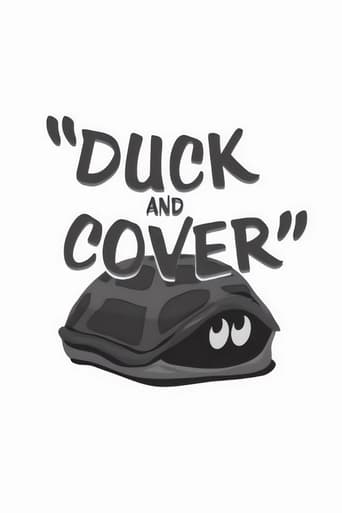
Duck and Cover
1952 · Film · short · 9 min
Directed by Anthony Rizzo
An instructional short aimed at school-aged children of the early 1950s that combines animation and live-action footage with voice-over narration to explain what to do to increase their chances of surviving the blast from an atomic bomb.
1 positive3 neutralfrom 4 commenters
Where to watch
No streaming data for this title.



4 comments on Hacker News
That was the feel-good non-starter that I got taught in school (in the US, in the 1980s). We learned it, class-by-class, from then-old film reels projected on a relatively big screen in a relatively small classroom.
So sure, why not?
[1]: https://footagefarm.com/reel-details/nuclear/atomic-bomb/duck-and-cover--1951 is an example of a tired old film, and I distinctly recall it being shown to my class in a public school sometime in the 1980s. Even though big parts of it were already rather outdated by that time.
Even though neither I nor my classmates were never alive and aware at a time when Civil Defense was a thing.
(Thattaboy, Tony.)
I think it's useful to know and understand things. How a nuclear war would play out might not correspond to what your imagination or popular culture say they will. I started reading that book about 6 months or so ago after coming across it on HN, and I thought it was pretty interesting in an abstract way. Now the idea of nuclear war is closer to the forefront of my attention, but I think it's good to know approximately what to do and why if I find myself as an involuntary participant in a nuclear war.
An important thing to understand is that it's not like everyone within some radius dies and everyone outside it lives. In the event of nuclear war there will be a lot of people in marginal areas that could survive based on luck or doing the right things. Those "duck and cover" films kind of get a bad rap, but I wonder if this is a good moment in time to notify whole populations of how to survive a nuclear strike. Even something like an episode of John Oliver or Steven Colbert's show where they explain how to protect yourself from gamma radiation might save thousands or millions of lives in the (hopefully unlikely) event that things spiral out of hand.
Many people will say they'd rather just die quickly, but for someone to die needlessly when they could have survived and moved to another city is kind of sad. If all of Russia and all of NATO unload all their nukes at each other, then maybe anyone in any affected country who happened to survive will have a very bad time, but you wouldn't know that on the ground. Maybe most of the nukes don't work. Maybe it was a limited exchange, and only a few cities got hit. Maybe they only targeted military targets, and most cities without military bases are fine. No one knows.
> there was a sense that extinction could come simply from a single random error
Agreed, I was there and watched the "Duck and Cover" films in school. That only stopped when leaders realized that surviving the initial blast was one thing, and surviving a month later for most urbanites was unlikely.
> So, through things like the Moral Majority and the efforts of Thatcher and Reagan ... happiness and satisfaction comes only through the pursuit of financial success
I don't see a coherent argument here.
You can ignore Thatcher, since she was the head of a bankrupted, hapless country (Britain had food rationing for 9 years after WW2.)
Reagan was one of the most powerful leaders in world history. He wanted a strong America, both domestically and overseas. Can't really argue with that. We don't like people who utter words like "Evil Empire" [see Prof. Victor Davis Hanson], but somebody has to say it. Just be glad Reagan was on our side.
In related news, even the much-maligned "Duck and Cover" is full of good advice (which is coincidentally also useful against large meteors).
http://en.wikipedia.org/wiki/Duck_and_Cover_(film)#Accuracy_and_usefulness