 Hacker Cinema
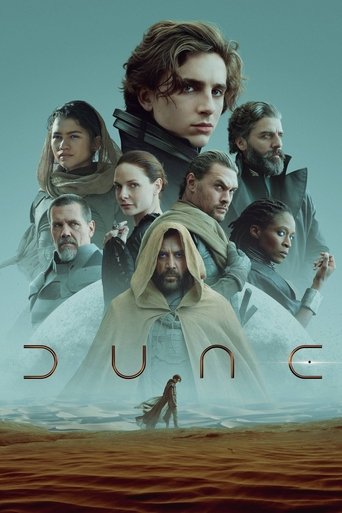
Dune
2021 · Film · 155 min
Part of Dune Collection
Directed by Denis Villeneuve
Paul Atreides, a brilliant and gifted young man born into a great destiny beyond his understanding, must travel to the most dangerous planet in the universe to ensure the future of his family and his people. As malevolent forces explode into conflict over the planet's exclusive supply of the most precious resource in existence - a commodity capable of unlocking humanity's greatest potential - only those who can conquer their fear will survive.
189 positive113 negative43 mixed213 neutralfrom 558 commenters
Where to watch
No streaming data for this title.
702 comments on Hacker News
Timothée Chalamet is in Dune and is a dual US / French citizen, born in NYC. I'm not sure 'because people are not ready to hear what's coming' is why the movie performed poorly in the box office but interesting speculation.
Much of the VFX and CGI industry is already in India.
Movies and shows like Inception, Interstellar, Ex Machina, Tenet, Dune 1&2, Odyssey, Chernobyl, Foundation, and The Last of Us were VFXed in large part by Indian companies like Prime Focus, Makuta, Phanton, and their subsidiaries.
A number of these overlap with HPC and Distributed Systems with a number of major players in the space coming out of the GPU design space like Raja Koduri (AMD, Apple, Intel). Nvidia, AMD, Intel, Apple, and others having dedicated GPU design teams in India since the early 2000s also helped.
I grew up on Dune lore and the first movie is one of my favorites of all time. Highly recommended for any Dune fan. I didn't care for the second one.
The most recent Dune movies pull off the incredible feat of being a better telling of the tale than the book, but only if you already know the tale from the books. They’re not beginner-friendly, but they’re extremely respectful to the book reader, while still make conscious (and in my opinion, positive) changes to the story.
The only movie I've ever enjoyed after reading the book was Jurassic Park. I've never seen the Dune movies or most other book-based movies, but honestly The Martian and Project Hail Mary were tempting. I'll probably surrender to one of those two someday.
You mean the new, worse, Dune movies. The David Lynch Dune movie was pretty colorful, right? So Dune itself was... Dunkirk-ified?
This matches my experience/takeaway as well. I didn't feel or think anything during, let alone after, the movie.
And same for the recent Dune movies - (even more) gorgeous, well made and blah.
> This is a reason why many people get upset when a movie adaptation is made
I still haven't watched the Dune movies because of this reason. I liked the book a lot, and had a very personal image of what the world looked like, and was afraid to lose it. Unfortunately, by now, I've seen many video clips on social media, and my internal imagery has already been poisoned. Might as well watch the movies at this point.
There’s a clear thread of human effort and presence from The Muppets to Space Jam to Dune that this Odyssey movie’s creators understood. People want Amelié, not Avengers. It’s fine to use so much CGI that your film can’t be re-exported in 4K (yes, that’s why) so long as you have people wearing stuff and standing in front of other stuff. It’s not fine to film your entire movie with mocap bodysuits on green backgrounds and having them perform to a tennis ball as co-actor that will be AI-generated from a dead actor later. I probably won’t watch the Odyssey but I will absolutely celebrate this aspect of it to others now that I know.
And yet. The other day I saw Dune described as this generation's LotR, which was that generation's Star Wars. Dune (and LotR, and SW) are all Hero's Journey stories (what isn't?), yet they're each pretty unique.
Granted, LotR and Dune were written in the 50's and 60's, respectively, with Star Wars following a decade later.
All I'm saying is that what is new depends on what generation you grow up in. And I suppose how much media you're exposed to. Speaking for myself, LotR was the second film I ever saw in the cinema so it was a whole new experience.
For the younger generations, these are old films, much like how idk, Spartacus and co was an old film for me.
tl;dr, the kids will be alright. Actually the kids also appreciate older media, there's a whole generation of late teenagers now rediscovering 2000's music / culture.
I hate Elon Musk. But when I see people who idolize him, I sometimes think of 'Dune.' Among the criticisms of Dune is the argument that it's contradictory to portray Paul Atreides as such a cool superhuman and then tell the audience not to admire him. The critique of superhuman worship failed.
In Dune, Paul is gifted and extraordinary. He appears as the center of prophecy, as a liberator to the oppressed Fremen, and in both the film and the novel, he's just too cool.
The problem arises when one human rises as a superhuman figure, and around them, aspirations, grievances, and all sorts of things coalesce at once, creating an order that no one can control.
In Dune, Paul is truly special. It's too easy to say we shouldn't worship a human with no charm and no abilities. But people yearn for him to be their savior because he's handsome, special, and disrupts the existing order.
Many critics say, 'Don't believe in superhumans because they eventually become monsters.' But a superhuman might become a monster, or they might remain flawless to the end. However, the moment the world is reorganized around them, even if the individual is virtuous, they cannot stop the mob's rampage. The moment the yearning for freedom and the anger against oppression attach themselves to a single figure, that person is no longer a person—they become a symbol.
When we face a human who seems truly remarkable, who seems capable of shaking up a corrupt world, who seems to see further and decide more strongly than we do, can we hand over the reins of history to them? I think that's the message of Dune.
I think Elon Musk is a charlatan, but he has actual achievements. People don't project the Kwisatz Haderach onto a fraud who can't do anything.
Musk is genuinely special. He focused the electric vehicle transition agenda on himself, carries the image of making humanity a multi-planetary species with SpaceX, and has the goal of breaking through human cognitive limits with Neuralink.
One person is imagined as the answer to too many future problems. Maybe my thinking of him as a charlatan is just envy, but many people around me think of him as a Kwisatz Haderach.
And in the end, when we hand over the reins of judgment to Elon Musk, this is the result. And when I see articles like this, I feel good because it seems to justify my hatred.
But the hard-to-bear truth is that worship of Elon Musk and hatred of Elon Musk feel like mirror images of each other. The worshippers around me see him as humanity's savior; I see him as the source of all problems. Both sides are assigning excessive historical meaning to one person.
And the media encourages this, and I just get angry as the media tells me to. I think of myself as an autonomous person, but whenever I see these articles, I realize how easily swayed and fragile I really am.
I go to the theater rarely, but recently watched Project Hail Mary in-theater and quite recommend it. There _have_ been some great films made in the last while, among a sea of derivatives.
(E.g., you may find the new Dune films too violent, but they were great. And the moral is not very subtle in them. :)
My backlog is crazy long. As much as I love TV I don't get nearly as much time to watch it as I'd like.
* Andor * Black Rabbit * Dune * Last of Us * Percy Mason * The Paper * Pluribus * Severance * The Studio * Succession * White Lotus
Of all those, Andor was the biggest surprise. I'm a mild Star Wars fan (I've seen the movies and that's about it) but I really enjoyed this, probably more than the movies. It looked amazing, was well written and acted. It's a prequel to one of the movies and we watched the movie right after we finished the series and I ended up liking the movie a lot more than I did the first time I saw it.
The Paper and The Studio are comedies and watching them made me miss the great sitcoms of the past. Why aren't there more comedies?
I liked the Last of Us game and I think that's a big part of why I enjoyed the tv show. If you haven't played the game or aren't a zombie person, you could probably skip that one.
I liked The Peripheral but it was canceled so I have a hard time recommending it. What they made was very good but there just isn't enough of it. The William Gibson book it's based on is worth reading IMHO.
Dune movie was inspired by Apocalypse Now, with even several shots being exact copies, but Francis Ford Coppola isn't getting a penny!
I'm just here to share my love for this film. I'm a big movie fan. I've been watching the Fifth Element since high school, and I've only grown to appreciate it more and more as a film as I get older.
It's so full of life, creativity, color, humor, and themes we can all relate to (purpose, love, loss, etc).
This is peek Bruce Willis, and the movie is filled with other exceptional actors including Gary Oldman and Ian Holm. Milla Jovovich is extremely entertaining to watch as a sort fish-out-of-water, and I know Chris Tucker's character here isn't for everyone but in my opinion it's right on-brand for the film. Cracks me up every time for decades.
Mostly the effects have aged really well. That's generally thanks to heavy use of practical effects, as this article highlights.
I often get sad that this is becoming a lost art. Great filmmakers with big budgets are still doing this type of practical effects work (Nolan [Interstellar], Villeneuve [Dune]), but I think eventually it will be lost in time.
Book 1-3 of Dune are masterpieces IMO. Book 4 was still good although I didn’t enjoy it as much as the trilogy. But I still consider it part of the same overall “Leto/Paul arc”.
Book 5-6 were okay, but didn’t live up to expectations.
To go on more of a tangent, I really thought these books would be impossible to turn into films, but the Villeneuve films are good so far!
That’s not a compelling argument. Sometimes bad reviews can be useful when there are a lot of them, but you’re taking them out of context and ignoring the mountain of good reviews, and furthermore making unsupportable claims about why there are good reviews. Some 1-star reviews are also people who were in a bad mood, or had a rare/unique experience. Occasionally bad reviews are competitors and occasionally trolls who like saying mean things. In this case, the 1-star reviews on IMDB (the site you pointed to) are less than 1% of the reviews, and 6-star and above are 97% of all reviews.
You named Dune and 2001. Let’s look at IMDB’s 1-star reviews for them:
(2001) https://www.imdb.com/title/tt0062622/reviews/?ref_=tt_ov_ql_2&rating=1
(Villeneuve’s Dune) https://www.imdb.com/title/tt1160419/reviews/?ref_=tt_ov_ql_2&rating=1
(Lynch’s Dune) https://www.imdb.com/title/tt0087182/reviews/?ref_=tt_ov_ql_2&rating=1
Do the same for products that you like and paid for. I’m certain that an honest application of that test will demonstrate that you’re cherry-picking, made up your mind here for some reason and are unswayed by facts.
Somewhat related, nature photographer/youtuber Danni Connor had her recording of a red squirrel used in the movie Dune (Part 1) for the sound of the desert mouse (muad'dib). Her interviewing with (Oscar-winning) sound designer Mark Mangini on it:
* https://www.youtube.com/watch?v=YtfzjehDg74
* transcript: https://otter.ai/u/PA9dbWFA7BgPgLZN9CSo1WFAjXk
* https://www.iflscience.com/wildlife-photographers-viral-squirrel-clip-becomes-voice-of-dunes-desert-mouse-61502
* https://markmangini.com/Mark_Mangini/Blog/Entries/2021/11/7_Dune_-_The_Dsert_Mouse.html
Story of her 'adopting' the squirrels:
* https://www.youtube.com/watch?v=3tDlh62AVPo
The name of the squirrel is "Baby Pear"; her viral tweet:
* https://twitter.com/DaniConnorWild/status/1275349417508384768
Exactly, Avatar was literally what I was picturing when I wrote that. They're not good movies. But damn they're fun to watch in 3D, on a giant screen, and with great sound.
That's not to say that all movies in this category are *only* worth watching in the theater like Avatar is. For instance I would have still enjoyed the recent Dune movies either way but they were a lot better with all the pomp & circumstance.
> Rama may turn out unrecognizable after the Hollywood script jockeys have been through with it, as happened to Foundation.
Denis Villeneuve (Dune, Blade Runner 2049, Arrival, Prisoners, etc) is set to direct and is writing the script as well:
* https://en.wikipedia.org/wiki/Rendezvous_with_Rama#Film
Though it may be a little while since he first has to release adaptation of Dune Messiah, and a Bond film is probably next:
* https://en.wikipedia.org/wiki/Denis_Villeneuve#Upcoming_projects
>as happened to Foundation. (I actually like the Apple TV version, but it’s definitely its own thing.)
This is not necessarily a bad thing. Others have noted that a faithful adaptation would have been a snooze-fest and inconsistent at best. There's lots of cases where a movie/TV version departed greatly from the source material, and was better for it.
>Rama may turn out unrecognizable after the Hollywood script jockeys have been through with it
It's being helmed by Denis Villeneuve, the guy who did Blade Runner 2049, Arrival, and the new Dune movies. If anyone can do a good job with it, he can.
>For sci-fi takes on truly alien first contacts,
Don't forget Villeneuve's "Arrival".
> Frank Herbert wrote something that is particularly prescient.
Curiously enough the Dune books are a strong rebuke against prescience (read: humanity coveting precog abilities.) I'll leave it at that to avoid spoilering.
Keep an eye on the next movie this year!
Ah yes. I really enjoy watching Dune (or Openheimer, or even less bombastic movies) on my 65" TV with two rather tiny speakers [1].
Streaming killed theaters because movie advertisement basically stopped (the lesser problem), and movies are immediately released on streaming platforms (the bigger problem). Why go to a theater when it will be released on Netflix/Hulu/Amazon within a week or two?
Movies used to get several weeks (sometimes months) of theatrical runs, and then there was at least a 90 day window (often longer) before home releases on VHS/DVD/BluRay. Now theaters are fighting for at least a 45-day window.
[1] Well, a 2015-ish Sonos soundbar and two IKEA Sonos speakers.
I absolutely love the idea!
As a movie geek I'm personally offended when someone says "oh, it's from 2017, it's an old movie!", or "I don't want to see anything from 90s, yuck" - and that's pretty common.
Of course, "Nosferatu, eine Symphonie des Grauens" is not for everyone, but I firmly believe that you can watch the new Dune and Lawrence of Arabia back to back and have similarly enjoyable time.
Fallout 1 and 2 are miles ahead of Fallout 3 (mostly due to uncanny valley phenomenon). Sure, the medium has changed a lot and modern consumers are used to more streamlined experience - my favorite example is the endless stream of Baldurs Gate "modern reimplementations" or rehashes, like Pilars of Eterniety that were too close to the original source, and then, suddenly, someone came up with Divinity, basically a Baldurs clone but with modern UI and QoL improvements.
But consoles are different.
This can truly be a window for the next generation to look back in the past.
I think the visual differences broadly break into technical aspects (film grain, contrast) and aesthetic (composition, lighting, density, motion). A lot of modern viewers don't like film grain so any director not named Christopher Nolan, will get studio push back.
Personally, I'd prefer more grain texture in cinematic images but it's the era we live in, so I don't hate on BR 2049 for being an artifact of its era. It's nowhere near as bad as the visual sterile wipe that Wicked is. I do agree the compositional energy is a stylistic choice by Denis for this film. While Dune strikes a similar note visually, Sicario does get pretty kinetic at moments - so it's not his only note.
My main point was 2049 couldn't be the innovative, style-setting, visual sledghammer to that BR was - simply because there can only be one first and 2049 still had to be related to BR. Also, it's worth noting that the back story has much of Earth's population moving off-world in the 30 years since the original - as constant ads in BR were urging. So the urban overcrowding was reduced by 2049. In fact, it's one reason replicants are openly doing work-a-day jobs on Earth. Most of the humans have left.
Ultimately, I have so much reverence for the original as a visual tectonic impact still influencing films decades later, I went into 2049 with low expectations - which Villenueve managed to exceed. 2049 is nowhere near as great as the original, but I don't think there was any way it could have been - and very few films ever are. So it was enough that it didn't insult the original or stain its legacy. And to me, by simply being good, 2049 manages to be a success on its own terms.
- and thanks for the call back to Escape From New York, a film I saw on opening night at the Pantages in Hollywood.
Stubborn old directors like Christopher Nolan, Quentin Tarantino, Steven Spielberg, Paul Thomas Anderson, Martin Scorcese... https://www.kodak.com/en/motion/page/shot-on-film/
Films are mostly post processed digitally - but some, like Oppenheimer, are color graded the old optical way. While Dune was shot digitally, printed on film, then scanned back in again!
I want to make films that look like Denis Villeneuve's Dune. (Just to cite one example, not that I'm interested in replicating his style.) How am I supposed to do that?
You know what my sci-fi films look like? This is one of my productions, and it cost over $10,000 - https://www.youtube.com/watch?v=-24s-AmqR5k (I don't even have a real link to the finished film, apparently. I don't typically do sci-fi because it's so inaccessible to do the things we want to do.)
We actually did a bunch of rotoscoping and VFX work for this. It was not bad for our budget, but I'm so tired of this. I have always dreamed of having my films look exactly like what I see in my mind's eye.
Why should I have constraints, and why should my audience dictate my constraints? It's my life, and I have a desire for my own creative output. My number one judge is myself, not you or anyone else. I make things to satisfy me.
I'm especially disheartened (?) angered (?) by non-artists stepping in to tell me this. People who haven't spent ten thousand hours on it.
I disagree.
One multimillion dollar unit can cover only one location and the area nearby. And that unit requires logistical support, cover and time to move to another location.
IOW I'm well aware of the "cost-per-shot" analysis and believe it doesn't hold water and isn't the future.
Future drones will be more like the "hunter-seeker" in the novel Dune: that is the future of drones. Here are depictions from several Dune movies:
https://www.youtube.com/watch?v=bxgIpBFpzDs
Dune: re-read the first time since I was a teenager. Mostly to compare my memory of it against the films.
Foundation and Second Foundation: for much the same reason.
Both very enjoyable reads, but quite different from the modern interpretations.
"How Life Works: a users guide to the new biology" by Phillip Ball. Really extended my understanding of where biology is now.
That to me, feels opposite the the article's advice.
And I too, often watch youtube at 1.5x or 2x speed, and dislike audiobooks because I read so much faster that I can possibly listen to them, and there's always an ever growing list/pile of books I want to read after this one. I wonder if that's why a certain type of movie works so well for me - I think of them as "movies made from short stories, not novels", and now I'm wondering if it's something similar to the OP's idea - and that spending 2 hours watching a short story I'd expect to read in 15/20mins is what I'm enjoying, in a different way to, say, the new Dune movies - which so far have been 4-5 hours watching a couple of big novel's worth of story that'd take me a week or so to read? Just writing that out now, I realised theres a two orders of magnitude difference in speed there going from 1/10th of reading speed to 10x reading speed - from a 15 minute read to 2 hour watch, to a week long read to 4-5 hour watch. Hardly surprising they hit my brain differently.
A few recent Warner Bros films / coproductions
Imagine if these had not had theatrical releases, or, had only had 1 week limited releases just to qualify for awards..
Tenet
Dune
The Batman
Barbie
Furiosa
Twisters
Minecraft
Sinners
Superman
Weapons
One Battle After Another
I’m not even talking about this. Those cat videos are just stepping stones for academy award winning masterpieces of cinema like dune. All generated by AI on a click in one second.
No, no it doesn't. Are you talking about the recent movies that split the first novel into two movies? The novel Dune ends after Paul defeats his enemies and becomes emperor.
I've seen many good films this decade too ¯\_(ツ)_/¯
There Is No Evil (شیطان وجود ندارد) 2020
Drive My Car (ドライブ・マイ・カー) 2021
The two Dune films
Alcarràs 2022
Suzume (すずめの戸締まり) 2022
Monster (怪物) 2023
Fallen Leaves (Kuolleet lehdet) 2023
The Holdovers 2023
Perfect Days 2023
The Substance 2024
Bugonia 2025 (even though it's a remake)
What's aspects of sci-fi or fantasy draw you? I personally go for the weirder sci-fi that seemed to come out of the imaginative (and, well, drug-fueled, probably) 60's and 70's, so my recommendations tend to come from that.
Dune by Frank Herbert - I'll get the obvious one out of the way. Everyone needs to read at least the first book. The world-building is a commentary on our own and none of the movies, series or games will every really capture the books in their entirety. There is just so much more to Dune than the barely-below-the-surface treatments we get with film because they have to appeal to a mass audience that tends to have the relative intelligence of my left shoe.
Candy Man by Vincent King - take PKD's Electric Sheep question of what makes a human a human, then explore the answer in a far-flung future that ends up being a bit of a nightmare circus. Great world-building, here, but King reveals in slow morsels that leave us with questions and fuel turning the page. While his other works are not really that prolific, he hit the nail on the head with this one, bringing some dialect playfulness to the writing that just adds to the immersion. It's a haunting world, unsure of why it exists due to short memories and withholding of information, and unintentionally hints at the modern day disquiet of man as we race toward whatever Singularity we have accidentally or intentionally created.
Colossus by D. F. Jones - a bit like Wargames but more swanky, the US and Russia each create artificial super-intelligence then let them talk to each other, which goes about as well as you can imagine. The story hints at the notion that as soon as politics gets involved with science, things tend to get really cocked up, resulting in hostile takeovers, or worse, annihilation. It's a short read, and should be on the to-do list of anyone experiencing existential dread over the AI race today.
A Canticle For Leibowitz by Walter M. Miller - everyone needs a bit of post-apocalypsia now and then and I always recommend this one to get your fix. Here's an extreme treatment of what happens when anti-intellectualism becomes the modus operendi as we are thrust into a harsh and desolate world brought about by global nuclear war, roaming mobs blaming science (rather that politics, as Simpletons will do) for getting humanity into the mess it's in, going so far as to forbid pretty much any book-learning or education beyond the church. As artifacts from the past (our present, more or less) are uncovered, things get a bit hectic.
I'm also happy to take any recommendations, enjoying other authors like Stanislaw Lem, John Brunner, Robert Heinlein, Vonnegut, Jack Vance, etc. Reading books is probably one of the few things in my life that makes me feel a little less alone.
Yeah, I have 11.1 with sound treatments and a receiver that does room correction, and some movies are just annoyingly mixed. Dune (2021) has the voices mumbled and so low that when I turned it up enough to hear them it caused the explosions to be so loud that my cat jumped off my lap and ran out of the room, which I don't think he's ever done before.
Christopher Nolan is probably the most infamous offender; he's said even other filmmakers contact him and complain about his mixes. It's apparently how he wants it to sound, and he's said things like he sometimes treats dialogue as a sound effect and mixes it low on purpose, despite the many many articles and such about how much audiences hate it. I could swear at one point he even countered with something like "you shouldn't need to hear all the dialogue to understand what's going on". Ugh.
Dune, like Lynch movies, are pieces of art you appreciate differently at different ages. But you always come back to them … [at least I always come back to them ;)]
What genuine connections are you making waiting in line to get movie tickets and popcorn?
Why not just walk to the theater to your seats and actually get excited for the movie? That ticket seller is doing their job and Gtfo.
I think people are so doom and gloom about this stuff.
Isn’t it better to just like go sit at the seats with your family or friends and enjoy the trailers and talk about the movie before it starts? Idk. That’s actual connection building.
I saw Avengers in Japan and my friends and I were talking to Japanese people about the movie at our seats.. using google translate. Actual connection building.
I don’t think anyone goes to the movies to enjoy waiting in line to ask some college student who doesn’t give a shit for 4 tickets to Dune.
It seems at least to me that they don't really make very good movies anymore. The last time I remember watching a movie and thinking "That was pretty good" was the Dune films. Before that I can't even remember. I watched Thunderbolts and remember I thought it was the first Marvel movie that wasn't just terrible since End Game and that was primarily due to the Russian guy as a comedy source.
I wonder how much of that is because the movies themselves changed vs everything else that has changed. Back in 2002 most people still watched tv on CRT that were very small by today's standard and had very low resolution. You either had to go out and rent a movie, rewatch something you had recorded or bought or watch whatever was on and enjoy the ads. Now we have a huge choice of movies and tv shows at our finger tips any time. Yes, the screen is still much smaller than in the cinema but I also sit much closer. I can pause the movie when I need a bathroom break. I can eat and drink what I want. A movie has to be really good for me to want to spend $40-$50 on going to see a movie with my wife. No travel required, no sitting through ads, no risk of someone in the audience being obnoxious.
I used to go to the cinema quite a bit. Now I only go once every 1-2 years to see something on IMAX that I hope will really benefit from it. In recent years that was just the two Dune movies and most recently the F1 movie. Unfortunately, even the biggest IMAX theater in my area is still not what I'd consider a proper IMAX like the Metreon in SF so I'm always underwhelmed. Not sure if that's because this IMAX is too small or because even IMAX stopped being amazing due to growth and improvement of other screens.
I used to watch a lot of smaller movies in the cinema. That's stopped entirely. With any movie the question now is how long till we just can watch it at home. Smaller movies which I'd be more willing to support frequently even seem to skip the few months where you have to rent them and go straight to streaming. So unfortunately even less incentive to go to the cinema.
Culture around it doesn't help either. Friends used to recommend movies that they watched in the cinema. I can't even recall when that happened last.
They didn't that was my point. But if people just go to the food court at the mall and complain there's 90% fast food...
Go to a smaller movie theater, go to movie festivals that happen every year in most big cities, you'll see the majority of movies have nothing to do with the few major Hollywood block busters. And comparing Dune, a major block busters to other ones makes no sense when the point was that you need to go outside the main circuit.
I think they simply did what AAA video games did. They found what sold best at one moment in time and then obsessively tried to work to copy that.
But the problem is that people don't want to play 40 different Call of Duties, or watch 30 different Batmen. It's just that Batman or Call of Duty were the 'meet in the middle' of a variety of different tastes. But when those other tastes aren't accounted for, it becomes nauseating. It's like how most of everybody really likes cake icing, but eating nothing but cake icing is quite a repulsive concept.
I think things like Dune, Interstellar, and other such films emphasize that there's a gaping hole in the market for things besides men in spandex, but it's just not being filled. And there's even extensive social commentary in Dune (as in the book) but it's done through metaphor rather than shoving it down your throat. And the movie is also rather slow paced with some 3 key events playing out in a 155 minute film, yet it continues to do extremely well. On the other hand those Fremen suits are kind of spandexy...
> imagine a sci fi movie (like Dune) where the rulers want their AI servants to "align" with their interests.
Ironically, your chosen example is a sci-fi universe that not only doesn't have any AI, the backstory had a holy war against them.
I skimmed one of the Berkeley Simons AI seminars (on YouTube) where one of the top experts (iirc one of the Canadian academics) who has pivoted his work to AI safety because he genuinely fears for the future of his children.
My objection is that many of these scientists assume the "alignment" framing, which I find disingenuous in a technocratic way: imagine a sci fi movie (like Dune) where the rulers want their AI servants to "align" with their interests. The sheer hubris of this, and yet we have our top experts using these words without any irony or self awareness.
> [Dune] makes the mistake of not communicating anything to you about it. If you haven't read the books, much of the story is easily lost.
Counterpoint: my wife. I took her into Dune knowing nothing at all about it, besides how excited I was to see it, and she got everything. Like, seriously, everything. She's a super intelligent and intuitive person, and Villeneuve is one of her favorite directors so she's maybe the ideal audience member.
It might be fair say that the exposition is too subtle for a general audience to pick up, but it's certainly there. I refuse to hold that against the film, though. The usual state of Hollywood movies is to browbeat an audience with heavy-handed explanations, so I love it that Villeneuve makes you pay attention and think and remember and put together clues to understand everything that's going on. It's sophisticated filmmaking, dammit, and there's not enough of that around - especially in big-budget / sci-fi / franchise films.
In my opinion that's what makes Villeneuve's so great. For example, I think almost any other director would have had an info dump about what Mentat's are in the Dune universe, motivations and they they are important. Instead in Villeneuve's version, you simply see the results. For those watching the film without the context you simply chalk it up to a weird and wonderful way that the universe works. For those that have read the book, you get to do the information dump about Mentat's on your poor unexpecting wife who's watching the film with you.
This embodies show don't tell and it works amazingly.
> unspoken "show-don't-tell" internal logic
This is another axis separate or orthogonal to worldbuilding.
Recent Marvel and Disney films, the Jurassic Park and Star Wars sequels, and most Godzilla / Kong slop doesn't build believable worlds. The writers don't spend any time writing the universe that the story takes place in.
Lord of the Rings (the theatrical film trilogy), Game of Thrones (save for the last seasons), and Jurassic Park (1993) all build vast and credible worlds. Intricately detailed, living and breathing universes. Backstories, histories, technologies, warring factions, you name it. They then create believable characters that occupy those worlds and give them real character arcs within which they suffer, rise to prominence, grow, and die. Multiple heroes with multiple journeys. You're fully immersed in the fictional world, watching characters you care about occupying it. It's masterful storytelling.
Villeneuve's Dune has the same vast world and literature to draw upon as many of the other great epics, but he makes the rare mistake of not communicating anything to you about it. If you haven't read the books, much of the story is easily lost. He doesn't spend time on character arcs or even as much as dropping hints to what the subtitles of the world are. It's a super rare misstep, because most bad storytelling is from under baking the fictional world.
Then there's the mistake of sequels that try to expand on the mystery of the original world. The Matrix films and countless others have over-illuminated the mystery of their stories in trying to build universes. In doing so, the magic has been lost.
I'll hold out some hope that he can do something interesting with the franchise.
I think the best film in the Harry Potter franchise was auteur Alfonso Cuarón. It was far my stylish, and got some incredible performances from the young actors.
I dunno if Villeneuve's slow, thoughtful style will work for the high-energy Bond franchise. (Even Dune managed to be strikingly slow paced.) And maybe he'll just phone it in -- the way talented director Kenneth Branagh does when he gets a Hollywood superhero movie. But I'll hold out some hope that a stylish director can take a stylish action hero some place more... well, stylish than he has been.
I am suddenly reminded of the fact that the most recent movie adaptation of Dune used the word "crusade" for what the book consistently, unflinchingly called a "jihad".
https://www.aljazeera.com/opinions/2020/10/11/paul-atreides-led-a-jihad-not-a-crusade-heres-why-that-matters
Every once and a while you see an auteur get coaxed out of their genre. Lynch did Dune in '84 right off the back of The Elephant Man. And while he hated the entire experience I know that I'm not the only person that enjoyed the particularly lynchian facets of the story that he brought into the light. His film is much more concerned with exploring the more psychedelic aspects. The divination that comes with being the Kwisatz Haderach, the grotesqueness of the Harkonen house, the psychedelic experience of the spice.. which are all present in the source material. Whereas the Villeneuve take is much more concerned with other aspects colonialism primarily, and those things that Lynch leaned into he certainly acknowledged but spent more time in other places. I love both and I love when we get to see multiple adaptations of the same source material, even if some aren't so great, just because we do get to see these different aspects of the original work.
Perhaps you can share some examples of the films you are referring as "mindless banter in between sex and explosions". I'm not sure that description really fits most of the films coming out recently. If you said, "Dumb comic book films", I would maybe agree with you, but there isn't typically any sex in those so I assume you are not referring to them.
Covid halted the production of a lot of movies, and changed how others were made. It also shut down theaters. So, "since covid", is really talking about before and after an era. Kind of like saying, "since 9/11", in terms of the impact on culture. A lot of creativity has moved from the movie theaters to streaming services and from films to more episodic content.
However, here is a short list of films worth seeing (imo) since covid (2019).
Zone of Interest (2023) The Holdovers (2023) Parasite (2019) Dune (2021) Dune Part Two (2024) Everything Everywhere All at Once (2022) 1917 (2019) The Banshees of Inisherin (2022) The Substance (2024) Palm Springs (2020) Oppenheimer (2023) The Lighthouse (2019) Hundreds of Beavers (2022) Barbarian (2022) Flow (2024)
Your pedantry probably requires a rewatch.
I also think "masterpiece" is a heavy term to throw around but the emotional impact of the this series and the complexity of its narrative as it catalogs a hero's journey from reluctant participant to true believer with an epic story arc can be held up next to most film and historical epics like Laurence of Arabia, Ben Hur, The Matrix, the Original Star Wars trilogy, Dune, Kingdom of Heaven, Gladiator, The Handmaid's Tale (series), The Odyssey (epic poem). His personal journey which leads to his persecution and enslavement, his role in leading a slave uprising, rescuing his friends from the aftermath of a rebel uprising, building the foundations of a rebel army, risking his life countless times and ultimately sacrificing himself to prevent his enemy from having an insurmountable edge.
The series makes the very popular "Avengers" film series look like trite dogshit and does the same for most of the "Star Wars" sequels and prequels so I don't fault people for using the term "masterpiece".
I'm "only" 40 and strongly prefer films made when they still shot and edited on film. The peak as far as visual quality and overall effect of film, for me, was probably the 60s through early 90s, though I love a bunch of films older or newer than that.
The constraints of not being able to color-grade the whole film with a slider or two, of every cut in the edit taking time to do, and of effects that weren't in-camera being relatively expensive, tended to lead to better and more-interesting filmmaking, even in middling films.
I appreciate what the right people can do with modern tools—I enjoy and even love plenty of newer films, and it's undeniably brought some cool stuff within reach of smaller, cheaper productions—but overall I see it as making cinema worse.
"We did it in a computer" being the answer to every "how'd they do that?" isn't movie magic, it's boring as hell. It's why even a film that tries to avoid that to some degree, like the new Dune duology, is in some important respects—though setting aside overall quality of the film on some other dimensions—just less interesting than broadly similar films like Lawrence of Arabia or Star Wars (or even, if I may be so bold, David Lynch's Dune).
I think this sort of opinion is fairly common among film-fans of all ages, due to interest in film making itself as much as output of the process per se. Not sure most movie watchers care, and they may well prefer the newer stuff because of the ultra-fast editing and tuned-to-be-cotton-candy-appealing color schemes and unconstrained video-game camera of fully CGI scenes and all that.
> I prefer 1970s music. Autotune is for whippersnappers.
Hard agree. I can't friggin' believe the heavy-handed autotune in children's media, especially (Daniel Tiger! Fred Rogers would be so unhappy with it). Let's teach them that natural human singing voices, like their own, sound wrong and bad. WTF.
Watch a Dune movie some time and replace "the spice must flow" with "the features must flow".
Making money is the task at hand, and orgs make money these days by monetizing users and not treating them well. Their status as a customer is taken for granted - because where are you going to go? All the other guys are as bad or worse.
The Chase app I use is 298mb.
> Painting out these movie mistakes as part of a restoration is wrong. What's in the movie is in the movie, and altering the movie to this extent is a form of revisionist history.
How many times has Lord of the Rings been revised? Dune? <Insert other long-lived actively managed novel>. Is the active management of these novels "wrong"? Is fixing grammar, spelling, or clarifying story beats "wrong"?
I personally don't think so, and I'd rather read something which has been corrected, especially if done for story clarity.
How is Snapchat a black mirror episode? Do you think even 10% of Snapchat users are harmed in the ways discussed in this article?
This is like saying we are living in Dune because we have some people in space.
So just because some people are harmed in society suddenly black mirror is not too on-the-nose or unrealistically pessimistic?
I somewhat agree. For me Dune: Part One (2021) and Dune: Part Two (2024) had the visual, sound and acting talent, but felt like it was missing something. I'd almost say it was soulless. I think the problem was in the dialogue or how scenes we acted, I don't know. I didn't think Dune (1984) was any good, but I think that had a lot to do with the technology and film making techniques at that time.
I think the only good Dune media besides the books was the video game Dune II: The Building of a Dynasty by Westwood Studios (RIP). Without it, I think there would be no Command & Conquer and no heyday for the real-time strategy (RTS) genre.
I've seen this plot in various movies, TV shows, and books. It definitely is a possibility. In the Dune universe the AI's are banned after a war against them.
The fields didn't fully allow knife fights. High speed impacts the shield would repel but slow but strong movements with a knife could penetrate it. The way the movie at least justified disabling the shields was that the Fremen were seen to use laser weapons which in the Dune universe would cause a mini nuclear explosion if they hit a shield.
Bret Devereaux has an interesting writeup on "The Problem with Sci Fi Body Armor" and discusses the Dune movie in detail.
https://acoup.blog/2024/11/29/collections-the-problem-with-sci-fi-body-armor/
I do think it's unfair when people claim Dune is a straight retelling of T.E. Lawrence's story. For instance I think the messianic aspects are drawn from other episodes in history, like the Mahdist War
https://en.wikipedia.org/wiki/Mahdist_War
https://en.wikipedia.org/wiki/Taiping_Rebellion
I had friends that raved about Dune. Think they actually read the book.
Later saw the movie and kept thinking there would be a twist. Was largely disappointed but the mother starting a holy war was a bit intriguing.
Lol. More like Dune lifts wholesale from Sabres of Paradise, translating the stories about Imam Shamyl into space, only adding some bits of LSD inspired trippiness. If anything, Herbert toned down the historical accounts. On the other hand, Lesley Blanch went for the dramatic over the historical in Sabres. The story about the Sultan that drowned his son's mistress, for example, was from a Greek movie version.
When I finally got around to reading Seven Pillars, I wasn't too far in before I was convinced Herbert had the book on his desk the whole time he was writing Dune. So many minor similarities, little scenes that don't quite match up but if you squint they do. Even the arc toward eventually committing war crimes, while seeking some great end for the people he's leading, feels like a connection. But also little stuff like the early travel scenes in Pillars reminded me of early scenes among the Caladanians(?) in Dune.
I think the part where I went "OK yeah this was the reference when he was coming up with the core plot and character of Paul" was when I came across the part where Lawrence comes up with his novel guerrilla war strategy: he's sick, feverish, possibly dying, in a tent in the desert, tended by a few companions. When he comes out of it, he's got his Path. It's too perfect.
[edit] Incidentally, it's not clear to me this author has a good picture of Lawrence's background. Lines like this:
> In terms of clothing, Lawrence comes to accept the Arab dress as “convenient in such a climate” and blends in with his Arab companions by wearing it instead of the British officer uniform.
make me think the author isn't aware that Lawrence had already spent a lot of time in the Middle East (especially, IIRC, modern Syria—so, near Damascus) very shortly before the war broke out, and that was a big part of why he was recruited by British intelligence for the mission(s) in Seven Pillars. It was on an earlier, pre-war trip that he'd adopted Arab dress—unlike what's suggested (if not quite stated) in the film Lawrence of Arabia, he was already quite familiar with and comfortable in it.
I'm very interested in seeing how he's going to approach adapting this particular part of the story.
I feel like the first two movies of Dune he directed, which cover the first book, were much more world/action oriented as it was that way in the book too. But Dune Messiah is much more introspective so it'll be much more challenging to show the change in the characters.
I'm not really nervous, more so excited to see the adaptation.
And Lynch's Dune looks like it does, probably in no small part due to Jodorowsky, Giger and Mobius.
I recommend everyone interested in Dune to take a look at Jodorowsky's Dune [0], the documentary which explains how they did the preproduction of Dune, and pitched it to the studios. All the deals eventually fell through, but the pitch decks circulated all the studios for years afterwards, and inspired countless other movie makers.
The best things about the new Dune installments imo is the art, but all, or most of it feels like copy pasted ideas from what came before them. CGI is a huge asset to actually get it working though.
0: https://m.imdb.com/title/tt1935156
The lengths they went to to mate in the landing of the Duke on Arrakis.
They used a football stadium in Mexico, in order to get enough distance. The mind boggles as to what they did without CG.
I believe the film run aground on the special effects for the worms, it just goes to show that critics will feast on the weak points.
I utterly relished the scene with the Emperor meeting the navigator; Mr PlansWithinPlans.
Is there enough film to make the purported mini-series of Lynch’s Dune, I take it there was only the film.
Lynch Dune is so underrated. The creativity on display was immense. The new Dune movies have amazing craftsmanship but feel as if they were generated by AI, almost every move and visual predictable.
The existence of a fictional movie says nothing about how popular conspiracies are. I have seen a lot of dystopian movies and read such books, including cyberpunk. A Scanner Darkly, The Illuminatus Trilogy, The Matrix, Snow Crash, Dune, eXistenz, just name some random ones. I'll mention four series, too: Twin Peaks, X-Files, Utopia, Nikita. That doesn't make me a conspiracy nut, because I am able to differentiate between fiction and non-fiction.
The trouble from 80's is different. We've shifted power vacuum, but whilst doing so the rich have become very much more rich, and [generally] they don't want to take responsibility; they want raw power. Things like bullshit (lies, conspiracies, manipulation), drama (such as creating friction between poor and middle class), obliteration of facts and science, cryptocurrency to avoid sanctions and law, and criminal behavior (including methods to avoid paying tax) are each tools for achieving more of such power.
UFOs are one of such, too. They're a tool to accelerate the distrust in government. For the acronym UFO itself is broad. A meteorite or Starlink satellite could be mistaken for an alien spaceship. Furthermore, drugs, hallucination, psychosis and the power of suggestion alone are strong tools to feed such fables.
I am well aware fans of conspiracies can very well be fans of X-Files but it is fiction first and foremost, plus don't forget Scully's role and background.
My wife and I recently watched the HBO Dune miniseries (it’s great!) and I was thinking how bizarre it would be if people in that universe were spending their days passive scrolling the screen on their pocket computers.
Wall-E depicted a future like that, but I can’t really think of any other books or movies that imagine that kind of future for humanity. Surely this is a phase we are going through, right?
I really like the original Dune. While uncommon I think that hearing what people thought worked well. I also like the visuals, like the guild navigator or the disgusting baron.
That said I appreciate the new films too, in different ways. It looked amazing watching it in the IMAX theater, and I liked how the visions were presented. Not perfect films though, especially I think casting fewer big stars could have helped. I almost got distracted by the familiar faces.
I love Lynch and Dune, but his Dune was a cult film but not a good adaption. I mean the cat milking scene is absolutely a wtf.
Villeneuve version is the superior adaptation.
I appreciated the change to make Chani fill a role like Sherif Ali in the film Lawrence Of Arabia (the book Seven Pillars of Wisdom, if not the film, is plainly a huge influence on Herbert's Dune, and it's probably impossible for a director to film so much as a scene set in the desert without thinking of Lean's film).
So much of Dune takes place inside people's heads that it's basically unfilmable if you don't make some changes. Plus, even with five hours of film, you're going to be cutting whole scenes from the book whether you want to or not. Lynch's solution was to make it a more straightforward hero's journey—and given the length of his film, and no expectation of sequels, I can't really blame him. Villeneuve had more space and so could tell a darker and more foreboding story, closer to the original, but still needed to externalize some of that internal struggle and foreshadowing, for which he used, especially, Chani.
[EDIT] Oh and as for this:
> I know its nerdy but I absolutely hate when movies of classic books think the story needs to be changed
Every now and then such a deviation ends up being excellent as its own way, while still benefitting from the connection to the original and being better as an "adaptation" than an independent property. Verhoeven's Starship Troopers would be one of the more extreme examples of this kind of outcome. A gentler one might be Kubrick's The Shining.
Some of my favorites (no particular order):
- The Martian
- Arrival
- Snowpiercer
- Annihilation (a bit scary in some parts, but not really horror overall)
- The Congress
- Ex Machina
- Her
- Children of Men
- Blade Runner & the new Blade Runner
- Gattaca
- District 9
- Edge of Tomorrow
- Elysium
- Terminator 1 & 2
- Upgrade
- Eternal Sunshine of the Spotless Mind
- Mad Max (new one) and Fury Road
On the cheesier side:
- Demolition Man
- Judge Dredd (both the original and the new one)
- Terminator 3 and beyond
- Matrix movies
Grand vistas but slow and sometimes boring, and often haughty / overbearing:
- The new Dune movies
- 2001: A Space Odyssey and its sequel (some other number, like 2010 or something, can't remember)
- Interstellar
- Inception
------
Of all of those, my top 3 would be the first three (Martian, Arrival, Snowpiercer).
The pixels per inch on a TV vs. Vision are a wash, in my experience.
Technically they are better on the TV in terms of density, but the greater brightness, control of surrounding light, and clarity and (always!) perfect focus of the virtual screen in the eye-screens has its own benefits. Especially when in a surrounding night scene.
> I saw Dune in 4DX and the way the ornithopter shook my seat and moved it around and blew wind in my face was really cool. Can’t get that with a $3500 Vision Pro!
Sounds really great. Maybe not yet, but perhaps something that could be done with linked home theatre furniture - sign me up!
But don't knock being "in" the movie (as a result of my customization recommendations)!
Another not obvious benefit is that by moving the virtual screen "closer" and "farther", you can line up the artificial "depth" of the stereo vision with distance in a way that clicks at the right distance and feels much more real. You can't do that with a physical screen.
> nobody in significant numbers is going to buy an expensive isolating 3D experience just to get an amazing cinema experience
That is indeed the impediment!
Of course, you can watch it in a higher pixel per inch on a conventional TV, which can be shared with everyone in the room, for half the price (assuming a high end OLED).
If people didn’t buy into 3D TVs which have the advantage of being able to be shared within a room, nobody in significant numbers is going to buy an expensive isolating 3D experience just to get an amazing cinema experience.
And let’s not forget that cinephiles can get a 4D movie experience for twenty bucks at their local theater. I saw Dune in 4DX and the way the ornithopter shook my seat and moved it around and blew wind in my face was really cool. Can’t get that with a $3500 Vision Pro!
Dune 1 3D is fantastic. If you customize the Vision Pro’s light shield to put the screens closer & expand field of view, even better: you are essentially in the movie.
Is dynasty (family) inheritance of copyright assets (books and music) really that big of a problem?
Was Dune mismanaged? We got a lot of movies, TV shows and a famous video game from it!
Was Borges estate mismanaged? Wiki talks about two examples that are not dramatic.
What is the idea?
20 years ago HBO made the tv show Rome. They filmed it on analog film. I’ve recently been watching it for the first time and it’s absolutely amazing how well it looks compared to shows shot on digital from the same time. It looks good even compared to modern cinema and because it’s film they could do 4k captures.
For a recent movie, Strange Darling was filmed in analog. Great movie and looks unparalleled.
Dune was filmed on digital, transferred to analog, and the scanned back to digital for distribution.
I guess my point is, that there is some magic in analog. Whether the inherent limitations of the form, or by introduced randomness of the chemical process, or by placebo assumption of “realness”.
We live in an age of Netflix enforcing all shows to look exactly the same and even adding de-aging filters to actors. The gulf between the perceived reality of analog film and digital has never been larger. So yeah, analog excites me.
Isn't "Dune" said once in both of the Villeneuve movies?
If the results aren't cherry-picked it looks like more than good enough to make any high budget movie from the early 2010s if not Dune.
At face value
No, they don't. Like the book series they deconstruct the hero's journey. The outcasts only accept him because of his mother. He is the promised savior because of deliberate societal manipulation, something he even repeatedly points out within the movie. He doesn't defeat the challenger; he is the challenger. He repeatedly rejects being a hero and assumes the role of villain, first as a terrorist and latter as a tyrant who leads an invasion that murders millions. And in the movie at least he loses Chani's heart at the end; a deliberate change from the books.
Dune's wildness is only evident once Paul Atreides' arc ends in a tragedy of galactic proportions
This doesn't happen in the books for several thousand years, long after Paul has died.
I’m the opposite. I liked Dune, but I loved Dune 2. Villaneuve said that he didn’t think he quite hit the mark with the first movie. He didn’t get in close enough to the characters. He did that in the second movie, and I felt it was more emotionally engaging.
The released dune movies follow a cliche hero's journey. (At face value)
Talented hero faces tragedy -> adopted by outcasts-> is the promised savior -> learns their ways -> defeats the challenger -> wins heart of ladies -> becomes king.
Dune's wildness is only evident once Paul Atreides' arc ends in a tragedy of galactic proportions ushering an era of worm NSA personified.
I loved dune 1, was a huge childhood fan of the books, like Villeneuve as director, but still couldn't get into Dune II. The whole move felt like a montage. Not the artistic montage I would hope for, but a clunky montage with forced lines like something from a marvel movie. I got the sense that either critical parts were left of the chopping block or the film was relying on the book knowledge for context cohesion and gravitas.
Instead of feeling exhilarated by scenes of sandworm ridding, I found myself rolling my eyes.
Similarly, I'm ok with modifying the source material to make a story work on screen, but I thought the changes had the opposite effect. They muddled the message and created more narrative issues than they solved.
Also, was #triggered by the voiceovers. In the words of Robert McKee in adaptation (2002) :
>God help you if you use voice over in your work my friends, God help you. It is sloppy flaccid writing. Any idiot can write voiceover narration to explain the thoughts of a character
https://www.youtube.com/watch?v=KQgHNnlmErg
>The streaming platforms, for which you pay full price, don’t even let you choose the quality of the movie you want to watch
I wanted to re-watch Dune Part 1 before Part 2 came to theaters, so I rented the film on Youtube Movies which said it would be HD $3.99. I paid, but when the movie started playing it was NOT HD. The quality selector didn't even let me choose a HD resolution. I tried different browsers, I tried Safari on my Mac, Chrome on my Mac, disconnecting from my 4K display... was it a some bug? Was it a haywire copy protection because I opened the film on a 4K display over Displayport? I have no idea, but I felt cheated. I haven't paid for a movie since.
> it's not Fahrenheit 451 anymore.
What it is, is your relationship to the story and that's really what an adaption is about. A good adaption I think always shows you what someone feels in regards to the original work, it's a response to or a dialog with the original and that can include any emotion you have towards it. Artistically you don't really owe Fahrenheit anything, that's the sort of "fandom" mentality that I think is pretty misplaced and immature in art, but popular now because everything has fans and followers.
I agree with your observation about Dune but I think it's quite smart. Villeneuve has basically rewritten Chani entirely and shows us the story from her point of view, starting and ending the two movies with her deliberately. It's a critical outside view on Paul unlike the book in many ways, and I think that just reflects Villeneuve's perspective. (and also coincidentally Herbert's actual intent for Paul, it will hopefully spare people the awkward monologues from the second book)
Deep Space 9 is another example of this right, there's the die-hard fan mentality of "It goes against everything ST is about!", but ultimately it makes the universe much more interesting and compelling because it gives you another perspective from another point in time from someone who didn't quite buy into the utopianism and just expressed that.
But if you wan to have your own vision, why don't you just create your own world to do that in?
If I took Fahrenheit 451 and adapt the story so that the state executes Guy Montag because my vision is that hate speech is dangerous, it's not Fahrenheit 451 anymore.
Take the most recent Dune movies as an example; In the books, Paul spends so much time becoming Fremen and trying to resist the prophecy as well as endlessly worrying about a space jihad, only taking the water of life when he was not able to predict that Gurney would try and kill his mother.
In the new vision "Let the Jihad begin!"
The first is the story of a reluctant hero who is trying to keep his family alive and cherish the love of the desert people who adopted him.
The second portrays a mother and son who scheme to use those around them to further their end goal of power and revenge.
If I enjoy eating Oreo cookies and I buy an ice cream that is labeled "Oreo Ice Cream" but when I taste it, it is Strawberry Jam flavor, I am not going to be writing a review that praises the product designer for their bold vision. I will be taking the product back for a refund.
Nice, it even has Muad'Dib (the desert mouse from the “Dune” movies) as its mascot. The question “but does it have Muad'Dib?!” was the first thing I thought of when I saw the title.
I find that religion adds an interesting dimension to space sci-fi - Dune, The Expanse, and even some of the Riddick movies feature religion in varying degrees.
For convenience, I asked ChatGPT to create this table, which summarizes how many times each movie has been mentioned in this conversation so far. It got a few counts wrong (as usual), but it still gives a good sense of the frequency. I hope it can be useful to someone:
| Movie | Number of Mentions | |-------------------------------------------|---------------------| | The Matrix | 9 | | Lord of the Rings Trilogy | 8 | | Pulp Fiction | 8 | | Alien | 7 | | Fight Club | 7 | | Ghostbusters | 6 | | Die Hard | 5 | | Back to the Future | 5 | | Inception | 5 | | Star Wars Trilogy (original) | 5 | | Groundhog Day | 5 | | Terminator 1 & 2 | 5 | | Jurassic Park | 4 | | The Thing | 4 | | The Fifth Element | 4 | | Monty Python and the Holy Grail | 4 | | Ghost in the Shell | 4 | | Interstellar | 4 | | Casablanca | 3 | | Office Space | 3 | | Shawshank Redemption | 3 | | The Godfather Trilogy | 3 | | The Blues Brothers | 3 | | Blade Runner | 3 | | Mad Max: Fury Road | 3 | | Unforgiven | 3 | | Total Recall (1990) | 3 | | The Crow | 3 | | The Princess Bride | 3 | | Akira | 3 | | The Big Lebowski | 3 | | Guardians of the Galaxy | 3 | | American Psycho | 3 | | Indiana Jones Trilogy | 3 | | Kiki’s Delivery Service | 2 | | Ratatouille | 2 | | A Clockwork Orange | 2 | | Mission Impossible (various) | 2 | | Casino Royale | 2 | | Skyfall | 2 | | Ferris Bueller's Day Off | 2 | | Star Trek: The Wrath of Khan | 2 | | Apocalypse Now | 2 | | The Shining | 2 | | Groundhog Day | 2 | | Donnie Darko | 2 | | Dune (2021) | 2 | | Gladiator | 2 | | Predator | 2 | | Seven/Se7en | 2 | | The Dark Knight | 2 | | Snatch | 2 | | Prometheus | 2 | | Schindler’s List | 2 | | The Wolf of Wall Street | 2 | | Dr. Strangelove | 2 | | Silence of the Lambs | 2 | | Kill Bill | 2 | | Real Genius | 2 | | Top Secret! | 2 | | Tenet | 2 | | Tinker Tailor Soldier Spy | 2 | | The Adjustment Bureau | 2 | | The Expanse | 2 | | Pulp Fiction | 2 |
I'm going to check out Mad Max for that! My show off my home theatre sound / Atmos go to movies are Edge of Tomorrow, Dune, and the newer Blade Runner.
I basically never rewatch movies, but I've seen Dune (2021) at least 8 times. Will probably do the same when part two comes to streaming services. Something about Villeneuve's version really captures the awe of Herbert's universe for me.
One more - The Princess Bride.
yeah i don't get how people want a game to somehow be completely without politics.
The only games that could be that way are completely abstract.
Imagine if someone asked for the Dune movies or books but without politics..
The drone in TFA's cover photo looks like a hunter seeker from the latest Dune movies.
There's more specs here: https://fpv.bg/article?eid=15
It costs $200,000...
This isn't a bad idea but 85% seems like it would filter out a lot of good movies. The recent Dune, for instance, is at 83%.
Looks like about half my library would be filtered out.
I've had enough of the Dune remakes, too. The world doesn't need more Planet That Went Ape remakes, either.
The Mote in God's Eye would make a fine miniseries.
Back at you! I appreciate your points, and agree with your take on Dick, generally on Spielberg, and Scott; all well said.
I guess I believe film is an independent art form, but I'm generally a reader first, so I don't mind your proposed flow book -> film for analysis. In reality, we have directors/producers/studios/actors who may or may not want a lot to do with any given book; Dune's history stands out to me here.
If I think about films that have tried to do more than the source book, Bladerunner is the only one that's even a candidate to me. I guess I just really like it!
Dont forget they already said windows 11 will have complete keylogger and screen OCR for "ai search"
Because SOMEONE thought complete privacy rape is worth "when did i tell my friend about that dune movie?"
completely against everyone's will: absolute tracking
So now the hackers dont even have to do any real work in identifying juicy targets... just hack something, and now built in automated queries to the "ai search" will find everything good without the slightest targeted effort any more
Well, the timing is bad since the dune3d software was initially named only 7 months ago [1] (after the first new Dune movie), and just last month the second new Dune movie came out.
1: https://github.com/dune3d/dune3d/commit/3d17bc57e07ea39a7b89a88e7dde2615031e7e28
For me the Vision Pro has been my “Mac replacement” in terms of how I use and love it. (Even though it needs a Mac.)
I completely customized the light shield and straps to be very conformable with a wider field of view. Third version was the charm. Apple could have done better.
Games they have are very meh. Pass. Got a Quest for that.
But 3D movies are finally what 3D should be. At least the well done ones. Blade Runner 2049, Dune Part 1, are fantastic. Felt like I hadn’t really seen them before.
Strange to me they only have a few “environments”. Gorgeous, just so few. I use them to focus when working and meditate.
I hope they keep up with it as a developer friendly Mac replacement. It does that well, and with just a few improvements could be significantly better. Devs using it will start building for it, even if just to scratch an itch.
Life isn't an RPG where you read the gamefaqs and do an ULTIMATE BUILD. Your sense of self is a story, it's a narrative we tell ourselves, something we've evolved so that we can simulate our environment over and over and over and over in our heads without losing the thread. The idea that you're a meat machine being steered through the world by some disembodied entity - that you happen to identify with - is an illusion.
I'm going to feel like a real tool for quoting this, but I like the line they added to the new Dune movie: "The mystery of life isn't a problem to solve, but a reality to experience."
Now, this could be due to the fact that I've hed singular, terrible moments of energetically bad luck. Lots of them. And this sci-fi pseudo-dao is just a part of my personal narrative that keeps me from racking a slide on just the one bullet. But everyone, everyone everyone is going to have one of these moments. Dao isn't the solution, but resilience is part of one.
> known for cult films like Mulholland Drive, Inland Empire and Wild at Heart
Really? No, really? Not Twin Peaks? Not Lost Highway? Not Eraserhead, not The Elephant Man? Not Dune?!
How many people watched Dune 1 and 2 because of a story that has been around for decades and already had one interesting film interpretation? How many people watched Avatar for the story?
The existence of IMAX should be a hint that there is value in very crisp visuals.
However, this stupid tiktok filter is NOT "very crisp".
I’m pretty sure Dune is fiction.
BBC has plenty of documentaries if fiction upsets you.
Pedants angsting over the reality of fiction does spoil the fiction so best to ignore such peoples laments about how things are unrealistic.
Arguing with the physics of Dune is like taking issue with the way time travel works in Back to the Future.
Still suits honestly have the more glaring issue, and that's one that's apparent not just on film, but in the original text as well.
Anyway, it's not science fiction; it's space fantasy. Let it be.
Thanks for the thoughtful reply.
> I'm not sure why this is particularly needed and it isn't really in the novel...
I know saying this is sacrilegious to some sci-fi fans, but I think that the novel, Dune, could do with improvement. Neither the book nor the movie spend enough time fleshing out the details of their characters, which in my opinion robs both of them their ability to connect more deeply with the audience. The scene where Duke Leto explains to Paul that they will require desert power to rule Arrakis, for instance, did not have to be set such that the characters were alone on an empty cliff above the shoreline. There could have been a city full of culture upon this shoreline with great boat yards and planes over the sea to show the audience the empire that they are leaving behind on Caladan. I want both the novel and the movie to flesh out the details which make the audience engage with the fact that Caladan is a comparative paradise to the harsh, prison-like planet called Arrakis. It would suck to be forced to leave behind all the great work that the Atreides' forefathers put into Caladan. But, ultimately, both the film and the novel fail to fully engage their audience with these facts since they don't flesh out the details about the environment and people that the Atreides rule. At least that is my opinion.
There are a number of things I'd like to change or improve upon if I had the chance to edit Dune (novel or film): the story's allusions to the Cold War fight for oil in the middle east; the poor decision making by the Harkonnens; Dr. Yueh's murder of Duke Leto etc. But I don't want to ramble on too much. My point is that I think the film could have improved upon the novel in a number of places, instead of following the novel to its detriment.
> There's no character development to speak of, the plot is secondary, and visual spectacle is placed front and center.
I totally agree with this take, but I think Dennis' directing/writing is full of 'Telling' instead of 'Showing', not that he took "Show Don't Tell" to the extreme. The entire movie is full of instances where the audience is told aspects of the characters/world, but isn't shown them in the first Dune movie:
- We are told the Atreides ruled Caladan, but at no point is the audience shown who the Atreides' subjects are, or how their subjects feel about the Atreides. The only shots the film has on Caladan are beautiful yet empty areas of the Scottish Highlands. Where are the people they rule over? What does their way of life look like? None of this is shown, but it should have been.
- On Arrakis, we are only ever told how strong and powerful the Fremen are from characters like Duncan Idaho. In fact, the only time we get to see the Fremen fight is at the end of the movie when Paul, the child _who has never been in a life or death fight before_, makes a fool of a supposedly strong Fremen fighter! Dennis clearly wants the audience to perceive the Fremen as strong, yet he fails to illustrate their strength on screen. I understand that Dennis wants Paul to be seen as powerful too, but the resulting scene undercuts everything that the movie has told us about the Fremen's fighting ability.
If it isn't already clear, I don't think Dennis Villenueve is a particularly good film maker (though this is not to call him a bad one). He likes to have large empty scenery shots which are almost monochrome. I find that it makes his imagery striking but, ultimately, boring. For instance, his shots in Bladerunner 2049 mostly depict an empty wasteland that, though striking in its scale, doesn't drive one's imagination. The original Bladerunner's shots are so cluttered with detail and color that it fills every location with a unique character. This is why I think Bladerunner inspired so much other media after it; the audience's imagination can't help but linger on the sets and one off characters of the original film.
Dune took "Show Don't Tell" the the utmost extreme that it practically inverted upon itself. There's no character development to speak of, the plot is secondary, and visual spectacle is placed front and center.
I tire of movies with lazy expositional dialogue, but this was absurd in the other direction.
You conveniently left out Arrival. Also, Blade Runner 2049 was not a remake, but a sequel with original content. Also, Dune was a book adaptation, not a remake. Also, that's just a weird reason to reject a director. Is it easier to direct a movie that's set in an existing universe? Should we reject all World War 2 movies as potential masterpieces since they're just remakes of a thing that happened?
Not sure I'm following on Denis, his most loved movies are all remakes of singular masterpieces (Dune, Sicario, Blade Runner)
It's so strange because my experience is the opposite. I see a lot of content about reading and books (how there are no great books anymore, what was the best book, etc), fun facts and other trivia about authors, a few books getting made into movies (hello Dune, but I was thinking of the Martian and Ready Player One) ...
but I don't see any of this cultural expectation, this peer pressure. (One of my friends keep recommending me books and movies, but that's an exception. Okay, I saw Pikkety's Capital on a different friend's bookshelf. And that's it.)
...
and it's also interesting because I remember when half of the world was waiting for GRRM to stop trampolining!
I purposefully put down the last book somewhere around halfway because I thought the next one will be upon us soon, so it'll be great to pick it up and read the remaining story in one go. Hah.
And somehow after Banks died I stopped reading books. (Sure, no connection, but well, it would have been nice to get more of his funky space stories!)
If the problem is that not many people read SF, how can popular SF books be part of the problem? Are you supposing that if not for popular books like Dune, people would read a wider variety of other SF works? I don't think that's how it works.
I think popular SF books are important for bringing the genre to a wider audience. Someone who is not familiar with the genre might pick up Dune because of the films, and sure, maybe that's all they'll read, but maybe they'll enjoy it and pick up some more.
TikTok shows you what you want to see. I see a lot of musical covers, dumb jokes about the Dune films, standup comedy clips. I don't know what first ~20 videos a brand new account with no history sees but this caricature of TikTok (Tide Pods? really?) is pretty outdated.
Do you know what computers do they use to edit Hollywood movies like Dune for the final cut?
Do they use MacPros, workstation PCs or do they have some local sever farm?
Some, yes. Adobe products also widely used.
Fun story from a friend who worked on Dune 1:
Big films like Dune can push these products to their limits in unexpected ways. Avid product support apparently can dispatch live humans to your workstation same day if the software is not working as expected.
I have never heard of a support person being helicoptered in, but I wouldn’t be surprised if it has happened on a big budget production that was blocked by a software issue.
how come? the movies are not made to be perfect adaptations. As it stands, they are likely the best adaptations of dune to date
Dune Part 2 is an excellent adaption but all adaptions of Dune are ultimatley inferior to the books. I was actually disappointed when I was watching it but I could see how it was trying to tell the story. The story is just way too complex and has too many things going on to adapt to movies or tv.
> We've entered a new era. Dune costs more to see at the theater near me than other movies. The default movies are not discounted. Dune just has an extra fee for being popular.
That sounds totally reasonable to me.
If that's what it was going to be, that's what they'd call it.
We've entered a new era. Dune costs more to see at the theater near me than other movies. The default movies are not discounted. Dune just has an extra fee for being popular.
Probably why LotR translated so well into film, while Dune is very hard to capture in live action. The first book at least has some big battles and over the top villains to anchor the whole thing. Children of Dune is like 90% discussing religion and its appropriate role in government. Especially all the chosen-one tropes that are fun in a movie are pretty brutally deconstructed in Children.
Dune is pretty good, deserves talking about.
It's good that the movies are bringing it back into the public eye.
Just saw the movie.
Dune is far and away my favorite story.
The movie was absolute shit. I felt like I was watching a sterilized series of previews stitched together and called a “movie”.
I have never been so let down by a movie in memory.
> A typical SciFi space opera wasn't really a thing when Herbert wrote the books.
Huh? Space opera was well established long before Dune[0]:
"Despite this seemingly early beginning, it was not until the late 1920s that the space opera proper began to appear regularly in pulp magazines such as Amazing Stories.[7]: 10–18 [16] In film, the genre probably began with the 1918 Danish film, Himmelskibet.[20] Unlike earlier stories of space adventure, which either related the invasion of Earth by extraterrestrials, or concentrated on the invention of a space vehicle by a genius inventor, pure space opera simply took space travel for granted (usually by setting the story in the far future), skipped the preliminaries, and launched straight into tales of derring-do among the stars. Early stories of this type include J. Schlossel's "Invaders from Outside" (Weird Tales, January 1925),[18] The Second Swarm (Amazing Stories Quarterly, spring 1928) and The Star Stealers (Weird Tales, February 1929), Ray Cummings' Tarrano the Conqueror (1925), and Edmond Hamilton's Across Space (1926) and Crashing Suns (Weird Tales, August–September 1928).[16] Similar stories by other writers followed through 1929 and 1930. By 1931, the space opera was well established as a major subgenre of science fiction.[citation needed]"
[0] https://en.wikipedia.org/wiki/Space_opera#History
A bespoke fictional language and a Hans Zimmer score aren't the interesting bits of Dune. They're mandatory for big films of this sort.
Directly from David J. Peterson's website, tons of resources (for the first film): https://dedalvs.com/work/dune/
The scene that sealed the deal for me was Paul's awakening: I absolutely loved how it was done in Lynch's version, complete with the grand score by Toto, and it was so, so bland and uninspiring in Villeneuve's version.
Mind you, there were great moments in it too, and my ideal Dune movie would take things from both movies (and also from that [0] Dune 1 game!), but overall Lynch's direction was better for me.
[0]: https://en.wikipedia.org/wiki/Dune_(video_game)
He's not a huckster. I know some of the conlang crowd including him.
What he is, is obsessed with a particular idea of how realistic the process of creating conlangs must be. And in what sense that process must be realistic. Instead of creating languages that please the audience, he creates languages that please the hardcore conlang community. I get it. As a language geek the results are pleasing.
As a Dune fan he did the book and fandom a great disservice and that sucks. He also made a crappy political choice to remove Arabic against the authors very clear intent which hides the true meaning of Dune. Sometimes realism makes something feel more real and tangible. But at other times it makes it feel pointlessly inaccessible. What's better? One kind of realism for language geeks or the integrity of the author's vision for the story? There's a clear answer for him.
You can only appreciate his work and his choices if you dig deep. And virtually no one does. Even hardcore fans.
There are also countless ways he could have justified keeping Arabic in. For example, by saying the Koran ensured that there would be little linguistic drift, or at least that the drift would have some limits to it. Just like say Hebrew. Or he could declare that it became a liturgical language like Latin or Vedic Sanskrit and so remained unchanged. But that's not language geek fun.
Also his example of Beowulf is, as someone who has published many papers and also taught linguistics, just stupid. That didn't happen to Hebrew or Greek or many other languages. English went through a massive lexicon, grammar, and pronounciation shift right after it. That was an abrupt non linear change in the language. In any case, with just a little practice you can read it far better than you might think.
It's also just false that words can't be observed long periods. Reconstructions of proto-indo-european show that very likely quite a few words hardly changd.
It's really sad that so many projects are picking only him, just like countless movies pick only a few musicians for their scores. The community is large and there are a lot of curious viewpoints and ideas out there.
I feel like I live in a different reality to the other viewers of the new Dunes
"Best Sci-Fi of the decade"??
They're both some of the dullest sci-fi movies I've ever seen, especially compared to the Lynch one.
Disgracefully I imagine that few people saw the extended two-parts version of the Lynch movie, and were burned by the insanely shortened ending and the other cuts of the theatrical one. I recommend checking the extended version out, it will probably change a lot your idea of the movie. I was probably influenced by seeing it before the (criminal) theatrical version.
Lynch's Dune was visionary, at times disturbing and with Kyle McLachlan. Can you really beat a Kyle McLachlan movie? No, I don't think so. xD
In Villeneuve's version I was e.g. shocked by how watered down the Baron Harkonnens is; the movies are just bland and Hollywood-y.
The music is as banal and badly employed as any average Hollywood blockbuster; the actor chosen for Paul Atreides is as much insipid as Kyle McLachlan was eclectic; Zendaya is incomparable to Sean Young; a couple parts are plain stupid (Gurney's entrance...)
Despite not having the length problems that Lynch had, they managed to compress the ending again; they gave too much time to unimportant parts while compressing the ending and other important passages (the final battle lasts what, five minutes? Does he actually cross the desert??).
Some actor choices seem good (Florence Pugh, Rebecca Ferguson...), but yes not some of the most important.
And I did like a lot Blade Runner 2049, I think I liked Denis Villeneuve, but these movies made me change idea.
To be clear, it's not the worst movie I ever saw; it's simply bland, and I think it's bewildering that this version gets praise while Lynch's one is considered junk.
I should say that I never managed to read the books, though, that might play a role in these opinions.
The article mentions several other examples of fictional languages in television and movies, including Game of Thrones, and they spent some time talking about those. So, I was surprised they left of lang belta, which is a pretty well developed fictional language, probably better than any of the examples from the article.
One thing I absolutely loved about the first Dune movie was the incorporation of secret hand signals (covert sign language) from the book. The use of secret hand signal conveys the gravity and peril of the world they live in.
> What he fails to take into account is the fact that the wide availability of audiovisual distribution of language has a conservational effect that we've not really seen before.
We can observe in English that this sort of effect has happened with the advent of the printed word - I've certainly read before that Shakespeare effectively codified the English language, not just by giving us lots of words and sayings, but by causing a de-facto standardisation by becoming widespread.
And while the language has moved on since then, and added a multitude of new words and phrase, the structure appears to have moved more slowly than it did before this time.
> It robs something from the original text
Eh, it's a while since I've read the original text, but Villeneuve's adaptation of part 1 left me cold anyway. It's a shame, this might be the last big-budget attempt at making a Dune movie, but to me it was hollow and dead. So if they've changed the language the Fremen speak, it's one of the lesser flaws.
I really enjoyed the first Dune movie by Villenueve and decided to read Dune for the first time in anticipation the second movie.
Reading the book, I was surprised by the focus on mysticism and Islamic references, which were only a minor background element in the first movie. I do think the religious elements add depth to the story beyond the typical SciFi space opera and is a likely a strong contributing factor to Dune's enduring cultural impact. It's unfortunate the movies shied away from those references despite the potential consternation it may have stirred up.
For those that have recently read the book, this article by Harris Durrani on the probable influence of muslim theological development on Frank Herbert's Dune world is engrossing.
https://reactormag.com/the-muslimness-of-dune-a-close-reading-of-appendix-ii-the-religion-of-dune/
Lynch's Dune is, I think, a significantly better movie than Villeneuve's Yeah. Ultimately I think Villeneuve's movie commits the worst sin of all which is being kind of boring. (Though as a Dune "veteran" I realize my perspective is highly skewed!)
Lynch's movie is kind of a mess maybe, but there is a sense of wonder there that I just don't get from Villeneuve's beautiful-but-sterile version.
> It just seems kind of wrong to expend so much thought inventing new languages for the movie when it had so much context and culture already there to use.
It did all work great in the books, and would certainly have worked in the movies as well. But, the effort and care they've put into this additionally world-building seems totally in the spirit of the original Dune to me. There were a number of things that I had imagined differently when reading the books, but this was a rare case where I think they've done an excellent job bringing their version to the screen.
> I think Apple just wanted their own Game of Thrones flagship
Dune makes the most sense for TV and not the movies. A lot of the political subtlety is lost in the movies
My anecdata with Dune part 1 is that people who haven't read at least the first book are far more likely to not love the movie. For me, the movie isn't so much an adaptation as it is a window into the world. As someone already familiar with that world, I think the movie is incredible.
Arrival is an incredible film. (And sure enough, as is the story it's based on.) That's even with the discounting factor of the useless rogue bombers subplot.
Blade runner 2049 is an interesting film. Visually gorgeous. Ana de Armas doing one of the best stone-cold scenes I have ever seen. And the whole film having the guts to tell a small story in a big world. Commendable. But I also find myself cringing at how it took a well constructed universe and pretty much dismantled it. So I'm rather torn over what I should think of the film.
Of course, story telling wise the Dune mini-series was far above the first new film. But that didn't make the new film bad, it just made it ... different. And too packed. Dune's story is fundamentally big, sweeping and slow. Squeezing it into a film format will cripple it.
I've probably seen Dune 1984 too many times to have an objective opinion, but I feel like the acting in Dune Part 1 is comparitively very very muted. All the characters (minus Duncan) seem bored the whole time, which is disappointing in relation to the bombastic Shakespearean performances in the Lynch film.
Yeah I feel this. I just watched Prisoners for the first time and didn't realize it was Villanueve. It felt like a much more impactful and 'whole' film than Dune Part One.
Yeah, I don't remember Jessica being nearly as overtly emotional in the book as she is in Part 1.
I enjoyed Part 1 while watching it, but somehow it's just not memorable to me. It's a much more faithful book adaptation than Lynch's Dune, but Lynch's Dune is full of moments that stick with me and has an iconic soundtrack. To be fair, I first saw Lynch's Dune when I was very young so that might explain part of why I find it so memorable. I dunno. To me Villenueve's Dune just kind of seems... flat, by-the-numbers, gray and dull. Weird thing is, I love Blade Runner: 2049 and I find it to be very memorable and vivid. But then, Villeneuve had a chance to make his own story with that one, which might explain the difference.
Lynch's Dune is, I think, a significantly better movie than Villeneuve's, but it is so different from the book that I'm not even sure I am willing to call it an adaptation - and that might have made Lynch's job easier. For example, Lynch's Dune fully just goes with the classical "hero's journey" approach to Paul, with no hint of the devastation that he will be responsible for. It also goes full on into mysticism, which I enjoy, but which is quite different from the book's skeptical and cynical approach to spirituality. Nonetheless, it is a better movie just as a movie. I have not seen Villenueve's Part 2 yet, but I hope that it makes up for some of the things that I find dull about Part 1.
I'm 44 and I think Lynch'n Dune is better, because it has soul. The first movie was very sterile and lifeless. I commented about it here a while ago: https://news.ycombinator.com/item?id=38980303
Dune has always been a really difficult adaptation because there is so much internal monologue. It's a great story but a very challenging film.
> The first part left me quite underwhelmed
The books are chock full of the various character's internal dialog, and when you make the choice to leave that aspect out, there is quite a bit of richness missing.
This version went the "show, don't tell" route. Visually, its amazing, but so much additional information from the book to help you understand the characters, the groups they belong to, and their motivations was left out.
I think the Sci Fi channel Dune miniseries did the best job of putting across the full richness of the book, albeit with a made for TV budget.
It suffers partially from contrived exposition. It seems whenever a Dune film is made, the filmmakers tend to try to include as much of the lore as tolerably possible. They could've just started off the first film with Paul entering a room to encounter Gaius Helen Mohiam and the audience being introduced to the box.
I would like to see the average age of people who prefer the new Dune movie to the old David Lynch one. Are you all Millennials and younger?
The LOTR movies are masterpieces in their own right, IMO. I can't say the same for Dune (part 1, at least).
Just wanted to say, it's easily the best interpretation of Dune I've ever seen.
So much so that I find myself wishing I had not seen it. It makes the current Dune interpretation movies look downright juvenile. Watch the current movies first, then go back and watch Sci Fi's interpretation. If you don't, you'll be extremely disappointed in the current movies.
I do think it's inevitable that a film adaptation will let down any major fan of the original book. There's simply a barrier between media that cannot be reconciled, certainly not for any story as complex and expansive as Dune.
(Sounds like this movie is at least three parts, for what it's worth.)
>The director literally made some of his other movies to prep for Dune.
You're saying BR2047 was practice? Because it was way better than DP1
I could not stand the first part of the movie Dune. I'm sorry for the fans, but it was amongst the worst movies I have ever (partially) watched.
Slow and incomprehensible for me.
P.S. I have not read the book.
I liked the first 2/3 of the first film. It had some fun takes on events and scenes. But after that it felt like it was on auto pilot plowing through plot bits. The events that close that film are really uninteresting / don't feel very climatic.
I get it's a two part film but I do expect a given part to feel somewhat complete, but I felt like it was more of a "to be continued" ending and I was less than entertained by that point.
I do like that there's such a variety of Dune films and content (the sci-fi miniseries including children of dune being my favorites). It's fun to see a different take on things. I really have never felt any of them were "wrong" or fundamentally "bad" just different approaches.
I wish every great sci-fi content could get lots of versions / interpretations.
> Even better than the first film
The first part left me quite underwhelmed, tbh. Maybe I had too high expectations given the director, but while the visuals are amazing, the characterization of some characters (like lady Jessica or Thufir Hawat) are very far from how the books depicts them, and I don't think is an interpretation thing.
I understand that Dune is too big of a masterpiece for a simple 2 part movie (it should be a 6-8 session series at least), but I think for instance that the graphic novels do a way better job of conveying the essentials.
I'll watch this anyways, I am still a Dune fan.
The first one was good enough for me to see 2/3 times in IMAX :)
The director literally made some of his other movies to prep for Dune.
Movies with dozens of Millions in budget were his practice for this next flick, so hey, I'm ready to give my money and be blown away!
I do hope so! I love Denis Villeneuve, but felt initially that Dune part one didn't live up to the standard I was used to from him. Mostly due to the structure and pacing.
But Villeneuve did explicitly intend this as a two-parter, and I've held on to the hope that it was all intentional and that his decisions will serve the films as a whole experience.
This is not a strong justification. If you switched out "arabic words and imagery" for say "blackface" would it still hold? There was a time where seeing non-white actors in film would have been considered distracting and off-putting, but we seem to have moved past that as a society, so why are we holding on to this justification now?
Moreover, distracting and off putting to whom? This article, in part, is responding to how distracting it is for fans of the books and readers to see the source material changed in a pretty crucial way. As others have said, its not exactly obvious to me that the use of these words and language are even possible to separate from the core story.
I get that this is a film executive's decision looking at the commercial viability of their product if they whitewash the story (or not), but at the end of the day we can't really say what the commercial success would (or wouldn't) have been if this language were preserved. To me this demonstrates more the entrenchment of the people who are in the position to make these choices rather than what audiences are willing to consume.
After all, consider the fact that Dune has remained important enough, despite the claim that Arabic (and specifically Muslim) imagery is used throughout that someone decided to greenlight two feature film adaptations so far.
And the Padishah Emperor is called Shaddam IV.
Dune the novel, is where I learned the word "jihad" long before it was commonly known. It wasn't used in the film much, since as noted, the world has moved on.
Here's my take as a person with two linguistics degrees, one of which had a big computational focus on historical change:
The person who constructed the languages eschewed using the literary influences because he didn't believe that the phonemic inventory would be consistent over tens of thousands of years due to prior information that we have about diachronic change in language families.
What he fails to take into account is the fact that the wide availability of audiovisual distribution of language has a conservational effect that we've not really seen before. So for instance, while there is a large variety of English dialects in the US, "Broadcast English" and "General American" are quite stable and broadly available.
What they've done with the constructed languages of Dune would be like if they made a new Clockwork Orange movie without any of the Nadsat dialect. It robs something from the original text, all so a hobbyist can make something internally consistent that he's personally satisfied with and that may be marketed to future consumers. That sucks.
I haven't finished TFA yet, but I had to double-check the date, since I recall reading an article that raised the same question as the subheadline when the first Villenueve Dune movie came out.
Jeez, at some point you folks who don’t like Elm’s decisions have to leave the theater so the rest of us can enjoy the show.
If you think a cult of personality is bad, you aren’t appreciating how much worse is, to the rest of us, the cult of anti-cheerleaders on every post that mentions Elm.
For years now any time someone wants to read about Elm, they have to hear from the same few HNers who don’t even use it yet refuse to let it go.
It’s like every time Dune plays in the movie theater, the same crowd comes in to explain how shit it is, how different it is from the book, in fact check out this ancient blog post about how bad it is, and there’s no way yall in the audience will enjoy it so don’t even try! The director sucks too, just look what he did! He fkin did that! It’s actually impossible to enjoy the movie once you know all the facts. And the guy who made the movie didn’t listen to my meticulous feedback and it hurt me cuz boy do I have opinions about how a Dune movie should be made, believe you me.
Meanwhile we just want to watch the dang movie.
A movie theater near me is now charging more money to see Dune than other movies. The "cheaper" movies are certainly not at a price point I'd consider discounted. It's just an extra fee to see Dune straight up, like the other fees you pay if you want to see it in their premium screen format.
Wendys has raised prices already, and they will raise prices again at the time this launches for whatever they consider their premium hours.
Looking at the page, it seems like there's nothing other than art installations in the Showcase. https://visualprogramming.net/#Showcase Is there something about the software the predisposes it being used only for art installations? Or just the community it attracts? It "looks" capable.
It seems weird that out of all the showcases, there's not anything like normal industry projects. No games, no movies, no television shows. Lots of museum displays, AI scultures, art walls.
Take Blender instead https://www.blender.org/features/ and its almost entirely "industry production pipeline" and "award winning shorts and films". Or Maya, which is pretty much nothing other than "used in Hogwarts, used in Avengers, used in Dune." Notably, not very many art walls or digi-scultures.
Usually its a chicken and egg thing, like nobody uses it, because nobody famous has used it yet, except vvvv looks like it has plenty of users.
Hollywood milking things for so long that the entire thing resembles anaemic dogshit is as old as Hollywood. Big budget films with stupid stuff because tons of people are involved is also as old as Hollywood. Dune, Alien >=3, Æon Flux, etc. etc.
Sometimes a bad film is just a bad film for all the reasons bad films have been around for 100 years, and that's it. This entire "zomg bad film + female character = woke mind virus!!11" is just silly.
Also Harrison Ford is 81. He's old. Almost old enough to run for presidency. It's physically impossible to make films with Indie like it's 1982. They tried that with Robert DeNiro and unintentional comedy ensued.
Oh, and I heard all of this bollocks with Mad Max too, and that did well enough. Again, sometimes a bad film is just a bad film.
The first Dune had an epic soundscape, it was the first movie I've watched where I thought the audio was doing a better job than the visuals in pulling viewers into the world. I'm going to see if I can pay a bit extra to see it in a cinema this time, and hopefully find one that has a good audio setup.
Dune has a take on this that the movie doesn't do a great job at explaining. But the shield is made to prevent high velocity projectiles and energy weapons. This way the shield can be hidden and fool enemies because the user is still able to interact with daily objects. Like you can eat while wearing the shield and since you'd have body guards it's much harder to get in and stab someone wearing a shield. The Apple version of Foundation has a similar shield but it is more sensitive. Dune's shield has obviously affected many subsequent works.
Books and films have different pacing. They each tell slightly different things in different ways. It isn't really possible for a movie to be faithful to the book because one uses images and the other uses words, with every reader making different images inside themselves. It took Dune to get that through to me. I loved the book, but realized it would take a 100 hour long movie to cover what the book covered. Some people hate that movie because it left out so much, or it had to compress things.
I find that I'm less disappointed if I watch the film before I read the book. Frequently because if I read it first, then I always dislike the director's choice of actors. Or their choice of locations. I'm such an annoying critic.
Movie watching (I've been holding off on watching Dune for this!), general-purpose computer-y stuff (browsing, writing, media consumption, etc), game streaming, using it as a larger display for a MBP, seeing what people build, and (maybe) building some things myself.
In general, I want to treat it like an iPad / MBP hybrid with enormous virtual screens that I can take around with me. There's a lot of potential for what could be built (especially with the AR stuff you mention), but having access to the majority of the iPad ecosystem, MBP mirroring, and other miscellaneous features already makes it an enticing device to me.
It's insanity. I can't even watch 1080p content from most streaming providers on my desktop. It's always capped to 720p on Chrome/Win11. And even when a service offers 4K, the bitrate is abysmal. Trying to watch Dune via HBOMax you can see color banding and blocking throughout the entire movie.
Fair enough! De gustibus non est disputandum after all.
I did say:
>> Don't get me wrong: I liked the film, as a modern SF film
I agree about Dune. If you know the book, it's a very pretty retelling. If you don't, it's a sort of weird summary with no signs of why so many people love it so much.
Yup. I was quite into this when I was younger, obsessed with research etc. Then with a new well paying job as a web developer/programmer I spent something like $9k or so in 1997 (in NOK, that's the USD conversion for that year) on a Rotel + Infinity 5.1 system, including a projector and a screen, VHS / CD / Cassette / LD - and then, best decision every, went completely cold turkey on the research/equipment obsession - I just checked out.
So from then on I have just been enjoying content instead, slowly over the years peeling down the input side to just a HTPC with a high end soundcard (with a multi channel RCA to DB25 cable), and the playback to now a Samsung QLED (2016).
So yeah, that was a lot of money back then, but I still use the base Rotel pre/amp + Infinity speakers (refurbished once), and the sound is absolutely lovely. (A no-name, cheap but big subwoofer was added along the way too, and it fills in the bottom end just right).
Divided by 26 years, I think I did pretty well. Some titles such as the new Dune movie still gives me goosebumps audio wise. Amp needs a service now, lost a channel, but once done I reckon it'll be good for many more years.
I think they are, which is why much of the public accepts absolute shit-quality mastering now.
I take earplugs almost EVERYWHERE. Restaurants, pubs, obviously clubs, and even movies. I saw Dune on the WB lot and didn't think to bring them; it was literally PAINFUL. I sat with my fingers in my ears for most of the movie. Disgraceful.
You should look into "musicians' earplugs." I have numerous sets of Alpine ones that claim to suppress the whole spectrum equally. Try these: https://www.alpinehearingprotection.com/products/musicsafe
I agree. Lynch's Dune is a really, really rough cut gem, but it is a gem. The last half-hour is obviously rushed without the ability to make it a longer film. Honestly it needed at least another hour or more.
Villeneuve's adaptation so far has been really good, but it's a piece of keenly honed metal compared to Lynch's. Better engineered, but sterile, and missing the kind of messy beauty that I find in Lynch's adaptation.
The Dune books are really, really weird, and the social order they depict has all the ugliness of the historical precedents it apes. Lynch's weirdness captures that, and the "mystical" feel you talked about in a way that Villeneuve doesn't.
Incidentally I agree that Mamoa's Idaho is one of the highlights.
EDIT: On that tentative connection I finished with. I do also worry that in this era of film, Villeneuve's Dune will become somewhat Marvelised. But we'll just have to see.
It does disappoint me a little that at the end of the day, Villeneuve will be the canon adaptation. Just good enough, but unless something radically changes, not nearly so weird as it should be. But we'll see. First movie could just be the first stage of boiling frogs, who knows.
I feel the same way.
Watched Arrival then read it, and loved the movie.
Read Dune and then watched it. Underwhelmed by the film.
I just completely disagree with you. Watched the film and read the short story. The central premise absolutely comes through. I watched the film first, and understood it well. Love all of Ted Chiang's stuff, too.
It's funny though, I do feel a bit the same way about Dune. It's a Cliffs Notes of the book, and doesn't add anything new and thought provoking. Mindless but beautiful.
Still, I wouldn't say it missed the point. Just that it wasn't really necessary.
Anyway, free to disagree.
I recently rewatched Villeneuve's Dune in addition to reading the books for the first time (after being a long-time fan of Lynch's take) and I kept thinking a TV series is what it needs. It's hard to imagine it following on from Villeneuve's film given they've dropped so much from the books although I think it can be done. What would be incredible is a Rings of Power-style big budget TV adaptation which would make room for adapting the more fantastical stuff from the sequels as well.
I just rewatched the new Dune, and disagree with my previous assessment. I enjoyed the movie a lot more the second time around.
Perhaps I had preconceived notions the first time (I did watch Lynch's version immediately prior). Perhaps also as others have mentioned I didn't catch all the dialogue as it is quieter than the score in many sections, this time I had the subtitles on.
The cinematography is great, there are way more wide context shots than I remembered. I also felt the magic was there and there is a dreamlike quality during Paul's spice vision scenes. I'm honestly not sure why I didn't enjoy it the first time.
If you are like I was and ambivalent about the sequel, maybe give this movie another go. I've changed my mind and now looking forward to seeing part 2.
I still think about the sunsets in that game. Simply flying through the dunes in an ornithopter felt like the most epic adventure. It's such a miss that the Villeneuve movie made everything so white, on a planet with no condensation or cloud cover, where dust storms are a major plot point. Perhaps there is some science-y reason why it could happen that a desert planet would be all white, but it's so bizarre to me that a director would voluntarily choose that washed-out palette when at least to a layperson it seems intuitive that deserts not just on Earth but Mars too tint cloudless skies in glorious technicolor.
You're right there aren't really many - if any - other games like Cryo's Dune. Perhaps the closest experience I had recently was Sable, which is an open world style game where you explore a Moebius-inspired world with several distinct and beautiful ecologies. It's mostly just a slice of life walking sim without any conflict or political intrigue, but visually and emotionally it captures some of that epicness that I look for in Dune adaptations and other Dune-like space operas.
Reading Dune was the first time I read the word 'jihad'.
I read that that Villeneuve's film omits the word entirely. On that basis I will not watch the film.
The word is such a strong one, it has resonance and implies history and culture and power and fury and an unstoppable force. It was a huge part of the original culture of the book, and for me was a window into religion and cultures outside of those I'd previously known.
Apparently using the word 'jihad' is verboten for some reason, and it's not even obscurity.
I generally don't trust IMDB or RT scores, but I agree with your assessment. They Shoot Pictures Don't They [1] has always been my go to for critically acclaimed movies. Neither Dune film makes it to their top 1000 of all time. The new Dune is #430 in the 21st century, which isn't spectacular, but it's ranked above some movies that I would consider quite good.
I'm a huge fan of Lynch and enjoy the original Dune for what it is, but there has been plenty of time for the critical assessment of it to settle, and it doesn't look good.
[1] https://www.theyshootpictures.com/
> On the other hand, Lynch's Dune also has a great cast, great music, great sets, and it also has the all-important dream-like mystic feel to it, which is completely absent in the new adaptation.
Im glad someone else is happy to say it out loud: Lynch's Dune is art. I love the book and know some people are beyond sore at how Lynch's Dune isn't "faithful" to the letter of the text. The real faith is paid to the spirit of the work and I really appreciate we have it.
Villeneuve's is the best since, and there have been other attempts between.
I would have loved to see what Jodorowsky would have done because he was also a "spiritual" film maker. Both his likely approach and Lynch's do a great job at, judging from what I understand of the later books, bringing out the mystical aspect of the work that envelops everything but is hidden at the same time. The event to event happens in Dune can be explained in mundane ways: issues amongst the royal houses, trade disputes, natives, resource extraction -- Lynch's Dune uses what's practical to amplify the role of the supernatural.
I'd be just as interested in a spiritually skeptic Dune, where the mysticism is downplayed or revealed as all smoke and mirrors.
I watched the original Dune at the cinema at around eleven years old, was a fan of Star Wars, and I didn't understand anything coherent about the movie. Probably because I was a young child (or have comprehension issues, though). I remember it was boring, Sting there was weird. That is my memory. The new Dune enlightened me. Have not read the books myself.
El Topo is my all time favorite movie. Different strokes for different folks.
Would have loved to have seen a Jodorowsky rendition of Dune.
> In contrast, Lynch's doesn't look anything like his other films.
Well because this was the only big budget film Lynch ever worked on and produced by none other than Dino De Laurentiis.
> beside that there is a sterility and cleanliness, a monotony in how the images are handled
Not sure what you're referring to. Maybe you're missing the analog feel of shooting in film? Dune 2021 was shot in digital (the newer digital Arri IMAX cameras) and Dune 1984 was shot in 35mm.
It's totally fine to not like digitally shot movies.
Not movie, but if there ever was one that should, it's Dune. It's about us.
I have not read the novel, but I felt from the film that it was crystal clear that learning the alien writing system was what gave Amy Adams' character the knowledge her daughter would die.
And yet, when I think about Dune 2021, I feel like it lacks a lot of interesting context and explanation from the novel. But I know plenty of people who didn't read it and loved the film. I suspect DV takes more care to lay out the important details than I'm able to perceive knowing the book.
I didn't find it to be incoherent at all, but I had read the book over a decade ago and had seen the previous adaptations. In some sense, maybe I was the ideal audience, because I knew the outline of the story going in but either didn't notice or didn't care when things were left out. Given the success of the film both financially and critically though, I have to imagine that a lot of people who hadn't read the book still understood and enjoyed it.
The reaction to Dune is similar to the reaction to Oppenheimer. I'm a huge fan of Christopher Nolan. A common criticism I see of him, which echoes what you are saying here, is that his characters lack motivation and are one-dimensional. I actually don't disagree. For me, film isn't primarily about character or plot like literature is. It's about creating a mood using pictures and sound. The best parts of Oppenheimer weren't the details of characters' personal lives or the Manhattan project or the senate hearings, they were the sweeping montages of beautiful images, music, and snippets of dialogue that came together to create a feeling of fear and awe appropriate for the subject matter. I feel the same way about Villeneuve's Dune. It might not be faithful to the intricate story of the book, but I think it nails the dark, vast, mystical quality that inhabiting the Dune universe ought to feel like.
You mention Blade Runner 2049. For my money, Villeneuve's true masterpiece is Arrival. It's not only great science fiction but also has a surprising amount of emotional depth, which sci-fi usually lacks.
What i'd really want is a tv series that looks like Villeneuve's Dune, with ornithopters, ships and all, and has a soul of Lynch's Dune, and is 10 episodes for the first book.
After Villeneuve had repeatedly blown my expectations out of the water. He turned my favorite short story that I thought was unfilmable into the fabulous Arrival created a worthy sequel to the groundbreaking Blade Runner. So I was extremely excited about him making a new version of Dunrle given that Lynch's Dune is one of my favorites movies. Yet, I somehow didn't feel it. I thought it was that I didn't like the actors nearly as much and that I was so used to the music from the Lynch's version. I think you hit the nail on the head though by calling out the lack of dreamlike qualities. To me that was always what I loved about the movie (and other Lynch movies). I can see that others might prefer it without that, but to me that's what made the movie. Without it it's just yet another space opera which I think of as a derogatory term.
I think DV was very clever in making Dune (2021) feel more like Leto I's story for a large portion of the film. Though we ramp into Paul's, we get a very satisfying focus on Leto. Of course, if you hadn't read the book you'd not have a clue about the bullfight motifs and probably not enjoy that arc at all.
I found both disappointing. They kind of had opposite prolems though.
Imo, the new movie was much better execution, but also is super generic removing much of what makes dune actually interesting. The lynch movie is in theory interesting but execution was poor, making it a drag.
I'm with you, _pace_ the bulk of the other comments in this thread. My wife, knowing nothing whatsoever about _Dune_, saw the movie with me, and "got" every element of the complex political background - in the car ride home she asked questions and spun theories, all of which were dead-on. It's a masterpiece of adaptation, a beautiful film, and I don't get the "soul-less" critique at all. On the big screen, at least, it's alive as hell, and Paul's prophetic dreams are handled perfectly: confusing and suggestive and strange, without ever taking you out of the narrative.
It's not even like the film is "slavish" to Herbert's narrative, either, like a few people have said. Having Kynes assassinated, rather than captured, removes a fun scene, but gives the audience a first hint of worm-riding, which is narratively useful.
My only regret, which I only arrived at after my third viewing, is that the actor playing Jamis should have played Stilgar, and Bardem should have played Jamis. I think Bardem is slightly mis-cast, but he's also enough of a name that the audience would have felt the same regret as Paul does at Jamis' death.
I like both Dunes for different reasons.
I do think there’s a major challenge in adapting Dune, which is that Paul’s arc is just starting at the end. The narrative tension doesn’t let up until three books later. If you’ve only got one movie guaranteed, morphing it into a more-traditional hero’s journey isn’t the worst way to solve that rather large problem.
I’m curious how Villeneuve’s going to deal with that.
The parts I found the most insufferable about Villeneuve's Dune are two pieces of dialogue towards the end: At one point, Chalamet says "You good?" like an American teenager, and Jessica has some other similar exclamation I can't remember that feels completely out of place, like "This is crazy!". No idea how those made it into the movie.
Forget the books for a moment. The film is a brainless action film.
Most of the criticisms I made are film criticisms that could be levied against any bad or middling movie.
- The film is a vacuum for intricacy and coherence.
- The characters are one-dimensional, unchanging, and don't matter.
- The stakes might be huge, but they carry no emotional weight. Like most superhero films these days.
These are deficiencies in storytelling.
If we contrast Lynch's Dune with Villeneuve's, we might find similar analogies in contrasting "Jurassic Park" versus "Jurassic World", Peter Jackson's "Lord of the Rings" versus Peter Jackson's "The Hobbit", or "Independence Day" versus whatever the hell "Independence Day 2" was.
Each of these latter films promised more, but they turned out to be empty and soulless. More box checking than composition, more visual spectacle than substance. The same is true of Villeneuve's Dune as a film.
I don't need a film adaptation to be faithful. I just need it to be a good movie. I'd be totally fine if the film made a wild departure from its source material, so long as it used that liberty to deliver something impressive. That would honestly mean more to me than a fully "by the books" rendition.
Villeneuve's Dune was just lazy.
Several women have told me they thought Lady Jessica was a strong female character in Dune pt 1 after I complained that she was more abject/emotional than in the book. It felt like we had watched a different movie, but it sounds like I'm just wrong.
This is the thing, the people here that complain that you need to have read the book to understand the movie are dune fans. On the other hand there are people like you and my partner who I watched the movie with, who understood and loved the movie without having read the book.
I think it's usually much harder to please fans of a book, because they all will find different parts of the book important and something will be omitted, e.g. see the discussions about Tom Bombadil in LOTR.
Agreed. I love the weirdness of the Lynch film, but it's not a great Dune adaptation. The SciFi miniseries has the lowest production quality (desert scenes shot in real deserts are a lot better looking than desert scenes shot on a very low budget soundstage), but it's the most faithful adaptation, covers the first three books, and still has its own weird Dune charm.
Villeneuve's Dune is sterile and devoid of charm or personality. I love Dune, and I was bored to tears watching that movie.
> I dearly love the books, but you shouldn't have to read the books to appreciate the film. It should stand on its own legs, and Villeneuve totally misses on that shot.
This is the part I completely disagree with. I don’t think you need to read the books at all to understand or love Villeneuaves Dune. I hadn’t read the book at the time of seeing it, and I loved it. And then after I read the book I love the movie even more.
I HATE Villeneuve's Dune.
Villeneuve leans so heavily into "show, don't tell" that the movie becomes a long trailer. It has lots of visual exposition, but no character experiences an arc or development. So much rich lore is passed by on the wayside, and no work is done to connect the dots between the plot points. Elements as essential as character motivations are nowhere to be found.
I understand wanting to keep exposition to a minimal, but there's a way to craft and weave it into the rhythm and pace of a story.
The reason Yueh's betrayal doesn't sting is because no effort is put into developing him or his relationships. The fall of House Atreides is rather dull, action fluff. The Spice, the Spacing Guild, the Mentats, and the Bene Gesserit are passed over for more CG and more action scenes. The flash-forward dream sequences of Paul are sloppy and don't do the forthcoming plot ramifications justice. The Harkonnens are turned into cartoons, and their one act of supreme cruelty is handled entirely off-camera.
I dearly love the books, but you shouldn't have to read the books to appreciate the film. It should stand on its own legs, and Villeneuve totally misses on that shot. He delivered incoherent action dreck. It's visually appealing, but it's practically a GPU advertisement.
I can't entirely hate on Villeneuve, though. Blade Runner 2049 is a masterpiece.
Yueh isn’t a mentat and his betrayal is unrelated to mentats. He’s suk, but even this is not integral in understanding that he was a trusted part of House Atreides and then betrayed them. The rest really isn’t needed to further the plot.
Movie adaptations will never be able to be as detailed as books. People that first read a book and then watch the movie will almost always notice there are things that are missing, and if those missing things are something the watcher was really attached to, they will be disappointed. But for people who haven’t read the book, as long as the missing things don’t create large plot holes or confusion, it’s fine. I think Dune does a fantastic job of striking the balance of detail while still telling a cohesive and fascinating story. Stuff like mentats and suk doctors are really fascinating and it’s unfortunate that movies don’t have the time available to expand on them, but the movie is able to stand alone without it.
The problem with mentats is deeper, as they are integral in the traitor subplot, which forms the main intrigue part of the first half of the book and pays off in the second half.
In new adaptation Yueh's betrayal came out of the left field without real explanation, wasn't shown how it was motivated, suspicions of everyone vs Jessica and Leto's trust in her are all dropped, and on top of it all Yueh's death was very anticlimactic compared to the old movie.
And also, Paul's awakening was my favourite scene in Lynch's Dune, and it was a letdown in Villeneuve's.
That the new Dune movie was widely enjoyed is a testament to the central themes and plot of Dune, moreso than an opinion on Lynch vs Villeneuve.
Honestly, I want to go back and watch the Sci Fi miniseries too, which also had a sequel that goes through Messiah and Children.
>Have you actually watched Jodorowskys movies? Because if you go and watch one, you know that his Dune would be have been an absolutely incomprehensible nightmare.
Yeah, it would've been great. El Topo is awesome. Holy Mountain is probably even better.
As a Dune enjoyer in pretty much all it forms these two movies occupy two different categories for me.
One one hand the Lynch adaption is the campy and fun movie I like to watch with my friends with a few beers, not pay a whole lot of attention to but laugh and have a good time.
The Villeneuve version however is something I want to watch in 70mm IMAX, feel the soundtrack in my bones and be left in awe at the visuals/cinematography. I don't want to talk, just watch.
I like both in different ways.
A part of me did laugh out at the thought of you naively sitting down with a group of friends to watch a Jodorowsky movie. Having watched The Holy Mountain, El Topo and Santa Sangre I could only imagine how awkward this was.
Regarding the creative process of creating Dune, Jodorowsky has this to say in the documentary:
> "if you respect the woman, you will never have child. You need to open the costume and to... to rape the bride."
Which is a horrifying choice of words considering Jodorwsky "claimed in a 1970 interview to have raped his co-star Mara Lorenzio on camera" [0].
[0] https://www.telegraph.co.uk/films/0/director-bragged-on-camera-rape-alejandro-jodorowskys-el-topo/
I’m surprised that the Sci-fi Channels Dune Miniseries from 2000 hasn’t been mentioned yet. While not a pretty as Villeneuve’s Dune, it does have its own visual charm and is able to tell more story in its 4.5 hour run time. Plus 3 years later they did a Children of Dune miniseries that also covers Messiah’s story.
For me Villeneuve was Part one story drags along taking forever to get to the point. Then there is this 2.5 year wait to get a part 2 release; during which I read the first 3 FH Books, waited 18 months and read the other 3 books.
You can't get stuck on such details. Even the Dune movie removed any references to "jihad", so I'm sure we can storyboard something fitting and modern for Hyperion.
Doesn't sound terribly different than how I perceived the actual movie. I often describe Dune as a 3 hour trailer. I didn't hate it due to the visuals and the immersive sound at the theater but I would have probably been pretty upset with my wasted time if I saw it at home.
One of the reasons Lynch's Dune is so (more) memorable than Villeneuve's version is the audio, due to Brian Eno generally, and Toto who scored the soundtrack. It was inspiring, majestic, spiritual. The newer film does not reach such heights, and depths, IMHO.
PS - I watched the extended cut with the tacky animation at the beginning, which was probably quite a good thing to have as a prelude if you hadn't read the book before. I had read the book before though.
Learn more about the scoring of the soundtrack and hear some tunes at:
https://pitchfork.com/thepitch/the-unlikely-story-of-totos-soundtrack-for-david-lynchs-infamous-dune-adaptation/
This is just kind of par for the course with Villeneuve; his Bladerunner was much the same. Absolutely stunning aesthetics, but the story kind of takes the back seat.
That said, while I agree with much of your points I still think it is an outstanding movie. I just don't think the movie form works for Dune, really, which is really based a lot on inner dialogue and philosophical meanderings.
> I, for one, prefer Lynch's Dune to Villeneuve's. I was very hyped for the latter and left the theater disappointed.
I prefer neither. Lynch's is odd and silly while villeneuve's is just eye candy. Dune should be read. A movie simply isn't going to capture all the emotions, inner dialogues, intrigue, history, etc. I think it's impossible to make a good movie out of Dune without completely reimagining and rewriting it. Dune isn't like a detective story or a horror story where the ending or jump scares are the the payoff. Dune is the culmination of the entire journey. It's greatness lies in the details.
Try it. Read Dune and then watch Dune. Something is off. Something is missing. It's like the difference between a grape drink and a grape flavored juice. The latter is a poor imitation of the former.
I agree, because Dune and David Lynch will still be part of the cultural consciousness I bet, the new films will be forgotten.
Do you feel the same way about the Lord of the Rings films? The most common complaints about those are where it has strayed from the source material.
Dune isn't fully pure, either. It goes against the most frequent theme of the first book simply by 'shooting' scenes outside during the day. Caladan is much more fleshed out. It introduces new Bene Tleilax lore in the first film which is notable because Herbert himself didn't introduce them until there was a second book to write, omniscience to restrict and characters to resurrect. Looking at the trailers for the next film, Feyd Rautha is bald Elvis instead of a handsome Paul-like character and I'd be very surprised if all of the Baron's proclivities are retained.
Good review, I really didn't care for the new Dune, or even Villeneuve's Blade Runner film and I'm not sure why exactly cause both are universally praised it seems. I don't know if I'm just being an old fogey or what but both films are competently made with top notch special effects but missing the souls of their source material.
Sterile and devoid of life would be probably where I'd start like you do but I'm waiting for someone with a better understanding of the art form to really dig into why these films don't really work despite having insane production values and great mise en scene.
I agree, I don't think it's a particularly interesting Dune film. One could say my perspective is a 'cope'.
I often agree about the animated bit, for example I'd much rather see the Alastair Reynolds novels as an animated series. I just don't think any movie can do them justice.
But personally I thought the new Dune movie was really good, I can't wait for the 2nd part.
To me, they're in an odd balance between Lynch's version, and the Villeneuve version. The visuals were much better, but because it was broadcast, were mostly experienced on TV's that couldn't do them justice -- but at the same time, they also weren't good enough for cinema anymore. And in a similar vein, unlike the Lynch version, they followed the books much more closely, which to me made them lose some of that warm fuzziness charm. I also can't say that the acting was particularly memorable to me, which is to say that nothing stood out as so bad as to be memorable, but I can also barely remember who was in it.
And as far as the sequel, Children of Dune goes, that year BSG blew it out of the water for me.
> [Lynch] managed to cram the whole story in less than 2h30 and in (to me) coherent and understandable way.
I don't think you can make a coherent and understandable movie-Dune without using voice-over character thoughts. You need the footnotes.
It's a tricky device, because it's so easy to overuse, but Lynch mostly limits himself to where it's really needed. AND makes it play better with his trademark dreamlike mood.
Villeneuve's Dune is what you get without this -- I hope everyone read the books! Which on one hand, respect your audience. But on the other, most people haven't read the books.
E.g. Lynch Gom Jabbar: https://m.youtube.com/watch?v=QrCfivcQe48
Villeneuve Gom Jabbar: https://m.youtube.com/watch?v=mbTp1vlRqYA
PS: Wtf Lady Jessica in Villeneuve Pt I? She's got enough mettle to defy the Reverend Mother and bear a male child, but then all that strength disappears? I get it... setting up for contrast with Fremen Jessica, but hamfisted. :(
Same here. Even though the "new" Dune has a lot of good VFX, I found it boring to watch, and that was only Part I. Before watching "new", I watched Lynch's to have something to compare to. I vastly prefer Lynch's Dune. It wasn't boring. He managed to cram the whole story in less than 2h30 and in (to me) coherent and understandable way. Although the movie did demand all of my attention and weaving of threads in my mind while watching. Lynch still wins, hands down, not the least because of the atmosphere.
For what it's worth, I think he is most likely correct that 20 years from now, any discussion of Dune and its adaptations will call Lynch's version "inventive, but flawed" and Villeneuve's "drab and lifeless, aimed at movie-goers who had freshly aged out of Iron Man and wanted to feel like it". I can practically feel this article stare at me from the screen already, too. And it probably wants to provoke a little. If anyone still cares, that is.
The reception of Lynch's version will continue to be colored by his overall ouvre, and it's all just so much more interesting and charming for anyone who has to see and write about movies all week long.
I feel the same. I went to see Villeneuve's Dune in the theater - the first time I'd been to a movie theater since the equally underwhelming Valerian - and it was... fine, I suppose. I was really disappointed by the washed-out color schemes permeating every shot. It made Arrakis look more like Antarctica to me than the Sahara. The only thing I recall being truly wowed by were the awesome Mass Effect Reaper-like sound effects that accompanied some of the drop ships, but those were more menacing in, well, Mass Effect.
All that said, I do think the visuals of Lynch's Dune have had longer to enter the public imagination. Cryo's Dune game took a lot of visual and musical cues from that movie, and even Westwood's Dune 2 felt like it drew mostly from the Lynch version. For me as a teenager, those became the iconic representations of the Dune universe, and it's hard for me to imagine it looking any different. Perhaps in 20 years people who grow up with the Villeneuve version will feel the same way about it.
Most films based on books are made only to cash in on the name and preexisting audience of the book.
Consequently, most films based on a book are worse than the book.
Neither Dune film is an exception to this. I'd rather just read the book again than watch either film. And if you're someone who has never read the book, and indeed has no desire to read the book, then why do you even need a "Dune" film made for you?
What's truly sad about Hollywood is the complete lack of original film ideas.
As someone that works in, and enjoys the visual arts field, I think they both have their place. Lynch's Dune is the one I would watch on a random weekday night -- there's a warmth to it that the new one lacks. As you said, there's something sterile about the new one (though maybe it's just the lack of film grain...)
But Villeneuve's is the version I would pay to see in 70mm IMAX. It is a feast for the eyes, and not every movie has to be something deeper.
But dune is also a world that I grew up imagining, and the movie does an effective job of letting me visit for a few hours
I agree that the story is lacking! But the world feels real
So many of the negative comments about Villeneuve's Dune in this thread are astonishing to me, but I will just pick this one: surely scale is something that Villeneuve does so brilliantly! From Arrival, though Blade Runner 2049, to his Dune, he has an amazing ability to make things seem vast (space ships, buildings, cities...) - it's almost a trademark of his work, to me, so colour me baffled that you would single this out for criticism.
(For context, I read and enjoyed the Dune books as a child, I've seen the Lynch film several times and find it broadly comical, I love Twin Peaks, and I think Villeneuve is arguably one of the best mainstream directors working right now.)
Great video. Thank you and yes, I agree it feels just like that. The unfortunate thing here is that this is a reboot. I guess it is this why those shallow characters hurt even more.
And yes, it is so gorgeous. It looks so breathtaking, but it feels hollow... I felt the same thing with the new Blade Runner. I really wanted to love that.
Jean Baudrillard would have something to say about all that.
Funny though that he brings up the new Dune somehow (hopefully?) positively, and there is even a fast shot of the new Blade Runner. I wonder if Dune makes the turn in the second part, but I doubt it since I haven't seen Villeneuve making it in any of his movies I've seen.
What I liked was "The Killer" vs. the whole John Wick thing. It was such a brilliant twist on the "revenge" trope. I doubt that I'll be able to watch another movie based upon this trope again. For me, it reached perfection with that.
Same here, it felt very dull and bland. I'm not sure why people get excited over the big latest movies like that, just because it's a new version of Dune. In 10 years nobody will remember it.
I, for one, prefer Lynch's Dune to Villeneuve's. I was very hyped for the latter and left the theater disappointed.
You see, Villeneuve's Dune has a great cast, insanely great cinematography and sets, but it is also very sterile, devoid of life and has very unimaginative directing. Some scenes were direct adaptations from the book, like Gom Jabbar scene, Shadout Mapes scene, and were very confusing for people who didn't read the book. (why does that sand woman shout when Jessica says a certain word?). Paul's awakening is very bland, too. His mentats were useless. De Vries was just a sad freak who stood nearby and then died. Hawat was in three scenes where he had any lines, and in two of which he counted expenses, and offered his resignation in the third. If I didn't read the book I'd assume he's some kind of accountant.
On the other hand, Lynch's Dune also has a great cast, great music, great sets, and it also has the all-important dream-like mystic feel to it, which is completely absent in the new adaptation. Sure, it has a lot of script problems, which mostly boil down to far too short runtime, as moviegoers in 1984 weren't ready for 2 part movies, so it had to cram the second part of the book in the final 20 minutes or so. Had it been two movies, it would have been much better.
One big improvement in Villeneuve's adaptation is Momoa's Idaho, who basically saved the movie for me. Lynch's Idaho was very bland and died far too easily and non-consequentally. Other than his scenes, if I ever want to see some scene from Dune on Youtube, it'll be Lynch's (except "the Guild doesn't take your orders", if you know what I mean).
It respects the source material too much. It serves the only function of being an acceptable, technically excellent version for two audiences: the purists, who care more about the book than about film as an art form; and the people who are interested in Dune because they heard about it but they will not sit down and read it.
It has nothing to say cinematographically, and it has nothing to add to the messages that were written into Dune 50 years ago.
It's very competent, nothing else.
Lynch's Dune is vibrant, transgressive and weird. Every detail is unsettling in the way only Lynch is. The scale invokes awe. Excited frisson and disgust overlap uncomfortably. The emotions evoked are grand and complex. It is a challenging film, a masterpiece.
Villeneuve's dune is an enjoyable film, it conforms to expectations, and easily lauded. As such it is somewhat anodyne and flat. It is only rich where it borrows from Lynch. The scale feels small like tilt-shift does.
I agree! I found the new Dune boring, nice looking but generic (a lot like e.g. any recent Ridley Scott movie) and the actors seemed bored too. It failed to communicate a sense of wonder at the strange world. I re-watched Lynch's version after the new one, and even though the story is the same, I cared about everything that happened. I can overlook other flaws in a movie if it's at least interesting. So I think you are right, not because Lynch's Dune was a masterpiece (it wasn't), but because the new one will be mostly forgotten in a decade or so.
Perhaps the new Dune was so appreciated because it ignores the recent trend of over-complicated story telling with time jumps and mystification, and instead just tells it straight. But that's a pretty low bar.
While I agree, I'd say the merit to the new Dune film is as an excellent example of ambient film - think of it less as a film in which things must happen and more of the waves at the beach - calming and tranquil, mostly, an occasional freak wave to keep you on your toes.
(Yes, I think it was solidly average otherwise and arguably the most boring of Villeneuve's work if watched conventionally).
What other modern scifi films look like Dune?
> the fact that the recent Dune movies are unremarkable
What makes this a fact? Why are they so unremarkable?
If we keep on praising uninteresting, soulless movies like Villeneuve’s Dune while shooting down more artistic (but weirder) views such as Lynch’s one, then I think we might end up with the opposite: human crews making films based GPT’s scripts.
The same thing happened with Society of the Snow: a technically beautiful movie with nothing to say other than being more “faithful” and using native actors. All that is appreciated but Alive was a flawed but much more exciting telling of the story.
Probably the -value- of F.Herbert Dune is high enough to survive a film transposition, givin an higher-than-mean Director (in theory), and in pratice all those read and love Herbert work will see his message and meanings behind a movie.. Lynch Dune is not bad seen today but the director is not 'fit' for SciFi IMHO, Villeneuve, decades after, seems mode inside the genre and capable to manage the matter and the modern SFX, it's Dune seems more close to the essential minimal trascendent adn vastness spirit of FH Dune. All IMHO.
> In other words: in 2050, Dune 2021 will be perceived as just another sci-fi film, whereas Dune 1984 will still be weird and unique.
Just like The Room is "weird and unique"? :)
> As a side note: does anyone take RT or the Oscars seriously anymore? That whole line of argument isn't very compelling to me, but I guess it is for some.
How much would you agree or disagree with this 'ranking' of Lynch's works?
* https://editorial.rottentomatoes.com/guide/david-lynch/
These are all personal opinions, but I agree that the first Dune is a much more interesting movie than the newer one. Awards are much more about politics and trend engineering than anything else. It’s good when they are on your side but I bet I can find highly awarded movies that you hate.
Villeneuve’s Dune looks like what a very advanced moviemaking ChatGPT would do: technically flawless, completely soulless, and an absolute snore fest. Lynch’s Dune is flawed, but full of character, and excitingly weird. It’s not a superb movie but then again the comparison isn’t either.
I said "a few decades from now" because I wanted to highlight the fact that the recent Dune movies are unremarkable and similar to other films made today, whereas the 80s Dune is fairly unique, even for the 80s. In other words: in 2050, Dune 2021 will be perceived as just another sci-fi film, whereas Dune 1984 will still be weird and unique.
As a side note: does anyone take RT or the Oscars seriously anymore? That whole line of argument isn't very compelling to me, but I guess it is for some.
And as a final comment: note that I didn't say Dune 1984 was an amazing film, I just said it would be looked at more favorably than the current films because of its uniqueness. This tends to happen to older films: the solid-but-boring ones get forgotten, while the weird-but-unique ones develop a cult following and get re-evaluated positively.
I feel very similarly - I will go and see the new one, because I love Dune.
But the last movie was.. sterile, dead. There was no warmth between the characters, little of interest in them. It was stark. I didn’t care for any of them and it didn’t seem much like they cared for each other.
The old Lynch movie isn’t a great film in that it doesn’t hold together well, and it’s not the best telling of Dune. But it has so much character, and it has characters, and they have meaningful interactions.
I worry that the money that has gone into the Villeneuve movies is the last time Dune will be able to attract that sort of funding, and the biggest budget telling of the story we will have is one in which the characters may as well be wax droids.
I already do.
There are some ridiculous changes to the story, and the end is so weird that it's funny, but the dialogues are so much better, the characters have substance. The scary ones are scary, the glorious ones are glorious. There is actual development in Leto. The whole world feels deep. Altogether, it feels like it was aimed at a more mature audience. The same audience that would also buy the books afterward if they didn't already read it.
New Dune however feels more like Young Adult Entertainment. It looks fantastic, but the rest doesn't really matter. I didn't feel anything for any of those characters. Some of the dialogues were really cringe worthy (the Hangar dialogue for example) I went there with someone who never read the books. They were confused also didn't bother with most of the characters or what has become of them.
I will go and see the second one though since it's Dune and I love Dune and this might also be the reason why this way of making movies works...the nerds still go in even if they complain and the "normal audience" gets something which won't be too challenging.
Just some more detail about this.
Reid Southen has been testing out Midjourney V6. He quickly found out that you could easily generate images of Thanos that are direct copies of images from the Avengers films. https://twitter.com/Rahll/status/1738286342390374882
In response to his and more discoveries like his, Midjourney updated their ToS to place the blame on users for infringing copyright. https://twitter.com/Rahll/status/1739155446726791470
Reid Southen had all his content erased without permission for his grievous transgression of showing just how easily it is to make copyright infringing material using Midjourney V6. This is after they update their ToS to persecute him and people like him, who are posting this kind of imagery on X. https://twitter.com/Rahll/status/1738408490543054949
He (and others) moved on and made more examples, using the film Joker: https://twitter.com/Rahll/status/1739331983992406508 And the film Dune: https://twitter.com/Rahll/status/1739003201221718466 And Star Wars Rogue One: https://twitter.com/KatieConradKS/status/1739765791996711034
A new account has also showed up that's collecting examples of this called Ai Piracy https://twitter.com/ai_piracy
Ed Newton Rex, a former Stability AI employee, has chimed in here https://twitter.com/ednewtonrex/status/1738141349172453785
but what if they were also scraping, for example, Netflix content to use as part of their training set?
There were some tweets the other day about how Midjourney could be prompted almost-exactly reproduce some frames of the film Dune. It wouldn't be shocking if these companies were using large databases of movies, with questionable legal status.
This comment reminds me of the recent Dune movie franchise.
that's true. Villenueve’s Dune did nothing for me though. i don’t consider it a “good” movie.
well film making is subjective so..
i personally prefer the film making on Villenueve mostly because he has double the time and 35 years of CGI and effects available to him so there are things he can show now that Lynch could not on the other hand Lynch needed to rely much more on storytelling to give us information while Villenueve can just show things and hope we will get it..
Another thing.. Lynch movie came out in the 80s when scifi was still in its infancy, so everything was new and exciting.. By now everything has being done and re-done a bazillion of times.. In the 80s they were still learning how to do things and remembers Lynch's Dune was a failure at the time.. Sure it achieved cult status now but it had its fair share of bad criticism when it was released..
One example, it was unthinkable making a film split in two parts in the 80s while it is common now.. On the other hand having 5min of face talking doing exposition on the start of the movie like it is done in Lynch movie is unthinkable now when you have the CGI to show stuff but it was often a necessity in the 80s.. They are both products of their time and work with were available to then..
But i think that if he will go on to write an essay about the movie, first he should watch the full movie and not only half. And second he should judge the movie on its own merits and defects and not keep comparing it to the Lynch movie at every corner. He think the movie making is not good tell us why instead of saying it is bad because Lynch made it different and he like Lynch more so Villenueve is automatically bad..
like he say that in Lynch film he use voice over to show characters inner voices, and that this make it "vastly texture-enriching and deftly add a haunting dimension of subjectivity", i on the other hand always found lynch's voice over inner voices to be weird and out of place even if it add to the movie, i dislike then not because they are there but how they were done.. The problem is that how they were done is a product of the time the movie was made and resources available at that time, it would never be done the same way today even if one choose to do inner voices..
Same when he talk about the Gom Jabbar test.. Lynch movie has to show the burning hand in the box melting as if it was actually happening to his hand to show the pain that Paul is facing at that moment and has to use his inner voice for the litany of fear.. While Villenueve show us glimpses of visions of a fully carbonized hand in the desert to make it clear what Paul is felling without actually showing what is happening to his hand so we can grasp the level of pain without really knowing it and then he cut to Jessica outside in despair chanting the litany of fear just because he the time to do it.. He think the Lynch version show the pain better because it was more explicit while i think the Villenueve does a better job exactly for the opposite reason.. totally a matter of personal taste.. Neither Lynch or Villenueve movie are bad because of it, just diferent ways of portraying things each limited by the resources available.. And to go even further, neither does a good job in portraying the fear the reverend mother felt of Paul for a split second that caused her to end the test because the pain level he was enduring was so high..
So it seen unfair to compare both works to each other like he did..
If he want write about why he prefer the Lynch movie over the Villenueve movie it is totally fine, but do not call it a review for Villenueve movie.
Both are good movies and both have their fair share of defects, some will prefer one, some the other and not everyone will agree and again this is fine.. But just because you prefer one over the other first it does not make the other bad and second it is not an excuse to just bash the other because they did not make things the same way..
This is why his review sound dull and elitist to me.
you misspelled incorrect.
But honestly, there is so many things wrong in his review that show he does not know anything about Dune, it look like this review is only for him to mention how much he liked the Lynch movie.
Only taking a look in the first four paragraphs.
Movie take place in year 21,267 not 10,196, it is in-universe year 10,196 AG, that mean after the navigator guild was formed that was when the calendars were reset.
The name of the substance is Melange not Spice and it is not a mineral, it is basically sand-worm shit.
He miss so much about why Leto was given Arrakis and why the Harkoneens took it back and completely miss the fact that it was the plan all along, i think this probably will be more clear in the next part, although it is mentioned by Leto to Paul that he knew it was a trap.
Paul never came to believe he was the messiah since he was not supposed to be, and surely not in the first movie. He will use the Bene Gesserit prophecies in his favor knowing full well the damage it will cause in the universe. But all that will take place in the second part so not sure why he is even mentioning.
The Kwisatz Haderach was not meant to be the savior of house Atreides and the Freemen like he say in the forth paragraph.
He make fun of Paul vision including Chani, first his dreams are the early signs of his prescience or his ability to see the future, so it is expected he would see her as she will play a important role in his future other then being his concubine and the mother of his children, she is the reason why Paul will rejected the Golden Path, his son will then accept it and became the god-emperor that will rule for 10,000 years. second, he dreaming of her is even in the books that is the source material although he keep forgetting it and things it is the Lynch movie.
He keep dismissing things that are in the book because they where not in the Lynch movie like this was a remake of the Lynch movie and not a completely separated and independent adaptation of the same source material.
The Lynch movie has a ton of problems as well, it had to cut many things to make the book fit into a 2h movie and it is one of the reasons it was a failure at the time, sure it achieved cult status by now, but it is not a movie without problems.
Also why Villenueve movie is so long that it had to be split in two and even with almost 6h they had to cut stuff from the books. It sure has its problems but it is way better then the Lynch movie.. hell, even the John Harrison series is better then the Lynch movie in my opinion.
It is not law..
It is the fact that if the found out you would have the imperial Sardukars (that were basically invincible) plus all the Landsraad houses going after you and your house would be effectively gone. What stopped was the huge risk.
This did not stopped Paul from using it in the Arrakeen attack that we will see in the second movie. If Paul and the Freemen lost then house Atreides would be gone either way so he had more incentive to use it.
The Dune universe favor war of assassins that would happen with Landsraad approval. It is established that Atreides and Harkonnens had many war of assassins between then pre dune novel.
* SPOILERS AHEAD *
the problem with lasgun and shield is that the center of the explosion could be either the shield, the lasgun or anywhere in between, no way to control it.
Some people are saying it is indistinguishable from a nuke.. that is because it is a nuke, i recall some later novel describing the reaction and basically it cause atom in the air to fuse and eventually blow-up. The effect would happen all around the shield and laser and the explosion could start any place.
But this phenomenon will be used by the Freemen in their attack to Arrakeen to destroy the rock mountains that protect the city from the sand-worms. I think this is show in the trailer, the scene where you see the imperial Sardukars in the ground and then a massive sand worm come out of a sandstorm carrying Freemens, the book even say it is the biggest sand-worm ever seen.
The shield tech in dune block fast moving things, so it not only require a skilled knife fighter, but a fighter that can control their speed, move fast when attacking and then slow down then it is time to pass trough the shield for the final blow, after all it is easy to block a slow moving blow and impossible to hit trough a shield with a fast one. This is supposed be be show when Paul is training with Gurney at the start of the movie\novel but it is hard to portray.
The shield will not block the shock wave from a explosion or the heat because that is just the air moving and the shield does not block air. As for darts, as long as they are slow enough they will work, they are even the weapon of choice for assassins and Dune universe has "war of assassins" in the landsraad so it is preety much a thing.
As for the freemen, they are the best warriors in the universe because they were raised in the most inhospitable environment that is Arrakis, it has nothing to do with shields, this is made very clear in the novels, and i dont think they even use shields in the desert. They are good fighters because they are raised fighting for very limited resources, so only the best of the best would reach adulthood. One of the things that Paul has to do is unify the Freemen and he has to use the prophecies left by the bene gesserit to do it, this will cause a lot of problems later on.
The second best fighting force in the dune universe at this time (and considered the best pre-dune novel) were the imperial sardukars that were raised in the also inhospitable prison world of salusa secundus. It is made clear in the novel that no one in the landsraad can fight on par with the sardukars, but they are defeated by freemen kids at one point, this is to show how much the Freemen are better then the Sardukars.
Actually, the only reason the Harkonnens were only able to win against the Atreides in the first movie was because the emperor borrowed some Sardukars to then. The only person confirmed in the house Atreides that could win against a imperial Sardukar were Duncan Idaho and Gurney Halleck, but they alone could not win the fight and Gurney was even away at the time.
This is why after Paul became the emperor he moved the house of Corino back to salusa secundus as and geo-enginered the planet into nice world so they could no longer make new Sardukars.
I liked that Lynch somehow preserved the mythology. In contrast, the new Dune, looks like an action movie.
Possible spoilers below (but probably not if you've seen the first movie or read any of the books)
I enjoyed the first movie, but they fucked with things they shouldn't have. Dune's technology was cleverly laid out to create a kind of scifi fantasy world of swords and wizards. The 100% effective shields could ONLY be penetrated by a skilled knife wielder, creating a scifi world of knights. The bene Gesserit served the role of mystic and wizard, which the Kwisatz Haderach could finally unify.
It offers a very in your face style combat, which sets up the Dune Fremen as the strongest force in the galaxy. However, the movie effectively stripped the value of personal shields: they are penetrated by dart guns as well as conventional explosives. This effectively nullifies the whole advantage the Fremen would give. AFAICT they did so in order to have more ships and explosions.
(There's also the original shield+lasgun=nuclear-detonation, which I always found absurd since it would be trivial to have a remote controlled lasgun demolish any target. If they had nerfed anything I would have nerfed the lasgun, not the shield)
Richard Brody said it best: "Dune: A movie sanded to dullness."
That’s very true and I did make that comment mostly in jest. I think the idea of art generated like that has a distinctly dystopian feel. I think one thing that might push this idea closer to reality is dedicated hardware. It would also allow you to do things like enjoy movies with your favorite actors. “Netflix, show me Dune but with Dustin Hoffman as Paul”.
For me it's not the bad plot decisions, it's the tone. Every movie has the same "feel" to it. It's a milder version of the "algorithm optimized" tone of eighty percent of YouTube videos. Almost like every movie is being made by the same person. I think the reason I loved Dune is that it didn't feel fucking identical to everything else I watched in the last ten years.
Nah, I think this is bullshit. One of the big movie of this year was Barbie, which is way more 'woke' than any Disney. A pretty 'woke' movie was honor among thieves, which wasn't great but still a better adventure/story than all recent Disney/Marvel movies (who imo are less 'woke', but I do not know the exact definition). Eeaao is also quite woke and was a huge success (the best postmodern film since Blade runner imho), and Dune was critiqued for 'being woke', and was still a success (I'd call it the worst Villeneuve movie, but it was mostly okay).
No,the reason why Disney movies fail is because they are bland rehash of already existing movies, who follow marketing instead of authors/directors. In general, I'm really disappointed in new movies from known directors, the worst being in my mind, Ridley Scott (who created the best medieval movie in 2007, and now all his recent film shit on historical realism, enough to bother me. And since my father worked on two of his recent movies, I had/have to watch it :/)
I couldn't make it after the second book, Dune Messiah. But I enjoyed the games, especially the RTS, the miniseries and the recent movie which is quite good.
IMO Dune needs to be a tv show that likely runs several seasons so all the world and backstory can be explored properly so the audience can get a full experience.
Think The Wire in terms of plot discovery and forwarding (leaves out bogus exposition, means you have to pay attention to get things etc that moves along at a good pace and has forward development each episode.
It would be expensive, but it’s the only way I can imagine Dune being done to its fullest extent on screen
> I don't understand all the love for Dune. I read it, it was ok, and that was it. 3 underwhelming film adaptations is more than enough.
It's the Count of Monte Cristo meets Star Wars, with great world building, pretty good plot and characters and a lot of interesting philosophy, sociology, strategy and tactics. What's not to love?
The scifi miniseries was decent. The 1984 one was...barely Dune, though I enjoyed it. The current one is the first really good adaptation IMO, I don't think it's overrepresented at all.
I don't understand all the love for Dune. I read it, it was ok, and that was it. 3 underwhelming film adaptations is more than enough.
Special effects don't make a movie anymore. What matters is plot (and music). For example, "Colossus the Forbin Project" is very good. Some other very good scifi movies:
. Invaders from Mars
. Flash Gordon (1980)
. Terminator
. Star Wars IV
. Alien
I would love to see how insane a 10-14 hour Dune movie would be. No intermission I'm sure.
I'm imagining more of an AI that takes a standard movie screenplay and a sidecar file, similar to a CSS file for the web and generates the movie. This sidecar file would contain the "director" of the movie, with camera angles, shot length and speed, color grading, etc. Don't like how the new Dune movie looks? Edit the stylesheet and make it your own. Personalized remixed blockbusters.
On a more serious note, I don't think Roger Deakins has anything to worry about right now. Or maybe ever. We've been here before. DAWs opened up an entire world of audio production to people that could afford a laptop and some basic gear. But we certainly do not have a thousand Beatles out there. It still requires talent and effort.
Political debate is such a waste of time. Why bother? Instead, write a book wrapping up all of your pet hates in the form of an antagonist, point a neon sign at them calling them evil, then use them to 'prove' that anything superficially similar in real life is also evil. AI? IDK, sounds a bit like Skynet! Once it's in a book or a film, it's unassailable.
Hopefully the new Dune films will maintain its political leanings so a new generation will be able to 'prove' the rationality of feudalism and the radical efficiency of military sapphism.
As a recipient of such a letter, I can tell you that the amount you torrent isn't really the problem, it's about the specific content. It works like this: copyright lawyer company monitors torrent trackers, then goes to a copyright-friendly court/judge with a list of IP-addresses that were up/downloading the copyrighted content of the media company they represent, they get some kind of court order from the judge to pressure ISPs to give up information about users behind the IP-addresses.
The letter I got was from Universal's lawyers and amongst the various movies I downloaded, all they cared about was the new "Dune". The letter was detailed with lots of lecturing, legalese, timestamps, info hash of the content and at the end they ask for 400€ or else they might escalate in court. I didn't want to pay or risk it, so there is another lawyer who specializes in these letters who you can pay 200€ to take care of things.
I saw the whole thing as a lesson learned that yes, I am being surveilled and no, my ISP is not my friend, but an adversary who keeps logs and doesn't care much about protecting my privacy. From now on I do most of my browsing and all torrenting via Mullvad VPN, paid for with Monero.
Same issue with Dune, the movie. You just cannot translate the writing technics used by Herbert into movie language. Does it diminish Villeneuvés artwork? Definitely [imho]. But let’s accept that reality and move on.
I rewatched Blade Runner yesterday and I don’t think I could disagree more. If anything, films from the 80s like BR were far more impressive and well made than anything coming out today. The level of minute details, background sounds, interesting lighting, etc. etc. is levels beyond any big budget film from the last decade.
Every time I watch something like the more recent 2049 BR or Dune films, I’m struck by how empty and boring it all feels. Everything today is too polished, too streamlined. It’s not organic or natural feeling at all.
Here are two clips to compare. The more recent film is typical of movies today: too digital, too clean, not enough movement or energy.
Original Blade Runner: https://youtu.be/vbRRL7S2Tg0?si=gwMJvEr8fj11vUkU
2049: https://youtu.be/opDlMeqRACI?si=Eu2SCx7F_s4lvXLx
Hollywod and big budget movies are not particularly great, it's true. There's a few exceptions - Dune and Don't Look Up, off the top of my head.
But there are great movies still being made. You just have to look fairly hard. The last few years have seen some brilliant films like:
* Everything, Everywhere All At Once
* Nobody Knows I'm Here
* Portrait Of A Woman On Fire
* Argentina, 1985
* The Banshees Of Inisherin
> Video streaming services need to take Gabe Newell's words to heart. Steam still heavily beats pirating games, and so I pay up for games
Absolutely. I do think there are subtle differences and bits of strategy that are often overlooked here though.
First off, the risk of using pirated games is significantly higher than that of pirated music/films/tv. You can't put malware in a video/audio file (modulo codec bugs), but it's fairly trivial with a game binary.
Secondly though, Steam has sales, regularly. The amount I care about content exists on a spectrum. I'll pay $30 to see the new Dune film in an IMAX cinema, but the 87th episode of House MD is probably not worth $1 to me. TV/Movie companies never seemed to understand this, with things like buying on iTunes, and it was left to retailers to sometimes price down DVDs, but even then there were restrictions (e.g. Disney). Streaming sort of solved this, but is now un-solving it with so many streaming services having their own pricing setup based on their perceived value of their content.
Steam nicely side-steps this with a range of sale prices – I can buy stuff I care about soon/predictably at high price, or I can buy stuff I don't care about later/unpredictably at a low price. And I do buy across a range of price points based on how much I care about the content.
Edit: another aspect that is maybe under-valued is that Steam doesn't seem to do regional releases. I've never experienced a game not being available in a region. However with TV/movies/streaming this is regularly the case. It's so common for a hit TV series to come out in the US, for the online discourse to be in full swing, and for the studio to just have plans to maybe possibly launch it in select other countries in a year's time. How did they think most people in the world were watching Game of Thrones?
The idea of prophecy is kind of curious when you think about it. These days if you said you had a vision of the future that you literally saw and were so sure about, people would tell you you were dreaming, and if you kept insisting, delusional.
Plenty of fiction uses "future seeing" as an interesting plot device, (Dune for instance, and currently the Foundation tv series), so we clearly find the concept intriguing, but it is relegated to fiction of course, so likely we generally find it preposterous, and perhaps it's all just biblical references after all.
But it seems that there was a time that people could get away with prophecy as a real claim. It's hard to put your mind sometimes into a pre-scientific mindset, but obviously enough people found these claims compelling. (I realize there is some survivorship bias going on here.). How did they get away with it, I wonder? Just make it vague enough and far enough into the future to be unverifiable? Just make it scary enough that people don't want to take the risk that you are wrong?
When you think about it, it's amazing that some of these stories made it so far and that people even today still believe them. I mean this from a kind of anthropological point of view I guess. Makes you wonder what we commonly believe today that will seem silly 1000 years from now.
Dune has the opposite problem, the movie by itself is quite confusing and even boring to newcomers, but people who had read the book can really appreciate its effort to stay true to the source material. It is a very difficult story to adapt.
Yeah; I've come to the point where I don't really want to watch "fresh" content. There's so many great movies in the back catalog, I'll probably never run out of great stuff to watch.
And if there's something great that's come out, I'll check it out after a couple of years when the reviews have settled down and all of the parts (I'm looking at you, Dune) have come out.
> The screenshots from Blade Runner 2 and Dune do look cool though.
Good news about Dune! It's actually a good movie. It's both close to the book and makes the right calls in changing what needs to be changed for the big screen. It looks amazing, too. Give it a chance.
Bad news about Blade Runner 2: it's not good. It looks good, but the movie is pointless and jarringly bad acted at times (Jared Leto, enough said). And I say this as someone who absolutely loves Blade Runner, so I'm not one of the naysayers who found it "boring". It's not boring -- it's bad and pointless. Someone here called it "fanfiction", and that's what it is: fanfiction by a very competent director who doesn't truly understand the source material.
Blade Runner 2 is basically .. fan fiction done by one of the best directors ever.
The story is pointless. The movie aimless. The visuals and acting and directing absolutely stunning. As lovely as it was to look at, I'd just like my 3 hours back. The original movie was a somewhat campy but beautiful film-noir sci-fi detective thing that actually didn't take itself that seriously, despite being aesthetically quite serious. The new thing took itself way way way too seriously.
But Dune 1 is amazing. Highly recommended, and I'm a deep Dune nerd (... but not the Brian Herbert crap, that's not Dune) for decades.
It's not the "same" as the book -- it lacks a lot of what's there -- but it's enough of the book and amazing in its own right that it's absolutely worth the experience.
IMHO, Denis Villeneuve (and the rest of the crew) did a wonderful job with the visuals in Dune; there's some aspects of it I don't care for, but it definitely looks cool. But then again, I also think David Lynch (and the rest of the crew) did a wonderful job with the visuals in Dune, although somethings were a bit over the top; OTOH, I first watched this one when I was like 10 and got sucked in, so I'm not unbiased. I think both films did a great job of practical shooting that will continue to look good well into the future unlike a lot of recent films that are a lot of short takes in front of a green screen (cough Star Wars after the first two; most of Marvel cough). I'm looking forward to Dune: Part 2 this year, even if I'm pretty sure I'll dislike the same things I dislike from Dune: Part 1, because the visuals are likely to be going to be wonderful.
The SciFi channel had zero budget and it showed; but I think they stuck to the book a lot better; but I don't think I'll ever rewatch them, because the visuals are so bad.
Anyway --- we can always treat adaptations as inspired by rather than based on. I, Robot is a fun action film that name drops the three laws, but is otherwise unconnected to the book. The song retains the name, as they say.
I only read the first Dune book, but I feel like the recent-ish movie did a pretty good job following what happened in the book.
After Game of Thrones season 3 I've began ignoring film adaptations of books I enjoy. I think the risk of tarnishing my experience with a good book is much worse than any possible film enhancement I've experienced.
The screenshots from Blade Runner 2 and Dune do look cool though.
I can see how that could be interesting, but I didn't enjoy it cause I saw it as a perversion of an awesome character. That's a problem writers face when they reinterpret beloved series/stories. I've hated nearly all the recent TV/movie adaptations that were based on written series I love - foundation, eye of the world, the lotr show, watchmen, come to mind. One exception was the Dune movie, which I thought was rad, even though it didn't entirely align with the way I imagined it, their interpretation was great.
With these types of shows, the TV writing will almost certainly be orders of magnitude worse since the originals were written by great authors with great imaginations. So, the more the TV writers try to innovate, the more glaring it's likely to be to fans of the originals. Plus, the innovation typically involves TV writers just ham-fistedly hacking in the drama de jour. I just can't treat the TV versions as independent from the source material when I try to watch them.
> making an aimbot look human by bezier curving the mouse path to the target
I can't remember the reference precisely but I believe in the film Dune some missiles follow Bezier curves to an estimated target position because it gives a more interesting flight path. Or something like that.
Yeah, I tried a couple times to get into Dune, never finished it. I'll just enjoy the movies.
There's no hard boundary between the two categories, since nearly every sci-fi is going to have fantastical elements to them. For example The Expanse authors have paid careful attention to the physics of space-flight, which they then use create their vision of "realistic" space battles. But they also have interdimensional stargates that instantly transport you across the universe. So hard sci-fi or fantasy? People can argue endlessly about which category a book belongs in.
Personally I think the most useful metric is "would my non-science geek fans like this?". Or to put it another way, is one of the primary appeals of this novel the extrapolation of realistic science. An appreciation that may be lost on someone who isn't as interested in that subject. My fantasy loving friend has been an interesting barometer in this way.
Didn't like The Martian therefore, it's Hard SciFi.
Dune: sci-fantasy
Star Wars Sci-fantasy
Three Body Problem: Hard sci-fi
The Expanse Book 1: Hard sci-fi
The Expanse Season 1: Sci Fantasy
Most the writing on TV today is just awful. I support living wages and fare compensation but the quality of programming and writing seems to be at an all time low. Dune was probably the last solid movie I have seen in years … and that’s because it mostly stayed true to a novel written decades ago.
> the public supports of the strike amounts to ... wanting new TV shows and movies
Nobody in my social circle has taken any notice of it, because movies and TV has become so bad that none of us watch them anymore. Dune was the last Hollywood movie I watched, Oppenheimer and the next Dune are the only movies I’m looking forward to watching. There’s nothing on TV that I watch. I’m somewhat looking forward to the 3 Body Problem adaptation, but I’m expecting it will be bad.
As far as I’m concerned they can stay on strike forever. Let somebody who can do a better job replace them.
I'm not referring to the technical aspects of filming, I'm referring to the huge differences between them as a storytelling medium. A movie only has 1.5-3 hours of screen time available to tell the complete story (unless you do something like the recent "Dune" movies, or make a trilogy like LotR), but in addition to that, a lot of things that work for books don't work the same way for movies: pacing, etc.
1. But that contrary-to-the-article doesn't really lead to greatness the way the film achieved it. Like the Dune films, there is a critical artistic dogma that exists and propels the movie to greatness. All hectic/frantic actions are in belief/support of that narrow focus.
This applies to work in so many ways. The greatest restaurants exhibit this same focus/pattern.
So it becomes introspective - what thing should you focus on to achieve your "greatness"? All hectic actions support that focus.
https://collider.com/max-4k-streaming-collection/
Headline and subhead:
Max Adds Over 200 Movies and TV Shows in 4K Ahead of Official Launch
'Dune,' 'Succession,' 'The Conjuring,' and regular and extended editions of 'The Lord of The Rings' franchise are among the added titles.
I think the writer's point is that Kubrick has been analyzed _to death_ on social media. It's true - there's a huge ecosystem of YouTube explainer videos, listicles, in-depth articles about his shooting style, camera tricks, editing, symbolism in his films, etc. So, I don't think he's actually wrong. In previous decades there was an ecosystem of books and magazines about films (for example I have books on the making of Dune, the making of Blade Runner, the making of Star Trek, books of essays on X-Files, Serenity, and Cinefex magazines that go into amazing detail on how the visual effects for Lord of the Rings were made). But most of this sort of thing seems to have shifted to online.
I like 3D movies, but only for real spectacles (Dune, Avatar). The market is there, but it’s smaller than one might think at first glance
I didn't see it mentioned here but if you watch the documentary on Alejandro Jodorowsky attempting to make Dune - the collection of folks he brought together (for a project that didn't happen) ended up being key folks in making Alien. Talk about bringing the right talent together
That said - love Alien and will occasionally rewatch it. It's "space trucker" environment with low tech interiors really took on a different approach compared to other works in scifi. It's tranquil scenes and score are also pretty unique. Even the trailer feels a bit ahead of it's time when compared to trailers today.
I think the movie industry can still tell good stories, I just think that many movies don't optimise for this and instead optimise for revenue (across cinemas, streaming, merch, TV, etc).
There have been some amazing films in recent years with plenty of effort put into their craft. Villenueve's Dune and Arrival come to mind in Sci-Fi, things like Everything Everywhere All At Once, Knives Out, these are all films that I think have been made with a deep appreciation for the craft, without trying to appeal too widely and lose their depth. I guess you could argue that some of these are telling from "weird angles", but I'm not sure I'd agree, and even if so I think those differences bring significant value rather than being gimmicks.
Alejandro Jodorowsky tried to get Dalí to play the Emperor in his mid-1970s film adaptation of “Dune.”
Dalí wanted to be the highest-paid actor in history, so he asked for a salary of $100,000 / hour:
”Dalí agrees with much enthusiasm the idea to play the Emperor of the galaxy. He wants to film in Cadaquès and to use as throne a toilet made up of two intersected dolphins. The tails will form the feet and the two open mouths will be used one to receive the "wee", the other to receive the "excrement". Dalí thinks that it is of terrible bad taste to mix the "wee" and the "excrement".
”It is said to him that I will need him for seven days... Dalí answers that God made the universe in seven days and that Dalí, while not being less than God, must cost a fortune: 100,000 dollars an hour. Perhaps that while arriving at the set he will decide to film each day more than one hour for the same price.
”The only condition is to have the Emperor on the throne scatologic. He does not want to read script: "My ideas are better than yours". He wants to choose his court among his friends, wants to say what he wants and moreover, at the time to sign the contract, will condescend to make me gift of three ideas that I will have the right to use or not.”
https://www.duneinfo.com/unseen/jodorowsky/
The story of this unmade movie is very interesting on the whole. It led indirectly to “Alien” and other sci-fi classics by introducing European artists like Moebius and Giger to Hollywood.
Loved Interstellar and Dune. I also need earplugs if I'm going to the theater to watch a Nolan movie—they're so damn loud.
We need more movies like Interstellar & Dune and less Guardians of The Galaxy 36, people might be more willing to go to the cinema then. I can get free tickets and still don't go more than once or twice a year.
Loved these two movies, and BR 2049. Agree with others that Dune felt paint by numbers and overly spare.
I actually quite liked 2049 and Dune. I say this as a fan of the original Blade Runner, Android Sheep, and the novel "Dune."
For 2049, maybe its just my own personal struggles with personal identity and losing people I love, but K's struggles resonated with me. Its a story that mostly says, at least the way I interpreted it, that who you are doesn't matter so much as the actions you perform in life. K, for most of the movie, is doing what other people tell him to do. In the end he takes action and makes choices that are meaningful to him. It results in his death, but it was a choice between either being a dead man walking with no meaning in his life, or finding meaning even if it means dying for it.
I can see why someone might not like it...its slow and it focuses more on the internal struggles of the main character than action on the screen. Still, when I ponder what happens in the movie, it resonates with me and lots of other people. Its pretty much a modern cult classic...did poorly at the box office, but certain types of people(including myself) are crazy about it.
For Dune, I agree it could be a bit dry. I love the book and I was a bit disappointed that the interactions were not as passionate, especially between Paul and his Mother. Still, the cinematography was amazing and they did the best they could IMO. Dune is a slow book that is hard to adapt to the screen so I am quick to forgive it.
I loved Dune and haven't seen Pig, so I think that says more about Pig probably being an amazing movie than Dune is milquetoast.
Dune Part 1 has a runtime of 2h 35minutes. Assuming that Part 2 has a similar runtime, we end up with 5h of film total.
The miniseries "Frank Herbert's Dune (2000)" in the extended directors cut - has a total runtime of 4h 55 minutes. So very similar in length to the movie.
The miniseries "Frank Herbert's Children of Dune (2003)" has a runtime of 4h 25minutes. So, shorter than the new movie (similar to the regular cut of the first miniseries).
So, it would seem that your typical miniseries has actually less time to work with, than a 2-Part movie...
Having read the book it was still hard to watch that movie without constantly thinking "how is this supposed to make sense"?
Lord of the Rings and Game of Thrones had a bit of that, where you know reading the books made the show easier to follow, but that Dune movie felt hollow
Dune seems to be one of those books that's really hard to translate into film. I had to read the book before I understood what the heck was going on in the 1984 film.
Having said that, I'm pretty excited about part 2.
I liked part One but not as much as the David Lynch version of Dune. I liked Part One better than the prior TV miniseries. The casting was better in the David Lynch version as the current Paul is weak.
Very stoked.
Villeneuve was the right person to make Dune into a film.
I agree. I think these are the best interpretations of the book that I've seen.
However I've also done a complete 180 on the book itself. I think there are just too many holes in the logistics of the Dune world for me to keep up the suspension of disbelief as an adult.
Given that, I'm pretty neutral towards the movies as the book adaptations. I hope they don't take the source material too seriously actually, because the source is honestly not as captivating to me as an adult as it used to be as a teenager.
You're asking a movie question in a forum that's probably very resistant or even actively hostile to visual storytelling[0]. Weight answers accordingly.
For my $.02, it's a great film. I loved it; we have a cheap IMAX in our city and I must have seen it there a dozen times, and then a few times at home later. Greig Fraser was a fine stand in for Deakins, which was a relief. I love the look of the Lynch film, expected to remember it better than the DenVil designs, but then the new movie surprised me by topping even Tony Masters' fantastic Lynchian fever dream.
As the film tells a story, however, it has some weaknesses[1] that it inherits from the text, and doesn't really completely dig itself out from those. Which is bad - that's an adaptation's only job. The worst of this is probably the choice of ending point: probably the vision in the tent would have been the latest possible moment to do a solid ending, IMO. That single change would have made the movie 10-20% better, and is the lowest hanging fruit. It still baffles me, because Dennis is no idiot, and I wonder if the payoff is next movie.
Another is the character count from the books. I'm going to say some bad things now, so get ready: the characters of Gurney and Duncan should probably have been amalgamated into a Duncan Halleck. There's zillions of other places to do things like this, because Dune is littered with characters who don't appreciably advance the story and disappear after Book 1; Shadout Mapes and Chani could, I think, be realistically amalgamated, and it would be a kick in the pants when you learn the housekeeper is daughter of Liet. Yeah, the book fans are gonna be pissed, but they were going to be pissed no matter what you did, because unlike LotR the novel is a young adult / coming of age story and people get weird about those. I've had friends screaming about the "missing dinner scene" for a year now.
Something more abstract, too, is the lack of an object - metaphorical or physical - that the danger revolves around. Lynch's film dealt with this via several devices: the signet ring, the weirding modules. Dennis' film does not. Now, disclaimer. Dune as a giant metaphor rejects, in its own way, narrative as a generic concept, or at least the heroic narrative, so you have to bite your lip and wonder if this lack is intentional, and Dennis chose to push that absence forward as a metaphor. But metaphor tricks in storytelling only work if they leave the movie's skeleton to function; push them too hard (like, IMO, The Lobster did, critic tonguebaths notwithstanding) and a film can fall apart, like a sloppy abstraction.
[0] This is "Hacker News", after all, and if there's one thing that's core to the word "hacker" it's "text".
[1] "Weaknesses" from a movie perspective, where time is the most critical resource. Vs a book or video game, which can - and does! - stay engaging even when the main character is going to the bathroom, or climbing a mountain, or chopping garlic.
I agree the movie is really good and hits the author's main themes pretty well. I also like the dinner scene in the book, and it plays a key role in fleshing out the complex socio-political-economic world of the Imperium - but for a movie it really wouldn't be feasible. It introduces too many characters (the banker, the water-seller, the smuggler, the honeypot, etc.) and has too many side-stories and nuances - it would probably take at least half an hour of screen time to do properly, and trying to cram it down would make it meaningless.
Similarly, in the book the time period between the arrival of House Atreides on Dune and the subsequent invasion is much longer and has many other side-stories going on, all of which are eliminated in the movie. Including all that material would require a HBO Game of Thrones type approach, with each book consuming an entire season.
Deciding which material is the most important must have been a hard decision, but I think they did a very good job considering the limits of the movie format, and the overall atmospherics felt just right.
Personally I'd like to see a David Attenborough-style special on "Dune: The Ecology of the Sandworm Life-Cycle" but it's not likely.
> Don't change the dialog
That would be one weird movie given how much the characters in Dune think about things rather than talk about them. There are important conversations of course, but... there would be a lot of "Paul thinking about the future" voiceover.
> A fair question I have, I think, is are these new Dune movies any good?
This particular iteration is trying to be far smarter than necessary or useful. If you watch the some Youtube breakdowns (not sure why you would - eg Why Dune's Editing Feels Different), you'll see that there are attempts to artfully inform the audience about things from the book through indirect means. Does it work? No. As a movie, it's pretty at times, but middling as an adaptation.
It won 6 Oscars, deservedly, though all technical, but should have won Best Picture, which went to CODA. CODA had a budget of $10M and a box office take of $1.9M, while Dune had a budget of $165M and a box office take of $402M, if that tells you anything. Chalamet should have won Best Actor, he did quite well, but he is too young. He'll get one later when he's older, undoubtedly. Best Actor went to Will Smith for King Richard, and Smith is certainly talented, but Chalemet is in a class by himself. Smith probably should have forfeit his Oscar for his violent outburst at the ceremonies.
The acting in Dune is simply excellent. Everyone brought their A-game. The cinematography, special effects and soundtrack are all excellent. The screenplay is surprisingly very similar to the 1984 film.
I'm "in the middle"; it's certainly not a bad movie, but it also failed to really capture me. I still prefer David Lynch's Dune – yes, it has its issues[1] but it's so much more creative and bewildering than the almost sterile "Villeneuve look". I certainly don't begrudge Villeneuve for following his own creative vision, but I wish it was more Lynch-esque, minus the problems of course.
[1]: The DVD copy of Dune I bought at the store many years ago has a cover with visible JPEG artefacts. It's a perfect cover.
This seems as good an opening as any...
No. (the first one, haven't seen the second)
This "Dune" is not good. It's pretty, but stupid.
For one thing, just one little thing, what's the Baron's guy's name? Not the Feyd-Ruatha/Raban amalgam. The mentat.
No one says Piter's name!? If you haven't read the book you wouldn't know WhoTF that character is.
- - - -
I could go on and on, but what I really want to say, what I want future filmmakers to hear, is just this:
Just film the book.
Don't change the dialog, don't change the characters, don't add scenes and for fuck's sake don't delete any! Just film the book. Don't second guess Frank Herbert. He lucked out, made a masterpiece, and a whole Universe so real you can taste it. (the rest of the series not so much, but "Dune" itself is a window onto an alternate Universe.) You wouldn't hack up Shakespeare, you're not going to improve on Dune. Just film the book.
Whew! That was bottled up for a while.
No it is not. There was Sci-Fi channel miniseries Dune and Children of Dune. Those, despite the lower budget, are much better than than the movie.
I've found a barbell shape to the response. People either seem to really like or hate it. Not too many people I know that are in the middle.
I will say I'm one of the people that really like it. I'm a big fan of the first Dune book and I think it does a great job of being true to the story. It's visually stunning and the score is perfect. My only gripe (and it's a big one) is that the cut the dinner scene. I don't understand that choice at all, but it wasn't enough to ruin the whole movie for me.
People that I know who don't like it think it's slow and that nothing really happens. And they're right. It also just awkwardly cuts off in the middle, so it doesn't feel like a complete movie. As a fan of the book, that didn't bother me too much because I realize it's just half the story and they can't make a 6 hour movie. But it is jarring, especially if you aren't already familiar with the plot.
And you are 100% correct that this would be better suited as an HBO miniseries. There's just way too much to cram into a movie. If you haven't checked out SyFy's miniseries and the Children of Dune miniseries, they are surprising good given the low budget SyFy had for it (compared to Villeneuve's budget at least).
> HBO also paved the way to the superficialization of the stories of those series
Completely agree. Modern TV is excellent in many ways – I think it's great at showing complex inter-character relationships and "politics" over long running stories, telling stories that are just a bit more complex than a 2.5 hour film, and things like cinematography have become really good.
But I don't think it's good at capturing the peak of the art of film-making. Dune is a subtle story in many ways, it doesn't really need 8-10 hours for a miniseries, it needs ~4-5 hours of really considered storytelling. The cinematography in the first film, like Villenueves other films, is also a cut above modern TV.
If you’ve already read the book, you might enjoy the movie. If you haven’t, I’m reminded of this article: https://www.theonion.com/dune-part-two-to-pick-up-right-where-viewers-fell-as-1850378546
A fair question I have, I think, is are these new Dune movies any good?
I always felt it would be best as a limited series so there was more time to expand on the characters / story / world and that movie runtimes - even though they're getting longer - just aren't a good medium for complex stories like this that rely on heavy background and backstory
HBO paved the way for high value high production series, seems like a more natural fit to a complex story like Dune
Dune was a 165M movie.
Not all American movies but most:
Have you watch Pig (2021)? It wasn't even nominated to the Oscars. Also IMHO Tar (2022) is an excellent movie. J'Accuse (An Office and a Spy...) (2019), The Father (2020), Also liked The Northman (2022). IMHO The House of Gucci (2021) is the best acting of Adam Driver that made me forget he acted in Star Wars.
Sorry but I need to continue with Boiling Point (2021), Dune (2021), Riders of Justice (2020), The Mauritanian (2021).
Reminded me immediately of a tweet someone made about Dexter when the newest season aired: https://twitter.com/_katiestebbins_/status/1461348307901378561?s=20
Personally I don't agree with the take of the article in two ways. The first one is that it gives way too much default credit to realism as a stylistic choice. Movies are works of fiction and the creator has total artistic freedom in what aesthetic to go for, and being 'realistic' isn't necessarily a good thing, you still need to make the case for it.
Secondly I think the bigger reason is a trend towards grittiness, bleakness or a sort of 'scandi-noir crime drama' look. People go for that mood not just visually but also in terms of writing, muted mumbly dialogue, minimalism, and so on.
Villeneuve's Dune that's mentioned in the article is to me, despite the apparent popular appeal, a negative example of this trend. The movie is overly bleak and oppressive, cold, distant in a way that many of his films are and heavy on visual stereotypes. (the hairless, pale, black-dressed 'brutish' Harkonnen's, a caricature that the books deliberately avoided).
> the culture that made those days happen
Literally one movie, that was an unexpected hit is your contender for better culture?
In 2001 the highest grossing movie was Harry potter, and right below lord of the rings was monsters inc and jurasic park.
In 2002 Lord of the rings, Harry potter, Spiderman
in 2003 lord of the rings, matrix,nemo and pirates of the caribean.
Like how is that any different to now when you have pirates, spiderman, some children disney movie and fantastic beats which is just more harry potter?
> the old skills are no longer there.
Dune had more practical effects than lord of the rings. In 2001 the TV golden age had not started. Shows like the sopranos and the wire where struggling to find an audience. Friends and CSI reigned. Nowadays House of the Dragon and Last of US two high quality shows, with good use of practical effects are doing better than comparable mediocre daytime tv.
Even blockbusters are in many ways better. Andor is a million times better than anything from the 2000s prequels.
Usually when game or movie publishers do this kind of crap, everybody slaps the year onto the title anyway. "Prey (2017)", "Dune (2021)", etc.
I get the sense that you would like some adult themes, but not too slow?
Top of my mind (and in no specific order) would be:
- Dark City
- The Thirteenth Floor
- City of the Lost Children
- Tron (original and maybe new one)
- Interstellar
- Inception
- A Clockwork Orange
- Her (very relevant to our times)
- Dune (2021 version)
- Brazil
- The Martian
- Children of Men
- Edge of Tomorrow (most like Marvelverse on this list but still very good)
- Moon
- Twelve Monkeys
- Upgrade
- The Fifth Element
- Contact
- Okja
- District 9
- Predestination (very relevant to our times)
- Serenity (but might need some prep from the tv show before watching)
- World on a Wire
- The Abyss
- Minority Report (very relevant in our times)
- The Fly
- Videodrome
- Equilibrium
- Strange Days
- The Andromeda Strain (relevant after Covid)
- eXistenZ (trippy but I loved it when it came out and was only around your sons age)
- In Time (interesting class dynamics on display)
- Enemy Mine
- Franklyn (some interesting takes on mental illness)
- The Arrival
> He found 2001: space odyssey kind of slow and tedious
Oh man, have you rewatched it lately? I had very fond memories of 2001, like I’m sure many people here, but I watched it again and found it slow and tedious and then some. The first act with the apes and wailing operatic singing went on forever. The stuff on the moon is forgettable. I was really surprised to find out that everything I remember about the movie, where they’re near Jupiter, starts halfway through. The ending is so weird I’d forgotten most it that too. There’s no question about 2001’s influence and place in movie history, but by today’s film standards, for kids who are used to modern film, 2001 is harder to appreciate. Or I don’t know, I looked up the critical reception and maybe it was then too… https://en.wikipedia.org/wiki/2001:_A_Space_Odyssey_(film)#Reception
I have made the mistake of showing my kids films that I loved from my childhood way too many times. It has backfired and made my kids not want to watch movies with me, and most of the time they’re right and the films I loved just aren’t that good by today’s standards. My youngest is also afraid of watching space movies, especially with me, because I liked a lot of them and maybe started trying to show him when we was too young. The quality of films and shows has gone up, though, and my kids helped me see it. Once I completely stopped pushing the movies I liked, the kids started sometimes finding them on their own, but they also show me movies they live that I wouldn’t have considered. It is also surprising how often movies I like haven’t aged well in terms of social dynamics, my kids are fairly sensitive to mildly racist or sexist dialogue, and there’s more than we remember from movies made in the 70s-90s.
Sci fi movies my kids have loved: Villeneuve’s Dune, The Last Mimzy, A Wrinkle in Time (non-Disney version), Cowboy Bebop (anime), Interstellar, Arrival. (Will add more if I remember)
The recent Dune movie is excellent and is rated PG-13. Same with Gattaca.
It's the same for sci-fi. We have a million Star Wars series and movies, a billion Star Trek series and movies. But we can't get anything else that is out there that could be so much better. Dune was a good start, but really, each of those books is a series on its own.
The Culture series by Iain Banks would be amazing, especially considering that the world is way more accepting of race/ethnicity, sexuality, and gender issues than it has been historically (not even to mention that we could use some hope for the future in our media instead of dystopia constantly). But instead we get baby yoda series 3. (for reference, I do like The Mandalorian, I just felt like being snarky).
Oh I notice alright, I use a big OLED TV and it's very visible.
The Dune example and others (Nolan films especially) are particularly annoying, so much that I literally use software to scrub the film grain off, like Topaz Video AI.
You might be surprised to find how many movies you've watched that do use some film emulation, mainly film grain. Most of the time it's just about imperceptible. I look out for it and notice it when it's there, especially on 4K displays.
In fact, for Dune they shot it digitally, copied it to film and digitized it again just to get "real" film grain as opposed to digital approximations.
Also looking at the trajectory of Hollywood its all down, down, down. Award show ratings have been plummeting faster than a meteorite[1]. Box Office sales have been dropping for years and this was before covid, after covid sales are back but are at a level last seen since 2000! [1]. The quality of movies and most TV shows are abysmal and the numbers back this up. I feel the last decent movie I saw was Dune, and there are maybe 2-3 movies a year that are watchable. Hollywood is not a industry that tech should look to for guidance.
[1] - https://businessreview.berkeley.edu/award-shows-a-thing-of-the-past/
[2] - https://www.the-numbers.com/market/
I imagine most people are aware but the second variant you have there is essentially what was used for the most recent movie: http://www.impawards.com/2021/posters/dune_ver16_xlg.jpg
I liked the original cover because it is the only one with a truly alien landscape. Once the movies started being discussed, Dune became and an earth desert with earth-like sandstone rocks. Look at the rocks in the original cover. They were different enough to clearly not be from earth geology.
I'm someone who stopped after God Emperor because I was under the impression the next books were an arc and it stops in a weird place if you end where Herbert did because of his passing.
It was interesting because I struggled with Dune, made it to the time skip, and stopped. Then the recent movie came out, I decided to read the rest, enjoyed it far more, and kept going. Blasted through Messiah through God Emperor pretty quickly with I think only one pause to get another book in that had just come out.
God Emperor is certainly not for everyone but I enjoyed it a great deal.
> Just the four letters D U N E, which are exactly the same shape but rotated 90 degrees.
This is what they went with for the movie posters too: https://upload.wikimedia.org/wikipedia/en/8/8e/Dune_%282021_film%29.jpg ...although, they cheated a bit with the E.
This would be ideal for the next Dune film(s)
I'm thinking a combination of reasons;
A) filmability - Gateway would be fantastic, but expensive to film. Counter-point would be "the Space Merchants", which would be "cheap" to film (but perhaps not please the sponsors.)
B) risk. PKD stories have a proven track record. A E van Vogt not so much (as far as I know). (although Weapon Shops would be great, albeit political bait.)
On the other hand its now becoming possible to film some of these stories in a non-cheesy way (think Dune) so I expect we'll see more of them.
Dune was complete, additional books are nice to have but aren't necessary to enjoy Dune. Frank Herbert didn't know there would be more Dune books when he wrote the first one, so the first is neatly contained and supports itself. If it had only ever been a single book, it would still have been a great book. A comparable situation to a narrative-driven TV show being cancelled on a cliffhanger would be if your copy of Dune cut off right after Paul meets Chani and the rest of the book is missing. You've just spent hours reading half a book that you now realize will never be completed.
Incidentally, I haven't seen Dune 2021 yet because I don't want to watch half a movie until I am certain that the other half exists.
There is no possible way you're casting your net wide enough if you don't think there are tons of good films coming out in "The West" every year. Or maybe you only like a small set of genres?
Horror's doing wonderfully, there's a bounty of good stuff, US and Europe both (since you specified the West—Asia, broadly, also puts out a few good horror films per year). 10+ films I'm very glad I watched per year, probably, and I do not manage to watch all the good ones.
Mid-budget sci-fi usually has a couple solid ones per year, too (Moon, The High Life, Annihilation, et c.), plus the rare high-budget good sci-fi film (maybe one or so per year? Dune, Blade Runner 2049, that kind of thing).
Usually a couple good-to-great westerns per year, at least, though they may not be the ones with the largest marketing budgets.
The average is trash, sure, but there's plenty of good stuff and you can just ignore the trash and still have plenty to watch.
> So why is it there is so much bad quality tv/films produced in the west? Such great opportunities wasted? I had great hopes for the Mandalorian. I couldn't watch more than 2 episodes because the story was written for 10 year old. Etc.
I'm with you on this. I think the average quality in Star Wars land is just so bad that a show that could be considered a peer of Hercules: The Legendary Journeys seems amazing by comparison. (I did finish it—playing "spot the influence/rip-off" was entertaining and occasionally made me feel smart for being familiar with whatever better thing the writers had also watched, I suppose)
I know nothing about the business of making movies, but I have to say the quality of films/TV produced in the west has been in steady decline for quite some time. Sure there are odd creations that are really good (like Dune), but then the average is horrible. Same stories rehashed over an over with lots of clishe's, sex scenes squeezed in just because etc. But the worst is the dumbed down stories. It seems as if Western producers think the story has to be horribly simplified or there is no chance of "world success".
To see how it should be done look at South Korean(and some Japanese) dramas on Netflix. Not all are great, but the average is way better. It came to a point I think I just saw one western TV production last year I liked and there were probably 5 or more Korean ones. Why is it that they can make interesting and surprising stories into TV/films in places like Korea?. Similar for Japan, but I found many Japanese dramas seem to be too focused on picturing "internal struggles" of characters in a way that seems a bit overdone for a western audiences. For examples of what I mean see "Alice in Borderlands" (Japanese - suffers some previously mentioned issues, but overall very good). "Glory" (Korean - when you read the brief it sounds like something that would be horrible to watch, but they pulled it off great), "Train to Busan" (Korean film about freaking zombies that is actually good), D. P.(Korean,again brief seems completely cheesy "Military police searches for escaped draftees" in actuality it has great story, it shows some really hard realities of military draft, like abuse etc in a way that is really believable a normal person could end up in such situation etc.) And many more. The only western TV drama that was good was "1899" (German/UK production). This was really good too.
So why is it there is so much bad quality tv/films produced in the west? Such great opportunities wasted? I had great hopes for the Mandalorian. I couldn't watch more than 2 episodes because the story was written for 10 year old. Etc.
As someone who LOVES the books (the frank herbert ones at least). I thought the movie was great. They captured the tone very well, casting was good. Even the dialogue created just for the movie that Duke Leto and Paul have about Desert power was very Dune. It also helped make clear that the Atriedes aren't "good guys" right off the bat.
My only real complaint was that the time between them landing and the Harkonnen's invading was too short and didn't cover all the intrigue/politics occuring on Arrakis before the invasion.
In the movie it came off as: Okay Leto you get Arrakis now LOL JK WE'RE INVADING IMMEDIATELY. But that being said, I understand there are length constraints and I think the movie was already about 2.5 hours so I can forgive them
I liked Dune for the world created there and for the philosophy in it. I heaven't read Tolkien, but the first LOTR movie was, IMHO, cheap.
High-end digital cinema cameras are not _that_ grainy per se. The sensors are very clean.
The level of grain you get from digital cinema photography is mostly by artistic choice and added through the camera or in post production. Sometimes the movie is shot digitally and transferred to film, then scanned. This was done for Dune (2021), for instance.
Also, ARRI (who make the most renowned cameras for cinematic use) now specifically let you choose a grain texture on the Alexa 35 that is imprinted in the digital material. [1]
[1]: https://www.arri.com/en/learn-help/learn-help-camera-system/image-science/textures
There is both a Dune TV series and Children of Dune TV series. Both much better than the Villeneuve movie.
What you are talking about is the visual experience. In my opinion, this will be mostly a problem BECAUSE the visuals have been there already. All of those movies following Blade Runner did their part of the Neuromancer-Cyberpunk thing.
However I consider the hardest part being the emotional depth of the characters which get their unique taste through the authors way to describe them. The Burroughesque touch and the unknowns is what makes Gibsons early works truly special (it gets easier with his latests works as we can see with the current adaptation of Peripheral). The show needs a true artists touch. It doesn't have to be what Gibson did but it should be something special, not mainstream.
Dune on the other hand is a straight forward dynasty drama at the beginning and only later escalates into a philosophical exercise later on before it explodes into something completely different towards the end (of the original books).
The beginning has been done already in Game of Thrones for example and is pretty much doable.
Neuromancer is harder but I think Apple can pull this off because I feel this brave approach from them. A feeling I had with Netflix at the beginning.
I totally agree, and hopefully it'll inspire the creation of Dune miniseries and shows, since there's ample precedence there.
I agree.
It surely is not the books and one character is just annoying but the books are not good TV show material and they did a truly wonderful thing with it. I actually enjoyed what they did with the world. The show is full of stunning moments and there are fantastic characters in it.
I was more happy with what they did to it than what Villeneuve did with Dune and their characters for example.
The Lost argument though...
The new Dune is better, but it still fails to capture all the intrigue, conspiracy, and politics that would be better captured by a TV series.
He did it, but still would have a preferred a Dune TV show, especially after the success of GoT, and the streaming wars. The money was there. Characters played by Jason Momoa, Oscar Issac etc only got a little bit of screen time. And all those cool characters would have been amazing to watch over a few seasons.
I watched “1899” last week and it was excellent. The characters seems real despite the very slow revealing of their backstories. I can’t stand most blockbuster movies. There’s always so much action going on that characters and plot suffer. No real dialogue between people. Just exposition and one-liners. And everything seems to be rushing. Compare Black Addams to Dune. Mad Max was also fast-paced, but the director knows that and focuses on the action to describe the characters instead of adding useless one-liners and forced jokes.
I am anti-jodorowsky because he raped a woman, talked about how it was super important to the artistic integrity of the movie, then when people started having problems with that kind of thing, said he was just saying all that stuff to get the movie noticed because hollywood hates mexican cinema. so i don't really mourn that he didn't get to make a dune movie.
There are still reasons people might want to go to the theater (and they do since there are some movies like Top Gun and Wakanda Forver have raked in money). One is you don't want to wait. Another would be that you like going to the theater, particularly if you have a nice one nearby. It's an afternoon or night out. A third would be that some movies you want to enjoy with a crowd. End Game or Avatar come to mind.
There are also dates, and it's a place teenagers can hang out, and you something for your kids to do away from the house. The socializing stuff you might not get as much of at home.
I went to the theater a couple months ago because Smile looked like a good enough horror movie that I wanted to see it when it came out. I enjoy the theater experience for certain movies. Dune was a really nice theater experience. There's been a few that were great to see in IMAX 3D, like Prometheus or Tron: Legacy. Infinity War and Endgame were magical becuase of the audience reactions and just they incredible excitement around them across the globe. Granted, that was pre-pandemic, but maybe the latest Avatar recaptures some of that.
The new Dune does what villeneuve does in all his films. Like go watch Arrival or Bladerunner 2049, they all have this big sweeping shots, every frame is a painting. Villeneuve sees films as a way to capture the visual feeling of something being bigger then you. All his films do this. In Bladerunner 2049 Villeneuve literally has the hologram girl as a giant hologram that Ryan Gosling's character encounters when he is deciding whether he exists as a person or not. She stands there demonstrating that the world has digitized and moved away from humanity so far that whatever humanness is left is whatever you decide for yourself. The best part of this movie I thought was that then this relationship between Ryan Gosling and the hologram girl becomes the most human relationship in the film. Because they chose it to be that way. Even though neither one is actually human.
The thing the new movie did was capture the cruelty of the haves and havenots and the cheapness of life in Dune. Dune is a universe where a tiny select group of people matter and everyone else exists in their servitude. Not even as people, but as currency. The scene where they murder people to take their blood so that the Sardukur have war paint in the new movie perfectly captures this. They don't even dwell on what they are doing, it's just there in the background. This is a major theme in the book and what the Freemen fight against and live a life that recognizes each life as sacred. They do this by essentially subjecting themselves to a desert environment that actively tries to kill them every second. This visceral experience makes each life precious.
> Tbh I thought David Lynchs Dune captured the oddity of the universe
What I liked about Lynch's version is hold old everything felt. The Empire was around for a long time and so had become mostly ossified and decadent (which the Golden Path was/is meant to rectify), and you could tell that by the clothes people wore and many of the sets (e.g., the room where the Navigator and Emperor meet).
The Sci-Fi miniseries hewed closer to the story, but everything felt too 'shiny' (no doubt due to budget constraints).
Villeneuve wasn't as old looking as Lynch, but not as shiny as Sci-fi, but somewhere in the middle. The costumes were also pretty good.
I also appreciated Zimmer's 'alien sounding' musical score, and the way it blended in with the sound design many times (the teams ended up working together a lot instead of being strictly siloed like often happens).
I'm going to be Pollyanna and say that we might be at the cusp of a golden age of sci-fi adaptations. For decades people said that Dune was unfilmable and then Villeneuve went and done it and made it look easy, even conventional. (I actually have some additional thoughts on that- it could have been a little bit longer for greater exposition and characterization, and more weird.) So this should mean that any classic work of sci-fi should get some consideration. We're at a time in the industry where both visual effects and audiences (with the mainstreaming of nerd culture) are ready for such media.
That's not to say these adaptations will be good, but they're certainly filmable. Neuromancer gets a lot of cachet, but other IPs have been attempted already. Villeneuve successfully made a good Blade Runner sequel. Live-action Ghost in the Shell happened- it was execrable and wrapped up in controversy, but it still got made and the neon-soaked setting looked decent. They made a fourth Matrix. Stepping away from cyberpunk, Childhood's End got a miniseries. The Expanse got a full show.
So I doubt that there's anything inherently more difficult about Gibson's novels. If anything, the popularity of Cyberpunk 2077 and its Edgerunners anime has primed the public for '80s retrofuturistic cyberpunk, so they can choose to adapt this as a period piece if they wanted to, without "modernizing" its futuristic conceits. No need to add smartphones.
Call me when they start adapting John Brunner '60s new wave sci-fi. Now that would be a hard sell.
Hmmm from the Dune documentary Holy Mountain was a “hit”, particularly in Europe. That’s why he got funding to work on pre production for a Dune film, hired multiple artists to work on it for a period of time etc.
The box office you’re quoting is from a re-issue. It says right there on the page.
Again if you watch the Dune documentary, it’s stated there that: - holy Mountain did relatively well at the box office - that led producers to fund concept stage for his next idea, Dune
If the documentary is innacurate I don’t know. But that’s there, from memory.
> name a big up and coming director
Villeneuve! Bladerunner and Dune were both beautiful and highly stylized, and his work is enough to sell me on Cleopatra and Rama. Yes he's also in his 50s,but at least that means he's getting huge budgets to do what he wants now.
Wes Anderson is a similar story, though he's been doing it for longer because his films don't need as big a budget. Most people I know would go to see "the new Wes Anderson" sight unseen.
Although I haven't seen his earlier acclaimed work, Bong Joon-ho certainly does not seem to be at "the tail-end of his career".
I think the reason these directors are all in their 50s is that studios aren't willing to trust younger directors as much, but that just means there ARE up and coming directors in their 20s and 30s who are making low-budget short/art films, who have not yet found public appeal.
Expanding to TV series, Alex Hirsch is not technically a director but his name is a major stamp of quality assurance.
Edit: Ari Aster is 36. Jordan Peele is 43 but just beginning his directing career. Roger Eggers is 39. Damien Chazelle is 37. I'm using age here as a metric for being at an early point in their career.
I don't believe that anyone who says anything about how X or Y as a Jodorowsky movie would have been $positiveHyperbole has seen anything other than the documentary about the unmade Dune movie.
First, because his most compelling stuff is heavily surrealist and I've found the audience for that is niche and has very little overlap with what modern Sci-Fi/Fantasy fans have in mind. Second, because at this point whatever they have in their minds for what it would have been is likely an impossible standard for any director, much less the one that made El Topo or The Dance of Reality (not a slight, just pointing out this guy makes art pieces - not blockbusters).
Can you explain the connection?
Only huge multinational corporations can fund the production of movies like Dune and Tron today, and if anything it seems like this phase of ai art is surprisingly scrappy/democratic/grassroots and not hidden behind a billionaires lock and key.
I like watching all this garbage sometimes so I am not putting anyone down without putting myself down but it is what it is and the latest Dune movie might as well been a star wars or marvel movie, and that was the point when they watered down the smart parts, cleaned the politically dubious parts/swapped characters for representation, and added all the CGI summersault action
>30 year open mouth beard consumers and wanted to 'blow their minds' with
No one said anything about blowing minds.
>But because it is planned to drag on
Unfortunately all shows are infected with this garbage. You end up grading this stuff relatively on a spectrum (“don’t let the perfect be the enemy of the good” etc) . This the “ads” of the streaming era. It is so ubiquitous people either build a tolerance, tune-out during the interval, or stop watching tv all together in protest.
>to make baby men feel more sophisticated while hooking them into consistently watching
A more sophisticated show with better writing and actors would indeed make people feel more sophisticated…yes. If, to take another example, somebody pitched me “Better Call Saul, but in space,” I’d probably watch that as well. Frankly, Dune is more a children’s movie than Andor, so you might as well say that 25-40 year olds have no business amusing themselves with science fantasy or sci-fi at all.
The litmus test for this seems to be: Make the exact same scifi show (space etc) but without the Star Wars branding. Will it be considered a children’s move? My answer in this case, no. Will it still be decent? Yes it would.
Mandalorian, Boba Fett, Obi-Wan are all magnitudes more juvenile than this attempt.
A quasi-spoiler perhaps, but I personally find it hilarious that a subplot involves a workers revolt in what could be a Tesla gigafactory 20 years from now…in a tv show produced by Disney.
Is Dune that bad? I at least liked the first two books and the movie.
I suppose this is part of the reasons that "Dune Was Shot on ALEXA LF, Transferred to 35mm Film, Then Scanned Back to Digital"
https://ymcinema.com/2021/12/03/dune-was-shot-on-alexa-lf-transferred-to-35mm-film-then-scanned-back-to-digital/
This effect is also used in dramatic movies, for example sci-fi and horror. It was used in the recent sound-award-winning Dune movie, where they used some interesting techniques for recording low-frequency sound, like recording moving sand dunes:
https://www.youtube.com/watch?v=-KHcbp8szrY&t=257s
There's also an app for detecting low-frequency sounds, although it seems surprising that cell phone microphones have the necessary frequency sensitivity. They seem to use some interpretation processing though the code is proprietary:
http://www.toon-llc.com/support/lfd_en.html
This is why I love going to the movies near a nice promenade. The quiet walk afterwards with my SO (who also easily gets lost in thought) is part of the experience.
We strolled down the Embarcadero after Dune - couldn't tell you what we talked about, but it was peaceful.
Meanwhile, on a cloud gaming service that has already taken off:
A native Xbox Series X test running at 60Hz gets an 85ms average - from a trigger pull to the first flash of gunfire. Xbox is far off a native PC result, which comes in at just 49ms. And the big surprise is that GeForce Now using the PC app beats a local Xbox Series X in latency, coming in at 81.7ms - while a Shield test is comparable to Xbox at 86ms.
https://www.eurogamer.net/digitalfoundry-2022-geforce-now-rtx-3080-review-is-cloud-gaming-finally-a-viable-alternative
It will never cease to amaze me how consistently far behind HN’s user base is on this topic, the average 20 something service worker will watch a movie like Dune on an illegal streaming site through their cracked phone screen in 720p, but we’re actually entertaining the idea non-PC native latency is a requirement for playing video games without spending >$500-$3k.
The market for these services is slightly larger and more diverse than the folks currently running 4K@144hz setups.
Is it that much crazier than previously, when a movie was shot on film, scanned to a digital intermediary, then printed back onto film for distribution?
EDIT: Now that I've read up on Greig Fraser's reasoning, it makes a lot more sense for Dune! https://ymcinema.com/2021/12/03/dune-was-shot-on-alexa-lf-transferred-to-35mm-film-then-scanned-back-to-digital/
It sounded crazy to me that Dune was shot on digital cameras, converted to analogue film and then digitalized again. It doesn't really make sense in theory, but I loved the end result in IMAX, it felt different to other movies.
I’m trying to think if I have any discs with Dolby Vision, I’m only buying 1080p blurays so maybe not. Most recent purchases were Dune and the new Batman movie and those both look and sound fantastic.
Hah - I just started on the Dune series myself too!
Am only a hundred pages in or so, but seeing the progress on my e-reader at only 2% makes me quite stoked for what's to come. Sadly I saw the movie (for pt. 1) first, but even so the books add a lot to what the movie attempts to portray.
I began reading fiction, science fiction, this year at the age 47. I started with the first book of Dune (out of 6) and now after almost 2000 pages read, I can tell it has been a life changing experience for me to the point I can't no longer watch TV series or even Sci-Fi movies. It all feels boring compared to what I get by reading sci-fi instead. I wish I had picked up this habit earlier in my life.
For the records, I also read Dostoyevsky this year, his "Crime and Punishment".
Like the recent Star Wars movies. The action scenes were immaculate, but the character develoment was half baked, and plotwise it teetered on the edge between paying homage to the original trilogy and just recycling the same plot with a different coat of paint.
Some people say that hardcore fans will hate on any new adaptation, regardless of content. But the few SciFi movies that actually did commit to narrative focus and believable characters got rave reviews from the same crowd. Dune and the Blade Runner sequel come to mind.
> Yeah but this is 2022 are there even movie theaters anymore?
My uninformed and probably stupid thoughts:
Hollywood was doing some amazing movies in the 90ish (think Seven, The Matrix, Requiem for a Dream etc). It was a mix of new and established players that were allowed to innovate and be creative. Then Hollywood became more risk averse, I assume because sales were unpredictable and production companies wanted guarantees similar to other industries' large investments. So they started recycling ideas, produce sequels and trading IP rights for dudes in specifically colored spandex suits, which came with a guaranteed fanbase that would watch anything with the brand. This eventually became the MCU-type of crap where everything is a 4th wall joke packed with references to current events, leading to a shelf life less than a year and plots became an afterthought. The sales mindset went as far as putting stuff in the movie for the sake of producing a compelling trailer. At the same time TV was taking the Hollywood's lunch money, but for some reason they doubled down on the approach and blamed streaming for their failures.
The issue isn't the format though, or that everyone has Netflix on their microwave display now. There are still great movies today, and if you get a chance to watch one in a good theatre it's a mesmerizing experience. Me and my partner watched The Joker, 1917 and Dune in Alamo Drafthouse (a theater that has zero-tolerance to texting/talking and serves food & drinks). It's an experience that trumps even great TV shows, when done right. It's just sad that it's so rare.
Very true. I can't stand the screen door effect you see on a lot of digital projections. It's horribly distracting. I saw Dune in digital IMAX and spent the whole time thinking there was something wrong with the projector. I think they need some kind of final analog optical step that mitigates the pixelated look many have.
Plus with digital you never have the film getting stuck and melting - always a treat to witness!
The problem with changing the world that was created by a writer is that the world had become so popular for a good reason.
I didn't read Dune nor Brave New World, but I loved the Dune movie and didn't enjoy Brave New World series, because it just didn't make sense. I love exact book adaptations even if I hadn't read the book.
yeah mine is 95% paperbacks. Most in somewhat-poor condition. They were printed cheap 70 years ago, and the fact they are still viable is an achievement in itself. They are getting hard to find now, partly because 2nd hand bookshops don't stock them because the condition is too bad.
I imagine younger readers would struggle to get into the genre, although I think a lot of the big classics are still accessible. Seeing Dune as a big recent movie shows, I think, that a lot of the themes were tireless and haven't changed. I'm often amazed at how some things could have been written today, with the same social angst, but were written in the 40's or 50's. Poul's insight into advertising (The Space Merchants), Bradbury's commentary on censorship and offence (Fahrenheit 451) are both ones that spring to mind. But these are not isolated examples - there are lots of others. (Erik Frank Russell's Wasp is a perennial favourite and works as well today as ever.)
Someone on the midjourney discord is making a comic with images generated by the bot. Another person is making a Magic The Gathering card pack with generated art (it looks good too!). People are already using it for stock photos
One murky area we're still far away from but I'm curious to follow the developments on: AI-generated movies. Once generated clips gets good, what if some movie buff can just generate a movie, scene-by-scene, just using these tools? What about "casting" certain celebrities? The comic I mentioned uses Zendaya (probably because she plays a character in the Dune movies) as a character
I feel like I have a pretty good idea of what does and doesn't impact him; he reacts quite clearly if something is problematic (he's read/watched LOTR/Hobbit and one moment he reacted to in The Hobbit movies was Bolg vs Kili). Mal in Inception was probably the heaviest thing as the gunplay there isn't overly visceral. We've watched The Matrix together, Ready Player One (undead ballroom was fine, but skipped the old zombie in the bathroom) and Ender's Game (has a graphic bullying revenge scene). I love Moon, but the language is a bit old for him for now - one day though, as I think that's one of the tightest sci-fi stories, and will get him thinking. Blade Runner too.
He'd probably cope with recent Dune, which I thought was very polished. We should watch The Martian, as he read Project Hail Mary and liked it. From memory, Arrival would be good assuming some of the undertones went over his head. Contact is another good one in a similar vein (common element with Project Hail Mary and Arrival of decoding messages).
> No way that actress was old enough to be Paul's mom unless she had him when she was 6 years old.
If you know anything about Dune's lore, you would know why this is the case. The movie absolutely does not go into enough detail about this or explain the abilities of Bene Gesserit.
In fact, I don't think it does it at all.
The miniseries and especially Children of Dune are so much better that the recent movie.
The thing with dune is the first 2 books are perfect for that sort of thing. Then it goes kind of meta weird. Not sure most audiences would be up for that. The last movie I was pumped for. However, I did not realize you could make dune that mind blowing boring. It was very nicely done, but kind of boring. I think that is because the book breaks one of the rules of movies/tv 'show dont tell'. Whereas the dune books are nothing but 'tell'. It is why a lot of Steven King books fall flat in the movies. That can be tough. As that can get rather dull. As you look at what the chars are seeing but you are missing out on their commentary. They tried that in the 84 dune and it just came out awkward.
Tangential — I wish they or someone else serializes Dune. It’s so tailor made for a tv series.
Also looking forward to Three Body Problem from nflx
Don't get me wrong I likely the movie, but I found it hard to follow. As someone who didn't know much if anything about Dune prior to watching.
The scifi channel miniseries from around 2000 is pretty enjoyable. Has bonus appearances by a then-unknown actor or two, James McAvoy being the one I remember.
The most recent Dune movie I consider the best so far though (besides the book), by a pretty wide margin, so our tastes may differ some.
My favoritest movie of all time. Blade Runner 2049 was a really good movie, but I don't consider it canon, Scott's endorsement notwithstanding. They were both awesome science fiction. The original was transformative, brilliant, hopeful and had a sense of humor; by contrast the sequel was dour, gloomy, pessimistic and despairing. Still, I am glad it was made, and I think Villeneuve is a phenomenal director. Arrival was amazing. Dune has been brilliant.
I'm with you. Arrival is an absolute classic. BR2042 needed some suspension of disbelief IMHO, but it was as good as you could hope for in a BR sequel. Dune pt. 1 ... it's one of the greatest sci-fi movies ever made.
Jodorowskys Dune is the Xerox Parc of movies.
Excellent comment. Makes me feel "less guilty" for being bored to bits by Blade Runner (and 2001, similarly). I "feel guilty" because I consider myself a big sci fi fan, and while they are visually brilliant movies, they just drag ass. I have see why they are widely acclaimed in concept, but also felt like I was not not "getting" something.
The new Dune is long, dense, cerebral, visually brilliant, but is paced way better in my opinion. There's a continuous forward drive.
De-emphasizing pacing is just as bad as de-emphasizing any other important facet of cinema. But we have this dichotomy that action is "cheap" and not as "smart", because it has wider appeal.
I think neurotype plays a lot into this. I have ADHD, and the snobby cousin comment about "digital detox" is exactly the elitist garbage that rubs me the wrong way. It attaches value to "not being bored" as if that's something I have control over.
I think it still holds up. Very few films are as bold and original today. Everything is CGI focus group contrived garbage now.
What good recent scifi comes close? Dune? Bladerunner 2049?
Marvel films have cheap, lazy cinematography, for the most part, so they leave a lot on the table in the name of (I assume) saving money. Every Frame a Painting mentions this in a few videos, especially their poor use of music and failure to do anything with mood-of-setting and, relatedly, camera work and editing (match it to the mood of the scene, contrast it to mood of the scene—little of that kind of thing at all, it's just very flat).
> (I realise TG: Maverick isn't going to be everybody's taste but it's the best film I've seen at the cinema in a long time, and the first time I've walked out of a movie feeling absolutely wowed since, perhaps, The Matrix came out in 1999.)
- Everything Everywhere All at Once
- Mad Max: Fury Road
- Blade Runner 2049
- RRR if pure, audacious, crazy popcorn-munching spectacle and a movie that's constantly saying "yes, and..." does it for you.
- Dune (the new one). Watch it on the biggest screen and best sound system you can get access to. Actually, that kinda goes for all of these.
A big step down from those in quality and they're not going to give you that "wow" effect, but still action films that are better than nearly all Marvel movies:
- Any Mission Impossible movie except maybe 2.
- The John Wick movies.
- Dredd.
- The Raid 1 & 2 (which Dredd rips off pretty blatantly, but it's decent, too)
I've heard very good things about the later Planet of the Apes (remake series) movies but have only seen the first one, personally.
Painful to limit myself to action movies. There are so many good films.
> I think this underestimates the huge job of publishing Tolkien's manuscripts. HoME was published from 1983 to 1996 and spans 12 volumes and some 5400 pages, and still doesn't contain everything!
I passed on that too. Mostly because I thought it will be a jumble of inconsistent stories. Or not what Tolkien would have wanted anyway.
But it was at least published before the movies... and the 9 hour Hobbit movie that should have been 90 minutes... and before a series that has nothing to do with LoTR.
While this new one, I bet it's a soul less professionally written work. Kinda like the Dune "sequels".
I just watched the latest Dune movie on the weekend after being fairly keen to watch it knowing it was a famous novel. I didn't realise that it had already been made into a movie in the past and I think from memory, also adapted into a TV series.
I have to say I watched it with my housemate and whilst the soundtrack and video effects were great, the story lost me. I felt like I'd started watching the second Lord of the Rings movie before watching the first. I got the gist of what was happening, but the dialogue felt like it lacked depth in terms of where they came from, who they were and what they were trying to do.
Lynch’s Dune was ambitious but we all know it missed the mark. It’s been memed to death at this point.
Vilaneuve’s Dune was spot on. It remains to be seen how great the film turns out with Part 2 more than a year away. But I had it at a solid 8.5/10
I liked the Villeneuve dune, but I have to admit it was a bit self-serious. Lynch may be avant-garde, but he understands that the movies are supposed to be entertaining
There was a previous Dune film, this is an unrelated retelling. Isn’t that the definition of a reboot?
The article focuses on dwindling creativity, but points 2, 5, and 9 are a symptom of good journalism being mostly financially unviable.
Also, the Dune movie is not a reboot.
No one does it like him though, or rather his team.
I thought his work on no time to die was pretty boring, but the work he did with Pfister on 2049 and on Dune are almost genre defining, I feel.
His ability to integrate the score into the sound design of the movie is something I don't think anyone can do. Maybe no one else has the budget for it.
I think Dune is probably his best work, it's the perfect blend of atmosphere, evocations of a strange new world, but also thematic and structural rigour that has let down previous adaptations.
I definitely get tired of him sometimes, but equally I never feel like I need more deliberate choices from his work. When I listened to Giacchino's mostly fairly good score to The Batman, I felt myself thinking "This motif's entropy is too low", I very very rarely feel that in Zimmer's more modern work.
That being said I think Zimmer gets more credit than he deserves because I think more than many other names he is the director of the music. There's genius in sitting back, too, but I doubt he composed all the trills and melodies in the dune soundtrack.
Depends on the content. For popular crap that I'm probably going to delete later I generally go for the 10-15GB option as finding a decent rip at a lower file size can be annoying (Latest marvel movies, etc). If something is sufficiently obscure or visually stunning I'll normally keep it at 10-15GB rips depending on the source material (Obscure horror movies, Dune). For regular stuff that I still want to have a copy of but that is popular enough I'm not worried it's going to disappear I go for the smaller versions (The expanse, adventure time).
Right now one of the biggest things on disk are a bunch of Boston Legal episodes. I have family that enjoy it, and I'm too lazy to find a good small release so it's taking up more space than it needs to.
I try to get HEVC encoded video where possible, and when I know there's a particular release group that produces high-quality I'll set up tags to prefer them.
Until recently, Denis Villeneuve's movies were in this range as well:
* Prisoners: US$ 46M
* Sicario: US$ 30M
* Arrival: US$ 47M
See: https://en.wikipedia.org/wiki/Denis_Villeneuve#Reception
His first three movies were <$7M. He went up market (>$160M) with BR2049 and Dune.
In my opinion you're absolutely right and I'm relatively young. (that is to say I'm born in the 90s and grew up in the 2000s).
One big argument in the thread is that mass culture was always mediocre but I think that's just wrong. If I look at the music I like it's to a large degree electronic, rock, popular music from the 60s to late 80s. Bowie, Daft Punk, Clash, Aphex Twin, dozens more.
Same with videogames. People need to take a look at what was released in a single year like 1998. Banjo Kazooie, Starcraft, Half Life, Metal Gear Solid, Ocarina of Time, etc. They still milk these franchises right now, and they've barely made any new ones since. They used to actually invent new genres of games every year.
No different with movies. My favorite movies like Strangelove, Alien, 2001, Psycho, Godfather, all ordinary mass culture stuff but great. Virtually everything in the cinemas right now is awful in comparison.
And I literally cannot be accused of nostalgia because I wasn't even born. Not just is everything homogenous but it's old. Science fiction now consists of Blade Runner remakes and Dune and Star Wars and Cyberpunk frozen in the aesthetics that are half a century old.
For people who disagree I have basically a simple question. Can they name something that is as new in form to us right now as Blade Runner was back then, or as punk and electronic music were in the 70s and 80s?
Disagree. CGI is getting "easier" in the sense that even low budget films can do things that used to only be reserved for large budgets. And there's so much CGI in use that you don't notice these days because it's so seamless / not the center of attention (e.g. check out this before/after about Wolf of Wall Street: https://www.youtube.com/watch?v=bP2sJqoZD7g).
But at the end of the day, you still need good direction and editing that involves understanding the limitations of doing things on the computer vs. in camera. I think this video about Dune provides great examples: https://www.youtube.com/watch?v=uIKupTibxKQ. One example provided is that using green screen can sometimes result in "flat" unrealistic lighting because the camera doesn't expose the image the same if representative lighting isn't used to actually capture the shot.
If I want a movie, I’ll generally wait for it to go on sale on iTunes, buy it there, and then strip the DRM so I can put it in Plex. That worked for everything except Dune; Apple improved their DRM for recent movies and nothing I’ve found can remove it. So, I pirated it. And I plan to do the same in the future (buy then pirate).
I’m happy to spend money, but no one is selling what I want: DRM-free digital movies/TV shows. We got there with music but now that streaming has taken over I doubt we’ll ever get there with video.
> if woke culture is being enforced by China
Don’t they mandate Chinese lead actors on movies filmed in China - regardless of merit
> Diversity is not a primary factor for purchasing for the large majority of America or the world.
Is the opposite true ? If they don’t care either way - does it matter?
> The latest iteration of 'woke' Ghost busters is a prime example of how this can spectacularly backfire.
Are you sure it failed because of its wokeness ?
FWIW 2022 “woke” Dune did a lot better than 1984 white Dune
Any story has an implicit assumption about the kinds and levels of absurdity you can expect. People get weirded out when you violate those expectations. Marvel, by virtue of their source material if nothing else, has set a much higher baseline of goofiness for their movies than most others. Whereas we all sort of know Dune was meant to be Serious Scifi. And I guess people who decide they like the Lynch adaptation have re-calibrated their expectations, and found the movie internally consistent on some level. It's all about audience expectations (and sometimes Hollywood ignorance/laziness, I guess).
If you're referring to something in the Villenueve Dune, I don't remember it in enough detail to know what you're talking about. And I only know the Lynch one from snippets and memes. :) I think I agree about breaking formation. Just once I'd like to see a movie that took battle formation seriously.
Dune is not a good movie though, unfortunately. It's like 1/3 of a good movie. By any conception of storytelling, it doesn't constitute a story. As its own piece of media, without knowledge of the book, it doesn't stand as a coherent work. Compare it to something like Fellowship of the Ring which could be watched alone.
Dune is very very pretty, and there are some good performances in it, but over all I found it a terrible movie and a bad rendition of the source material. I think it's so visually and aurally overwhelming that folks don't notice how lousy it is.
For one thing, most of the characters are elided, they appear but they have so few lines and so little consequence that they might as well have been left out. Thufir Hawat especially was woefully neglected. Piter De Vries? No one even says his name! If you haven't read the book you wouldn't know who David Dastmalchian is supposed to be.
I think there's a better version of Dune somewhere between Lynch and Villeneuve.
Lynch didn't trust the audience enough. The wierding modules, the amount of voice-over, the limitations of the special effects of the time, etc. Also, the studio didn't fully trust the material, forcing Lynch to cram everything in one movie. The movie starts off well-ish enough. But after Paul and Jessica escape the Harkonnens, we just sort of yadda yadda years away and jump to Paul getting ready to attack Arrakeen. I think only the last 30 or so minutes is after the escape (excluding credits). Could be longer, but the jump is jarring. The movie moves at a decent clip otherwise. Set up with the emperor whinging about the Atreides, the Atreides getting ready to leave, the arrival, establishing the Atreides are not the Harkonnens, the coup, the escape, the time jump montage, the final attack.
Villeneuve's movie covers up to the escape and that's it. Villeneuve's film is 19 minutes longer. So Villeneuve basically had the opportunity to expand the beginning of the story by about an hour. He's going to be able to cover the same ground as the last 30 minutes of the Lynch movie with at least 2 hours.
The issue is that Villeneuve kind of wastes his time. We see Dr. Yueh. And that's really it. We never get even a mention of imperial conditioning or why it's shocking that it's Dr. Yueh that betrays the Atreides. Piter is seen, but I don't think ever named. We don't meet Feyd at all in the movie. We get way more backstory about a bull's head than we do any character.
If we had more of Lynch's development and Villeneuve's aesthetic, we'd have a near perfect version of the film.
I hear this criticism a fair amount. I felt the polar opposite. I felt like Dune was made for me. I really enjoy that engrossing feeling of scale(both visually and aurally) that I am constantly bombarded by.
I am glad that a film like that can even be made these days given that I think you're right about modern attention spans.
It has always weirded me out that Zimmer keeps getting jobs. His overly pathetic drone has always been like a parody soundtrack. But people plays it straight as if he is actually making something that adds to the movies. Dune was peak Zimmer so if you like him I guess it makes sense to call it his best. But to me it was him making fun of himself with a straightface and nobody calls him out on it.
It was really beautiful but the pacing was horrible for modern attention spams. I loved the movie, but only because I read way too many of the books and played all the games and watched every Dune before it. My partner had no idea what was going on and fell asleep 1/3 of the way through... even though she is normally a movie completionist.
That dude had a certain style, cinematic intellectualism with beautiful cinematography. It's definitely not for everyone. Dune is that unique blend of world building, political intrigue, religious exploration, coming of age, and a tiny bit of action. Hard to get all of that in one movie, and the trailers made it seem more Star Wars than Blade Runner.
It's the sort of movie to watch when you're seeking quiet contemplation, not popcorn pulp...
Incendies is his first movie that got him a nomination at the Academy Awards. The budget is smaller than Dune and it's in French and Arabic, so the mass appeal isn't there, but it's well worth the watch. To quote Denis Villeneuve: "[it's] a modern story with a sort of Greek tragedy element".
The movie is filmed in Jordan and Montreal, which have a similar feel to Dune, and I would say that he probably took inspiration from his Incendies days to make Dune.
The movie is based on a play by Wajdi Mouawad, who now works at the very prestigious théâtre national de la Colline as the director.
Sitting alone, laughing in a coffee shop while reading this. Good start to the morning.
I enjoyed Dune, and believe it should win best picture. Partly because I haven’t seen the other movies mentioned.
After learning about the coughgeist, I’m more convinced than ever they will win. Sound research.
Old Dune is kind of trippy view that happened once and I can't imagine it happening ever again, not with that budget and quality actors. Its still most approachable of all of Lynch's work. I like it a lot for sort of nostalgic feeling for the 80s vision of the future like from some pulp comics.
New Dune is completely different beast, can't wait till second part comes. That universe is rich for other stories, tv series etc. which seems to be the direction all major studios are moving to.
Lynch-dune is mostly good, but Villeneuve's is so much better in a beautifully indescribable way that only cinema can really do.
Villeneuve has been dreaming of making his Dune since he was a boy and it shows. ignoring the visuals, the tone is just so much more ominous and alien than Lynch's. One thing that really dates old movies versus their modern counterparts (of sorts) is the sound design. Dune's sounds are absolutely fantastic.
Like most films directed by Dennis Villeneuve I found Dune to be a work of art and visual masterpiece. His recount of how they prepared the set and the scene for the Gom Jabar ritual just shows how commited he is and how much passion he puts into his work. Absolute delight to watch.
https://youtu.be/GoAA0sYkLI0
Dune in cinema was a transcendent experience. I didn't analyze so much why, but I think it was the soundtrack (+being let outside for cinema "after covid").
Remember when Kubrik went into space and eschewed a traditional sci-fi soundtrack of theremins playing in locrian mode in favour of classical compositions by one Strauss or another? Science fiction movies, at least, were changed forever and in a good way. Ground was broken.
The Dune soundtrack evoked the middle east but leveraged cliches to do so. It was good music and an enjoyable listen but not ground breaking and if people associate wailing voices and heavy bass synth glissandos with desert scenes in future, it will only be because many movies have done that before Dune. Sticking to tried-and-true ups the grosses.
If you want to see the full scope of Hans' work for Dune I would suggest checking out 'The Dune Sketchbook'. It is Hans' uncut attempt at the soundtrack for the film, and it's very adventurous.
Eventually these music cues had to be edited and adapted for the final version of the film, so a certain amount of compromise was necessary, but this is your best look at the essence of what Hans is doing, and it's very exciting. I like it better than the final soundtrack, and it ruined my appreciation of the final film somewhat because I know what Hans was going for.
All in all, I still enjoy the final film.
It's not even the best soundtrack to a Dune movie. By a long way.
See:
> Ever since I saw Dune (2021) I was interested in the conlangs spoken in the film, including Sardaukar. Cue my surprise however finding out that Sardaukar is not actually a conlang - David J. Peterson (the creator of conlangs in Dune as well as Dothraki and High Valyrian in GoT) said that it was actually just English, but warped and modified by the sound team.
* https://nihilinpeccato.tumblr.com/post/667497212569354240/the-sardaukar-language
Peterson has some tweets on Dune, e.g.:
* https://twitter.com/dedalvs/status/1452724546369253376
I completely disagree. I think it was pretty different compared to typical Zimmer soundtrack; it felt very alien and didn’t lean on an orchestra as much. For me, the soundtrack was an important part of why the movie was so engrossing in a theatre. Many of the people I know (subjectively) felt that the music was pretty unique and non-stereotypical. I mean, compare any of the top blockbusters and the soundtracks are all going to be pretty similar — Dune is an outlier, at least compared to that!
I don't mean this in a derisive way, but was anyone else just a little disappointed by the Dune soundtrack? When I saw Hans Zimmer was working on it, I really expected him to get cut loose on this project. Instead we got pretty standard Hans Zimmer fare, some of which just sounded like him phoning it in. We're in the desert? Do the stereotypical Arabic singing sting! We're in a dark evil place? Cue the chanting (which wasn't anything interesting, either; just some people reading off the names of different Duniverse factions, nothing creative). Since Dune was (to me) always about this constant subversion of tropes, hearing Zimmer lean into these played-out sounds really sucked the air out of a movie I anticipated for a while, and a musician who I have great respect for. Maybe my expectations were unrealistic, though.
Some of the most famous science fiction stories in the world tell administrative stories.
The Dune series chronicles the interlocking machinations of various administrative bodies: governments, religious orders, tribal leadership, activists, company representatives, trade ministers, etc. While they had to make the movie look like action to sell tickets, the books consist primarily of people in meetings talking to each other.
Foundation by Asimov is another one. The book famously features a galactic bureaucracy so large and complex that its offices have taken over an entire planet. And of course it topples under its own weight, giving rise to the titular Foundation. But again, like Dune, many (most?) of the pages are taken up by meetings.
Dune did just fine at the box office and its was amazing at least for me to watch at home on release day, I have no interest in going to the theater anymore.
The Matrix did bad because it was unfortunately a really bad movie which was so disappointing.
>Even the talented people—you could take Dune, made by Denis Villeneuve, an extremely talented, gifted artist, and you could take No Time to Die, directed by…Gary?”
Cary Fukunaga.
Cary Fukunaga—extremely gifted, talented, beautiful artists, and you could take both those movies, and you and I could go and pull the same sequence out of both of them and put them together. The same sequence where the cars all crash into each other. They all have that stuff in it, and they almost have to have it, if they're going to justify their budget. And that's the good films, and the talented filmmakers.
It is interesting but when I watch Denis Villeneuve last films I really ignore all this genre thing because I'm so at awe of his execution. Similarly, when I first watched Tarkovsky's Solaris I quickly lost track of the plot but was drawn to the uniquely crafted cinematography and hypnotized by the deliberate manipulation of pace; at the end I was watching a movie by itself instead of contrasting it with my reading experience beforehand. The same could be said about the seamless implementation of Conrad's "Heart of Darkness" into the Vietnam setting of "Apocalypse Now"
[Arrival has imho a very noticeable weak plot, it is only when you read the short story "Story of your Life" that it fits nicely in. Nevertheless once you ignore that apparent flaw, it is a wonderful shot movie.]
The "marvelisation" has gone so absurd that here you are in 2019 after dozens of franchises watching "Joker" (in parallel with another Joker version at the backdrop of Ledgers last peformance) which subversively utilized the marketing ploy into tricking the audience watching a deeply disburting indie-film about the chasms of our society depicted in a masterfully balanced unstable character drawing by an actor using nearly his whole skill set.
Cervantes as a prisoner of his time quite successfully played with the readers expectations of "chivalry romance" (a popular franchise back then) to express himself artistically in a new way we now call a "novel". You laugh and cry at the same time when reading through the book, a comedy, tragedy, persiflage, psychoanlysis, slap-stick ... it really is a mess. Embrassing the mess is not something you can persuade "rational thinking" types in the movie industry making the decisions, so you trick 'em. Unfortunately nowadays you have to do a lot of lip-service. I don't know about Chloé Zhao but "The Rider" and "Nomadland" were great movies, I wonder what "Eternals" meant to her aside the recognition of entrusting her with a 200$ million budget.
Dune is such a movie and yet Villeneuve basically had to beg and wait for the studio to greenlight Part II. This should have been shot back to back as it's simply an unfinished film in its current form.
Superhero movies aren't even cheap, is the sad thing. Dune cost less than Black Widow to make, and that's a fairly wide-scope space opera with lots of practical effects making up large amounts of the movie.
Gene Wolfe's "Book of the New Sun"
It's a masterpiece. Not just of sci-fi/fantasy but of literature. I have to be careful: if I pick it up and start reading I tend to sink into it and read until the end. In a sense, it's a bog-standard sword-&-sorcery novel, but you don't notice it. I shudder still at the memory of the analeptic alzabo...
- - - -
Dune, of course. I reread it every year or two, just for pleasure. (Don't get me started on that latest movie attempt. Not a complete failure, but very disappointing. At least it gets people to buy the book.)
- - - -
Beyond those two specific books I have favorite writers, Larry Niven and Vernor Vinge are probably my favorite authors (in case it's not clear when it comes to fiction I only read sci-fi and some fantasy. I don't see the point of non-sci-fi fiction. Just read history, eh?)
[Legendary][1] is listed on the game's site footer. Since it's the production company behind Denis Villeneuve's Dune adaptation, it's at least blessed if not co-produced, albeit not seemingly with any canonical story relationships or obvious
The same game publisher, Funcom, is working on an open world game per Polygon: https://www.polygon.com/2019/2/27/18243384/dune-funcom-video-game-legendary-entertainment-movie-2020
[1]: https://www.legendary.com
I... I'm not so sure. I really like the universe of Frank Herbert's dune, but a lot of the set design on Dune is just... boring. The ornithopters are built like a Cybertruck, which doesn't make sense in an era where computers were destroyed long ago. The monolithic buildings and spaceships look more like a Quake 2 map than they do professional VFX. Having gone into the film with an open mind, I was severely let down by the visual side of things. Even the cinematography felt... fine. Surprisingly, I thought Dave Bautista and Jason Momoa were the strongest parts of the film.
Dune is pretty fantastic. It’s definitely not a movie that’s best enjoyed with tv speakers though.
Does this description also apply to his latest film (Dune)? Because I'd describe it as the opposite of that.
> Sure but don't you think it would give more weight to the story if we understood viscerally, visually how spice enables space flight? It would be challenging to show but that kind of challenge should excite a talented director, it's an opportunity to do something experimental.
At this part in the story? IMO, no. It's enough that they started to show it for mentats and a bit for Paul and etc. The navigator part of spice becomes important for the story once it affects our main character directly and once we need to get into the galactic politics more. It's a big part of what will be the finale for the next movie. I'm fine with it not being spelled out yet.
> I've only seen her in trailers and in Dune.
I'd say give her more time. Her character is just barely even in this movie, she'll be a huge part in the next. What did she even get, like 5 lines?
> The guild navigators I'd expect will be in the next movie, as the spice and its effect on Paul are explored more.
Sure but don't you think it would give more weight to the story if we understood viscerally, visually how spice enables space flight? It would be challenging to show but that kind of challenge should excite a talented director, it's an opportunity to do something experimental.
> Zendaya's character is barely in this one. Maybe you know her from elsewhere.
I've only seen her in trailers and in Dune. I didn't find her credible as a desert-hardened bedouin woman. Whether it's her voice or physical acting, she seemed too much like a teenage girl.
I think they mean they rented/bought Dune to watch, via YouTube's movie platform[1]. The host of the Microsoft Teams video meeting then likely shared their view of the YouTube screen (I don't know how it works in MS Teams, but, for example, I know Jitsi allows a meeting participant to embed a YouTube video for all to watch+listen to. It's surprisingly good quality)
[1] https://www.youtube.com/watch?v=jd2DrxUi4H8
I'm a massive Dune fan. I've read every one of Frank Herbert's books in the series and a few of his son's and honestly... I kind of agree with you. Don't get me wrong, I absolutely loved the movie, and it was definitely a faithful adaptation to the book, but it could have been SO MUCH better. The potential for beautiful scenes and captivating stories was there but it never reached the point I thought it could. Maybe it's because I was watching it at home and not at a theater. They could have made the Baron so much more disgusting and villain-like.
> One of the cool ideas in Dune is that there are no computers so people take a psychedelic drug to pilot spaceships. Maybe this is explained in some boring monologue or text flash but there's no reason it couldn't be shown and it certainly isn't.
The guild navigators I'd expect will be in the next movie, as the spice and its effect on Paul are explored more.
This concept though was well done with the mentat(s) in this one though IMO, they didn't explain it, just showed it. I'd expect they'll do similarly with the navigators when it comes up.
> It doesn't help that Timothy Chalamet and Zendaya are awful.
Zendaya's character is barely in this one. Maybe you know her from elsewhere.
I didn't have any real complaints on Timothy Chalamet's performance myself, but it didn't particularly stand out to me either.
> The _fight scenes_ were horrible? In what way? Even just the first fight scene with the shields was cool and well done.
The fight scenes are people slapping each other really fast. There's no weight to it.
> And the plot was boring? I don't even know what to say, that story is very well loved and the movie didn't change too much.
A more significant consideration than what happens is how it is relayed to the audience. The way the story in Dune unfolds is linear and boring. It is chracters in rooms having conversations to fill the audience in before the real plot starts. It's not exciting or interesting and few risks are taken.
One of the cool ideas in Dune is that there are no computers so people take a psychedelic drug to pilot spaceships. Maybe this is explained in some boring monologue or text flash but there's no reason it couldn't be shown and it certainly isn't.
It doesn't help that Timothy Chalamet and Zendaya are awful. The only notably good performance is Rebecca Ferguson (Jessica).
I was watching Dune 2021 on Microsoft Teams streaming (virtual company Christmas party from Youtube Movies), and the auto-diction translated Arrakis to Iraqis.
Suddenly the whole story make sense to me.
> Highly superior to Dune which has a boring plot and mostly lacks compelling images. Seriously, where were the guild steersmen? The dragonfly vessels were okay but do you even remember a spaceship from Dune? Stellan Skarsgard was unrecognizable and boring in the villain role. Plus the fight scenes were horrible.
What movie did you watch? I am so confused.
The _fight scenes_ were horrible? In what way? Even just the first fight scene with the shields was cool and well done.
The thopters were just _okay_? They were _brilliantly_ done, had really interesting special effects, etc.
The spaceship of note in the film would probably be the guild ship, whatever they're called, the hiliners? Looked nice to me. Dune doesn't really have a ton of spaceships, it's planet-centric which makes sense really.
And the plot was boring? I don't even know what to say, that story is very well loved and the movie didn't change too much.
The people who bought the pitchbook for the Dune movie that was never made should have looked it up, too.
I've been thinking of that Harkonnen line more and more lately. The film reminded me of it. The unfortunate thing is, as in Dune, the squeeze can last for many years. This is why they warned us about monopolies.
Ehh, the content is the problem because there is a lack of bad content ? There's a heap of 3D content and growing. Like last years Marvell movies, James Bond, Dune. And movie theaters still show those in 3D. Which works because people go to a movie theater for the experience and donning 3D glasses is a minor annoyance with that mindset. Most people don't go to the movies very often. However people wanting to view a quick movie at home don't want that annoyance. It's a bit the same with VR I think. When you go to an arcade or a friends house the space is already available and you accept being isolated because it's expected. Going for a quick VR session at home is an anti social hassle (unless you got a dedicated VR room or live alone).
> You do realize that all this range and depth that purists talk about is just like what audiophiles do when they talk about the "warmth" of a vinyl recording?
Yes, and no. GP is referring to a specific fundamental difference between digital capture and film negative capture that is not vague or woo or wine tasting.
Highlights record differently on film negatives, because they do not clip; they roll off progressively as the negative image gets denser and denser. This is why wedding photographers kept shooting black and white film alongside digital colour for a long time, for instance.
You retain that benefit when you then scan the negative back into a digital form (because the scanner's dynamic range significantly outdoes the range of the developed negative). You can significantly "redevelop" that negative digitally.
I don't know if that specific fundamental difference was what the Dune production was aiming at -- I am guessing that if it was, they exposed their digital files very carefully to maximise the chance of being able to use it the way they wanted to.
I have to agree. I don't know what it was, but it all never felt real to me. Actually the Frank's Herbert SciFi miniseries felt more real to me, despite it very obviously being filmed cheaply in a studio. Dune 2021 looks too clean, maybe.
One thing that stands out to me is the scene in Dune 2021 where Paul is outside on Dune talking with a gardener, who is watering palm trees. The conversation is about how many people could live from the water for the trees, and consequently about how atrociously hot Arrakis is. Paul is standing there, in the full sun, in a uniform obviously meant for colder environments. Yet there's not a single indication he's feeling any inconvenience from the heat and the sun. Not a drop of sweet, nothing. Just standing there like it's nothing.
Paul is used to a moderate climate, not (yet) accustomed at all to this grueling heat. Don't just tell us that Arrakis is hot. Show us that he's suffering! Show us how unbearably hot his new environment is!
Jordan, not UAE. Both Lawrence of Arabia and Dune 2021 were (largely) shot in the Wadi Rum in Jordan (and likewise desert scenes in many other movies).
> But Dune is barely out for a few months - it's a blockbuster, for sure, with enormous production budget, lots of public interest, etc. But so was Jurassic World, the Star Wars sequels or the Hobbit trilogy. Whether Dune will become an all-time classic like Laurence of Arabia remains to be seen.
Those movies have worse visuals than Dune imo.
These are still not fair comparisons.
Legend and Justice League are both mediocre movies, but Legend won a ton of technical awards, including being nominated for Oscars for Makeup, BAFTAs for visual effects, and won an award for cinematography [0]. Justice League's list of awards is much more meager, and nothing for technical achievements. [1]
The Dune and Lawrence of Arabia comparison is also flawed. Sure they're both "acclaimed", But Dune is acclaimed as "One of the best films of the year", and Lawrence of Arabia is acclaimed as "One of the best films OF ALL TIME."
Also, Lawrence of Arabia is a real story of a real person set in the real world. So realism is bound to be important. Dune is a fictional story set thousands of years in the future in a different part of the universe. And specifically deals with a bit of mysticism and fantastical elements closer to fantasy than science fiction. Comparing the "reality" of their effects is apples and oranges.
I'll give you Star Wars for sure. Star Wars most assuredly did NOT benefit from "improved" technology.
[0] https://www.imdb.com/title/tt0089469/awards/?ref_=tt_awd [1] https://www.imdb.com/title/tt0974015/awards/
> Lawrence of Arabia from 1962 looks so much more real than Dune, even when just comparing the shots of people in Bedouin costumes hanging out in a desert
I don't quite feel that's a like-for-like comparison. All of the Denis Villeneuve's films I have watched have a surreal/unreal quality to them: from the top of my head Sicario, Arrival, and especially the one with the weird deer, whose name escapes me. That's just his "style" - I suppose it's how scenes are framed, color grading, and how his shots tend to linger; there's a dream-like quality to it, even for the "grittier" scenes - Sicario has a lot of those.
> For example, when he discusses the latest Dune with Lawrence of Arabia - both acclaimed movies.
But Dune is barely out for a few months - it's a blockbuster, for sure, with enormous production budget, lots of public interest, etc. But so was Jurassic World, the Star Wars sequels or the Hobbit trilogy. Whether Dune will become an all-time classic like Laurence of Arabia remains to be seen.
Maybe a fairer comparison would be something like Lord of the Rings vs Dragonheart or Conan the Barbarian or whatever else iconic fantasy movie there was before the CGI era?
Or for Scifi, maybe the old Star Trek movies vs Avatar? (Blue cat people, not the other Avatar)
Or Star Trek TOS vs Deep Space Nine vs Discovery.
Yeah, I don’t think anybody except thr OP has ever complained about Dune not feeling visually weighty and powerful, so it almost comes off as a disingenuous criticism of the film. OP is comparing stills from two movies and essentially pointing out that one is obviously digitally color-graded and the other is obviously filmed on celluloid and not color-graded. The difference is obvious in a side-by-side comparison. However, if you actually watch Dune beginning to end, your brain accepts the color palette as part of the visual language, you don’t even notice it.
I do think the Dune film suffered from this problem. I didn't really believe the actors were actually in an environment like Arrakis.
Thanks for the link! I didn't mean Dune looked intentionally fake, but I think there was some cohesiveness in the creative decisions behind the VFX, the cinematography, the set and costumes designs, the editing, etc. that intentionally creates an enhanced dramatic aesthetic, along the lines of what you might see in a Baz Luhrmann movie.
As per the original author's point, the shot included from Dune looks like something out of a fantasy world, whereas the shot from Lawrence of Arabia just looks like a dude walking around in the desert. But I think this difference was intentional and goes deeper than just CGI
There is a great YouTube video breaking down how Dune's special effects were created to look as real as possible, as opposed to what you get in the average Marvel movie:
https://www.youtube.com/watch?v=uIKupTibxKQ
Also, Dune is a science fiction movie. Looking as real as possible was not necessarily the goal, but rather to maintain a stylized glean appropriate for a movie with hunter-seekers, force-fields, and sand worms.
I think the VFX approach worked well for the movie, and movie critics seem to universally agree that the cinematography and effects were magnificent.
A better comparison would be a modern period epic like Dunkirk.
It is hard to think of a good example of CGI from modern films because good CGI is invisible. There are an incredible number of effects shots in modern films and TV, everything from removing backgrounds to replacing stuntpeoples faces with the stars. Most of it you will never even notice unless you look.
I don't disagree with the article entirely but I think the landscape of film has changed so much over the years that it is hard to make a comparison. The rise of superhero films has meant that blockbusters these days have to include comic-book style CGI characters, spaceships, and citywide destruction that is always going to look fake because it is literally incredible (as in non-credible) to our eyes.
Dune is an interesting case because we can directly compare Dune 2021 to Dune 1984. Both SFX powerhouses of their times. Dune 1984 does contain some very impressive shots but nobody is going to say that it looks better than 2021.
The author, is at best misguided, or worse lying.
yes, "CGI" movies are dire. Not because of the CGI, but because they lack story and vision.
Let us look at the main thrust of the argument: CGI movies feel fake.
This is patently false. Did you know that the Great Gatsby(2013) has a fucktonne of CGI in it? https://www.redsharknews.com/post-vfx/item/859-the-great-gatsby-stunning-vfx-cgi-breakdown
same with wolf of all street: https://youtu.be/2D7MqlNWUEs?t=137
more modern version: https://www.youtube.com/watch?v=9HzQKsgNt70
CGI is there for set extensions, and is really common. Its often cheaper to do a virtual set extension, than it is to build it for real.
In short, the author is pining for the "good old days" which were never there. Yes, there are some standout films that look great from the last 60 years. But we are forgetting the sheer amount of dross.
Of _course_ lawrence of arabia is gorgeous, its shot in technicolor with a fucking massive budget. Its an adventure movie, like jumanji its going to have bright colours.
Dune is dystopian rebel movies, about complex and grubby power struggles. Just as it always rains when the main character is sad, or there is a storm when things go wrong, colour is a tool to signpost emotion.
The author is a typical film theory fan, all talk and no experience.
TLDR: the author is comparing the cream of 50 years of film to generic movies of today. Asserting things that are demonstrably untrue, as 95% of all big budget films have digital set extensions and other CGI elements.
The blue-eye effect looked to me like the first colourised movies where they hand-painted the actual film. It really put it me off. I don't know if they were meant to be "glowing" or if the colour just "bled" outside the contours of the eyes. Either way, I wasn't a fan.
The rest was fine though. I've often thought that it's silly to spend so much time creating a huge digital scene with lots of detail only to pan by it in less than a second. Dune got that part right. Linger!
the strength of the new Dune was in its sound design. At least that was the decisive factor that gave me goosebumps (I think). But the CGI deserves a shoutout wrt the design of the flying vehicles.
On the whole I agree with the article, earlier movies (and Tarantino movies) felt more real due to them being filmed in real life.
Lawrence of Arabia is also one of the most expensive and most insanely massively epic films ever shot - I am not sure it is a fair comparison. Dune is a massive massive movie today but I am not sure I agree the comparison.
Realistically yes we should just be doing more practical SFX but you have to realize it is not just some big hollywood exec deciding they want to ONLY do VFX - the available skill market for these things has drastically changed. In the 1980s there were lots of very skilled SFX people and studios that could do some incredible things. The amount of people with those skills has dwindled.
I think the best example of this sort of thing is the OG Jurassic Park. Everyone has an armchair evaluation of why it holds up so well and many are correct but there is a subtle difference most people never bring up. Years ago I worked with a guy much more experienced than me who had originally been a talented stop motion artist and then as the industry progressed moved on to doing animation for VFX. He did a lot of animation for the CGI dinosaurs - imagine the scene where the T-Rex is chasing the jeep for example. The big difference is that because his back story was in stop motion he had a much more direct and real world experience of how things and people move and how their weight is thrown around. One of the underappreciated things in Jurassic Park and why it seems to hold up so well today is simply that the dinosaurs move like they should as huge, lumbering creatures - it ends up a subtle difference that ends up making a huge impact on what we unconsciously accept as "real".
I don't know if it was just me or the theater I was in but I felt like some of the effects in Dune were second rate. Was a bit disappointed, especially during desert scenes. I wish I could think of a counterexample of good CGI from modern cinema. Actually, I remember certain parts of Interstellar, for example the black hole and the 5-dimensional book shelf, were really well done. I think I was able to suspend my disbelief and just have my mind blown by them.
> Yet despite his best efforts, I cannot help but notice that digital post-processing seems to have ruined Villeuneve’s more realistic vision
I get the criticism of bad/overused CGI these days but the post-processing of Dune is a really bad example here.
I'm a big fan of both movies but the post effect on Dune is clearly an artistic choice that makes it look more dramatic and dreamy.
If it looked like Lawrence of Arabia it would totally change the vibe of the movie.
Why would I want it to look like it took place on Earth?
>In Dune 2021, it's just background for the action
I wonder if we even watched the same film. The harsh desert environment and its lack of water is the whole point
The author is not saying that modern movies are artistically worse than old movies. He's saying that CGI, despite decades of progress, seem _fake_ in a way that subtly destroys our sense of immersion:
"Consider Ridley Scott’s 1985 Legend, wherein Tim Curry’s onscreen presence as a horned devil is heavy, weighty—despite playing a fantastical devil, his clopping around in hooves comes across as ontologically solid. Your eyes are not deceived. And moreover, under the slathered makeup and prothestics, he is still acting—when his lip curls, that’s a real lip. Compare that to Steppenwolf, from the 2017 Justice League. After almost a quarter-century of “progress” in cinema he comes across as digital dust, a void where physicality should be. His superstrength is unthreatening, because deep in our occipital lobes we know Steppenwolf weighs nothing, impacts nothing. Therefore the entire movie has no stakes. Of course the bad guy will be defeated, he’s a hologram."
Yes, of course the article ignores the hundreds of old movies with terrible prosthetics and costumes. I think the author tries his best to compare similar things. For example, when he discusses the latest Dune with Lawrence of Arabia - both acclaimed movies. Specifically, he discusses how the desert scenes _look_ to our eyes:
"Lawrence of Arabia from 1962 looks so much more real than Dune, even when just comparing the shots of people in Bedouin costumes hanging out in a desert ... For instance, the shadows both characters cast to their right. In the 2021 Dune, it is a monochrome chunk, despite the billowing fabric around the character. In the 1962 Lawrence of Arabia, the shadow of the fabric is actually see-through. It has dimensionality, thinness and thickness. Because it’s a real shadow. So despite both being filmed in similar locations, one scene unconsciously triggers more belief in the ontology of the fictional world—the directionality of the light, the blue above the dune—while the other comes across as an ersatz reality."
I felt this coming out of the latest Star Wars movies: the space battle scenes felt so... flat, despite being technically amazing. There's something to be said for actually shooting on location and using physical props.
A part of this that's missing is the effects of HD filming on practical effects.
Back in ye old days of the 90's, props didn't need to be super good looking unless there was a close-up. Now in the days of 4k, every prop needs to look gorgeous or the suspension of disbelief gets pinged. Same reason why you have people going through the Marvel weightlifting program and shaving _everything_.
The increase in film detail happened from the same technological push that made CGI. Now folk are trying to figure out what to do with this hugely different film-making world, and you can see the cracks.
That said, I agree with a lot of the author's ideas, particularly about Dune.
I don't think we need a shift back to practical FX or 2d animation in general. Only for those situations CGI can't handle yet.
What we need is good stories and unambitious effects that support those stories.
The author touched on several key problems:
* Color Grading:
> Notice the color differences. Every movie now takes place as if it were in The Matrix, appearing in deep greens or blues or in gray shades, like the complex colors of the world have been bleached out.
* Shadows:
> In the 2021 Dune, it is a monochrome chunk, despite the billowing fabric around the character. In the 1962 Lawrence of Arabia, the shadow of the fabric is actually see-through. It has dimensionality, thinness and thickness. Because it’s a real shadow.
* Over-ambition:
> how could the same filmmaker go from making a movie as good as The Fellowship of the Ring in 2001 to a movie as bad as The Hobbit in 2012? It’s not budgetary. The Fellowship cost 93 million to make, while The Hobbit cost 180 million.
Jurassic Park (1993) was so good and stands the test of time because the primitive CGI was hidden by night-time darkness. The filmmakers knew what was achievable and believable relative to the technology of the time.
If in 2022 you make a movie with flat colors, fake shadows, and 3D characters (like Maz Kanata in Star Wars) who need to interact in scenes with human characters, then yeah: it's going to be bad.
Modern movies fail because they're too ambitious. The battle of the five armies in The Hobbit was too ambitious: our technology can't make it look as good as live action yet.
The answer is to make movies we can make with a mix of practical + CGI, and wait for the technology to catch up. And to fix the damn color grading. Songs used to sound good. Movies used to look good.
Apparently Dune was transferred to film and back again to try and get the look. I'm not sure how much it really mattered in the end- I'm sure there are digital methods- but it did work.
https://ymcinema.com/2021/12/03/dune-was-shot-on-alexa-lf-transferred-to-35mm-film-then-scanned-back-to-digital/
The comparison of the shadows in the article feels a bit weird, considering it's comparing shadows in a bright clear sky vs a sky with a lot of dust and debris. Especially weird considering Dune does a lot to make it's CGI feel more grounded then the competition.
All of Dune's outdoor scenes were filmed outdoors, to capture brighter light and sharper shadows. Instead of green screens, sand colored screens were used, to eliminate the subtle green glow from the light reflected off the screen. Even subtle things like having actual glass in the windows helps a lot to make a scene more grounded.
Is Dune's CGI perfect? Obviously not. But it does look pretty damn good. And I'd like to see more filmmakers use it as an inspiration when producing other movies.
If you want more info on Dune's CGI, I can't recommend this video enough: https://www.youtube.com/watch?v=uIKupTibxKQ
> the author's entire argument is: <amazing old film> is better than <terrible new film>
I think that's unfair. Villeneuve's Dune is not a terrible film, and in fact its visuals are pretty nice -- though I agree they suffer in the comparison shot with Lawrence of Arabia.
The original Lord of the Rings trilogy by Peter Jackson, also mentioned in the article (as a "good movie"), is a special case: its visuals are both terrible and good. They are good when they are practical effects, e.g. the makeup of the Orcs looks terrific, and they are terrible when they are CGI, e.g. the mines of Moria have some of the worst CGI ever, and so is the embarrassingly bad troll.
Whatever your opinion is on Dune otherwise--I had my doubts on first viewing but changed my mind--it was clearly a great looking movie.
also important to remember the 1.5 hour Marvel film almost certainly took more human hours in the input side than virtually any video game
This is simply wrong.
Marvel movies (and indeed, most studio releases) are generally produced and released within a year or two. Only the biggest blockbusters have crews in the hundreds, and it is rare for a movie to have a crew in the thousands. For example, Endgame is one of the most expensive movies ever made...and production and post-production (i.e., VFX) took less than 2 years. Dune (2021) was filmed and post-produced in under 2 years. Tenet, Nolan's most technically complex film, was actually filmed and post-produced in just over 1 year. (But contrast to Avatar 2 and 3, which have been in production for over 4 years and counting.)
On the other hand, almost every AAA game of the last decade has spent years in development with a crew of hundreds for almost the entire time. For example, Red Dead 2 was in development for 7 years. Starcraft 2 was in development for over 5 years. Destiny was in development for 4 years.
Note that the above timeline does not include pre-production work (like writing the screenplay, casting, hiring crew, raising funds) because in the movie industry pre-production work proceeds very slowly (for example: Avatar 2 was in pre-production for 7 years; Gemini Man for over 20 years), but the actual production and post-production (i.e., the actual making of the movie, editing, FX) happens at a lightning pace. In the game industry, the creative parts happen in tandem with the development of the game itself.
Also note that while movies can have large crews, the different teams aren't all working at the same time; for example, film crews and other production crews rarely interact with the VFX or other post-production crew.
I'd argue that advanced and easily-accessible software tools is doing this to most mediums. Personally, I'm very jaded by amazing cinematography, at least physical landscapes, in films these days. It's too easy to go on location (well, less that part), shoot some breathtaking scenery, and after the IMAX footage is digitally processed, make a macOS wallpaper. Or even a smartphone background. Everything looks glossy and spectacular to the point of banality. One of the reasons I was less than overawed by Dune.
Technical perfection is too easy to achieve these days, and music is just but one example.
I'm not. It does sound like the kind of thing I would like (I'm a fan of the Dark Sun setting). I normally prefer movies over books, again, because it's less time commitment. But Dune tops Amazon's list week after week, so there has to be a good reason for that.
That is not surprising. If you aren't paying for the highest bitrate stream then it's not a fair comparison. HBO Max's highest bitrate is far more like Netflix's mid-tier option. What's weird is that movies that were released on HBO Max like Dune are in great quality and a much higher bitrate.
TBH it's a bit strange to pay the premium for an OLED but then not be willing to pay for the highest bitrate. The fact that it's called 4K and it's technically in 4K is a bit misleading. Plus having Dolby Vision will make a huge difference when watching on an OLED.
Its truly one of the wildest stories very few people know about. He (very seriously) planned for it to star: Mick Jagger, Salvador Dali, Orson Welles, and... Jodorowsky's 12 year old son playing Paul. With music by Pink Floyd (post-Dark Side). This was not pie-in-the-sky dreaming; he met with all of these people, and they all agreed. Planning for a 14 hour movie, they ultimately gave up due to the budget being "short by $5M" (adjusted for inflation: ~$15M).
Though by the end of the documentary, you'll definitely arrive at the conclusion that it wouldn't just be another $5M, and the project had so many problems beyond money; it is interesting to think about how Dune (2021)'s budget came in at ~$165M. We missed out on something truly unique for sure; probably an acid-fueled fever dream, but I totally understand why some people have an obsession with the work Jodorowsky put into the adaptation, and would pay to own a piece of that history.
I really hope Netflix proves everyone wrong. HBO and Disney+ may have a huge advantage but neither seems interested in the tech side. Disney+ may be OK now (it's been a while since I checked) but HBO Max seems to be extremely inconsistent when it comes to streaming quality. Even new, popular shows like Euphoria on HBO Max are only 1080p with a bitrate so low that the frequent, dimly lit scenes are a blocky mess. At the same time, AAA movies like Dune stream in nearly Bluray quality. Meanwhile even dumb reality shows on Netflix still stream with suburb quality.
IMO assuming Netflix doubles down on original content which seems to be the assumed direction, they have two strategies. Strategy one is to produce/distribute content that is developed outside the US where production is much cheaper and existing production companies have less of an advantage. Partnering with local, smaller production outfits is probably a good strategy.
Strategy two is to use their tech advantage to lower the cost of content production. I'm quite surprised that we haven't seen Netflix create a Holodeck-esque production method. The Mandalorian (Disney+/Holodeck) and The Witcher Season 1(Netflix) have somewhat similar production costs per episode at ~$15M and ~$10M respectively but The Mandalorian had significantly more and better CG then The Witcher so clearly the Holodeck method has a lot of benefits and cost savings.
That said Squid Game only had a total budget of ~$21M, although a lot lighter on CG, strategy one offers a more cost savings.
HBO Max has more and better content than any of the other ones you listed.
* I watched the new Dune on it, a bunch of other new movies are there
* most (all?) the Cartoon network stuff like Rick and Morty is there
* all the HBO content is there, Jon Oliver, GoT, etc.
* it passed the Matrix test. (1. I want to watch the original Matrix. 2. I searched for the Matrix and clicked the result. 3. It streamed the Matrix to me.)
* that crazy Ridley Scott series with those shrieking harpies that fly around asploding the hell out of atheists
* HBO has a track record of producing high-quality content on subscription model. If they win the streaming wars they are the least likely to do annoying ad-support bullshit dark patterns (like those ads shoved in the middle of a fucking scene on some ad-supported services now)
Edit: reworded so I only use the adjective "fucking" once when referring to ad-based streaming services
There was a movie made about that story book https://en.wikipedia.org/wiki/Jodorowsky%27s_Dune
With it there are 4 Dune "movies" out: the 1984 Lynch version, the 2000 Sci-Fi Channel one (a 3 part mini series, nearly a movie), the aforementioned 2013 one, and of course the 2021 Villeneuve one.
Off topic, but I see that everyone involved in the photo used in the article gets a mention, even the model whose hand is pictured. Yet when a film like Dune is reviewed, or a new spacecraft lands on another planet, not a single engineer or 3d artist or software developer's name is mentioned, even though what they have done is far more difficult and impactful. It's time we recognised the people who make these amazing things happen.
> For every Spider-Man: No Way Home, Venom: Let There Be Carnage, No Time to Die, Dune, or Fast & Furious 9 that brings in big bucks, there’s a Space Jam: A New Legacy, The Suicide Squad, Tenet, or Raya and the Last Dragon that fails to turn a single penny of profit in theaters.
Tenet made plenty of money in worldwide box office sales, not counting DVD/Blu-Ray or streaming: https://www.the-numbers.com/movie/Tenet-(2020) "worldwide box office is 1.8 times production budget"
Raya (budget $100m) also made money in theaters alone (worldwide box office $116m) despite being released in March 2021. Phew, I was going to be sad for a moment that Raya was some kind of failure, as if being included in a list that contained the new Space Jam movie wasn't bad enough.
Whoever wrote this article doesn't seem to know what they are talking about.
> Dune for example should have been a weekly series
The movie is a trailer for the books.
It's as good as it could ever be, considering it was in the making for 40 years [0].
[0] https://www.hollywoodreporter.com/movies/movie-features/dune-storyboards-denis-villeneuve-photos-1235052576/
Exactly. Box office numbers are going to become less and less important over time. Except for the few big special effect movies, most movies will move to streaming.
Another wrinkle is the movie format itself is under attack. Dune for example should have been a weekly series. There just isn't enough time to do it right in a movie.
Dune was cool, but it really sent me into a deep cycle of researching Jodorowsky's Dune and how much more visionary it was by comparison. 2021's Dune is beautifully shot and tells the story in a different, more personal tone (which I'm happy to accept for a story about familial conflict), but it never quite flaunts it's scope like the book does. The Dune experience should be expansive and mind-blowing, too big to fit on my paltry TV set, and Jodorowsky's psychedelic visuals really stuck with me. It seemed like the kind of movie that would have had a shot at really changing things up.
There isn't a lot of choice, is there? At least not out of mainstream movies. I only saw Dune and Matrix Resurrections. Dune was okay, not amazing by any means, and it's also half a movie. Resurrections was garbage in every possible way.
Last Night in Soho looks interesting, I guess? I haven't seen it yet but I like Edgar Wright's movies.
Dune. The film score and sound design were really great.
Dune - I loved it so much I’m avoiding watching the film in case it doesn’t live up to the book.
Never split the difference by Chris Voss - it’s a classic on negotiation. I’ve learned a lot of practical tips and tricks from it.
Ready Player Two. I kid, skip it unless you really liked Ready Player One.
Dune, to prepare for the movie, I love this book but I could see some of the flaws now that I'm older. The book's recognition that politics is an art and cam be studied, mastered and manipulated brought some of recent history into sharp relief.
I liked the Gom Jabar Scene, the pain box part that is, a little bit better in David Lynch's adoption. Jessica's despair about this whole thing was done better by Villeneuve, if you ask me.
If they pull of at least one more book, or even two, this will be on par with LotR if not a tad better. If the team can keep the level, that is.
I did like the original Dune movie a lot, one of the most under-valued films.
I was pleasantly surprised by the new film, already looking forward to Part two. Even more so now that I know Anderson was a consultant. I made a conscious decision to not read anything from him, or Michael A. Stackpole for that matter, a long time ago.
I do have to read Frank Herbert's Dune series again so.
To be honest, having Kevin J. Anderson as co-writer doesn't help. He wrote some of the worst Star Wars, now Legends, books out there. And given how bad some of those Legends books are that is something.
I loved those books back the day when I was younger, they just don't compare well against Timothy Zahn's books, the original Han Solo series and the short stories about small characters from the original movies.
What is sad so, is that the IMHO brilliant Dune encyclopedia was declared non-canon...
EDIT: The quote from Dune about ecology rings true for all kinds of very complex and large systems. Especially those that are of the self-maintaining kind.
I think the thing with Dune is that it has a really strong litmus test to it i.e. if you find the setting interesting then it's a really interesting world, whereas if you don't it can seem quite arbitrary and (I guess) odd.
I'm not sure exactly what to put my finger on but the melting pot of culture and religion explicit throughout the book, wrapped in a psychedelic haze is definitely a draw for me. It's definitely more of a below-the-neck type of experience vs. (say) a Dick novel.
Wrt to the new movie I'm just glad that Denis Villeneuve is getting funded. His sci-fi movies are some of the only big movies in and around the genre (especially if you compare (say) Dune to star wars) which seem to be actively trying to tell a story at their own pace. He's a very smart and unpretentious person too, any interview with him is a much watch for me.
To a certain extent it's supposed to be a a little bit teen superhero-y, so you get dragged along with the myth of Paul Adreides too i.e. he wants you too like Paul, so you get dragged along by/with him.
For what it's worth I see Dune as much more of a space opera than a avant-garde sci-fi book. For me I basically view it as star wars but as if George Lucas wasn't a hack. When I saw the new movie open with "dreams are just messages from the deep", I was just totally in love with the iconography of dune and was genuinely kind of miffed we don't get this kind of film more often versus whatever star wars is.
The thing with Dune's world building isn't that it's realistic, it's not very realistic, but rather that it's still blindingly original, to my western eyes at least - the way Herbert approaches religion and culture is a really good balance between wow-factor, critique, and avoiding pretense.
All in all I guess it's in the eye of the beholder so my comment contains no insight ;)
> First of all any article referencing Brian Herbert as an authority on Dune is suspect as a result. Those atrocious fanfiction additions are best used as cat litter box liner, period.
Haha. It's nice to see this opinion written out. I read a few of the Herbert/Anderson books (I had a lot of time on my hands) and came to similar conclusions. I was most disappointed with the post-Chapter House stuff they did. It was allegedly based on extensive material left behind by Frank Herbert for the seventh book, but it very quickly tied in material and tropes from the prequels that Brian Herbert and Kevin Anderson had written, clearly being their creature and not the father's.
I was somewhat disappointed to learn that Anderson had been a consultant on the new film.
Well it doesn't have Dune at all, AFAICT. 28k pages vs 595k movies on IMDB, it's going to miss some. And they seem to have quite restrictive policies on who can edit, what counts as a gun, etc.
still, the new Dune explains itself better than the old Dune. Meaning the old Dune was even more whack (in every possible way) than the new one. Still, all these movies (Dune A and B and also LOTR) have one thing that makes them worthwhile: gorgeous visual world building.
> The world failed to establish any rules or explain itself adequately.
Peter Jackson's Lord of the Rings trilogy is a masterwork on all counts. Its lore, world building, character development, thematic juxtapositions, and pacing are all incredible. If it has one pronounced flaw, it's that the denouement could stand as a film on its own, but taking it away would be an injustice.
A film that failed to explain itself or the rules of its universe is Denis Villeneuve's Dune. That's the film to watch if you want a visual aid to the novels that has zero character development and is wholly a visual spectacle.
There's several lifetimes worth of content out there that's older than I am. Some of it I may never watch/read/listen to, but some of it I will, especially the works that are regarded as "classics".
I wouldn't be surprised if millions of people first experienced the plot of Dune this year, even though the book is over 50 years old. When I talk with friends who are still reading the books (or waiting for part 2 of the movie) I try to avoid spoiling things as a courtesy.
At this point some endings like Citizen Kane have become so memetic that it's impossible to avoid spoilers, but some people still prefer to go in as blind as possible.
> They are both toy models
Dune is not a model, toy or otherwise, it is a narrative with no independent variables.
The illusion that there is a model involved is art, just as the illusion of (say) spaceships in the film version.
Does that mean that the old Dune movie got it right?
Good movies are still readily available, they just don't make it as huge blockbusters because people want a visual spectacle in theaters, not an action-less drama. I just watched "Worth" and it was great, easily comparable to an acclaimed movie from 30 years ago, but if I was gonna pay 20 dollars to go to a theater I would choose Dune.
I do think public discourse is often rooted in either people or events, which are a product of the past(even current events/living people). It does take special types of people to discuss and dissect ideas and think about the future.
In fiction writing I think happy-go-lucky stories don't evoke that much of a response. There needs to be conflict and resolution, or some kind of tension. On that note, I just watched the new Dune movie and would love to read through the series now!
I read the dune books years ago and didn't appreciate them. After watching the recent film it inspired me to re-read the books and I must say I'm having a far more enjoyable time, to the point I look forward to going to bed to read :)
In no particular order.
- Scrum by Sutherland: We all know Scrum yet nobody really gets it. We've all read the blogs, we paid and heard the coaches, we've all done the daily standup and other cargo cult like rituals without really understanding what we are doing and why we're doing it. The book is very easy to read and simple to understand and you actually to know why Scrum came to be and therefore why you're doing it wrong.
- The Phoenix Project: Pretty much the best introduction books about DevOps. One of the few tech books written as a story yet also one of the best, because concepts are easier to remember and internalize when they are part of a broader story. The first half will make you go "are you me?", if you ever were in any kind of dysfunctional software organization. The second half borrow solutions from the manufacturing world and the authors successfully make the point about how they can be applied in in an IT context and also why they work. One of the few tech audio books that you can actually listen to.
- The C Programming Language: Learn the basics, a lot of what you will learn there is applyable to other languages and frameworks. Again, learn why stuff exists so everything makes more sense.
- The C++ Programming Language by Stroustrup: Get out of tutorial hell. Actually get to know the language. You don't have to read it back to back.
- How to Win Friends and Influence People by Carnegie: A great book about leadership and reciprocity. Not a book about manipulation as the title might lead you to think. As pointed out by others, the world would be a better place if more people read this book. Really great to getting along with other devs.
- Win your Case by Gerry Spence: Based on the same principles of How to Win Friends but applied to adversarial circumstances. Eventually you will have to defend your implementation, convince your colleagues against rewrites and sell your products to clients who were disappointed in the past. This book provides the right tools for that.
- Call of Cthulhu by H.P. Lovecraft and Lovecraftian literature in general. When I read this book I had a huge sense of déjà vu, but this is because Lovecraft really was the spearhead that put the cosmic horror genre into the minds of the public. Also a great way to deepen your English vocabulary, especially if you are not a native English speaker like me.
- C++17 Standard Library Quick Reference by Van Weert and Gregoire: The fastest and most convenient way to navigate the STL and find the feature you want with just enough information that covers 90% of usual needs. I saved a lot of time with this book.
- Introduction to Electrodynamics by Griffiths: This is the best science book I have ever read and this sentiment was shared among my fellow physics class camaraderie at the time. The explanations are first intuitive and then builds to more rigorous foundations, as it should be for all scientific literature but is not unfortunately. It was so good that people got their copy stolen. I even bought it back years later even if I don't study physics anymore.
- Dune by Hebert. The Denis Villeneuve movie doesn't give Dune's lore it's proper due in my opinion and should have had a proper 20 minutes long prologue like LOTR did but I digress. This book really aged well because of the premise that all computers were banned ten thousands years ago and what replaced them was the supremacy of the human mind over body and matter. The book, at least the first which I just read, is very easy to read. The appendices are very good too, make sure to go back and read them often.
- The Art of War by Suntzu: More than a book about war, but also about organization, leadership, and general principles of strategy. Aidan Gillen (Little Finger) also reads in on Audible.
- CIA Human Resource Exploitation Manual by CIA: Now publicly available as declassified. Worth reading not only for its historical value but also for a toolkit on how to defend oneself against exploitation and know by the knowing the signs and methods. Funny fact: the mentions about torture are rewritten by hand to say not to use torture instead of "only with proper authorization".
The film sure looks like Avatar. The 7-volume manga series, on the other hand, feels more like Dune, especially after the second or third book. It goes much deeper into the ecological and political history of Nausicaa's world, shoving her unwilling into the middle of a world war and shaping her to become a different kind of Messiah figure than the cute version of the film. The landscape outside of the Valley of Wind is far from the lush green of Pandora, and in fact is just as deadly as Arrakis is. Also, giant worms.
But if James Cameron takes an interest in the Nausicaa universe, he'll probably develop an actual flying contraption that looks and works just like the moeve! Absolutely no complaints about that, either. :)
I found Dune hard to get into, although I loved the film.
But I think we're getting into just differences of opinion, so firm handshakes all around.
I'm glad there's more out there to read every day!
1) You can't do much if the other person doesn't want to be helped, it is not your job to save people, this instance seems to go beyond friendship and the rules i've stated might not apply.
2)Drinking is just one venue, these days i go to the movies with friends (went to see dune recently), have communal meals (korean bbq is a particular favorite), try to ride a bike with a friend once in a while
3)There unfortunately is no fast way to build a circle of friends, cultivating relationships takes time, anyone who tries to rush this process will see their endeavors fail. If you have 0 friends, the best thing to do is try to make at least one friend by talking with people, initiating events, and following through. The rule here is that one lifelong friend is better than dozens of flakey friends.
4)I have friends much older than me and much younger than me, realize that people are people, they all have individual personalities, personalized interests, a relationship is a give and take, take an interest in learning other people's hobbies and interests, give them your attention but ditch them if they don't give you any attention (value yourself as a person first before attempting to make friends).
5)"Sausage party" events are where i had some of my best fun, i mean, unless your goal is to get laid or find a girlfriend, not sure why hanging out with a bunch of guys is considered a negative? The older i get, the more i cherish events where i can hangout with like minded individuals and play video games or talk about tech (which means it is mostly a "sausage party")
Maybe you are right, I want to be able to talk and discuss topics with friends and peers. I feel that is hard sometimes to know what others are watching and how it matches my taste. I enjoy as much watching and reading media as I enjoy sharing that experience with others.
If you do not enjoy sharing experiences with others, whatever you see is good if you like it.
> rather than as an attempt at gaining social cachet then it's fine.
At least for me, I do not think that watching iZombie, Dune or Cowboy Bebop makes me look better, but it allows to share good moments with friends. To explain the complete plot of a movie or several episodes from a TV show just for a pun or a quick observations is not what we like.
I am ok with you watching just for yourself, but it seems that you do not approve that I or others like to share opinions and talk about media. Why is that?
> $200 million production
I'm aware that the accounting methods presumably aren't completely comparable but considering Dune apparently cost about $165 mil to make I am perpetually amazed how expensive some films have ended up being.
I get what you mean; I am also a fussbudget when it comes to these things. But I don't think that's the common reaction.
If you look at Dune reviews, there was high praise for the look of the film. Ditto for audience reaction. So I think "coming up on effectively perfect" is a reasonable way to phrase it. Things can always be better, but as long as the effects are good enough to not be distracting to 95% of the audience, I think we'll still see the sort of plateau that will eventually lead to some directors and audiences getting bored enough with CGI that we'll see a revival of practical effects as an aesthetic.
I think it really just comes down to the skill of the film makers, as it always has.
I think a really good example of this is this comparison between the old and new Dune movies:
https://www.youtube.com/watch?v=OHPkdMGI6D4
The new Dune is masterfully crafted, and I was never once bothered by the CG, even though there was clearly a ton of it. The old Dune, on the other hand...I don't think it's aged particularly gracefully. Then again, I've never been a huge Lynch fan.
> I think CGI is coming up on "effectively perfect"
Then why does it still look ... like CGI? I've seen several of the biggest budget productions from recent years, and it seems to me like CGI is not getting any better. Take buildings with debris destroyed in recent Marvel movies for example, or almost any scene in the last film in Peter Jackson's Hobbit trilogy, or even Dune, which I just saw in theaters. The CGI sandworms look like CGI.
> especially with the way it has gone from a post-production thing to becoming part of the world around the actors
I can agree with you on this point. The good / unnoticeable uses of CGI are to add background details around the actors, not replace action / stunts, and use as few digital models as possible (the models are still the weak point). Mad Max: Fury Road was the one film where I'd say the CGI approximates "perfection".
Duh. There were just tinfoil.
Watch the incredible rescan from a few years ago. You can clearly see them.
Still one of the best movies ever. I watched dune recently and while very well done, it felt more like theatre than a movie. Cameron and Verhoeven are my directors. They know how to do action
Reminds me of scenes in the new dune movie with spice harvesters that look like they weigh hundreds of tons being lifted with lifting gas balloons. Bunch of huey is what it is.
My unfiltered additions:
* SpaceX. I have lots of reservations about the company but the fact that they are consistently doing things previously thought impossible is very important for humanity in general.
* The new Dune movie was downright amazing. The CGI was believable and an important part of the story.
* AI-generated art. Fascinating.
* Wikipedia. Wow.
* I can invest in lots of different assets relatively easily.
* Playwright and Puppeteer. I have automated a lot of workflows thanks to those projects. Pressing a button and watching those workflows run is an empowering experience.
* Raspberry Pi and Arduino. A month back I built little hack projects for the pure joy of exploring. Very rejuvenating experience.
* Electric cars. I'm particularly excited about the F-150 Lightning. They really leaned into the whole electric thing and tried to find some compelling use cases e.g. the generator and the massive front storage (Disclosure: I have some Ford stock, less than 1% of my overall portfolio). The prospect of cities with much less air pollution is wonderful.
* Wind + solar + nuclear energy. And a nod to geothermal and hydroelectric. Our civilization will make the transition. It will be messy and could have been much less painful but we will do it.
I understood that distinction perfectly. And as OC wrote "at the time Dune was written", it is absolutely true the distinction was generaly not made.
However this movie has been made in 2021. People who fail to make the distinction today are few and far between, except maybe in the extreme Christian Right or Fundamentalist Islam. Somehow, I don't think those are the target groups for the movie or book.
IMHO the filmmakers wanted to "protect" (if you allow me such an expression) the "cause" of homosexuality by using preventative narrative censorship. However, a trope cannot be fed if next to nobody understands it in that way, under that specific context. Most of the audience would completely gloss over his homosexuality. Even homophobes are "used to it" now.
This is precisely why I think they did a disservice to the work to pander to modern virtues and little gain. The audience/readers are supposed to find the Baron to be the most execrable human-adjacent being they have ever heard about.
The author wanted to drive us to despise him. In only watching the show, you are robbed of the necessary substrate for that emotion to arise. His evil was abstracted.
,, The business model is refreshingly simple: people pay to watch shows they'll enjoy''
I believe that this is true, but I also have a feeling that the main goal for netflix is maximizing views, and not maximizing the experience per supscriber weighted by user spend.
In other words I would prefer less, but very well thought out and executed movies that focus on having a great story (like House of Cards until the main character was kicked out of the series). I would still pay the same amount of money for those few movies than a person who's binging on all new lower quality and lower budget series. I loved the movie Dune for example, where the story made sense, in opposed to Netflix's Brave new world, where even my girlfriend who read the book said that the movie doesn't make any sense, and it has nothing to do with the book itself, and totally ruined it, as the movie series had no story.
Can you tell me if Netflix focuses on total views for a movie, or rather tries to estimate the revenue by dividing user spend by the number of movies the user watched?
I thought the same about Dune. It's one of my favorite books, but there's a lot of detail in there that didn't make it to the movie.
Hmmm. Harry Potter movies ? ~Lord of the rings ? Dune (even though I didn't enjoy it) ?
I love science fiction and I’m usually fairly forgiving of it’s worst tropes. However, while I mostly liked the first couple of seasons of Discovery (if you don’t consider them as proper Star Trek) but hard bailed with S3. Picard immediately pissed me off as tone deaf.
There were just too many moments with these shows where I rolled my eyes. Their inability to understand the legacy they inherit, the stereotypes, the lazy magical technology. The endless out of focus wailing of characters emoting doesn’t help either. I get they want to show grief and emotion but this is feels like filler.
I was excited for Foundation and it’s mostly fine but it’s not something I’m looking forward to new episodes of. It also suffers from the out of focus crying stuff but the new stuff they’ve added such as the clone emperor is interesting. The switch to some special chosen one is frustrating however.
All of these aforementioned shows suffer from a complete lack of scale, or an appreciation for it. An empire in the scale of the galaxy shouldn’t feel so empty. The day to day activities of the clones shouldn’t feel so bland and parochial. The Foundation shouldn’t even register as anything other than a minor whisper. Yet it seems all that matters to them along with some political squabbles. It all makes the world feel tiny.
With Dune on the other hand I never once rolled my eyes. It’s not perfect, it skips too quickly over characters and subplots, but it does an astounding job of building a believable and cohesive world.
Well, Dune has been a success, after 40 years, on about the fifth try. So we should expect the _good_ Hyperion adaptation around 2060, then :)
(Though, I think Hyperion is actually a _much_ harder one to adapt than Dune, certainly into a movie. There's far too much in it.)
You can't have your cake and eat it.
Apple made a ton of buzz around the TV show, and it took _because_ they use the Asimov work.
Apple did the Apple thing, they overhyped a product that they then designed according to their own rules, expecting everybody to just eat their crap and smile as usual.
But it turns out people liking classic SF books are not your average fanboy, and they don't like being lied to.
It's not just about marketing, it's about trust. It's about taking a dump on a legendary art piece to make money with a the Apple smug confidence. While Dune was a masterful yet humble demonstration of respect and love to the book.
Sure, it's was impossible to adapt the book as a show. By nature. Any reader would have told you that.
They didn't care. They wanted their poney.
It was never about making something for us.
Well, for once, I'm happy it back fired. They don't get to hear "no" often enough.
So why is that surprising? There are few or no quality scifi/fantasy movies if you actually read scifi/fantasy books.
Villeneuve did something competent-ish with Dune. Altered Carbon season one was decent. I couldn't watch the second season because they really went off the rails with it. That's about all lately.
Funny enough, I think the best sf movies are the one that ignore the source material and do ... something else. Blade Runner for example. Or Tarkovski's Stalker. Note that they aren't named as the books that inspired them.
As for Foundation, I haven't seen it and don't intend to. But judging by people's opinions it looks to me that not only it has no connection with the book. It's also a bad movie taken as a standalone movie?
The biggest problem with the 1984 Dune is that the film becomes overburdened with clunky exposition. I think there was a deliberate decision to avoid that mistake with this adaptation.
While, as a fan of the novel, I'd have liked to see these elements given more explanation, I think on reflection that they did a commendable job deciding which elements needed exposition for audiences to follow the plot and which ones could be left as background details and texture for the world to avoid overwhelming the viewer and letting the film breathe more as a film.
> If the show is not called foundation, he will probably enjoy it.
It wasn't about Foundation, then why call it "Foundation"?
It's like that Will Smith movie called I, Robot: why did they bother calling it that?
You can create a new sci-fi show or movie without the 'false marketing' of referencing previous source material: that's what the original Battlestar Galactica and Star Wars did in the 1970s. Or you can try to faithfully use the source material as much as possible as The Expanse show has done, and what Villeneuve has generally done with his Dune.
There are plenty of both sci-fi and fantasy works available for adaptation into shows and movies. And if (general) audiences expect action-y stuff in their sci-fi/fantasy, then pick one in which the source material is more action-y.
Don't try adapting Waiting for Godot into the next Die Hard.
I would say that Dune would be better as a limited serie vs being a movie. It would give more time to expand on the background information and yes I agree as it is, I feel that it's a movie that just works better for people who have read the book but at least it's accurate. I can feel watching it that the director actually cares for the books.
Foundation is more like David Lynch's Dune. It calls itself Foundation but it doesn't even give lip service to the material, it actively betrays a lot of the story. While overall TNG was good, there were a few terrible and mediocre episodes. I feel that the Foundation TV show is more akin to those mediocre episodes but with very good production value and a passing resemblance only in name to the book. It doesn't feel like the writers actually cared for the books at all.
The economist Paul Krugman of all people wrote a 'review' of Foundation versus Dune:
> “Foundation” might seem unfilmable. It mostly involves people talking, and its narrative inverts the hero-saves-the-universe theme that burns many acres of CGI every year. The story spans centuries; in each episode everything appears to be on the brink, and it seems as if only desperate efforts by the protagonists can save the day. But after each crisis, Seldon’s prerecorded hologram appears to explain to everyone what just happened and why the successful resolution was inevitable given the laws of history.
> So how does the Apple TV series turn this into a visually compelling tale? It doesn’t. What it does instead is remake “Star Wars” under another name. There are indispensable heroes, mystical powers, even a Death Star. These aren’t necessarily bad things to include in a TV series, but they’re completely antithetical to the spirit of Asimov’s writing. Pretending that this series has anything to do with the “Foundation” novels is fraudulent marketing, and I’ve stopped watching.
* https://www.nytimes.com/2021/10/26/opinion/dune-movie-foundation-series.html
* https://archive.md/YFxVi
I'd say that Dune, as a single book, is a metaphor for a local Arab community rising up to overthrow a pair of colonial powers (Brits/Harkonnen and American/Atreidis) to take control of their own oil reserves (spice). It is a story about Jihad, a word that is used many times in the books but is notably absent in the latest film. Start changing too many characters and the metaphors to our real world fall apart.
I'm not so sure about Dune. I think it calls for (at least) a limited series, rather than a film. However, it's about far more than Paul. There are lots of complex themes and the most important setting in the story isn't on Arrakis; it's in peoples' heads. I think you can make a good show. I'm not sure it'll be Dune.
It doesn't matter that Dune was previously adapted and Foundation wasn't. Prior adaptations could have been terrible, and this iteration of Foundation will be seen in 2042 the way 70s Lord of the Rings animation, or 1984 Dune, is seen today. I reject the premise you put in another post that there is some "test of time", some arbitrary number of years, that a book passes that deems it unfit for adaptation.
It's one thing to acknowledge the flexibility required in converting a story from novel to film. It is another to change the entire message, character motives and morals while merely retaining the surface plotlines.
For what it's worth, having read ten chapters of Dune after watching the amazing 2021 film, I can say they did a fantastic job capturing the spirit and the core storyline of the book.
One can make the case you can get away with more deviancy in tv shows than in movies. The changes you listed to Dune did not felt to me like they fundamentaly altered the story.
Jessica should be a terrific fighter since she is a Bene Gesserit https://dune.fandom.com/wiki/Bene_Gesserit#Powers_and_Abilities.
I don't agree with this take that it was modified to satisfy PC morality. There were a lot of criticism that Dune is white mesiah for arabs in space. Imagine a change where black Paula together with her partner Chani and Fremen overthrow the male dominated Landsraad.
The movie is basically in line with the books in terms of story: it's not about a hero saving the world; Paul is not an-Aragorn like figure, he is manipulating and taking advantage of prophecies put in place in the collective mind by the Bene Gesserit, in order to further his own goals.
> didn't that apply to (at the very least) both Gurney and Duncan also?
Yes, although to a lesser degree for Duncan.
> It seems that you wanted to see a different film than the one Villeneuve wanted to make.
I’m not talking about how the film did or didn’t match what I wanted, I’m simply refuting that “the source book should be the Bible and you don’t mess with it” applies to Villeneuve’s Dune.
Having read both, I don’t think Dune is impossible to bring to the screen. I think it needs to be a TV show because as a film it will need to be super long (and will be exposition heavy and/or kinda boring.)
But Foundation is like the Silmarillion. It’s supposed to be detailed over centuries/millennia and definitely is hard or impossible to get right on the screen.
My point is that something is only unfilmable up until the point at which someone makes a good film about it.
There's lots of literary attributes which may make a series easier or harder to adapt, but, just like Dune used to be called unfilmable for the heavy monologue, length, and nonverbal components, a director with a vision can overcome them.
> They made Jessica into a physical fighter
Reread chapter 31. Jessica bested Stilgar in a physical fight the same as the movie.
Jessica was demoted in the movie. She was far stronger in the book. I didn't understand why until I read this review. https://www.lawyersgunsmoneyblog.com/2021/10/dune
While Dune (The Movie) is not exactly a treatise on colonialism with a specific focus on European/Arabic cultural conflict, it has several sections in which characters from both Fremen and Atreides camps describe and discuss colonialism directly and indirectly.
If the portrayal of Kynes was "a forgetabble "generic strong woman"", didn't that apply to (at the very least) both Gurney and Duncan also?
It seems that you wanted to see a different film than the one Villeneuve wanted to make.
Foundation, as written, does not lend itself to any medium other than text. Dune had already been adapted to films, TV shows, and games multiple times before Villeneuve's film. Yet, despite its popularity, Foundation had never been adapted into another medium before the current TV show. I agree that the Apple TV series does not capture the essence of the books, but no series or film possibly can. Best we can hope is a loose adaptation, which is what we have gotten now.
Didn't you get the memo? The streaming industry fucked up, it's back to torrents again.
Edit: On DDG, search "dune miniseries <file-extension>", the second result has a working magnet link.
Also true of Also true of Lynch's version. Also true of Jodorowsky's abortive attempt.
Is it that Dune books seem slow-moving? Is it the concepts being difficult to visualize?
Also, are Dune and Don Quixote both cursed to never quite make satisfying films?
I suppose it wasn't a cliffhanger, but it just felt a bit like the start of a movie rather than the end. Star Wars has done that a bit, but I felt like Dune did it in more of a suave, almost perfect way, which kind of made me sad there wasn't another 2 and a half hours to watch. I suppose I'll wait for the sequel.
Reflecting back on the movie, I really like the aspect of surviving in a desert, and flowing, becoming one with the Dao, the energy of the universe. It was really well done, and even if that's the only thing the movie provided, that is a sage adage that I will hold in my heart for years to come.
> These two are presumably Harkonnen slave girls.
I think they're face dancers contracted to help heal the Baron. I think it's a nice way of introducing the face dancers into the story visually.
I really liked the film despite it's length and Villeneuvery.
There were quite a few things that bothered me though, which I'm surprised were not discussed in the blog. (My memory of the book is now very old, so I could just be wrong on some of these).
1. The combat was all wrong. I saw las guns being used in various places, which would have been suicide with everyone running around with personal shields. The fact that the knife needs to travel slowly through the shield seemed as far as I could tell to only occur when it made for a good visual and most of the time was ignored. Sure, it would have been hard to make visually interesting fight scenes given the constraints, but solving problems like that is what being a genius director is all about.
2. Not showing Paul cry over the killing felt like a real Hollywood move - the action hero does lots of killing without it bothering him, and we don't want to get too depressed at this point in the film. But actually Paul is a real person, and a good person, and good real people generally don't like killing even when necessary, and this is his first kill, and the shedding of water for his victim is one of the things that gets the Fremen to start to believe that he is someone different to what they're used to.
3. I was irritated early on by people unsheathing and resheathing crysknifes without them tasting blood, (e.g. in the gift to Jessica scene), but then they do cut themselves in the later scene, so maybe there's some sort of explanation?
4. The blog post picked up that Feyd-Rautha is a key character to understanding the Bene Gesserit, so it was weird that he wasn't introduced.
5. Dune just didn't feel that hot. The planet from Pitch Black felt way hotter. They keep saying that Dune will kill you and then just seem to wander around in full dress not seeming all that bothered.
6. The timeline feels wrong. The film makes it feel as if the invasion is on like Day 2. This would make no sense.
6. Extremely cringe final line 'this is only the beginning', weird obsession with saying 'desert power'.
A Fire Upon The Deep is my super fave-rave SF book.
It would be really difficult to film - as is Dune. I haven't seen the new movie, but two producers have screwed it up. I think a movie of AFUTD would be a guaranteed money-loser.
I watched it with folks new to Dune and they were dazzled by the art. It’s an engrossing film to watch on the big screen and I loved the feeling of being dumped into this fictional world. It is a direct contrast to the modern humanity instilled into all of the Marvel or similar films that use our society as a cultural backdrop for fictional future or alien worlds.
In that vein, it is similar to the book. The book doesn’t provide immediate context. The reader collects the puzzle pieces over hundreds of pages.
The 1984 movie did a better job of efficiently explaining what was happening.
Two good examples are the pain box and the slow blade penetrate the shield in training.
While the new Dune movie mention how they work - they just do a bad job of communicating that as effectively as the 1984 movie. To really appreciate this movie, you either needed to have read the book, or watched the prior movie (1984), or the TV mini-series'.
They also introduced things from the book, like how to walk in sand, and the visions of the jihad, but describe them poorly, and leave the viewer wondering why they're even mentioned. It's just badly written.
...but there were other issues with the movie as well. Long useless sequences of sand visuals that added nothing to the story - and that annoying scream sound that left our eardrums ringing, for no other purpose than to try to make the audience feel like an uneventful scene is somehow important to the plot.
A lot of people complained about the voice-overs in the 1984 film but they actually added a lot of value by efficiently introducing concepts to the viewer succinctly - especially the intro in the beginning which sets up the universe.
The best take on this universe after the book is actually SciFi channel mini-series in 2000 and then the Children of Dune in 2008.
Of course Paul Krugman is a fan of the Dune and Foundation books!
Very few shows or movies can pull off exploring how a system works, from top to bottom, to show how the world is shaped by rules, customs, etc. The Wire comes to mind as the best "real world" example. I was very impressed by how the Dune movie hinted at the underlying systems while translating the salient points and the "feel" of Dune to the language of film. While I feel it failed in some places, it's a hugely impressive achievement. I love Lynch and like his Dune, but really it's a totally different work from the books with surface level similarities. 2021 Dune feels like a true film adaptation, no easy feat.
Well at least I can take the Foundation TV show off my "to watch" list now
I am really looking forward to being able to spend some time in forums and with friends over the coming months (and years given how often I talk about the things I like over and over again) and see how the feelings for the Dune(2021) film correspond to peoples feelings on which books are a part of the series.
I am waiting to see the film until this weekend, so I will have to take my own impressions as a baseline and look forward to discussions and arguments on Dune saving from a dreadfully boring winter.
I actually like my share of scifi books. I love the hyperion series, a fire upon the deep, lots of books written by Isaac Asimov, and other books, but I really struggled with Dune. I think the prose just bored me.
The being said, I really enjoyed the movie.
I might be in a minority, but I came to a conclusion, that Lynch's "Dune" (1984) is a superior movie. Of course, the extended version with all deleted scenes put back in.
Sure, this movie has great visuals, great actors, great cinematography, but _that_ movie too had great actors, imaginative distinct sets, and great memorable music. The biggest flaw is short runtime - first half of the book fits 85% of runtime, and then things are quickly rushed to a conclusion (note that the audiences in 1984 weren't taught to see movies in 2 or more parts). I feel that many book scenes were done better by Lynch (Paul's awakening, Yueh, Leto's death, Gom Jabbar test), while many Villeneuve scenes must be utterly confusing to viewers who didn't read the books (Shadut Mapes scene, which is quite weird without Jessica's inner monologue, and her lucky 'maker' pick).
In Villeneuve's Dune, the plot is very unclear, the traitor plot is absent, no meaning is given to why nobody suspected Yueh to be a traitor. His mentats are useless furniture. Thufir Hawat is given three scenes: in the first, he counts the travel costs, in the second, gives assessment of production capabilities, and in the third offers his resignation, which is declined. Who is he, an accountant? COO?! Peter DeVries is reduced to a sad freak who stands near the baron and then dies.
If you look past the visual effects, the only three big improvements in the new movie are Momoa's Idaho, which was GREAT, Batista's Rabban, and all fight scenes. Idaho's role is wasted in Lynch's Dune, Rabban was so-so, and battle sequences were meh. If only Lynch had steered away from those sonic weapon modules and had 6 hours runtime, we'd have an extremely good and vivid movie. Oh, and sound design in new movie is good, Harkonnen / Sardaukar singing / battle language are cool and weird.
All things considered, Dune (1984) was a flashy, vivid, and somewhat messy movie full of life, while Dune (2021) is sterile and almost devoid of emotions.
I took my son to see the movie who didn't know anything about Dune but is really into Star Wars. After, I told him Dune heavily influenced Star Wars, he said "I could tell!" but at first he thought I meant it was heavily influenced by Star Wars, he's been rethinking his entire childhood ever since :)
Theres a lot going on in Dune, not all of it is explained up front. Its the kind of book where earlier parts make more sense later because theres not a crazy amount of exposition explaining things and how the world works, and theres a lot to digest. The movie ends up being kind of worse in this regard for people new to Dune
Wait and watch it with part 2.
My biggest gripe with it is that it's just yet another Villeneuve movie. It's not different enough compared to BR2049. It seems as if 2049 was just a study for Dune. (Because probably it was.) And there's just not enough life in Dune compared to the richness of the books. (Nor in BR. Or in Arrival. ... Because Villeneuve emphasizes the anxiety of alienation a bit too much...?)
Haven't seen the movie yet, but from reading the book I just don't see the white savior angle. Freemen were indoctrinated by the Bene Gesserit to believe in a prophesy and Jessica "lies" to them to make them believe Paul is the one.
Freemen are being oppressed, but they aren't the weak ones in Dune not by a long shot since they even have enough wealth to outbid the empire on satellites in orbit around Arrakis.
I want to see Dune God Emperor adapted now that would start getting to "seriously weird" territory.
This is how I felt about his Blade Runner 2049 -- aesthetically stunning, but weak hollow story, like an intensively expensive well done fan-fic.
As a big fan of the Dune series I'm a bit unsure if I really even want to see the movie.
Arrival was excellent, but my experience with Blade Runner 2049 makes me unsure about Villeneuve's work.
To me Sicario was a masterpiece. But Dune ... I could never get warm with it. Neither the book, nor the first movie nor the recent one.
The problem for me is that the movie wasn't leaning into ideas and concepts either. I see a lot of comments about political, religious and ecological topics in Dune but I saw almost nothing about that in the movie, other than very shallow comments/ideas. To me, Dune felt like a completely empty movie: scenes are beautiful, yes, but that was it.
Dune's influence on science fiction and storytelling afterwards is undisputed, but it doesn't mean it can actually compete with a franchise like Star Wars. Dune was written with a goal in mind - world building, politics, I'm not going to try and analyze it - whereas Star Wars is a pure entertainment product with a fairly straightforward "good vs evil" plotline - at least that was the initial product at the time. The sequel added plot twists, by the 3rd film it started to become formulaic, and the threequel made it kinda ridiculous.
Anyway, there's a few stories and books that had the impact and that influenced a lot of things to follow, but which are difficult to actually translate to a successful movie franchise. I mean one of the advertising slogans or quotes they used in Dune's promotional material was that it would go toe-to-toe with Lord of the Rings and Star Wars both. I think everyone that has read the books knows it wouldn't be able to.
> An essential fact of the Dune universe — but one that goes unmentioned in the movie — is that there are no computers. Around 10,000 years before the events of Dune, a mass galactic revolt — the Butlerian Jihad — against “thinking machines” ended in a new commandment, adopted by the universe’s many religious sects: “Man may not be replaced.”
That part is very interesting, I wonder why it wasn't ever mentioned. It explains SO MANY things.
Over my long film watching life I've learned that there can actually be a lot of value in watching very well made movies in genre's I don't like. I learn more about cinema, the different ways it's made and what works and what doesn't. It's the same with music, very well made and especially innovative music in any genre can be interesting to listen to. In fact sometimes the fact the genre doesn't appeal to me I think allows that to fall away, to an extent, so I can see the practice of the craft more clearly.
This might be true of books too, but the time investment in reading books in genres that don't appeal to me is too much.
My wife didn't like the Dune movie, but my teenage daughters loved it. None of them have read the book, or had any explanation of it before walking into the theatre. Honestly I think it's just that people have different tastes. Any change to make the film more digestible to people likely to bounce off it would also probably weaken it for those predisposed to enjoy it.
Dune is an exceptionally skilled and personal implementation of very particular creative vision. That is true of both the book and this film. The result is not for everyone for sure, not all art is, but the film and the book are both incredible works of art.
I am glad that the movie didn't do that, I liked it precisely for the reason that it made me the fly on the wall of a greater story. I know we are used to get likeable protagonists, but ultimately I often perceive these as cheap tricks that take away from my feeling of immersion for a place. Because all the usual plotpoints and hyperfunctionalized narratives ultimately tend to turn the world they take place in into exchangable backdrops, which is the polar opposite of the idea of the Dune series, where a Place (Arakis) influences the lifes of whole societies in interesting ways. I am glad that Villeneuve managed to do without the classical Hollywood-Three-Act-Script-Consultant-Techniques that make so much of todays movie production bland and unwatchable (for people like me), precisely for the same reason: I can't care for stories where I feel the cheap tricks that make it up at every corner.
It's like 2049 in the sense that both overly rely on the admittedly really great cinematography, score and atmosphere. I enjoyed both but 2049 had a somewhat thin plot while Dune spent most of the movie on exposition and set-up as if I'm watching the first episode of a TV show.
Yeah with Dune you sortof just have to ignore the tech. It never makes much sense.
Later on the books get heavy into bio-engineering. Some really strange stuff in the books w/ clones (and multiples/generations of the same clones) etc. The film sorta hinted at it a bit with the spider creature thing (which is not in the original book) but...one of the distinct things about the Dune universe is anything "alien" is really just weird Human bio-engineering.
I love Dune. I read all the books. I love it so much that I read some of the books in French (my native language) and also in English ! I did not start by reading the first book of the serie. Instead i begun reading the "Emperor God of Dune" it's probably my favorite. If i had started by the first book i don't whether i would have read all the others. So I did not expect much of this movie. I enjoyed watching it (and giving some details to my wife) but I hope the rest of the story will be adapted in movie. I think the movie is a good introduction to the rest of the story (kind of like the book)
I think it's also worth reflecting on how modern attention spans have shortened. Modern media has spoiled us with instant and constant gratification in our pockets. Dune, the book, was written in an era where it was still considered acceptable for media to demand something of its consumers, like attention, patience and so on - and the movie is a faithful adaptation of the book.
I haven't seen the movie yet (and to be honest probably wont for some time) but this gives me the same apprehension I've had for it for the past year or so.
Half of the shots look perfect, exactly as I want from Dune. The other half look like quite boring, modern big budget sci-fi movie. The trailer had the same effect, some of the costume design was fantastic, but the ships looked a bit dull and the cinematic orchestral score is a pretty big red flag to me. Not that it sounds bad, it just doesn't sound all that memorable or interesting. A little bit like the "default" horror movie trailer music you here, its not nessecarily bad or unfitting, it just tells you a lot about how much the movie is pushing the boundaries of the genre.
But, I haven't seen it, so I don't know.
I had tried to get into Dune many years ago, but found it hard to keep track of all that was going on. I wish I had pushed through, because I'm now enthralled by the Dune universe. I can say that the movie helped lay a foundation for me that has made the book far more enjoyable - to the point where I'm almost finished with the audiobook after only starting it last week!
Well, this instance of Dune is two movies. Part two is due in October 2023.
Every time I go to the cinema in the past few years I feel assaulted by how loud the explosions and screaming are - Dune was no exception. I don't know if I'm getting old or other people just enjoy unhealthy noise levels.
I agree. Having read the books of both series though and coming in with the expectation that I just wanted interesting science fiction I’ve been pleased with both the Dune movie and the Foundation series.
Yeah I had the same feeling. I watched the new movie, and was left feeling underwhelmed. Striking aesthetics, and a true visual and audio experience. But the first half of the film felt like all exposition with no plot, and the film didn't give me much reason to care about the characters so I didn't. But the movie left me with a feeling of wanting more, so I did some research about the world Frank Herbert created, and I actually watched the film again and enjoyed it a lot more with a better understanding of the relevance of what I was seeing.
To be honest, I think that's a bit of a failure of the film that it doesn't stand truly on its own. It seems that they tried to be very faithful to the text in terms of what they depicted - which I'm sure was appreciated by Dune fans - but I understand the source material was quite dense, so they would have had to leave quite a lot of important details out.
And I think one of the mistakes of the film was to focus so much about Arakkis. The film opens with the struggle and exploitation of the fremen over spice extraction. But I think it's the wrong focus. The thing that makes Arakkis interesting is the fact that the entire empire hinges on the spice production there. The planet itself is just sort of a back-water. I think it would have been better to start with a vignette explaining the importance of spice, to properly set the stakes for the rest of the film.
Dune was the only book for which I had trouble keeping track of what's going on as I'm reading. It's like the writing didn't invoke any mental images, some of the characters were interchangeable in my head and I had to constantly reread paragraphs to figure out what's happening.
The movie was an okay adaption but it's not a great experience to leave the cinema halfway through a movie and maybe see the second half in a couple of years.
The Dune miniseries is about 4,5 hours long. If the second Dune movie will have a similar length to the first one, the pair is going to be more than 5 hours long in total. So the movies wouldn't have to be more compressed. That surprised me a little.
Agree,the movie is ok and well done within Villeneuve high standards, but as expected a 2 parts movie is not enough to describe the depths of the Dune book. Maybe a trilogy or limited series would give more breath to describe the complex world and the size of the events; hopefully an extended version will bring some life into it.
Yes, Arrival was terrible and bloodless. The central conceit was what I called the sundered triforce but this tropes page calls the Dismantled Macguffin [1]. It was Villeneuve's first real stepping out into becoming whatever Hollywood needed him to be and it shows every step of the way.
> This is the easy way out. Revering the old is easy. In 40 years people will be saying how new films don’t compare to Dune (2021) or Blade Runner 2049.
Startlingly rare within our generation means what I say. I would expect there to be a strong corpus this round given film history but it defied my own expectations. That doesn't mean I don't think good examples exist just that they're, well, startlingly rare.
Upstream Color was courageous I'll give you that. But I think it took real moxy from Carruth to make it happen: he did the music, shot the film, wrote it, directed it, and starred in it and for basically no money just like Primer. And I think directors like Ana Lily Amirpour who did A Girl Walks Home Alone At Night are the courage we need to see. The problem doesn't appear to be a lack of directing talent so much that the media machine takes that talent and corrupts it absolutely.
Look what happened to Ridley Scott or Taika Waititi. They became owned and operated by the industries behind them which must ensure a broad appeal for the highest ROI. It's market forces at their most efficient at a global scale we've never seen before.
[1] https://tvtropes.org/pmwiki/pmwiki.php/Main/DismantledMacGuffin
You only chose older films to contrast with Dune (2021). Blade Runner being the newest at nearly 40 years old. It’s a lot easier to bring up old media. Be it music or movies. People revere the old, the classics.
Apocalypse Now, which is amazing, in my opinion, didn’t get amazing reviews upon release.
Fall from grace means you didn’t like Arrival too much either? I loved Arrival as I loved Sicario and Enemy.
> Alien or Blade Runner?
I love the concept of time so personally I enjoyed Arrival more than either of these. Same with Ex Machina, Annihilation, Primer, and Upstream Color. I also think these films are better too. I admit I must have a bias against glorifying the classics because of it being done so much. Obviously everyone has biases.
> There is good cinema within our generation but it is startlingly rare. Most of what makes it to the theaters is bloodless, drained of anything to say about anything at all.
Yes. This is the easy way out. Revering the old is easy. In 40 years people will be saying how new films don’t compare to Dune (2021) or Blade Runner 2049.
You said what makes it to theaters. Not wide release films. That would include a lot of indie and other films. In that case, I completely disagree. I believe it has gotten better. I get to see movies with a wider range with the easier access and technology for smaller films that get to be made. Same with music.
I can't agree with this. The movie was easy to follow (although the lore isn't spoonfed via long exposition scenes). I went to watch it with several people who had no prior knowledge and they seemed to genuinely enjoy it, as well as understand the plot.
This is anecdotal evidence, but I found that online (Discord chat, reviews...), most people who had no prior knowledge of Dune, seemed to have enjoyed it more than the people who had prior book knowledge.
My main concern going in was the 3rd act (or lack of one) but I was already fully expecting it, so I had no issues knowing it was only part 1.
> It felt like reading a Brian novel - a bunch of weird stuff that didn't have any heart or feeling.
The novels were largely written by Kevin J. Anderson, who also was in the credits for the movie as a "Creative Consultant," so make of that what you will.
I agree with your feeling, though; the metaphor I keep coming back to is that it was a tapestry that was reduced to a thread: Paul's rise.
It felt like all the supporting characters and their motivations, which form a part of the tapestry of time that the entire Dune series covers, were reduced to steps that Paul is climbing to the top.
Lynch and Jodorowsky had wildly imaginative visions for Dune. A precedent has been set that Villeneuve failed to live up to.
The new Dune relied on mostly the same key scenes, and lifted dozens of shots directly from Lynch's Dune. Villeneuve isn't enough of of an artist to imagine his own film, so we instead got a watered down version of Lynch's Dune.
Baron Harkonnen was properly villainous in Lynch's Dune. In Villenueve's Dune we got a fat guy in a mumu, and Gurney had to explain to us that the Harkonnen's are "brutal", because no actual brutality made it to screen.
The new Dune had way more expository talking heads than the old Dune, yet I still managed to lose the plot. The battle sequences looked like something you'd see on the history channel. They sent a full crew out to the Wadi Rum desert and somehow managed to make it look like the rear-projection set of The Mandalorian.
I loved Blade runner 2049, but I suppose with that film Villeneuve had an established style guide to work from, and understated performances fit with the tone of the film.
Dune is a different beast, and Villeneuve doesn't have the chops, unfortunately.
When you state it's one of the best movies ever made, do you mean it's up there with Apocalypse Now? Are there lines or performances from Dune you intend to stand next to Brando's? Is it in any way pointing at or making explicit an essential aspect of the human condition in a way that no other film has done before? (You don't have to agree with me this is important for one of the best movies ever made but it helps.) Should it stand shoulder to shoulder with Bergman or--for sci-fi--Alien or Blade Runner? If so, I'd really appreciate an explanation of why you think it's one of the best movies ever made.
It's my opinion that Dune is the seal to Villeneuve's fall from grace. His early career was studded with greats like Sicario, which explored the deep vulnerability of a powerless female lead outflanked by the violent potential of the professional men in her company; and Enemy, a psychotic allegory for fear of real intimacy. Villeneuve was a rising star, I couldn't have been more excited for where he was pushing film together with his often companion, Roger Deakins.
Dune is nothing more than beautiful scenery with airbrushed beauties vaulting through bedecked spaces. The dialogue could have left the lips of anyone in any scene with as much impact as the platitudes of a college freshman.
There is good cinema within our generation but it is startlingly rare. Most of what makes it to the theaters is bloodless, drained of anything to say about anything at all. Villeneuve's new Blade Runner 2049 was a visual feast as equally as bankrupt. The passage from Nabokov's Pale Fire that Gosling was allowed to develop into the film's baseline test appears as a kind of last, bare rebellion from the director against the powers of Hollywood like Sylvan Esso's pop track Radio, 2 seconds longer than the mandated 3.30 of a real radio hit.
Yep. For a world building story the movie was very pedestrian in making it seem like a new and different world. They made several poor choices cutting and modifying the story which I feel directly contradicts the spirit of the book.
It felt like reading a Brian novel - a bunch of weird stuff that didn't have any heart or feeling.
I watched it and will watch it again and maybe I'll change my opinion but it wasn't the savior of the Dune world story. I'll even pay to see it in a theater even though I saw it free on HBO.
I agree that the pacing in Dune was uncommon, but for me it fit quite well with the story, as it doubles the feelings Paul must have felt within the audience. He and his family is exposed to bigger forces and can do nothing about it, while being exposed to dreams and visions of far off places, all with a hint of puberty which is disorienting in it's own right. So a lot of this emotional "unguidedness" is part of the material the director worked with.
Whether Paul or his family works as a projection surface for the viewers or not seems to be a bit of an individual topic. I personally didn't feel unable to empathize with the protagonists. If anything the untypical impending doom (like in a greek tragedy) that is so rare in hollywood cinema nowadays made me care in a different way. Yeah, Paul is the hero, but you can't shake the feeling it is not gonna end well. Instead it made me ponder more about the world and society that produces such fates and where one would find parallels in our time (opiates in Afghanistan maybe?)
I like it when the filmic world is the protagonist before anybody in it and these films are sadly quite rare, especially with a decent production.
An important note, I have read all of Dune, all the way up to the God Emperor. I wasn’t expecting the movie to be as good as the book. However, the feeling I get from the experience is lost opportunity. We won’t get another rendition of Dune probably in our lifetimes. Would have been nice if it was given more screen time / there’s a lot of good story there and if this movie is any indication all we’ll get is a couple deep stares by the protagonists with no context.
My girlfriend who never even knew what Dune was, was blown away by the world and the movie and hat no issues at all with the unexplained bits.
If a movie just throws you into a new place of course that new place feels foreign and might be hard to read, but if I wanted a known thing I wouldn't go and watch a new movie in the cinema, right?
I love the way it is directed. Finally a movie that doesn't treat the audience with contempt and just wants us to be a fly on a wall in a story bigger than life.
I had no trouble following the story and I had both never read Dune before (yeah I know) and English is not my first language. The story lets those who want to dive into it do just that, but it is never spoonfeeding the audience, which is just too common and throws me off in so many movies because instead of feeling something that has been motivated by some inner forces of the world I am watching it feels like something just done to tingle my feelings in often very predictable ways.
Just like in everyday life emotions are not a 100% explained but there is nothing arbitrary in that movie. E.g. the way Paul's mother acts is unexplained more or less, but it isn't unexplainable. By explaining this for example, the film would loose parts of what made it great to watch in my eyes. But tastes differ of course.
Foundation (on Apple TV) seems to be trying to GoT-ify the books, and not for the better in some cases (characters are less thoughtful, more action-hero, kind of weird choices). Dune (2021) at least avoided that, but it really needed more dialog. There are a lot of ponderous and beautiful scenes and soundscapes + landscapes, what Villeneuve is great at (it's in all of his movies that I've seen, and an element I greatly enjoy). However, watching it with a friend he had more questions than answers by the end, and not just because it was the first half of the book (and the first of the original 6 books). More dialog with a bit more explanation, which could easily have fit into the movie with its long scenes just watching people stand there and look contemplative or worried without extending the total runtime. The pair of movies may work well as a whole, but this movie is not a terribly good standalone film.
I think trying to find the book in the movie is useless, there's already the book for that, and the movie can't really be better at being a book than the book. I don't have many memories of Dune, but I have still strong ones of Hyperion, and I don't think I would ever be satisfied by a movie that attemps to be just the book. On the other hand, I would be fine with Villeneuve adapting it with his usual style (though maybe Hyperion is a bit too organic for his style? It's hard to say).
> A better style of movie
> It wasn't bad, but it certainly wasn't good.
I think it was great.
Yes. A better style of movie, that engages in storytelling, and not shallow highlights riffing off the experience of the book, with sufficient razzle dazzle to make people who haven't read the book follow along. The power of Dune is the interwoven plots, not the linear narrative the movie attempts.
It wasn't bad, but it certainly wasn't good.
I don't really agree, I think it was great. I'm really glad it's not GoT style, and that it's more austere, cold in a way, as I think it's a better fit for the story. I don't think it failed to engage the audience emotionally, but rather that you personally failed to engage with it. Same thing with the lack of backstory, I don't have many memories of the Lynch one and had no trouble following.
I think maybe you are used to a certain style of movie that Dune differs from, and thus have a hard time with it?
Awesome, I really enjoyed Dune, it's one of the best movies ever made. The scenery were so beautiful.
Similarly, over the years I've read the novel in my mother tongue (multiple times), watched Lynch's movie, read the original and finally listened to the audiobook. I have seen Dune today in IMAX 3D and I simply loved it.
As for the missing details, I think what especially hit me was SPOILERS AHEAD the whole Jessica<>Hawat tension is simply not there.
The screenplay was the worst part of the new Dune movie
>>>What makes Dune and Foundation scifi and not just feudalism in space? The Foundation TV show bores me to death
A LOT of science fiction is "X in space". The Hammer's Slammers stories are "Vietnam in space". The Honor Harrington novels are "Napoleonic naval warfare in space".
I listened to Asimov's Foundation trilogy on Audible in the past 2 years and greatly enjoyed it. I hate the TV series. At this point I'm just watching the episodes to see how bad the trainwreck can get. Villenueve's Dune was like a palate cleanser for me Saturday. It's been 20 years since I read the book, but I grew up in the 90's with David Lynch's movie and always really enjoyed it. Dune 2021 felt like a faithful book rendition with some of the best visual/stylistic influences from David Lynch, but without his worst excesses of weirdness.
>>>The last time someone tried to pull this conquering stuff was almost 100 years ago and it was doomed from the start.
Arguably none of the conquest-minded leaders since the late 1700s have been successful, almost always because they've been fighting against larger economies of similar technological/industrial development. Also, offensive technology has become so destructive that closely-fought wars leave too much of the "target" economies completely devastated and not much of a prize. That doesn't mean a) tech won't develop to shift the balance towards protection (such as the shields in Dune) b) the next megalomaniac might start from a better existing powerbase, such as, say....China in 2050.
You might like this post also from today describes a simple science fair like way to demonstrate the effects of hinged flap surfaces. I called it a Venetian valve wing but whatever..
https://news.ycombinator.com/item?id=28950161
I thought about it a year ago but put it away due to no interest from my peers. I only brought it up to news.ycombinator recently because of the cut scenes from the new dune movie. You can try the experiment for yourself. It does in fact work. The only immediate benefit I see so far is that trust power does not get sheered at the edges with super sonic helicopter edges. Meaning the flaps, even if they are traveling at a whopping 100 meters per second are moving far less than would cause a super sonic shock wave like helicopter blades. An aircraft built around it would be more maneuverable, and have more lift power than similar sized aircraft. I can almost picture an ornithopter picking up a tank and transporting it to the battle field with the lift these things can develop. I'd animate it but there seems little point. This thing is going to show up soon and neither of us will get credit for the idea. But it does work..
What makes Dune and Foundation scifi and not just feudalism in space? The Foundation TV show bores me to death and when I look up their summaries online, they both seem to be about lessons of past civilizations more than the future. A galactic emprire? The last time someone tried to pull this conquering stuff was almost 100 years ago and it was doomed from the start.
It surprised me, but Dune (1984, full version) is an overall better movie.
This one is beautiful, but the direction is weak, many scenes are confusing to non-readers, mentats are useless furniture, traitor plot is absent. Two bright spots are Momoa's Idaho and Batista's Rabban.
I’ve read Dune about once a year for the last two decades, the first time I did so was a formative experience for my thinking about religion in my teens. The film does remove a few bits but none of them were of any real consequence, and the changes that were made didn’t have any impact on the story.
There were even a couple of scenes where I found myself reciting the lines as they were said, the whole scene was just lifting the dialogue straight out of the novel and putting it on film.
For a lot more background on his time on the Oregon coast at Florence (mentioned at start of interview), check out this Oregon Public Broadcasting story...
https://www.opb.org/article/2021/10/23/florence-oregon-movies-dune-frank-herbert-science-fiction-novels/
And two random Dune items on HN front page. Is this just clever gorilla marketing for the new movie / series coming out?
(TBH, I love Dune enough that I don't care. I just find it suspicious.)
When I went to college my only friends at that school were from HS, both were Presbyterian. I went to their campus group (they had a building, some students lived there). About half of the people there were Presbyterian, the rest of us were just friends with them (some religious, others not). So while the community ostensibly formed around the particular church, it had a more diverse group and we all had different interests. The common thing was that we mostly enjoyed each others' company, and then smaller groups formed around specific kinds of activities. Some of us were more video game nerds, or anime nerds, or we formed intramural sports teams, etc.
I also joined the IEEE student society and, later, the ACM student society. While they formed around the technical disciplines, they weren't as specific as a movie watching club. This offered similar opportunities to the other environment.
These broader groups have general social activities and events that are good opportunities to meet people without there being a specific focus. Another element of these groups is that you often don't need to be a member to go to their social events. That church group had cookouts every once in a while. People could just walk up and eat and talk, we didn't care if they were properly part of the group or not. If you see announcements for things or pass by an event, join in. You may meet people you like, or not, but you have to take the chance.
As far as setting up activities, start simple. If I were in college right now, this weekend I'd want to see Dune. I'd invite whoever I knew and suggest dinner and a movie. The movie is the impetus to get people out, the dinner is the opportunity to talk. Do it in either order (dinner then movie, movie then dinner), though the latter is nice because it means there is no clock on the dinner (c'mon people, we've got to go or we'll miss the movie). Then you can branch out from there. Whatever you're interested in, start inviting people but try to have a social component, a chance to just sit and talk. Learn their interests and if you see or hear something that may be of interest to them but is not high on your own list, still suggest it.
Like, I enjoy white water rafting, it's fun, but it's not my thing. I've had friends who would do it every weekend if there were no cost or travel time. So I still threw it out as an activity sometimes because I knew that it would be of interest to some of my friends, even if it was a take-it-or-leave it thing for me.
Suspensors aren't really used for thrust, but as a way to augment or nullify the effect of gravity on an object.
In the books, the kernel of fictional science used for multiple effects, including suspensors which is what the Baron uses, is called the Holtzman Effect [1]. The movie doesn't mention it at all, but the depictions of suspensors with all the massive vehicles, as well as floating furniture, glow globes, etc, are all consistent with how the books describe them.
[1] https://dune.fandom.com/wiki/Holtzman_Effect
The first scene of the 1984 movie does not exist in the books, even though they were depicted correctly. In fact, they didn't appear directly in the original Dune book at all, and they were only described in later books of the series (Both the 2021 and 1984 movies are adaptations of the first book, the 2021 one adapting the first 75% ish).
Not a huge Dune lore-head, but I kinda feel slighted by how the new movie depicted them now...
It's damn near perfect. Finally there's a Dune movie the book's fans can be proud of. The casting is perfect. The acting is great. The sets are great. The photography, editing, and direction are great. The pacing is not rushed--but then the movie is only half the book, which IMO was a good choice. The CGI is understated and doesn't draw attention to itself.
One thing really stands out: The score. Hans Zimmer has built some fantastic movie scores, but he really knocked this one out of the park. I want to rewatch this movie just to listen to it again.
This movie was created by a team that loves the book and it shows.
Bit of a stretch. Lynch disowned Dune as they denied him final cut privileges, i.e. his artistic vision. It may have been great otherwise but as it was it failed to capture the philosophical mystique I got from the books.
Jodorowsky's Dune could have also been great but his ambition outstripped practicality and the movie never got made as a result.
I've heard Villeneuve's version is good and will be watching it on release. He is one of my favorite directors so I have a lot of confidence in his rendition.
A better option is rereading the book ahead of the movie.
Side note, if this latest version is good I hope Villeneuve directs any sequels, all the way through at least God Emperor of Dune as that was my favorite.
Maybe, if the movie was shot in 3D and intended to be seen in 3D. Dune wasn't. I had the same problem as the grandparent. I wanted to see Dune in IMAX, 2D as the director intended, but everywhere I looked, and I looked at the neighbouring countries too, the IMAX screenings were all in fake 3D.
I had to settle for 2D in non-IMAX screening, but at least I could find a screening in English and without German subtitles...
Anyway, I dislike 3D cinema even when properly done. It only looks good at high framerate and with deep depth of field. I prefer my 24fps and shallow depth of field.
They charged me extra for Dune at least. 20 euro ticket + 2 euro for the glasses which you keep in Berlin. Last time before that I had been in Bulgaria a few years ago and there it was just part of the original ticket price. So I guess it matters per location but I think the profit margins on the glasses are tiny compared to on anything else in the Cinema anyway.
3D movies are sadly still super popular. I couldn't find a single high quality streaming of Dune that wasn't 3D in the capital I live in.. It does seem like most people don't have problems wearing the glasses.
I'm from the US and have the same experience. Just glancing at my feed it's:
Somebody celebrating getting out of rehab.
Somebody heading to Italy for vacation.
Somebody going in a hot air balloon.
Somebody going to Santa Fe for vacation and asking for things to do.
Somebody said last night was one of the best nights of their life.
Somebody sharing progress updates on their offgrid homestead.
Somebody got a new pizza oven for National pizza month
Somebody going on a train ride.
Somebody telling me that Dune movie tickets go on sale today (cool).
A bunch of posts from a tesla owners group, laser cutter operators group, and sailing groups that I am a part of.
A bunch of posts from buy nothing, and housing groups that I'm a part of.
I see literally nothing related to politics.
However, jumping over to twitter it's:
Something about "the establishment"
A news story about somebody getting shot.
Something about counterterrorism strategies.
North Korean FUD
Something about a gunfight and a DEA agent being killed.
etc. etc.
Facebook seems to me to be a place where people come together and talk to each other about happy things happening in their lives (or sometimes, looking for support when sad things happen).
Twitter seems like a place people go to get angry and scream at each other.
It is a bit of a slow burn.
But with these books, Vernor Vinge has now become one of my favorite authors, up there with Douglas Adams, Isaac Asimov, Ray Bradbury, Arthur C. Clarke, Philip K. Dick, David Drake, Robert Heinlein, Larry Niven, and Jerry Pournelle (although I don’t care for Niven and Pournelle when they work together).
Larry Niven has introduced me to some new authors that I’ve liked, through his “Man-Kzin Wars” series, but I haven’t read enough of their works to put them in my “favorite authors” category, at least not yet.
Piers Anthony is also great, but I’ve only read his fantasy novels, so I can’t speak for where he would rate on the SF scale. I also wouldn’t consider Edgar Rice Burroughs to be SF. Same for Arthur Conan Doyle.
And Orson Scott Card is just plain weird. I love his work, but I find it hard to recommend to others.
James S. A. Corey is a pseudonym of two authors, so I don’t feel like I can include it on the top list above. But I do love what I’ve seen of their work.
Ironically, while I love the Dune movie, I haven’t actually read any of Frank Herbert’s work. I look forward to seeing the new Dune movie as well, and then maybe I’ll go back and read some of the novels.
I absolutely hated, loathed, and despised Aldous Huxley. The closest I ever came to suicide was while I was forced to read his book. The second closest was when I was forced to read “Madame Bovary”. Both were a result of a sophomore level English class I was forced to take in order to get my degree.
I don’t think I’ve actually read any of Roald Dahl’s novels, same with Cory Doctorow, Harlan Ellison, and Neil Gaiman.
And I think I’ll stop there. I’m seeing too many names that I recognize on the list at https://en.wikipedia.org/wiki/List_of_science-fiction_authors but which I don’t remember reading any of their work. So, I’ve got a few decades of reading to catch up on.
Dune was such an awesome movie.
I'd almost forgotten the feeling of having high hopes for a film, and then sitting in the cinema and actually enjoying every second of the experience. On the way home, I tried listening to my usual music, but it just sounded... too small and like it would cheapen the afterglow. Only a Hans Zimmer mix fit the occasion.
For sure. Its rather convenient for Moderna that the vaccines will probably need to be re-administered every year. Which isn't to say that it could be better, just that it isn't, and that's very convenient for them; I bet the creators of the once-and-done MMR vaccine are shooting themselves in the foot, think of how much money they're missing out on.
Or, jeeze, even one dose every year isn't enough! That's very convenient for Moderna. You need two, maybe even three of them. Why not four? Well, hold on there, the science says its two. Until you start digging in to why, precisely, its "two" at "Xmcg dosage" spaced "Y weeks" apart and you realize that the "science" was really only a byproduct of their phase 3 trials, which were rushed, encountered different variants of COVID, and all sorts of other variables. The paperwork was justified with science; science does not justify the paperwork.
Incredibly convenient for Moderna's shareholders how the Federal government is now mandating that everyone in the United States who, I don't know, wants to, you know, work, now has to get vaccinated. Well, Moderna and Pfizer. You get two choices, really, and that means there's competition. Apple or Google. AT&T or Verizon. Moderna or Pfizer. Take your pick.
Its normal to look at this situation and feel an existential dread about our society's future. How its looking more and more likely that we're spiraling toward some dystopian cyberpunk blade-runner judge dredd-esque corporatocracy. Democracy is dying, if not already dead. But, those fears are absolutely unfounded, because they would require that human society be able to survive the next killer virus, global warming, decreasing male fertility, critical supply-chain shortages due to an increasingly global trade network, global nuclear or non-nuclear war, hyper-inflation in an IMF reserve currency, democratic political polarization...
Really looking forward to the new Dune movie though. That should be good.
Alien, The Matrix, 12 Monkeys, Terminator, Fight Club, The Fifth Element, The Sixth Sense, Back to the Future, eXistenZ, Gattaca, The Arrival, 2001 space Odissey, the Shining, Trainspotting, Ground Hog day, Dune, Dark city, Tron, Demolition man, Total Recall, Robocop, The city of lost children...
Nuanced, scify, full of smart details or mind bending films are not new.
In fact, it's really hard to innovate now, because so much as already being covered.
This.
A few years ago, I subscribed to Netflix. That was it (no cable, no other streaming). The amount of good content was reasonable.
Now, I have to cycle through Netflix, Hulu, HBO, Apple, and Amazon. I unsubscribed to most of them most of the time, and resubscribe as a show or movie comes to my attention (Dune will get me resubscribed to HBO for a month or two, etc).
I still spend less on streaming than I did on cable, but if the whole ecosystem gets any more fractured or any more expensive or any more annoying to navigate, I'll probably start cancelling and just find something else to do.
Unfortunately, finding books isn't much better, or I'd likely spend more time reading than watching TV. But a bad book, for me, is 100x worse than a bad TV show.
Possibly because the Movie is coming out October 22nd: https://www.imdb.com/title/tt1160419/
I read it again for the first time in years last month and enjoyed it all over again. I red the children of dune sequel as well.
> Once you add in language and cultural barriers, i.e. the fact that a movie about 'Captain America' will have a strong enough audience domestically, with some acceptance abroad, and you have insurmountable competitive advantage. (Nobody is going to watch a film about 'Captain France', or 'Captain Japan' - or rather, many fewer).
That explains why Parasite and Money Heist flopped.
> The new Dune film is Denis Villneuve, and his 'posse' of creatives are from Montreal. In some ways, it's a 'Canadian-led' film, but that just happens to be talent, it's not really part of the industrial base. Villneuve exists because Quebec strongly supports creative endeavours (and FYI for every Villneuve, there are 10 you've not heard of, 50 who never really had support or a shot, and 1000 who tried and failed).
From what I've been told, Quebec is the only place in Canada that consumes its own culture.
It's interesting to even fathom that someone would put cultural domain issues entirely within a capitalist context.
There are two fundamental reasons that content everywhere is subsidized and protected. They are of course related.
First, more obviously is the cultural aspect. The things we believe, the stories we tell, are part of our identities. With critical mass and investment those stories some will take root.
It's a little bit of a myth to suggest that a small creative team just 'makes something' and it goes big. This does happen, but generally speaking, it takes a machine. Many layers. 'Taylor Swift' should be thought of as a 'Brand and Production Company' - as opposed to a person.
You'll find that almost all truly creative endeavours are at least partly communitarian. The ballet exists only because Louis XIV, the most powerful man in the Western Hemisphere, personally created it.
Almost all such endeavours have a purely creative component, it's actually more rare than not that those works are purely commercial. The creative world is in constant tension between 'art and money'. You often hear famous movie stars say 'One for Me, One for the Studio' hinting at that.
Some cultures are stronger than others (aka European), and some have more of a critical mass in terms of audience (aka Indonesia), some have both (aka Japan). Some have contiguous histories of relative sovereignty (aka Thailand), some the opposite (aka Laos, Tibet) and so varying levels of support and protection are needed otherwise a lot of it would just evaporate.
Most countries provide fairly significant tax advantages etc. for creative works.
Second, is the fact that creative works on the commercial side, like anything, are an industry with similar kinds of underlying components and critical masses.
In that context it's a little bit glib to say to a group of people in a little region for example to 'compete' with a massive established industrial base. Whatever the industry.
Hollywood is big enough, has several very institutionalized layers of production, incredible degree of hyper-specialization (i.e. you will find more 'kinds of trades' and people who are really good at it there, than anywhere in that field). That includes access to capital, legal frameworks, specialized talent, workers guild specialization, harmonization with government (i.e. getting locations), talent agencies, distribution channels and relationships with Netflix etc..
This extends to the rest of the 'support' aspects of the industry like bookings on talk shows, morning shows, cover placements in magazines, media dockets etc.. It's all professionalized and mostly corporate.
Marvel films, in particular are a really good example of this - they are not particularly good films, but the production quality of them is basically '1st rate' at every turn, from writing, production design, direction, story narrative, the immense production support, post-production / effects, marketing.
Once you add in language and cultural barriers, i.e. the fact that a movie about 'Captain America' will have a strong enough audience domestically, with some acceptance abroad, and you have insurmountable competitive advantage. (Nobody is going to watch a film about 'Captain France', or 'Captain Japan' - or rather, many fewer).
The only other place that can compete really is the UK, which has many of those same foundational advantages, plus a long history of 'popular theatre' and especially the BBC which exists in part as a systematic support / lynch-pin under the auspices relevant to Point #1.
Canada, pound for pound, actually punches above it's weight relative to the US in a lot of production aspects. The new Dune film is Denis Villneuve, and his 'posse' of creatives are from Montreal. In some ways, it's a 'Canadian-led' film, but that just happens to be talent, it's not really part of the industrial base. Villneuve exists because Quebec strongly supports creative endeavours (and FYI for every Villneuve, there are 10 you've not heard of, 50 who never really had support or a shot, and 1000 who tried and failed).
FYI there is actually a lot of film production in Toronto/Van/Montreal, but mostly the 'labour' bits of production, not the choice roles.
The raw economics of entertainment, in the short run, optimize like anything else. Take a 'Large Open Economy' and put it next to 'Small Open Economies' and you'll see consolidation hugely disproportionately in the 'Large' economy, which is where all the talent, surplus, and good jobs end up.
Entertainment happens to be at least one sector, where due to 'Point #1' (i.e. culture), there's wide recognition of the need to support it via non-market forces, so at least there's that. But really the same applies to any sector.
If we really think that we should just all enjoy Marvel and Netflix - and that's that - well then all of that is fine - but it's such a hugely narrow aspect of creative output.
Finally, the true globalization of the industry has seen the biggest budgets move towards ever dumber films. Fast and Furious, Transformers ... they have to appeal not not just to 'working class Americans', but to 'the global working class' which is barely literate, and of course they're from diverse cultures so there's a lot less to draw upon for cultural reference. 'Transformers' , 'Godzilla' etc. are basically giant action sequences and that's it. Of course that's totally fine - but they suck up the budget and attention of other potential works, which don't get made. So ironically, this problem has manifested itself even for the 'Large Open Economy'.
For your reference, here are quotes from a few dozen industry luminaries on that subject [1]. It's a good read.
[1] https://www.nytimes.com/interactive/2019/06/20/movies/movie-industry-future.html
> How about hollywood starts making GOOD content again?
Well I'm expecting a new surge of great movies coming out after everyone's vaccinated. Looking forward to the 2021 version of Dune, although I don't think that was spurred on because of the pandemic (maybe I'm wrong?). Expect some epic movies to come out in the next few years.
Availability can absolutely be highly contextual.
Frank Herbert's Dune, for example, has been difficult to find in second-hand bookshops (even the old mass market paperback) because there is (and has been for some time... thanks COVID) a film adaption by a prominent director (Denis Villeneuve) on the cusp of release.
Having turned 30 and watched a lot of movies, I have a similar feeling. I still pay for Netflix (even if I only use it a couple times a month) and look forward to movies, like the upcoming Dune, and occasionally rewatch some of my favorites, like Blade Runner, but these days I'm much more into YouTube. There's so much good content out there, and a lot of time it's interesting, and I'll learn something useful.
As the author says, TV shows have really gained foothold, but I don't have time to watch several hours of content only to find out whether I might enjoy it. It's too big a time commitment for me.
I could come up with a dozen forward-leaning SF and technology narratives off the cuff, and I bet you can too. In fact, many authors have already done this and continue to publish great speculative fiction.
I think the problem -- and I speculate here -- is that the US media machine enjoys the downtrodden narrative. There's limited room at the top, and they're funding what they like. Not always necessarily what sells.
I don't think science fiction would fail to sell. I would certainly consume it. You would. Look at Star Wars and other popular science fiction. Dune. The problem is that nobody seems to want to film this stuff at volume. We're in a supply side drought.
I blame Hollywood for not funding their dreamers. They'd rather make depressing shit that tells people they can't reach the stars. Today's films are more gritty and human, but they're so stifling and boxed in.
(fwiw, I'm personally trying to change this, but it's a tough road ahead. I can't stand the lack of good fantasy and science fiction.)
I’m looking forward to Apple’s upcoming TV versions of Dune by Frank Herbert and Isaac Asimov’s Foundation trilogy. These are such big stories that they can’t be squeezed into a movie without losing their allure.
Only if you walk away from the experience thinking about it, processing it, perhaps thinking differently yourself.
Few television shows did that for me — "Connections" is a HN favorite and changed my way of thinking.
Several books by Kurt Vonnegut (and Dune as well, FWIW) also changed how I think about the world.
Content is important is my point.
I agree with you, Blade Runner 2049 explored more in depth the philosophical the older movie brought up. I was very hyped for the movie, and was really satisfied with the result. Same director is doing Dune, are you looking forward to that as well?
Its precisely that statement that makes me sure that movie theaters are not going anywhere, they make a ton of money for studios and alot of people like the experience. Once the vaccine is out and cases have dropped I will be back in the theaters to watch Dune, the new Avatar movies etc.
Just in case someone doesn't read the full article, before you respond saying "wow, expects people to go to theatres in the middle of a pandemic":
> Public safety comes first. Nobody argues with that. Which is why when it became apparent the winter would bring a second wave of the pandemic, I understood and supported the decision to delay “Dune’s” opening by almost a year. The plan was that “Dune” would open in theaters in October 2021, when vaccinations will be advanced and, hopefully, the virus behind us. Science tells us that everything should be back to a new normal next fall.
I've been looking forward to the movie and would have watched it in theatres once it was safe. I still intend to try even if it's streamed (I don't want to subscribe to another streaming service anyway), plus the experience of watching it in theatres is worth it for me.
Certainly empathetic to how he feels about this.
"Streaming services are a positive and powerful addition to the movie and TV ecosystems. But I want the audience to understand that streaming alone can’t sustain the film industry as we knew it before COVID. Streaming can produce great content, but not movies of “Dune’s” scope and scale. Warner Bros.’ decision means “Dune” won’t have the chance to perform financially in order to be viable and piracy will ultimately triumph. Warner Bros. might just have killed the “Dune” franchise. This one is for the fans. AT&T’s John Stankey said that the streaming horse left the barn. In truth, the horse left the barn for the slaughterhouse."
The upcoming movie only covers the first half of Dune; they're hoping to make a second movie but AFAIK it's not locked in yet.
Publicity seems to be keeping rather quiet about this, for obvious reasons.
Not everyone has room or space for amazing AV for movies. So I feel sad this will hurt movie theaters. I would much rather be watching Dune safely in a theater than watching in OKish AV at home.
I don't know if Dune would be the best example. Have the producers said that they plan on using the year delay to continue making real changes to the movie? My impression was that Dune was essentially ready to go this year, and doing a re-edit to take advantage of TV's lack of time constraint isn't necessarily ideal or feasible. I agree that Dune as a book has enough content for a TV miniseries. But if they barely finished shooting before covid shut things down, it's not as if they can in early 2021 attempt expand the scope of the story they hoped to tell.
I would argue the "Snyder cut" of Justice League might be a better example, but that's also an extremely weird and bespoke situation. That is actually being released as a 4-episode mini-series. Even though HBO has budgeted $70M for additional shooting and production, presumably most of the cut will use what Snyder shot back in 2017. I'm unclear how much he shot back then was then cut when Joss Whedon took over. Snyder being who he is probably had wanted to do a 3+ hour movie for the original release, and may have actually shot most of those scenes.
I'm generally a fan of miniseries, but I wonder what pressure the producers are putting on creators to lengthen them. I loved the Chernobyl miniseries for example, but I also think it was maybe 1-2 episodes longer than it needed to be. The first and last couple were amazing, but it kind of lagged in the middle.
I'm reading Dune now (no spoilers please!) and I'm really surprised they're making a movie rather than a miniseries.
>>The studio's 2021 slate includes projects such as The Suicide Squad, The Matrix 4, Dune, Godzilla vs. Kong and Space Jam: A New Legacy. Other films include Little Things, Judas and the Black Messiah, Tom & Jerry, Mortal Kombat, Those Who Wish Me Dead, The Conjuring: The Devil Made Me Do It, In The Heights, Reminiscence, Malignant, The Many Saints of Newark, King Richard and Cry Macho.
well this is an impressive line up! i usually take a pass of $20 or go on Tuesdays for movies that are worth $6-$7 , but with $15 for new movies and HBO shows this is a no brainer (YMMV)
But i do miss the big screen experience , may be cheap home theater ideas will rise up and grant a % of that experience
I'm interested in how this impacts the actual movies. I expect them to get much longer. I also expect this will free directors to cover topics and material that might not be appropriate for theatres. What people are willing to watch when in public is different than what people may be willing to watch in their own homes. I expect that Disney will have to run parallel focus groups, possible resulting in slightly different versioning between the streaming and in-theatre content.
Dune is a good example. Dune has for decades been viewed as the quintessential impossible story to ever put on screen. It was done best as a miniseries, and even then it wasn't complete. But an open-ended streaming option not subject to theatre/TV time or content constraints? There is potential for very interesting content.
It'll be interesting to see how this effects a culture/mindset shift among large movie producers and directors. Putting aside their artistic concerns that their films are best experienced on the massive widescreen, having a big box office haul seems to be a key part of Hollywood braqfests.
If simultaneous theater+streaming becomes the norm, it would seem the days of multi-hundred-million box office gross will be past. In 2020, the highest grossing film (domestically) so far is the Bad Boys sequel, which released in January and got $204M. The only other 2020 release to break $100M is the Sonic the Hedgehog movie. And many of 2020's top grossing movies were released in late 2019, e.g. "1917" and Star Wars. Even worse, Christopher Nolan's "Tenet" – released in September by Warner Bros – basically bombed at under $60M [0].
Given the huge movies that WB is planning to put on HBO (Matrix 4, Wonder Woman, Dune), I wonder if that'll spur Disney to throw Black Widow onto streaming. Apparently its Mulan release (which required a premium subscription) didn't do so well, but seems risky for Disney to sit on its hands while WB goes all in.
[0] https://www.boxofficemojo.com/year/2020/?grossesOption=calendarGrosses
More things to look forward to. Curious if they will start producing the next Dune movie in that time.
My standard advice for people reading the books with the movies/mini-series mixed in:
Read the first one. It's not for everyone, it's a little dry, POV is all over the place, and it's very political and thoughtful. It can be a slow read, but it's worth it.
Watch the Lynch movie. (Lament that this could have been Alejandro Jodorowsky's Dune if so inclined.)
Watch the Sci-Fi Channel's Frank Herbert's Dune.
(Probably watch the Villeneuve Dune due out in December this year.)
If you happened to like it, read Dune Messiah and Children of Dune. You'll probably like these books as well. (If you didn't like Dune, it's okay to stop here.)
Watch the Sci-Fi Channel's Children of Dune.
If you happened to like those, try God Emperor of Dune. Be warned it is extremely different from the previous books. It's become my favorite book in the series after multiple re-readings of the entire series (previously was Dune Messiah), but it is certainly not for everyone. It's okay to quit here.
If you made it through God Emperor, read Heretics of Dune.
If you enjoyed it, read Chapterhouse: Dune. (If you didn't enjoy Heretics, don't bother).
Lament that it is over.
If you must, read Sandworms of Dune which is written by the son, but is supposedly based on the father's notes. It is the least bad of the books I've read by the son. Don't read anything else.
Edit: Formatting
One aspect of the original novel: Frank Herbert is rather terse on his descriptions of the environment, world and universe, leaving a lot for the reader to imagine. He excels at world building without being prescriptive, I think it’s a strength in the novel and allows for a certain timelessness.
Lynch’s film production design was pulled out of nowhere and it isn’t any more accurate than Villeneuve’s. It just has a more direct relation between the subject - a future space feudal society - which most people correlate with pomp and elaborate visual motifs.
In fact, if you consider the only visual work based on Dune that Herbert himself endorsed, it recalls the the newer film more than the baroque aesthetics of the former - the work of John Schoenherr for an illustrated edition of the novel: http://ski-ffy.blogspot.com/2010/08/illustrated-dune.html
I agree with much of what you say but I’m still optimistic that smart, high concept genre films can be made with integrity and turn a profit without the need for calculated compromises or a kind of censorship against anything being too cool or interesting to the point of alienating 1/2 people. But it’s possible that a film like The Matrix, as an example, is about as good as SF/Fantasy could possibly get and we should count ourselves lucky that films like that sometimes are made and become successful.
Take Starship Troopers for example. I don’t think I’ve met anyone who dislikes that movie. It almost seems like everyone between the ages of 10 and 20 when the movie came out has seen it in some form. But it seems like a movie such as Starship Troopers would be impossible now, especially with its satire intact. I often feel like we are regressing in many ways as a population of mature adults and the overall state of the film industry suggests exactly that. I remember hearing Spielberg talking about how he can’t get funding to make theatrical releases anymore. Even Spielberg has become high risk. What are we even becoming as people?
But I digress. I hope the trailer for Dune is slightly misrepresenting the film. I want fantastic cinema to make a comeback.
As a die-hard Dune (1984) and book fan, I'm not really ecstatic yet. Old movie had some unique qualities, and would be a great movie if it was 7 hours long.
Also, why on earth they changed jihad to crusade in new movie?!
The Dune subreddit community (/r/dune) organized a discord server featuring two reading clubs that will begin book 1 very soon. One club is for first timers and the other for those who are re-reading and potentially spoiling in discussion. There's something unusual about this and thought it was worth sharing here. People are very passionate about the Dune stories and are desperate for a remake worthy of the book. I hope that the film can meet expectations.
When Lucas sold Star Wars to Disney he was talking about using to money to produce medium to high budget genre films with deep fine art sensibilities with almost zero meddling which is almost never what we get from Hollywood. Unfortunately that was like ten years ago and Lucas is like totally removed from the cultural zeitgeist.
Deal makers need to be forbidden from creative decisions. One of the major studios should consider adopting a Blumhouse business model where new talent are given a very small budget to prove themselves with zero restrictions or meddling and if they can turn a profit on the Low stakes film then they are promoted to a new budget tier using the previous films profits to bankroll the next film. I truly believe the cream would rise to the top under this model and a new golden era of groundbreaking pictures would occur. Or not, we’ll never know until someone tries. I’m really hoping Blumhouse keeps going in this direction and take bigger risks.
There’s no reason why Dune couldn’t make a great movie, or any other SF book classic but it seems like once SFX and money enter the picture you get deal makers injecting weird love triangles, buddy sidekicks, Rihanna songs, whatever it takes to ruin everything. Hollywood is also super arrogant about how they have mastered storytelling so whenever they adapt something good, like let’s say the Sandman comics, they need to “fix” everything to make it really good.
I’m also a huge fan of Lynch’s Dune. Lynch, I would say, probably hates the movie because of memories of industry drama and studio pressure- more to do with having had a bad experience than the movie being actually terrible. It also almost killed his career in a way. I wonder if he had a desire to work on more big budget films in the mainstream like Spielberg throughout his career and perhaps Dune was the film which ended those dreams. Guy has like three of four legit towering masterpieces (not including twin Peaks)so his career was great despite things but I do wonder what kinds of movies he’d have ended up making if Dune was a success or if he never made Dune after The (very nearly perfect film) Elephant Man.
High concept sci-fi is consistent box office poison and while this new version of Dune looks good, and I want to see it, I don’t think it will set the world on fire. It seems to feel like YA fiction more than I’d like it to be and borrows heavily, stylistically, from Lynch’s Dune but doesn’t seem to have the same design impact as the original. The YA tone in the trailer for me feels like studio meddling. But we’ll see how good the actual movie is. Blade Runner 2 was a fine film but not quite a home run and I expect the same from Dune.
I had the impression that the Fremen were based on the middle Eastern stereotype male. This was a great use of the word Jihad to describe. The culture needed a focus point and the Atreides family provided one by manipulating their beliefs.
Jihad was also used to describe the past where thinking machines (AI) was destroyed in a tech smashing jihad which lead to the world of the books without AI.
While I liked the books 20 years ago .. I think that the previous Dune movies were really bad and I'm going to give the new movie a chance. Even without being true to the books and somewhat politically correct.
Chalamet's Hal in The King is just perfect. He's the only reason I'm interested in watching this Dune.
https://www.imdb.com/title/tt7984766/
I can’t completely blame the writers. Since Dune was written, a few things such as 9/11 have happened. Radical Islamic terrorism was nowhere near what it ultimately became after the book for dune was released in 1965.
Prior to 9/11, I think the majority of the public probably had a very different association with the word “jihad.” It pretty much conjures the image of crazy bearded Muslims in Afghanistan strapping bombs to themselves and blowing things up.
That image simply does not describe precisely what happens in the book. I think the word “jihad” also creates a jarring interruption and a distraction also.
“What the hell, why is this white guy talking about jihad?” It feels like a non sequiter and a distraction. Do white people jihad things? What???
The media will jump on it and start calling this a racist tv show which perpetuates stereotypes. It’s also cultural appropriation by modern standards, which are crazy.
HBO has had a HUGE blowback to Game Of Thrones on this topic in a dozen ways. I think the blowback was so bad they changed their entire programming to be more diverse and inclusive (Watchmen, Lovecraft Etc). George Martin has been constantly pestered with questions from concerned audiences about white saviors and other such things.
Long story short, the term jihad is an unwelcome distraction, too loaded, opens HBO to criticism they don’t want and it doesn’t accurately describe precisely what happens in the book.
I think crusade is correct and doesn’t create this interruption.
I've always felt you can't do Dune in a single movie, the world is just too big. I'd say it has to be a minimum of two or three parts to really tell the story.
I was seriously excited when I heard they were rebooting Dune. It is one of my favorite books and movies. Modern graphics, sound, music, actors would have been wonderful. Then I found it was may have fallen victim to being "woke". All of my favorite franchises are being wrecked. Star Wars, Star Trek, Doctor Who and now Dune. In this case, Liet Kynes has changed gender and ethnicity. It doesn't even make any sense. The original Dune already had plenty of diversity and arguably some of the most powerful female characters in all of SciFi. I wish I knew how to fix this.
If we want to dig into the sexism of the Dune universe, there are far far darker places than those. Axlotl tanks. I don't think those will be mentioned in the next movie/series.
But take Dune with a grain of salt; I read them, but the books after the first get a bit, I dunno, wishy-washy? Vague? Philosophical? I wanted to like it because the universe it describes is compelling, but the stories themselves lose a lot of luster.
Interesting to see what they'll do in the upcoming movie / series, whichever it was though. It's great in terms of worldbuilding, and it's influenced a lot of other stuff (like Warhammer 50K).
Thank you for the recommendation, will look into it.
Do you know of any epics close to Hyperion? I have been searching for a long time and have not found anything on par with it.
Dune (often named) and The Expanse were not meant for me and have been ruined for me by the movies/TV shows. The old Asimov stories are... old.
I read many larger volumes such as the Commonwealth Saga, Three Body Problem etc. but nothing caught the way Hyperion did for me.
Funnily, from the many books and series I read, the ones I remember most fondly were on the other end of the spectrum of Hyperion: Bobiverse and The Murderbot Diaries - both short, much less beautiful language and more on the funny side but original and thought provoking.
There’s a couple Dune themed usernames getting around.
Have you seen the latest episode of Star Trek: Picard?
Dune is a great movie. It's just not completed. The first part, up to the meeting with the fremen,is great. Set, costume design, music are all top notch, and actors are all great. But it would be 6 hours long to fit all the book, and the producers didn't know they can split movies in two parts like "It" or "Kill Bill"
lmao, they're always working on a new Dune movie I think.
It's been 20 years since I last read through the 2 dune series, but I still think they're one of the best I've ever read.
In case you don't already know they are actually working on a new version of a Dune movie to be released in two parts, first movie at the end of 2020 IIRC, directed by Denis Villeneuve
It's amazing how Dune is becoming more and more relevant. Not because of any dystopia thing, but because the fundamental issues it talks about (unstable power systems, ecology and power, the right to sovereignty) are becoming more and more mainstream. If they make another movie, I think it could potentially do quite well.
The Dune movie isn't due until December 2020, but I figured I'd get started with Dune the book, which has been sitting on my bookshelf for a while. Maybe if I enjoy it I will get my hands on the rest of the Dune series.
It's of course a reference to Dune but given the fact that the episode with this joke aired just days ago, there's quite a chance that OP was making a reference to South Park's "spice melange" (shit)
And by "a couple", it is just that. There are exactly two novels set in the ConSentiency Universe: Whipping Star and The Dosadi Experiment. There are also two short stories, available in the collection Eye. The Dune Universe proved more popular, but I think ConSentiency would have been more movie-and-television friendly. There's plenty of space in there for rubber-mask aliens.
> I might be in the minority but I liked the Dune movie.
I liked the aesthetic of the movie (everything was 'old' and worn and staid). I liked the mini-series because it stayed closer to the original story, but (because of budget?) things looked too shiny: things seemed too 'fresh' for a societal structure that had been static for generations and generations.
That was kind of point of the Golden Path: you wanted the Imperium to seem 'static' because of inertia, and humanity needed something to shake them up from stagnation.
I loved the book and mostly liked the movie.
Some of the movie is fantastic, but some of it is laugh out loud silly.
It's one thing to read about the voice and worm-riding, it's very hard to put those into movies.
Apparently a new film is being made by Denis Villeneuve. Let's hope for the best.
https://en.wikipedia.org/wiki/Dune_(2020_film)
>As David Itzkoff noted in 2006, what’s curious about “Dune” ’s stature is that it has not penetrated popular culture in the way that “The Lord of the Rings” and “Star Wars” have. There are no “Dune” conventions. Catchphrases from the book have not entered the language.
The movie next year oughta do it, if the star-studded cast and acclaimed director are any indication.
The Digital Antiquarian did three pieces on adapting Dune a to a screen (movie and game): https://www.filfre.net/2018/11/controlling-the-spice-part-1-dune-on-page-and-screen/
These are great, inspiring, detailed oriented articles which brush the history of the teams who loving the book, tried to port it. The first part gives many details on Herbert inspiration and sources, and explain what drove Jodorowsky and Lynch (among others) to make a movie out of it. The following articles are about the games, Dune 1 and Dune 2 (the first RTS game!).
This is a great read and the whole website is a treasure trove of great articles about the history of many games of legend, check it out!
I was mind blown by Dune
I enjoyed Messiah
But I just couldn't go through Children. I had to put it down. Felt like an average TV series.
But people tend to get used to the environments they grow in. So if you had low access to water, you end up learning to shower only once in a while, and you take it as something natural. Like the cliche (racist cliche?) of people in America complaining about people from Europe or Asia having a more apparent body odor. This also reminds me of the movie (or books) Dune. Where people from Arrakis are used to drinking very little water, and deem people from other planets as "fat on water" because they can even smell their "excess" off water on their bodies, and see it as a sign of wastefulness.
I believe the cynicism would be when a studio chooses demographic and marketability over art.
There is no "best" art (sorry, high art world), but there are absolutely choices you can make for marketing rather than artistic reasons.
I like Robert Zemeckis and Ron Howard films, but they're boring ideas, well-executed. And I have a sneaking suspicion that given their copious directorial output and uniformity of end product... some of those choices were made for monetary rather than creative reasons.
Nobody says "I want to make a mind-bending Dune film, get me Robert Zemeckis!"
Disclaimer: never heard of the book before today and will never read it (no longer in the Y segment of the YA audience). I'm basing my opinion on the info in the article and similar issues in the past.
> racial stereotypes and careless borrowing from other cultural traditions
It's time to accept we live in a world where you can't "win". Someone will be offended no matter what you do. First thing that popped in my head was if Dune would have still had a chance in today's world where each generation was raised with the increasing expectation that all opinions are equal and maybe their's is a little more equal.
The quote above disqualifies 95% of Hollywood movies. Russian/Chinese hackers? Arab terrorists? Damsel in distress? "Genius, billionaire, playboy, philanthropist" guy with tall blonde assistant? Mutants with superpowers being discriminated against?
I guess this backlash comes from people wanting to think they're changing society but don't bother picking their fights, they just join one that seems easy.
> a false oppression narrative that equates having legitimately dangerous magical powers that kill people with being an oppressed minority
Same person probably kept quiet when X-Men was pushing the narrative in order to protect their social media standing. The hypocrisy of going only after the "easy target" and for the wrong reasons undermines whatever point one might try to make.
To me, "Solyaris" by Andrei Tarkovsky comes close, even though the sweep is much more limited when compared to 2001.
And let's also not forget the greatest sci-fi movie never made, Jodorowski's attempt at "Dune". Even artifacts from that aborted attempt are iconic, like the Harkonnen chair:
https://useum.org/artwork/harkonnen-capo-chair-hr-giger
For anyone looking for that movie, it is Dune. Worth the watch.
I recently listened to them and I agree. Also the Butlerian Jihad series would probably make a better movie by today's standards and become a gateway to a dune TV series.
I'm hopeful about the news that a new Dune adaption is currently in the works.
https://www.theverge.com/2017/2/1/14471312/dune-movie-adaptation-director-denis-villeneuve
Does anyone have other news about this? (Anticipated release date?) Googling around, the bits of news seem to indicate it will be a movie that covers only the first half of the Dune book.
In the meantime I'll need to check out the documentary "Jodorowsky's Dune", which appears to have been well received.
Dune, today, sounds like something M. Night Shyamalan would make into a movie.
It would not have been a faithful adaptation of Dune. It might not have even bore a passing resemblance to the novel! But it would have been one hell of a film.
One of the most unexpected & interesting "history of space aesthetics" to me came from the recent documentary "Jodorowsky's Dune" (which is awesome!).
The film recounts the attempt by avant-garde director Alejandro Jodorowsky to turn Dune into an epic, 12 hour film in the mid 70s.
He assembled an incredible cast of conceptual artists and designers including Moebius (jean giraud), Chris Foss, HR Giger , and others and designed a giant illustrated tome laying out the shot-by-shot epic, largely penciled by Moebius and filled in with art from the other contributors.
Producers scoffed at the scope of the vision but ultimately the team of people that Jodorowsky got together went on to design the art & aesthetic for seminal credited films including Alien, AI, Gaurdian's of the Galaxy, Tron, etc.
And even more broadly this group is credited with the inspiration behind the aesthetic of Star Wars(1), Blade Runner(2), and more recently Fifth Element.(3) as their giant tome of incredible, outstanding sci-fi conceptual art was passed through Hollywood in the giant, fabled Tome.
As a nod to the importance of Moebius' designs in particular, the imperial probe droid in Empire Strikes Back is a direct copy transfer of one of his creations (4)
I was already a hopeless fan-boy of Moebius & Jodorowsky thanks to "The Incal" - which in and of itself is one of the most inspiring pieces of storytelling and graphic art I've come across, but Jodorowsky's Dune cemented to me that the early works by these teams are the true inspiration for much of the visual sci-fi aesthetic that has predominated 50+ years of pop culture.
(1) https://kitbashed.com/blog/chris-foss-and-the-triangular-totalitarianism & http://www.tasteofcinema.com/2015/7-famous-sci-fi-movies-influenced-by-jodorowskys-dune/
(2) https://en.wikipedia.org/wiki/The_Long_Tomorrow_(comics)
(3) https://boards.straightdope.com/sdmb/showthread.php?t=376571
(4) https://kitbashed.com/blog/moebius
Call me crazy, but I liked the movie, and I’m a fan of the books. Just finished God Emporer of Dune.
I’d love a good modern Dune movie series. It would go well in the current genre of dystopia movies.
This is first time I'm learning about this company. Interesting read.
This part:
"General Magic came to an excruciating end. Tony went on to build the iPhone, Andy Rubin built Android, Pierre Omidyar built eBay, Megan Smith became VP of Google and then America’s CTO, Kevin Lynch built apple Watch…I could keep going."
Reminded me of Jorodosky's Dune and how the team he gathered went on the do iconic films/art
I've read the classics, Dune (+sequels), Lord of the Rings, and the Amber books by Zelazny at least 20 times each over the past twenty years.
Other favourites include the Vlad Taltos novels by Brust which I've read at least ten times each (still thinking "WTF?" over Vallista though!) and Les Liaisons dangereuses by Pierre Choderlos de Laclos.
My tastes tend towards SciFi & Fantasy, but I have no shame about my love of romance either.
(The last set of books I read were the complete Bond novels by Ian Fleming. I don't think I'd read them again, very dated, very different to the films, and not that great.)
I've read most of Terry Pratchett's books a few times each, some more than others, along with other "comedy" writers such as Jasper Fforde, and Tom Holt (his "Portable Door" series is my favourite.)
"His science fiction in general wasn't particularly that good"
I think you have to consider it in context, and compare it to other SF at the time.
There's a reason why he was one of the "Big Three" of that time, and why Foundation series and his Nightfall novelette were acclaimed so highly.
I can't stand reading Edgar Rice Burroughs, but I can tell that SF fans in the early to mid-20th century thought he was great. I think Dune is simplistic in how it portrays ecosystems and economies, but I recognize that it was the book which really got people to start taking those ideas serious when writing SF.
You'll note that both have been turned into movies, as have several of Asimov's works, so it's not like he's mediocre.
But yes, Asimov wrote with a mid-20th century viewpoint, which dates the material. (Just like early Niven has such a 1970s/Los Angeles viewpoint.[0]) And here we are, post-New Wave, post-cyperpunk, even post-space-opera-revival. Our views have changed, and we now have different expectations and higher standards.
In his non-fiction works, I quite enjoyed the broad coverage in "Asimov's Guide to Science".
[0] Consider that "Puppeteers" comes because on the human ship which met them there was "a camp revival of the ancient Time for Beany TV show featuring Cecil the Sea-Sick Sea Serpent." Compare to Cordwainer Smith, whose works, I think, are not so easily dated.
I think the director of Blade Runner 2049 is working on a Dune movie
As much as I love The Lord of the Rings trilogy, I don't think I'd like to see Amazon take this on. In my mind, the Peter Jackson movies (not including the Hobbit series) were done so well they kind of put the definitive stamp on the Tolkien epic for me. I guess Amazon could mine some of the extensive Middle Earth history but there are so many other fantasy and scifi master pieces that have not been successfully adapted. Dune and Foundation come to mind or, for more adult fare, something like Kushiel's Legacy. How about bringing China Mieville's Bas-Lag and New Crobuzon to life on the small screen? I think Amazon should take a bigger risk than a LOTR retread.
I don't know if it is common, certainly the reviews for the following three did not seem as warm as for the first, which was also the only one to win a Hugo. This is why I prefaced it with "if you like literature", because I think it depends on how much fiction you've read before and what you think is still fresh. Hyperion is most definitely fresh, a wild, tightly written run of imagination mixing Chaucer, Dune and Asimov with Heart of Darkness.
The problem with the way he wraps up the story [SPOILERS-ish] is that you feel that he was up against a wall and couldn't find a satisfactory way to connect the dots and picked the easy way out (similar to a deus ex machina - and yes, the Shrike sort of is one, but it limits itself predictably for your enjoyment). There is a certain suspension of disbelief, rules of the story you are willing to accept as it is woven, and through which you pick a direction and a pace, and he breaks them out of desperation.
A less major gripe I had was the stupidity of the "enemy". A worthy opponent would find it easier to manipulate humanity; in other words, a supposedly phenomenal antagonist is weakened to fill plot gaps. For an example of the opposite, watch the chess game between the two sides in Tinker Tailor Soldier Spy and Smiley's People (the BBC miniseries, not the modern remake which does not come close to Alec Guinness' performance). Karla is ferocious, intelligent, unstoppable, it is life's randomness that in a believable way opens the weakness (very well defended, throughout, but ultimately indefensible) that allows Smiley to get him.
And of course [spoiler!] the Dune series was heading to a similar conclusion as is reached about the crucibles within a couple of books; but the Dune meta-antagonist is much better written at least until the son takes over the writing to wrap up the series, and it is technically more of a very subtle Chekhov's Gun than a deus ex machina, which is why it feels so good as it clicks together (or might have).
Finally, I felt the last books were not as well edited. I think a parallel might be House of Cards where the first season (and perhaps the second) was the frantic work of a fresh team trying something bold and new, and the remaining episodes were the risk-free work of a team with the spotlight of the world on them, unwilling to risk their freshly acquired laurels. Frank and Claire Underwood become another token politician in another token political show with Zeitgeist-dependent in-jokes that will age badly, and the occasional flash of brilliance merely emphasising how much was lost. And perhaps I'm missing the point with House of Cards, perhaps the writers are saying that this is what happens when a narcissist wins the biggest prize and has nowhere else to go, existing only to keep it, but if so it is not said well.
Dune is hard to get right... although someone someday will make an excellent TV show out of Dune I think.
I am happy and sad. Arrival and Sicario are precisely the kind of complex, thoughtful directing that SF needs after years of Marvel movies.
On the other hand, why reboot Dune yet again? Nobody has given Asimov's Foundation a try!
Very surprised to pop in and see discussion of Dune without mention that Denis Villeneuve is rebooting Dune. [0] Villeneuve is also working on the Blade Runner sequel scheduled for release in October.
For anyone who has seen Arrival, Sicario, or his other movies, I wonder if you're on the same hype level as me. He's absolutely excellent. He also seems to loves sci-fi, which can't hurt.
[0] http://www.theverge.com/2017/2/1/14468876/dune-reboot-denis-villeneuve-director-official
Dune has been butchered too often for another rewind. There's even a horrendous mini-series with very silly hats and extremely poor acting.
> The stars are not about "enjoyment" factor, they are about perceived quality
I ignore ratings because of that. They don't mean anything and I am guilty.
On Good Reads, I have given what is deemed as a trashy piece of writing 5 stars. At the same time, I have given Dune 1 star because the story was garbage.
So what is this 5 star rating? Some people say it is the experience, some say it is the writing style, others say it is the story telling, or the plot.
Lets also face it, when it comes to films, the news papers have their own agendas and personal commitments to other agencies. My film could be absolutely garbage, but since I dined with the Editor a few times, It gets 4/5 stars and then, it gets 4/5 stars because the rest of the population is told how to feel.
I would even say that this whole system of rating based on Stars or Likes can simply be removed. If a film is good, you will know about it. If a film has been watched 1000000 times more this weekend than another, base it on that if anything.
Another annoyance is amazon not allowing rating separate editions of something. For example a bad kindle version resulted in bad ratings for Dune a few years ago. Sometimes certain versions of movies are bad while the movie in general is great.
The money quote from the book is:
> [...] What made it possible for me to exercise > freedom of choice also made it impossible for me > to know the future. Conversely, now that I know > the future, I would never act contrary to that > future, including telling others what I know.
I.e. her situation is completely analogous to Paul Atreides in Dune. She can see the future, she can change events, but if she ever did she couldn't see the future anymore. So she throws her daughter under the metaphorical bus to retain her powers.
I think it's a rather bleak story, "woman can see future events, prefers to live out the spoiler version of her life rather than changing anything and being surprised", but whatever, at least it's internally consistent.
What I'm pointing out is that the storyline of the movie makes absolutely no sense, because there she can see the future and is able to change events based on that information, not lose her seeing powers, and seemingly create time loops where people in the future only did certain things because she did them in the present, based on information they gave her in the future because she did that!
The movie tries to evade this problem with a slight of hand. They change the circumstances of her daughter's death to be inevetable, otherwise the audience would be up in arms at the obvious contradiction that she can change the future based on seeing what General Shang is going to do, but somehow can't tell her daughter not to take up climbing as a hobby.
The correct answer really depends on what you're into, and what kind of person you are. There are a lot of subcategories in fiction (just like there are in non-fiction).
Lord of the Rings is much more than mere fiction. It is possibly interesting from a linguistic PoV as it contains an entirely new language called Quenya developed by Tolkien. It also contains a lot of subjects which are relevant IRL.
Without getting further into LOTR I agreed with another poster on Dune and attempted to explain the subjects it touches in another reply to your post.
Problem with both of these (as well as say GoT) is there are movies made of them.
You might also be interested in stories which are based on non-fiction, but are written in a story telling kind of way, greatly adding to suspense. In that category I read the books Ghost in the Wires by Kevin Mitnick and Kingpin by Kevin Poulsen [1]. If you're interested in following a suspenseful hacker story I can recommend them both.
[1] https://news.ycombinator.com/item?id=13240924
Thanks for that story - I'll look up that Amazon link. I love the movie but definitely prefer the book. I'm not sure Red is a better character inherently but I'd certainly rather hang out with him than "Stalker".
Tarkovsky always brought his own perspective to things; it's been ages since I read Lem's Solaris but from what I recall Tarkovsky also packed it full of Daddy Stuff that wasn't in the book.
Not such a bad thing; hushed reverence for the source material often yields movies that are no more interesting than reading the book (the obverse of the problem where directors run rampant and screw things up completely; the two best contrasting examples of this are SF Channel Dune vs Lynch Dune).
Its also creepy to watch either of the two Dune movies. Herbert borrowed a lot form Islam Jihad.
Author here. I wasn't sure if it was bad etiquette to submit my own article to HN but decided in the end that it might actually interest the community.
For fans of metal and sci-fi, I should mention that Dutch musician Arjen Anthony Lucassen does much more than just write science-inspired metal operas for Ayreon. He also has another project called Star One[0], where each song is based on an iconic sci-fi movie, book or series (Blake's 7, Doctor Who, Dune, Alien, Star Trek, A Clockwork Orange...).
[0]: https://en.wikipedia.org/wiki/STAR_1
Philip K. Dick's The Man in the High Castle is definitely worth a read. Valis [or is it VALIS?] is also an interesting read...in the psychotropic sense of "interesting".
I found Do Androids Dream of Electric Sheep worth a read for the way in which it differs from the movie...the importance as status symbols of synthetic animals in the novella and its implications in regard to synthetic human lives a more compelling theme than the straightforward human rights theme of Blade Runner [or Alien from the same period in film].
What's funny is that I consider God Emperor and beyond to be the Dune series books worth skipping, but that's probably because they came out after I had read the first three...at the time, trilogies were the thing due to Tolkien's Lord of the Rings and Assimov's Foundation series [later to also be extended like Herbert's epic opus].
It feels a little early to make this call. Dune has influenced a certain vision of the future, but it's influence has been limited to a specific genre of literature and art.
It also remains to be seen whether Dune is influential beyond the current cultural zeitgeist, since it hasn't even been around for a century yet. It's entirely possible another book or movie will come around that changes the entire aesthetic of speculative fiction, leaving Dune as a book that was popular for a particular culture as a particular time.
Dune has influenced or flat out inspired plethora of writers and their novels and films. The most popular, I'd say is Star Wars, which is arguably the most recognized film of all time. Dune, in one way or another, has touched majority of the people who are alive today. And that is leaving the techno-psychological, political, sociological and philosophical arguments in the novels aside.
HG2G does not belong to the list, I agree, dunno what I was thinking when including it.
And if you don't call Asimov's work influential, I don't know what else constitutes as such.*
* if we agree that when talking about sci-fi we should waive the test-of-time argument
Some degree of "pirates" are just underserved customers. This is a good business move - especially if the brand is strong.
Iron Maiden is a great example, a "thinking man's" metal band that often produced music inspired from famous books (Dune), movies (Where Eagles Dare) poems (Rime of the Ancient Mariner), and tv shows (The Prisoner). Their mascot is very distinguishable.
Correct; Dune is meant to take place in the far future of our galaxy. Star Wars is a "far away" galaxy and in the distant past.
The "long time ago / far away" disclaimer is brilliant in a number of ways, not the least of which is that it helps the viewer suspend disbelief. It's also an elegant way to future-proof the technology, clothing choices, etc., on display in the movie. If Star Wars had made a claim about being the future of our galaxy, it would age pretty badly (the way that the "futuristic" inventions in Star Trek tend not to age well; consumer technology tends to advance more quickly than projections thereof).
My understanding is that Dune is Earth's future (http://dune.wikia.com/wiki/Earth), so that doesn't really fit. :)
But the opening line of Star Wars is truly impressive in its economy and efficacy. It tells the viewer all that they need to know so that they have permission to accept the truly fantastic. No need to connect it to Earth or anything vaguely familiar, no reason to wonder if this "future" could really happen, because everything they're seeing has already happened. It even has a beautiful rhythm and cadence, despite never being spoken aloud.
That iconic phrase is one of many little touches that prevents Episode IV from slipping into the silly B-movie niche occupied by so much prior sci-fi.
I find it hard to have sympathy for Christopher Tolkien, who hasn't exactly been a model steward of his father's imagination. I'm reminded a lot of Brian Herbert, who really hit left field with the posthumous Dune stuff.
Given some of his actions, calling the film franchise an "evisceration" is the pot calling the kettle black. Yes, let's film a 16-hour word-for-word rendition of each book, because that will work on film. I've liked everything Jackson has done, and I think his work can coexist with the source material without issue.
I'm in the minority; I enjoyed The Hobbit even fully aware it suffered from First Film Syndrome. (Just had a thought: Peter Jackson should film Dune next, so he can annoy two posthumous estates.)
Star Wars and Alien drew from his work indirectly. Notably his work on the scrapped Dune movie that started Salvadore Dali and was directed by Jodorowsky.
If it happens I'll watch it, but only because of my william gibson fanboy loyalty. My first thought when I saw the headline was how bad the Dune movie turned out.
Well, for what it's worth, it does send me to the movie player, but then, I'm logged in and have the silverlight plugin installed. Still don't see why this would be on HN.
(And yeah, it sends you to a "Riverworld" movie. Did they make a miniseries out of PJF's SF epos? I shudder at the thought, considering the quality of the recent Dune and Earthsea adaptions.)
I am currently reading Dune and I promised myself to never watch the movie so I can keep the images alive in my head. Did the same with His Dark Materials. And even though the movies were good epic movies, I miss my own Lord of the Rings.
As awesome as this movie might have been, I'm content with _Dune_ remaining a book -- a beautiful, mind-blowing book. Thank god there weren't any other attempts to adapt it for screen.
I think a Dune project aimed squarely at capturing Jodorowsky’s original vision would have tremendous traction. It would be perfect for the 3D techniques developed for Avatar. The techniques in Pixar's palette would be awesome if turned to this purpose, especially if they used a different art director for each planet/culture.
Lord of the Rings was covered by Bass and Rankin and Ralph Bakshi animations before WETA's LotR movies. It was LotR that finally did full justice to those properties. (Though I really like Bakshi's movie. He just didn't have enough funding to do 3 movies.)
If I were a Pixar competitor, I would look seriously at Dune. The religious/economic/political issues Dune covers would really resonate right now.
I know lot’s of really dumb geeks that are into sci-fi because they can’t function in society. I also know several highly intelligent people who simply don’t want to function in society and happen to like sci-fi. It can be difficult for outsiders to separate these groups, especially because the less intelligent geeks try and mask their faults. It's something like the Bulb problem where it's hard to tell if someone is actually highly intelligent or just acts differently than you do.
There is still a shared context among the geek community. I think Equilibrium was the most emotionally moving movie I have ever seen yet I have little interest in seeing it again, others just like the gun play and will watch it constantly. But, such distinctions are only relevant once you have seen the movie. Stepping back a few years and Blade Runner has the same dichotomy of people who like and or obsess over the movie and those who simply reacted strongly to it. (Now add Dune, Enders Game, Stranger in a Strange Land, etc.)
PS: The number of times you have seen each of the Star Wars films is probably a good metric for this. (Not to insult Star Wars.)
I loved Atlas Shrugged (though it did take me a while to complete the speech), and coincidentally, I'm working on Dune right now, but I'm honestly struggling, and I haven't even reached page 100 yet.
It's just a little slow for me. Though having seen the movie and the miniseries, and knowing a fair bit of the Dune lore may be taking some of the "discovery" out of it.
Except for the speech, I didn't think Atlas Shrugged was slow at all, just LONG
still a few more (some are in the works)
* Stargate
* "startup.com" - about the formation of 'govworks.com' i wonder what these guys think about Obama.
* Takedown - 'Kevin Mitnick's story'
* Serenity
* Star Trek: the Voyage Home
* The Last Starfighter
* Johnny Mnemonic
* Short Circuit 1 & 2
* Crest of the Stars (anime)
* Fahrenheit 451
* Equilibrium
* Batman (begins, dark night, the tim burten one)
* Edward Scissor Hands
* Space Balls
* Avalon ( http://www.cyberpunkreview.com/movie/decade/2000-current/avalon/#comments)
* LAIN: The Serial Experiments (anime)
* Cherry 2000
* Dune
* Ender's Shadow (in the works)
* Ender's Game (in the works)
* Diamond Age (in the works for sci-fi, 'a young girls illustrated primer')
* The Arrival
* The Terminator 1,2,3
* The Sarah Conner Chronicles
* D.A.R.Y.L
* Flight of the Navigator
* Explorers
* AI
* Batteries Not Included
* Blade Runner
* IRobot
* Appleseed (anime)
* Bubble Gum Crisis (anime)
* Ergo Proxy (anime)
* Virtuosity
* Metropolis (all of them are good)
* The Last Exile (anime)
* Cherry 2000
* Robocop (this so hold up)
* Primmer
* Probe ( the TV series, it took me 3 months to find the copies of this Issac Asimov based TV series on ABC ) http://en.wikipedia.org/wiki/Probe_(TV_series)
* Infest Wisely
* Logan's Run
* Planet of the Apes
* Star Trek: First Contact
* CQ ( if you get it, you'll get why this is a hacker movie , 'la resistance')
* Amelie
* 2046
* Trigun (anime)
* Escaflone (anime)
* Tank Girl
* Twelve Monkeys
* THX 1138
* Bicentennial Man
* The Philadelphia Experiment http://en.wikipedia.org/wiki/The_Philadelphia_Experiment_(film)
* Seaquest ( some episodes )
* Strange Days ( new yeas hacker style )
* Freejack
I really didn't get Shakespeare until I saw it performed. His plays are plays for a reason, after all. That's enough (for me) to blow away the "requires authorial control" theory: no two performances are the same.
Or any book: everybody reads it and has a different mental image of what's going on. (How many people read Dune and saw it as Lynch did?) In a book, you're given fixed words and given free reign on the visual and auditory axes. In a game, you're given fixed audiovisuals and given free reign on plot. I don't see how one could be inherently artistic, and the other not. Only a movie reviewer (where virtually everything is fixed) could claim that lack of viewer participation is the defining attribute of art.
I absolutely agree and we did our best to automate as much of the process as possible. There were a few problems that required a pair of human eyes though. First, no copyright holder sent a complaint in the same format. Some sent a simple email with a file name and ip/time stamp while others sent a long poorly rendered xml file that was automatically sent from some contractor's hacked torrent client. There was no rhyme or reason to the manner in which we received the data. Another issue was file name problems. The copyright holder would send out complaints for a user sharing the movie "Dune" when in reality the file was only a copy of pictures taken dirt biking at the local dunes.
The automation mostly came in pulling known data like our IP block from the complaints, and having a good IP logging system. We broke the process down to 3 steps, each very quick. A complaint only took 3-5 seconds to process, so the issue was just the sheer volume in them.
When the end result is the possibility of a lawsuit, it is in everyone's best interest to maintain a human element in the chain.
Good to hear he's still working on it, although as I recall they've been trying to get the movie made for decades now. (Meanwhile, Dune is being adapted for the third time...)