 Hacker Cinema
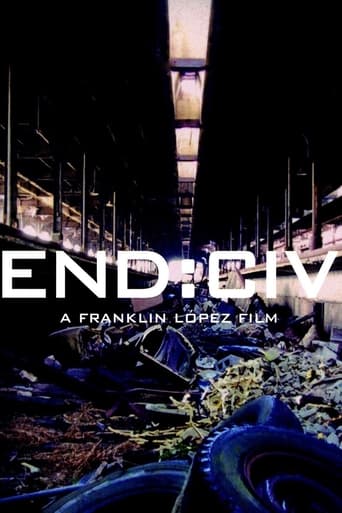
END:CIV
2011 · Film · documentary · 115 min
Directed by Franklin Lopez
The causes underlying the collapse of civilizations are usually traced to overuse of resources. As we write this, the world is reeling from economic chaos, peak oil, climate change, environmental degradation, and political turmoil. Every day, the headlines re-hash stories of scandal and betrayal of the public trust. We don't have to make outraged demands for the end of the current global system - it seems to be coming apart already. But acts of courage, compassion and altruism abound, even in the most damaged places. By documenting the resilience of the people hit hardest by war and repression, and the heroism of those coming forward to confront the crisis head-on, END:CIV illuminates a way out of this all-consuming madness and into a saner future. Backed by Jensen's narrative, the film calls on us to act as if we truly love this land. The film trips along at a brisk pace, using music... Written by Franklin Lopez
1 positivefrom 1 commenter
Where to watch
No streaming data for this title.
Videos commenters linked
From YouTube links in the comments below. Most are clips and trailers; “Full” means the uploader says so.


6 comments on Hacker News
The trends are not reversible, but they may be attenuated if we don't adopt a "dooomed" worldview. In the french speaking world, there's a wave of eco-angriness starting to replace eco-anxiety and that's a welcome change.
People are getting involved and putting their ass on the line to stop this madness. At a great cost, given that cops regularly maim and sometimes murder ecological activists trying to stop ecocidal projects (see NDDL / Sivens / Sainte Soline).
We have a choice to make: destroy capitalism and its consumption lifestyle, or let it destroy humanity and millions of other species. I strongly recommend watching END:CIV, a 20-year-old documentary that hasn't aged a bit.
> The issue is that the entire financial market is a bubble now, not only crypto, but stocks, credit (mortgage, student loans, all private debt really), real estate, etc.
That's correct. But that's nothing new. Major economic crises are a feature (not a bug) of the capitalist system and were already quite common in past centuries (plural). Remember when 1929 was supposed to be the very last crisis?
I agree with you it may have dire consequences but it all depends on the scenario. Economics (money + private property) is just a lousy/leaky abstraction to extract value from certain people are redirect it into other pockets, but if the entire system collapses, housing will not tear itself apart and fields won't stop growing.
If we as popular classes (those who produce value for the system to waste) are ready to organize without higher management and without greed (and without transnational supply chains who may be harder or undesirable to keep flowing), we may all well be better off in the medium term.
On a micro level, the VioMe factory in Greece is a good example of a destructive industry run for profit turning into a "greener" (all things considered) self-organized factory after the 2008 crisis. On a macro level, the spanish revolution of 1936 also showcases the power of the proletariat and what Graeber calls the "caring classes" (see CCC talk) to operate a radically-different society in a situation of crisis (in that case, a fascist coup d'état in some parts of the country).
So i agree with you we're in a bad place, as our dependence on fucked-up/polluting centralized processes and abstractions, and repression against autonomous/struggling communities have only increased in the past decades... but that's a cultural bias and there's in absolute no reason humanity (and the rest of the planet) can't fare much better without industrial capitalism, given a painful transition period.
It's also interesting to realize just how fucked up we are if we keep going in the same direction. "End:Civ" is an interesting documentary in this regard, although it's starting to be dated and the climate change situation has definitely gotten even worse since then. In that sense, and given that collapsing the entire economic apparatus looks more and more to be the only way to save literally millions of species, i think not all hope is lost if we were to crash the whole system.
Well that's a nitpicking argument which depends on your definitions. From what i understand, what you call "communism" i call "State capitalism" and what you call "democratic socialism" i call "liberal capitalism". Under all these systems, there's privileges: people who have more and people who have less, while communism is usually defined as a stateless/classless society (including by marxists).
> Wouldn't it be more accurate to just say: where industrial humans are or have been?
Indeed! Yet this formula ignores the ties between the two concepts. Industrialization and capitalism grew hand in hand with extractivism and colonization starting in the 16th century. Without the industry to build boats to exploit the overseas, capitalism could not exist: yet without massive accumulation of wealth, industry as we know it could not be created.
This is not to say pollution is impossible without capitalism. But capitalism as a social structure incentivizes not to care because there's no (immediate) profit involved in respecting your environment, and because there will always be more areas to exploit and pollute: our overlords are now openly talking of colonizing Mars once they're done fucking things up over here!
If you have intellectual curiosity for critiques of industrial capitalism, i strongly recommend the "End: Civ" documentary.
Very unlikely we'll see them again, but we can do all we can to protect the 1M+ endangered species:
- build communities with cooperation, not competition; shared pantries/kitchens help reduce waste
- in general, mutualize as much infra as possible to reduce resource usage
- go low-tech as much as you can (as a community) ; every single piece of electronics is close to the worst you can do for the environment
- sabotage surrounding industry? organize with fellow concerned citizens? chances are the psychopaths running the show (hello bezos) will never stop until we're all dead or they've successfully colonized Mars, so we should help them stop peacefully or find their way to the guillotine
Strongly recommend watching the (not-so-recent) End:Civ documentary (you can find it pretty much anywhere on the Internet).
Is the datacenter disconnected from the electric grid? Does it not have huge tanks of petrol to run backup generators? Was the datacenter built from locally-sourced materials? Those are the easy questions.
What "renewable" energy does it run and how was it produced? What's the carbox/fossil profile of those energy sources? How long do they need to run, and in what conditions, in order to offset this initial fossil energy invested? Those are the medium-difficulty questions. And as i much as i hate Michael Moore's rhetoric, "Planet of the humans" does a pretty good job of explaining why these questions are important.
What is the ecological impact of the cloud? Why do countryside folks have to have their data run across the country just to exchange messages with their neighbors, and what's the impact of that? What's the impact of a song that you downloaded from Youtube (replicated, dedicated centralized infra) instead of Bittorrent (decentralized, already-in-use hardware)? What's the impact of streaming this same song over and over? What's the impact of online advertisement and web trackers? How many people are working in concrete offices in a city in order to maintain that hellish infrastructure? Where does all the sand and minerals come from to build all that infrastructure as well as all the electronics you find in there? Those are the hard questions and when you answer them you'll never fantasize about green capitalism ever again.
In case you're interested in such topics, and what to do about it, but can't stand for Michael Moore, i strongly recommend the "End:Civ" documentary: https://youtube.com/watch?v=L4ccAJJrrjM
> it's crap like this which makes me wonder if the humanity of future centuries will look back at our greed-powered society with disdain.
If there is any humanity left in the coming decades, they will for sure look down on us as monstrous greedy beasts killing each other for a little power. Because that's all that capitalism and private property brought humanity since their invention.
But it's far from sure there will still be anyone alive to resent us given the very likely collapse of capitalist civilization (and most of life on earth with it).
There's an excellent ecologist documentary specifically on this topic called End:Civ. You can find it in many good corners of the web/net for free :)
In the meantime, we'll keep working on decentralizing naming authorities of the Internet, such as with tor, cjdns, etc..