 Hacker Cinema
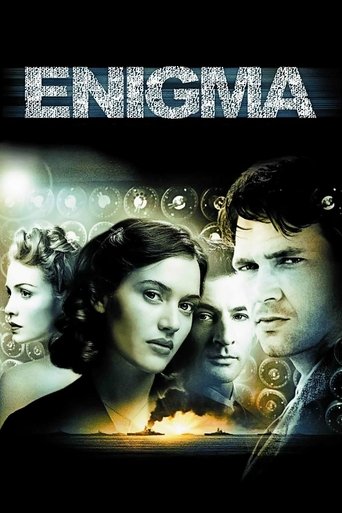
Enigma
2001 · Film · 119 min
Directed by Michael Apted
MysteryDramaThrillerRomanceWar
The story of the WWII project to crack the code behind the Enigma machine, used by the Germans to encrypt messages sent to their submarines.
2 positive1 negative1 mixed4 neutralfrom 8 commenters
Where to watch
No streaming data for this title.


9 comments on Hacker News
I am reading "Enigma" the book, that the recent Turing movie was made from. I am exactly at the point where Alan is taking classes with Witgenstein. Hehehe :-)
The movie "Enigma" from 2001 is better.
Here's the NSA's official history of Enigma and the bombe: https://www.nsa.gov/about/_files/cryptologic_heritage/publications/wwii/solving_enigma.pdf
They credit the Polish cryptanalysts who first cracked the Enigma and built the first bombe. Turing and Welchman at Bletchley Park came up with improvements which made it much more effective. Building the new machines was outsourced to the British Tabulating Machine Company.
Then the Germans switched from a three-rotor Enigma to a four-rotor, which the British machines could not solve and increased the effort required by a factor of 26. So the US Navy had National Cash Register build much faster machines. Hundreds of them.
Four wheels was about the limit for a portable rotor machine where the key presses advanced the wheels. The key pressure required for even a 3-wheel Enigma was very high. (I've typed on one, when one was at Stanford. The key travel is huge, almost an inch.) So that was as complex as the ciphers used by German mobile units (ships, trucks) ever got.
For fixed installations, there was the German Lorenz machine, which had 12 wheels. That required a completely different approach to crack. Bombes were a brute-force solution. The Colossus machine used electronics and a more statistical approach. But that's another story.
Actually, the article only talks about the Enigma machine featured in the movie, not all the different models (with different rotor counts, etc.) that the Germans used throughout the war. The title might sound linkbaity, but it's accurate.
Enigma is an outstanding book, but once you've read it the film is pretty disappointing in the way it falls back on Hollywood tropes. However, a 'gratuitous' spy plot is not one of them; Enigma is not a documentary, the plot is the story.
Enigma (2001) is a better film.
I haven't seen that, but my understanding is that they cast him as straight. If so, how is it possible to get past that (rather insulting) inaccuracy?
All German units sent in a strength return each day (all serious armies do this) which reads like "#1, 12000, #2, 450 ..." and is simply many effective soldiers, how much ammo, and other basic numbers. It's dull, boring, and tells which units can fight effectively and how far they can move. Much of Bletchley Park's work was decrypting and tabulating that info, which told Allied commanders where the weak spots were on the German side.
Can't believe that there wasn't a glut of bogus strength reports floating around. ("No, Mr. Turing, your friends will find that the 14th Panzer is fully armed and operational.")
Enigma (2001) is a better film. It, too, has a gratuitous spy plot. Actually, not only were there no leaks from Bletchley Park, the secret was kept until the early 1970s, and full details didn't come out until the 1990s. Turing was a reasonably important figure at Bletchley Park, which had about 9000 people at peak. But there were lots of other smart people working on the problem. Dilley Knox was in charge of the cryptanalysis, and Gordon Welchman did much of the design on the improvements to the Polish Bombe. Welchman went on to teach the first computer course at MIT and worked on computers until the early 1970s. He overcame his early opposition to vacuum tubes; he thought they would be too unreliable.
The real secret of US and British cryptanalytic efforts was to approach it as an industrial problem. That was new. Cryptanalysis until WWII was someone at a desk with pencil and paper. Cryptanalytic units were tens of people. The WWII effort on the Allied side involved not only Bletchly Park, but a big operation at Arlington Hall in the US and another operation in Hawaii. Bombes, the electromechanical key-testers, were built by the British Tabulating Machine Company, National Cash Register, and Western Electric. (NCR's was the most useful and was produced in large quantities.) About 60,000 people were involved at peak. It wasn't clear until long after WWII how big the operation was. Few people were allowed to see more than a small part of it. This wasn't a "one lone genius" thing.
Some of the secrecy was to make Churchill look good. There were times during WWII when Churchill sent a message to a general facing heavy opposition "Press on and you will be victorious", and took historical credit for his courage and decisiveness. Decades later we find out that Churchill had info such as "14th Panzer low on fuel and ammo, cannot fight for more than 2 hours" from intercepts. All German units sent in a strength return each day (all serious armies do this) which reads like "#1, 12000, #2, 450 ..." and is simply many effective soldiers, how much ammo, and other basic numbers. It's dull, boring, and tells which units can fight effectively and how far they can move. Much of Bletchley Park's work was decrypting and tabulating that info, which told Allied commanders where the weak spots were on the German side.
'Enigma' the novel by Robert Harris on which that movie was based, is superb though. Definitely makes 1943 seem like 1943.
Another book worth reading is David Kahn's historical account 'Seizing the Enigma.'
I'm glad that Poland wants to honor these people, but to say that Bletchley Park has been overlooking them is utter nonsense.
1. Here's what Bletchley Park says on their first history page about their wartime role (http://www.bletchleypark.org.uk/content/hist/wartime.rhtm):
"The Poles had broken Enigma in 1932, when the encoding machine was undergoing trials with the German Army. They even managed to reconstruct a machine. At that time, the cypher altered only once every few months. With the advent of war, it changed at least once a day, effectively locking the Poles out. But in July 1939, they had passed on their knowledge to the British and the French. This enabled the codebreakers to make critical progress in working out the order in which the keys were attached to the electrical circuits, a task that had been impossible without an Enigma machine in front of them."
2. There's a memorial for the Poles at Bletchley Park (http://www.flickr.com/photos/ell-r-brown/5109679597/) and they have an annual Polish day.
3. There's a special page on the Polish contribution (in English: http://www.bletchleypark.org.uk/content/hist/history/polish.rhtm and in Polish: http://www.bletchleypark.org.uk/content/hist/history/inpolish.rhtm)
I do agree, however, that the 2001 film Enigma was an utter piece of crap that depicted "Turing" as straight and a Pole as a traitor.
A Hollywood movie about the Enigma? Like the movie "Enigma"?
http://www.imdb.com/title/tt0157583/
(If you take the tour at Bletchley, they will point out everything they have there that was used in the movie.)