 Hacker Cinema
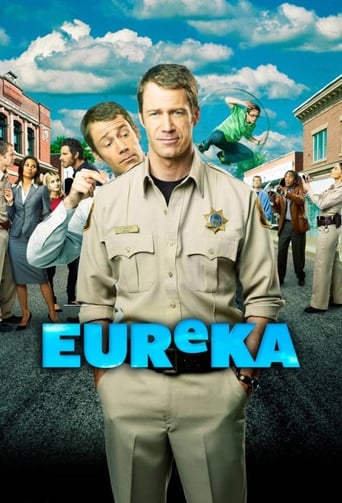
Eureka
2006 · TV series · 44 min episodes · 5 seasons
Created by Jaime Paglia, Andrew Cosby
Science FictionFantasyComedyDrama
The sleepy Pacific Northwest town of Eureka is hiding a mysterious secret. The government has been relocating the world's geniuses and their families to this rustic town for years where innovation and chaos have lived hand in hand. U.S. Marshal Jack Carter stumbles upon this odd town after wrecking his car and becoming stranded there. When the denizens of the town unleash an unknown scientific creation, Carter jumps in to try to restore order and consequently learns of one of the country's best kept secrets.
4 positive7 neutralfrom 11 commenters
Where to watch
No streaming data for this title.

12 comments on Hacker News
Glad you drew this comparison. I have a 4yo who (TLDR) we didn't really push TV on and started reading on his own when he was two.
Before he was born I put a lot of thought into what he would watch before he was born assuming it would be a huge necessity to address. I torrented Mr Rodgers and Reading Rainbow and Eureka (amazing old science cartoon if anyone's encountered it) and I even started writing a script that would randomly select from these and automatically turn off after 1-3 episodes.
Basically I am shocked at how wrong I was. He had no natural interest in TV beyond a few minutes, even if we were watching something. We didn't have a reason to push it, when he did see newer kids media like Bluey / Cocomelon etc he would zombie out exactly as you described and then have noticeably crappier behavior for a while after we would have to have a minor battle to turn it off. Felt like microwaving his brain and we had no reason to push it on him so we didn't. After a few days he would never miss it. We let him watch stuff at friend's houses and still pop on old stuff that I downloaded once every week or two. Same basic behavior / problems. We always back off for the same reasons.
I grew up on TV and I don't judge parents who legitimately love watching TV with their kids or need it as a babysitter because of demanding schedules or absent child care assistance. It is an incredible tool in a culture that often separates extended families and discourages grandparents from playing active daily supportive roles.
But yeah for whatever reason our kid started reading independently when he was two, got really interested in languages, got his basic operators down while he was 2-3 and has never had any serious behavioral or developmental problems and other parents are always asking us what we did to accelerate his development and make him such a genius.
We didn't do anything unnatural, we just didn't intentionally push him to watch a lot of TV. He still watches stuff, we still watch stuff. It's just on a laptop and ends when he starts turning into a zombie.
With that said Bluey seems fine to me, my kids the one with the weird zombie reaction. And disclaimers all kids are different, I'm incredibly lucky to work from home on a schedule where I get to hang out with him all the time and I'm pretty sure regardless of zombie Cocomelon watching his generations problems are not going to be rooted in them zonking out on TV but who knows.
I bet there is too! But I think it is also hard to form this community. Given the increased friction from the general community I think it might be time to put serious effort in determining how to make this a reality.
I don't have a great idea for it tbh. I'll pitch a bad one at least to put something out there. Maybe we can convince some billionaire to perform a post scarcity experiment? To buy large chunk of land, gather people who have both high passion and expertise in domains, and let them run wild. Less like Star Trek and more like Eureka[0]. I don't think it is a realistic expectation to get billionaire funding, but I think the idea of looking at something like Eureka (or this category of groups you see in many Sci-Fi stories) is worth drawing inspiration from: effectively post scarce (possible on small scale?), high levels of freedom (very doable), high levels of creativity and expressiveness (this is the experiment, to see if it is decreased/maintained/increased).
[0] https://www.imdb.com/title/tt0796264/
Tldr: not Eureka of tv show fame
> We are all the sorcerer's apprentice
Back in the mists of time at BigCo internship day1, the incoming cohort of interns was briefed by outgoing cohort, without managers present. One of their pearls of wisdom was that a great manager (and by extension, team) could lead and defend an oasis of excellence in a desert of industry detritus. Today, this dynamic can also be seen in serial founding teams and spinoff projects.
If time is more spiral than linear, then cyclical patterns are not merely swings of a pendulum, but a recursive opportunity for redemption or relapse. In that worldview, merely waiting would be enough to experience a different set of local maxima. But human actors with agency can move to new contexts instead of waiting for cyclical change, or work with peers to spark new cycles.
Stargate/Fringe/Eureka posit multiple universes and versions of ourselves, each universe further having multiple timelines. If it were possible for us to see an infinite tapestry of futures, would we be invigorated or paralyzed by choice? Looking in the other direction, we have access to the near-infinite, unfinished work of our ancestors, some of whom deserve the sorcerer moniker.
One way to gain perspective on local minima/maxima is to step back to a different scale of time or space. The classic film "Powers of 10" [1] offers a spatial perspective. There are history of technology books which span decades to centuries, showing recurring patterns of both good and bad. One tiny example is the decoding of the Maya language, which was unsolved for centuries, then cracked by an art history teacher on vacation.
There is a 1930s sci-fi book [2] which spans 2 billion years and many generations of humans going through cycles of technology and social structures. The successor book has an even longer timeframe. As a thought exercise, it leaves one with the impression that everything has already happened before, and will happen again, but slightly differently in future spirals of time and space. Where does that leave mortal humans prioritizing action within finite lifespans?
If we can't find a sorcerer from whom to learn, we can choose which sorcery we want to teach. Be the change.
> For every story about how tech is improving lives, you hear another two about yet another horrible dystopian usecase for the same technology, and it's never hard to imagine a dozen more.
If one looks into the history of tech, they can find initially benevolent tech that was twisted into dystopian purposes. But there are also examples of tech designed for one purpose, later adapted to positive use. Even hostile social media can be tamed by manually curated lists of non-hostile writers. With the proliferation of open-source, it has never been easier to Embrace & Extend, or harder to choose a direction.
If you have the space/time/tools to build something tangible that fuses software with the physical world, it can combine the dream-catcher inspiration of software with physical constraint. If lacking inspiration, recreate a pioneering tech demo or meet a hyper-local need, then extend that foundation.
[1] "Powers of 10", https://www.youtube.com/watch?v=0fKBhvDjuy0
[2] https://en.wikipedia.org/wiki/Last_and_First_Men
[3] "Only those questions that are in principle undecidable, we can decide." --Heinz von Foerster https://news.ycombinator.com/item?id=8018832
I didn’t even realize that we started rolling out intersections that talk directly to the cars nearby, and apparently only 30 minutes away from where I live.
I remember an old episode of Eureka about smart asphalt that if I remember correctly ended up causing a town wide traffic jam and then was never brought up again in subsequent episodes.
If only we could learn the pitfalls from sci-fi along with the cool ideas lol
If you can suspend your disbelief, there is a fantastic episode of Eureka that considers the release of something similar.
https://m.imdb.com/title/tt1060049
"Primary Education of the Camiroi" by R.A. Lafferty has a fun, fictional curriculum, http://uncabob.blogspot.com/2015/05/the-primary-education-of-camiroi.html
"Profession" by Asimov (1950) remains a definitive story on systems and talent-beyond-ontology, https://www.abelard.org/asimov.php
University course on Art and Geometry/Math, with a bibliography that could lead to ideas for early education, https://math.dartmouth.edu/~matc/math5.geometry/
Offline toys/tools that encourage creative expression and working purely from memory (lower latency than all devices), using thousand-year old techniques (e.g. memory palace).
Social games which involve temporary loss of a sense or range of motion, to encourage communication and empathy with others of different capabilities.
Five year paper journal/scrapbook which co-locates experiences from the same dates in multiple years. Helps with awareness of growth and seasonal patterns.
Tech & humanity in 20 years? There are competing visions for the definition of human. Ancient and timeless skills help with surfing unpredictable waves of opportunities and threats, bending emerging tech to personal visions of humanity. Two of many competing strands: https://www.youtube.com/watch?v=wD6hyGXRcgk & https://wrenchinthegears.com. The 2011 TV series "Eureka" has several storylines with STEM families, as most of the town qualifies as gifted, https://en.wikipedia.org/wiki/Eureka_(American_TV_series).
If all humans are flawed and all systems reflect the consciousness of their creators, then a necessary human skill is navigating around the flaws of human creations. Sometimes called "hacking" :) https://en.wikipedia.org/wiki/Fravia
Thanks. The pattern isn't perfect but the trend is clear. These are Season 1, excluding pilots.
A-Team (1983): 49m
MacGyver (1985, original): 48m
Quantum Leap (1989): 47-48m
X-Files (1993): 43-44m
Monk (2002): 44m
Eureka (2006): 44m
MacGyver (2016, remake): 42-43m
I think it's because it's easy. Dystopia bring automatic conflict which is easy/lazy to dramatize.
Still all isn't bad, it isn't Star Trek, but there are non-dystopic popular fictions:
- Her
- Stargate SG-1 and spinouts
- Fringe
- Warehouse 13
- Eureka
- Sanctuary
- The new crop of super hero shows and movies, Arrow, SHIELD, The Flash
- Heroes
- The short lived new V series
- Dr. Who
- Guardians of the Galaxy
- Inception
- Gravity
and more....
in Literature there's a huge bounty of great non-dystopic stuff too.
- The Golden Oecumene
- The Culture series
- The Night's Dawn Trilogy
- The Gap series
You just have to know where to look.
Obviously not, since a corporation has never actually bought a city like the proposed Google buyout of Detroit. I was making a glib remark about possible downsides to a Google city.
So in that spirit: Yes, in TV shows like Deadwood and Eureka.
There are quasi-modern-day sci-fi stories like the TV show Eureka or Fringe.
Going backwards just a little in time... Dieselpunk is often set between the two world wars. I loved the style of The Rocketeer, Skycaptain and The World of Tomorrow along with other post-aviation, pre WWII sci-fi/fantasies (even if the non-stylistic aspects of Skycaptain were deeply disappointing).
Reminds me of the Eureka episode where they plan to drop Fargo down a 10,000 pit...