 Hacker Cinema
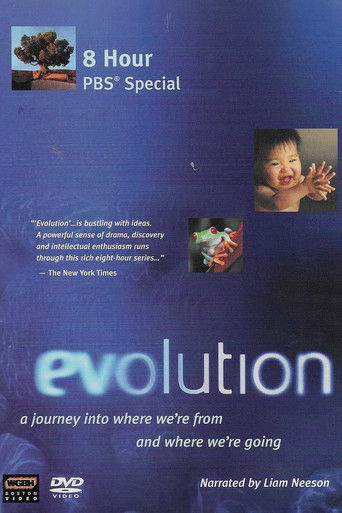
Evolution
2001 · TV series · documentary · 1 season
Evolution is a 2001 documentary series by the American broadcaster Public Broadcasting Service and WGBH on evolutionary biology. The spokespeople for the series were Jane Goodall, Kenneth R. Miller and Stephen Jay Gould, Eugenie C. Scott, Arthur Peacocke and Arnold Thomas. The series was narrated by the Irish actor Liam Neeson. The series was accompanied by a book by the popular science writer Carl Zimmer Evolution: The Triumph of an Idea. An extensive website provides teaching resources for each episode's material, including "The Mating Game", further looks at Charles Darwin, and an interactive history of speciation in the invented "pollencreeper" birds.
1 neutralfrom 1 commenter
Where to watch
No streaming data for this title.
Videos commenters linked
From YouTube links in the comments below. Most are clips and trailers; “Full” means the uploader says so.




1 comment on Hacker News
You cannot use cherry-picked examples to conclude how to improve your chances of success.
I don't know enough about the other people to comment.
I do know the characterization of Darwin is distressingly wrong. I don't know how anyone with a reasonable understanding of Darwin's life can characterize him as a slacker.
Even watching a documentary like https://youtu.be/MCOc7Xqj-kQ?list=PL7UadKoCkgW219C8ZH-Md9X_5Kn3Wugsx&t=4452 ("Evolution - Part 1 of 7 - Darwin's Dangerous Idea (PBS Documentary)") shows Darwin worked hard. (Link to his brother asking "why must you work so hard at your horrid little mollusks", following a scene where Darwin starts coughing during a walk, and before the scene where he undergoes cold water treatment, prescribed by his doctor to help treat the consequences of "excessive mental exertion."
Again, walks and hiking in the mountains were part of how Darwin worked.
I'll cherry-pick the other end of the spectrum - Paul Erdős. "He devoted his waking hours to mathematics, even into his later years" (quoting Wikipedia) and used Ritalin and Benzedrine because not using them impacted his mathematical performance. He would be up at all hours of the day and night.
Or Von Neumann, "The fact he was constantly working on all kinds of intellectual, academic and advisery affairs probably meant he could not be a very attentive husband. ... His work habits were rather methodical, after waking up and having breakfast at the Nassau Club, he would visit the Institute for Advanced Study and begin work for the day. He would continue working for the entirety of the day, including after going home at five. Even if he was entertaining guests or hosting a party he could still spend some time in his work room working away, still following the conversation in the other room where guests were. Although he went to bed at a reasonable time he would awaken late in the night, two or three in the morning by which time his brain had thought through problems he had in the previous day and begin working again and writing things down." (Again, quoting Wikipedia.)
Or cherry-picking an example of getting a Nobel Prize without "having a lifestyle that enables consistent productivity" - Kary Mullis.
Don't base your understanding on cherry-picking, because you can get almost any conclusion you want that way.