 Hacker Cinema
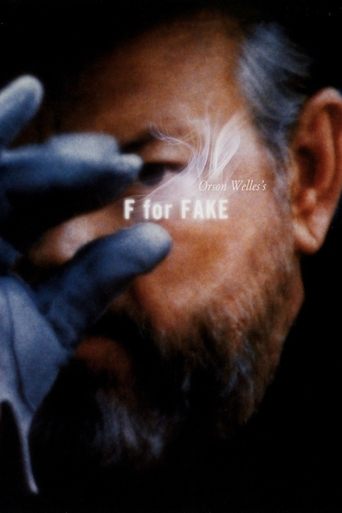
F for Fake
Vérités et Mensonges
1973 · Film · documentary · 89 min
Directed by Orson Welles, François Reichenbach
Documents the lives of infamous fakers Elmyr de Hory and Clifford Irving. De Hory, who later committed suicide to avoid more prison time, made his name by selling forged works of art by painters like Picasso and Matisse. Irving was infamous for writing a fake autobiography of Howard Hughes. Welles moves between documentary and fiction as he examines the fundamental elements of fraud and the people who commit fraud at the expense of others.
21 positive3 neutralfrom 24 commenters
Where to watch
No streaming data for this title.
30 comments on Hacker News
"F for Fake" - Documentary, 7.7/10 on imdb, 88% on RT. "A documentary about fraud and fakery."
At first I was a bit mad that you linked a 1.5 hour video just like that, but this sounds really interesting after all. Thanks for the recommendation.
You should definitely watch documentaries, as long as you first watch Orson Welles's masterpiece F for Fake as a pre-req. That or Abbas Kiarostami's Close Up. Then you are free to watch as many documentaries as you please.
There is a film essay by Orson Welles called "F for Fake" about art forgery, an artist that creates forged works that gain value by being works of art in their own right, that then takes a sudden turn. I don't want to spoil it, but it's a fascinating look at art, truth and lies.
https://en.wikipedia.org/wiki/F_for_Fake
Your post reminds me of the very underrated latest film from Orson Well, F for Fake, which is about forgery. It contains an excellent quote from Elmyr de Hory, a notorious art forger, who at some point exclaims: "Guilty? Of what? Making masterpieces?".
Just watched "F for Fake" (Orson Welles, 1973), a documentary of sorts about the great art forger Elmyr de Hory who was able to imitate the style of many of his contemporaries to perfection (Modigliani, Matisse, etc.), fooling the painters themselves!
At one point in the movie his biographer says
> I think Elmyr's problem for years and the reason why he could not succeed as a painter in his own right was that the type of life he led prohibited him from having a personal vision.
Elmyr had great skill, greater than anyone alive perhaps, but he had nothing to say.
This reminds me of Orson Welles' excellent film: F for Fake.
It explores art forgery, art experts, and the author of a book about art forgery committing a massive forgery.
I’m convinced by the article which is so hell bent on casting a poor light on Han van Meegeren it’s hard to care enough to read but if you are interested in forgers and forgery - a fascinating subject - I heartily recommend Orson Welles F for Fake. It’s for most part a documentary about the famous forger Elmyr de Hory and his biographer Clifford Irving, himself somewhat a forger. I say for most part because to serve its point the documentary itself intentionally verges into the forgery territory in an amount which is hard to gauge. It’s an extraordinary brilliant and personal reflection on the place of authenticity in film and the art.
The movie notably includes this brilliant quote by Elmyr de Hory: “Guilty? Of what? Making masterpieces?”.
F for Fake by Orson Welles. Documentaries on art forgers (not 'how this art forger was caught!' which is of secondary importance) all tend to be interesting, but this is transcendent.
The Pervert's Guide to Ideology' by Slavoj zizek/Sophie Fiennes.
Hypernormalization* is an Adam Curtis doc so you'll love or hate it, but I think it's his best one.
The 1973 Orson Welles docudrama "F for Fake" is worth watching if you're interested in art forgery. It posits that there is value in the art of the forgery itself, if the forgery is high enough quality and fools enough people.
Orson Wells' F for Fake is a terrific film about an art forger, that explores concepts of art, authenticity, and value.
In the film, an artist forges works of art by famous artists and fraudulently sells them to museums. It's implied that the museums don't know they are forgeries or don't care. So why is a Picasso more valuable than a perfect reproduction of it?
I think the point is, it's all just perception, and greed.
Cryptography is a highly significant technology, but cryptocurrency and now NFT too often just smacks of a money making scheme, promoted by self-serving people who happen to own a lot of it.
Banksy’s film Exit Through the Gift Shop reminded me of F for Fake. Ostensibly a documentary but with more complexity.
F for Fake remains one of my all time favourites, it's not quite a documentary, it's not quite a video essay, it's not quite a movie. I've still not seen anything else that skirts the line in exactly the same way, and certainly not so long ago. I am admittedly a huge shill for big Welles though.
If you are at all interested in art forgery (or just good cinema) I highly recommend the Orson Welles film F for Fake. It’s a true story about how a man who faked a biography of Howard Hughes went to meet one of the greatest art forgers of the 20th century, all wrapped together with great commentary on the concepts of fakery and originality. Incredible film.
The entire thing used to be on YouTube but here’s the trailer:
https://youtu.be/twlA_yzagXo
Edit: Every Frame a Painting made a great analysis video on it too:
https://youtu.be/1GXv2C7vwX0
If this is interesting to you, Orson Welles has an utterly fascinating kind-of-documentary (it's a bit genre defying) about art forgery, named "F for Fake".
It's a very strange movie, but it's worth a watch: https://en.m.wikipedia.org/wiki/F_for_Fake
For those intrigued by the subject of the Fake, I highly recommend Orson Welles’ film “F for Fake”
https://en.m.wikipedia.org/wiki/F_for_Fake
Check out the movie "F for Fake". It's a fake documentary that makes a point about art fakes and the experts who encourage judging work based on who made it.
Lots of good ones already mentioned, but here's a few nobody's brought up yet:
Orson Welles' F for Fake: https://www.imdb.com/title/tt0072962/
Robert X. Cringely's Triumph of the Nerds: https://en.wikipedia.org/wiki/Triumph_of_the_Nerds
The Maysles Brothers' Gimme Shelter: https://www.imdb.com/title/tt0065780/
Randy Olson's Flock of Dodos: https://www.imdb.com/title/tt0800334/
Les Blank's Burden of Dreams: https://www.imdb.com/title/tt0083702/
Steve James' Hoop Dreams: https://www.imdb.com/title/tt0110057/
Chris Hegedus and D.A. Pennebaker's The War Room: https://www.imdb.com/title/tt0108515/
There is a wonderful documentary about a quite famous and "successful" art forger on Netflix https://www.netflix.com/title/80015279 (Beltracchi)
There is also F for Fake, by Orson Welles, but I cannot seem to find it on Netflix...
F For Fake is a great movie/video essay by Orson Wells investigating the work of one of the most notorious art forgers of the 20th Century. Fascinating story worth seeking out. The full film is on youtube at the moment, as well as Filmstruck.
On a general Welles note: I also recommend One Man Band http://www.ubu.com/film/welles_oneman.html which is actually where I first heard of F for Fake and talks a lot about Welles ' creative process (or well talks about how he was creative).
I though Duchamp was making fun of the art world. There is a large group who are obsessed with curators and experts, and will praise anything that's put in a gallery whether it's any good or not.
Edit: well it seems that was wrong, so let's derail the thread some more with a strong recommendation to watch "F for Fake", and a long Twitter rant I found about how to approach the "are video games art" conversation. https://twitter.com/ForgetAmnesia/status/882933955174989825
There's an excellent documentary by Orson Welles called 'F for Fake' on art forgery if this sort of thing interests you.
It's Saturday, everyone should go watch Orson Welles' "F for Fake". (Unfortunately it's not on Netflix at the moment. https://www.justwatch.com/us/movie/f-for-fake ) It's a crazy "documentary" about forgeries and originality. Modigliani comes up a lot.
I quite enjoyed "F is for Fake" by Orson Welles, which starts of as a documentary essay of sorts about an art forger. It discusses some of the same issues with authentication.
https://en.wikipedia.org/wiki/F_for_Fake
This is as good a time as any to recommend Orson Welles's mesmerizing documentary, "F for Fake" about the now infamous art forger Elmyr de Hory.
https://en.wikipedia.org/wiki/Elmyr_de_Hory
This reminds me of Elmyr de Hory. I watched him one of Orson Wells last movies "F for Fake" and I have no idea what to make of it.
Have a read of John Berger's "Ways of seeing". He believes the rich are trying to exclude the poor from art by insisting that the original has some indefinable quality to it that is inherently better in order to retain a higher ground by owning originals in a world where perfect copies can be made.
http://www.goodreads.com/book/show/2784.Ways_of_Seeing
It's very good and a short book. Really you've already stumbled across one idea yourself just by not falling for their BS.
Also see Orson Wells "F for fake":
http://www.imdb.com/title/tt0072962/
Like Ways of Seeing it's short and very good.The main forger is fabulously talented IMHO.
General note: he made ONE great film (Kane), a few good ones (Ambersons, F For Fake, Chimes) and the rest were howlers or just dull. I can't watch Lady From Shanghai because of of his awful accent, plus it's s bit dull. Touch of Evil was almost good but 45 minutes too long. Genius? Nah.
I think everyone should watch Orson Welles' F for Fake. The main theme of the documentary/exposé is that art is too rarely appreciated for what it is, but more for who made it. And everything went downhill as soon as "experts" started claiming that they could tell a "real" painting from a "fake" and acting as if the fake weren't also valuable as a work of art. If we just got rid of the experts...
Wikipedia calls it "meandering" but Welles is far too charismatic to be boring. https://en.wikipedia.org/wiki/F_for_Fake <- spoiler in the last 2 paragraphs of the "Plot" section
The whole point here is that it's not really an antique piece. If I sell you a 'drawing by Picasso' for $10k, but when you examine it you see that's it's on a kind of paper that was manufactured after Picasso's death, then naturally you will want your money back. Now, the broker (eBay/Paypal) could simply require you to send it back to me and that I refund the money, but that likely means I will just sell it again and again until I find some sufficiently gullible buyer - putting all the risk onto the broker and damaging its reputation.
Now, we could argue about whether a drawing by some modern artist that looks very like the work of Picasso is really any less valuable in aesthetic terms, and this question has cropped up a few times in the art world - see Orson Welles' little-known masterpiece F for Fake for a documentary treatment of the subject. But the fact is that the buyer is not satisfied, and whether the buyer has poor taste or is acquiring a famous signature rather than excellent art is beside the point. The buyer could have chosen to love the piece on its own merits or sell it on to some more credulous or indifferent person, but has instead exercised a contractual right to a refund (from the broker). And the broker is, in turn, exercising its contractual right to make the seller carry the cost of the misrepresentation. The seller could have brought the piece to an expert and sold it for cash, as-is and no refunds, but experts are used to such risks and would offer a much lower price. By offloading much of the transactional risk to the broker (compared to, say, advertising it on Craigslist), the seller accepted the broker's conditions.
It's all very well to complain about Paypal being terribly mean, but somehow I doubt the original offer of sale was 'possibly-fake violin, buyer beware.' Lots of people sell damaged or otherwise flawed goods on eBay with no problem, but they clearly identify the potential deficiencies so that buyers cannot claim to be surprised after the fact. If authentication disputes are a common issue with used violins, then the seller should have used an authentication service or sold on consignment through a specialty dealer, and accepted the costs involved as a marketing expense.