 Hacker Cinema
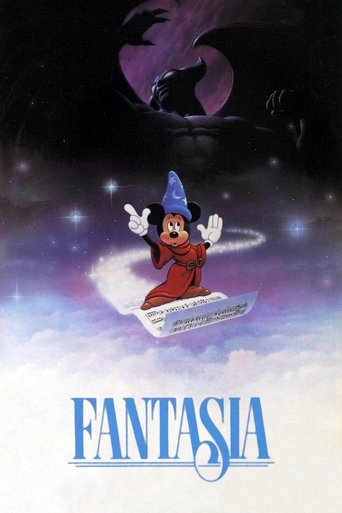
Fantasia
1940 · Film · 124 min
Directed by Bill Roberts, Paul Satterfield, Wilfred Jackson, Ben Sharpsteen, James Algar, T. Hee, Hamilton Luske, Samuel Armstrong, Jim Handley, Norman Ferguson, David Hand, Ford Beebe Jr.
Walt Disney's timeless masterpiece is an extravaganza of sight and sound! See the music come to life, hear the pictures burst into song and experience the excitement that is Fantasia over and over again.
10 positive4 negative33 neutralfrom 47 commenters
Where to watch
No streaming data for this title.
50 comments on Hacker News
'Some versions of the tale differ from Goethe's, and in some versions the sorcerer is angry at the apprentice and in some even expels the apprentice for causing the mess. In other versions, the sorcerer is a bit amused at the apprentice and he simply chides his apprentice about the need to be able to properly control such magic once summoned.[] The sorcerer's anger with the apprentice, which appears in both the Greek Philopseudes and the Dukas score (and its film adaptation Fantasia), does not appear in Goethe's "Der Zauberlehrling".'
When I was about 4 years old, this was the first movie I saw in a theater, it was a double feature with fantasia. Next time I remember going to a theater when my parents took me and a friend out of kindergarten to see Star Wars on opening day.
The Sorcerer's Apprentice is a poem by Goethe, or more famously, a sequence from the Disney movie "Fantasia", which you can see here: https://video.disney.com/watch/sorcerer-s-apprentice-fantasia-4ea9ebc01a74ea59a5867853
The short summary of it is: the sorcerer's apprentice (Mickey) uses magic to get a broom to fetch water for him, and then the situation gets out of control as the broom continues to get water, and he has no idea how to stop it.
(It's a cautionary tale about the danger of playing with forces you don't really understand/"be careful what you wish for".)
If you don't mind classical music (I love it), there are recordings at the Internet Archive and a few mirrored at imslp.org (most are "Not PD US")
So, I am considering creating songs for religious and political groups (the kind and gentle kind, IMNSHO. Anything expected to go viral (5 or more copies, LOL) I would choose the classical (scores available as well as those few CC performances) and for informal (let's jam) use, anything goes, as "fair use".
Is classical music "limiting"? Well, look at the countless movies with classical music "snuk in". The most famous is probably Mozart's Piano Concerto 21, now nicknamed "Elvira Madigan".
The converse, music composed for movies, is undoubtedly still under copyright, so use only with small groups at home, with all the Alexa's and Home Pods powered off. (phones too?)
See
https://en.wikipedia.org/wiki/Film_score
Under Artistic Merit.
FWIW, there are some fine pieces listed under "Classical Music in Movies" when you search.
Favorites from this list? Too many to list, but it all started for me with Fantasia, of course.
Dukas should get a mention alongside Disney. Paul Dukes wrote the symphonic poem L’Apprenti Sorcier (1897) based on Goethe’s poem, which was later animated by Disney for the film Fantasia.
A not insignificant part of human history is retelling the same stories. Stories like the Odyssey and the Iliad were oral traditions refined, refined, and refined, until taken down by a master. Every time Dracula and derivatives get made, something new gets added, changed, improved.
The problem with Disney's remakes is that they are trying to be the original story, reshot, but LESS Disney. The Little Mermaid is a prime example of something that should have been brighter, more colorful, more energetic, more beautiful, and IMPROVED, but instead they chose a least common denominator impersonation.
The concept of going back and retelling a prequel can work. It worked for Rogue One (despite production challenges), it worked for Wicked. What isn't working for the Disney Live Action movies is letting the machine output reduced facsimiles, instead of giving the projects to experimental storytellers, or master storytellers to do their thing.
Id love to see a remake of Bambi that amplified the music/animation connection, using modern technology to sync the movement of elements in the frame to parts of the musical composition, much like a visualizer. Breathing, fluttering, raindrops falling on the beats, quivering with the strings. Imagine a modern Little April Showers by Atticus Ross that looks like Spiderm-Man into the Spiderverse or Puss in Boots 3 or Wild Robot or Teenage Mutant Ninja Turtles: Mutant Mayhem. Bambi should be a music video like Fantasia. Instead Disney will try and tell a story about a Deer, and forget the rest of what made Bambi so revolutionary.
And yet, Disney still does make things like Soul, which really was innovative in its animation style by how restrained it was. It's simple complexity of its dream world was its strength. Animation can be done well without the hyper speed over indulgences I cited above as good examples.
It’s the older version where there’s no division between the sclera (white of eye) and the rest of the skull:
https://upload.wikimedia.org/wikipedia/en/0/0d/Mickey_-_The_Band_Concert.png
Compare to later versions, where the eyes are well defined:
https://upload.wikimedia.org/wikipedia/en/f/f6/Mickey_-_Fantasia.jpg
In recent years, Disney has been using the old version from Steamboat Willie at the start of movies:
https://en.wikipedia.org/wiki/Steamboat_Willie
And even making new shorts with that style:
https://www.youtube.com/playlist?list=PLC6qIbU1olyXQe1WOKt8UJ4hErx3D7qt8
Have you ever seen Sorcerer's Apprentice from Fantasia? I haven't seen the movie, and the original poem it's based on is in French, so I only have seen it in the Disney form. That being said, it's the perfect analogy for what is a deliberate decision by the sorcerer's apprentice to enchant a broom and get it to start bringing water in from the well outside into the cistern in the room. The process starts, and everything is going well, but it's taking too long. So he finds a way to make two brooms. Then ten...etc. Things quickly get out of hand and he can't find how to stop the brooms, and the whole room gets filled with water (chaos). At the last minute, the actual sorcerer appears and sets everything aright, and chastises the apprentice for his foolhardy curiosity in meddling with things he doesn't understand.
We could use some of that humility with regard to interfering with complex systems. Most of the effects of perturbations of a complex or chaotic system are unpredictable, and great care should be exercised before making a change, and even with great care, most of the effects will be surprising and unpredictable.
So yes, on a superficial level, all decisions in software are deliberate, but the way those decisions interact, and the outcomes of those decisions are unpredictable and largely unknown when the decisions are made. Also, and you mentioned this in the article, many of the decisions are not made deliberately, after much reflection, but rather, on the fly and in the moment.
To hand-wave that all away by saying "but a human made it" seems pretty disingenuous, or at least extremely naive.
Fantasia is 2h 4m according to IMDB. https://www.imdb.com/title/tt0032455/
12 more years, I guess.
Is Mickey content good enough that we'll see continued interest? My encounters with Mickey (35 year old American) have been only through the movie Fantasia and I know he is a prominent mascot of Disney World. But the pull to Disney world is probably what, Star Wars or Pixar these days? I was recently thinking Star Wars and the Friends TV series could reach that permanent status. Mickey seems unlikely to me.
When I was a kid Mickey had transcended movie character, he was like the Santa of the Disney world. the M.C. The spirit of Walt in some ways. I think I'd seen maybe one special or fantasia with him actually starring, and even that was after I knew him. My nephews have seen less of him and yet he's still something of a magic benevolent being to them.
He represents so much more than a character, I think in a time when they're expanding portfolios they NEED to keep Mickey to stay Disney if they want to - and imo they should want to.
Grew up in the 90s and Mickey was not a significant character in their movies that decade and the old Mickey cartoons were rarely shown. Mario became more famous than Mickey by then, but the mouse logo is ubiquitous, and most people had at least seen Fantasia or clips of the old cartoons.
Even when I have a model that isn't logistic regression, there is always a logistic regression stage at the end for probability calibration.
I mean, what good is a prediction that is 50% accurate? If you are classifying documents for a recommendation model a "up/down" classification is barely useful, a probability calibrated classification is golden. With no calibration you have an arXiv paper, with a calibration you can build a classifier into a larger system that takes actions under uncertainty.
The generative model holds progress back. You can ask ChatGPT to do anything and it will do it with 70-90% accuracy in all but the hardest cases. Screwing around with prompts can get you closer to the high end of that range, but if you want to do better than that you've got to define your problem well and go through a lot of the grindy work that you had to do with symbolic A.I. and have always had to do with machine learning.
The image that comes to my mind, almost intrusively, is Mickey Mouse from the movie Fantasia where he shows various sins, laziness most of all
https://www.youtube.com/watch?v=VErKCq1IGIU
So many of these efforts show off terrible quality control. There is a site that has posted about 250 galleries (at a rate of 2 day) of about 70 pornographic images a piece generated by A.I. At best the model generates highly detailed images including the stitching on the seams of clothes, clothing with floral prints matching cherry blossom trees in the background and sometimes crowds of people that really click thematically. Then you notice the girls with two belly buttons and if you look enough you'll see some with 7 belly buttons and realize the model doesn't really understand the difference between body parts and skin so there is a nipple that looks like part of the bra rather than showing through the bra, etc.
Then there are the hideously distorted penises that are too long, too short, disembodied, duplicated, bifurcated, pointing in the wrong direction and would otherwise be nightmare fuel for anyone with castration anxiety.
If the wizard was in charge he'd be cleaning these up, I mean looking at 150 images a day and culling the worst is less than an hour of work. But no, Mickey Mouse is in charge.
"Chat" in "ChatGPT" is a good indication of what is going on because it is brilliant at chat where it can lean on a conversation partner to provide meaning and guidance and where the ability to apologize for mistakes really seduces people, even if it doesn't change its wrong behavior. The trouble is trying to get it to perform "off the leash" at a task that matters is a matter of pushing a bubble around under a rug, that "chasing an asymptote" situation is itself seductive and one of the worst problems in technology development that entraps the most sophisticated teams, but put it together with unsophisticated people who don't think systematically and a system which already has superhuman powers of seduction (e.g. "chat" as opposed to problem solving) and you are cruising for a bruising.
I studied and played classical into college during my engineering degree and have some insight into the realities of the profession - it's much harder than that and the pay for those stable gigs are oftentimes less than $300 / month. You're looking at one of the classic professional survivorship bias that I thought even the layman understood very well. Firstly, orchestras are in dire straights currently where programs are oftentimes supported by movie and pop media performances (see: National Symphony Orchestra playing Fantasia, Danny Elfman scores, and even freakin' Super Mario Brothers). This is a similar situation to ballet and theatre - legacy performance media I guess I'd call them. These orchestras don't pay much at all and most of the money classical musicians make are from lessons, typically the children of fairly affluent professionals, including from tech, finance, real estate, and other usual suspects of said caste. I saw grad students have to skip meals and beg and plead students to continue lessons to eat while I went off to recruiting events sponsored by tech companies where I ate food constantly and I never stopped feeling guilty even after inviting some friends to avoid pizza waste.
Some very lucky others that do well are from multiple generations of musicians that were essentially born, bred, and raised to be among the world's best and live and breathe music. There was no way I could ever compete with these kinds of folks and the hard life I saw so many talented people including professors that _are_ established after decades to live a very modest life made it clear to me that it wasn't something I should do for a living despite how much I love and respect it all. My role I feel is to support these folks now, so I go to shows, buy merch at the show, etc. and try not to take up space or attention too much and let people do what they do while trying to show appreciation for the work I was too chickenshit to ever do.
The arts and now entertainment fields are very much "tournament" style careers where given very limited public attention the winners take basically all and the remainder struggle quite a lot. It's nothing like professional fields like tech, accounting, medicine, law, or trades like construction, hospitality. In fact, any field that becomes more mass market-driven seems to become substantially more "tournament" style which has greatly impacted sex work - a top n% take an increasingly higher percentage away from an elastic but fundamentally highly dynamic demand.
The misattributed quote "find what you love and let it kill you" is the typical path of the career musician like most arts. I prefer to at least have some money to have more options to make it more fun on the way without resorting to the trap that is recreational substances.
> Can you offer a full throated defense of why you feel it's okay to pirate media in 2023
-- NOT OP --
In the general case, no, but consider the cases of:
1. "Altered media" e.g. (1) Star Wars, (2) THX 1138.
2. "Remixed media" e.g. (1) Terminator 2 not having its theatrical CDS mix, (2) Earthquake not having its SENSURROUND mix
3. "Omitted media" e.g. (1) Halloween not having its original mono soundtrack, (2) The Exorcist not having its original mono soundtrack
4. "Missing media" e.g. (1) The Star Wars Holiday Special, (2) HBO's "Real Sex" documentary show
5. "Censored media" e.g. (1) Fantasia, (2) Song of the South
There are entire online communities dedicated to finding, restoring, and preserving items like the ones mentioned above.
So, is piracy OK in these cases? I emphatically believe it is.
If they weren't paying attention to Black Mirror, the BSG reboot, the Terminator franchise, the Replicator arc of Stargate, every episode of Star Trek where the computer/Data/the holodeck/nanites went wrong, Ex-Machina, The Matrix franchise, Age of Ultron, basically any Asimov AI story, Blade Runner, 2001, or any folk tale about being careful what you ask of powers that take you literally from Midas to Fantasia…
"Oh, they're just fictional!"
…then I suggest attaching a rusty metal spike to the keyboard.
It won't do anything, it's easy to avoid, it'll just sit there looking dangerous.
Hopefully that would be enough just by itself.
And yes, this is a reference to a similar suggestion for making drivers pay more attention behind the wheel.
The range of subjects in Disney’s Fantasia is encyclopedic, placing it in a class with such very different works a Dante’s Divine Comedy, Goethe’s Faust, Melville’s Moby Dick, and Joyce’s Ulysses (cf. Mendelson on encyclopedic narrative and Moretti on the modern epic). The episodes are arranged such that they call on an increasing range of mental faculties with each succeeding episode. In discussions of individual episodes (all of them) I deal with ring-form, animated acting, Freudian undertones, the relationship between sound and imagery, and Jakobon’s poetic function.
To those who complain about Koyaanisqatsi being dated, remember this film was made before such a thing as music videos existed. You might even say it was one of the first, the other being Disney's Fantasia.
So you're simply unusually sane. Can't even hallucinate in two-dimensional projections like most people--they usually have like a marker for "imaginary" that all imaginations are dyed with. It looks like a ghost in a movie. And they're not actually that careful with the marker, everyone's telling them to believe in their dreams ie let the dye bleed out, but then shrinks are like "delusions of grandeur" or what's the other one, one old word for this was in fact "fantasia" (from the Latin with an "f" because Romans themselves adopted it from the Greek with a "ph" because it's a great word. I forget the word but including that word, as in movie by Disney Fantasia) meaning thinking things that aren't true. But like seeing them, in gray, like ghosts.
Ghosts as portrayed in movies are actually a highly realistic view of the common man's imagination from the first person. That's what it looks like to them, so you know. They're usually people because that's what matters most is people spesh the face that's like who they are in a 2D projection, they're imagined because the real person is not there anymore, they're not colored in first because that's work for their limited imagination, plus it interferes with the "imaginary" marker, plus they generally don't realize they're not seeing things colored in, that's something the movie producer only realizes because he's trying to sell tickets. Also because in white societies the last image the living have of the dead are their paleness--in white societies primarily, so Europe and Asia which dominate cultural exports--so they are imagined as they were last seen. That will always be the latest version of their face.
.
Then there's what I call "macro-phantasia" which is like, like a video game with perfect graphics at this point. It is a gift and a curse. As though there were a difference between gifts and curses. Overboard.
.
Because in fact aphantasia prevents you from certain forms of harm, like imagining yourself in terrible places as people are wont to threaten you with. Threats of like "place worse than you can imagine" that's so you turn your imagination on to the max, and harm yourself in your own imagination to coerce yourself to their bidding with no proof it ever happened. If you can't imagine that, guess what, police interrogation is a waste of time even for the policeman on time-and-a-half, you didn't cooperate and that's it, or the gang-land interrogation equivalent, what side you're on is in this case irrelevant. It helps against coercion.
.
Aphantasia. Curse and a gift.
> Are the owners of the IP losing money on letting someone generate new characters in their movie/show?
Typically, creators are very protective of this sort of thing, unless it stays in the area of fan art. If anyone tries to seriously monetize this kind of output, I'm sure we'll see a lot of cases.
Imagine what Disney would do if you used DALL-E to create an animated feature film in the style of Mickey Mouse, but with cats instead of mice, and they found out you used actual footage from, say, Fantasia to train an AI model. No idea if they would win, but I'm certain they'd sue.
Yes, a few 35mm films had 4 track mag audio. The only one I can think of off the top of my head was Fantasia.
The Neverending Story (Die unendliche Geschichte) by Michel Ende was published in 1979, and mostly takes place in the country of Fantastica. J.R.R. Tolkien’s The Lord of the Rings (which mentions and describes Saruman and Orthanc) was published in 1954, 25 years earlier.
Fantasia was a Disney animated movie from 1940, but did not, as I recall, feature a wizard’s tower.
Back then, their feature films weren’t money makers, as they didn’t make them.
Their first feature film was very profitable, but it was from about 15 years later (https://en.wikipedia.org/wiki/Snow_White_and_the_Seven_Dwarfs_(1937_film)).
However, their next two movies (Pinocchio, Fantasia) cost them money because they were released during World War Two, when they couldn’t show them in large parts of the world.
They needed Dumbo to make up for that (https://en.wikipedia.org/wiki/Dumbo#Box_office), then Bambi wasn’t a huge success, either (https://en.wikipedia.org/wiki/Bambi#Box_office)
So, I guess it wasn’t till after World War Two that their feature films became profitable. They survived, so chances are the shorts brought in money.
How many movies does your avg movie goer know or can name movies from the 40s? Maybe, maybe half a dozen (it's a wonderful life, casablanca, citizen kane, Disney Fantasia and Pinocchio, and his girl Friday. I'm pretty sure your average person can name an order of magnitude more video games from pong to mario to sonic to modern day AAA games. And over time, some will have staying power, like I hope Breath of the Wild will.
https://thomaspark.co/projects/no-scary-parts/
A Chrome extension that skips creepy scenes on Disney+. Supports the movies you'd expect like Lion King, The Little Mermaid, and Fantasia. Bambi next?
Walt Disney's ambition for the original Fantasia movie was that it would remain in cinemas with new segments replacing old ones over time.
> there's no attempts at making something special, they're just the McDonalds of entertainment.
They used to be much more experimental as an animation studio but some of those projects didn't do as well. It'd be great if they could alternate between telling "safe" stories and passion projects like Fantasia or even films like Tron but I guess it's hard to pitch something risky when you can get a guaranteed hit by doing it by the numbers. The last movie I think they really took a chance with was Treasure Planet and that movie was pitched over and over for more than a decade before they agreed to make it.
With those composers, I think it depends on if you are listening to music that is intended to stand alone, or if it was originally intended to support a film work. Even there the line can get a little blurry. There is music by John Williams that is definitely on the classical concert circuit, like the Emperor Theme, but even then the form is different than what you hear in the film. I believe Zimmer has some music lifted out that stands alone. But even then, music still might only make it to Pops concerts rather than the standard repertoire. Another example, I used to listen to Elfman's original Batman soundtrack a lot - but you can tell it's much more wandering and moody than standard classical music.
But just because a piece of music is programmatic doesn't mean it's not classical. Beethoven's 6th symphony is a great example.
If you go back and watch Disney's original Fantasia, that's a good example of the difference between music that supports film, versus music that stands alone - in Fantasia's case, the film was structured to support the music.
There's definitely good classical music out there that has a pleasing "sweep" to it like film music. Maybe sometime get out the headphones, sit back, and listen to the first movement of Sibelius' 5th symphony. I like the Bernstein version most.
That isn't how the entertainment industry works. Automation doesn't reduce the man-hours needed. The man-hours remains fixed and the quality of the product increases. Look at animation. Lots of tasks have been automated. Animators don't paint each cell individually. But the total man-hours put into a film haven't decreased. If anything, they have only increased. The average pixar film is exponentially more labor intensive than any of the great disney animations of old (fantasia et al).
Sources? Copyright issues back then were a bit tricky. 28 years with mandatory registration, and so Stravinsky's Rite Of Spring (1913) is around the line of 27 years to Disney's Fantasia (1940), and if Stravinsky didn't register it, then the only organization they'd have to pay is the Philadelphia Orchestra, depending on when it was recorded...
https://en.wikipedia.org/wiki/History_of_copyright_law_of_the_United_States
https://www.imdb.com/title/tt0032455/soundtrack?ref_=tt_trv_snd
The best Disney movies are in my opinion sublime artistic creations surpassing most "art movies" in quality and depth of the craft and art of visual storytelling. Just look at Bambi, Pinocchio or Fantasia. They also happen to be some of the most popular movies of all time. So I reject the premise that entertainment is in opposition to artistic or that popular means "lowest common denominator". And what is wrong with car chases and explosions? Some of the best films of all times have featured car chases and explosions. Just take the car bomb and explosion at the beginning of Touch of Evil - this is recognized as one of best scenes ever.
The problem with the Little Mermaid is that she is suffering all the way through and kills herself in the end, and then the story ends with the moral that every kid who misbehaves will prolong the suffering of this mermaids soul. I don't think even Lars von Trier could make that into a successful movie.
On the one hand I see where they are coming from. On the other I sure do enjoy the genius of production of those old animations, particularly Fantasia. On the one hand I understand the criticism that Spielberg torpedoed indie cinema, on the other hand Empire of the Sun was a masterpiece. Two things can exist, in their own right, meriting praise, yet opposed and unresolved.
If you think about it this came about through laziness and to lower budgets, same deal with great programmers, programmers shouldn't want to do repetitive lazy work but innovate it away. Tedious work becomes a pain on time and budgets, so you innovate to do it faster/better.
Animators didn't want to draw all the backgrounds slightly moving and this allowed re-use and new innovations to make movies faster. This allowed animators to focus on the character cels and making characters look better, the main focus.
The multiplane camera with movable layers for parallaxing directly led to some of the best early Disney movies (Snow White and the Seven Dwarfs, Pinocchio, Fantasia, Bambi, The Adventures of Ichabod and Mr. Toad, Cinderella, Alice in Wonderland, Peter Pan, Sleeping Beauty and The Jungle Book) and helped their budget as well as made them look better. Plus at the time, it was actually an improvement that animators welcomed to speed up their tedious work.
That was the predecessor not the multiplane aspect of it with moving layers, definitely inspired it. Lotte mostly just used it to swap out colored backgrounds on her silhouette cel style to adjust placement and color.
A predecessor to the multiplane camera was used by Lotte Reiniger for her animated feature The Adventures of Prince Achmed (1926). Berthold Bartosch, who worked with Reiniger, used a similar setup in his film L'Idee (1932).
Ub Iwerks invented the multiplane camera with movable layers to create parallax and zooming [1] which created immersive depth. It also saved on budgets, tedious background animation and allowed animators to focus more on the character cels, the star of the show.
The first multiplane camera, using movable layers of flat artwork before a horizontal camera, was invented by former Walt Disney Studios animator/director Ub Iwerks in 1933, using parts from an old Chevrolet automobile. His multiplane camera was used in a number of the Iwerks Studio's Willie Whopper and Comicolor cartoons of the mid-1930s.
Fleischer Studios (Popeye/Betty Boop) also made one or copied in 1934 [1]
The technicians at Fleischer Studios created a distantly related device, called the Stereoptical Camera or Setback, in 1934. Their apparatus used three-dimensional miniature sets built to the scale of the animation artwork. The animation cels were placed within the setup so that various objects could pass in front of and behind them, and the entire scene was shot using a horizontal camera. The Tabletop process was used to create distinctive results in Fleischer's Betty Boop, Popeye the Sailor, and Color Classics cartoons.
William Garrity took Ub Iwerks invention further and that iteration was used in many large successful movies they made [1]
The most famous multiplane camera was invented by William Garity for the Walt Disney Studios to be used in the production of Snow White and the Seven Dwarfs. The camera was completed in early 1937 and tested in a Silly Symphony called The Old Mill, which won the 1937 Academy Award for Animated Short Film. Disney's multiplane camera, which used up to seven layers of artwork (painted in oils on glass) shot under a vertical and moveable camera, allowed for more sophisticated uses than the Iwerks or Fleischer versions, and was used prominently in Disney films such as Pinocchio, Fantasia, Bambi, The Adventures of Ichabod and Mr. Toad, Cinderella, Alice in Wonderland, Peter Pan, Sleeping Beauty and The Jungle Book
[1] https://en.wikipedia.org/wiki/Multiplane_camera
One thing I’ve never understood about the whole Disney/Mickey Mouse discussion is Trademark doesn't expire.
If Disney can hold a trademark on Mickey Mouse, all the old movies could enter the public domain but you still wouldn’t have a right to make your own Mickey Mouse movies or t-shirts.
So it seems what they are really trying to protect is Fantasia or whatever. Specific movies. Not iconic characters.
I don't think the target audience really matters. Film critics regularly cite Disney fare like Snow White, Fantasia, and Pinocchio as some of the best films ever made. Analogous lists of video games are pretty much required to have some Mario games on the list. Good is good.
What other art forms dictate events as a function of time? Dance, I suppose. I must be missing something obvious. Maybe spoken word slams.
Most other art forms that are performed over a period of time are not a function of time, but a function of dependency. In a play, you say your line after another actor finishes. Even in a movie it's the same way - it's not locked into an actual tempo until the editing process. Exceptions are the films where the music is written first, like Fantasia (this is a sorely ignored medium; I'd love to see a live-action film scored to a pre-written John Williams or Michael Giacchino score; where they have the freedom to pull in actual musical forms).
It's odd to consider music written like this - where snippets of a piece are written in all sorts of conflicting tempos, and then finally assembled during "editing" into something cohesive (although I guess this is how the Norwegian megapop songwriters kind of do this).
I think there's a lot of opportunity for introducing more tempo-based notation into other artforms. What if an internal pulse were introduced into a play? What else could sheet music be applied to if you kept everything except for the instruments and pitches/melody/harmony? Could you rehearse/perform a debate, a game, a dinner party...?
The movie Fantasia Sorcerers Apprentice was right! All the the household objects will rise and overthrow their masters!
> One of the most common refrains among ex-Disney staffers was that Disney had a strong aversion to risk.
Now why does that not surprise me. Disney stopped making art somewhere in the 1940's (fantasia) and started shipping product. I didn't share people's relief that the force awakens at least didn't suck like the prequels. The writing was so derivative as to almost make it a remake. Instead of Jar Jar Binks, the comic relief was Emo-Vader, but the comic relief shouldn't be the best part of the movie, and I'm not even sure if he was meant to be funny.
I tried to watch Fantasia as a child a few times, but was never able to make it all the way through. It remains sort of a misunderstood anomaly on the shelf of early Disney movies.
Haven't given it an honest try in a few years. Perhaps some 'adult substances' would help. I still enjoy most of the others.
Fantasia is incredible. I also still think it's an underutilized art form to have the music drive the picture rather than the other way around (three-minute music videos aside). For instance, I've always thought that Mahler's 3rd symphony could make an epic fantasy film - actors, battles, special effects, and no spoken dialogue.
About companies this is what I think: If Mickey Mouse goes off copyright, sure there would be copycats making Mickey toys and not paying royalties/fees.
Possibly somebody non-Disney approved would be making a Mickey Mouse movie.
However, Disney could still be certifying approved toys(Nintendo seal worked quite well, there were non Nintendo cartridges but they were hard to find and generally horrible , I was tinking Custer's Revenge - https://en.wikipedia.org/wiki/Custer%27s_Revenge but that was a non Atari approved cartridge).
And if someone can make a new Mickey movie that stands along Fantasia then more power to them is what I say. Disney has been sitting on Mickey laurels for too long.
I'd imagine Disney makes plenty on merchandise related to their hoary old characters, particularly Pooh Bear, and not so much the movies/animation/wizened content like Fantasia or Steamboat Willie.
I sometimes operate media servers that deliver video for several classical pops concerts including Fantasia and a number of more modern Hollywood type movies. The conductor gets a special synchronized video feed with white dots flashing to indicate tempo, colored lines to show when changes are coming up and bar numbers, all superimposed over the movie. The conductor has to speed up and slow down the orchestra in order to match the music exactly (or as close as possible) to the original video. I never change the speed of the video. Some pieces seem to be harder and also require a click track. These are shows that obviously require very close attention to the conductor.
I always wonder if all the orchestra was given a click and a copy of the modified video, if the conductor could just sit down and eat a sandwich. Of course, that is kind of like contrasting watching a DJ that selects mp3 tracks vs someone who can adeptly spin vinyl.
Curiously, I can tell you from listening to the conductors speak candidly, they often consider this sort of conducting much harder despite these added tools. Even when they are playing very familiar pieces like the music from Fantasia, it is very difficult to match it so exactly to the original. They compare adjusting the speed of an orchestra to speeding or slowing a freight train.
With professional orchestras, most only do 1-2 rehearsals before the shows I control video. It is amazing how fast the musicians take notes and adapt to the direction of the conductor. There is almost always a marked improvement between 1st and 2nd rehearsal and the actual show.
I will say that having stood at the conductor's podium at many of the top theaters in the U.S. (while empty) - it is an incredibly intimidating thought. Every seat points straight at you. It is much more singularly focused than a dramatic stage. It definitely has given me (someone with very little musical understanding) a great deal of respect for their responsibilities.
Maybe I'm being nostalgic but Mickey used to be a big movie star and now he's relegated to mostly direct-to-dvd. He was still immensely popular through the 1980s with rereleases of Fantasia in theaters, Mickey's Christmas Carol, etc. Now it seems unimaginable that he'd star in a big budget Disney film. It seems reasonable to me that they are preferring IP that was created post-1976 for a reason.
While Miyazaki's contributions to animation are important and numerous, you're quite mistaken that he "defined" animated films. I would look very closely at early Disney films (Fantasia is a personal favorite). Most of those movies very literally involved inventing new techniques for animation.
The text of the linked article, for those that do not have access to TPB (oh, the irony....):
INTERNETS, 18th of January 2012. PRESS RELEASE, FOR IMMEDIATE RELEASE.
Over a century ago Thomas Edison got the patent for a device which would "do for the eye what the phonograph does for the ear". He called it the Kinetoscope. He was not only amongst the first to record video, he was also the first person to own the copyright to a motion picture.
Because of Edisons patents for the motion pictures it was close to financially impossible to create motion pictures in the North american east coast. The movie studios therefor relocated to California, and founded what we today call Hollywood. The reason was mostly because there was no patent. There was also no copyright to speak of, so the studios could copy old stories and make movies out of them - like Fantasia, one of Disneys biggest hits ever.
So, the whole basis of this industry, that today is screaming about losing control over immaterial rights, is that they circumvented immaterial rights. They copied (or put in their terminology: "stole") other peoples creative works, without paying for it. They did it in order to make a huge profit. Today, they're all successful and most of the studios are on the Fortune 500 list of the richest companies in the world. Congratulations - it's all based on being able to re-use other peoples creative works. And today they hold the rights to what other people create. If you want to get something released, you have to abide to their rules. The ones they created after circumventing other peoples rules.
The reason they are always complainting about "pirates" today is simple. We've done what they did. We circumvented the rules they created and created our own. We crushed their monopoly by giving people something more efficient. We allow people to have direct communication between eachother, circumventing the profitable middle man, that in some cases take over 107% of the profits (yes, you pay to work for them). It's all based on the fact that we're competition. We've proven that their existance in their current form is no longer needed. We're just better than they are.
And the funny part is that our rules are very similar to the founding ideas of the USA. We fight for freedom of speech. We see all people as equal. We believe that the public, not the elite, should rule the nation. We believe that laws should be created to serve the public, not the rich corporations.
The Pirate Bay is truly an international community. The team is spread all over the globe - but we've stayed out of the USA. We have Swedish roots and a swedish friend said this: The word SOPA means "trash" in Swedish. The word PIPA means "a pipe" in Swedish. This is of course not a coincidence. They want to make the internet inte a one way pipe, with them at the top, shoving trash through the pipe down to the rest of us obedient consumers. The public opinion on this matter is clear. Ask anyone on the street and you'll learn that noone wants to be fed with trash. Why the US government want the american people to be fed with trash is beyond our imagination but we hope that you will stop them, before we all drown.
SOPA can't do anything to stop TPB. Worst case we'll change top level domain from our current .org to one of the hundreds of other names that we already also use. In countries where TPB is blocked, China and Saudi Arabia springs to mind, they block hundreds of our domain names. And did it work? Not really. To fix the "problem of piracy" one should go to the source of the problem. The entertainment industry say they're creating "culture" but what they really do is stuff like selling overpriced plushy dolls and making 11 year old girls become anorexic. Either from working in the factories that creates the dolls for basically no salary or by watching movies and tv shows that make them think that they're fat.
In the great Sid Meiers computer game Civilization you can build Wonders of the world. One of the most powerful ones is Hollywood. With that you control all culture and media in the world. Rupert Murdoch was happy with MySpace and had no problems with their own piracy until it failed. Now he's complainting that Google is the biggest source of piracy in the world - because he's jealous. He wants to retain his mind control over people and clearly you'd get a more honest view of things on Wikipedia and Google than on Fox News.
Some facts (years, dates) are probably wrong in this press release. The reason is that we can't access this information when Wikipedia is blacked out. Because of pressure from our failing competitors. We're sorry for that.
THE PIRATE BAY, (K)2012
I've experienced this with Disney's Fantasia some years ago, looking for a copy generally for me but specifically to show a friend a particular sequence. I searched high and low for a legal DVD copy and only found second hand dealers and other traders who wanted an extortionate amount, people the other side of the Atlantic which would have made postage+duty similarly expensive and a few VHS copies. So I downloaded the thing from a disreputable source (there being no real legitimate download sources for this sort of thing back then).
Maybe it is available now. Maybe I'll search later and consider buying a copy if it is officially available as a DVD or via download in a good quality format. Though my interest has dropped off considerably in the intervening years.
On other occasions I've hit the "we can't show you this in your country" thing. My reaction has always been "fair enough, there is an Internet awash with other things I can watch and I have plenty of other things to distract myself with at home too". A couple of times the restricted item has been a film trailer/preview - those productions may have lost the chance to garner my interest in paying to see them when they are released over here.
This isn't quite the same problem as the linked article discusses - this was an older item that was effectively out-of-print rather than a new item that wasn't available in all territories. The entertainment industry does shoot itself in the foot quite often with staged roll-outs though - either because people who might buy if they could easily obtain the content by other means or because people have a chance to happen upon negative reviews that put them off or have a chance to be distracted by other things and forget about this particular thing. While it can be excused to a certain extent with physical mediums (manufacturing and distribution logistics could make a coordinated global release difficult to manage, and a risky undertaking if initial demand for the product is not easy to judge) it simply makes no sense with content that is being distributed digitally.
Oh, and on a point of pettyness... Hello Mr In The US And Can't Get Content That Is Available to UKians Waaa Waaa Waaa. Welcome to what the rest of the world often experiences!
These days, the commonly accepted wisdom is that movies were always as bad as they are now, and anyone who says otherwise is just idealizing the past. I offer the following evidence that the quality of movies is not constant over time:
1939: Mr. Smith Goes To Washington, Gone With The Wind, The Wizard Of Oz, Stagecoach, Ninotchka, Wuthering Heights
1940: Rebecca, Fantasia, His Girl Friday, The Grapes of Wrath, The Philadelphia Story, The Great Dictator
1941: Citizen Kane, The Maltese Falcon, The Lady Eve, Sullivan's Travels
Rather than relying on personal taste, I took these from various 'top 100' lists. I haven't seen all of them myself, but the ones I have seen are a mile apart from anything released this year, or any recent year.
>I know that Disney stops people from taking Walt's original concepts. But is that a bad thing? What concepts did Disney steal? None: he made his own. Other people can do that too.
This is completely wrong. Nearly every famous early work of Disney's was "stolen" from others. Among the more famous are Snow White (1937), Fantasia (1940), Pinocchio (1940), Dumbo (1941), Bambi (1942), /Song of the South (1946), Cinderella (1950), Alice in Wonderland (1951), /Robin Hood (1952), Peter Pan (1953), Lady and the Tramp (1955), Mulan (1998), Sleeping Beauty (1959), 101 Dalmatians (1961), The Sword in the Stone (1963), and The Jungle Book (1967).
The first iteration of Mickey Mouse, called "Steamboat Willie", was copied directly from Buster Keaton's "Steamboat Bill."
This is an excerpt from one of Lawrence Lessig's speeches about the topic: "It was a parody, a take-off; it was built upon Steamboat Bill. Steamboat Bill was produced in 1928, no [waiting] 14 years--just take it, rip, mix, and burn, as he did [laughter] to produce the Disney empire. This was his character. Walt always parroted feature-length mainstream films to produce the Disney empire, and we see the product of this. This is the Disney Corporation: taking works in the public domain, and not even in the public domain, and turning them into vastly greater, new creativity. They took the works of this guy, these guys, the Brothers Grimm, who you think are probably great authors on their own. They produce these horrible stories, these fairy tales, which anybody should keep their children far from because they're utterly bloody and moralistic stories, and are not the sort of thing that children should see, but they were retold for us by the Disney Corporation. Now the Disney Corporation could do this because that culture lived in a commons, an intellectual commons, a cultural commons, where people could freely take and build. It was a lawyer-free zone."
To address your second point, "the idea of capitalism" does not necessarily require giving anyone permanent, state-enforced monopolies of anything, no matter how well written it is. Any justification for copyright has to stem from a benefit to society. Strong arguments can be made for giving creators temporary monopolies of a limited scope, but permanent monopolies are bad for both innovation and the public.