 Hacker Cinema
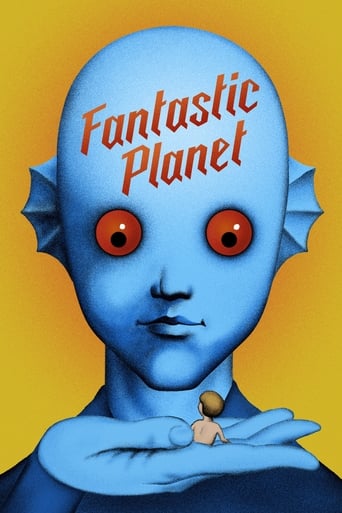
Fantastic Planet
La Planète sauvage
1973 · Film · 72 min
Directed by René Laloux
On the planet Ygam, the Draags, extremely technologically and spiritually advanced blue humanoids, consider the tiny Oms, human beings descendants of Terra's inhabitants, as ignorant animals. Those who live in slavery are treated as simple pets and used to entertain Draag children; those who live hidden in the hostile wilderness of the planet are periodically hunted and ruthlessly slaughtered as if they were vermin.
4 positive3 neutralfrom 7 commenters
Where to watch
No streaming data for this title.




8 comments on Hacker News
> Hoberman makes clear one crucial factor in the city’s creative energy: “cheap rents.”
I keep seeing this in various places. The rise of the "College Music" scene in Athens, Georgia during the 80's has also been in part attributed to the cheap rent in the student ghettos (typical of many college towns).
Growing up in Kansas City, the neighborhoods around the Kansas City Art Institute were also low-rent. Child (impressionable) me remembers walking through the neighborhood at night, let by my mom, for the free Friday night film ("Journey to the Far Side of the Sun", "Fantastic Planet" to name a few I recall). There was a large chicken leg sculpture, perhaps 8' tall in one yard that always spooked me to walk past. Some kind of sculpture of broken bits of mirror and glass made another small lot look like an alien set from "Star Trek"....
I punched in 1972 and there were some fantastic movies that year (The Godfather, Deliverance, Cabaret, Solaris, Jeremiah Johnson, Aguirre - the Wrath of God, The Last House on the Left, Silent Running, The Heartbreak Kid, Fat City, etc.).
Also tried 1973 — same (The Day of the Jackal, Soylent Green, Westworld, The Wicker Man, Papillon, American Graffiti, The Sting, Serpico, Mean Streets, High Plains Drifter, Don't Look Now, Badlands, The Long Goodbye, Jesus Christ Superstar, The Three Musketeers, Fantastic Planet, etc.).
I think they simply made better movies decades ago.
Fabulous, trailer at https://www.imdb.com/title/tt0070544/
"Animation film/movie: Fantastic Planet (1973), a.k.a La planete sauvage. Κινούμενα σχέδια" - https://youtu.be/9PcqitDkOGc
The interesting thing about Blade Runner and almost all modern sci-fi and cyberpunk is that they all took their influence from one single comic, The Long Tomorrow, by Dan O'Bannon and Jean Giraud (aka Moebius).
Dan and Moebius were working on Jodorowsky's Dune. During a slow period, Dan was bored and started drawing a comic. Moebius saw this and offered to rework it a bit. Their collab appeared in Heavy Metal (Metal hurlant) magazine. Ridley Scott used this comic as visual inspiration for Blade Runner. William Gibson even credits this comic for Neuromancer. Other movies influenced by this comic, or the art of Moebius include Tron, Heavy Metal (based on the magazine comics), The Fifth Element, and The Abyss. And, of course, pretty much everything else that came later such as The Matrix or video games like Deus Ex.
It's crazy to think about all the what-ifs with Jodorowsky's Dune. If he did not bring Dan and Moebius together, we wouldn't have Blade Runner (or a vastly different one). If Dune didn't fall apart, Dan wouldn't have gone and written Alien. If Alien didn't happen, Ridley Scott may not have known about Dan O'Bannon or Moebius, and never have done Blade Runner.
Nausicaä of the Valley of the Wind was also influenced by Moebius, according to Miyazaki. Look at Azrach (again, Metal hurlant magazine) and the similarities are obvious. The French were really ahead in illustration and animation at one point, and don't often get the credit they deserve. Go and look at what René Laloux was doing with Fantastic Planet, Time Masters, or his short films. Some of this stuff still blows my mind.
I echo the sentiment. It has become harder and harder to find movies you truly like. When I was in late teens, I had made the goal to watch every good movie out there. So I quickly ran through hundreds of 8+ rated movies on IMDb and I liked most of them.
Now, there are pretty good movies in 7+ rated class too, but they are often hit or miss. But it's not impossible to find them. There are hundreds of classic I still have to go through, but having watched the 8+ my expectations are high, and it's pretty difficult to match them. But still, I find myself appreciating little things in movies. For eg, Fantastic Planet (1973) doesn't have a smart plot per se, but I like how it reflects surrealism of the 70s and it's not the kind of movie that will ever be made again.
The hardest thing is it's impossible to find recommendations that truly match my taste. Memories of Murder (2003) is rated 8+ on IMDb but I absolutely hated it. It's slow and pathetic. Misery (1990) on the other hand was A+ movie for me, but I almost found it accidentally.
> I wonder where the stereotype of scantily-clad leather-fetish armor for barbarians actually comes from, given its extreme prevalence in modern culture and complete absence in actual historical cultures.
I think it developed roughly like this: it probably somehow is rooted the "othering" that is fundamental to the "scientific" racism that was used to justify slavery and colonialism[0]. Leathers, furs and plain nakedness would fit there as a convenient stereotype of primitive cultures, compared to woven cloth which implies the use of technology and being refined. That gives us the (inaccurate) rough leathers vs woven colorful clothes contrast, representing primitive savages vs sophisticated civilizations.
Caveat: that is the most speculative part - I might be projecting modern stereotypes to a time before they were established, but it sounds like a sensible starting point to me.
If that holds up, then after that stereotype is established we enter Romanticism. People longing back to imagined pre-industrial times when things were pure and good (note that thanks to Tolkien this is also deeply, deeply embedded into the DNA of fantasy - Sauron and his orcs represented industrialism). We get the stereotype of the noble savage[1], which endured all the way to a fairly recent movie about giant blue natives on other planets[2] (not to be confused with that other movie about savage planets and blue giants[3], but anyway).
This was and still is hugely problematic, btw. Even if you don't include the anti-industrial vibes, you still have the glorification of a mythological collective past. That was a big part of 19th century propaganda used to sell the idea of nation states to people who historically did not belong together at all. Same with justifying the use of military force to unite people into one country. You can probably guess where that ended up. Spoiler: Godwin's law applies - which I think also makes it clear why it's Tolkien's depiction of "Sauron = industrialization = bad, Elves = nature = good" is not quite so simplistic and easy to reject either, since the theme also is a reaction to WWI and WWII.
Anyway, this is probably also where revealing skin really started becoming a thing: nakedness has a long history of implying innocence in art, and as a contrast also emphasizes vulnerability being violated by civilization. So suddenly being simple, barely clothed and primitive is "good".
And then we get to what everyone else has pointed out: pulp stories and sexy fantasy.
[0] https://en.wikipedia.org/wiki/Scientific_racism
[1] https://en.wikipedia.org/wiki/Noble_savage
[2] https://en.wikipedia.org/wiki/Avatar_(2009_film)
[3] https://en.wikipedia.org/wiki/Fantastic_Planet
If you find this style of art interesting, I recommend this sci-fi movie animated in Czechoslovakia: https://en.wikipedia.org/wiki/Fantastic_Planet