 Hacker Cinema
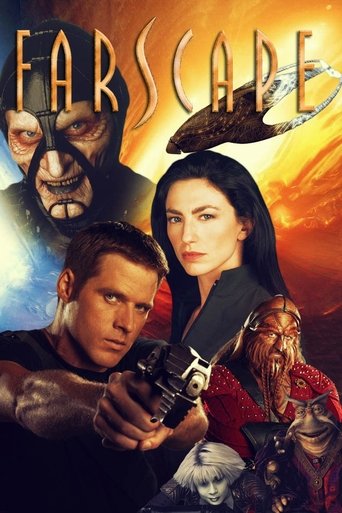
Farscape
1999 · TV series · 60 min episodes · 4 seasons
Created by Rockne S. O'Bannon
Science FictionFantasyActionAdventureDrama
A freak accident during an experimental space mission catapults Astronaut John Crichton across a thousand galaxies to an alien battlefield.
18 positive2 mixed16 neutralfrom 36 commenters
Where to watch
No streaming data for this title.
40 comments on Hacker News
Haha nicely done.
I did rather like SG1s parody of Farscape for this (iirc) 200th episode.
> My main annoyance with B5 is how the alien designs echo human historic stereotypes. A lot of sci fi falls in this trap.
1) The problem with TV is that you have to cough up an episode every single week on the fly. And JMS wrote a huge number of the episodes for Seasons 3 and 4 (I think all of them, but I can't find a citation).
2) Babylon 5 was specifically engineered to be TV budget friendly and was about $650K per episode. That puts significant limits on what you can do. Contrast to say Farscape at $1M or TNG at $1.5M per episode.
TNG has several species like the Q that have evolved to godlike abilities and there are episodes where a humanoid undergoes the final stage of physical evolution and then ascends to a higher plane of existence (becomes something like the Q). Star Trek Picard (relatively new show) had a lot about exploring internal conflict and I think even in TNG one of the final episodes has Q tell Picard that the final frontier is internal and doesn't involve mapping out stellar nebulae.
Other shows like Stargate also have the concept of "ascension" as a pivotal plot point of many episodes. Farscape covers this as well in several episodes. Things like mind melds and mind reading are pretty common in these shows once someone ascends.
There is a lot of "woo" in science fiction as it is kind of hard to still believe in gross limitations for us over a cosmic scale of thousands of millions of years. Assuming we don't die out, I'd believe our ultimate potential is unfathomable to us now.
B5 is my favorite sci-fi series of all time but Farscape is up there.
My favorite thing about Farscape is that the writers would just throw so much shit at the wall to see what would stick. So many episodes felt like the writers asking the question "what if X was true", and then spend an episode (or an entire arc) exploring it. They'd let the question lead THEM rather than the other way around"
When my ex told me she "didn't like sci-fi" but couldn't name anything in particular she didn't like, I showed her Farscape, and she watched it end to end almost every year after that. In fact, I just checked the media server logs, and she logged into watch an episode just this week.
I can't see Farscape discussed without reminiscing on the episode of Community where Abed "really likes talking about Farscape". [0]
It still makes me laugh after all these years.
[0] https://www.youtube.com/watch?v=WT1QPFr6qPI
Far and away, one of my favorite shows. The characters, the writing, the sets and the puppets are all top notch. Of course there's campiness. Of course there are bad episodes and tropes, but the thing taken together is a well done work of art. I'm supremely impressed that they were able to pull together support for The Peacekeeper Wars to wrap it all up.
One of the things that I find most novel and appealing about Farscape is that the human might be the lead character, but The Humans are not the galaxy's bad-asses. Quite to the contrary. If not for the circumstances of Crichton's transport, he would have just been some (galactic) low tech monkey from a backwater planet.
I've always found the Hollywood trope of "plucky current era humans face off against pan-galactic force and save the day" to be abused and absurd. Farscape gave that a pass by making Crichton "The dumbest smart person in the room" who didn't want to dominate. He just wanted to be left alone.
Additionally, Farscape did venture a bit into the idea that if aliens exists, they likely don't look like us. There were a lot of bipeds walking around with heads on top, but there were also a good number of extremely different types.
Funny thing about Farscape, it was my favorite TV show as a child. Fond memories. The only thing that doesn't hold up is Rygel, maybe back then it was ok, but it's pretty horrific to see it now in all of it's Animatronic glory.
The Crichton Split of course was about coming up short in the budget department. So the storytelling was limited to interactions among 4 characters rather than 7. Those arcs were split every other episode. I think they did a stellar job despite those constraints but no doubt the production took a hit.
But the most telling thing IMO about Farscape was the dedication of the fans that actually pushed and got their conclusion in the Peacekeeper Wars. Contrast that with BSG where we basically got no resolution.
For anyone looking for a nostalgic, but honest, revisit, check out "Farscape(1999) Retrospective/Review" on YouTube[1]. It is comprehensive and I think picks out the strengths and weaknesses of the show very honestly as a fan. My personal belief is that the show peaked in Season 2 (the heist arc is pretty epic) and then started going downhill after Crichton split, and the introduction of some legitimately annoying crew, but they regained some glory with the Peacekeeper Wars mini-series/movie. The chemistry between the two leads (Ben Browder and Claudia Black) was always a particular strength of the show. Highly recommended but, like with so many series (The Walking Dead, GOT, etc) if you skip the last season(s) you'll be fine.
1 - https://www.youtube.com/watch?v=m0POJFs5PUM
The show definitely has some campiness to it and some episodes are a little cringe, but overall it's wonderful and a breath of fresh air. I didn't watch it until I was a young adult and enjoyed it. The Farscape corner of the galaxy is so bizarre it does feel actually alien in a sense.
Scorpius is a terrifying villain. He's brilliant, ruthless, and seemingly always one step ahead.
If anyone hasn't seen it, I'd recommend giving it a go if you like scifi and anything Henson.
> I could go on for more pages than anyone would care to count about Farscape. It is, without any doubt, one of the greatest science fiction television series’ ever created. Please quote me on that.
A’men! It holds up incredibly well to modern scifi because there’s very little CGI and it doesn’t look as badly dated as say, Babylon 5. It’s sad that there’s no one who really does animatronics like Henson anymore and if the show were to be remade today (god forbid), all the characters would probably be Andy Serkis in a mocap suit.
My favorite puppet to this day is the Seer Creesus [1] which would have given me nightmares if I had watched the show as a kid.
[1] https://static.wikia.nocookie.net/farscape/images/5/55/Cresus.jpg
Babylon 5 is the best science fiction series ever IMO (if you can make it all the way through). The first season was especially campy, but the world building, geopolitics (not politics, but how the alien species interact), storytelling, and philosophy are all very thought-provoking. Yeah it had amazing space battles, but where it shines the most is in the dialogue. I still get chills to this day from some of the discussions. The show is even better on a second or tenth watch as all the foreshadowing is so apparent.
I thoroughly enjoyed DS9 as well, but outside of some things like Quark and Garrak, I feel it to sometimes be a pale imitation of B5.
Farscape is just freaking weird, but just so much fun. The characters have no restraints on emotion. There is no chain of command.
Stargate SG-1 and all the spin offs are also extremely good and the only science fiction show my wife could really get into. If you haven't watched it yet...well then you have like 18 seasons and a few movies to get through if you count all the TV shows.
This is also why a lot of recent films have absolutely tanked in viewership lately. Everything just seems like preaching and it can be difficult to watch even if you agree with the message.
I'm getting near middle aged and have started watching more of the 90s scifi (with some good modern shows as well) when I just want to escape for a bit. I just started rewatching Farscape again. What a bizarre/wild ride.
I feel a lot of this.
Parts of Discovery are good, more-so if you look at it from a 'home team' perspective where you'll take any win. OTOH It's only re-watchable to a certain point.
Lower Decks, I do like as far as escapism goes but frankly has a lot of 'Yeah this is licensed parody' moments.
Sometimes, things should end. Sometimes they end too soon (Farscape comes to mind [0], thankfully it did get a finale at least,) but when you keep adding on 'the additional adventures of' the risk of winding up in some form of everyplot, or just breaking canon, gets wayyyyy tooo damn high.
As a counterpoint to that, Picard Season 3 is incredibly watchable, (even RLM thought so,) I hope you try it if you haven't. It somehow does a pretty dang good job with things.
[0] - It really is a benchmark for a lot of sci-fi despite the fourth wall tapping.
Someone recommended I watch Farscape… maybe 20 years ago at this point. I absolutely did not expect to enjoy it as much as I did. I don’t really go for campy, so I expected to be turned off, but it’s got a ton of heart.
I am rewatching Stargate with my 9yo. She loves it. It introduces a lot of sci-fi, science, culture, political, and humanitarian topics that are fun to talk with her about. We're somewhere in season 3, so definitely in its prime. TBD how the later seasons go. It can get pretty intense for a 9yo, but it always comes out light hearted and a pretty good message. I intentionally skipped ~2 scenes and maybe one episode from the first season, but really everything else has been fine for a more mature kid.
I finished watching B5 and making my way through Farscape. At the moment it just doesn't come close to what I think she gets out of the Stargate franchise. B5 story was good, not probably not for someone new to sci-fi. Farscape I am still reserving judgement.
to bring it all in on itself -- this is a premise in a later Farscape episode if I remember right. Some distant alien race is looking for television show ideas and one of them keeps pitching Earth shows until finally they decide upon creating a new Farscape.
They used Stargate cast members as cameos as fan-service towards people who mentioned the likeness of actors between the two series.
I like Farscape very much, but, to be fair, the really good episodes were few and far between. You had to slog through a lot of sub-par episodes, and people can be forgiven for not really taking to it because of that.
It's really a shame that Farscape didn't have stronger writing because the whole puppets and minimal effects thing works pretty well. (I can forgive Season 1 a bit as the actors and the writers were still figuring out the characters. Season 2 and forward sub-par episodes were all on the writers.)
However, as I understand it, the problem with the puppets is that they are expensive.
Stargate did have an overarching plot, but was still very episodic (like many other shows at the time). To me, Farscape was far more in line with the new idea of a continuous narrative.
This type of TV was enabled by TiVo/DVRs. Before then, producers couldn’t rely on people not missing an episode, because if they did they’d be lost. (Not coincidentally, Lost was also enabled TiVos for the same reason).
> Please feel free to reply with your finest swearing and put downs.
How about strange?
I binge-watched all of Farscape in under a month during college over a decade ago, and "frell" (usually in the form "frelling ____") seems to have become a permanent part of my vocabulary. The word is a 1:1 translation of every meaning of "fuck", used very liberally in the series.
There's a bunch more swears and work-inappropriate sayings they also leave "untranslated", but "frell" was probably the most used.
Farscape has an episode where wormhole time travel happens.
How does time travel get presented in that game? Searching got me unrelated results.
I will agree with the other comment that it's between "stargate and farscape in terms of quality" and also point out that it's a great comparison and a glowing recommendation.
If you go into it expecting 2020s era prestige production, you will be disappointed, but if you liked the 90's SciFi channel it's fun. That said, not every episode is good, and ymmv.
I loved it as a teenager, but it's... aged poorly. IDK, maybe that's not fair. I am sure my standards have improved quite a bit since then. Certainly, if you like campy, cheesy sci-fi and don't mind some community-theater grade acting in the first few episodes, it'll be right up your alley. It's not as bad as, say, Tremors (same era, shlock sci-fi), but it's also not a prestige series like Star Trek. It's probably somewhere between Stargate and Farscape in terms of quality.
There's an Outer Limits episode with a transporter-like device, but it merely makes an exact "copy" of the person and the machine automatically destroys the "original".
I don't recall the episode name off-hand, or want to give away too much of the plot, but I thought that was better than the duplicate Rikers.
Also: two Crichtons in Farscape, although that wasn't due to a transporter-like accident but a "normal" clone.
Wormholes were a core principle of the lesser-known Sci-Fi TV show called "Farscape".
Season 3 was the absolute pinnacle of the show and some of the best scifi ever on tv. It completely blew my mind, and I’ve watched my share of Star Trek, Stargate, Babylon 5, Farscape, BSG, etc over the years. It completely pays off for the buildup of seasons 1 and 2.
> People who decide to commit suicide sometimes appear to others to be feeling a lot better in the time between the decision and the final act.
To misquote a line from a favorite TV show;
"Fear accompanies the possibility of death. Calm shepherds its certainty." -Ka D'Argo, Farscape
I have attempted suicide, and that line fits for me. As another reader has pointed out there is also peace that comes from making a choice and knowing that your pain will be ending soon.
I loved the ending of Farscape, even before the mini-series wrap-up.
First, they wrapped up essentially every dangling plot-line. Everyone was safe, everyone was happy.
Then in the last minute of the show, out of no where, an alien no one had ever seen before swoops in and disintegrates the main characters.
"To be continued" flashes on the screen.
The series was canceled before this episode aired/was finished, and that's how they chose to go out. Could have just cut the last 30 seconds off the episode and called it a wrap, but nope.
I watched Star Trek (TNG, DS9, Voyager, Enterprise), The Expanse, Orville, Continuum, Altered Carbon S1, Farscape, Firefly, Travelers, Dark, and even Stargate Universe.
What do you recommend watching next?
I think it's the novelty of it. Friends with kids report losing their minds after sitting through the nth replay of a Disney movie. To the kid, everything in it is new and they enjoy seeing new details each time. The adult can guess their way through any new Disney movie because they all stick close to a formula anyone with a passing interest in writing can recite.
I did the same rewatching all the Star Treks, Stargates, and other '90s sci-fi TV several times. Now it's kind of...dull. It's all too familiar. Now I'm more impressed with newer scifi that tries to evolve the genre without being too different. Like: The Expanse, Farscape, Dark Matter, Another Life.
> So...you're upset to see space opera played straight in your space opera?
No, I like space opera too. I'm upset that ST has become Buffy the Vampire Slayer in Space. (Don't get the wrong idea, I like Buffy too.)
> Have you forgotten entirely about S1 of TNG, or just chosen to ignore it?
You'll have to clue me in to what specifically you're referring to, I re-watched it last year but I don't want to guess at what you mean.
> DS9 is "not Roddenberry"
I agree. DS9 was, in part, created specifically to explore "not Roddenberry" directions in the ST universe.
There's a book, I can't find it at the moment, and I don't remember the title, but it's all excerpts from interviews with cast and crew. That's it. It's amazing.
Anyhow, I bring it up because, reading it, it became clear what, for me anyway, is the crucial defining aspect of ST that differentiates it from other sci-fi franchises: In ST, people in the future have gotten over their bullshit. They are emotionally mature, guided by reason and rationality and their higher values. That's the key difference (from say, Star Wars or Farscape or Firefly...) People in the future pretty much have their shit together.
Now this is something that some of the writers don't get. You find them complaining in their own words that Gene won't let them write an episode involving interpersonal drama between bridge crew. (Apparently this is really hard for some writers. No judgement intended.) It wasn't until after he died that Berman/Braga started to relax that.
Now to me, this is wrong (for ST) for two reasons:
First, it makes sense to me that these folks who fly around the galaxy in machines that can destroy worlds would have to be level-headed to use them w/o destroying themselves.
Second, and more importantly, that's a huge part of what made ST so endearing and appealing in the first place: the deep and abiding love that Kirk/Spock/McCoy (most obviously) and the rest of the crew (less obviously) feel for each other.
I mean, when Spock tells McCoy that he would also wish him to be present at his Pon farr, oh man, my eyes well up with tears.
When it comes down to it, the characters in the "real" ST (if I may) treat each other like members of a healthy family do, and that's wonderful to see (in any context, not just space operatic sci-fi.)
That's also the source of the "moral" superiority of Star Fleet: they actually are good guys. (And Vulcans don't lie.) You erode that and you've got Spaceballs.
> To be honest, I don't get the mockery angle at all. I mean, you're talking about a show whose first season not only has antimilitarism as a major through-line in the way Lorca's story plays out, but concludes with a war being ended by a couple of people having a conversation about why more fighting sucks for everyone, and implementing a clever technobabble-driven plan to bring about peace. There's a lot I don't love about Discovery - most of its second season, for a start - but come on, what could possibly be more Star Trek than that?
I've only seen ~4 minutes so I can't speak to the good things about the show, feeling mocked was my subjective response (I don't think the ST:D folks sat down and twirled their mustaches while contemplating how much they despise ST fans, hey?)
It was things like how the Klingons are space orcs; the Romulan guy looks like space Legolas the elf. The people wearing hoodies (why does everyone in space wear hoodies these days?) The gay guys are the only ones married? Why does the female lead have a masculine name? It seems like they're trying to tick the diversity boxes without actually rattling anybody's cages (and I say that as a SJW, pro-diversity.) The rolling spaceship is ridiculous, the flash illuminating the nebula was just idiotic. The whole thing feels superficial and lazy despite obviously being the result of a lot of hard work by a lot of skilled, talented people. Maybe they're just pandering to the tastes of a younger audience (with whom I am out of touch.)
Let me see if I can sum it up... Lord of the Rings and Game of Thrones seem similar, yeah? But LotR is about Good vs. Evil whereas GoT is about aristocrats being really really shitty to each other. They are both entertaining, but I wouldn't let my kids watch the latter.
Cheers!
The spore drive is a correctly-formatted and notarized petition to Juffo-Wup.
The flash does not originate at Discovery and propagate outward as light, but begins before the ship appears, from a diffuse source, constructively interferes at Discovery's normal-spacetime discontinuity, and generates a holographic illusion between the observer and the nebula that just appears to be a flashbulb reflection.
Every Star Trek problem may be resolved by sufficient application of technobabble (a.k.a. [TECH] in the script). It's space opera. Apply the MST3K rule. (It's just a show; I should really just relax.)
The space-mushroom dimension is the same as the gate network from Stargate SG-1, or the wormhole-traversal tech and Leviathan starburst from Farscape. It's the plot conceit that allows the cast to instantly move from one set to another without any of the boring and unremarkable travel time. The exact nature of the instant-transport is dependent on the dramatic series plot arcs that the show-runners came up with in case they ever got past the pilot episode. The cool CGI visual effect used to signal to the viewer that sci-fi is happening now is flawed. Not everyone can pull off the Stargate-opening vortex.
Discovery and Picard are very much darker than pure Roddenberry, in that they portray The Federation as something far short of a perfectly ethical Utopia. In my opinion, this is a decision that allows for a far wider range of character development. An imperfect Starfleet can employ a monstrous starship captain that murders to keep its secrets. Klingons can be more than just a racial stereotype to be used as a script proxy for 1960s Russia (and the language has already been constructed, so might as well use it).
> I'll catch hell for this, but Battlestar Galactica was the same way.
I just rewatched the mini-series and first few episodes of Season 1 of BSG. While, I remember thinking the same thing at the time, it was very obvious the second time around that for large arcs, the writers didn't have much of a plan. If I remember correctly though, there was always a lot of uncertainty about how many seasons they show would have, so it was difficult to plan more than a season at a time. It was also SciFi's most expensive show at the time, IIRC. They had a similar problem with Farscape... it was a big (and expensive) show, which stressed the network financially.
BSG is a great premise, but hard to come up with an overarching story arc that makes sense or offers closure. But sometimes you just have to let the writers go with things to see where they end up. There were some really good episodes later in the series, even with the filler.
You can see it on TV if you are a scifi fan. Look at the x-files, Outer Limits, and early Stargate episodes filmed in 1990s Vancouver. Vancouver's wet climate gave them a very specific tone that became an industry standard. 1990's scifi was generally dark, as opposed to the more colorful productions filmed in California (Trek) or Australia (farscape). But today Vancouver suffers droughts every summer. The Flash is a colourful production. The foggy grey backdrop is now a blue sky. Rainfall numbers might not be very different, but the perpetual cloud that coloured scifi for a generation is gone.
They did the same to Firefly and Farscape, cancled them too soon before they could develop the characters more and close up loose ends.
I like The Expanse and I will miss it.
I've been meaning to write my own scifi books to be turned into movies.
The Expanse was no Star Trek or Star Wars but it had a realistic feel to it.
Never judge a show by the first season, or worse the first few episodes. Cast need time to get accustomed to the part, to create alchemy etc. Also, "unusual" shows like DS9 (IMO best Trek ever) or even Babylon5 (IMO best non-Trek ever) etc. need some adjustment from the viewer. I recall hating Farscape, but decided to keep watching it anyway and in the end I loved it so much that I cried after the last episode. Now I'm watching again Stargate Atlantis (IMO best SG ever) which started strong from the very first episode, but nonetheless grew anyway with time. I wished ST Voyager could get better as well... that show had so much potential:(
I actually agree with the GP, SG1 was dragged for way too long until they just ran out of time they clearly expected an additional season to finish the show (the final episode was pretty underwhelming).
The loss of RDA which was a major part of the appeal of the show and the constant attempts to replace/clone him for every show in the franchise afterwards was pretty lame.
The constant rotation of the supporting cast also did not really help the show, and the move from a procedural format with a few long term plot lines to a fixed seasonal story arc also didn't really help the show to maintain (it's weekly) audience (most fans would agree that the Showtime seasons were the best).
I did chuckle at the Farscape fan service they did in the later seasons, and there were a few fun moments but overall the show was pretty much dead around season 7.
They should've let SG1 go and spun it to a few other shows, but sadly SyFy (or how ever they spell their name now) wanted to dumb things down and make it flashy and splashy which is why SG: Atlantis looked more like Sharknado than SG1. By the time they tried to bring things back to the roots with SGU they still mocked it up, SyFy promoted SGU as a worthy replacement to Battlestar Galactica and tried to appeal to it's fan base with pretty disastrous results.
I suspect this is more a matter of what "sci fi" you like. The 1990s had lots of sci fi TV shows, including, among others:
X-Files
SeaQuest DSV / SeaQuest 2032
More Star Trek than you can shake a stick at (TNG, DS9, and VOY cover the whole decade, with most of it having two at once)
Babylon 5
Sliders
Stargate SG-1
Farscape
I think there's a better case that the 1990s were the high-point of sci fi popularity on TV than a particular drought (though I can see a case that there was something of a drought starting sometime in the mid-1980s through 1993.)
Back in the day, we used to laugh at how awful IRIX was (a colleague who used an SGI box to run an F-18 flight simulator said IRIX leaked 512MB of RAM a day on idle -- back when 512MB of RAM was more than any desktop computer had; we had SGI sales reps visit our office and just getting their presentation software to work (on their hardware) was a major production. Essentially, once 3D acceleration went mainstream the writing was on the wall -- within 3 years of the first 3dfx video cards, a game box had more graphics horsepower than tens of thousands of dollars worth of SGI junk, and 3DS Max was enormously more productive for most things than Power Animator/Maya (Maya has improved a lot).
The company I worked at in 1999 did the special effects for season one of Farscape on SGI. They were underbid on season two by a factor of two by Animal Logic (across the street) doing everything on fast PCs running 3DS Max.
Edit: and when the writing was on the wall, SGI decided to go downmarket and fight Apple on its home turf -- porting its software to NT and competing against PC workstation vendors already running AutoCAD and 3DS Max. This allowed everyone to see the emperor had no clothes -- SGI's NT boxes were half as fast and twice as expensive as name brand competitors, and they were charging $20k for a software license.