 Hacker Cinema
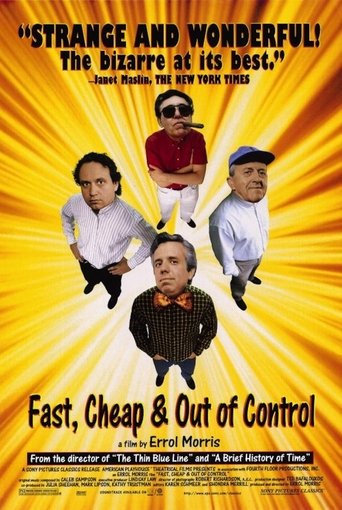
Fast, Cheap & Out of Control
1997 · Film · documentary · 83 min
Directed by Errol Morris
Errol Morris interweaves the stories of four men, each driven to create eccentric worlds from their unique obsessions, all of which involve animals: a lion tamer shares his theories on the mental processes of wild animals; a topiary gardener devotes a lifetime to shaping bears and giraffes out of hedges and trees; a man fascinated with hairless mole rats; and an MIT scientist who has designed complex, autonomous robots that can crawl like bugs.
5 positivefrom 5 commenters
Where to watch
No streaming data for this title.




6 comments on Hacker News
Rodney Brooks, the former director of MIT CSAIL, is the founder and CTO of Roomba, Rethink Robotics, and Robust.AI.
https://en.wikipedia.org/wiki/Rodney_Brooks
He and his colleagues invented "Subsumption Architecture" in 1986, which he later applied to the Roomba.
https://en.wikipedia.org/wiki/Subsumption_architecture
>Subsumption architecture is a reactive robotic architecture heavily associated with behavior-based robotics which was very popular in the 1980s and 90s. The term was introduced by Rodney Brooks and colleagues in 1986. Subsumption has been widely influential in autonomous robotics and elsewhere in real-time AI.
>Overview: Subsumption architecture is a control architecture that was proposed in opposition to traditional AI, or GOFAI. Instead of guiding behavior by symbolic mental representations of the world, subsumption architecture couples sensory information to action selection in an intimate and bottom-up fashion.
>It does this by decomposing the complete behavior into sub-behaviors. These sub-behaviors are organized into a hierarchy of layers. Each layer implements a particular level of behavioral competence, and higher levels are able to subsume lower levels (= integrate/combine lower levels to a more comprehensive whole) in order to create viable behavior. For example, a robot's lowest layer could be "avoid an object". The second layer would be "wander around", which runs beneath the third layer "explore the world". Because a robot must have the ability to "avoid objects" in order to "wander around" effectively, the subsumption architecture creates a system in which the higher layers utilize the lower-level competencies. The layers, which all receive sensor-information, work in parallel and generate outputs. These outputs can be commands to actuators, or signals that suppress or inhibit other layers.: 8–12, 15–16
R. A. Brooks (1986), "A Robust Layer Control System for a Mobile Robot", IEEE Journal of Robotics and Automation RA-2, 14-23.:
https://apps.dtic.mil/dtic/tr/fulltext/u2/a160833.pdf
R. Brooks and A. Flynn (Anita M. Flynn) (1989), "Fast, cheap, and out of control: A robot invasion of the solar system," J. Brit. Interplanetary Soc., vol. 42, no. 10, pp. 478–485, 1989. (The paper later gave rise to the title of the film Fast, Cheap and Out of Control, and the paper's concepts arguably have been seen in practice in the 1997 Mars Pathfinder and then 2004 Mars Exploration Rover Mission.)
https://en.wikipedia.org/wiki/Fast,_Cheap_%26_Out_of_Control
https://www.austinchronicle.com/screens/1997-11-14/518907/
>Fast, Cheap & Out of Control: Interview With Filmmaker Errol Morris
https://www.technologyreview.com/2019/08/21/133411/rodney-brooks/
>Rodney Brooks: The professor who got robots zipping through the world—and cleaning house—by challenging conventional wisdom in AI.
>Rodney Brooks was hot, bored, and isolated at his in-laws’ home in Thailand when he had an inspiration that would redirect the field of robotics and lead to Roomba vacuums in millions of homes.
>It was December 1984. Brooks was turning 30, and as a new member of the MIT faculty, he was trying to get robots to move about in the world. If they could, they might grant wishes from science fiction: venture into dangerous places, explore space, clean our houses.
https://www.wired.com/story/roomba-robot-consciousness-enlightenment/
>My Roomba Has Achieved Enlightenment: To my robovac, hitting a doorjamb and cleaning with dispatch are one and the same. There is no success or failure—these concepts have merged.
>ALL THROUGH THE fall my head was spinning, and I steered into the spin by watching Fast, Cheap & Out of Control.
>Errol Morris' rhapsodic 1997 documentary about a bunch of monomaniacs features a xylophone-heavy score and the roboticist Rodney Brooks. I wanted to hear Brooks dilate on robots in his cosmic way again.
‘Fast, Cheap & Out of Control’ is a fun and wild Errol Morris documentary that, in part, covers a naked mole rate specialist.
https://www.imdb.com/title/tt0119107/
The Errol Morris documentary "Fast, Cheap & Out of Control" has a segment on mole rats [0].
I think that movie would appeal to a lot of HN members -- it's broadly about people who obsessively pursue some interesting corner of skill or knowledge, and how that makes the world a richer place. Kind of like the "Fred Dibnah, Stepplejack" series that I learned about on HN ([1], and I know it made HN about 7 years ago as well).
[0] https://www.imdb.com/title/tt0119107/
[1] https://news.ycombinator.com/item?id=9796254
You see the same thing in natural organisms. Vestigial adaptations and odd or even awkward designs abound, yet they are functional. Some people take "Worse is Better" to the extreme of "Worst is Best" but there is some wisdom in the idea that it's better to get an adequate solution into play early than to wait for for a perfect, clean-room design. The important thing is to setup a feedback loop that continually refines your solution.
For an inspiring take on the power of chaos in evolution check out Errol' Morris' film "Fast, Cheap & Out of Control": http://en.wikipedia.org/wiki/Fast,_Cheap_%26_Out_of_Control
But all the little bits of complexity ... they slowly accreted until it all got out of control, and we got comfortable with systems that were impossible to understand.
I'm convinced that all systems of any significant complexity can only be created in evolutionary steps, and that process always leaves vestigial traces behind. The most complex computing environments always have an almost organic quality.
I strongly recommend Errol Morris' film "Fast, Cheap & Out of Control" for insight into the paradox that order seems to somehow magically emerge from chaos.
I’m not sure how you came up with “3” (or for that matter how objects in view of a lion is comparable to “concepts” in the working memory of a programmer). As far as I know this idea was popularized by Errol Morris’s film Fast, Cheap, & Out of Control: http://www.errolmorris.com/film/fcooc_transcript.html
“Dave Hoover:
“The chair has four legs... Now, an animal has a one track mind, For instance, the animal is coming after you with the idea of tearing your head off... You put the chair up, and all of a sudden, he has four points of interest. He loses his original train of thought because this agitates him. He can’t comprehend those four points of interest, so what he does he attacks the chair. He takes his wrath out on the chair. His mind now had been completely distracted from his original thought: ‘Eat the man in the white pants.’
“It’s basically animal psychology. You try to keep the animal afraid of you in that he does not understand you. He does not understand that you’re weaker than he is. [...]”
(The next few paragraphs are also quite interesting, and I recommend the film generally.)