 Hacker Cinema
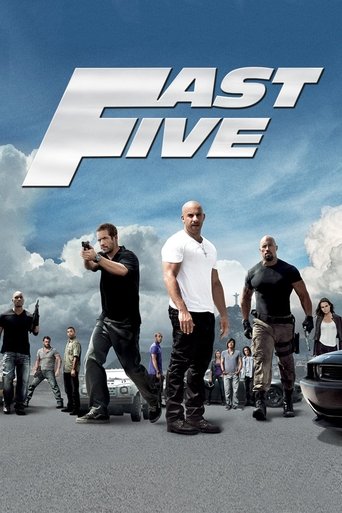
Fast Five
2011 · Film · 131 min
Part of The Fast and the Furious Collection
Directed by Justin Lin
Former cop Brian O'Conner partners with ex-con Dom Toretto on the opposite side of the law. Since Brian and Mia Toretto broke Dom out of custody, they've blown across many borders to elude authorities. Now backed into a corner in Rio de Janeiro, they must pull one last job in order to gain their freedom.
2 negative3 neutralfrom 5 commenters
Where to watch
No streaming data for this title.
5 comments on Hacker News
That's interesting, but we (as far as I know) weren't talking about game development, but about TV/movie production.
Most people don't realize it, but many recent high-budget movies were filmed in Georgia, e.g. Fast Five, Vacation, Ant-Man, all three Hunger Games movies, one of the recent X-Men movies, Flight, etc. After 2008, there was an abundance of empty warehouse space here available at deep discounts, not far from the highest volume airport in the world.
As the economy rebounded, momentum in that industry seems to have remained even though there aren't many empty/cheap warehouses here anymore. A few developers are even working on purpose-built movie studios around town now.
It has been interesting to watch, and certainly could parallel what could happen in the bay area if an exodus to somewhere like Austin began in earnest.
"If Hollywood wants to make MORE money. Let me watch NEW movies at home."
Is there even a point to watching new movies? Hollywood is not all that creative these days. The same plot plays out over and over; they are remaking movies that are less than a decade old; actions scenes are formulaic, sex scenes are formulaic, and the way in which scenes are composed is formulaic. When movie studios run out of ideas about what to copy, they just create formulaic sequels to movies that were OK the first time around (Fast Five? Really?).
Hollywood's problem is quality. They spend enormous amounts of money on improved special effects, when special effects are not really what needed to be improved. If you can predict how the story ends (or count the number of possible endings on your fingers), the movie probably isn't worth paying for.
Top ten movies for 2011-
1. Harry Potter and the Deathly Hallows Part 2
2. Transformers: Dark of the Moon
3. The Twilight Saga: Breaking Dawn Part 1
4. The Hangover Part II
5. Pirates of the Caribbean: On Stranger Tides
6. Fast Five
7. Cars 2
8. Thor
9. Rise of the Planet of the Apes
10. Captain America: The First Avenger
Yes, every single one is a comic book or a sequel. That's why they get made, they're what people pay to see. Everyone complains about it, everyone sees 'em.
If you want different movies to be made, go see different movies.
We tried solving this problem in 2007 with the "plans" functionality in the first iteration of Localist. It's definitely a tough nut to crack, as a website/app will never beat the convenience/accessibility of email.
Here's the biggest issue we ran into, which I'm not sure WhereBerry has solved either:
Let's say Julie wants to see Fast Five (ugh), and she wants to know which of her friends would like to attend. At first, she considers using WhereBerry, as it's designed for such things. But wait, Julie's friend Joe doesn't have an iPhone. And I know her other friend Steve doesn't use social networking sites besides Facebook. Julie resolves to just send an email out to everyone, so she knows she'll get a response from everyone she wants to talk to in one step. Plus, she already has everyone's email address.
See the problem? Julie is forced to isolate her non-WhereBerry friends, or invite some on WhereBerry, and others via email (huge inconvenience). This isn't solving the problem. It's compounding it. Let's say WhereBerry tries to "solve" this problem by allowing Julie to invite non-members via email. We tried that, too. While it sounds good on paper, nobody wants to send their friends an email saying "Hey I want to go to this movie. Join WhereBerry to tell me your response!" In reality, they'll probably text Julie saying "Sure, I can go! Why didn't you just text me?"
It doesn't matter if 95% of your friends are signed up to WhereBerry. You'd need 100% to get people to use it in any consistent form.
It's not a tough problem to discover, as many products have attempted to solve it. But, no company has succeeded, specifically because of the scenario posed above. I wish WhereBerry luck, but I think it needs to solve the problem before being a "cool plan-making utility." There are millions of those.
This article points out that movies are now excessively marketing-driven, and suggests that the reason is that the generation born in the 1960s suffers from "arrested development" — i.e. psychological neoteny — to a unique degree, and that they now control Hollywood. Although it does not offer any evidence to support either of these propositions, it suggests that Top Gun or the Reagan administration might be the cause of the neoteny.
In reality, marketing-driven movie are nothing new. In the 1960s, they were called "exploitation" films; "exploitation" was the 1960s movie-biz term for "marketing". The crucial question is, why is so much of the movie business organized around exploitation films today? And an unsupported psychological hypothesis doesn't cut it as an answer.
Here's an idea that seems at least as good as the answer proffered by the article. The internet makes word-of-mouth travel a lot faster now. It used to be that the box-office receipts of a stinker movie would decline over the first few weeks after its release. Now, they decline even during the opening weekend. (I haven't verified that, but it seems like it ought to be easily verifiable.) People tweet about how bad the movie is even before they've finished watching it.
In turn, this word-of-mouth heightens the winner-take-all nature of the film industry; hit movies take home a bigger share of the total box-office receipts of the industry (unverified, but should be verifiable), with the result that more movies these days fail to even make back their production costs (unverified, but should be verifiable). In short, film production is a riskier investment than it used to be, and there's less that marketing money can do to rescue a stinker.
An economically rational response to this situation (assuming I'm correct!) would be to work harder to figure out which films are going to be hits and which are going to be flops, make the hits bigger hits, and spend less on the flops. For example, you could do any of the following:
• Value talent more highly. Talent can't stop a flop from being a flop, but it can make the difference between a hit and a mega-blockbuster.
• Don't spend anything on marketing. Release films in a single theater or a single city. If it takes off, print more copies. If GQ is to be believed, this would cut the cost of filmmaking in half, which would mean you could make twice as many movies.
• Release movies to audiences in episodes; start by releasing a half-hour pilot, and if it takes off, call the actors and director back to make another hour. This could cut the cost of filmmaking by more than a factor of 2, especially if the first part goes easy on the special effects, the music, that kind of thing. (In a way, that's what's happening with the sequel craze that the article is complaining about, but the difference is that you need to have the story arc planned out: Dune or Star Wars Episode IV or Babylon 5, not Fast Five.)
• Instead of a first episode, release an abridged version, maybe a half-hour. This has been done unintentionally and on a small scale for many years; think of Blade Runner and Blade Runner: the director's cut. The difference is that you can actually save money by not shooting the parts of the story that you leave out. Maybe instead of showing it in theaters, you can show it on Lifetime or HBO or something, or just on your web site.
• Instead of a pilot episode or abridged movie, do the first installment of the movie as a comic book. Comics have a lot in common with films: they're intensely visual and powerfully immersive, they even use cinematographic techniques, and a "graphic novel" is a lot closer in length to a movie than it is to War and Peace. These days, online, maybe you could even add a voiceover to your comic book. (Admittedly, filmstrips never really took off as a dramatic medium.) Again, in a sense, studios are doing this already; they're just not funding the production of the comics in the first place. They ought to. If there were ten times as many graphic novels coming out every year, they'd have a much better selection of audience-proven storyboards.
• Post trailers and teaser episodes on BitTorrent before you're done filming in order to see if they take off. It's no guarantee — lots of people will be willing to watch the movie for free even if they wouldn't shell out for a ticket — but if it flops there, it'll probably flop in the theater too.
• Cancel more films before they're even finished shooting. If your early indications are that it's not going to work out, don't try to rescue your investment by sending good money after bad, hiring a famous film editor to try to salvage something from the wreckage, nonsense like that. You need some kind of interim feedback on quality, of course, which is impossible to do reliably, although some of the approaches above might help. The big returns are going to go to the mega-hit films. Invest the money you would have invested in finishing the film in something that has a chance to be a mega-hit instead.
• Leave room in filming budgets for expansion. If early feedback (from the first episode, or just during screenings) is that the film is good, double the special-effects budget. Splurge on ADR and better music.
• Make more films, which means making a lot of low-budget films.
• Diversify your film investments; we should see more multi-studio films, just like we see lots of multi-VC-firm startups.
• Share the risk with the fans. Sell nonrefundable opening-night tickets before you're finished shooting, in order to raise money for the film. Give them cash back if the movie is a hit. Or sell the advance tickets in groups of four. (If the movie's worth watching, they can treat three of their friends for free.)
However, although as I said above, the studios are using some of these approaches, we're mostly seeing something else entirely. When you're used to a certain level of risk, and that level of risk goes up, your natural inclination is not to figure out how to take advantage of the new risk; it's to try desperately to push the risk back down. So, instead, we're seeing stupid moves like these:
• Release the film initially in more theaters, not less. That way, if it sucks, you might still make your money back before everyone sees their friends tweet about how it was so bad they walked out of the theater.
• Make films that people will want to see before they hear from anyone who's actually seen them: sequels, comic strips, toy brands. This is a necessary complement to releasing the film in a lot of theaters at once.
• Spend more on pre-release marketing instead of less. This slashes your maximum possible return on investment, but you have to do it if you're going to get people into all those theaters on opening weekend instead of a week later.
(The author's grudge against comic books is pretty embarrassing. Are you going to tell me Watchmen was infantilizing, not aimed at adults?)
Now, I admit I know little about business and nothing about the business of movies. So maybe these ideas are stupid.