 Hacker Cinema
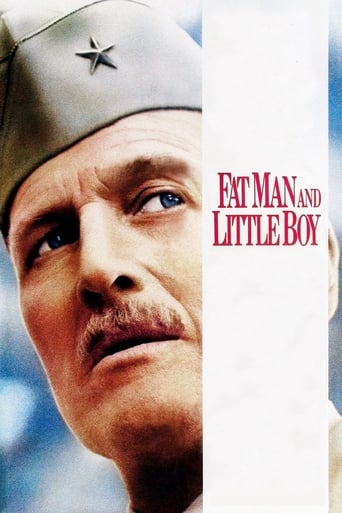
Fat Man and Little Boy
1989 · Film · 127 min
Directed by Roland Joffé
Assigned to oversee the development of the atomic bomb, Gen. Leslie Groves is a stern military man determined to have the project go according to plan. He selects J. Robert Oppenheimer as the key scientist on the top-secret operation, but the two men clash fiercely on a number of issues. Despite their frequent conflicts, Groves and Oppenheimer ultimately push ahead with two bomb designs — the bigger "Fat Man" and the more streamlined "Little Boy."
4 positive3 negative2 mixed8 neutralfrom 17 commenters
Where to watch
No streaming data for this title.
18 comments on Hacker News
There are other movies about the Manhattan Project where Gen. Leslie Groves is the main character.[1] "Fat Man and Little Boy" is probably the most Groves-oriented.
[1] https://en.wikipedia.org/wiki/Category:Films_about_the_Manhattan_Project
A dramatization of the accident was part of the film Fat Man and Little Boy, clip below:
https://www.youtube.com/watch?v=AQ0P7R9CfCY
A little more factual dramatization was presented in the TV show Dark Matters titled "Risky Radiation" but I am unable to locate a video clip atm.
https://www.imdb.com/title/tt2421370/?ref_=ttep_ep4
I don't think it's reasonable to be insulted or offended.
But it was a noticeably odd choice and odd scene. Jean didn't read Sanskrit and does not come across as a "intellectual", so the likelyhood that she randomly picked the line out of a random book in the middle of fun times strains the credibility. It would have been believable if he was picking the verse while isolated up on the mesa or something like that (and probably more true).
It was weirdly incongruous in an otherwise nearly flawless movie. I re-watched Fat-man-and-little-boy which contained far more flubs and clumsy scenes (still good though).
You can see this in the movie Fat Man and Little Boy
https://www.youtube.com/watch?v=AQ0P7R9CfCY
Came to say, essentially, the same thing.
I will add that I also enjoyed the move Fat Man and Little Boy which was about the Manhattan project. Not an Oscar-worthy movie. But told a good story, centered around Oppenheimer.
The movie "Fat Man and Little Boy" dramatizes this with John Cusack playing a fictionalized version of Louis Slotin.
Oppenheimer has had his own movie (and opera and TV series and a ton of books as others here have pointed out).
The earlier Hollywood treatment was "Fat Man and Little Boy" with Paul Newman. It's rentable on Amazon Prime. It's not a great movie despite the talented cast and good photography. I expect Nolan to make a better movie, but FM&LB does a decent job telling the story of the relationship of Groves and Oppenheimer and some of Oppie's back story.
Highly recommend the film “Fat Man and Little Boy”. A little melodramatic but an interesting view of Oppenheimer played by Dwight Shultz (Murdock from The A-Team.)
This sounds a lot like Fat Man and Little Boy movie. The John Cusack character was killed by radioactive exposure from a mishap at Los Alamos. The movie is really interesting.
https://www.imdb.com/title/tt0097336/?ref_=ttfc_fc_tt
The scene is fictionalized in the movie Fat Man and Little Boy with John Cusack performing the role of Slotin under a different name.
https://en.wikipedia.org/wiki/Fat_Man_and_Little_Boy
Recreation of the criticality event in 1945 from the movie Fat Man and Little Boy, with John Cusack
https://www.youtube.com/watch?v=AQ0P7R9CfCY
Depiction of the accident in the film "Fat Man and Little Boy": https://youtube.com/watch?v=0ZFPio2PeQc&t=6m24s
Scary.
The BBC Oppenheimer miniseries is probably the best I've watched on it, though it's not just about the atomic bomb in WW2. I've also seen the "Fat Man and Little Boy" film mentioned by another poster. The later was ok, but it's sort of fictionalized and the Oppenheimer series covers the same events far more accurately and at much greater length.
BBC also had a documentary series on nuclear weapons and espionage that was pretty good.
https://en.wikipedia.org/wiki/Oppenheimer_(miniseries)
https://en.wikipedia.org/wiki/Nuclear_Secrets
Fat Man and Little Boy. Can't remember that much, and a very quick glance at Wikipedia suggests a personality piece rather than a documentary.
It's very easy to see patterns which aren't present. We as humans are quite good at doing this. How might I confirm that this pattern is present?
To start, let's look at movies that deal with "Scientists, Engineers, Doctors, Researchers, Inventors, Explorers and People who do Amazing Things", from http://www.imdb.com/list/ls050940841/ . These include Apollo 13, Fat Man and Little Boy, Einstein and Eddington, Shackleton, Creation, Captain Cook: Obsession and Discovery, Gorillas in the Mist, Temple Grandin, Jobs, and Reach for the Sky.
Of the 31 films (though two are not biographies or based on real-life), 2 are about women (Gorillas in the Mist, Temple Grandin), and the rest are about men. Einstein is certainly high on the list of mythologized people, so mythologization is not limited to women. (Feynman would be another. Infinity (1996) is a biopic about Feynman, but it's not on the list.)
Women appears underrepresented in that list compared to their modern presence in STEM fields. To be fair, the movies include Pasteur from the 1800s, and Harrison from the 1700s. Women were often strongly restricted from doing research in STEM fields during that time.
I saw one non-white person on that list, Vivien Thomas, from the 2004 film "Something the Lord Made".
"Reach for the Sky" from 1956 is "The true story of airman Douglas Bader who overcame the loss of both legs in a 1931 flying accident", and Temple Grandin is autistic. However, since 1956 is rather a long time ago, it does point out the need for a baseline - if the percentage of movies about disabled people has been stable, then it's not a growing pattern. As another example of someone who 'received the mythology treatment', consider "Helen Keller in Her Story" from 1954.
(Howard Hughes, in 'The Aviator' (2004), may also fall into the mentally challenged category, due to his obsessive-compulsive disorder which was present already by the 1930s. I haven't seen the film to see if it touches on his mental illness.)
Films about gay people would have been restricted under the Motion Picture Production Code, so not really seen in films from the 1930s to 1968. That would make it hard to establish a long term pattern. Still, as about 2% of the US adult population (1.2 to 5.6 according to https://en.wikipedia.org/wiki/LGBT_demographics_of_the_United_States ) identifies as LGBT, then about 2% of the films about famous people in STEM should concern someone LGBT.
It should not be hard to come up with an evaluation technique, like "all biopics about people in STEM done as movies/made-for-TV movies in the US from 1970 to the present", and redo this same evaluation to see if there is a pattern.
The tricky part is to normalize it. If 2% of the population is homosexual, then what percentage should we expect to see portrayed as they are in movies? If 51% of the US population are women, and 27.9 percent of the PhDs in the physical sciences are women, what patterns should we expect to see in films?
Otherwise you might just be seeing the secular trend that more women are getting involved in STEM, that policies like the ADA make it easier for people with disabilities to get advanced educations, etc.
How have you done the analysis to determine if the patterns you see are due to the expected shift in population distribution of people in STEM, vs. any special sort of mythologization?
Indeed. The new WGN show "Manhattan" [1] was extremely disappointing in that regard. It's highly fictionalized, and having read TMAB and other books and articles about the project, I found most of its depictions of Los Alamos unrecognizable.
Among the scientists, only Oppenheimer is included (and the actor is horribly miscast); no mention of Fermi or Feynman or Teller or any of the others. If you're doing a series on the Manhattan project in Los Alamos, how can you not have Feynman skulking around cracking safes open and disobeying curfew (not to mention the tragedy of his wife's situation), or Teller keeping everyone awake by playing Bach loudly on his vintage Steinway far into the night?
The movie "Fat Man and Little Boy" is interesting, as it's a straight attempt at telling the Los Alamos story, but dramatically it falls pretty flat, and both lead roles are extremely miscast. (The most interesting part of it is a fictionalized version of the Slotin/Daghlian incidents where John Cusack gets radiated.)
The canniest casting of Oppenheimer so far was the 1980 miniseries "Oppenheimer" with Sam Waterston, which is great classic "theater television"; ultimately just a bunch of people talking, in various rooms, with a static camera and many closeups. Waterston looks quite a bit like Oppenheimer, and captures his combination of keen intelligence and boyish enthusiasm.
Edit: Forgot to say, Dark Sun is also interesting. Not as lyrical, but chock full of fascinating history.
[1] https://en.wikipedia.org/wiki/Manhattan_(TV_series)
[2] http://www.imdb.com/title/tt0078037/
> "Immediately, all eight scientists in the room felt a wave of heat accompanied by a blue glow as the plutonium sphere vomited an invisible burst of gamma and neutron radiation into the room. As the lab's Geiger counter clicked hysterically, Louis used his bare hand to push the upper plutonium hemisphere off and onto the floor, which terminated the supercritical reaction moments after it began."
Nit pick: What you have described is the incorrect version in the movie "Fat Man and Little Boy". It was a knee-jerk reaction that stopped the supercritical reaction, and it was the beryllium outer sphere which was dropped, not the plutonium core.
Slotin was holding the top half of the beryllium sphere with his thumb which he immediately lifted up due to the intense heat.
Primer - Ultra low budget film about a couple of engineers who accidentally invent a time machine in their garage while working on a startup.
Blow - Not really a hacker movie, but it's rags-to-riches-to-rags storyline should be interesting to a lot of entrepreneurs.
Day of the Jackal - Not a hacker movie either, but the main character's methodical preparation for an assassination will appeal to a lot of hackers.
The Net - A pretty good thriller about a hacker who has her identity stolen in a big conspiracy.
Fat Man and Little Boy - Slow but well done movie about the Manhattan Project.