 Hacker Cinema
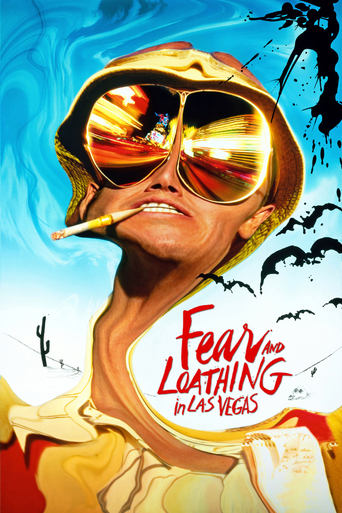
Fear and Loathing in Las Vegas
1998 · Film · 118 min
Directed by Terry Gilliam
Raoul Duke and his attorney Dr. Gonzo drive a red convertible across the Mojave desert to Las Vegas with a suitcase full of drugs to cover a motorcycle race. As their consumption of drugs increases at an alarming rate, the stoned duo trash their hotel room and fear legal repercussions. Duke begins to drive back to L.A., but after an odd run-in with a cop, he returns to Sin City and continues his wild drug binge.
9 positive1 mixed14 neutralfrom 24 commenters
Where to watch
No streaming data for this title.
27 comments on Hacker News
same! in the last couple of years i've seen these movies in a cinema: The Big Lebowski, Fargo, La Heine, Apocalypse Now, HEAT. and i already bought tickets for Run Lola Run, Clerks and Fear And Loathing In Las Vegas.
it's especially cool as someone who's young and wasn't even born when some of these movies initially came to cinemas.
at the same time it's unbelievably sad that in recent years about 70% of the movies i saw at a cinema were multiple decades old.
With the sunglasses, the long flamingo neck and the "joint", I immediately thought of the poster for Fear And Loathing In Las Vegas:
https://www.imdb.com/title/tt0120669/mediaviewer/rm2647909376/?ref_=tt_ov_i
EDIT: Actually, it must be a beak. If you zoom in, only one eye is visible and it's facing to the left. The sunglasses are actually on sideways!
For the benefit of any others unfamiliar:
Thompson: The man who invented gonzo journalism, writing beginning in the 1950s for numerous publications but most notably Rolling Stone, best known for Fear and Loathing in Las Vegas, serialised in RS, published as a book, and the basis of two films, Where the Buffalo Roam (loose adaptation, 1980) and more faithfully in 1998 under the original name, starring Johnny Depp and Benicio del Toro.
Would you say this is more or less faithful to his style than the film adaptation of Fear and Loathing in Las Vegas?
I need to rewatch it now that I've got a bit more context as to what it's about.
I didn't "get it" the first go round.
It's seems to be a "slice of life" type movie, in that it depicts a particularly interesting and eventful time in the characters lives, as opposed to having any kind of narrative or story.
My favourite movies in that category is Fear and Loathing in Las Vegas. Just fucking madness bounded by opening a closing credits.
Just a bunch of stuff that happened.
I remember reading this and preceding 'In the Kingdom of Mao Bell' https://www.wired.com/1994/02/mao-bell/ and imagining making those articles went down like in 'Fear and Loathing in Las Vegas' book/movie :-)
Sometimes, very rare, the dub is actually better (yes, subjective, but still) than the original. E.g. I do find Fear and Loathing in Las Vegas in German absolutely hilarious, start to finish. Then I watched the english version - was I surprised how serious this is in original voice. It's an entirely different movie in its original tone.
An EPIC scene from "The Congress" (2014): A short but entirely mesmerizing drug come-down, reality dissolving scene from the film "The Congress" (2014) based on the 1971 novel "The Futurological Congress" by Stanisław Lem. All rights to the makers.
https://www.youtube.com/watch?v=IMMI8HWhqEc
The comments on this youtube video are actually spot on and excellent!
https://news.ycombinator.com/item?id=8314622
DonHopkins on Sept 14, 2014 | parent | context | favorite | on: The Future According to Stanisław Lem
I just watched The Congress -- https://en.wikipedia.org/wiki/The_Congress_(2013_film) -- and WOW, it was excellent. Quite different from the book The Futurological Conference that it's based on: for example, it had cockroaches playing poker instead of sewer rats playing bridge. ;) But well worth watching for its unique take on the entertainment dictatorship. If you liked Who Framed Roger Rabbit, Looker, and Fear and Loathing in Las Vegas, you won't be disappointed! Something weird happens in the middle of the film, that's all I'll say...
>According to director Ari Folman, some elements of the film were inspired by the science fiction novel The Futurological Congress by Stanisław Lem in that similarly to Lem's Ijon Tichy, the actress is split between delusional and real mental states. Later, at the official website of the film, in an interview, Folman says that the idea to put Lem's work to film came to him during his film school. He describes how he reconsidered Lem's allegory of communist dictatorship into a more current setting, namely, the dictatorship in the entertainment business, and expresses his belief that he preserved the spirit of the book despite going far away from it.
It took longer than its length of two hours to watch, because I had to stop and rewind to replay and and freeze frames frequently. (Check out what's going on in the fish tank while she's saying "I wish you could see me animated, it's pretty sick. It's like a genius designer on a bad acid trip. Oh my god, I don't know, I look like a combination between Cinderella on heroin and an Egyptian queen on a bad hair day".)
I'm going to have to watch it many more times, because there were a lot of details to absorb -- time will tell if it's up there with Blade Runner as one of my favorite movies very loosely based on a great book.
https://culture.pl/en/article/ari-folman-on-the-genius-of-stanislaw-lem
https://news.ycombinator.com/item?id=15175516
DonHopkins on Sept 5, 2017 | parent | context | favorite | on: The sudden death and eternal life of Solaris
I really loved the movie The Congress, directed by Ari Folman, an adaptation of The Futurological Congress. Like Blade Runner's relationship to Do Androids Dream of Electric Sheep, it was a lot different than the book, but shares some deep ideas, and stands on its own as a great movie.
The scene in the USC ICT's motion capture studio was riveting, with Robin Wright playing a partly fictionalized version of herself, and Harvey Keitel playing her agent, baring their souls to the giant emotion capturing machine.
https://en.wikipedia.org/wiki/The_Congress_(2013_film)
https://www.youtube.com/watch?v=1rNSTizOsws
https://www.youtube.com/watch?v=pPAl5GwvdY8
https://news.ycombinator.com/item?id=30069100
DonHopkins 8 months ago | parent | prev | next [–]
Paul Debevec created the Light Stage to capture high dynamic range reflectance fields (including clean high resolution normal/bump/gloss/texture maps) of human faces. It uses hundreds polarized LED lights and cameras, plus lots of image processing, to separate the lighting effects of specular reflectance (glossy shine) from subsurface scattering (glowing skin), so you can reconstruct the 3D image and relight it under different conditions, environments, and viewing angles.
https://en.wikipedia.org/wiki/Paul_Debevec
https://www.pauldebevec.com/
https://en.wikipedia.org/wiki/Light_stage
"The Light Stage With Paul Debevec" - 360 Video (captured with JauntVR panoramic camera):
https://www.youtube.com/watch?v=xujwI4dimDA
Digitizing Photorealistic Humans Inside USC's Light Stage:
https://www.youtube.com/watch?v=c6QJT5CXl3o
Paul Debevec: Light Fields, Light Stages, and the Future of Virtual Production:
https://www.youtube.com/watch?v=bAe2dUJxe3w
A Light Stage was featured in the 2013 film "The Congress", which is a 2013 film adaptation of Stanislaw Lem's book, "The Futurological Congress", directed by Ari Folman:
https://en.wikipedia.org/wiki/The_Congress_(2013_film)
https://en.wikipedia.org/wiki/The_Futurological_Congress
I really love that movie and the book it was based on, which both raised some interesting issues: Like Blade Runner's relationship to Do Androids Dream of Electric Sheep, it was a lot different than the book, but shares some deep ideas, and stands on its own as a great movie.
The Congress Official Trailer (2014) Robin Wright, Jon Hamm HD:
https://www.youtube.com/watch?v=1rNSTizOsws
The scan scene in the Light Stage at USC ICT's motion capture studio was emotionally riveting and technically realistic, with Robin Wright playing a partially fictionalized version of herself, with Harvey Keitel playing her agent, baring her face and soul to the sparkling panoptic all encompassing emotion capturing machine.
The Congress (2013) Scan Scene:
https://www.youtube.com/watch?v=pPAl5GwvdY8
[...]
A Pissed Off Tutorial For Google Wave
https://www.youtube.com/watch?v=4Z4RKRLaSug
>Josh from the Game Helpin' Squad actually tries to get some work done. Or, rather, he complains about how people didn't appreciate it when he got some work done.
Fear and Loathing in Las Vegas (7/10) Movie CLIP - The High Water Mark (1998) HD
https://www.youtube.com/watch?v=vUgs2O7Okqc
>Strange memories on this nervous night in Las Vegas. Has it been five years? Six? It seems like a lifetime, the kind of peak that never comes again. San Francisco in the middle sixties was a very special time and place to be a part of. But no explanation, no mix of words or music or memories can touch that sense of knowing that you were there and alive in that corner of time in the world. Whatever it meant.
>There was madness in any direction, at any hour. You could strike sparks anywhere. There was a fantastic universal sense that whatever we were doing was right, that we were winning.
>And that, I think, was the handle -- that sense of inevitable victory over the forces of Old and Evil. Not in any mean or military sense; we didn't need that. Our energy would simply prevail. We had all the momentum; we were riding the crest of a high and beautiful wave.
>So now, less than five years later, you can go up on a steep hill in Las Vegas and look West, and with the right kind of eyes you can almost see the high-water mark -- that place where the wave finally broke and rolled back.
I've written about the film "The Congress", based on Stanislaw Lem's book "The Futurological Congress", starring Robin Wright and Harvey Keitel, and featuring Paul Debevoc's Light Stage, which explores the issues of actors selling their likeness so their twin can star in movies:
https://news.ycombinator.com/item?id=8314622
DonHopkins on Sept 14, 2014 | parent | context | favorite | on: The Future According to Stanisław Lem
I just watched The Congress -- https://en.wikipedia.org/wiki/The_Congress_(2013_film) -- and WOW, it was excellent. Quite different from the book The Futurological Conference that it's based on: for example, it had cockroaches playing poker instead of sewer rats playing bridge. ;) But well worth watching for its unique take on the entertainment dictatorship. If you liked Who Framed Roger Rabbit, Looker, and Fear and Loathing in Las Vegas, you won't be disappointed! Something weird happens in the middle of the film, that's all I'll say...
>According to director Ari Folman, some elements of the film were inspired by the science fiction novel The Futurological Congress by Stanisław Lem in that similarly to Lem's Ijon Tichy, the actress is split between delusional and real mental states. Later, at the official website of the film, in an interview, Folman says that the idea to put Lem's work to film came to him during his film school. He describes how he reconsidered Lem's allegory of communist dictatorship into a more current setting, namely, the dictatorship in the entertainment business, and expresses his belief that he preserved the spirit of the book despite going far away from it.
It took longer than its length of two hours to watch, because I had to stop and rewind to replay and and freeze frames frequently. (Check out what's going on in the fish tank while she's saying "I wish you could see me animated, it's pretty sick. It's like a genius designer on a bad acid trip. Oh my god, I don't know, I look like a combination between Cinderella on heroin and an Egyptian queen on a bad hair day".)
I'm going to have to watch it many more times, because there were a lot of details to absorb -- time will tell if it's up there with Blade Runner as one of my favorite movies very loosely based on a great book.
https://culture.pl/en/article/ari-folman-on-the-genius-of-stanislaw-lem
https://news.ycombinator.com/item?id=15175516
DonHopkins on Sept 5, 2017 | parent | context | favorite | on: The sudden death and eternal life of Solaris
I really loved the movie The Congress, directed by Ari Folman, an adaptation of The Futurological Congress. Like Blade Runner's relationship to Do Androids Dream of Electric Sheep, it was a lot different than the book, but shares some deep ideas, and stands on its own as a great movie.
The scene in the USC ICT's motion capture studio was riveting, with Robin Wright playing a partly fictionalized version of herself, and Harvey Keitel playing her agent, baring their souls to the giant emotion capturing machine.
https://en.wikipedia.org/wiki/The_Congress_(2013_film)
https://www.youtube.com/watch?v=1rNSTizOsws
https://www.youtube.com/watch?v=pPAl5GwvdY8
https://news.ycombinator.com/item?id=30069100
DonHopkins 8 months ago | parent | prev | next [–]
Paul Debevec created the Light Stage to capture high dynamic range reflectance fields (including clean high resolution normal/bump/gloss/texture maps) of human faces. It uses hundreds polarized LED lights and cameras, plus lots of image processing, to separate the lighting effects of specular reflectance (glossy shine) from subsurface scattering (glowing skin), so you can reconstruct the 3D image and relight it under different conditions, environments, and viewing angles.
https://en.wikipedia.org/wiki/Paul_Debevec
https://www.pauldebevec.com/
https://en.wikipedia.org/wiki/Light_stage
"The Light Stage With Paul Debevec" - 360 Video (captured with JauntVR panoramic camera):
https://www.youtube.com/watch?v=xujwI4dimDA
Digitizing Photorealistic Humans Inside USC's Light Stage:
https://www.youtube.com/watch?v=c6QJT5CXl3o
Paul Debevec: Light Fields, Light Stages, and the Future of Virtual Production:
https://www.youtube.com/watch?v=bAe2dUJxe3w
A Light Stage was featured in the 2013 film "The Congress", which is a 2013 film adaptation of Stanislaw Lem's book, "The Futurological Congress", directed by Ari Folman:
https://en.wikipedia.org/wiki/The_Congress_(2013_film)
https://en.wikipedia.org/wiki/The_Futurological_Congress
I really love that movie and the book it was based on, which both raised some interesting issues: Like Blade Runner's relationship to Do Androids Dream of Electric Sheep, it was a lot different than the book, but shares some deep ideas, and stands on its own as a great movie.
The Congress Official Trailer (2014) Robin Wright, Jon Hamm HD:
https://www.youtube.com/watch?v=1rNSTizOsws
The scan scene in the Light Stage at USC ICT's motion capture studio was emotionally riveting and technically realistic, with Robin Wright playing a partially fictionalized version of herself, with Harvey Keitel playing her agent, baring her face and soul to the sparkling panoptic all encompassing emotion capturing machine.
The Congress (2013) Scan Scene:
https://www.youtube.com/watch?v=pPAl5GwvdY8
"Rouen Revisited" is an earlier interactive kiosk project that Paul Debevec and Golan Levin created in 1996 at Interval Research Corporation, based on photogrammetric modeling techniques he developed at UCB:
https://www.youtube.com/watch?v=Ao3kf0YQ31c
https://acg.media.mit.edu/people/golan/rouen/
>Between 1892 and 1894, the French Impressionist Claude Monet produced nearly 30 oil paintings of the main façade of the Rouen Cathedral in Normandy. Fascinated by the play of light and atmosphere over the Gothic church, Monet systematically painted the cathedral at different times of day, from slightly different angles, and in varied weather conditions. Each painting, quickly executed, offers a glimpse into a narrow slice of time and mood. We are interested in widening these slices, extending and connecting the dots occupied by Monet's paintings in the multidimensional space of turn-of-the-century Rouen. In Rouen Revisited, we present an interactive kiosk in which users are invited to explore the façade of the Rouen Cathedral, as Monet might have painted it, from any angle, time of day, and degree of atmospheric haze. Users can contrast these re-rendered paintings with similar views synthesized from century-old archival photographs, as well as from recent photographs that reveal the scars of a century of weathering and war.
>Rouen Revisited is our homage to the hundredth anniversary of Monet's cathedral paintings. Like Monet's series, our installation is a constellation of impressions, a document of moments and percepts played out over space and time. In our homage, we extend the scope of Monet's study to where he could not go, bringing forth his object of fascination from a hundred feet in the air and across a hundred years of history.
Here's a paper about "Multifocus HDR VIS/NIR hyperspectral imaging and its application to works of art" that references his work, about how you can capture the 3D texture and hyperspectral reflectance field of artwork in a way that you could dynamically relight in different conditions and environments, interactively view in VR, use in high quality computer games and renderings, etc:
https://www.osapublishing.org/oe/fulltext.cfm?uri=oe-27-8-11323&id=408878
>Multifocus HDR VIS/NIR hyperspectral imaging and its application to works of art
>Abstract: This paper presents a complete framework for capturing and processing hyperspectral reflectance images of artworks in situ, using a hyperspectral line scanner. These capturing systems are commonly used in laboratory conditions synchronized with scanning stages specifically designed for planar surfaces. However, when the intended application domain does not allow for image capture in these controlled conditions, achieving useful spectral reflectance image data can be a very challenging task (due to uncontrolled illumination, high-dynamic range (HDR) conditions in the scene, and the influence of chromatic aberration on the image quality, among other factors). We show, for the first time, all the necessary steps in the image capturing and post-processing in order to obtain high-quality HDR-based reflectance in the visible and near infrared, directly from the data captured by using a hyperspectral line scanner coupled to a rotating tripod. Our results show that the proposed method outperforms the normal capturing process in terms of dynamic range, color and spectral accuracy. To demonstrate the potential interest of this processing strategy for on-site analysis of artworks, we applied it to the study of a vintage copy of the famous painting “Transfiguration” by Raphael, as well as a facsimile of “The Golden Haggadah” from the British Library of London. The second piece has been studied for the identification of highly reflective gold-foil covered areas.
[...]
>5. Conclusions and future work: In this study, a complete framework is introduced for the hyperspectral reflectance capture of a painting in situ, and under high dynamic range conditions. Both the high dynamic range and the focusing problem due to chromatic aberrations have been overcome by using multiple captures with different focus positions and exposure times. A final hyperspectral reflectance cube has been computed using weighting maps calculated for both sample and flat fields and the quality of this cube has been tested and compared with a spectral cube captured in the usual LDR and single focus way. Our results show that the proposed method outperforms the best low dynamic range capture acquired. The sharpness index, as well as the color and spectral metrics show that it is possible to achieve good quality spectral reflectance images using a hyperspectral scanner in non-controlled illumination conditions. Moreover, as an example application, highly reflective golden material has been segmented from a facsimile. Our results show that by applying the proposed framework for capturing and processing, those areas which saturate the sensor in the usual capturingway, can be correctly exposed and segmented using the HDR multifocus capture. In future research, a new version of this framework will be developed including piecewise cube stitching for blending different cubes captured in different regions of big paintings. This will allow us to get closer to the painting and retrieve higher spatial resolution data, whilst still maintaining the spectral resolution and performance achieved in this study. Moreover, we will use the spectral reflectance images computed in this study, together with X-ray fluorescence measurements for the non-invasive pigment identification, in order to help the dating of ancient paintings and other works of art.
https://en.wikipedia.org/wiki/Hyperspectral_imaging
Duke: “We’re all wired into a survival trip now. No more of the speed that fueled the ’60s. That was the fatal flaw in Tim Leary’s trip. He crashed around America, selling “consciousness expansion” without ever giving a thought to the grim meat-hook realities that were lying in wait for all those people who took him seriously—all those pathetically eager acid freaks who thought they could buy peace and understanding for three bucks a hit. But their loss and failure is ours, too. What Leary took down with him was the central illusion of a whole lifestyle that he helped create. A generation of permanent cripples, failed seekers who never understood the essential old-mystic fallacy of the acid culture: the desperate assumption that somebody, or at least some force, is tending the light at the end of the tunnel.“ From:
Fear and Loathing in Las Vegas (1998)
https://moviewise.substack.com/p/movies-that-are-frightening
https://en.m.wikipedia.org/wiki/Fear_and_Loathing_in_Las_Vegas_(film)
It just means "My adventures with _". Actual fear or loathing is not necessarily involved.
Fear and Loathing in Las Vegas (a tale about a time and place I have not experienced), The Rum Diaries (surprisingly such a feel good movie), Bang Boom Bang (a hilarious German Comedy)
And "fear and loathing in Las Vegas" I imagine.
https://en.m.wikipedia.org/wiki/Fear_and_Loathing_in_Las_Vegas_(film)
Fear and Loathing in Las Vegas. The movie is a scene-by-scene rendering of the novel, but it's also fantastic.
” That was the fatal flaw in Tim Leary’s trip. He crashed around America selling “consciousness expansion” without ever giving a thought to the grim meat-hook realities that were lying in wait for all the people who took him seriously… All those pathetically eager acid freaks who thought they could buy Peace and Understanding for three bucks a hit. But their loss and failure is ours too. What Leary took down with him was the central illusion of a whole life-style that he helped create… a generation of permanent cripples, failed seekers, who never understood the essential old-mystic fallacy of the Acid Culture: the desperate assumption that somebody… or at least some force – is tending the light at the end of the tunnel.”
Fear and Loathing in Las Vegas is one of my all time favorite movies. It’s a disorienting and psychedelic plot filled with subtle yet striking insights into human nature. I highly recommend giving it a watch if you’re looking for a taste of Hunter S Thompson’s legacy.
The one for Fear and Loathing in Las Vegas could actually be a cover image for that movie. It's perfect.
Some of these are just bizarre in how effective they are.
I have never picked up the book or watched the movie Fear and Loathing in Las Vegas. I probably couldn't have told you anything about them beyond what was included in the text description the AI got. Yet I instantly knew that was the movie.
I could even envision a few of these as art work for a special edition blu-ray or something.
I read their works. They were on about the ability of LSD to undermine the establishment. (They may have been right). The result of their success was a vicious clamp down.
My view was crystallised by HST in his "Looking west from Vegas with the right kind of eyes..." monologue in Fear and Loathing in Las Vegas (it is in the film, if reading books is not your thing. The film is, IMO, a faithful portrayal of the book)
When it comes to drugs, I am more of a follower, not a imitator, of HST than Leary. Drugs should be fun. When they stop being fun, stop doing drugs. Real simple!
Ah, they figured out how to brand the nightmare generator!
Example context: "Fear and Loathing in Las Vegas run through Google's Deep Dream neural network is pure nightmare fuel" https://www.independent.co.uk/arts-entertainment/films/news/fear-loathing-run-through-google-s-deep-dream-neural-network-pure-nightmare-fuel-10371063.html
Also don't forget "Fear and Loathing in Las Vegas", another controversial classic directed by Terry.
Along that same line, Fear and Loathing in Las Vegas is a pretty good movie at warning that playing it fast and loose with recreational drugs beyond alcohol can have you end up with a very bad time
From the Fear and Loathing in Las Vegas movie: http://www.upout.com/blog/wp-content/uploads/Vintage-Nevada-marijuana-sign-e1415719315494.png
For those not familiar with Hunter S. Thompson and looking to get an understanding of his outsize personality and cult following, I highly recommend watching the 2 movies in which Johnny Depp played his character:
* Fear and Loathing in Las Vegas (1998) http://www.imdb.com/title/tt0120669/
* The Rum Diary (2011) http://www.imdb.com/title/tt0376136/
If you are not already a fan of Johnny Depp, these movies should do it.
I'll give you an up vote because it's a fair question. (And, I don't see any reason why someone would down vote.) I don't want to spin my appreciation for Hunter, but I'll provide you some articles. If you want some interesting reads, his most influential books are (pre-gonzo) 'Hell's Angels', 'Fear and Loathing in Las Vegas', 'Fear and Loathing on the Campaign Trail '72', and, much later, 'Kingdom of Fear'.
'Campaign Trail 72' is about the antics at the 72 Democratic Convention to get George McGovern the party's nomination. He was a longshot, but many young writers (including Hunter) started a movement to get him nominated; which succeeded. A lot of people thought that Nixon was undefeatable that year, but things got interesting after the youth movement behind McGovern. Unfortunately, his campaign failed miserably after his running mate, Thomas Eagleton, revealed that he underwent electric shock therapy years earlier. I think that many people would qualify McGovern as the first progressive democrat to be nominated, but, TBH, I don't know much about him, or his campaign, other than what I've already told you.
The other books don't need any introduction, from me, because you can easily find out a lot about them.
Articles by Hunter (personally selected):
"The Kentucky Derby Is Decadent and Deprived", notable for his first meeting with Ralph Steadman. [1]: http://grantland.com/features/looking-back-hunter-s-thompson-classic-story-kentucky-derby/
"He was a Crook" Obituary to Richard Nixon [2]: http://www.theatlantic.com/magazine/archive/1994/07/he-was-a-crook/308699/
... Somewhere there is an article about Hunter talking about his only conversation with Nixon. They talked about football. Both men hated each other, but Nixon had no idea who he was talking to at the time. Those events are fictionalized in the movie 'Where the Buffalo Roam' starring Bill Murray as Hunter.
"Fear and Loathing in America" - Published September 12th, 2001 [3]: http://proxy.espn.go.com/espn/page2/story?id=1250751
"Don't you dare cancel football" - [4]: http://sports.espn.go.com/espn/page2/story?page=thompson/040727
"Shotgun Golf with Bill Murray" - His last article, submitted hours before his suicide. [5]: http://sports.espn.go.com/espn/page2/story?id=1992213
'Hey Rube, Page 2' Archive [6]: http://totallygonzo.org/gonzowriting/hst-hey-rube-espn-page-2/
Edit: As for the documentary that you watched, it was likely 'Gonzo: The Life and Work of Dr. Hunter S. Thompson' which was produced by his son, Juan, and narrated by Johnny Depp. As far as his family life, he raised his son, and remained friends with his first wife. I don't know the facts behind the abuse claims, but he was certainly a chaotic person. So, I would imagine he was a difficult person to be around.
Edit2: Fixed the documentary mentioned in the first edit, I had stated it was 'Buy the ticket, take the ride'.
Yeah, well, not mentioning Erowid is pretty counter-intuitive to the entire article. It's ignorance dressed up as education. The path has already been started long before VC/SV smelled something interesting. Maybe if VC/SV had a great track record in investing in actual research science, which in fairness is being choked and driving people out of the profession, then maybe there'd be some hope. Thus far, I see far more risk than reward in complimenting or encouraging the VC/SV community to pursue this field.
Also, citing movies like Lucy and Limitless just feels juvenile. Why not strap on Fear and Loathing in Las Vegas for some counter balance? Drugs is drugs is drugs...
I just watched The Congress -- https://en.wikipedia.org/wiki/The_Congress_(2013_film) -- and WOW, it was excellent. Quite different from the book The Futurological Conference that it's based on: for example, it had cockroaches playing poker instead of sewer rats playing bridge. ;) But well worth watching for its unique take on the entertainment dictatorship. If you liked Who Framed Roger Rabbit, Looker, and Fear and Loathing in Las Vegas, you won't be disappointed! Something weird happens in the middle of the film, that's all I'll say...
>According to director Ari Folman, some elements of the film were inspired by the science fiction novel The Futurological Congress by Stanisław Lem in that similarly to Lem's Ijon Tichy, the actress is split between delusional and real mental states. Later, at the official website of the film, in an interview, Folman says that the idea to put Lem's work to film came to him during his film school. He describes how he reconsidered Lem's allegory of communist dictatorship into a more current setting, namely, the dictatorship in the entertainment business, and expresses his belief that he preserved the spirit of the book despite going far away from it.
It took longer than its length of two hours to watch, because I had to stop and rewind to replay and and freeze frames frequently. (Check out what's going on in the fish tank while she's saying "I wish you could see me animated, it's pretty sick. It's like a genius designer on a bad acid trip. Oh my god, I don't know, I look like a combination between Cinderella on heroin and an Egyptian queen on a bad hair day".)
I'm going to have to watch it many more times, because there were a lot of details to absorb -- time will tell if it's up there with Blade Runner as one of my favorite movies very loosely based on a great book.
http://culture.pl/en/article/ari-folman-on-the-genius-of-stanislaw-lem