 Hacker Cinema
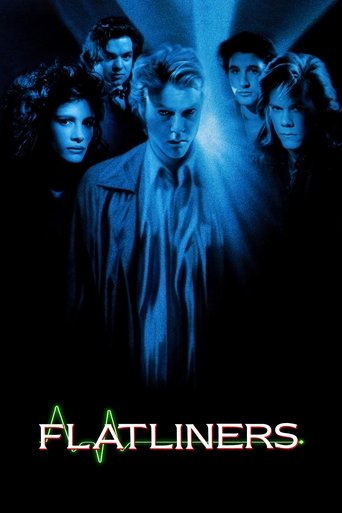
Flatliners
1990 · Film · 115 min
Directed by Joel Schumacher
Five medical students experiment with "near death" experiences, until the dark consequences of past tragedies begin to jeopardize their lives.
1 positive2 negative7 neutralfrom 10 commenters
Where to watch
No streaming data for this title.





10 comments on Hacker News
It's kind of the central concept of the 1990 movie Flatliners as well.
This reminds me about the movie "Flatliners"[0] in my need-to-watch queue. Maybe this weekend.
[0]https://www.imdb.com/title/tt0099582/?ref_=fn_t_2
I don’t know why — and forgive the potentially low value comment — but the headline alone made me recall the movie “Flatliners” from the 90s, which I saw way too young, and which thoroughly terrified me.
Movies like "Brainstorm": "The Final Cut" "Strange Days" "Total Recall" "Altered States" "Lawnmower Man" "Ex Machina" "The Thirteenth Floor" "The Truman Show" "Inception" "Selfless" "Flatliners"
There are all kinds of interesting implications and questions here.
1. What is the meaning and intent of a "life sentence", or other punishment?
2. Does it apply to a singular life, or all lives a prisoner might have?
3. What (if any) legal definitions for "life" and "death" are there, in relevant jurisdictions. And how are they treated in sentencing laws?
4. Is clinical death the same as legal death?
5. Is there legal precedent for obligations lifted (or privileges revoked / denied) on the basis of temporary clinical death? E.g., lifetime obligations for debt, etc.?
6. With advances in medical technology, what are the implications of either induced death (e.g., the film "Flatliners") or extended / eternal life (Singularity, cryopreservation) on future legal matters -- not only sentencing but contracts and the like.
6a. If a convict were sentenced to death and were clinically but reversably killed, would that sentence be considered fulfilled?
6b. What of eternal or lifelong benefits or obligations -- government pensions, wills, property ownership, etc., in the case of immortal or resurrected individuals.
7. Is a resurrected individual the same or a different person? Clinically? Legally? (Ship of Theseus, as @nprateem notes.)
8. Is a person who dies naturally but is resurrected against medical directives (as in the Iowa case) considered discharged? If so, or if no, on what legal basis?
It's worth noting that the law is not a system that's consistent either externally (as with science or public opinion/sentiment), or internally. It is based somewhat on legislation, precedent, and gloss. But also on argument, persuasion, judicial temperment, and political and power relations. It kinda works, but is awfully creaky in parts.
This story reminds me of an old movie called Flatliners (https://www.imdb.com/title/tt0099582/) where medical students experimented with near death by intentionally inducing cardiac arrest. If you get a life sentence you could hire the Flatliners to come and kill you for a few minutes and then bring you back. hehehe
Yeah. I saw an ad last night during a late night comedy talk show. Said, "boy, sounds like someone didn't see this same exact movie two decades ago, Flatliners."
Turned out, no, that's exactly what happened. They remade the exact same movie with different actors. Why bother??? How stupid. What a waste.
As I see it, the basic flaw in the materialist worldview is this: http://plato.stanford.edu/entries/perception-episprob/
It is also what leaves the door open for more transcendent views. Eastern religions, in particular, are founded on the basic idea that your everyday experience is illusory.
You dismiss religious beliefs as based on "essentially nothing". In fact, the basis of religious belief in the most general sense is conscious experience. The kinds of conscious experience that you would probably call hallucinations. But, referring again to the link above, you are probably disposed to call shared perceptions "real", and non-shared perceptions hallucinatory. Religiously, metaphysically, or even philosophically minded people might call that arbitrary. Chauvinistic even. We act like consensual reality is real because it's convenient, intuitive, and seems to get us good results in consensual reality.
You say "zero credible evidence of an afterlife." That's true, if you restrict yourself to what's usually considered "evidence" in science. Evidence that more than one person can perceive at the same time. But individuals can go further if they really want to see whether there's anything to see. Are you willing to dedicate yourself to a meditation practice for a long time? Psychedelic drugs? Flatliners (the 1990 movie)?
I'm not recommending that anyone do anything dangerous. Just pointing out that there are things you can observe first-hand, that aren't likely to be replicated in a study.
Flatliners! http://www.imdb.com/title/tt0099582/
Having started NeXTSTEP/Objective-C coding in the early 90s, and lived through the mid-90s near-death of the platform, I find it pretty remarkable that in 2011 a prime-time major network comedy had a whiteboard with "NSObject", etc, on it.
(In the late 80s, early 90s NeXT hardware turned up in some pop culture locations due to how it looked: Mono NeXTStations in the Madonna video for Rain I don't know how I remember that, and a Cube in the movie Flatliners. But source code is something else entirely. Granted, given the recent cultural phenomenon of the iPhone, it's not that weird. But from a longer-term perspective, it feels a little like we're through the looking glass.)