 Hacker Cinema
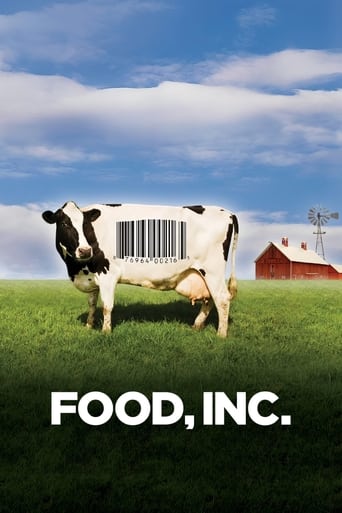
Food, Inc.
2008 · Film · documentary · 94 min
Directed by Robert Kenner
Documentary filmmaker Robert Kenner examines how mammoth corporations have taken over all aspects of the food chain in the United States, from the farms where our food is grown to the chain restaurants and supermarkets where it's sold. Narrated by author and activist Eric Schlosser, the film features interviews with average Americans about their dietary habits, commentary from food experts like Michael Pollan and unsettling footage shot inside large-scale animal processing plants.
36 positive2 negative1 mixed11 neutralfrom 50 commenters
Where to watch
No streaming data for this title.
54 comments on Hacker News
im reminded of the old documentary food inc. pretty good stuff, it points out that the centralization of the american food supply into the hands of ever fewer companies is going to harm us at some point.
have you ever seen the documentary food inc?
I think it was Food, Inc, a documentary from a number of years ago. Joel Salatin of Polyface Farms talks about factory farming and Salatin often argues that industrial farming is not necessarily more cost-effective and that his method is both profitable and environmentally sustainable.
yes, exactly, the problem is not whether those are more or less nutritious, the issue is the lack of variety. It seems that gut bacteria only improves if your diet is very diverse. But modern industrially produced food is made from just a small list of commodity ingredients. If you are curious about these topics, you could check out "The omnivore's dilemma", a book by Micheal Pollan, or the video documentary "Food Inc." that is also narrated by Pollan
Admittedly I only skimmed through through it, but it looks like yet another vegan documentary (e.g. Dominion, which I watched all the way through and wasn't convinced at all by) where the worst examples of the worst excesses of industrialized slaughter are taken in the worst possible light and suggested to be broadly representative of the whole. Honestly, anybody with basically any exposure to real-life animal husbandry can find issues in these sorts of documentaries with minimal effort. For myself, I'm a hunter and so I regularly kill and butcher wild animals literally as a hobby -- despite this (or maybe because of it), I'm actually quite open to criticizing the ethics of intensive livestock farms as long as it's not through the lens of "meat is murder".
I wish there was a halfway decent documentary that took a more balanced approach, because if your goal is "better animal welfare" rather than "the abolition of meat eating on moral grounds" then there's actually a lot to criticize and improve on. e.g. I thought "Food Inc" was a lot more even-handed, even though it still fell into some of the usual traps.
This seemed counter-intuitive to me, and in particular I recalled a scene in the documentary Food Inc where an organic poultry farmer extolled how much cleaner it was to be processing meat in the open air rather than in an environment mediated by chemical sterilization.
However, it does seem like this is a thing, in particular there was a Swedish study in 2009 that was referenced several times in media coverage and I can find no follow-up or rebuttal to:
https://www.sciencedaily.com/releases/2009/01/090114200003.htm
And then in 2014, an industry-focused article on how to mitigate some of these effects, in particular rodents:
https://www.thepoultrysite.com/articles/range-management-for-disease-control-guidelines-to-protect-your-freerange-flock-from-exotic-disease
>There's a documentary on Netflix called Food, Inc. that goes into Monsanto's vendetta against farmers, suing them for intellectual property theft if their GMO seeds blow into their fields from a neighbors field.
AFAIK that's not an accurate depiction of what monsanto has been doing. According to wikipedia[1] monsanto says they won't "exercise its patent rights where trace amounts of our patented seed or traits are present in farmer's fields as a result of inadvertent means". I'm not sure what the exact that was discussed in the documentary, but the ones mentioned in the wikipedia article all have elements of the farmer doing something intentionally, eg.
>The case began in 2007, when Monsanto sued Indiana farmer Vernon Hugh Bowman who in 1999 bought seed for his second planting from a grain elevator – the same elevator to which he and others sold their transgenic crops.[17] The elevator sold the soybeans as commodities, not as seeds for planting.[17][18] Bowman tested the new seeds, and found that ,as he had expected, some were resistant to glyphosate. He intentionally replanted his harvest of GM seeds in subsequent years, supplementing them with more soybeans he bought at the elevator. [...]
[1] https://en.wikipedia.org/wiki/Monsanto_legal_cases#As_plaintiff
There's a documentary on Netflix called Food, Inc. that goes into Monsanto's vendetta against farmers, suing them for intellectual property theft if their GMO seeds blow into their fields from a neighbors field.
The entire documentary made me very sad because I could not think of any solution
> Voting with your dollars doesn't really work....I stopped shopping at Wal-Mart around 2007
There's a really interesting part in the documentary "Food Inc." Where they're talking about big industrial food processing places destroying quality, etc.
At one point he interviews Walmart's head of milk ordering (whatever it's called).. and the person has some really interesting insight. Customers didn't want to buy milk from cows that had whatever hormone... and it became such a big deal that Walmart saw sales of that type of milk plummet, so they stopped buying and selling all milk with that hormone.
They now don't stock or sell any. Period.
So in fact, when people vote with their dollars companies as big as Walmart do actually notice, and they do make changes for the better.
They’ve got a long history of doing this. I learned about it from the documentary Food, Inc. (which I’d highly recommend), but it’s also been widely covered in the media:
https://www.theguardian.com/environment/2013/feb/12/monsanto-sues-farmers-seed-patents
https://www.cbsnews.com/news/agricultural-giant-battles-small-farmers/
This isn't a recent occurrence. Over 5+ years ago, Netflix had dozens of popular food documentaries, notably "Food, Inc."
For reference you might consider watching the excellent documentaries "Our Daily Bread," and "Food, inc"
As i remember it there was much negativity around them in Michael Pollan's books and the documentary Food Inc.
IMHO it all boils down to economic interest of some strong powers: in EU they're not cheap, but cheaper ... I would like to say a lot about this, but I am gonna redirect you to some documentaries: - https://en.wikipedia.org/wiki/Food,_Inc. - https://en.wikipedia.org/wiki/The_World_According_to_Monsanto
Here is the list of my favorite documentaries: - The Cove - Food, Inc. - The Century Of The Self - Inside Job - Earthlings - Samsara - Earth - A Map For Saturday - The Story Of India
This seems like a rather important issue that few people know about. The fact that the majority of the crops being planted today are the intellectual property of and controlled by some monster GMO food companies really means we could end up in a bind in the future.
"Food Inc." (http://en.wikipedia.org/wiki/Food,_Inc.) is an excellent documentary that explains some of the major problems with this system.
This belief is unfortunately misguided; there is much suffering involved in industrial milk production [1]. It begins with the cow being separated from its calf, usually when it is just newly born. The cow generally responds by searching frantically for its lost calf, repeatedly crying out for it until its throat becomes sore. The cow might also become sick and lose weight due to the separation. It continues with the milking process, which is painful and terrifying for the cows, as evidenced by their response. Milk-producing cows have been bred to maximize milk production, which means they have oversized udders that lead to illness. These are just a few examples of many. Generally speaking, cows in the dairy industry lead a short and exceedingly miserable life.
If the goal is to minimize suffering without going vegan, I think that wild-caught fish provide the least offending animal-based food. But wild-caught fish are generally bad from an ecological perspective.
[1] See for example http://modernfarmer.com/2014/03/real-talk-milk/ , http://www.farmsanctuary.org/learn/factory-farming/dairy/ , and the documentary films Earthlings and Food Inc. A quick google search will reveal many more sources.
>>GMO labelling is of no value though. Because whether or not something is produced using genetic engineering techniques does not explain whether its safe.
Ah, now here's the thing. If you don't know whether it's safe or not which side do you error on? For me and my family, all I know is that my family has no particular history of health problems eating mostly "organic" in that I'm the first generation born in America and the rest of them grew up in Nigeria eating food from plants & farm animals raised with centuries-old tribal techniques. Not saying this was 100% of their diet, but certainly a great deal more natural than USA. I have a relative who doesn't need their diabetes medicine when in Nigeria to control blood sugar level. I'm guessing it's because in Nigeria 97% of the food isn't loaded with HFCS and other sweeteners.
I have no idea wether GMOs are safe, but I'm not interested in being the experiment for it. GMO labeling should be allowed. Or at the very, very least I should be able to go online to see the GMO status of a brand of food product. GMO labeling should be allowed. Or at the very, very least I should be able to go online to see the GMO status of a brand of food product.
Another part of this is probably from the core belief I hold; that human beings messing around with mother-nature is generally hubris and risky. I do respect the fact that many, many amazing things have come out of medial science but I treat it all with caution rather than just whatever-the-scientists-say-must-be-right. Then I watch something like "Food Inc."[1] and become just a bit more skeptical of foods enhanced by science via processing, GMO, pesticides, whatever. I want my food grown with plain ol' water & sunshine & animal feces fertilizer... at least for now.
1. http://www.imdb.com/title/tt1286537/
There's an amazing section in the documentary Food, Inc. that deals with the consequences of this in the US. Genuinely disturbing, hopefully this is overturned or at least protested against before it can be enforced.
Some time ago I saw the documentary "Food Inc." where they show this process with ammonium hydroxide and ignorant as I am about the food processing industry, I was negativey surprised.
There is still more going on and although the documentary may be a bit sensationalist, if just 10% is true it's still appalling what the industry is doing to cut the costs. And I wonder if impact on human health and environment can be good in the long run.
But at least for me it made a difference, I think about what I eat and I try to choose organic, locally produced and less pre-processed food. Probably I'm imagining things, but I feel better, have more strength and being less tired after work.
My partner had the idea to try an old-fashion "startup" for ourselves as soon as we can get a piece of land. With chickens (eggs), beekeeping and growing vegetables, we can hopefully take a step further away from the processing industry.
There are a lot of things I like about Food Inc. I can geek out a bit on seasonal and local food. I have a local butcher I work with for most of the protein we cook and he sources his product from a small set of farms within driving distance of here. I have ethical problems with battery farming, both because of animal cruelty issues but more importantly for pragmatic reasons like environmental externalities and antibiotic abuse. I cook, a lot. I'm very sympathetic to Food Inc's viewpoint.
But the Monsanto stuff is a highly technical issue, and neither Michael Pollan nor Eric Schlosser appear to have much expertise in them. There is a lot of GMO FUD. I would not assume that none of it leaked into the movie.
I thought there was pretty much a whole movie (Food Inc) documenting that very thing (i.e. cross contamination). Please don't try and say that the hatred going towards Monsanto isn't deserved because it most assuredly is.
http://www.damemagazine.com/2013/04/03/monsanto-six-truths-and-lie
I got my information from the documentaries "The Future of Food" and "Food, Inc" both of which have an obvious bias. I'm having trouble tracking down any other citations at the moment.
Here is a [again, biased] citation about Monsanto suing people for saving seeds, allegedly going so far as to forge documents: http://nelsonfarm.net/issue.htm
While it would be great if the FDA did something about this, there are probably global dimensions to this problem also. Presumably antibiotics are used globally against strains of disease that spread quite merrily from country to country.
I'd assume epidemiology is not domestically constrained: the antibiotic/agricultural practices of one nation impact all others.
I have no idea what is standard practice for domestic agriculture in my own country. Things I think I "know" about agriculture are distorted through the prism of American cultural influence - documentaries like Food Inc., are writ large in the imagination even where these are only concerned with domestic affairs.
What resources exist that document antibiotic use on a global basis?
The problem with GM foods is less to do with health and more to do with public control of food supply. There's a good documentary called Food Inc. which looks at the effect of GM crops on farmers and some of the pretty openly evil tactics of Monsanto to cement their monopoly on supply of seeds.
This is one example, taken from the Food, Inc. documentary.
The parent topic asks, Monsanto made the roundup-ready soybeans, which took millions to develop. If the farmer doesn't want to be sued, he could use non-roundup-ready soybeans.
In the documentary, they profile a farmer who got sued by Monsanto for not paying their license. The farmer claimed he was not using Monsanto seeds. However, Monsanto's argument amounted to "We are the largest seller of these seeds in the world, therefor, it must be our seed. Even though you can prove it isn't, you must have "washed" the seed to make it seem like it isn't ours, or maybe some of your neighbor's Monsanto seed blew into your land and you owe us for that too."
The judge sided with Monsanto.
Yes, this shows our legal system is evil for letting them get away with this, but the fact that Monsanto is driving around & actively looking for farmers who aren't using their seed, extorting them for not & dragging them into a court battle they know will bankrupt them is evil too.
For further viewing, check the Monsanto Food Inc. clips. They are on YouTube. Mansanto has also responded on their website.
I suggest you watch the documentary Food Inc to see why it isn't as straightforward as that..
If you eat factory farmed meat, eggs, or dairy, you are almost guaranteed to be supporting animal cruelty. There are many fantastic books and documentaries detailing the horrors and dangers of factory farming and I've linked to a few below. This is an open secret.
I would be willing to bet that almost anybody here, once they've looked deeply into factory farming, would come out the other side and look at factory farmed animal products in a completely new light.
Do you truly want to stop farm animal cruelty? Investigate this industry and consider no longer buying factory farmed animal products.
http://www.amazon.com/Food-Inc-Participant-Industrial-Poorer-/dp/1586486942/ref=sr_1_1?s=books&ie=UTF8&qid=1365429391&sr=1-1&keywords=food+inc
http://www.amazon.com/Eating-Animals-Jonathan-Safran-Foer/dp/0316069884
I just watched "Food, Inc" this weekend, it's a very well made documentary. Much more evidence-based and non-preachy than I expected.
They talk at length about what they call 'veggie libel laws' and other laws introduced by food producer lobbies that limit free speech and surveillance about food productions. There's a long history of this, unfortunately it's nothing new.
If you have amazon prime, you can watch it for free: http://www.amazon.com/Food-Inc/dp/B002VRZEYM/ref=sr_1_1?ie=UTF8&qid=1363576916
"I don't see how Monsanto would ruin family farming -- family farming existed centuries before Monsanto was founded. You can still buy non-GMO seeds"
Traditionally farmers would save a portion of their crop to plant for the next year. There is even a special machine that prepares seed for planting called a "seed cleaner". Enter patented GMO seed which gets planted in a field next to regular seed and is cross pollinated by nature. Now the farmer who didn't plant GMO seed has a crop that contains the GMO patented gene. So if he cleans that seed he is at risk of being sued the next year for patent infringement by monsanto. In fact they have been systematically been suing seed cleaners to to get their client lists and then sue the farmers. Since it is nearly impossible to ensure your crop hasn't been cross pollinated with a GMO crop Monsanto has essentially shut down the traditional way farmers have worked. additionally they are reportedly very aggressive in pursuing farmers and frequently trespass on their fields to take seed samples. That is why they say that they have "ruined" family farming.
Food Inc. is one good documentary where this is discussed in detail among other food related issues.
http://www.slowfoodsanfrancisco.com/blog/policy/monsanto-destroying-farming-communities/
They are raised in unsanitary conditions and antibiotics reduce the infections. Watch the documentary Food Inc. for a good overview of how screwed up the US meat industry is
Food Inc is what really whipped up the anti-Monsanto rhetoric; it's uncommon for me to interact with someone about agriculture and food without the film coming up.
I used that case because it's the most famous one people refer too. Runyon is another famous person. Look, I've watched Food Inc too. Again, show me the case (which I believe does not exist). You showed me a news article. Otherwise this is just someone who has been in a bunch of movies and is suing Monsanto, and is not really an unbiased source (just like I don't link directly to Monsanto's website on the Runyons.)
The obvious one is that it's illegal for food companies to advertise whether or not their products are GMO:
http://www.rawstory.com/rs/2010/09/18/fda-labeled-free-modification/
There are a lot of other food safety best practices that the FDA has effectively banned as well though. For example the movie Food Inc. explains the issues surrounding bacteria in beef.
Those claims are only valid for feedlot raised cattle which you shouldn't eat anyway if you care about your health. Cows aren't meant to eat grain. Plus, you get to support your local community by buying from local, responsible farmers.
And if you want to be completely honest with yourself, take a good look at industrial agriculture and tell me how self-righteous you feel.
Here's a couple of decent articles to start: http://www.alternet.org/story/13900/ http://www.organicconsumers.org/Organic/IndustrialAg502.cfm
Also, the documentary Food, Inc. is a well done introduction to the issue.
I've learned a lot about this issue from books such as Fast Food Nation and movies such as Food Inc, which tend to focus on the incredible power that food industry lobbies seem to have over congress and the FDA. In the case of Fast Food Nation, the issue isn't the expected premise - that McDonalds et al serves low-quality food and causes obesity - that is merely the result. The issue, he seems to claim, is that certain people in the government are literally paid off to allow the industry to do so, both with passive defensive methods (not implementing laws that would restrict them) and active, offensive methods (creating laws that impede initiatives that aren't in the food industry's interest.)
The documentary Food, Inc. (among others) has a segment about Monsanto's "business" practice, in particular seed saving for following year's planting. So the problem is not necessarily GM food but how they twist farmers arms through litigation. If software patents are bad, imagine patents over the constituents of life!
The documentary "Food Inc" describes Monsanto's behavior with respect to genetically modified seeds.
Example from my admittedly poor memory: A farmer's neighbor bought Monsanto's genetically modified seeds and some of the seeds blew into the farmers flield. Monsanto sued him and made him destroy all his seeds. When the farmer complained to the government he discover that the official responsible for representing his interests was on the board of Monsanto.
As far as "feeding the hungry". Monsantos seeds are genetically modified produce plants that don't have replantable seeds i.e. every year you have to buy your seeds from Monsanto. The 3rd world can't afford to use Monsanto's seeds and our subsidies of the corn industry make is hard for 3rd world farmers to make a living.
I'm kinda hurt to see this on here, to be honest. Might advise getting out before you plant the self-terminating PR seed. Dramatically illuminating movies you can watch to learn about why everyone on YC thinks this is an absurd move: FUEL, Food Inc.
Food and Health:
Fat Head (2009) http://www.imdb.com/title/tt1333994/ Especially if you've seen "Super Size Me", but even if you haven't, an amusing yet educational take on the obesity "epidemic".
Food, Inc. (2008) http://www.imdb.com/title/tt1286537/ - Exposing the absurdity of our industrial food economy.
Music and Entertainment:
Anvil! The Story of Anvil (2008) http://www.imdb.com/title/tt1157605/ Talk about never giving up on your dreams.
Metallica: Some Kind of Monster (2004) http://www.imdb.com/title/tt0387412/ The other side of fame.
Thanks for taking the time to offer a balanced opinion. I find myself largely agreeing with your sentiments.
I think there must be a better balance to be struck between the approach taken in Europe (seen as too difficult to fire people, which isn't conducive to a healthy business environment) and to the American approach (you can be fired at-will).
I myself like to watch US-based documentaries like Gasland, Food Inc., Inside Job and Boogie Man: The Lee Atwater story. I know these stories are biased, but I'm silently horrified by the sheer extent to which the odds are stacked against the good of the ordinary person in favour of big business. For example, in the film "Inside Job" an IMF banker made the extraordinary revelation that a Wall Street banker basically said to him in a meeting: "Please regulate us. We're too greedy. If you don't regulate us we'll continue to cause markets to blow up because we can't help ourselves." This was before the bailouts, so the banker was genuinely terrified that the banking system would utterly collapse and that they would lose everything.
Also important however, is to ponder on why America is so rich and why America to a large extent drives the global pace of innovation. There are smart, ambitious people there who can get access to capital and raw talent that is unavailable anywhere else in the world. These conditions must have sprung up in America for a reason - the environment was fertile enough for them to take root. By having a thriving, innovative economy, everybody wins. The standard of living improves for everyone. You get to keep your sovereignty by being rich - just look at the PIIGS (Portugal, Italy, Ireland, Greece and Spain). They lost economic sovereignty (except for Spain, but it could happen to them too) by being economically weak. (You can also lose political sovereignty if you are poor, as you can't afford all the military hardware to fight off an enemy). I would urge you to read "The Ascent of Money" by Niall Ferguson. He makes excellent points as to why money, and innovations like bonds, stock and insurance actually drive countries forward. For example, the riskiness of the Dutch voyages to the far-East in the late 1500s onwards were mitigated against by forming a limited-liability company, where stock could be sold to ordinary investors. If it weren't for this innovation, then the risk of the voyage would have turned people off from financing such a risky prospect. The voyages were highly successful overall and a remarkable new financial innovation was born. I think what you see in America today is a mix of these very good ideas with some very bad ideas too.
"To answer your question though, I do believe that it is roughly true that pursuing riches makes it harder to be a moral person. It's not impossible but I do believe it is harder. It is my belief that in a majority of cases one's morality and perception of what is right/wrong/acceptable changes for the worse as they acquire more money."
Money certainly seems to change people (can't say first hand because I'm one of those aspiring millionaires!) I think if you have a solid moral compass to begin with, and realise just because you may be wealthier than someone else doesn't make you better or more important than them, then you will be ok. This is probably difficult as you've mentioned. However, look to the likes of Warren Buffett - he's giving nearly all of his fortune to charity. Or Elon Musk, who is using his wealth trying to advance electric vehicles because the incumbents either can't or won't, and to further space exploration also. Or Bill Gates, who after a career being accused or being a bully and a monopolist, seems to be using his wealth and privileged position to try to make the world a better place. So there is cause for optimism for being wealthy doing the right thing.
"I believe it is true that the love of money is the root of all evil (as a rough approximation)."
My take is that the blind pursuit of money, to the detriment of other considerations, is the root of (some/all) evil. The lack of money causes a lot of evil too.
Knowing food basics about carbs, fats and protein, basic vitamins and minerals, calories and food digestion can help a lot. It seems like a miracle but once you know of what consists your food your brain magically adapts and doesn't sense any pleasure emotions once you eat something unhealthy. Food Inc. movie changed in similar way my view on processed food in supermarkets.
I can also recommend South Beach Diet for you (http://www.amazon.com/South-Beach-Diet-Delicious-Doctor-Designed/dp/B000FTWB1C/ref=sr_1_2?ie=UTF8&s=books&qid=1280157602&sr=8-2). The book explains in simple terms how cravings occur (it mainly has to do with insulin levels and the digestion speed) and how to get rid of insulin (carb) spikes by replacing bad carbs and fats with good ones and balancing your diet. And exercise is my personal recommendation, don't know the physics but for some reason it improves digestion and overall feeling.
As a related note, if any of you guys have a Netflix account, I'd highly suggest watching the film Food, Inc. It's on streaming, so you can watch it on your computer, Xbox, etc... Definitely an insightful film that relates to genetically modified foods.
Yes, probably this is true, but, it is like saying that "by nature, all humans have facilities for speech, and they are free to speak up whatever they want; however there are many laws they can be used for punishment afterwards". I remember in the movie "Food Inc" in Colorado there is a law that prevents you from public criticizing businesses if you can hurt there profits. So "freedom of speach" is quite narrow term in fact.
I've just started watching Jamie Oliver's Food Revolution series on ABC and it's quite shocking to see so much prepackaged/processed foods. This trend is happening everywhere, but nowhere as much as the States. I really hope movies like Food Inc., the new ABC series and articles like this will reverse that trend.
There is an interesting documentary related to this: Food Inc.
http://www.youtube.com/watch?v=QqQVll-MP3I
I think a lot of people would be surprised to find out how few companies all of their food actually comes from in the supermarket (no im not talking about _you_, HN reader, that frequents the farmers market).
This is discussed in the documentary, Food Inc.
http://www.foodincmovie.com/
If you buy local you're much more likely to get beef that is grass fed, and not factory farm raised beef that is fed corn and lives in their own filth. You know in order to kill bacteria in ground beef, they actually use an ammonia bath, and they can only guarantee it will kill 99% of the bacteria? Somehow, the FDA thinks this is safe. What's the harm in 1% E. Cohli, after all?
Watch a documentary called Food, Inc. and become enlightened.
Food, Inc. is also available on netflix streaming. Quite a good documentary.
When was your grandfather born? He and his generation may very well have been eating what today is labeled "organic food".
Factory farming is a relatively new phenomenon that has swept the country in only recently, and with phenomenal speed.
>> In the 1930s, 24 percent of the American population worked in agriculture compared to 1.5 percent in 2002; in 1940, each farm worker supplied 11 consumers, whereas in 2002, each worker supplied 90 consumers.[23]
>> The number of farms has also decreased, and their ownership is more concentrated. In the U.S., four companies produce 81 percent of cows, 73 percent of sheep, 57 percent of pigs and 50 percent of chickens.[24] In 1967, there were one million pig farms in America; as of 2002, there were 114,000,[25] with 80 million pigs (out of 95 million) killed each year on factory farms as of 2002, according to the U.S. National Pork Producers Council.[23]
From: http://en.wikipedia.org/wiki/Factory_farming
And that wiki article is missing a lot of information that's mentioned in Pollan's book and the film Food Inc.
> Is there any empirical evidence that milk is harmful?
When much of the USDA and other governmental bodies are either made up of food company lobbyists, or are influenced by them, it's hard to know what the truth actually is.
For reference, see:
http://www.healingnaturallybybee.com/articles/corrupt14.php, "Omnivore's Dilemma" by Michael Pollan, Food Inc. (film)
However, there is research, you can google it. Here's an article that talks about it, and links to some studies at the bottom: http://www.naturalchild.org/guest/linda_folden_palmer.html
There's lots of other seemingly-quackery stuff out there, but from what I can tell the main issue is that no one has funded what you're looking for: a long-term, controlled, peer-reviewed study of the effects of modern (non-raw) milk. My guess is because a lot of companies with a lot of money who already exert a lot of power over governmental bodies and grant-givers, don't want such research done.
But, if you're willing to read what's out there, just google it:
http://www.google.com/search?q=milk+harmful+research
> Oh yeah, and watch what you eat, I guess.
We may be complimentary hackers in this sense, so I'd like to expand on this sentence of yours.
I don't exercise very much, but be it good genes or not, I'm very healthy--ahem, as far as I know, where'd I put that piece of wood..?
From my years of exposure to the topic, what I've found is that your last sentence deserves far more than a sentence dedicated to it. For some (and only some) of the reasoning along this line of thought, see the TIME article "Why Exercise Won't Make You Thin": http://www.time.com/time/health/article/0,8599,1914857,00.html
To stay healthy, I try my best to eat healthy. This means buying as many organic veggies that I can satisfactorily afford, and cooking and eating them at home. If you want to have a delicious and healthy dinner, don't go out, make it yourself at home. Besides saving money on the food and gas, you'll have yourself a healthier meal and you'll be doing the planet a favor. It'll probably taste better too.
Although I don't really think of myself as one, I'm typically a vegetarian as well. Meaning, I'll eat meat, but only if that meat was organically produced at a local farm. As such meat is hard to come by at the store, and completely nonexistant at the restaurants near me, this tends to be a very rare occasion indeed. Avoiding meat not only means that I spend less money on my groceries, but it also means I'm helping the environment, and am healthier as well (as a result of what "industrial meat" is).
Of course, discussions on healthy eating, and food in general, shouldn't fail to reference the movie Food Inc. and the book that inspired it: Michael Pollan's "Omnivore's Dilemma". If you haven't read that book, or seen that documentary, you may disagree with what I've said, and there's a decent chance that what you're eating is going to put you, and a decent chunk of American society, in an early grave. ;-)
According to the movie Food Inc. the nasty e coli in meat problem is from feed lots. It's a new acid resistant strain is harder to kill.
I saw food inc. the other day. one interesting point made in the documentary was that income levels effect obesity. people with less income are not able to by the most nutritious food and settle for foods "rich" in hydrogenated corn syrup. foods made with hydrogenated corn syrup are often less expensive because corn has been subsidized, is cheap, and can be stored for a verrrry long time.