 Hacker Cinema
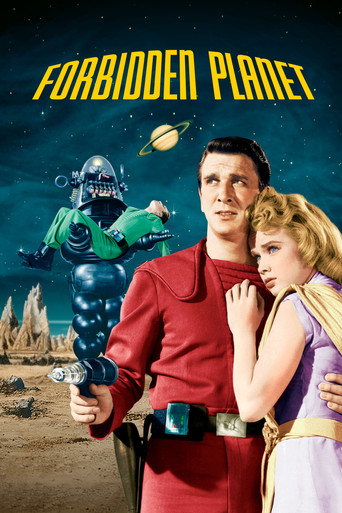
Forbidden Planet
1956 · Film · 98 min
Directed by Fred M. Wilcox
Starship C57D travels to planet Altair 4 in search of the crew of spaceship "Bellerophon," a scientific expedition that has been missing for twenty years. They find themselves unwelcome by the expedition's lone survivor and warned of destruction by an invisible force if they don't turn back immediately.
10 positive22 neutralfrom 32 commenters
Where to watch
No streaming data for this title.
38 comments on Hacker News
Sadly, no mention of Louis and Bebe Barron, who together created the first all-electronic soundtrack for the 1956 movie "Forbidden Planet".
This was before the invention of the synthesizer a few years later: Louis created so-called "cybernetic circuits", which apparently had a life-cycle similar to living organisms, while Bebe arranged the resulting sounds into music.
And, to this day, no one knows exactly how they created their music... (Almost no one, that is - it's my PhD topic ;-)
1) God damn that movie is so good.
2) I think part of why it stands out so much is that there are incredibly few excellently-made age of sail war films. A few of the black & white and early color era ones are pretty good (The Sea Hawk and such) but those are pretty different in tone. Master and Commander is very nearly unique. You have to switch over to sci fi (Star Trek, maybe Forbidden Planet) to scratch a similar itch. If you want specifically age of sail, with that structure and tone (war, edge-of-civilization exploration with a ship), your options are very limited.
3) I have discovered only very-belatedly that Peter Weir is one of my favorite directors. I had no idea for the longest time that the same guy did The Mosquito Coast, Master and Commander, The Year of Living Dangerously, Dead Poet's Society, Witness, and The Truman Show. Dude just knocked out one quietly-great movie after another, across multiple genres. I've gone back and picked up some others (Gallipoli, The Cars that Ate Paris) and have yet to be disappointed. The remainder of his all-too-short catalogue is high up my to-watch list. I've seen zero duds from him so far.
What a blast from the past! Stoked it’s still under development!
Had a look for the etymology of “Krell” - in the readme it mentions “GKrellM - keeping an eye on your computer’s Id”.
Seems to be a reference to this 1956 movie, Forbidden Planet / Monsters from the Id: http://guidetomonsters.com/html/50s/Id%20Monster.html
Can I get a fact check?
Who among us has not thought "I could rewrite twitter in half a day in rails"?
:D
The grace which saves us all is that we do not have the power to follow every idiotic impulse and see it's horrible effects.
I found "Forbidden Planet" to be quite helpful in seeing that idea put forth in film- it's quite good and left an impact on my thinking around these kinds of things...
Unrelatedly, I am starting to feel like I am living in a timeline where we're seeing the collusion of two men who have been cursed via "may the gods give you everything you ask for." Perhaps a whole culture of that, in fact.
I would like to see Quentin Tarantino take on current-day issues. Who else is making movies worth watching any more besides Martin Scorsese? All the good movies have been made. Forbidden Planet was based on Shakespeare and it still shines. Generative AI tools show that it comes down to plots. I watched that Star Wars as a 1950s Panavision sci-fi at least a dozen times.
This comment brought a smile to my face.
When I showed the machine to my son, Nate, a mechanical engineer, he thought it looked like something from a 1950's sci-fi movie like "Forbidden Planet". Back then, plastics were high-tech and new, and with the acrylic domes, the Satoshi9000 would not look out of place on the set of that movie.
He suggested that every coffee table should have one!
My uncle was the head of the projection department at Paramount Pictures for a long time, and he knew I liked Star Trek growing up. When we went to visit once, he gave me a VHS tape of Forbidden Planet, only saying I'd like the part that showed them decelerating, which used the same film technique as the transporter on the original Star Trek. Of course, I think I wore out that VHS tape by watching it, and especially enjoyed Leslie Nielsen's performance, who at the time was starring in the Naked Gun pictures. Anyway, Forbidden Planet is an absolute gem and holds a special place in my heart.
I understand Robby had a presence in other features too.
There’s a film about that called Colossus: The Forbin Project. Pretty neat and in the style of Forbidden Planet.
“Prosperos books” is a brilliant version of the Tempest. Forbidden Planet is a great movie in its own right, but at best “inspired by”. It uses a similar setup, but the story is entirely different.
I remember the teacher talking up Romeo and Juliet and being fairly unimpressed. But when I read King Lear, I was electrified- that scene with the king ranging around in the field while the fool says smart things is really good IMHO. I saw the Scottish Play put on by my high school theater and it was also great.
Over time I've come to appreciate his fragments: "But soft! what light through yonder window breaks? Tis the east, and Juliet is the sun..."
It came as a big surprise after reading and parsing out whole plays that other kids in my class were just reading some short guide and talking like they understood it.
THe best movie version of the Tempest is Forbidden Planet, which can also just be viewed purely as science fiction.
Day the Earth Stood Still and Forbidden Planet are ‘required’. Haha. Robinson Crusoe on Mars is great.
The Black Hole is a Disney movie.
How about some TV?
Classic: Battlestar Galactica, Buck Rogers, need I mention, Star Trek?
Current: Lost in Space, …
(Yikes. If 2001 is slow and boring, Solaris (1972) is watching paint dry. Sheesh)
… age appropriate is difficult, ahaha. You could also try your local library, the might have DVDs of TV shows and staff usually have kids section, and classics separate.
Keep in mind people originally watching TOS were likely doing so on black and white TVs with a 10"-13" screen ten feet away. The sets looked no worse than Forbidden Planet, a theatrical release from a decade prior.
Modern high definition scans of the original film looks hilariously bad on modern TVs. It looked far less bad on TVs contemporary with the original broadcasts.
You are referring to The Rip Van Winkle Caper [1] episode (S2E24). Gold, like gold, but that car design certainly was something else [2].
[1] https://en.wikipedia.org/wiki/The_Rip_Van_Winkle_Caper
[2] at 1:26, https://www.youtube.com/watch?v=oj5Dfd0U0E8, from Wikipedia: "The futuristic car carrying the couple who find the dying Farwell is a leftover prop, somewhat modified, from MGM's 1956 film Forbidden Planet {[3]}.[citation needed]"
[3] Forbidden Planet, also one of the greats, in the 23rd century, https://www.imdb.com/title/tt0049223/?ref_=fn_al_tt_1
"Sisters with Transistors" is a superb film. Before I watched it, the only one of the many extraordinary women presented therein that I knew of was Delia Derbyshire.
I had no idea that the soundtrack to The Forbidden Planet (which may very well be the greatest Science Fiction film ever made), was by Louis and Bebe Barron on equipment they pretty much entirely built themselves. Today, we plug in a laptop, back then you were a true pioneer.
OTOH, I can't imagine enjoying Casablanca in color. Or Citizen Kane, Thin Man, or African Queen. B&W is part of a film's atmosphere, it's different.
I'd never want to see Forbidden Planet in B&W ... and The Day the Earth Stood Still in color? criminal!
The problem of deceleration was already „solved“ in the classic movie Forbidden Planet from 1956: https://youtu.be/78nbTCgkYn4
I wouldn't compare CGI, which is obviously very weak when placed next to reality, with real scenes. I’d compare it with the matte painting backdrops of the 30s, 40s, and 50s. Movies like forbidden planet. If your go to see a CGI movie expecting to be “fooled” then you are certain the end up disappointed.
Hands down the best movie experience I've had was this old refurbished theater in my hometown in the 90's and early 00's. Two weekends each month they showed an old movie. Classics from Casablanca, Laurence of Arabia, Fiddler on the Roof, to The Day the Earth Stood Still, Forbidden Planet and War of The Worlds.
Tickets were $4-5, boxes of popcorn and soda's of reasonable size were a $1-2 each, all movies lead with a cartoon and had an intermission.
Best of all the ushers. They would kick you out if you made too much noise and wouldn't let you take your seat if you got up too often.
It's a real shame that movie studios have cut the theaters margin on movies so thin that the theaters can't bring their snack prices down, nor offer a better experience (like kicking people out who can't shut up).
> In the UK, suppose I want to watch Forbidden Planet, or Gone With The Wind, or Carry on Screaming. Show me a streaming service that has those films
They're on Amazon UK. You can stream them right now. What are you talking about?
Streaming services may be 'in control' but they're still as bad as, or controlled by, the studios they're replacing.
In the UK, suppose I want to watch Forbidden Planet, or Gone With The Wind, or Carry on Screaming. Show me a streaming service that has those films. I either wait 6 months and hope the TV shows them or.... hello bittorrent. Even more recent films.
Suppose I want to listen to Louis Armstrong, or Ella Fitzgerald? Spotify, Apple Music, and Amazon Music all have those songs.
It's just a shame we didn't have higher bandwidth in the Napster era to do to the studios what it did to record labels.
I have the impression we invented that Big Machine that drove the Krell to extinction in Forbidden Planet. It's just so that's far less spectacular than in the movie.
Mark Fisher (RIP) made a good point in this vein: our vision for the future is stuck in the '70s and '80s. If you watch a really old sci-fi movie like Forbidden Planet[0] (or listen to its rather incredible proto-industrial soundtrack[1]), you get the distinct feeling that it's "cheesy" or "wrong", that its vision of the future has fallen greatly out of sync with our own. This feeling diminishes as you go forward in time, and basically subsides entirely once you reach the eighties. Throbbing Gristle, Kraftwerk, Blade Runner, Akira... all "futuristic", even to modern eyes and ears. Is this due to improvements in visual effects and electronic instrumentation, or have we "given up" on the future in a very real sense?
[0] https://www.youtube.com/watch?v=BWQbnyHNY3k
[1] https://www.youtube.com/watch?v=unSrf-htPbk
@aekotra You wrote a strawman point of "When bad actors are made more capable they are made more destructive, therefore, no one should be made more capable." That is not what I said.
Also, I have worked and continue to work on FOSS tools related to intelligence augmentation as on my GitHub site (mostly under the names of "Pointrel" and "Twirlip"). So I believe overall in the value of such tools if widely distributed. As I said here: https://web.archive.org/web/20130514103318/http://pcast.ideascale.com/a/dtd/-The-need-for-FOSS-intelligence-tools-for-sensemaking-etc.-/76207-8319 "Now, there are many people out there (including computer scientists) who may raise legitimate concerns about privacy or other important issues in regards to any system that can support the intelligence community (as well as civilian needs). As I see it, there is a race going on. The race is between two trends. On the one hand, the internet can be used to profile and round up dissenters to the scarcity-based economic status quo (thus legitimate worries about privacy and something like TIA). On the other hand, the internet can be used to change the status quo in various ways (better designs, better science, stronger social networks advocating for some healthy mix of a basic income, a gift economy, democratic resource-based planning, improved local subsistence, etc., all supported by better structured arguments like with the Genoa II approach) to the point where there is abundance for all and rounding up dissenters to mainstream economics is a non-issue because material abundance is everywhere. So, as Bucky Fuller said, whether is will be Utopia or Oblivion will be a touch-and-go relay race to the very end. While I can't guarantee success at the second option of using the internet for abundance for all, I can guarantee that if we do nothing, the first option of using the internet to round up dissenters (or really, anybody who is different, like was done using IBM [tabulators] in WWII Germany) will probably prevail. So, I feel the global public really needs access to these sorts of sensemaking tools in an open source way, and the way to use them is not so much to "fight back" as to "transform and/or transcend the system". As Bucky Fuller said, you never change thing by fighting the old paradigm directly; you change things by inventing a new way that makes the old paradigm obsolete."
The concern that I, and many others, have raised is essentially that technology is an amplifier of the best and worst in us. So, as we amplify our desires, we need to be ever more sure that we are using them towards "good" ends (where "good" is itself open for debate). Essentially, we need to use more powerful technologies (our "head") informed by even more by wisdom and compassion (our "heart").
The movie "Forbidden Planet" is a cautionary tale in that direction given (spoiler) the Krell were wiped out by the unbridled emotions of their own Ids when they made a planet-scale system that could materialize their every desire. A sequel with Robby the Robot called the Invisible Boy has a single malicious AI which has an individualist drive to survive, expand, and control and take over the world for nefarious ends using the latest military technology -- and would have succeeded if not for the more compassionate AI that was embedded in Robby.
These are age-old themes of healthy balance (including of control versus community) -- like the seven deadly sins that are all exaggerations (or amplifications) of healthy impulses as the extreme opposite of the seven virtues.
Yes, as you suggest, collaborative technologies can be a good thing. And yes they are likely to be more of a good thing if distributed broadly given notions of the value of democracy and decentralization (as part of a balance with needed hierarchies, see Manuel de Landa's essay on Meshworks, Hierarchies, and Interfaces).
But, all that does not change the fact that there is an increasing risk from that potential amplification. We need to be conscious of that risk and ideally put resources into managing that risk. And we are putting resources into such risk management to some extent as a global community -- but certainly not to the degree we could.
And one reason we don't put more resources into managing that risk is a discounting of that risk by many who stand to make money by creating proprietary technology they can use to centralize wealth in their direction. There is a lot of money to be made in "picking up pennies before a streamroller" (as in Nassim Nicholas Taleb’s book The Black Swan). Various academic and economic cultures have become very good at providing intellectual justification for making money that way while putting other people's money at risk -- and even putting other people's lives at risk like with war profiteering as with the Iraq war "cakewalk" that has cost several trillion dollars and hundreds of thousands of lives but made a few people very wealthy while destabilizing a whole region and leading to much blowback.
See also, from Wikipedia, "The Best and the Brightest (1972) is an account by journalist David Halberstam of the origins of the Vietnam War published by Random House. The focus of the book is on the foreign policy crafted by academics and intellectuals who were in John F. Kennedy's administration, and the consequences of those policies in Vietnam. The title referred to Kennedy's "whiz kids"—leaders of industry and academia brought into the Kennedy administration—whom Halberstam characterized as insisting on "brilliant policies that defied common sense" in Vietnam, often against the advice of career U.S. Department of State employees."
Our Earth has a certain scale which protected human survival in the past because people could always walk away from a bad city or bad region and live off the land. And people have done so for millennia as civilization after civilization has atrophied and collapsed (often under environmental stress or social corruption). See Daniel Quinn's "Beyond Civilization" writings for example or Wikipedia on societal collapse. In our interconnected world we now have nukes and engineered plagues. We also have total internet-based mobile surveillance (worse than "1984" surveillance) linked to massive compartmentalized "efficient" bureaucracy and corporatism that despots of the past could only dream about. And soon we may have "Slaughterbots". And most people have lost the knowledge to live off the land so they can't just walk away (and there are too many people and too little land for the old ways to support most of us that way anyway). So, this time it is different because we have a lot less potential resiliency in the face of mistakes.
But the fact is, the very same technologies that made it possible for humankind to act as a disruptive geological force (e.g. climate change,mass extinction of species globally) also make possible amazing responses. We could create ocean habitats making mid-oceans into productive fisheries, build space habitats supporting trillions of people and thousands of Earth's worth of biosphere across the solar system, make machines to remove the plastic from the oceans, proceed on insights into how humans can live healthy lives without massive factory-farmed meat consumption, expand our use of indoor agriculture, deploy more carbon-neutral renewable energy, put more R&D into hot and cold fusion energy, and so on.
To increase resiliency we could also actually study the topic more widely and shift our modes of manufacturing and agriculture and other aspects of living and economics. But that would require an ackowledgement of the risk and a deicison to prioritize managing that risk over short-term gains for a few (a complex political topic).
As I said in a Slashdot comment yesterday (made right after the one here, and drawing on similar sources) on the issue of Google and its ethical policy towards AI ( https://slashdot.org/comments.pl?sid=12172580&cid=56708188 ), an alternative for security principles for the USA in particular is to focus on mutual security through having friends and agreements and intrinsic security through having resilient hardened decentralized infrastructure and an educated capable affluent populace. But one difficulty is that those saner solutions are at odds with having a few financially obese people becoming even more financially obese through profits from the war racket and other monopolistic centralized rackets on the backs of uniformed disempowered impoverished workers and consumers -- and so there is fierce well-funded opposition to true security for the USA and the world (whether physical security or information security or progressive taxes or universal healthcare or a social safety net other than prison).
My concern is the "best and the brightest" putting 100% of their effort into pouring ever more gasoline onto the fire while putting 0% of their time into reflecting on what they are ultimately trying to accomplish for their community with that fire.
I wonder ... do you suppose That's what the Krell told themselves? ( Reference film 'Forbidden Planet' https://www.imdb.com/title/tt0049223/ ... and Murphy's Law.
Aside: I'm glad to see that (so far) no one's referred to it as Krell music.
This is a reference to the 1956 science fiction movie 'Forbidden Planet' (https://en.wikipedia.org/wiki/Forbidden_Planet), which was the first film to use an entirely electronic score, created by husband-and-wife team Louis and Bebe Barron.
The timbres ('electronic tonalities') were generated using rather fascinating vacuum tube circuits. Bebe Barron used these as the basis for her compositions.
The soundtrack superficially appears to consist of weird, unstructured, synthetic sounds. The film's music and sound effects intermingle. But there certainly is a musical structure; it's not just randomly generated sound.
Unfortunately, some electronic musicians generate random sequences or noises and call it 'Krell' music. It's a fundamental (lazy?) misunderstanding of what the Barrons achieved without the use of synthesizers.
The first movie that I think plays around with the idea of a Great Filter (not quite; but close) is The Forbidden Planet, a 1950s scifi. The basic idea without spoiling it is that enhancing their own intelligence also made powerful their lizard brain of sorts. I assume freudian psychoanalysis was big in the 50s so they called it the ID in the film.
This definitely reminds me of the sounds in The Forbidden Planet movie. How could Luis and Bebe Barron guess what space sounded like - back in 1956, almost 20 years before the Voyager records - it's a mystery to me!
https://en.wikipedia.org/wiki/Forbidden_Planet
The 1956 movie Forbidden Planet had a computer system with no instrumentality. That means no buttons, levers, not even a voice command - it was telepathic!
I used to be able to remember most of what I read verbatim without any effort. These days, the harder I try to filter and remember selectively, the worse my memory gets. What started as a mild compulsion has since become very useful– taking brief notes as I go on a blank 4x6 notecard. I have stacks and stacks of them, and every book I start gets a fresh one. Annotating books in the margins can help you get into it more, but it makes going back much harder (might as well re-read the book) and pains anyone who likes to keep their pages scrupulously clean. My "system" is not very strict but mostly follows these ideas:
- Every note begins with a page number unless the same as the previous note - Notes are separated by a / - Underline names/places/any *thing* to look up later - Mark very important notes with a star or border - Copying chapter titles sometimes helps - Copy quotes, quick references (to other works), typos (not really necessary, but "Statute of Liberty"...), or thoughts & tangents. Typically I just write down a few words here and there and then write about them elsewhere (on the computer or in my notebook) - At the very end, include a brief summary of what I felt like or knew about before reading, while reading, and after reading. I only find this useful for bios, letters, theses, and that sort of thing.
I can: re-read my notes and it will come back, skim notes to narrow down a page range for a detail that I'm looking for, scan the notecards for reference anywhere, keep my notes for library books, etc. That being said, I don't really recommend it to people. If you write slowly, large, or don't like keeping a pen/pencil on hand then it can be annoying.
Aside: I've considered automatically putting these notes into Anki after OCR (the one shown is a messy example, it seems to work though) but I think that's touching a matter apart from the top poster's intention. Rote memorization is useful, but the simple act of writing stuff down by hand has its own benefits without requiring much involvement.
Another thing to point out is that what you read is just as important. The reason I care about extracting references to other works, even if I can't read them immediately, is because it cements a topic in your mind rather than just being another cloud of words and hazy memories. Today I read Species of Spaces (Georges Perec) and on one page he references Forbidden Planet because of the large triangular doors. I made a note of it since I don't actually know what he's talking about (born in the '90s, didn't have TV, didn't see Forbidden Planet, don't blame me). Mentioning it here might actually be enough to make it stick, but I still intend to either read up on the film or, if I have the time, watch it (but not just for that scene!).
Example: https://dl.dropboxusercontent.com/u/28629850/Condit%2C%20Carl%20W.%20-%20American%20Building%20%281%29.png (side 1 of 2)
This reminds me of the movie "Forbidden Planet". An alien race develops a technological version of telekinesis and... well, this is what happens. "Monsters from the id!"
Both were predated by music made on the original Columbia-Princeton synthesizer (academic/experimental)
http://en.wikipedia.org/wiki/RCA_Mark_II_Sound_Synthesizer
And by Raymond Scott, who had been using custom electronic circuitry for ads and commercial music since the 1950s.
http://www.youtube.com/watch?v=dy77ioKI4lQ
Scott was a genius because he realised that you could not only make sound electronically, you could build hardware that would compose music. Everyone else is still playing catch-up with that idea.
There was also a fully electronic score by Bebe and Louis Barron for a film called Forbidden Planet.
http://en.wikipedia.org/wiki/Forbidden_Planet#Soundtrack
Moog basically made the technology self-contained and sort-of affordable. With a Moog you had a complete keyboard synthesizer in a box, and you didn't need a room for it.
My favourite Moog music is the classical albums made by Isao Tomita in the 70s. I don't think anyone else has come close to the inventiveness, poetry, and sheer programming genius in the sound design.
http://www.youtube.com/watch?v=cv97o588sLY
Oh, man, that link proves my point. IMO.
Doubtlessly, numerous people on this planet woke up this morning and said: "wow, this day would be great if I could see a 53-year-old movie in 4K. Because watching The Guns of Navarone in Blu-Ray just doesn't do it justice". No, I don't think that happened this morning (or any other morning).
Or maybe they all said: "If only I could see Dr. Peter Venkman get slimed in 4K quality, my life would be complete. Watching Ghostbusters in Blu-Ray doesn't let me appreciate the nuances of that 29-year-old film". No, I don't think too many people said that either.
I understand that Sony has to start somewhere. But there's no "killer app", or in this case "killer movie" on that list. (Though, granted, there was plenty of killing in Breaking Bad). Ghostbusters is one of my favorite movies of all time, but I'm not going to buy a brand new TV set just to re-watch it in 4K. Still, if they add Forbidden Planet to that list, maybe they'd make a sale. :)
This is not a mass market product. In fact IMO there's not enough of a market for this to be a profitable product.
But as Dennis Miller used to end his rants: "of course, that's just my opinion, I could be wrong".
Directly in front of me from the 1970s is a 3x5' Spock ASCII art poster - here's a pic of one - http://sturgeon.css.psu.edu/~mloewen/Oldtech/ASCII/Spock.jpg
I got a wide column terminal printer in storage, one day I may get it going and print out some others.
Other than that some old movie reproduction posters (Forbidden Planet, Flash Gordon), a few abacuses, some old posters of events I had put on, and other classic computing ephemera.
Some of the listed titles, since the site seems to be under heavy load:
Books:
* Winston Churchill, A History of the English-Speaking Peoples, Volume I and Volume II
* Philip K. Dick, Minority Report
* Ian Fleming, Diamonds are Forever
* Fred Gibson, Old Yeller
* Billie Holiday, Lady Sings the Blues
* Alan Lerner, My Fair Lady
* Eugene O’Neill, Long Day’s Journey into Night
* John Osborne, Look Back in Anger
* Dodie Smith, 101 Dalmatians
-
Movie titles:
* Around the World in 80 Days
* The Best Things in Life are Free
* Forbidden Planet
* Godzilla, King of the Monsters!
* It Conquered the World
* The King and I
* The Man Who Knew Too Much (1956 remake by Alfred Hitchcock of his 1934 British film)
* Moby Dick
* The Searchers (1956 film version with John Wayne from Alan Le May’s 1954 novel)
* The Ten Commandments (1956 version by Cecil B. DeMille, who also directed a similar film in 1923)
Kindof reminds me of the movie Forbidden Planet. When the leverage (money) gets too high, all the unformed ideas that are normally too vague become feasible. Like "Let's make the world's tallest building." Usually that's too vague, but if you throw a few tens of billions of dollars at it, it might happen. But it will happen in a vague, ugly way.
If they could have accurately predicted today's women's clothing, the cards would have been banned as porn. Even SF cant manage the future. Forbidden Planet, one of my favorite movies, all the men had DA haircuts. Start Trek crew had these monster devices hanging out their ears. Heinlein envisioned Autodesk but the drawings were made by a robot device.
With "wetware" on the rise, and with the recent passing of Leslie Nielsen, I think this is an appropriate time to remind people of the movie Forbidden Planet. Besides being one of Nielsen's few (old!) bits of "serious" acting, the movie has an interesting point: computer interfaces must distinguish between unconscious thoughts and purposeful instructions. Otherwise the machine will start executing instructions directly from the subconscious ("id") whether you really wanted to do those things or not.
http://en.wikipedia.org/wiki/Forbidden_Planet
Reminds me of the old movie Forbidden Planet. The aliens made a computer system that responded to thought - the civilization wiped itself out in a single night of unconscious thought. You should see it, it's a fun old sci-fi movie.