 Hacker Cinema
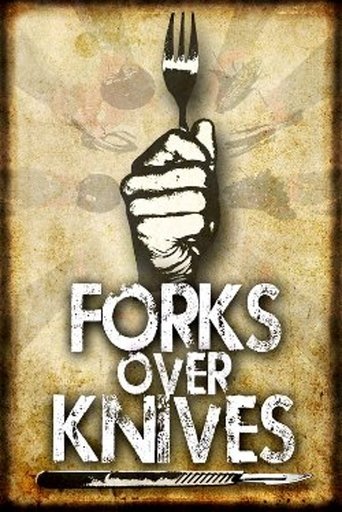
Forks Over Knives
2011 · Film · documentary · 90 min
Directed by Lee Fulkerson
Examines the profound claim that most; if not all; of the degenerative diseases that afflict us can be controlled; or even reversed; by rejecting our present menu of animal-based and processed foods. The idea of food as medicine is put to the test. Cameras follow "reality patients" who have chronic conditions from heart disease to diabetes. Doctors teach these patients how to adopt a whole-foods, plant-based diet as the primary approach to treat their ailments - while the challenges and triumphs of their journeys are revealed.
16 positive2 negative1 mixed3 neutralfrom 22 commenters
Where to watch
No streaming data for this title.
Videos commenters linked
From YouTube links in the comments below. Most are clips and trailers; “Full” means the uploader says so.




25 comments on Hacker News
Are you sure about this? There is data to back it up in The China Study https://en.wikipedia.org/wiki/The_China_Study and mentioned in the Forks over Knives documentary. That's more about prevention, but it has a measurable impact on cancer rates, I don't see how that could be classified as no impact.
The link between animal protein was investigated in some detail in the China Study. Also in the documentary Forks Over Knives. Evidence found that there were “diseases of the west” that correlated with the western diet. Since then, the Cleveland Clinic has used plant-based diets to reverse heart disease successfully. Other programs use it reverse heart disease.
The book How Not to Die covers many of the top killer diseases in the US and what food are best and worst to eat to avoid those fates based on reviews of scientific literature. The trend thoughtout is that plant-based diets fare best. Not surprising that this correlates with Blue Zone diets.
The book Fiber Fueled looks the science of gut health and what foods are best for gut health. The answer: a variety of plant foods.
As a study size of one, I’ve personally been able to recover quickly enough to do 6 26.2+ mile runs in six months in my forties. I think that would difficult and injury prone on a high-inflammation diet.
I don't supplement and have been vegan for a decade, and a vegetarian for 5 years before that. My yearly blood tests show everything has been fine since day one. I eat what most people do, just the vegan version. Luckily plant-based meat alternatives are everywhere these days.
A lot of the nutritional misinformation out there is deliberate to scare people off. It's not a conspiracy theory to say that the meat and dairy industries spend millions promoting their products and scaring people off vegetarian and vegan diets.
My advice is to watch the documentary Forks Over Knives and maybe read the corresponding book, The China Study. I personally avoid vegan websites and groups as their meals are super complicated to make. I don't have time for that.
Map out your fave meals then looks at how to make them vegan. It's super easy and you really don't have to worry about nutrients etc. People have been desperately searching for some nutrient that negates a vegan diet, and they think they found one in B12. They have not. 40% of Americans are B12 deficient, and this is after livestock being pumped full of B12 supplements themselves!
Same author did this:
Forks Over Knives Documentary: Debunked with Real Science [1]
[1] https://www.doctorkiltz.com/forks-over-knives-debunked/
Actually, just put this in google: Liam McAuliffe site:doctorkiltz.com
Getting the vegan message across is incredibly difficult. I don’t image many non-vegans would watch or be converted by this film.
The two documentaries that made me go vegan were:
- Forks Over Knives - Earthlings
I’d recommend them to anyone who wants to elevate their morality.
Sounds like he adopted the diet that Dr. Esselstyn recommends (http://www.dresselstyn.com/site/). There’s an excellent documentary, Forks over Knives, about his approach and he’s written a book that is awesome.
Human evolution is poorly understood, and the assumption that any choice $X supposedly made by early humans led to our forefathers’ anamolously rapid brain development is flatly speculative.
> Unlike most great apes today, whose diet is primarily plant based, we can thank the incredible nutrient density in meat and our incredible hunting and tool creating ability for prefrontal cortex development.
Complete and utter speculation.
> We were pack hunters, forging tools and strategies capable of taking down mammoths. Call it 'diabolicaly evil' if you want, but this is simply nature and survival.
Subsistence hunting amongst early human tribes is not comparable to modern day factory farming in any conceivable way.
B12 doesn’t come from eating plants OR animals: it comes from bacteria, and ironically that bacteria is in such short supply on factory farms that the animals need to be injected with synthetic B12.
> I don't personally believe highly processed plant alternatives such as Beyond meat are a long term option if you're even vaguely interested in your own health.
I eat raw soybeans, legumes, grains, nuts and seeds. I’d recommend watching the documentary Forks Over Knives [1] if you care about your personal health, and the documentary Dominion [2], if you’d like to see what really happens on factory farms.
[1]: https://www.youtube.com/watch?v=YtnlwqEii2I
[2]: https://www.youtube.com/watch?v=LQRAfJyEsko
I'm not here to be your enemy, so please don't make me out to be one. I wasn't raised vegetarian by any means, and I know fully well meat tastes amazingly good, and that having a varied diet is important. But heart disease, diabetes and many types of cancers are worryingly linked with the consumption of meat, dairy and eggs. As the documentary Forks Over Knives [1] makes abundantly clear, a whole foods plant-based diet is in every way a life extension technology.
> Is that something to be ashamed of?
Wanting to feel satiated is nothing to be ashamed of. What is arguably shameful, however, is how the bacon gets made [2].
[1]: https://www.youtube.com/watch?v=YtnlwqEii2I
[2]: https://www.youtube.com/watch?v=LQRAfJyEsko
It's not commonly known but Vegetables, Grains and Beans are extremely excellent sources of protein. Most of them have between 10-20% or more of their calories from protein. if you want exact numbers, check out this: https://kale.world/c
And, if people reduce their meat consumption form these shortages, it could have excellent results on people's health. The last time a country went completely without meat or dairy was in durring the world war, when the Nazis took all the dairy and meat from Sweden. Their rate of heart disease went down dramatically for many years. As soon as the war ended and meat returned, the rate of heart disease sky rocketed back to the original numbers. (source: Forks over knives, a netflix documentary).
on google you can find some: https://www.webmd.com/prostate-cancer/news/20051206/lots-of-dairy-linked-to-prostate-cancer#1
https://www.ncbi.nlm.nih.gov/pubmed/11566656
But, I remember hearing about it from the talks that Dr Milton Mills (Associate Director of Preventive Medicine with the Physicians Committee for Responsible Medicine (PCRM)) gave.
And, i've heard it in other places as well. For instance in Forks over Knives (the documentary), they were saying that in Japan there 17 cases of prostate cancer (before they started eating dairy) in the entire country, when in the US there was something like 15000.
And, then there was the China study, also mentioned in that documentary. there's some fairly compelling stuff in that documentary, it blew my mind.
Fundamentally a documentary is trying to sell a narrative using documentary cinematic style.
Now sometimes this is mostly benign or even "good." Such as detailing an event in a in-depth matter-of-fact style. Works such as the early Planet Earth series are simply trying to capture and show the wonder of life around the planet! And maybe hopefully encourage you to try and protect them as a secondary upshot. As time has gone on, they've produced works are that much more blatant with their "save the environment" messaging.
However, most of the most popular ones have a significant editorial bias. Heck, one of the first landmark pieces, Nanook of the North, was almost completely fabricated! Often quite easy to spot as well. Some are very up front about their bias, such as Michael Moore's work. Some less so, such as the editorial narrative in features like Forks over Knives or Blackfish. And some it's quite subtle. The recent Making of a Murderer comes to mind where certain facts weren't presented and it's framed in a very sympathetic light towards the defendants. Sure they have a lot of true facts within them. And often you learn quite a bit! But they are often presented in a particular fashion or certain points are talked up while others are ignored or not presented.
It's an unfortunate thing, but even the most innocuous of documentaries have some small bias. And it's up to the user to try and understand how much is narrative editorializing and how much is "truth." It's all part of making the documentary feel more true and tap into our need for a strong narrative arc via romanticizing the story we see unfold.
Healthiest way to go about it is to go low-fat, high carb. The body uses glucose for energy most easily. Whole-foods plant based diets, as shown in documentaries like Forks Over Knives, have been shown to let people lose weight and reverse diseases like diabetes. A cooked carb like a potato or rice is like 1 calorie/gram, including the water. Oil is 9 calories/gram. Without oil, sheer food volume and fiber will make you feel full. A huge portion of the world thrives on grains and legumes as staples.
Here, even in super expensive CA, In college I got by with less than 2-3$ per day on rolled oats (70c per lb), Onions, potatoes, flax seeds, green peppers, bananas, whole wheat flour etc, all of which were less than 1$ per lb if you go to the right stores (for example Sprouts).
Going to McDonalds is much more expensive, something like 20$ per day!
With the proper education, you can eat cost effectively and very healthily. And, I know it's really controversial to say this because of the decades of conditioning we've received from the dairy and meat industry, but Meat and Dairy aren't needed in the diet, and have been shown to even cause cancer, heart disease and heart stroke for many. (source Forks over Knives, the documentary, plus the China study -> check it out, seriously.)
Isn't arterial calcification still considered irreversible? Arterial obstruction due to cholesterol is known to be reversible with a change of diet, check the work of Dr. Esselstyn from the Cleveland cardiology clinic.
But in one of the interviews, I think in the documentary Forks over Knives (several years back) he mentioned that calcium deposits cannot be reversed.
After watching the documentary Forks Over Knives and reading The China Study, I switched to a whole food plant based diet two years ago. The experimental, clinical, and epidemiological evidence convinced me of the danger of eating animal products. I dropped 20 pounds without even trying and my weight is stable. I walk for 20 minutes at lunch on weekdays. My cholesterol is under 150. I feel more energetic and my mood is slightly better. I occasionally eat animal products, for example when I eat at my mother’s house.
Forks over Knives. Details the findings of an extensive string of studies on the consumption of animal protien. What is not covered in this particular documentary was how the US government was about to change thier food recommendations in 1977 but was stopped by agricultural power brokers invested in meat production. Uphill battle ever since but we can see exploding diabetes, heart disease, and cancer--all demonstrated as controllable I the studies talked about in this documentary. Changed my life.
Another movie is "Forks Over Knives" on Netflix. That one is more about going to whole foods rather than just cutting out sugar.
If you want to get the "team vegan" take on reversing type 2 diabetes with diet then watch Forks Over Knives on Netflix. Its actually not a purely vegan film like everyone claims, because the doctors talk about limiting meat (e.g. 5% meat intake), if not completely removing.
Check out the documentary "Forks Over Knives" for great information about the health benefits of a vegan (whole food plant based) diet. The title makes reference to how much better it is to prevent (and even treat) many chronic health conditions with the fork rather than the surgeons knife.
Yes. Went from omnivore to vegan overnight, stayed that way for two years, and then went vegetarian three years ago. No meat since Jan. 3rd 2012.
When my wife and I took the plunge I had been eating lots of meat at lunches...mostly in sandwich form and we had been unintentionally transitioning from all meat to chicken and fish to mostly just fish at home for dinners...wife's preference for fish over other meat drove that.
Then we watched the documentary "Forks Over Knives" and, regardless of the scientific accuracy of the film, said "Why don't we try going vegan for a month and see what happens".
So after a New Years trip to see family in LA where we are a ton of meat we drove home and then...never ate meat again. After the first month "test" we asked each other if we should try it again for another month, agreed to do it, and then never asked again.
Over the holiday break in 2014 we ended up eating a bunch of eggs and decided we really wanted eggs and cheese, so we ditched the veganism and went vegetarian. We probably eat 80% of our dinners as vegan still, unintentionally, but we don't feel bad about eating cheese anymore.
One quick tip if you try to be vegan...be flexible if your not doing it from a moral standpoint. If I ordered a sandwich and they accidentally put mayo on it, I just ate it anyway. If a coworker brought cookies or cake, I ate it. I didn't ditch my shoes or belt. True vegans would probably be appalled, but life is so much easier if you go with the flow. Try to stick to it, but don't fuss or worry about the occasional lapse.
Hell, I know plenty of vegetarians that are 99.9% vegetarian but occassionally grab a slice of pepperoni pizza or slice of bacon or whatever. There aren't any rules...it's a personal decision. Do what makes you happy.
This complaint of "Why can't these scientists make up their minds?" is addressed well in the book "The China Study" ("Forks Over Knives" was the movie sequel to this book).
Before you are two conflicting research papers. One says eggs are bad, the other that they are good. One paper came from The American Poultry Society, and the other from The Poultry Research Institute (those are made up names for the sake of argument). One of those organizations is full of industry shills, and the other is actually doing legitimate research. Every few years, they release papers which contradict the another, in an endless arms race.
The problem which the consumer is faced with is: which is which?
This is a pretty ground-breaking study, and do hope it gets much wider coverage in mainstream media. I had earlier read the book by the lead author of this study Dr. Esselstyn, "Prevent and reverse heart disease", which describes the plant-based diet approach and research done earlier that was effective with a group of 22 patients with terminal heart disease. Also, recommend reading related work on diet-based approaches by Dean Ornish. Ornish's approach does allow the use of some diary, eggs, and some amount of oil.
The documentary "Forks over knives" - available on Netflix, describes this approach and has features interviews with Esselstyn as well.
More useful links:
[1] http://en.wikipedia.org/wiki/Caldwell_Esselstyn [2] http://en.wikipedia.org/wiki/The_China_Study
I was going to post a link to this movie. I think they have it on AMZN Prime. Netflix has it. It's pretty inspirational, and discusses a great way to eat.
Another one of interest is Forks Over Knives, which talks about the benefits of eating a mostly plant based diet.
http://www.forksoverknives.com/
I enjoyed Forks Over Knives but as with any documentary there is always a bias. I would recommend taking a look at this write-up in response to the film: http://rawfoodsos.com/2011/09/22/forks-over-knives-is-the-science-legit-a-review-and-critique/
Just one anecdote on that point. I'm pre-med and I recently shadowed the director of cardiac research (a cardiac surgeon) at the big hospital/medical school in this area. He was asked point-blank by a patient, "I've been reading that with diet and exercise I might be able to reverse my heart disease. What do you think?"
The doctor's answer was, "Absolutely not."
This is one data point, so it's hardly conclusive, but coming from a doctor who (a) teaches doctors and therefore plants seeds for the next generation and (b) should be an expert on new medical treatments with his position as the director of research, it's troubling.
Meanwhile, there is a growing minority of doctors who take patients through an eating "bootcamp" where they help them take out processed foods/white-flour/high-fructose corn syrup from their diet, teach them how to shop and cook plant-based foods, etc. I saw a documentary on it, "Forks Over Knives" I believe. Fascinating stuff.
In the documentary, they take a man with advanced heart disease, cut out all meat/dairy/processed foods from his diet, and take before-and-after blood readings (cholesterol, blood pressure, etc.). It was surprising how quickly the intervention reversed his numbers.
There are other pioneers working in this area. There's Dr. Terry Wahls, an MD who reversed her multiple sclerosis by eating what some would call a "paleo" diet (only vegetables, fruits, nuts, meat). Here's her TED talk if you're interested: http://www.youtube.com/watch?v=KLjgBLwH3Wc She's currently working on human clinical trials to test this diet-intervention in other patients.
To your point, "all doctors say eat better, etc." I have two thoughts.
1. I'm glad you have doctors who have mentioned that but I've never had that experience.
2. A doctor who says, "You really need to eat better," is not quite what we need. For reversible conditions like heart disease, diabetes, (MS?) etc we need doctors who say, "Your next appointment will be with a food specialist/nutritionist. He will help you completely change your eating habits, go shopping with you to get new staple-foods, and you will stick to this new lifestyle for x months. Here's a list of foods you must not eat and here are x great-tasting recipes that are easy to make. Come back in 6 weeks and we'll do another round of blood-tests to see how it's working. If you're not willing to do this I can give you [statins, etc. fill-in-the-drug] but they won't actually treat the disease and may not make you feel better. They will keep you alive though. It's totally up to you and I'll support you in either decision."
Just my 2 cents. I think medicine will eventually look more and more like this, but it will take time to change the culture and the traditions of western medicine.