 Hacker Cinema
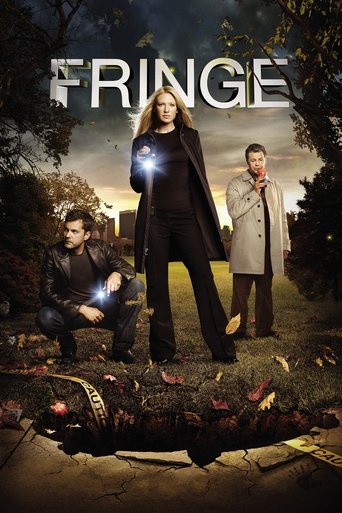
Fringe
2008 · TV series · 5 seasons
Created by Alex Kurtzman, Roberto Orci, J.J. Abrams
Science FictionFantasyDramaMystery
FBI Special Agent Olivia Dunham, brilliant but formerly institutionalized scientist Walter Bishop and his scheming, reluctant son Peter uncover a deadly mystery involving a series of unbelievable events and realize they may be a part of a larger, more disturbing pattern that blurs the line between science fiction and technology.
22 positive7 negative3 mixed28 neutralfrom 60 commenters
Where to watch
No streaming data for this title.
65 comments on Hacker News
besides already recommended Fringe, Millennium and Halt and catch fire I enjoyed at same time as X Files in 90s also new Outer Limits, opening credits were great and episodes are always thought challenging, I'm just rewatching it and still enjoy it, though technical quality is horrible since I think FHD was never released
but if you wanna straight up X Files just based on 50s check out Project Blue Book, it's like retro X Files, you won't get closer than that to X Files
Fringe was kind of a remake of The X-Files. It wasn't an exact copy but clearly derivative. Still a decent show.
https://www.imdb.com/title/tt1119644/
Loved him on Fringe.
The economics of movies, tv etc are changing. If the Warner Bros purchase goes through it will only get worse. The debt load the acquiring company will have will increase pressure on actor paydays. And let’s not forget who is controlling the company. It will be ugly.
> We are all the sorcerer's apprentice
Back in the mists of time at BigCo internship day1, the incoming cohort of interns was briefed by outgoing cohort, without managers present. One of their pearls of wisdom was that a great manager (and by extension, team) could lead and defend an oasis of excellence in a desert of industry detritus. Today, this dynamic can also be seen in serial founding teams and spinoff projects.
If time is more spiral than linear, then cyclical patterns are not merely swings of a pendulum, but a recursive opportunity for redemption or relapse. In that worldview, merely waiting would be enough to experience a different set of local maxima. But human actors with agency can move to new contexts instead of waiting for cyclical change, or work with peers to spark new cycles.
Stargate/Fringe/Eureka posit multiple universes and versions of ourselves, each universe further having multiple timelines. If it were possible for us to see an infinite tapestry of futures, would we be invigorated or paralyzed by choice? Looking in the other direction, we have access to the near-infinite, unfinished work of our ancestors, some of whom deserve the sorcerer moniker.
One way to gain perspective on local minima/maxima is to step back to a different scale of time or space. The classic film "Powers of 10" [1] offers a spatial perspective. There are history of technology books which span decades to centuries, showing recurring patterns of both good and bad. One tiny example is the decoding of the Maya language, which was unsolved for centuries, then cracked by an art history teacher on vacation.
There is a 1930s sci-fi book [2] which spans 2 billion years and many generations of humans going through cycles of technology and social structures. The successor book has an even longer timeframe. As a thought exercise, it leaves one with the impression that everything has already happened before, and will happen again, but slightly differently in future spirals of time and space. Where does that leave mortal humans prioritizing action within finite lifespans?
If we can't find a sorcerer from whom to learn, we can choose which sorcery we want to teach. Be the change.
> For every story about how tech is improving lives, you hear another two about yet another horrible dystopian usecase for the same technology, and it's never hard to imagine a dozen more.
If one looks into the history of tech, they can find initially benevolent tech that was twisted into dystopian purposes. But there are also examples of tech designed for one purpose, later adapted to positive use. Even hostile social media can be tamed by manually curated lists of non-hostile writers. With the proliferation of open-source, it has never been easier to Embrace & Extend, or harder to choose a direction.
If you have the space/time/tools to build something tangible that fuses software with the physical world, it can combine the dream-catcher inspiration of software with physical constraint. If lacking inspiration, recreate a pioneering tech demo or meet a hyper-local need, then extend that foundation.
[1] "Powers of 10", https://www.youtube.com/watch?v=0fKBhvDjuy0
[2] https://en.wikipedia.org/wiki/Last_and_First_Men
[3] "Only those questions that are in principle undecidable, we can decide." --Heinz von Foerster https://news.ycombinator.com/item?id=8018832
My most (deliberately) rewatched movies include:
* Breakfast Club
* Rosencrantz and Guildenstern are Dead
* Penn and Teller Get Killed
* Chungking Express
* Pink Floyd PULSE
* Black People Hate Me and They Hate My Glasses
* Pulp Fiction
* Fringe (not a movie)
You can probably identity my real identity from this list alone. YOLO.
Try this: look up the most highly rated episodes on IMDB and watch only those. Missing the crummy episodes usually does not interfere with understanding the story arc. Often, I set a minimum IMDB score that I will watch, like 8.5 or 9.0 to capture only the best. This works well with series that:
- take a year or two to find their footing or
- have a large cast (some mediocre) that get their own story lines of no consequence occasionally or
- introduce cast members that don't make it or
- implode towards the final season.
I have done this for many series that are somewhat uneven:
- The Americans
- How I Met Your Mother
- Fringe
- Orphan Black
- Halt and Catch Fire
- House of Cards (watching the ratings allows you to miss all of season 6)
- Arrested Development
- Bojack Horseman
- Veep
- 30 Rock
- Jane the Virgin
- Black Mirror
- The Marvelous Mrs. Maisel
- Suits
- Six Feet Under
- La Femme Nikita
- The Blacklist
- Peaky Blinders
- The Romanoffs
- Ozark
- Westworld (sometimes dropping episodes does not matter)
- Succession
- Borgen
And all of these series have lots of strong episodes.
Series I would not do this with:
- The Bear
- Breaking Bad
- Money Heist
- The Serpent
- Fleabag
- Chernobyl
- The White Lotus
Graham Roland: https://m.imdb.com/name/nm3169366/
Enjoyed LOST and Fringe.
Jack Ryan seasons tended to start off strong, but then lose my interest as they got to the end. To be fair, that's also true of their source: the beginnings of Tom Clancy books are more interesting than their resolution.
We'll see.
Hopefully this doesn't go Altered Carbon and decide "This bit is too complicated for the audience, so we'll rewrite it." (Envoys were UN black ops used for civilian unrest suppression, some of whom defected, which was way more interesting than TV's "they're rebels")
Edit: What happened to Gibson being historically unwilling to sell media rights, after dissatisfaction with previous attempts?
And also, reference to the New Rose Hotel movie that was supposedly Gibson's fave: https://m.imdb.com/title/tt0133122/
It is a personality trait I identify with, made more stark because my wife is quite the opposite.
IMHO, good fiction asks us to suspend our disbelief to create a novel setting and unique circumstances. Having accepted that, we still expect the world to behave according to its own logic.
Bad fiction abuses the suspension of disbelief, and it rubs people like me (and the gp) wrong.
In this case, it is a silly short story, so it doesn't bother me much. On the other hand, complaining about TV shows and movies can practically become a sport with the the right company.
For example, I quite enjoyed the Netflix movie Spectral, right up until the end, where they tried too hard to explain the mystery and violated things that I had not suspended my disbelief about. The TV show Fringe had a ton of these moments as well. Some were easy to accept, some episodes were painful to get through.
Makes for an intriguing concept in a tv show set in an alternate universe (Fringe?), where file extensions are not in the name but in the attributes of the file.
You would not need to hide file extensions then.
Heh. I literally just tabbed away from watching an episode of Fringe[1] to check HN. I didn't expect to walk right into a Walter Bishop reference.
You make a good point though: what do you do with somebody like Walter who is simultaneously A. batshit crazy and B. a genius? I guess the Fringe approach of having people (Astrid, Peter, etc) to "babysit" him most of the time is one approach, but it probably doesn't scale. And one slip-up could result in... well, the end of the world in the fictional case. Hopefully nothing quite so dramatic is at stake here in our real (??) world.
Just don't let the crazy guy keep a cow in the office...
[1]: https://en.wikipedia.org/wiki/Night_of_Desirable_Objects
Streaming services have already stopped publishing entire seasons, going back to the TV model of an episode a week. This is to prevent people from subscribing to a service, watching a whole season, then canceling the service.
But that still lets people wait until the whole season is over, watch it, then cancel. To avoid that behavior, IMO streaming will move more and more to the TV model: it's available for a limited time, maybe 1 week, maybe the last few episodes, then it's removed. If you want to watch the old stuff, pay more, either by the episode, by the season, etc. Amazon is already doing that with Fringe for example: you can watch Season 1 at no cost, but the other seasons will cost you.
Media companies are gross. It's a damn shame the media producers didn't just put all their shit on Netflix for one low price, but greed all around would have likely never let that work either.
This reminds me of a line from the TV show "Fringe" Pilot episode, which freaks me out to this day:
"How long has he been dead?"
"About five hours."
"...Question him."
My other Four:
o Firefly - no brainer. Brilliant. o Battlestar Galactica - Has some issues mid-late course, but still pretty end-end enthralling. o Dark (I keep re-watching this over and over every few months. I have many notebook pages full of analysis. Seriously good SciFi for the most part.) o Altered Carbon (mostly Season 1 - but Season 2 was okay)
Big Recommendation:
Not really science fiction (even bigger themes explored) but far superior in terms of overall quality of work/screen writing, and has a similar "concept" that a lot of supposed science fiction shows have - "The Leftovers" - Which I put on my list of the 5 most brilliant things on Television (Sopranos/The Wire/Deadwood/Breaking Bad being the other 4).
I'll give a honorable mention to stuff I loved but I can't totally recommends:
o Travelers - I'm a sucker for a good Time Travel Show. o Foundation - Pretty - I watch it, but I totally would never recommend it. o Fringe - Wow - was totally into this. Definitely an acquired taste though. o Raised By Wolves - Interested in where it's going. Could entirely suck eventually I guess. o Black Mirror - Hit and miss, though hits often enough that I keep coming back to it. o WestWorld - I mean, we all watched it. Season 1 was *awesome* if you watched it in realtime and didn't read all the internet commentary when the aha moment hit you. Season 2 was pretty good as well IMHO. Season 3 was just dreck where the screen writing tanked *but* it paid an *awesome* homage to the very last of the Foundation Novels to bring it all home.
The TV mini-series "Secret City" (https://www.imdb.com/title/tt4976512/) was courageous in its depiction of the growing surveillance state in Australia.
(And it stars Anna Torv, from "Fringe", but with her native accent! ;-)
Here “alt” is being used as an abbreviation of “alternate” - I am pretty sure it’s not proper English, just flows better if your going to have to use the word a lot.
I really like how the TV show Fringe named some of the alternate versions of the main characters - Walter and Walternate (short for Alternate Walter), Olivia and Bolivia (short for Olivia-B), etc. though many of the characters didn’t lend themselves to that naming or their alternate counterparts weren’t remarkably different.
Then Rick and Morty came along and there were so many alternate universes they just gave them all numbers - and added the twist that you never know which Rick from which universe your watching in any given episode which also conveniently explains away any continuity errors (sorry nit-pickers) and creative license needed for a given storyline.
Fringe, Stargate, Stargate Atlantis (though Rodney's constant yelling gets annoying, sort of like Scott Bakula's of Enterprise; neither are great actors). Dark Matter is good too, but it ends abruptly after 3 seasons without an ending.
Fringe gets a little lame/silly when the alternate universe starts getting featured in the later seasons, but at least it does have an actual ending.
I really hate that aspect of the new TV programming models: studios don't even have the courtesy to write a few "wrap up" episodes at the end. Instead, they show a preview of the next season, then have no problem with just canceling it.
Yes, yes it was. For me it was a better successor to X-Files. I even forgive Fringe's last season because, as weak as it was, it had some powerful moments. Tell me you didn't get misty eyed with Broyle's laconic "Dunham!" when they meet again in season 5.
I loved that show.
Not jumping the science, but on the outside this is a terrifying idea. If cells still have life maybe consciousness could as well.
It reminds me of a scene in the TV series "Fringe" where they wheel a body into the evil corporation "Massive Dynamics" high-tech lab, where the CEO orders that he be interrogated since he's only been dead for five hours.
Fringe (TV Series)
Fringe is an interesting case because the first season got one less commercial break per episode so there were five extra minutes compared to the other shows on network TV. That doesn’t sound like much but it’s amazing how different it feels from other shows in that first season. Also make sure you decode the glyphs: https://fringeglyphs.com :-)
I've been rewatching the first season of Fringe lately and really enjoying the type of pacing you're talking about here. While the standalone episodes often have some piece tying into the overarching conspiracy, they're also valuable for offering time to build the relationships between the characters. Often in more contemporary shows, with hour-long episodes in 8-12 episode seasons, I feel like the interpersonal relationships rise and conflict abruptly and feel more contrived as a result; these longer seasons make the relationships feel more natural, as they're built on-screen rather than partially between episodes.
Reminds me of the "Fringe" TV series.
And this Fringe episode: https://fringe.fandom.com/wiki/Green,_Green,_Green,_Red
I think they addressed a similar concept in the tv show “Fringe”. Attempting to move an object from universe to another where something already existed did not end up well.
Anyone remember the TV show Fringe? I seem to remember them using science fiction tech like that. Life imitates art.
I am not Dutch, the handle is thewhitetulip because of a TV show called Fringe, where in the protagonist asks God for a sign of forgiveness, a white tulip.
That is seriously cool! I would love to see the inner workings of that thing a bit more. Reminds me of the typewriters in the tv show Fringe.
If you enjoyed Black Mirror you have to watch Utopia by Channel 4 in the UK. It's remarkable. Don't search for a synopsis online. It's a sci-fi conspiracy thriller like none you'll have ever seen before.
This is an imdb review that echoed my sentiments:
"First of, I made an account at IMDb solely so that I could submit this review.
Utopia is exceptional. It is a masterpiece. It gets 10\10 from me.
I won't explain what Utopia is about because I don't want to give any possible hint of what is to come, so I'll describe it by comparing it to other things.
Buy the DVD or download the show and your life will get.... stranger. Its rather unsettling how Utopia gets under your skin.
There are a few television shows that share some similarity to Utopia.
For example, if you enjoyed Fringe, the X-Files, then you'll be quite at home with Utopia's paranoid wanderings.
So then you cross the weirdness of Fringe and the paranoia of the X-Files with the violence of Kill Bill and the action\suspense of the Jason Bourne series.
Now cross that already bizarre hybrid with a series of scientific TED Talks given by Joesph Mengale, yes, the Nazi who chopped countless pairs of twins to pieces for the greater good.
I'm not sure which is more bizarre. That description or that incredibly, it works.
However Utopia is much, much darker than any of those. It is the darkest TV series I have ever seen. It also as others have said, feels very real.
A note of warning. When I said Utopia was dark, I was not joking. If you suffer from excessive anxiety or you're squeamish, then do not watch Utopia. Because this TV show is nothing like you've ever seen before, it will affect you. You will be thinking about the themes in it long after you've watched it.
The violence in Utopia isn't actually that strong at all, most of it occurs off the screen. But the intense atmosphere of paranoia which accompanies it makes it brutally real.
On the other hand since the governments of the world have apparently taken a leaf out of Utopia's manuscript lately with regard to surveillance, Utopia could well seem prophetic in a few years time. This really is a TV series for 21st century of flying killer robots and universal surveillance.
The Sopranos changed the way I thought about television. I thought television was for lightweights until I watched The Sopranos. It was like thinking books were mostly about erotica and then coming across Shakespeare and entering a world full of subtle complexities on a bunch of levels.
Utopia is nothing like The Sopranos. But the way it'll change how you view television is very similar.
Just one last thing. There is an American show called "Person of Interest" or something like that which has similar themes. Watch this instead.
In a word: this is intense. "
It also has one of the strangest soundtracks you'll ever hear. Listen to this:
https://www.youtube.com/watch?v=m2f6MfEzhvo
Warning: Do not watch if you are especially prone to paranoia, depression or anxiety.
Lately I have binged on the television show "Fringe"(2008–2013). Good example of science gone off the deep end.
http://www.imdb.com/title/tt1119644/
To be fair, some of the movie issues could be a question of the influence of the other "Bad Robot" collaborators. I've come to the decision to never pay to watch anything ever again that Damon Lindelof has been given the last writing pass on, for instance. Certainly, it seemed to be JJ Abrams pushing the heavy action "Wish-It-Were-Star-Wars" schlock of the films and on the flipside it sounded like Kurtzman was the only actual Star Trek fan and the voice of Trek reason in the first film (and too busy with the end of Fringe to do so for the second).
Fringe too is a possible reason for hope, but the science still seems out on how well Kurtzman works alone without frequent collaborator and fellow Fringe showrunner Orci.
(That said, I'm running on huge cynicism for this Star Trek project and my expectations right now are indeed rather low.)
One of the better overviews of mobile and IoT. A few quotes:
".. evolution has equipped [the Ood] with two brains—one in their heads, the other carried around in their hand.
.. a computer that is always with you .. undermines old certainties about what was what and who was who ..
.. spatial cues—getting into a lift or onto a train, for example—can reliably trigger a check of the screen ..
.. the world’s smallest slot machines ..
.. lives playing out in a “timeless time” in which activities and exchanges happen in parallel or even backwards (when people’s lives come with timelines, it is a common experience to find out what they said first only after you know what they said next)."
Edit: If this article was a Fringe episode, apps on the mobile would be portals into possible universes, each trying to convince users to choose one pocket universe for physical materialization.
Fringe is another good example of using colour casts to indicate [in this case] which universe the viewer is in.
http://www.imdb.com/title/tt1119644/?ref_=nv_sr_1 - Fringe (2008)
> (Of course, none of these streams show the same ads the original broadcast does—but if you're a clever ad agency, you're already doing product-placement instead of interstitials most of the time anyway.)
I think you just backdoored into the most interesting ad campaign ever: 1) Find a show with a directory / writer / production team known for producing content that "stands the test of time" (e.g. likely to have a high total_views_over_time:broadcast_views ratio) 2) Include product placement for a non-existent product by a currently-existing company with strong brand recognition 3) Test response to non-existent product by initial viewers 4) Start viral campaign around non-existent product (this likely favors "Hunh?" shows a la Lost or Fringe) 5) Trigger view bump in show (win award, produce new episodes in partnership with Netflix, produce new movie, etc.) 6) Launch real-product multiple years after initial product placement
I think it's because it's easy. Dystopia bring automatic conflict which is easy/lazy to dramatize.
Still all isn't bad, it isn't Star Trek, but there are non-dystopic popular fictions:
- Her
- Stargate SG-1 and spinouts
- Fringe
- Warehouse 13
- Eureka
- Sanctuary
- The new crop of super hero shows and movies, Arrow, SHIELD, The Flash
- Heroes
- The short lived new V series
- Dr. Who
- Guardians of the Galaxy
- Inception
- Gravity
and more....
in Literature there's a huge bounty of great non-dystopic stuff too.
- The Golden Oecumene
- The Culture series
- The Night's Dawn Trilogy
- The Gap series
You just have to know where to look.
Don't forget that while users want to watch video entertainment, quite a lot of users have no specific preference as to what they watch. Each consumer has no more than 24 hours in a day to devote their undivided attention to something.
Studios are in a competitive environment. Not only do they have to fight other current studios for monetizable customers, they have to compete with the entire corpus of existing works. Fringe has to compete with X-Files. Law and Order: New Episode has to compete with Law and Order: Rerun.
In order to make money from customers, there must be an intact distribution path between supplier and consumer. In the world of physical goods, you cannot sell a Chinese widget to Joe Merica without a cargo ship, a stacktrain, an intermodal truck, a big-box store, its parking lot, and the roads between it and Joe's house or business. All that has to be paid for. It is completely unreasonable for the overseas manufacturer to expect that he be paid by all those links in the supply chain for the privilege of carrying the goods.
The manufacturer has to pay them a portion of what he earns from Joe on the sale, because without them, he cannot get Joe's money at all. The transport network provides value to the manufacturer because it increases the potential size of his market. Likewise, the manufacturer provides value to the transport network by giving it something to move. Neither one can even try take the whole pie, or it ceases to exist.
The distributor has to pay the supplier. But the supplier also has to pay the distributor.
In the case of broadcast television, the problem of who pays whom is partially resolved by advertising. Advertisers pay the supplier for access to their customers' attention, and the supplier can therefore pay distributors in proportion to the number of customers they can provide.
This is why broadcasters pay so much for licenses. Over-the-air radio broadcasts can bring in a huge number of customers with relatively low infrastructure investment. As long as they are paid by advertisers on a per-viewer basis, there is no reason why they should be getting any additional money from anybody for rebroadcasting rights... except one.
If the rebroadcaster is not providing the same number of consumers for the advertisers as for the entertainment content, the supplier is not getting paid for them. Enter the commercial-skipping DVR. The advertising model breaks down. The advertisers have to assume that every person not watching a show live is skipping their ads, so they only pay for the live audience.
And so castles made of sand fall in the sea eventually.
If any necessary part of the supply chain is not paid for, the money dries up for everyone. And the advertisers are paid with statistics. Aereo probably could have made this go away simply by offering up timestamps and button presses, to identify the number of customers actually watching the ads.
> I'm sure this is too much of a generalisation but Anericans don't like to know of the atrocities done in their name as long as their "catching the bad guys"
I think it is worse than that. I think that they either don't care, or perhaps even support it as long as it isn't too close to home for them. See the treatment of torture on American television shows like 24 or Fringe (related discussion: https://news.ycombinator.com/item?id=7017222).
None of us are completely okay. But the pressure to conform to being perfectly functional and happy is a burden that we should neither want nor bear.
We are playing Elsa in Frozen. Be the good girl you always have to be. Conceal, don't feel, don't fear, conceal.
College is certainly very different. Well, also, depending on the people you rely on in school.
I want to say that we should recognize depression and mental illness is just part of life and don't be afraid when bad things come to us.
When I was in HS I had a severe depression. Starting in the junior year I had multiple anger issues and I had to drop some AP classes due to stress. In senior year I had several serious incidents within and outside of school. The stress was killing me. I couldn't resist to see my grade going down, losing grasp of the new shiny robotics club I just started and couldn't get the girl I really like at the time.
I was sent to hospital twice for evaluation. The second time, I was called by my counselor. She told me someone wanted to see me and I asked who. Two NYPD officers showed up and they escorted me to the hospital. I was really scared. I cried and I thought I was under arrested. I was only 17 at the time. I have never been arrested. I thought my counselor betrayed me. I thought everyone sold me out. My counselor said someone else from the school would come with me. A school aid came with us. Both evaluations are dull and tiring. My whole family had to stay with me until 2, 3AM in the morning. Some times later my mother said they all cried when they heard how sick I was. When the MD confirmed I was sick, it was like someone just sentenced me to death. I could finally tell people "yes, I am sick", but at the same time I was sick and people would look at me slightly different.
We all have some experience with depression and anxiety. The experience is never pleasant. For me, it involves sleeping late and feel unmotivated. My day and night reversed. I could sleep for 12-14 hours a day. Nothing felt real when I was depressed. Just watch Frozen.
I could go on and on with a novel writing here (well I suck at writing..). But I can see I am a lucky person. I knew a lot of the people in HS. I used to work in the principal office, I was the go-to IT guy so I knew many people. When I was sick they would tell me "go on John." The school didn't ban me from entering the school. They hired psychiatrist to come to school on a weekly basis (apparently I wasn't the only one having issue in my high school). The social worker and the psychiatrist were both Chinese so my parents could actually talk to them. My teachers didn't penalize me much for the tardiness and would encourage me to come to school. PE became my favorite class. I could run 10-20 laps around the track and the sweat made me happier. Yes. Sun light is important. Locking a patient in a concrete building forever is not going to help much. Socializing with other patients won't help much either... If my senior year last 10 months, I lost probably 7 months fighting depression with 3 months somewhat happy, crazy moments with classmates, friends and teachers.
College is different to me. People come and go. I go to a commute type of school. I get to come home. I get to sleep in and stay inside my room for a whole week if I want to. My parents can worry or feel angry but they are my parents. Unlike people who dorm they have to put up with other "strangers". College is like going for a boring interview for a boring job. That's just me. That's just my experience.
We shouldn't treat people with mental illness as third class citizen. We need to make rehabilitation more human. Drugs can damage brain and can change people. If you have watch Fringe you would know how much the drug and the environment affect Dr. Walter. And if you watch Orange is the New Black, prisoners are afraid of going to the psycho solitary.
I am proud to tell people my story because this is part of my life. I feel like a real person. I am not a Disney character. I have desire and my desire pushed me beyond my limit and so I become depressed, stressed and hopeless.
Don't be afraid to tell people when you are not okay. It's fine. Knowing you are not okay is the first step to rescue yourself. It's okay to feel depress and get depress for a while. Just remember, one day, when you wake up, you will feel better and you will force yourself to go out there. When that happens, don't let the freedom run away from you...
For the first time in forever, there will be music there will be light. For the first time in forever, I will be dancing through the night.
But of course, luck does play in a role. Some people are just not so lucky. They don't get the nice people on their side and they die because of that...
As a side note, I was depressed recently again. I feel better now. I set my foot out of the house. I went to realworldcrypto conference and did volunteering for local FLL (FIRST Lego League). I chilled with friends and people I used to work with and then I saw two great movies. I built a snowman and now I feel better.
I'm currently binge watching Fringe on Netflix; currently in the final season. So it is still fresh in mind; but I have yet to see all of season 5.
In your article you specifically state, "Torture is used by all parties. Everyone resorts to torture, whether they are the good guys or the bad guys."
You then use X-Files and Fringe as the main points of contrast. This is blatantly wrong. All of the examples you have pointed out above, as well as all of the instances of torture I recall from the show, were from the "bad guys".
I would disagree with this being a form of normalization of torture, but rather a statement against torture. The bad guys use torture because they are bad; ergo this is a quiet form of protest from the shows producers against things going on today; Guantanamo, water boarding, etc...
A point you repeatedly make in your OP is that everyone uses torture -- not just the bad guys -- and that it's just a tool to extract information. So it seems certainly relevant that your selection of examples are all of bad guys committing torture on the "good guys" or otherwise innocent victims.
Fringe, especially in its earlier "monster of the week" seasons, has a very clear distinction between the "good guys" and the "bad guys". Since only the bad guys are committing torture, it seems more plausible that the writers of Fringe think that the audience will view torture as something bad people do. However, it does not support your point that torture is a tool used by everyone.
There's one plot line in season 5 where Peter tortures an Observer. But it was depicted as a moral failing of Peter to commit torture, opposite what you suggest in your OP ("In fact it’s often portrayed as a moral failing to not do anything it takes to get the results you need.").
The entire plot line is very dark as Peter's grief over his daughter takes him down a bad path. It is supposed to be (and was for me) uncomfortable to watch.
I binge watched Fringe and the X-Files over the holidays. The most stark difference to me was the torture. Fringe in some ways is delightful and gentle. Especially in the portrayal of Walter's mental illness. It's very much like the X-Files in that regards. But even in a show like that they still packed in the torture. What blog post SHOULD I have written? I know Scandal is full of torture. Does our Sci-fi need to be as well? Why is that? What changed since the X-Files were released? That's the point I was trying to make anyway.
Really? I'm the OP. I just binge watched all of Fringe and it's jam packed full of torture. The very fact that you don't remember it is perhaps part of the point I was making. It's very much just the done thing. Torture doesn't have to be conducted in a dungeon with hot irons. It's any situation where you cause serious distress to a helpless person you control. I would argue that fans not being able to remember torture scenes is my point precisely. Oh, it's so blase and mundane that you don't even remember? Oh the government's torturing people you say? So what? I see that shit every day. It's not that bad... etc.
I'm the author... I pretty much figured that 24 was generally acknowledged to be torture full. I wrote that piece after spending the holidays binge watching X-Files and Fringe. Such similar subject matter but such hugely different treatments.
The main problem I have with this article is that it doesn't give specific examples of when torture is used, especially by the show's protagonists. I love both Fringe and the X-Files, but I've actually more recently seen the X-Files (I'm on Season 7) so Fringe isn't exactly fresh in my mind.
The main scene I remember where one of the protagonists resorts to torture is in the final season where Peter tortures a captured Observer to figure out how to put together a time portal stabilizer the Observers are using for transport. But if I remember the scene correctly, Peter doesn't even want information - he's just really pissed off at the Observers for killing his daughter. Even though this scene shows one of the protagonists doing something wrong, I question whether it was really trying to get the watcher's approval for the his actions. If anything, it was trying to show disapproval for his actions by depicting him as mentally unstable. I'm not saying that there aren't more scenes where the protagonists resort to torture, just that I can't remember them.
A further question that I have is what exactly torture is in a sci-fi show. There are at least two episodes where the Fringe gang uses a device that reanimates a recently deceased enemy so they can get the necessary information to stop an impending attack. Is a scenario like this torture? And what about when one of the Observers attempts to read Walter's mind causing him a great deal of pain? This seems to be torture, but would the shows viewers think that governments should torture because Fringe depicted a character reading another character's mind?
Finally, Ntrails makes a fantastic point. Typically, torture is not depicted as a critical story piece in Fringe. Torture occasionally makes appearances, but many of the shows fans can't even remember when and how often they were used. What does that say about the "legitimizing" force of depiction of torture in Fringe?
That episode of TNG was a work of art. I think it's a bit unpleasant to watch, and it's supposed to be. It should be. But knowing about this stuff is part of being a real adult. That sort of evil is still out there.
By contrast, what's the purpose of Fringe's torture? Am I actually supposed to find this entertaining? Honest, if leading, question.
Very interesting! I would look at the depiction of torture in Fringe in another light though. X-Files was a cult show that ran on Friday nights (first few seasons) with low expectations. Fringe had high-expectations from the start, had J.J Abrams named attached and (this part is a guess) a more expensive cast. It never did very well in the ratings and was on cancellation watch for most of its existence. It actually did follow the "Monster of the Week" formula more often the first couple of seasons but then started emphasizing the overarching plot more often in the later seasons. The threat of cancellation, I think, explains the use of eye-catching tactics like torture, and how they seemed to retcon the previous season, each season and start an entirely different plot. They never expected to keep going and didn't plan very far in advance.
X-Files had very different constraints which were only relaxed as the years went on and their budget increased. You can actually see the point in season 2 where the show is beginning to become popular enough that they start having better make-up and effects.
The first episodes of Fringe felt like a leftover script from Alias, with some car chase action, a mild sex scene and X-file monsters dropped in.
(Thinking of it, maybe that combination is the reason why I got hooked... :-)
I don't know what other people think. But as someone who loves Sci-Fi, I loathe this man and his approach to what he calls "art". I can't stand the many series and movies he's made.
Did not like Lost, I tried to watch a couple episodes of Fringe, I just hated it. It was bland, boring and feels so calculated. And Star Trek was a great example on how Hollywood movies are made nowadays, piece together a buncha action scenes and hope the story makes sense(I'm looking at your Iron Man 3).
Now I say this because I am not that big of a fan of Star Trek, I really liked TNG, Voyager and Enterprise, but I barely know anything about Star Trek(haven't even watched TOS) like many people do. But this man claimed on TV that he didn't like Star Trek, how on Earth can you expect someone to even understand it well enough to make a half decent movie. Especially considering the level of quality Star Trek is suppose to have.
Not really. I found that shows like Person of Interest, Continuum or even bits of Fringe are best watched in a row. I would say American TV production schedules of 24 episodes a season is the bits that are killing TV watching.
I would definitely not mind 6 episodes per season of high quality entertainmen (aka British TV production schedule).
I wouldn't know about the water-cooler effect because I've never actually experienced discussing with other people last night's TV.
Watch all episodes of the first three seasons of Fringe and La Femme Nikita (old version). Read Carroll Quigley, Olaf Stapledon and Jon Rappaport. Question all symbolic media including this message.
Know that time will only provide additional reasons why you must or cannot do XYZ. Thus your task is to safely and soon go beyond claimed boundaries, before you become convinced that they are non-negotiable.
Read "how to code a secure system": http://catless.ncl.ac.uk/Risks/27.25.html#subj16 . Life offers the challenge of coding a secure self-modifying mind. As the piece above quotes Seneca, "There is a great deal of difference between a person who chooses not to sin and one who doesn't know how".
One answer to your question is another question. What do you want to say now to your 15-year old self? What if all of your possible future selves were each trying to convince you to bring them into existence? How would you choose between their justifications for existence? Do you consider this to be a security, optimization or spiritual question?
As much historical "hardware" becomes software, historical constraints will disappear. What will be the basis of the new software constraints that we (you) will choose for our shared worlds? Should it be the future worlds/startups with the best team, best marketing or largest cluster of peers?
It is harder than it seems to identify when choices lead to divergent futures, or when all official choices lead to equally undesirable futures. Thus the obligation of every startup and teenager is use their imagination to grow the pool of possible choices, future selves and future worlds.
I've tried watching it. It seems that I fall asleep whenever I start watching the first episode. The same thing happens to me when I watch "Fringe." Both are shows I'm fairly certain I would like.
I'll give it another try when I'm well-rested.
The point behind following the show would would be if you never saw it before. For instance, if I just started watching fringe, I would have multiple seasons to go through since I have never seen it before- I can still use the sites 'watched' feature per episode, to know where I left off.
Most of the cartoons I watched with my daughters have girls and women as scientists and doctors about 100% of the time. And exploit the trope of boys are stupid, fathers are bumbling.
These days, well for the past several decades, I would say TV encourages boys and girls to be high pressure, well dressed lawyers, or maybe high pressure, not perhaps not as well dressed doctors.
But even the Fringe like TV shows show scientists to be mostly dweebs represented by terribly beautiful and well dressed people with boxy bulky square hipster glass frames. (This is why I had to go into normal engineering and was always scared away from fringe pseudo-science science -- I wasn't as attractive and didn't have the wardrobe dollars or fashion sense.)
The TV show Fringe is a pretty solid celebration of hacker culture.
Hacker culture is a mindset, not just diddling with computers, as I would have thought everyone on this site was aware. But perhaps not.
B. Movies at the Star Wars level (i.e., blockbusters) cost about 200x as much as a single one-hour episode yet are only about twice as long.
A TV show would also double as extended brand advertising. Every episode would renew interest in, and/or focus on, the Star Wars brand, so each episode would double both as an income-earning vehicle and as paid promotion.
C. You greatly overestimate the mass appeal of movie stars and movies. The income generated by movies is easier to track, but TV shows have far higher viewership and mass appeal. Consider: every episode of Fringe, a low-rated niche TV show, is watched by "only" 5-6 million viewers. In movie terms, that would equate to $50-60 million in box office at matinee prices (i.e., would place in the top 30 all-time weekend earnings). Over the course of a season, the viewership of Fringe would exceed the total box office viewership of Titantic and Gone With the Wind, the two most popular movies of all time (based on the number of moviegoers, not earnings).
Famously, the Stargate TV show and its various spinoffs averaged fewer than 3 million viewers an episode per broadcast per channel, but the franchise is one of the most profitable in entertainment history, having generated more than $1 billion in licensing-related revenues.
I like the premise because exploring the ramifications is interesting and useful. Unfortunately they then turn to magical plot devices. I was very let down by that; it got steadily less entertaining after the first few episodes (just like Fringe).
Have you seen the new iMac?
Now, imagine apple making that thin and beautiful of a screen at 32", 42", and 50". They could price them at $499, $749, and $999. People would buy that.
There are 2 things they could do to really pull people in - make TV easy and put iOS apps on your television.
Make TV easy - have a beautiful UI that makes it easy. Less clutter, easier to read channel guide. Simple setup. Etc. Maybe channel search via Siri. "Siri, I want to watch Fringe." And Siri finds you that episode via maybe a built in DVR, Apple's catalog, Hulu plus, or the cable company's on demand stuff.
iOS apps on your TV. Seriously, $1 games on your TV. Even $6 premium games like Infinity Blade. Compare that to $60 games like Halo 4 or even "cheap" Xbox 360 games at $15 or so. People would go bananas for that. The trickiest part for apps is the control mechanism, but for games, most of them could be made to use a game controller similar to what OUYA is doing.
If Apple can get those two things right, they will be able to charge a real premium for a TV. The reason TV's have low margins right now is that they have no value adds or differentiation. It's hard to justify spending $1,000 on a "smart" tv when a $400 tv has the same picture quality for the most part and every $50+ add on box and blu ray player has "smart tv" apps like netflix, hulu, amazon video, picasa, etc...
With the global nature of the Internet and the universal human desire to participate in culture, it's difficult to discuss US copyright law without considering the international effects thereof.
There will always be more "copyright griping thread[s]" until the arbitrary and artificial barriers to universal cultural participation and consumption are torn down, until a Fringe fan in Mombasa can watch and participate in discussion about the latest episode at the same time as someone in Memphis.
There are quasi-modern-day sci-fi stories like the TV show Eureka or Fringe.
Going backwards just a little in time... Dieselpunk is often set between the two world wars. I loved the style of The Rocketeer, Skycaptain and The World of Tomorrow along with other post-aviation, pre WWII sci-fi/fantasies (even if the non-stylistic aspects of Skycaptain were deeply disappointing).
Kind of reminds me of the intense blue/orange colorizing so many movies and TV shows get these days (Transformers and Fringe are two notorious examples).
Absolutely agree with you. G0T's theme song is unusually long. Yet, I haven't forwarded past it even once.Same with Fringe (I love the little changes they make based on the episode's universe or timeframe). The retro theme song was absolutely nerdgasmic. I also used to be quite fond of Rome and Prison Break's (chiefly because of the music, which is also composed by the music director of GoT) opening sequences.
Fringe has become the last series I truly enjoy watching these days.
I'd definitely be in for $40 if there was a good chance for another 13 episodes of Firefly.
They should maybe use WePay for the largest collective payment ever?
All I want is for any TV or movie on iTunes that is purchasable to also be rentable. I don't have any desire to buy, say, The Social Network for $20, but I'll rent it for $5. This goes double for TV shows. I love Fringe, but if I miss an episode I don't want to spend $3 to buy it, watch it once and never see it again. Let me rent it for $1 and I'll be happy.
I've been a Netflix customer since 2002. Every time I attempt to use Hulu for anything other than the handful of current TV shows I watch (Fringe, Community, Chuck) I'm woefully disappointed in their offerings.
But more than that I'm frustrated by the UI and search. I don't know if that's why Hulu lost its place in a Netflix world, but it's certainly why its losing its place in mine.
Ouch. $2 an episode would be harsh for me.
Our cable bill is like, $80 and that includes internet. So maybe $40 of that is for TV.
And I watch a bunch of different shows. CSI x 3, Law and Order, Bones, House, NCIS, Fringe, The Mentalist, Psych, Criminal Minds, Numbers, Law and Order, Lie to Me.
At $2 a show, per week, that'd set me back.. about $110 a month!
Far more than I pay for cable right now.
This article looks like it leapt right out of a "Fringe" episode.