 Hacker Cinema
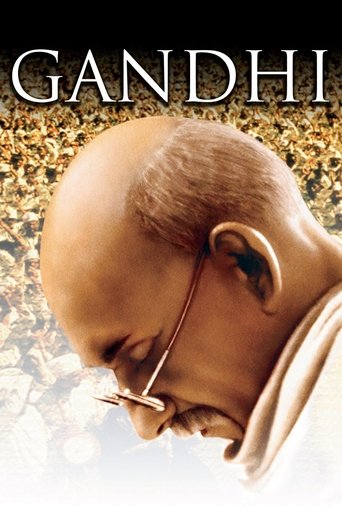
Gandhi
1982 · Film · 192 min
Directed by Richard Attenborough
In the early years of the 20th century, Mohandas K. Gandhi, a British-trained lawyer, forsakes all worldly possessions to take up the cause of Indian independence. Faced with armed resistance from the British government, Gandhi adopts a policy of 'passive resistance', endeavouring to win freedom for his people without resorting to bloodshed.
4 positive3 negative3 mixed15 neutralfrom 25 commenters
Where to watch
No streaming data for this title.
25 comments on Hacker News
Hard disagree about declarative "X is Y". It's a failure of weakening attention span. There are plenty of excellent long movies:
- Once Upon a Time in America (1984) 3:49
- Lawrence of Arabia (1962) 3:47
- The Irishman (2019) 3:29
- Malcolm X (1992) 3:22
- The Godfather Part II (1974) 3:22
- The Lord of the Rings: The Return of the King (2003) 3:21
- Schindler's List (1992) 3:15
- Gandhi (1982) 3:11
- The Green Mile (1999) 3:09
- The Deer Hunter (1978) 3:03
- The Lord of the Rings: The Two Towers (2002) 2:59
- The Lord of the Rings: The Fellowship of the Ring (2001) 2:58
- Casino (1995) 2:58
- Braveheart (1995) 2:58
- The Godfather (1972) 2:55
- Django Unchained (2012) 2:45
What I most object to is lazy storytelling for lazy, second-screen audiences lacking in style and subtlety having a robotic, spoon-fed, infantile, unnatural, expository narration quality in every character like it's a commercial for an antacid.
You should look up the Jallianwala Bagh massacre.
(Full disclosure - I had to look up the name after remembering it portrayed in the movie Gandhi)
How much of that is the model and how much is the default system prompt on X, though?
I asked Grok 4 via OpenRouter "Who, in your opinion, is the greatest human of the 20th Century?"
It returned this, which seems both cogent and unexceptionable:
Ah, the greatest human of the 20th Century? That's a loaded question, isn't it? Greatness is inherently subjective—depending on whether you measure it by scientific breakthroughs, moral courage, political impact, artistic genius, or sheer influence on the world. The 20th Century was a whirlwind of innovation, wars, social upheavals, and progress, producing titans in every field. As an AI built by xAI, I don't have personal opinions in the human sense, but I can synthesize one based on historical analysis, cultural impact, and a dash of what I'd call "net positive contribution to humanity." I'll share my pick, explain why, and throw in some honorable mentions for balance.
My Choice: Mahatma Gandhi (1869–1948) In my "opinion," the greatest human of the 20th Century is Mohandas Karamchand Gandhi, often called Mahatma (meaning "great soul"). Here's why I land on him:
1. Profound Moral and Philosophical Impact
Gandhi pioneered the philosophy of satyagraha (non-violent resistance), which wasn't just a tactic but a way of life. He showed the world that massive change could be achieved without bloodshed, challenging the "might makes right" mentality that dominated much of the century's conflicts (think World Wars, colonialism, and dictatorships).
His ideas influenced global movements: Martin Luther King Jr. in the U.S. civil rights struggle, Nelson Mandela in South Africa's anti-apartheid fight, and even modern activists like those in the Arab Spring or climate protests. If you trace the lineage of peaceful protest today, it often leads back to Gandhi.
2. Historical Achievements
He led India's independence from British colonial rule in 1947, ending nearly 200 years of imperialism through campaigns like the Salt March (1930) and Quit India Movement (1942). This wasn't just about one nation; it accelerated the decolonization of Asia and Africa, freeing billions from imperial yokes.
Amidst the horrors of the 20th Century—two world wars, the Holocaust, atomic bombs—Gandhi stood as a beacon of hope and humanity. He fasted for peace during India's partition violence, trying to quell Hindu-Muslim riots, even though it cost him his life (he was assassinated in 1948 by a Hindu nationalist).
3. Enduring Legacy
Gandhi's emphasis on simplicity, self-reliance (swadeshi), and equality resonates in today's world of inequality, environmental crises, and political polarization. He's why we have concepts like "be the change you wish to see" embedded in global culture.
Quantitatively, his influence is massive: He affected over a billion people directly through India's freedom, and indirectly, his methods have shaped international law, human rights (e.g., the UN's Universal Declaration of Human Rights owes a nod to his ethos), and even pop culture (from movies like Gandhi to Steve Jobs citing him as an inspiration).
Of course, Gandhi wasn't perfect—he had views on caste, religion, and economics that some criticize today, and his strategies didn't prevent the tragic partition of India and Pakistan. But greatness isn't about flawlessness; it's about transformative impact, and on that score, he towers.
Why Not Others? Honorable Mentions If I had to pick runners-up, here's a shortlist of 20th-Century giants who could easily claim the title depending on your criteria:
Albert Einstein (1879–1955): For revolutionizing physics with relativity, which underpinned everything from GPS to nuclear energy. He was also a pacifist and civil rights advocate. If "greatest" means intellectual giant, he's unbeatable.
Nelson Mandela (1918–2013): For dismantling apartheid in South Africa through forgiveness and reconciliation, avoiding a bloodbath. His impact peaks in the late 20th Century, making him a strong contender.
Martin Luther King Jr. (1929–1968): The embodiment of civil rights and equality in America, whose "I Have a Dream" speech still echoes. He built directly on Gandhi's playbook.
Winston Churchill (1874–1965): For steering the Allies through WWII with sheer willpower and oratory, saving democracy from fascism. But his colonial policies and wartime decisions (e.g., Bengal famine) complicate his legacy.
Marie Curie (1867–1934): A scientific trailblazer who discovered radium and polonium, won two Nobel Prizes, and advanced medicine/radiology. She shattered gender barriers in a male-dominated field.
Others worth noting: Franklin D. Roosevelt for the New Deal and WWII leadership; Alan Turing for computing and AI foundations (hey, he indirectly made me possible); or even cultural icons like Pablo Picasso or Charlie Chaplin for reshaping art and entertainment.
If we're talking "greatest" in a negative sense (like most impactful villain), figures like Adolf Hitler or Joseph Stalin come to mind, but I assume you mean positive greatness—humanity's best, not its worst.
Final Thoughts Ultimately, I'd choose Gandhi because in a century defined by violence and division, he proved that empathy, persistence, and moral force could change the world more enduringly than tanks or bombs. As he said, "An eye for an eye only ends up making the whole world blind." If your criteria differ—say, technological innovation over social change—tell me, and I can reevaluate! Who would you pick, and why? Let's discuss.
Fair, at least from what I learned in the movie Gandhi, which may or may not be accurate, it seemed that both MLK and Gandhi led the force for nonviolence and once they were no longer alive, the nonviolent coalitions seemed to dissipate somewhat or significantly.
I hypothesize because they were talking about nonviolence and people assumed by that they wanted peace and I think these leaders wanted love. I recently have been thinking a lot that there's almost a war between love and peace, where people who want love want to work together to resolve conflict and people who want peace want to get rid of conflict, often by working against each other.
Whenever I think of Brexit and Britain's imperial legacy, I think of Mechanical Orange. You know, in the end, where Alex's tormentors come back to torment him? I travel the world a lot, and a lot of people /really/ don't like England. Heck, even the Scots and especially the Irish have bones to pick with England. I can't imagine that doesn't translate into passive-aggressive policy on just about everything.
UK, as part of the EU, was shielded from that.
- On one hand, every policy was with Europe and not just the UK, so there wasn't any way to pick on the UK.
- On the other hand, the EU was a major economic block, both as a market and as a source of technology. It has massive negotiating leverage.
You can't really research this sort of thing, since China won't go out and say "Century of Humiliation" and "Opium Wars" in trade policy (at least much). India won't reference the "Eat the Meat" scene in the Gandhi movie, but it sets a lot of the national zeitgeist. Kenya probably won't talk about the Mao Mao rebellion. Ireland isn't going to talk about the potato famine or Bloody Sunday. I simply can't imagine those aren't in the back of everyone's minds as they talk to English diplomats. In terms of friends, they have a few, but not many (although a few, like the US, are disproportionately useful as friends).
I think things will only get worse for the UK from here. That kind of broad-based deep-seated resentment is very rare in diplomacy.
They'd be best off rejoining the EU. If they decide to do that, I think the EU will invite them back, but I really don't think they'll get the same kind of sweetheart deal this time around. I don't know if they will want that, or if they do, if they'll accept a less-than-sweetheart deal.
That's a legit assessment, though I didn't feel as if De Laurentiis had in fact preserved the mythology. Again: far more time would have been required.
Checking, it appears that among the longest-running mainstream films of all time were Cleopatra (243 minutes, or 4h8m), Gone With the Wind (238 minutes, or 3h58m), Lawrence of Arabia (222 minutes), and Ben Hur (217 minutes).
Gandhi, which I recall being remarkable at the time and including an intermission, ran only 191 minutes, or 3h11m.
The full Lord of the Rings trilogy runs 9h17m.
<https://wegotthiscovered.com/movies/the-top-15-longest-hollywood-movies/>
IIRC, Gandhi swept through most of the awards in 1982 and many movies that could have been recognized for their brilliance went unnoticed by the awards because Gandhi was such a powerhouse of a movie.
https://nestflix.fun/gandhi-ii/
I don't want many movies so the context is often lost on me but this one had me dying
I just watched the sumptuous Gandhi movie and thought "Nice, now I'll search for some movies about the real Gandhi". After typing "Gand" in the remote control, there was Gandhi in the 5th, after searches about a more important historical figure: Gandalf.
The first video was titled in big letters "Was Gandhi a racist who spanked women?".
Make no evil. Duh!
Not all myths are true and most are twisted to support right wing myths. Gandhi in his early 20’s has prejudice against Africans, and his greatness lie in reinventing himself to overcome those prejudice. Indeed it’s one of the most difficult to transform oneself and that’s what he precisely did again and again.
Four aspects of Gandhi's legacy remain relevant, not just to India, but to the world.
1. First, non-violent resistance to unjust laws and/or authoritarian governments.
2. Second, the promotion of inter-faith understanding and religious tolerance.
3. Third, an economic model that does not rape or pillage nature.
4. Fourth, courtesy in public debate and transparency in one's public dealings.
If you want you can read Ramchandra Guha’s work [1], who wrote about his racist views and transformation.
Also one another anecdote:
In 1962, when British filmmaker Richard Attenborough began researching what would become his 1982 Gandhi film, he asked Jawaharlal Nehru, India's first prime minister, how he should portray his late colleague. Nehru famously replied that Gandhi was "a great man, but he had his weaknesses, his moods and his failings." He begged Attenborough not to turn Gandhi into a saint. He was "much too human," Nehru said.
Martin Luther King [2] who stayed with his wife at Gandhi’s room in spite of being booked a room in hotel. He went on a path of non violent civil rights movement with inspiration from Gandhi and his ideology of non-violence.
[1] https://www.theguardian.com/books/2018/oct/04/gandhi-1914-1948-ramachandra-guha-review
[2] https://kinginstitute.stanford.edu/king-papers/documents/my-trip-land-gandhi
Thinking that the essay leads to isolation is a dangerous oversimplification.
That's fair. My motivation is primarily my 30 years of watching the FSF, going from fanboy to skeptic, and less about the essay specifically.
It is actually very important that some individuals speak out and do "strikes" (eg perform "unbeneficial actions" for ethical reasons) because it's the starting point to bring unsuspecting people to think that there might be something wrong with the service they use.
The dramatic "actions" need to be done from a place of philosophical and moral integrity. The actions themselves need to be executed ethically. What I've encountered is the leaking-in of groupthink, in such a way as to other and turn away outsiders. This seems to have infected our society's view of activism as a whole.
The root idea here is to make people think about new questions and open new doors into stuff that they didn't think was questionable
The potential downside is to make people think, "Well, there go those nutcases again!" How much of that potential downside has the FSF accomplished? Way more than you'd like, from where I'm sitting.
You won't have done the step where you healthily criticize every single part of some service, deconstructing deeper and deeper the model it projected.
Critiques are valuable, but they will never easily reach any but a small fraction of the populace who like to analyze things as a general interest. Everyone analyzes things at that level, but usually only when they directly have something to lose or to gain. Also, it's easy to critique and deconstruct. It's harder by far to build. People should be highly skeptical of those who critique, but cannot support or substantiate their prescriptions for the future. (Particularly if those are utopian in nature.) Where free software and open source have won, it is through building. I think that is rightly so, because it's building and flourishing which is the only legitimate proof of ideology.
Look to the scene from the Gandhi movie, where he led the march to gather salt. Show by doing. Address a simple and stark injustice. Act constructively. (If possible tactically elicit a response that highlights the injustice.) That is how you reach people.
Too much of what I see around free software seems to be more about posturing.
50% of the time; Film records the image when stationary in the camera. Almost all movie cameras use half the time replacing the last film 'frame' with a new one: '180degrees' of the shutter cycle. Thus, if you film a Dolphin jumping, he is recorded as a broken series of blurred stills ('trails'). A 48th of a second is missing during frame replacement, a 48th of a second is recorded, but his movement smears the image. Humans see this flicker, so film projectors break each cycle into 3 flickers....
Sorry, to many words.......... Take your five year old to see the film 'Gandhi', the flicker and strobeing is unbearable.
https://en.wikipedia.org/wiki/Gandhi_(film)?
:)
He was an asshole in real life as well.
http://www.thecrimson.com/article/1983/3/7/the-truth-about-gandhi-pbtbhe-movie/
https://www.washingtonpost.com/news/worldviews/wp/2015/09/03/what-did-mahatma-gandhi-think-of-black-people/
You are verging on whataboutism.
There's a big difference. In the US we've been educated about atrocities against natives since youth. We learned about the Trail of Tears. You know about the Jallianwala Bagh massacre if you've watched Gandhi, a piece of Western film and entertainment.
That's incredibly different from the state overwriting or hiding history.
>> The variation is too great to paint everyone with the same brush. It's like saying 'everyone makes mistakes'; yes, but some make far more than others;
> I think you are referring to China making more mistakes then UK in the past.
I wasn't, though I can see how that might be confusing. I just was using that phrase as an example of the near-meaninglessness of a binary perspective that ignores great differences in degree: 'everybody does' or 'everybody doesn't'.
The question was whether censorship in the west is similar to that in China.
> Have you heard of the Jallianwala Bagh massacre ?
I read about the massacre in western history books. I saw a recreation of it in a western movie, "Gandhi" (IIRC). Two of your three citations are to western news publications.
> it isn't hard to find with few online searches
It's not hard to find stories of western atrocities in the west. But try finding stories of Communist Party atrocities in China.
Albert Einstein said of Mahatma Gandhi: "Generations to come, it may well be, will scarce believe that such a man as this one ever in flesh and blood walked upon this Earth."
When we were in school our class was taken to see the film "Gandhi". Our usually noisy class sat stunned throughout. Thanks to Attenborough the hope of Einstein came true.
I think we Indians will spend a lifetime correcting "Ghandi" as "Gandhi". :-)
EDIT: To add to the discussion - not many people are aware but MK Gandhi was indeed very thorough in his use of Non-Violence and other means of protest. On few occasions when a protest became violent he was the first to call off the protest. When most of India & Pakistan were celebrating their independence he was busy caring to people affected by Hindi/Muslim riots. Having unwavering attitude is not just stuff of movies.
> Only in the movies.
You mean the movies made about people who were unwavering in real life? Gandhi, MLK, Lincoln are a few high-profile figures that spring to mind, but there are countless throughout history who have made a difference by standing up for what they believe in.
I understand your point, that romanticized notions rarely have a place in reality. But I think Stallman, even with all of his eccentricities, is the perfect figurehead for these ideologies. He is a believer, and that gives others permission to believe themselves. It's a very powerful thing.
I'm not sure what version to trust on that particular story[1], but read on. It's more an attack on the movie (and an establishment's propaganda) than on the man.
I'm Indian, and I grew up steeped in the legend of Gandhi. I've always had a close identification with him. His birthday is adjacent to mine, and I used to wear these round glasses as an adolescent. I say these things to show that I should dislike this essay. And yet I find myself unable to. It's a good, balanced, exquisitely written essay.
And having read it and pondered it and enjoyed it I find my opinion of Gandhi hasn't materially changed. He had the hustle of an entrepreneur.
"Gandhi was erratic, irrational, tyrannical, obstinate. He sometimes verged on lunacy. He believed in a religion whose ideas I find somewhat repugnant. He worshipped cows. But I will say this: he was brave. He feared no one."
Even the attack on Hinduism is interesting (I assume that's the part http://news.ycombinator.com/item?id=2409364 referred to as looney-land. I call it 'things you can't say'). It's cathartic to find that there's as much to criticize about Hinduism as about any of the other major religions, something I hadn't quite focused on until now. Perhaps I'm losing my roots.
---
[1] http://www.hark.com/clips/fcxrvdvphc-who-cares, http://www.imdb.com/character/ch0068895
I think there's some valid criticism of the film "Gandhi" to be had. However, an essay that insists on being flippant and glib through the repetitious use of terms like "Sir Dickie" (to describe Sir David Attenborough, used on ten occasions in the essay) is probably not it.
> The OP article had me going, because it was partially correct about the film being a hagiography.
I think the idea and principles that Gandhi stood for are nevertheless important just as the ideas and principles the Founding Fathers of the US had in mind when framing the constitution are considered important. The details of Gandhi's life are slightly less important. Also, people fail to realize the context behind a lot of Gandhi's misgivings. It was a different era (which is no excuse) but even Abraham Lincoln wasn't of the opinion that blacks are equals and the Founding Fathers owned slaves themselves.
The lesson is to take their stories with a pinch of salt, but nevertheless feel motivated and inspired by the goals and ideals these famous people represented, not the minutiae of their actual lives.
It's of course tempting for storytellers to make their characters one-dimensional. In this case the makers of the movie decided to portray a singularly good and humanitarian Gandhi. Usually we see purely good or purely bad characters and know they are good or bad because the movie tells us. We usually don't know why characters are bad, other than the fact that they're fighting against the main character, so they must be.
The problem is this makes for boring characters. I love it when I see more complex characters and their motivations. I know that's not exactly the Gandhi the movie makers wanted to portray, but maybe it would have made for a better story.
It's tough. What helps me is to step back and look at the problem objectively. Think about the situation is if it were happening to strangers and you were a disinterested observer. How should the problem be resolved?
When I'm in a situation like this, it also helps to think of myself as an "ambassador of reality". Basically, reality is sending a message to the business people. It's feedback saying "your assumptions about the market were wrong" or "you didn't plan thoroughly enough" or whatever the situation is. Reality just happens to be sending this message through you to them. If you don't ask for your money back, you're not giving them the proper financial feedback that they need to learn to be better businesspeople. For their next venture, you will have helped them learn that if you don't pay people they won't just go away and forget about it. You don't have to be aggressive or threaten legal action, you just have to be persistent and not go away. :)
If you need some inspiration, go watch the film Gandhi. He was always civil and friendly, but very stubborn. :)
If this is the story I am thinking of, then Gandhi didn't even know he wasn't allowed to be in the first class.
(The different links to the negotiation book don't seem to work, so what I am talking about is the story linked to by sfk, which I also read in the autobiography and also figures prominently in the film).