 Hacker Cinema
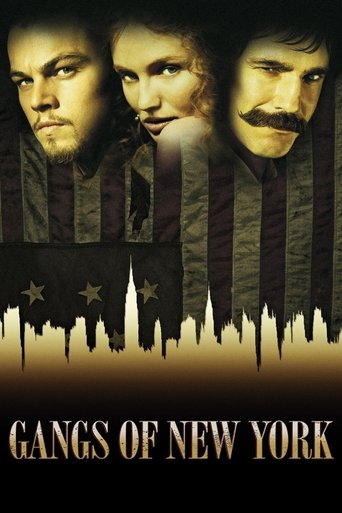
Gangs of New York
2002 · Film · 168 min
Directed by Martin Scorsese
In early 1860s New York, Irish immigrant Amsterdam Vallon is released from prison and returns to the Five Points, seeking revenge against his father's killer, William Cutting, a powerful anti-immigrant gang leader. He knows that revenge can only be attained by infiltrating Cutting's inner circle. Vallon's journey becomes a fight for personal survival and to find a place for the Irish people.
3 positive1 negative1 mixed7 neutralfrom 12 commenters
Where to watch
No streaming data for this title.
Videos commenters linked
From YouTube links in the comments below. Most are clips and trailers; “Full” means the uploader says so.


12 comments on Hacker News
I was going to say, were movies really that good in 2002?
Catch Me If You Can
Gangs of New York
The Pianist
City of God
Yes, yes they were lol. It is almost hard to believe those all came out in the same year.
Imagine in 2025 having to pick if you want to see The Pianist or City of God? It is just so unthinkable
I feel similarly. There are long movies where I don’t even notice (Carlito’s Way, Gangs of New York) and movies where I definitely notice (The Irishman) and short movies where I check the clock to see when it ends (Lego Movie 2).
I feel like there's a script for a movie here, no? Has this event been dramatized in anyway? Reads like "Gangs of New York (2002)."
Even most of his mobster movies aren't really about being depressed or Italian.
Casino's main character is Jewish. Gangs of New York is about Irish Catholics and American Protestants. The Departed is about Irishes. The Wolf of Wall Street may be about depression (haven't seen it), but is not about violence nor about Italians. The Irishman certainly has a lot of depression, and certainly violence and Italians, but even then.....it's called the "Irishman".
Goodfellas is probably the one prime example that is certainly about violence and Italians, and I'm not sure that's that depressed.
> Thanks for the considered response.
My pleasure! It's an interesting topic of discussion, and I think there's a lot of value in trying to understand where other people are coming from and what their motivations are.
> Could you point me to those records?
The well known documentary "Gangs of New York"[1]. More seriously, in early Rome fire brigades were often used as a tool to extort the compromised property from it's owner. Forgive me for quoting Wikipedia, but the article and quote is fairly well sourced[2]:
> The first ever Roman fire brigade was created by Marcus Licinius Crassus. He took advantage of the fact that Rome had no fire department, by creating his own brigade—500 men strong—which rushed to burning buildings at the first cry of alarm. Upon arriving at the scene, however, the firefighters did nothing while Crassus offered to buy the burning building from the distressed property owner, at a miserable price. If the owner agreed to sell the property, his men would put out the fire, if the owner refused, then they would simply let the structure burn to the ground
There are also reports of firefighting gangs in the new york times before the advent of professional fire services in the U.S.[3]:
> Our reporters give an account of another incipient riot got up by firemen and runners last evening. For a time the brawl went on with great violence, and the rival factions or companies enjoyed the pleasure of trying to kill each other without let or hindrance, because—and here is the fact of main importance—"the Chief Engineer and his assistants had completely lost control of the men,"
The first professional fire brigades in the UK would leave your building to burn if you didn't have their particular company's mark on your building[4]:
> If a building was on fire, several brigades would attend as quickly as possible. The different brigades would use the fire marks to work out if a building was insured by their parent company. If they didn't see their specific fire mark attached to the building, they would leave the property to burn.
> As far as I can tell, Denmark does fairly well with privatized fire fighters. (And if memory serves right, the US, for mysterious reasons, has about twice as many firefighter per capita as other developed countries.)
Privatised fire fighters in Denmark are still beholden to the local municipality, which in my opinion is different enough from a privatised "user pays" fire service that they aren't hugely comparable.
The US is much less densely populated than Denmark and dealing with fires is a fairly time sensitive operation, I'd imagine that might explain part of the difference.
[1] https://www.youtube.com/watch?v=y-vBJ8cS08U
[2] https://en.wikipedia.org/wiki/History_of_firefighting
[3] https://lostmuseum.cuny.edu/archive/new-york-times-coverage-of-the-transition-to
[4] https://www.london-fire.gov.uk/museum/history-and-stories/early-fire-brigades/
Its seems that Minority Report was in the can from July 2001 though you could imagine the amount of post-production required for that movie which would lead to it being released almost a year later. Catch Me If You Can was filmed between February and May 2002 to be released on December 25th. It seems like a busy year but doable,
Spielberg only stepped in to direct after Gore Verbinski dropped out because the film was delayed due to DiCaprio working on Gangs of New York. Verbinski's original casting had James Gandolfini as Hanratty and Ed Harris as Frank Sr. Verbinski ended up doing The Ring instead. Its amazing how much of Hollywood production is a string of almosts and conflicting schedules.
Gangs of New York is another great movie, and the second floor of the FDNY museum in SoHo is a real eye opener to the 19th century crossover between fire crews and gang culture.
> Right, that's another word for police.
I guess we agree then: more police so we can stop targeting minorities in street-level busts and instead target the big offenders: white collar crime that destroys minority communities and keeps them in perpetual bondage. If you want to haul the rich and powerful out of their homes with tear gas and tanks, who am I to disagree?
> No, but that didn't cause gangs, and you know it.
Now we're getting somewhere. By itself, no, it didn't. Institutionalized racism in the forms of employment, education, and housing discrimination carried from the 1960s caused largely-minority communities to remain segregated and poor while at the same time, white flight took money from the inner cities and moved it to the suburbs, leaving behind an underfunded and broken education system [0]. The Civil Rights Act and the Fair Housing Act are relatively recent developments: 1964 and 1968, respectively -- just a little over 10 years before your father got to LA. By the 80s, increased class stratification and tough-on-crime initiatives from the federal government meant minorities and the poor faced even more disproportionately aggressive policing and incarceration. With little hope of achieving the same success as their more affluent counterparts in the suburbs, many individuals turned to crime as a mode of survival. Then came Iran-Contra, crack cocaine, and gangs.
Of course, if you're talking about true gangs in the US during this time, we can also discuss the American mafia, white supremacists like the Aryan Brotherhood, the KKK, or even the gangs depicted in the film, "Gangs of New York" in the "Five Points" area of NY (but this is an example of some of the first gangs in the US, around the late 1700s -- thought some historical context would be interesting). These gangs, however, have faced less scrutiny because of their close connections with law enforcement and government.
[0] For a heartbreaking account of the devastating long term effects of this, I highly recommend Jonathan Kozol's 1991 book, "Savage Inequalities: Children in America's Schools"
The last few minutes of Martin Scorsese's (wildly uneven, but still) Gangs of New York found a good way to tell the same story 100% visually. The movie starts with a huge street fight between the followers of the two characters at the heart of its story, Bill the Butcher and "Priest" Vallon, battling over who will control the streets of 19th-century New York. Then at the end we see their tombstones, and in a sped-up time-lapse we see those stones get overgrown and forgotten as the modern city of New York we know today grows up around them, fading out on one last shot of the completely overgrown headstones -- with the Twin Towers looming over them, as if to say, this too shall pass.
You can watch the ending here: https://www.youtube.com/watch?v=p-8Lu7MRjQs
It's a really good little example of visual storytelling.
I was just thinking that they recently got some good content added.
These were all added this month: Batman Begins, Clerks, Gran Torino, Million Dollar Baby, No Reservations, Stripes, The Aviator, and The Fellowship of the Ring. The entire Comedians in Cars series is a lot of fun. Heat, The Godfather, Gangs of New York, Casino, and Seven.
Maybe you're bored of all that, but it's not like the films on Netflix are universally terrible.
This movie, Gangs of New York, by Martin Scorsese about New York City during a period of Irish immigration might suggest otherwise. I recall attempting to watch it when it came out on DVD but it was too violent for a Friday night: https://en.wikipedia.org/wiki/Gangs_of_New_York#Historical_accuracy
I'm torn as well. Some of my favorite movies and shows involve some of these recently exposed actors/producers. Shows like American Beauty, KPAX, Gangs of New York, etc. I get the knee jerk reaction of shunning the movies. But, if they go away entirely, that's a shame. It's also painting with a broad brush. Many other unaccused artists were involved in these things and will suffer along with the accused.
Hopefully this will be mostly focused at new opportunities for the specific offender versus past works.