 Hacker Cinema
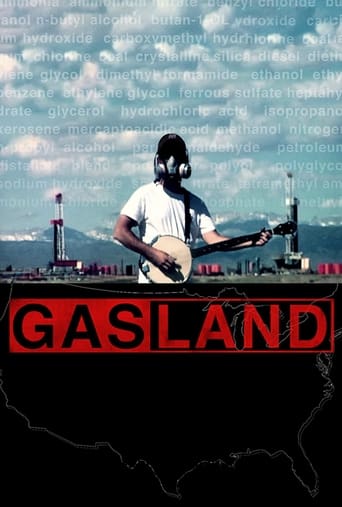
Gasland
2010 · Film · documentary · 107 min
Directed by Josh Fox
It is happening all across America-rural landowners wake up one day to find a lucrative offer from an energy company wanting to lease their property. Reason? The company hopes to tap into a reservoir dubbed the "Saudi Arabia of natural gas." Halliburton developed a way to get the gas out of the ground-a hydraulic drilling process called "fracking"-and suddenly America finds itself on the precipice of becoming an energy superpower.
8 positive8 negative1 mixed3 neutralfrom 20 commenters
Where to watch
No streaming data for this title.




28 comments on Hacker News
Yeap. "Gasland" is a good documentary
I agree wholesale with you but would like to point out that in "capitalism" prices for raw materials are often so cheap as to be called free not only in lawless shithole countries (see the films "Tapped" or "Gasland" concerning shale and bottled waterwater industry), even fines for polluting are often a slap on the wrist for hugely rich corporations (who are too big to fail ...) Swiss billionaire Stephen Schmidheiny is a rare example of someone being held accountable... But more to the point "The Corporation" makes the case that it's because a change in the law during the civil war let businesses have the same rights as citizens that such oversight occurs..they have more resources than individuals and often cause speculative havoc (ie buying up properties to make a Airbnb empire)
I understand your emotion and living in Romania I see the abandoned conglomerates and am glad that period is over...however if you discount the risk of chernobilian disaster (sea of Azov etc) that the lack of media and public accountability made possible I'd wager that capitalistic societies is powers of magnitude more polluting simply because people live behind paid layers (producer->wholesalers->distributors->retailers->consumer) paying for it by living in cities, working for buisnesses serving other buisness etc) Manufactured boredom (from living in cities) ->Advertising->fashion/fads->brands-> excess packaging is also a thing and part of the problem... Then there is the fact that businesses once created to solve a problem in the most efficient way often self perpetuate and bloat with govt closing their eyes to monopolistic behaviour in the name of customer pricing
In the city I live in, you can buy food from people from the countryside, rent/property is still cheap , so if you live simply you hardly have expenses and can avoid wasting your life working away while hardly seeing your kids grow up... I understand you lived in a failed system but you shouldn't throw away the baby with the bathwater, authenticity counts, real food counts, generosity and food that is less processed or sprayed (because cost) counts
I feel having grown up in a WIERD (acronym) people there forget that the apparent sophistication is just a sheen and like the 300ml plastic bottles they constantly consume they are choking the rest of us on their garbage (ie the developed world using x times more than the rest)
I think you can see where I'm going with this...the problem with capitalism atm or the way government treats it is that it inherently needs growth, whereas the planet needs "decroissance" a french word for "ungrowth" a french politician, (Yves Cochet )I think, said something like our economy has to "ungrow" 10% per year , it's possible even without covid, but it certainly needs a whole new mindset or a drastic realisation that droughts are going to get much much worse...
Yes, and same with fracking. Documentaries like Gasland have gotten some deserved criticism because there is evidence of methane and natural gas coming out of water pipes/wells way back at the turn of the century. But that doesn't dismiss the other points of fracking fluid being incredibly toxic and how they will destroy watersheds (you can't just pump that crap into the Earth and say 'well it's below the water table' .. how do you even know?!)
I do agree electric vehicles are a pretty big lie. You can't buy yourself out of an environmental disaster. We can't just consume more. The "Green New Deal" is about replacing tons of buildings and infrastructure that are perfectly fine, and will cause TONS of new waste in an effort to .. reduce waste.
The best thing you can do for the environment: don't buy a new car. Just keep driving your current gas vehicle and maintain it (so long as it was made within the past 20 years with good fuel efficiency) and when you do decide to toss it for an electric: buy a used one if possible.
It's actually sort of unclear what the status is. The problem is that "Gasland" has muddied the water, so you spend so much time vetting sources that it's slow going.
There is a movie from .. 1940? titled "Tulsa" where Robert Preston's character "invents" fracking - a column of water and dynamite. It got safer :)
I'm sure there are incidents. But it's not like an incident goes without recourse. I think there's one case where a formation in Wyoming is physically entangled with the water table. That operation should never have been approved ( and yes, these things have to be approved ). After a decade of reading, that's the only remotely credible one I know of. Generally, water is at, say 400 feet and oil/gas/shale is at 10,000 feet.
Even then, while it's not easy to clean it up, it's doable.
J. Larry Nichols is a founder of and on the board of Devon Energy, one of the companies that pioneered fracking for shale. He's on record saying "show me one case where fracking caused environmental damage."
But, of course, he's not considered reliable by people interested in environmentalism, usually. And I haven't found a demonstration (other than the one) that proves him wrong yet. I'm a lot more concerned that oil in general will get the USA v. RJR treatment which sets off some sort of scarcity cascade that could destabilize the Third World.
IMO, gas at the pump ougtha be $10 a gallon and $5 of that should go to alts research but I doubt that's possible.
IMO, and this is also just IMO, the whole thing is a proxy for AGW fear because nat. gas is a bridge technology while we wait for Elon Musk to save us from fossil fuels. But that's psychlogizing, really.
Fracking is a pretty high-energy activity. But most of the fuss seems at least to be mostly confirmation bias by both sides.
To the limit of my ability to tell, there's what amounts to a horror campaign about the evils of fracking going on out there. There's this film, "Gasland' that slings a bunch of ... inadequate information.
Nearly all frack sites involve two types of landowner - the people who own surface rights and the people who own mineral rights. This doesn't address injection wells but that triangular ( surface, mineral and fracker ) relationship "regulates" things pretty well.
Since the film "Gasland", all manner of untrue things are flung at fracking. IMO, a grain of salt is in order.
The stuff down the hole is much more dangerous than the fracking process - there is (maybe) HS gas, possibly radioisotopes, pressure, other stuff. Fracking is simply a part of the completion process of drilling.
https://www.sciencedaily.com/releases/2015/09/150915135827.htm
250 B gallons in, 210 B gallons out. So net-net 40B gallons for the entire industry between 2005 and 2014. Call it 40,000 swimming pools worth.
The "out" is completely treatable.
"Large though those numbers seem, the study calculates that the water used in fracking makes up less than 1 percent of total industrial water use nationwide." - FTA.
"Gasland" is a bad movie.
Now, in some places, the available water is sufficiently short that it probably should not be used for industrial use at all.
It's extremely hard to find unbiased reportage on fracking, but Wikipedia has a total of four* groundwater incidents, none of which seem to be slam-dunk conclusive one way or the other. And even if they're all due to fracking, coal is a whole lot worse. Coal companies are failing left and right.
*most of which appear to be peripheral to fracking proper; fracking possibly enabled the activity which led to an incident in most cases.
It doesn't help that the film "Gasland" is chock fill of disinformation.
It may be that remotely deployed water treatment at frack sites is the answer to both fracking effluent and injection wells. But this is one of those cases where when somebody does have accurate information, they're suspected of flackery because of who they are.
We all knew ( or should have known ) that fracking was to be used to enable gas as a bridge between coal and alts. It's not going to be perfect, but it's doubtless an improvement.
There's actually very little risk in fracking itself. Unfortunately, the movie "Gasland" made a real mess of the term.
I think you are confusing documentaries with "fair and balanced" news programs.
CitizenFour - did this present the NSA side of things?
An Inconvenient Truth - did this present the fossil fuel industry's viewpoint?
GasLand -- did this present the drilling industries perspective?
Documentaries are about presenting both sides. Documentaries are about presenting truth as the filmmaker sees it - usually with the intent to draw awareness and elicit change.
>over dramatize it into something like the bogus Gasland documentary
Generally, I feel the same as you. But, I understand that we need the over-dramatic to balance the under-the-radar.
Do documentaries like this bother anyone else? I'm only surmising from the trailer, but it seems to take this very serious event and over dramatize it into something like the bogus Gasland documentary. I already know about this tragedy, so maybe this movie's not for me.
First, some of them do,clearly, get into the water. See the documentary Gasland. Second, the companies that pump these chemicals into the ground have made it very difficult to do actual science on the situation. Also, see Gasland for lots of examples of that.
EDIT: also, since many of the chemicals are liquids and they are injected into an aquifer that feeds wells, the only thing we really need to know is: are any of the chemicals lighter than water. Even if they are not, once the water is pumped out, the remaining liquids will certainly be next.
If you want to learn more about where it comes from, watch the documentary "gasland".
Eye-opening to say the least.
Gasland has a giant hoax in it. Let's talk about the iconic scene in this "documentary": the lighting of the water coming out of the pipe. It is blamed on natural gas and the scene takes place in Pennsylvania.
The problem with the scene, beyond the allegations it was faked[1], is that methane is naturally occurring in the water supply of Pennsylvania[2]. In fact, long before fracking, George Washington and Thomas Paine did a bit of of an experiment involving it[3].
Add to this the fun fact the fracking is occurring at 6,000 and 10,000 feet and aquifers are about 500 feet down. Meaning that the gas released would still have to find a way up through a lot of rock.
There are some environmental concerns with fracking, but this isn't one of them.
1) http://reason.com/archives/2011/05/19/plentiful-fuel
2) http://stateimpact.npr.org/pennsylvania/tag/methane-migration/
3) search Writings of Thomas Paine - available from google books among others
I think you are conflating "Gasland" (documentary) with "Promised Land" (movie from Matt Damon).
The gas coming out of his faucet apparently had nothing to do with the natural gas exploration in the area, screw-up or otherwise.
From: http://en.wikipedia.org/wiki/Gasland
"Regarding Mike Markham - In a scene from the film, Weld County landowner Mike Markham is shown with director Josh Fox igniting gas from a well water faucet in his home with a cigarette lighter, which the film attributes to natural gas exploration in the area. In 2008, The Colorado Oil & Gas Conservation Commission (COGCC) investigated a complaint made by Markham alleging that nearby natural gas operations impacted his domestic water well. A Colorado Oil and Gas Information System (COGIS) report stated that Markham’s water "appears to be biogenic in origin." The Colorado Oil and Gas Conservation Commission uses the origin of the methane, either biogenic or thermogenic, to determine whether or not the groundwater contamination can be attributed to natural gas drilling. According to the agency, natural gas drilling does not lead to the presence of biogenic methane. The 2008 COGIS report concluded that "there [were] no indications of oil & gas related impacts to [Markham's] water well." Markham’s water well was drilled through four different coal beds containing biogenic methane gas."
Fracking scares me. Watched the movie Gasland, makes me depressed.
>if I had to guess I would say it was a 'feel good' piece about Fracking to try to offset the ever growing evidence that the dangers of hydraulic fracturing require much more oversight and regulation if we want to do it safely
Fracking is indeed extremely dangerous:http://www.cbc.ca/news/canada/british-columbia/story/2012/09/06/bc-fracking-earthquakes.html and many hard to believe promises of jobs and cost reductions in energy have come from the companies and even government. Check out the gasland documentary.
> The future of energy is natural gas. End of story.
Watching Gasland[1] may just change your mind.
[1]http://www.imdb.com/title/tt1558250/
Gasland is propaganda from one person (or groups) point of view. They definitely had an angle to push, and push it they did.
Not saying there aren't truths in the movie, but I've read enough on the background to know it was a movie with an agenda. The famous flammable tapwater, for example, is a naturally occuring phenomonen in many places.
Much more needs to be done on the studying of injecting the ground to see how this affects groundwater and ground stability. But fracking is not new - it's been around for a long time.
Here is a point by point rebuttal to the false claims made by agents of the gas industry in an attempt to discredit this film.
http://1trickpony.cachefly.net/gas/pdf/Affirming_Gasland_Sept_2010.pdf
From http://en.wikipedia.org/wiki/Gasland
"Dave Neslin, Director of the Colorado Oil & Gas Conservation Commission, offered to speak on camera with Gasland director Josh Fox during filming. Neslin requested that he be allowed to review any material that would be used in the film because "the issues are technical and complex and arouse concerns in many people." The statement concludes that "Such a discussion might have prevented the inaccuracies [in COGSS's opinion] noted above." Director Fox refused those terms, which would have given editorial control to COGCC for this segment of the documentary.[9]
Letting someone know what you're going to talk with him about is not giving editorial control, it's just letting someone prepare.
Not so fast.
From http://en.wikipedia.org/wiki/Gasland
"Laboratory tests concluded that Markham’s water well contained biogenic methane, a combustible gas that occurs naturally in underground coal beds.[10] Further investigation revealed that Markham’s water well had been drilled through four different coal beds containing naturally occurring biogenic methane gas. The 2008 investigation concluded that "there [were] no indications of oil & gas related impacts to [Markham's] water well." It was also concluded that the water well of Weld County landowner Renee McClure, also featured in the film, contained naturally occurring biogenic methane not related to oil and gas activity in the area.[11] On the other hand, Dr. Anthony Ingraffea, the D. C. Baum Professor of Engineering at Cornell University, whose research has involved fracture mechanics for more than 30 years, has said that drilling and hydraulic fracturing can liberate biogenic natural gas into a fresh water aquifer. Thus, just because gas is biogenic does not necessarily indicate that it reached a well by natural means. [12]
"The COGCC concluded that a well belonging to Weld County landowner Aimee Ellsworth, also featured in the film, contained thermogenic methane that was attributable to oil and gas activity in the area. The report states that Mrs. Ellsworth and an operator in the area had reached a settlement in that case.[9]
Note that "oil and gas activity" doesn't imply fracking wells.
jpetrosky, welcome to HN.
If the wells in question are "well below drinking water aquifers," can you comment on the water contamination shown in the documentary, Gasland?
For a nice summary of the issues in the US, watch Gasland; http://en.wikipedia.org/wiki/Gasland My wife and I enjoyed it immensely, or as much as you can enjoy a documentary about how we're destroying our own water.
In the comments a user mentioned the documentary that covers this impact called Gasland: http://en.wikipedia.org/wiki/Gasland
I recommend it higly to my fellow HNers.
Thanks for taking the time to offer a balanced opinion. I find myself largely agreeing with your sentiments.
I think there must be a better balance to be struck between the approach taken in Europe (seen as too difficult to fire people, which isn't conducive to a healthy business environment) and to the American approach (you can be fired at-will).
I myself like to watch US-based documentaries like Gasland, Food Inc., Inside Job and Boogie Man: The Lee Atwater story. I know these stories are biased, but I'm silently horrified by the sheer extent to which the odds are stacked against the good of the ordinary person in favour of big business. For example, in the film "Inside Job" an IMF banker made the extraordinary revelation that a Wall Street banker basically said to him in a meeting: "Please regulate us. We're too greedy. If you don't regulate us we'll continue to cause markets to blow up because we can't help ourselves." This was before the bailouts, so the banker was genuinely terrified that the banking system would utterly collapse and that they would lose everything.
Also important however, is to ponder on why America is so rich and why America to a large extent drives the global pace of innovation. There are smart, ambitious people there who can get access to capital and raw talent that is unavailable anywhere else in the world. These conditions must have sprung up in America for a reason - the environment was fertile enough for them to take root. By having a thriving, innovative economy, everybody wins. The standard of living improves for everyone. You get to keep your sovereignty by being rich - just look at the PIIGS (Portugal, Italy, Ireland, Greece and Spain). They lost economic sovereignty (except for Spain, but it could happen to them too) by being economically weak. (You can also lose political sovereignty if you are poor, as you can't afford all the military hardware to fight off an enemy). I would urge you to read "The Ascent of Money" by Niall Ferguson. He makes excellent points as to why money, and innovations like bonds, stock and insurance actually drive countries forward. For example, the riskiness of the Dutch voyages to the far-East in the late 1500s onwards were mitigated against by forming a limited-liability company, where stock could be sold to ordinary investors. If it weren't for this innovation, then the risk of the voyage would have turned people off from financing such a risky prospect. The voyages were highly successful overall and a remarkable new financial innovation was born. I think what you see in America today is a mix of these very good ideas with some very bad ideas too.
"To answer your question though, I do believe that it is roughly true that pursuing riches makes it harder to be a moral person. It's not impossible but I do believe it is harder. It is my belief that in a majority of cases one's morality and perception of what is right/wrong/acceptable changes for the worse as they acquire more money."
Money certainly seems to change people (can't say first hand because I'm one of those aspiring millionaires!) I think if you have a solid moral compass to begin with, and realise just because you may be wealthier than someone else doesn't make you better or more important than them, then you will be ok. This is probably difficult as you've mentioned. However, look to the likes of Warren Buffett - he's giving nearly all of his fortune to charity. Or Elon Musk, who is using his wealth trying to advance electric vehicles because the incumbents either can't or won't, and to further space exploration also. Or Bill Gates, who after a career being accused or being a bully and a monopolist, seems to be using his wealth and privileged position to try to make the world a better place. So there is cause for optimism for being wealthy doing the right thing.
"I believe it is true that the love of money is the root of all evil (as a rough approximation)."
My take is that the blind pursuit of money, to the detriment of other considerations, is the root of (some/all) evil. The lack of money causes a lot of evil too.