 Hacker Cinema
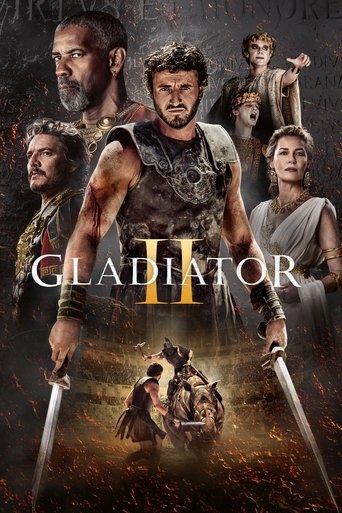
Gladiator II
2024 · Film · 148 min
Part of Gladiator Collection
Directed by Ridley Scott
Years after witnessing the death of the revered hero Maximus at the hands of his uncle, Lucius is forced to enter the Colosseum after his home is conquered by the tyrannical Emperors who now lead Rome with an iron fist. With rage in his heart and the future of the Empire at stake, Lucius must look to his past to find strength and honor to return the glory of Rome to its people.
3 negative1 neutralfrom 4 commenters
Where to watch
No streaming data for this title.
4 comments on Hacker News
The same sense of muddled analysis (which I also found to be extremely off-putting) comes through in this interview:
> There's a lot of myths that you need to bust about the gladiatorial games, particularly in the center of Rome in the Colosseum. I think everyone's image of that is in some way based on modern movies on "Gladiator I," "Gladiator II." In some ways, I think those were rather impressive, but they got some things terribly wrong. And I think the thing that, for me, the biggest mistake they made is to imagine how the audience behaved. We do tend to think that somehow the audience must have gone wild, they were there because they wanted blood lust, they were erupting in passion, in anger, saying "Kill him," or "Save him," or whatever. Everything that we can tell about the audience from Roman sources themselves suggests that actually it was much more controlled than anything you see are in the movies. For start, it was completely sex-segregated, the women sat separately from the men. But more than that, everybody came dressed quite posh, you had to wear a toga to go. Now a toga is the official Roman dress for Roman men, but it's worn when you are doing something official, you don't wear it to the local bar in the evening. To go to the gladiatorial games, that was kind of official, and you had to wear your toga. Everybody sat not just segregated by sex, but they sat in rank order. Senators by law, the top rank of Roman society, on the front rows, and then the next rank down just above them, until you got to the very back where you found the slaves and the women. Now I think that we somehow have to just overturn our sense that it was kind of mad, "losing control" going on. I think it was probably more like an evening at the opera than an evening at a football match.
If you're going to make an assertion that seems absurd on its face ("The large crowds of wine-drunk plebs were subdued and mild mannered whilst observing blood sport!"), you should offer up evidence that actually supports your assertion. Her reasoning appears to have been: Men and women sat separately. The rich got preferred seating. You had to dress up (in a toga). QED, the atmosphere was like an evening at the opera. Huh?
Pretty sure for all the examples given at the beginning, these can easily be explained as natural parts of the writing process.
The Gladiator II example is just lampshading. If you just wrote "the prisoner grabbed the weapon the guard brought in to the cell, and then killed the guard with it" the very first thing someone's going to ask is "well why did the guard bring a weapon in?" and then the writer says "oh well he didn't consider it a usable weapon" and then "but clearly it is, so that doesn't really solve anything" and rather than coming up with a better escape method the writer just leans into the absurdity of it - the on the nose dispensing of folksy wisdom establishes that the guard is just an idiot rather than leaving the audience to contemplate the contrived situation.
For Megalopolis, “What do you think of this boner I got?” [he shoots her] isn't exactly a compelling scene when reading it. It makes a lot of sense to punctuate the scene with some emotion to make it make some sort of sense. Can this emotion be shown on film without dialogue? Possibly, but the writer can't be sure how it'll actually look, and they need to convey to both the actor and director what emotion needs to be conveyed. It sounds like placeholder dialogue which could be cut or changed as needed.
For the Apprentice, again the writer likely doesn't know exactly how the scene is going to turn out. Is "Trump Tower" going to be clearly legible on the model as the scene is shot? Do you even want to spoil it by showing the name on the model? The point is this is supposed to be a reveal.
In all three cases, these lines very well could be great with proper setup and delivery, or perhaps could have been reworked into great lines. The issue is just these are mediocre films. None made any serious attempt to polish their scripts. It's not a deliberate tactic to dumb down movies or deal with poor attention spans, it's just the makers of the movie saying "eh, good enough."
I agree with some of the sentiment in TFA, but I think the author goes way overboard and ends up disliking some of the movies "just because".
I do agree that the dialogue from Gladiator II is awful, but what did we expect? The movie shouldn't have been made at all, Gladiator didn't need a sequel.
As for literalism: it's always been there in mainstream movies, I think. That we got so many (non-auteur) movies that are not so literal is surprising, actually.
Hollywood has always been a little bit dumb, a little bit over-written. It's hard to have both artistic individualism and a reliable business. This is not a new trend.
The examples are not very good. I would take Gladiator II, but Megalopolis was a self-funded project which is completely out of left field, and The Apprentice... I'm not sure what it's an example of. Many more titles are dismissed with a couple words. They really lose me when it comes to Anora. That's quite possibly the worst take I've heard about that film yet, and I've read some Letterboxd reviews.
> What feels new is the expectation, on the part of both makers and audiences, that there is such a thing as knowing definitively what a work of art means or stands for, aesthetically and politically.
Before rushing to judge today's movies, shall we remind ourselves what popular movies 20 years ago were? There were some real stinkers there, too, and they were not more smartly written in this regard. They just weren't.
> The point is not to be lifelike or fact-based but familiar and formulaic—in a word, predictable.
Has this person forgotten Titanic, one of the best-selling movies of all time? It's extremely formulaic, predictable, and intentionally so. It's basically opera, not really a new genre.