 Hacker Cinema
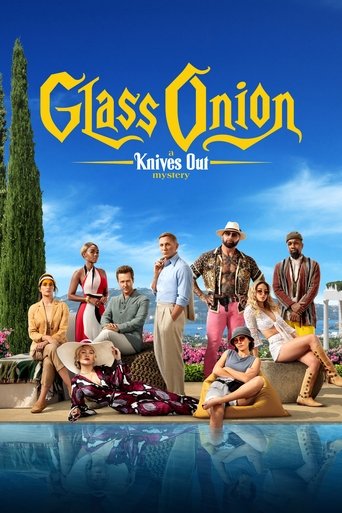
Glass Onion: A Knives Out Mystery
2022 · Film · 140 min
Part of Knives Out Collection
Directed by Rian Johnson
World-famous detective Benoit Blanc heads to Greece to peel back the layers of a mystery surrounding a tech billionaire and his eclectic crew of friends.
4 positive2 negative2 mixed6 neutralfrom 14 commenters
Where to watch
No streaming data for this title.
14 comments on Hacker News
Really. You've watched Ed Wood sometime within the last 10 years? The Last Seduction? Wolf? Red Rock West? That's just from the top 10 in that list.
I don't know what the point of your second list is. It's never been the case that streamers or cable channels (their nearest antecedent) were big producers of movies. But streamers --- unlike cable channels --- did manage to produce CODA, Killers of the Flower Moon, The Irishman, Buster Scruggs, Roma, Dolemite, and Glass Onion.
Defending Disney, the Palpatine-returns-with-better-and-more-weapons-than-before plot comes from Dark Horse comics. At least we didn't have Stackpole writing the scripts, JJ Abrams alone was bad enough. No idea what happened to Episode 8 so, Knifes Out and Glass Onion are great films with great plots and writing.
Hahaha, I expected the criticism of my comment to be that too much of what I was counting as good is "high brow", in fact. Too artsy-fartsy. Leaning too much toward "The Green Knight" and not enough toward "Jaws".
[EDIT] Here, lemme just list the 2022 movies that I think were worth a watch if you're at all into the kind of thing they were doing:
Black Panther: Wakanda Forever Glass Onion Top Gun: Maverick Bullet Train All Quiet on the Western Front Guillermo del Toro's Pinocchio Crimes of the Future Death on the Nile Everything Everywhere All at Once White Noise Nope Prey The Sadness You Won't Be Alone Dual The Northman The Unbearable Weight of Massive Talent (arguably just a less-exciting RRR, but hey, it makes up for it by also being shorter and non-horror comedy *is* a bit weak lately, so it gets in) Watcher Dashcam (one of the most interesting movies I've seen in a long time—you may hate it, but you'll feel *something*, damnit!) The Banshees of Inisherin
This is just ones I've seen (I usually manage, like, 1/2 of the films in a year that I want to watch, at best) and excluding a few that did in fact suck or that I didn't think quite merited inclusion (e.g. The Menu) or that are good for what they are but are pretty narrow in appeal (Violent Night). Like, I hear Cyrano is great, Emily the Criminal, Bodies Bodies Bodies, The Whale, and a bunch of others, but haven't made it to them yet (and, inevitably, I'll end up never watching some of them).
"Quite a few of those are sequels, remakes, or adaptations! White Noise was a book! Death on the Nile! One of those is a marvel movie!" yeah, I know—good luck finding an era in Hollywood when a ton of the films, and even a ton of the good films, weren't such. I reject that as, specifically, a complaint about this moment in cinema (it has more merit as a criticism of cinema in general)
I think as a whole the mystery genre doesn’t use this model. So, say, Glass Onion right now. There’s a different but similar model for the whodunnit.
There are other movies that play with the model, like The Big Lebowski, in that it skips a lot of the character development on purpose. Things may try to move his world, but The Dude abides.
Malapropism - not the phenomenon itself, but its name which I finally remembered from watching the movie Glass Onion.
https://en.wikipedia.org/wiki/Malapropism
I refer you to the current documentary on Netflix called _Glass Onion_ that examines this problem.
> It’s clickbait because it asserts something surprising and extreme about a movie that is generally considered to be very good
"Bad writing" is not suprising or extreme, just an opinion. And "very good" is subjective — we're talking about movies here, i.e. art. This isn't a review of programming languages where there's an objective reality of pros and cons to consider.
I haven't seen Glass Onion, but I saw Knives Out and while it was a decent film, I think comparing it to the Beatles or the Internet is a bit silly. It sounds like you really enjoyed the film and are just annoyed that someone else didn't.
To be honest, once I saw the direct allusions to Elon Musk in the build up of the film I thought... oh this is going to be annoying. When the conclusion of the film was "Hey! You know that guy! You know how he seems really stupid but everyone asserts he's a genius? Well guess what! He's a fucking idiot!"... well, I had a strong suspicion how a certain segment of people would react to this movie.
> Thematically, Glass Onion is showing how terrible people gain power.
I don't think that assertion is even close to correct. In fact, I think you have to work pretty hard to avoid seeing the actual theme. It's called Glass Onion for gods' sakes. It's not about terrible people. It's about appearances! It's about seeing people for what they are! It's called Glass Onion. What happens when you peel back the layers of a glass onion? It looks exactly the same. I don't know how to explain how much more obvious the theme was meant to be other than continually repeating the name of the movie... Look, read the name of the movie, that's the theme.
I think trying to get ou the rule book for this movie and scoring it is an unsatisfying prospect, because it doesn't play by those rules, so it doesn't care.
Airplane! was a complete spoof of a then popular genre from beginning to end. Glass Onion isn't really like that but it does play around with some detective movie tropes.
>the first rule of a good mystery story in that you need the audience to have enough information that they can plausibly solve the crime themselves
I feel like I disliked Murder on the Orient Express more for that exact rule.
But I do feel like Glass Onion does in fact deliver to some degree in that aspect. In the first part of the movie when you're lead to believe that it's about the murder of Miles, they do establish motives in order to have the viewers thinking of who it could be. And after the mid-twist that the focus shifts to the true murder mystery, there is a profound lack of good hints because it's not any one of the fingered suspects. If you watch the movie and think to yourself "Who would benefit the most from this murder?", all fingers point at the true suspect.
My biggest problem with the Glass Onion is the peashooter gun.
In the 1920s, Ronald Knox came up with a list of "Ten Commandments" of Detective Fiction listing what wasn't fair cheating [1], getting at this exact point. So codifying what is and isn't fair cheating in detective stories is nearly as old as the genre.
I'm 100% sure Rian Johnson was aware of these rules as the writer. I'd say Glass Onion technically violates 2 of them, but only for the first hour of the movie. Then you get let in on the cheating before the main climax of the movie.
[1] https://agathachristie.fandom.com/wiki/The_%E2%80%9CRules%E2%80%9D_of_Detective_Fiction
I too was disappointed with "Glass Onion: A Knives Out Mystery."
My first struggle with the movie is that it breaks the first rule of a good mystery story in that you need the audience to have enough information that they can plausibly solve the crime themselves. Glass Onion only provides information when it becomes relevant to move the plot along. You could have never known certain things, you could have never even guessed at them because the information did not exist right up until it was needed in the story.This happens repeatedly. Midway through there is a plot twist that you could have never guessed or seen coming and that pretty much ends any sense of suspense or intrigue.
I also don't care about any of the people in the story as people or characters nor do I find any of their relationships convincing. It seems implausible that any of them would have ever been friends. Close your eyes and imagine these people hanging out at a bar together and you can't. How did they interact? What was their friendship like? You never see it and so the weight of the strain of the existing relationship isn't ever fully felt. The characters in a "Knives Out" were caricatures too, but they were family, not friends. Everyone knows that strain. Everyone can relate to that relationship dynamic. You don't get to choose family. Friends tend to match each other to some extent. Give them some kind of connection. They are all trivia nerds and were a trivia team. Anything.
With all that said, I want to rewatch "Glass Onion: A Knives Out Mystery." I want to see how much was visible in scene. How much could I have technically figured out. It is an interesting movie, I am just not sure it is a very good one.
> Glass Onion: A Knives Out Mystery might be one of the worst written movies I’ve ever seen.
Then this person has not seen very many movies.
> And now Glass Onion will haunt me for the rest of my days.
I don't care too much for this superlative, unduly passionate style of pop culture critique even if it is a joke.
I enjoy reading negative critique of movies I like, as long as it shows understanding that reasonable people can disagree. This is not that.
I'm not sure if it's because of growing up watching most things online with limited bitrates, but I realized I dislike film grain a lot. I know that to a certain degree, film grain helps humans resolve finer details. Similar to using noise shaped dithering to allow you to hear more than the theoretical dynamic range in audio or see a larger range of color tones in a picture. But I found that on certain 4K uhd blurays, if I am watching on a small screen the film grain looks very obnoxious. The problem doesn't exist when watching on a big TV, so I know it's not related to projecting on a screen. I really dislike when directors go out of their way to add artificial film grain. Will media players eventually allow users to adjust the film grain that is added back in?
This reminds me of Steve Yedlin's, cinematographer on everything from Brick to Star Wars: The Last Jedi to Knives Out and its 2022 sequel, Glass Onion: A Knives Out Mystery, who showed through research that film can be completely emulated using digital techniques and mixed digital and film shots during Star Wars.
https://www.audiocheck.net/audiotests_dithering.php
https://www.polygon.com/2020/2/6/21125680/film-vs-digital-debate-movies-cinematography
https://www.yedlin.net/NerdyFilmTechStuff/MatchLensBlur.html
https://www.yedlin.net/OnColorScience/index.html