 Hacker Cinema
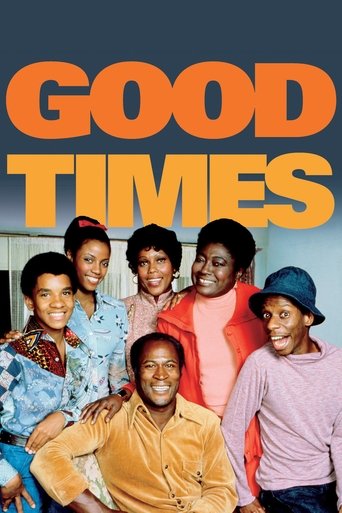
Good Times
1974 · TV series · 30 min episodes · 6 seasons
Created by Eric Monte, Mike Evans
Good Times is an American sitcom that originally aired from February 8, 1974, until August 1, 1979, on the CBS television network. It was created by Eric Monte and Mike Evans, and developed by Norman Lear, the series' primary executive producer. Good Times is a spin-off of Maude, which is itself a spin-off of All in the Family along with The Jeffersons. The series is set in Chicago. The first two seasons were taped at CBS Television City in Hollywood. In the fall of 1975, the show moved to Metromedia Square, where Norman Lear's own production company was housed.
2 positive4 neutralfrom 6 commenters
Where to watch
No streaming data for this title.
7 comments on Hacker News
In the era when the TV show Good Times existed, interest rates on loans were more like 17%. That’s credit card and payday loan territory today.
Oh, I remember a show which took place in an apartment in a public housing project - "Good Times". Takes place in Chicago. Two parents, three children ages 11-17.
OTOH, the TV series "227" took place in middle-class apartment complex in D.C. (Wife, husband, 14-year-old daughter.)
"One Day at a Time", working-class mother with two teenage daughters in Indianapolis.
I haven't watched much TV since the 1990s. A friend suggests "Wizards of Waverly Place", with a family (two adults, three teen children) in an apartment in Manhattan.
Anyway, at least on TV it does not seem like apartments are associated with low-income ghettos. They are much more strongly associated with cities.
Yes, Black Americans have their own culture from music to literature to TV shows like Good Times and the Jeffersons. This is not seen as a bad thing here, it has produced many great things.
Listen to 80’s music for a bit if you think the current decade has a lock on existential dread.
Or just the theme song of “Good Times”, a sitcom from the 70’s.
Hmmm...
When I pull up a random television network schedule from the 1970s -- let's pull up 1976-1977. (https://en.wikipedia.org/wiki/1976%E2%80%9377_United_States_network_television_schedule) I see some shows generally recognized as quality television.
And, er, some television that isn't. No surprise.
At least, I certainly don't think the variety shows count as "great" by most people's scope, of which 1970s television had a lot of. At least, I'm not aware of modern demand for the Tony and Dawn Rainbow Hour, Donny & Marie, the Shields and Yarnell show, or the Sonny and Cher Comedy Hour. Maybe I'm wrong.
In the scripted department, there's several single-season or less programs. I presume weren't that great. Shows like Holmes and Yo-Yo, Nashville 99, Quinn Martin's Tales of the Unexpected, and Gemini Man, were they that great? (A "TV movie" -- Riding With Death -- from the last one was used as fodder for MST3K. So, probably not.)
The one thing I think is notable in older TV listings is just how strongly several formats dominate. Namely, in addition to the variety shows, sitcoms and crime / medical dramas seem to dominate. (If you are looking for fantasy / horror / sci-fi, to give a few other genre examples, your pickings are slim.)
"Good" is by nature subjective. But one thing I can say is that none of these genres are typically noted for multilayered messaging. To give two examples from the sitcom side, here are two 1976 shows that are generally reviewed as "good": "Three's Company" and "Good Times". One is basically a farce often criticized as "jiggle television". One basically became a platform for the wacky antics of JJ. Not sure I'd describe either of these shows as very "deep". :)
Today, in the era of DVRs and on-demand streaming, I do think it's easier for writers to "risk" multi-episode plotlines.
I don't know if it was intentional but the name reminds me of the character JJ in the TV series Good Times. Awesome show that was. It sounds solid overall but one thing caught my eye, "A client can connect to any node to read the data. Similar to writes, a node serves the read request if it owns the data, otherwise it forwards the read request to the data owning node in the same rack.". I wonder if that could lead to an owning node arbitration storm when more than one node in a rack owns the data?
I don't have any data either way, but these statements felt wrong.
> If you hold purchases stable, incomes have to go up with prices because every price someone pays is also a price someone gets paid.
Assuming that is true, that doesn't mean that poor people's income grows. Maybe it just further consolidates income and wealth on the other end of the socioeconomic spectrum.
> They're in the opposite position, statistically, where the losses to purchasing power from savings is outweighed by the gains from the reduction of debt.
Poor people likely do not have meaningful savings so it's their very fixed incomes that is losing purchasing power, and their debts are often short term instruments that will compound the problem.
Speaking of inflation and savings and the poor, there is an episode of the late 1970's tv show "Good Times" where the family encounters a windfall, and one of the kids asks the dad what they should do with it, and the dad replied, and I'm paraphrasing, "We better spend it right away [perhaps on durable goods], becuase tomorrow it won't be worth anything." Having lived all of my life with relatively low inflation rates, as I child, I just assumed, as a comedy, it was just highlighting the foolish short-sighted decision making of the poor. Later in life I now appreciate what a powerfully poignant economic anecdote that scene represents.
Does anyone happen to know which one that was? Now that I'm thinking about it, I can't think of any modern TV shows that come close to depicting the lifestyles of poor people as "Good Times" did.