 Hacker Cinema
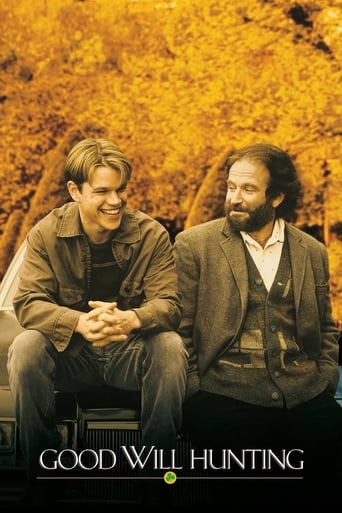
Good Will Hunting
1997 · Film · 127 min
Directed by Gus Van Sant
Will Hunting is a headstrong, working-class genius who is failing the lessons of life. After one too many run-ins with the law, Will's last chance is a psychology professor, who might be the only man who can reach him.
21 positive8 negative1 mixed73 neutralfrom 103 commenters
Where to watch
No streaming data for this title.
105 comments on Hacker News
https://en.wikipedia.org/wiki/George_Dantzig
> During his study in 1939, Dantzig solved two unsolved problems in statistics due to a misunderstanding. Near the beginning of a class, Professor Neyman wrote two problems on the blackboard. Dantzig arrived late and assumed that they were a homework assignment. According to Dantzig, they "seemed to be a little harder than usual", but a few days later he handed in completed solutions for both problems, still believing that they were an assignment that was overdue.[4][6] Six weeks later, an excited Neyman eagerly told him that the problems he had solved were two of the most famous unsolved problems in statistics.[2][4] He had prepared one of Dantzig's solutions for publication in a mathematical journal.[7] This story spread and was used as a motivational lesson demonstrating the power of positive thinking. Over time, some facts were altered, but the basic story persisted in the form of an urban legend and as an introductory scene in the 1997 film Good Will Hunting.[6]
Just because an 'automatic consistency' for something exists doesn't mean they automatically get their way on everything. And for most X that group is not big enough to direct federal policy.
Yes Amtrak exist and people inside Amtrak want it to continue to exist, and yet tons of reports the government does shows issues with Amtrak. Not to mention many groups outside of Amtrak, civil society, journalists and so on.
Many government institutions have existed for 100s of years have no managed to capture government to such an extend as to make them be able to monopolize any analysis of them. And there are plenty of government programs that don't exist anymore as well.
You are only looking at 1 side of this issue. You have given 0 consideration if X was actually solved or not.
Do you remember the movie "Good Will Hunting". The Therapist says "You can never do anything because you see every possible bad thing down the road" but that also misses also the opportunity for all possible good things.
In Switzerland we have SBB, a almost universally popular government owned institution that has existed for well over 100 years and has solved a problem about as good as anybody in the world. So X was solved, and we still have very objective discussion on improving X and we get reports about issues with X and so on.
In your view it would be good if Switzerland canceled the SBB? No matter if reports indicate that its beneficial or not?
I don't see how your attitude is not just defeatism and depression.
The argument Robin Williams character is presenting is roughly that reading about experiences as a young person is less genuine than personally living through said experiences. Perhaps that there's more merit to a belief when it comes from someone who founded it through their own lived experience than a belief which comes from reading about others' experiences.
The irony is that Good Will Hunting (an outstanding film, FWIW) was written by Matt Damon and Ben Affleck when they were very young. The belief that experience is necessary to true understanding is perhaps advice they'd gotten from someone else, not an axiom they came to through _their_ experience.
It doesn't make Williams' monologue any less true, and I imagine 30y later Damon and Affleck they'd stand by the advice, but it does make for an interesting philosophical quirk.
By the time Robin Williams filmed Good Will Hunting, he'd already dealt with his own drug issues and been struggling with sobriety. Hell, he visited John Belushi a few hours before Belushi overdosed.^
The article doesn't mention it, but the park scene is a response to the earlier office scene.
Office scene (aka painting scene): https://m.youtube.com/watch?v=SuBx0oy__EI
Park scene: https://m.youtube.com/watch?v=8GY3sO47YYo
Full disclosure: outside of Casablanca, these two scenes are my favorite in cinema
One of the things that makes them so watchable is the little ticks that Robin Williams puts in (probably from his improv experience). Maybe he doesn't have the precise lived experience, but the man knows how to emote trauma.
In the office scene, there's a neat turn right before the painting moment where they're talking about weightlifting and Robin Williams' character gives a "Don't fuck with me, kid" warning response ("285. What do you bench?"). Of course, Matt Damon's character just zooms right past it.&
Similarly, the park scene has a great beat where after he says "You've never been out of Boston." he waits for Matt Damon to acknowledge what he said.+
^ https://web.archive.org/web/20140816025724/http://franksreelreviews.com/shorttakes/morbid.htm#belushi
& Office scene, 2:03 https://m.youtube.com/watch?v=SuBx0oy__EI&t=2m3s
+ Park scene, 0:41 https://m.youtube.com/watch?v=8GY3sO47YYo&t=41s
This movie was a disappointment when I finally got around to watching it, recently. The movie was just so naked in how much it presented the perspective of somebody in their 20s. All of Robin Williams’s dialogue sounded straight out of the mouth of a 20-something kid trying to sound mature for his age.
> And if I asked you about love you probably quote me a sonnet. But you’ve never looked at a woman and been totally vulnerable.
The monologue is just so damn trite! When I say that it sounds straight out of the mouth of a 20-something kid trying to sound mature for their age, that’s because I remember hearing a lot of speeches like that, extolling the virtues of life experience, from kids in college, back when I was in college. Kids in college understand on an intellectual level THAT experience is valuable, but when they try to articulate it, these speeches end up sounding parroted, sounding like they’re putting on an act, sounding like they’ve gotten their life lessons from movies. Kind of the same way that ChatGPT gets its lessons by ingesting massive volumes of text.
I’m going to be honest here—I kinda hate the Good Will Hunting script. I really do. The movie was saved, SAVED from oblivion by some truly stellar acting from a few phenomenal actors. But that script, that script… there is so much wrong with it.
If there’s one thing that the movie really taught me is that “write what you know” is serious business. LLMs don’t know much, and that causes a lot of problems with their output. Matt Damon didn’t have the experience that comes with age, and so when he tried to write a monologue that extolled the virtues of experience that comes with age, it had similar problems. :-( The movie has an interesting thread of a story at its core; I don’t want to give the impression that I have nothing positive to say about it. There are some really good bits. The monologue from Robin Williams is not one of the good bits.
You're ignoring the core analogy. The author's point is that someone (or something) can be verbose and articulate about a topic without having any real knowledge or experience of it. I can talk at length about war because I've seen Saving Private Ryan and read a hundred books on the topic, but do I really understand what it's like to be shot at, or to watch my friend die? No, I don't. My cousin's husband does, though, because he experienced both of those things.
The author is saying that that difference matters, that it isn't just a philosophical point but is actually a fundamental aspect of this new technology. I can spit out a bunch of words about war, and so can an LLM, but our understanding of war is limited to textual representations of it. Thomas Hobbes made this exact point centuries ago when he said, "Words are the wise man's counters but the money of fools."
As a complete aside, I don't agree that "Good Will Hunting" is a power fantasy. The whole point of the movie is that that power was illusory, and that it has nothing to do with what really matters in life.
Sorry, but I don't think AI is entirely to blame here. When I graduated from a CS program at a top-10 school, I felt frustrated that the professors didn't ever teach. They had slides. They read off slides, verbatim. They explained things sometimes if you asked them, but most often in a very elitist and condescending tone. Like in the movie Good Will Hunting, you could have learned nearly all of it and more by borrowing those books for free from the library. Or, just opening a complex OSS project and learning to contribute.
And quite honestly. It shows in the CS grad population too. A lot of us are condescending toward anything that doesn't make sense to us. But, I digress.
The best engineers I've worked with are all non traditional backgrounds, non degree or degree holders from non elite schools. They think differently, they tinker, they are incredibly nice and patient, and do it for the love of connecting humans to technology.
Look up the names mentioned in the article. Garcia, Ranade, Nelson. All of them are involved with highly theoretical mathematics and scientific computing. Just because you're good at 1 thing does not mean you are qualified to teach. And none of these professors are trained or taught or graded or performance managed on how they teach. For most of them, its just required that they spend 10% of their time in the classroom lecturing.
Let's be honest about another thing. 99% of EECS graduates, even from elite schools, are wrangling objects and their relationships to a graph. Simply put, we're all just a bunch of glorified JSON massage therapists. It just so happens that we get paid well for it, and we hold that over people. The same happens in the classroom.
I think in order to facilitate a healthy, educational environment for young adults, we as adults must encourage, motivate and make that environment fun and practical. We force feed binary trees and the compiler AST's, but we need to make it fun. It's like the commonly accepted saying: Schools kill creativity :(.
You are aware that good will hunting is a movie from 1997, yes?
hey just because I am not making above median/average income doesn't mean I don't have the tech expertise. And HN is not that tech intensive. A movie recommendation for you - Good will hunting.
From the article:
> On the topic of films, I wanted to follow up with Tony a quote that I have seen online attributed to him about Hollywood portrayal of geniuses, often especially in relation to Good Will Hunting. A typical example is: "Hollywood's idea of genius is Good Will Hunting: someone who can solve any problem instantly. In reality, geniuses struggle with a single problem for years". Tony agreed with the idea that cinema often misrepresents how ability in abstract fields such as mathematics is learned over countless hours of thought, rather than - as the movies like to make out - imparted, unexplained, to people of 'genius'. However, he was unsure where exactly he had said this or how/why it had gotten onto the internet, and he agreed that online quotes on the subject, attributed to him, may well be erroneous.
Somewhat off-topic, but it's cool hearing this from someone who's contributed so much to the fields of programming and mathematics. It makes me hopeful that my own strugglings with math will pay out over time!
Correct, most mathematicians, at least the ones I know, do not actually spend time thinking about Good Will Hunting, but it's the kind of stuff that science writers eat up.
If you want to know a movie that I actually heard mathematicians discussing, it would be "A Beautiful Mind", and then only because some people were complaining about how the minor characters misrepresented the mathematicians and especially how the Princeton Math department was unfairly caricatured in order to create dramatic tension (you need an antagonist, after all).
In reality Nash was treated with incredible generosity and kindness, and was given extreme affordances. For example, he visited Nirenberg at Courant and gave him a stack of hundreds of pages of dense, hand written notes that were the proof of the embedding theorem, and Nirenberg took enormous time to go through it and try to understand what Nash did, and then championed the proof. With no renumeration or credit, just as a professional courtesy and desire to see if the proof is correct. Nash was not easy to work with, but because so many people were willing to devote time to reviewing and correcting the proof -- which took 5 years -- it was eventually published. Moser, Gromov, Chern, and Kuiper all played a massive role, donating huge amounts of their personal time in order to help Nash.
But, as is usually the case with real life, it doesn't make for a good 2 hour dramatic story. It's a shame, because the real story is a great story.
I mean, why not?
Haven't people seen the documentary, "Good Will Hunting"?
It depends. TFA's Good Will Hunting example is good storytelling, because the whole point is that Will was not ready to hear that direct conversation. In fact, Ben Affleck's character basically says that to him at the end of the movie, when he has finally grown up enough to hear it.
Bad examples include almost every episode of Friends, where all the drama is based on a stupid, unnecessary lie.
> Communication failures like these make for good storytelling ...
No, they make for horrible story telling and make the movies feel fake and the conflicts contrived. It's bad lazy writing. Bad because it's fake. Lazy because the writer should have come up with an actually valid conflict.
I'm not saying I agree with the examples though. I didn't feel Good Will Hunting nor La-La Land were examples of this personally.
I completely agree with the point, and I've made the same point myself.
However, I think "good will hunting" is a bad example.
> “I feel like you have a tremendous amount of intellectual potential that you’re wasting here — why are you getting in fights rather than trying to do something interesting?”
There is a scene where they have this conversation without words. Robin Williams is asking him without spelling it out and Matt Damon understands what the question is and dances around it. They both know what they're talking about even if they don't put it into words. In the case of this specific movie the problem isn't communication, it's just that the main character is incapable of dealing with things inside him that he doesn't understand (aka "emotionally immature"). (well, that was my interpretation anyway).
The Good Will Hunting example is terrible, since it's clear that Will has been told this before the movie and was told this by at least 2 of the 5 therapists he saw before Sean...
"It's not your fault"
(also the graph theory examples in the beginning are really simple. Good Will Hunting is not really great as a math movie. I preferred 'Proof' with Paltrow, Hopkins, etc)
> Good Will Hunting. The entire movie feels like it could’ve been skipped if literally any emotionally intelligent person said to Matt Damon’s character: “I feel like you have a tremendous amount of intellectual potential that you’re wasting here — why are you getting in fights rather than trying to do something interesting?”
Maybe I'm missing something but that's literally what everyone in the movie is telling Will. HIs best friend, his mentor, his girlfriend, his therapist. They all literally say this in some form during the movie. His character growth is believing it himself.
Not sure how good of an example good will hunting is or if the author has seen that film - at least half of the movie and basically every supporting character is constantly telling him he can do better. It's one of the central themes!
Yeah, I think the point this article is trying to make is somewhat interesting, and I do try to do this in my life, but the analogy their trying to make is actually I think the opposite of what they present. The point of Good Will Hunting is how hard what they’re trying to do is, that despite being confronted with “the problem” repeatedly Will needed some other life experience to snap him out of himself. And actually by the end of Good Will Hunting, I think what you realize is that everyone was wrong. That what Will was looking for was someone who could look past the surface conflict and love him for something deeper, and really simpler. I don’t think she needed him to be a genius the way his teacher tried to use him for that, and neither really did Robin Williams.
And in this I think movie logic is in some ways correct, that people often have to have experiences to make real change happen.
Maybe this is about deep truths vs shallow truths. “Hey it seems like there’s beef between us, is a shallow truth (for a relationship without years of history, if it’s father/son after 30 years of beefing, same applies?) Just addressing it is fine. “Hey, I think you’re not achieving your life purpose” is a deep truth. You can’t just tell someone what their purpose is.
> Or: Good Will Hunting. The entire movie feels like it could’ve been skipped if literally any emotionally intelligent person said to Matt Damon’s character: “I feel like you have a tremendous amount of intellectual potential that you’re wasting here — why are you getting in fights rather than trying to do something interesting?”
This person did not watch Good Will Hunting. I'm not a fan of the film, I just know for a fact several characters do this at several times. That is, y'know, the plot.
I haven't read further enough to discern whether this is AI slop, but it doesn't look promising.
1997 was an absolutely phenomenal year for movies. Life Is Beautiful, Boogie Nights, Jackie Brown, Titanic, Donnie Brasco, The Fifth Element, Good Will Hunting, As Good as It Gets, Austin Powers International Man of Mystery, Gattaca, LA Confidential, Men in Black, Liar Liar, Amistad, The Game, Con Air, Contact.
There was a lot to do in 1997, just not as much to do without leaving home. We went to movies because they were affordable and great movies were being released.
Also, that was the era where new multiplex theaters were being built with great sound systems, so it was worth going to a theater for the high-quality experience. While quality consumer electronics are more readily available today than ever before, I feel like the vast majority today only watch media with headphones, TV speakers, or maybe a 2.1 stereo+sub setup.
Calling the literalism "new" implies it wasn't present in older pics. You can go back to 1997 when Good Will Hunting won 8 Academy Awards, including Best Picture.
Pretty much everything was telegraphed, and that’s ok — the story resonated with millions of moviegoers and made a lot of money.
Other movies of the era (e.g. Being John Malkovich) didn’t telegraph stuff. That movie didn't win any Oscars and sold roughly 10x fewer tickets.
Someone needs to experience the real world and translate it into LLM training data.
ChatGPT can’t know if the cafe around the corner has banana bread, or how it feels to lose a friend to cancer. It can’t tell you anything unless a human being has experienced it and written it down.
It reminds me of that scene from Good Will Hunting: https://www.imdb.com/de/title/tt0119217/quotes/?item=qt0408105
It’s worrying that people really don’t understand the appeal of pseudo philosophers like Tate and Jordan Peterson. It’s not the same as gambling. It’s really much more complex than that. Gambling is an irrational, desperate act that takes advantage of magical thinking.
The new “manosphere” exists and is popular because they actually are speaking to and engaging with men. Men have issues and frankly there’s no one (that I know of) on the left who’s giving any kind of antidote or guidance on the problems.
Personally I can’t stand the likes of Tate, simply because they embrace a form of masculinity that I find to be repulsive. But when they speak, I find a direct sense of empathy that’s just completely missing from any other talking head. I also feel the same empathy in many fictional movies like “A Beautiful Day in the Neighborhood (2019)” or “Good Will Hunting.”
Any unfamiliar accent is difficult. The only question is the amount of effort we’re willing to put in to familiarise ourselves.
For example, I thought I had a decent handle on Scottish accents. Turns out I don’t, just that all the Scottish people I worked with were anglicising their accents. I only heard their natural accents after we had a few pints. Now I’m working with several Scottish people who don’t change their accent and it is hard. I’m thinking I probably have to watch a few seasons of Outlander to get used to it.
There’s nothing “natural” about any accent. How difficult was the Boston accent the first time you heard it? I needed subtitles for sure. Then I watched several movies set in Boston (Good Will Hunting, The Departed, The Town) and it’s understandable now.
All this to say - you need familiarity to understand and you need to put in effort to gain familiarity. That’s fairly uncontroversial.
Here’s the controversial part - people will put in the effort to understand the accents and dialects of people from Scotland, Ireland, Australia, New Zealand, Canada, America. But if it’s an accent/dialect from India, they say some racist shit about the brown people being unable to speak English.
So yes “Strong Indian accents are very difficult” for you. And now you know why.
I work at Google, and I didn't even know that there are good movies you can watch for free with a YT Premium subscription until I saw this article:
https://www.youtube.com/feed/storefront
Includes Roger Rabbit, Billy Madison, Good Will Hunting, Wayne's World, Mars Attacks, Grumpy Old Men, Osmosis Jones, the 90s TMNT movie…
It was a reference to 'Good Will Hunting'. Ben Affleck and Matt Damon's first movie.
I'm sure I'm in the minority here. When I see these kinds of comments, the first thing I think of the movie Good Will Hunting:
You wasted $150,000 on an education you coulda got for $1.50 in late fees at the public library.
This is not correct.
The loss of DVD sales has changed the type of movies that are being created.
Matt Damon himself has explained how Good Will Hunting would not get made today because of this.
It is really simple too if you think of yourself as the investor in the film getting pitched. "Will Hunting, a genius-level IQ but chooses to work as a janitor at MIT. When he solves a difficult graduate-level math problem, his talents are discovered by a professor"
Only an idiot would invest in that in 2024 but we are way past that. I imagine no one would even bother pitching that at all in 2024. Certainly wouldn't get a meeting with anyone.
There was a golden era of film not long ago and that era is gone forever. The Fountain might be the best example though. I love that movie but it lost millions of dollars even at the height of the golden era.
The future is going to be AI Batman vs Superman part 276.
Not my website. A friend of mine from school who was also one of the lead Infocom game designers. But feel free to ping me. My email should be in my profile.
I'm actually a Cambridge/Bostonite though live about an hour West. Peel free to ping me about local stuff. Some local Boston movies (e.g. Good Will Hunting) are pretty weel documented, others are in areas I probably wouldn't go out of my way to visit, but lots of good routes.
User: which is the larger number, 3 or 2?
ChatGPT: The larger number is 3.
User: If I have one apple, pick another apple and then get an apple from a friend, and Alice has two apples, who has more apples?
ChatGPT: You have more apples. You started with one apple, picked another, and got one more from a friend, so you have three apples. Alice has two apples.
[edit]:
User: what does good will hunting say to the know-it-all at the bar?
ChatGPT: After Will Hunting outsmarts the know-it-all student in the bar, he spots the student's female friend outside a shop later on. To tease the student further and show his wit, Will taps on the window to get her attention and, holding up his phone number, famously asks, "Do you like apples?" After she nods, Will triumphantly says, "Well, I got her number. How do you like them apples?" This line became quite iconic and is one of the memorable quotes from the movie.
> I should have loved biology but I found it to be a lifeless recitation of names: the Golgi apparatus and the Krebs cycle; mitosis, meiosis; DNA, RNA, mRNA, tRNA.
You just had bad teachers. The subject is all at once beautiful, bizarre, fascinating, daunting, mysterious, majestic, labyrinthine, and awe-inspiring.
We are solutions along a physical, biogeochemical optimization gradient. We're fit to the world around us like a glove.
We're also distributed systems. Every sub-component of every single one of our cells is a computational system in flux, dynamically adjusting to trillions of inputs every single second.
Even the packing of "junk DNA" is a calculated encoding of spatiotemporal expression dynamics and far downstream behavior.
We are the universe encoding behavior unto itself. Exchanging gasses, assembling polymers, replicating, carefully kept in balance. Battling against other systems attempting to utilize the same energy gradients.
> I think we also need inspiration. There is a romance in biology, as in any other science, that a movie like Good Will Hunting could bring out. We need heroes. Whoever delivers us from this pandemic in the form of a slam dunk vaccine, or a cheap quick reliable test, should become a household name, not for their own glory but for our kids—a Feynman for them to dream about someday becoming.
Biology doesn't have the rockets or the fancy computers, but it stands to one day unlock some of the best things for humanity: a world free of diseases, long lives, and perhaps one day, even immortality.
The only reason it's not sexier is that it's still in the punch card phases. We're just starting to scratch the surface of the computers that make up ourselves.
Good Will Hunting
I grew up in a rough neighborhood, in high school my view was limited and I thought there is no going out of trouble, being a black sheep of the family, etc. I saw that movie, and I felt hope for the first time and started making changes for myself.
> they will aggressively try to remove your property rights from it.... similar to the NYC squatters rights thing.
I think that's bad-faith reading of the quote from one arborist, not the CA Governor or Treasurer or Dept Director of Parks and Recreation. The way I read the article is that it was implied the state should have considered buying out the owner of the forest (or at least part of it) with state money and convert it to a park. I don't know whether that would have been economically viable and I don't understand people discussing here how forestry policy on redwoods changed after that, but it would be good to see numbers on all this, even if the answer was no.
FYI Lucasfilm shot the Endor scenes in Del Norte in Apr-May 1982, a year before release of RotJ. So, another huge errorbar would be estimating the film's popularity (if there's a deadline on the property being destroyed, as in this case).
99.999% of movies aren't memorable or profitable like the Star Wars trilogy, so they add no value. Also, this stuff isn't predictable at shooting time before the film's release. Compare e.g. 'The Matrix Reloaded' (2003) car-chase scenes were filmed in Oakland, but aren't that popular. But also the Boston Public Garden Bench from "Good Will Hunting", a low-budget $10m film by two young guys people had never heard of [0], or the prison location from 'The Shawshank Redemption' (the closed Ohio State Reformatory in Mansfield, OH).
[0]: https://www.livethemovies.com/home/the-boston-public-garden-bench-from-good-will-hunting
This sounds amazing, like the many scenes from science-themed movies that feature two scientists, often an elder and a younger. The younger is scrawling out the solution to some near-intractable problem on the blackboard, while the elder guides and goads, perhaps pointing out a flaw in the proof or an overlooked detail. I believe Good Will Hunting and Theory of Everything had scenes like this.
Regrettably I've squandered my youth and it's too late for my chance at the blackboard, solving something really hard under the eye of a judging but patient mentor. So now I code webshit for a living. Congrats on that doctorate, man.
Haha this is awesome, Good Will Hunting 2 is probably my favourite bit from a comedy movie.
There's a famous story that's a good example here, I think: George Dantzig solved two open problems in statistical theory, which he had mistaken for homework after arriving late to a lecture at university.
https://en.wikipedia.org/wiki/George_Dantzig
> In 1939, a misunderstanding brought about surprising results. Near the beginning of a class, Professor Neyman wrote two problems on the blackboard. Dantzig arrived late and assumed that they were a homework assignment. According to Dantzig, they "seemed to be a little harder than usual", but a few days later he handed in completed solutions for both problems, still believing that they were an assignment that was overdue. Six weeks later, an excited Neyman eagerly told him that the "homework" problems he had solved were two of the most famous unsolved problems in statistics. He had prepared one of Dantzig's solutions for publication in a mathematical journal. This story began to spread and was used as a motivational lesson demonstrating the power of positive thinking. Over time, some facts were altered, but the basic story persisted in the form of an urban legend and as an introductory scene in the movie Good Will Hunting.
I’m not sure if I should leave you with a recommendation to watch Good Will Hunting or suggest that therapy can be quite different from self-help books.
> The reasons franchises, especially superheroes, have been thriving in the last two decades is because of the excessive choice of movies. The general public struggles to pick which one to watch, so they pick franchises with expected plots. This market trend is partly why Disney's Bob Iger bet on franchises, acquiring Marvel and Lucasfilms.
I don’t think this is true. Consolidation of film properties was largely caused by the death of the tape/dvd market, which represented a significant revenue stream for movies, so the studios focused on properties that would have huge box office numbers. Matt Damon talked about this in an interview recently, saying that so many of his movies, like Good Will Hunting, would not be made today because they tended to have long tail VHS sales.
In middle school (in 1981), my buddy and I took an elective called Custodial Services. We were helpers for the school janitor. That often meant picking up garbage and cleaning things. We like it a lot. We were almost always outside getting exercise, but it also gave us lots of time to think. We talked a lot about whether that was the right career for us.
I went on to get a degree in math and become a software engineer. That buddy is a high school janitor. We've often talked about who picked a better career. Mine has clearly been better financially. But, in terms of fulfillment, it's less clear and probably leans towards his choice.
When the movie Good Will Hunting came out, we were quite amused.
Speaking of movie quotes.
From Good Will Hunting
"Wood drastically underestimates the impact of social distinctions predicated upon wealth, especially inherited wealth"? You got that from Vickers' "Work in Essex County," page 98, right? Yeah, I read that too. Were you gonna plagiarize the whole thing for us? Do you have any thoughts of your own on this matter? Or do you, is that your thing, you come into a bar, read some obscure passage and then pretend - you pawn it off as your own, as your own idea just to impress some girls, embarrass my friend?"
So, I mean, I know that not everyone loves The Lord of the Rings movies. But I just need everyone to remember that Peter Jackson did them. And I mean, I thought Heavenly Creatures was really interesting, and I think I'm one of the dozens of people who really liked The Frighteners (yes, I'm a hipster Frighteners fan.) But if you'd asked me, "Viking, should we trust Peter Jackson to make 11 hours and 21 minutes of The Lord of the Rings (extended editions)?" I would have said, "No," and I would have, in my humble opinion, been totally completely wrong.
I mean, I just need to remind people that great movies exist. LA Confidential. The Matrix. Hell, even the Fugitive is a lot of fun (for what it is.) Mr. Robot is simultaneously amazing and also boring as shit for huge stretches - but man, they committed to that vision, and when the big moments hit, they hit hard. True Lies. True Romance. The Abyss. The Fisher King. Good Will Hunting. Inglourious Basterds. Hell, even Hackers. And Sneakers.
I think Daemon and Freedom could be done wonderfully.
Just imagine ending the series with a nice cackle...
"I do so enjoy my vork..."
…Good Will Hunting. At the time that movie (and the ones you listed) came out, they were the talk of the country. They were THE zeitgeist.
Ha! Erdős–Bacon numbers originated in a 2002 Telegraph article by Simon Singh, referenced by Wikipedia as [1]:
https://web.archive.org/web/20121112081753/http://www.telegraph.co.uk/science/science-news/4768389/And-the-winner-tonight-is.html
I came up with this game after realizing I had an Erdős–Bacon number. He credits me, but spun the article to make this sound like a "thing" other people cared about.
I was written out of that Wikipedia page long ago. Very little of what survives on that page stands up to close scrutiny.
Combining these numbers is an obscure amusement, but people take the separate numbers seriously. For Erdős numbers, should one count posthumous papers? My "2" via Persi Diaconis goes to "3" if one doesn't.
The original intent of the Bacon number game was to count actors in fictional speaking roles. My "2" here is from a speaking role in "A Beautiful Mind". The "Oracle of Bacon" replaced this intent with whatever their database could easily report. Appearing as oneself in a documentary on Erdős had the obvious hilarious effect.
One understand these links better by studying IMBD credits. Daniel Kleitman's "2" depends on a "Thanks" credit from "Good Will Hunting", and few of the other low Bacon numbers on the Erdős–Bacon Wikipedia page can be confirmed at all.
If this were a movie you'd be the guy in good will hunting trying to name drop to pick up chicks.
So is this the equivalent of one of the stories in the 1997 movie "Good Will Hunting," but on the Internet for everyone to take a crack at some hard problems to solve?
That the Fields medal is in the public imagination at all is mostly due to its mention in the movie Good Will Hunting.
In which it is explained simply as "like the Nobel Prize for math".
So that's it. There you go
Over time, some facts were altered, but the basic story persisted in the form of an urban legend and as an introductory scene in the movie Good Will Hunting.
Aha, I thought this sounded familiar...
Also, the idea that Good Will Hunting is "very serious" also misses the mark. So much of why that movie worked is because it interleaved humor throughout:
* "How you like them apples."
* Sean talking about his wife farting when she was nervous.
* Will's entire monologue at the NSA interview.
* "My boy is wicked smaht."
I do find the thesis in the ending quite weak:
> For a longer time before the gritty period, we all dedicated ourselves to the idea that anything we’d acknowledge as very good had to be both serious and artsy. People really liked Good Will Hunting (see: very serious); it was also a good movie, so it won an Oscar. Zillions of people love movies like The Princess Bride and Happy Gilmore; it’s incredibly likely both dwarf Good Will Hunting in terms of total views, but you can’t even imagine a world where either could have possibly won an Oscar.
[...]
> This is a short article by my standards, but it does have me thinking: What kind of world could we actually live in, if we were willing to treat works of art made with the goal of making us happy as if they were important? What if we were willing to make them? We’ve seen what happens in a world where all the Oscars go to movies that make you cry, or that we pretend make us think even though they generally don't
There are plenty of widely acclaimed movies that can not be considered "very serious", picking some recent Oscar winners as examples with categorizations from wikipedia:
* Parasite ("black comedy thriller")
* Green Book ("comedy-drama")
* The Shape of Water ("romantic fantasy")
* Birdman ("black comedy drama")
* CODA ("comedy-drama")
* La La Land ("comedy-drama")
* Life Of Pie ("adventure-drama")
Are all those completely feel-good movies intended to make you happy? Maybe not, but still its not like happy/humorous/feel-good is completely disregarded category even among grumpy art critics.
The declaration of independence can be interpreted to mean that the government forfeits its legitimacy when it violates anyone's human rights. If the declaration of independence is considered legally binding then theoretically you could have a basis in law for fighting back against the police when they exceed their remit. I'm no lawyer but I remember something similar being brought up in the courtroom scene in the movie Good Will Hunting.
In france we have this research director, Didier Raoult, who pushed for the use of Chloroquine as a treatment against COVID. He was the head of a research center dedicated to tropical diseases. This guy literally argued that the smaller the test sample, the better the result. This guy lost his job of director (not to mention investigation of research fraud), but he mades it very difficult for uneducated people to trust the vaccine.
Not to mention that I dated a biology scientist and teacher who did not want to get vaccinated. I heard 2 other scientist lost their jobs in a research lab in my city because of not wanting to get vaccinated.
So no matter what people will tell me, it seems that science is rife with people who should not have their credentials, despite high level education, universities, "merit based" grades, etc.
It reinforce my cynicism, because I had some scientific education, but I dropped and never reached a degree. It's what Pierre Bourdieu talks about, that degrees are a way of maintaining social classes. It's exactly what you hear in the movie "Good will hunting", that a degree is just a piece of paper, while people can just educate themselves by reading science books.
The middle-ground movies like "Good Will Hunting" are, unfortunately, pretty much dead in the water right now, they have been since before the pandemic (I'd say since the early 2010s). Some directors and producers in France (because the same thing has been happening there, at another level) tried to do something about it by staging some protests around 2012-2013 if I'm not mistaken, this interview [1] (in French) from 2013 with Pascale Ferran, one of the main persons behind the movement, will add more details. Of course that nothing came out of the whole protest movement.
There is some (I think) temporary help from streaming and especially from Netflix when it comes to this type of movies ("The Irishman" is just one example), but, again and imo, I think this is just temporary and that in the long term Netflix and its kin will also give up on this type of movies. And, of course, you could say (like Scorsese himself sort of did) that watching movies on a TV screen is not really "watching movies", and I'm with Scorsese on that.
[1] https://www.afcinema.com/Pascale-Ferran-Je-m-inquiete-pour-les-films-du-milieu.html?lang=fr
> It must be really off the wall for a studio to not invest in that.
Not necessarily, it's gotten much harder to produce projects that aren't commercially marketable IP like Marvel.
I listened to a Matt Damon interview recently and he basically wondered aloud if he could get a studio to make Good Will Hunting today, which made me sad to hear. Many of his early movies were low to mid-budget one-off dramas, which aren't really getting made anymore.
If you can't license your film's characters for games/toys/food/whatever, your project is a lot harder to pitch to execs in 2022.
In the movie, Good Will Hunting, clarification is made with “Dot, not feathers” which seems more accurate since both a dot mark and a feather are forehead ornamentations.
There are many things to say (and I do agree with the author) but unfortunately that conversation is going to bring out people who think Doom is scarier than Silent Hill because there are more jump scares in Doom and too much reading and personal trauma in Silent Hill.
It's like when you are under 15 and watching a movie where a character gets raped or another has an abortion. The reality will only hit you later in life and that story won't be as easy to watch.
It's like that episode from DS9 where Captain Sisko tells his son his writing is dull because his son doesn't know what he is writing about and Siskok encourages him to write about matters he knows.
Or in Good will Hunting, when the psychotherapist explains to Will something along the line of "you can deconstruct my psyche and analyze it but you don't know jack about it".
Likewise some games that were recently acclaimed for their approach to the subject (Celeste, Old man's journey, Sea of solitude) really fell dull to me.
Maybe of their traffic, but not their infrastructure.
Netflix rents 300,000 CPUs on AWS just for video encoding. Encoding one TV series produces over 1,000 files that sit on S3, ready for those PoPs to pull them in and cache them.
They also do more data processing, analytics and ML than most people realize and that's all happening on AWS.
For example, not only are each user's recommendations personalized, but all of the artwork is personalized too. If you like comedy, the cover art for Good Will Hunting may be a photo of Robin Williams. If you like romance, the cover art for the same movie may be a photo of Matt Damon and Minnie Driver going in for a kiss.
They're also doing predictive analytics on what each person will want to watch tomorrow in particular. Every evening, all those non-AWS servers go ask AWS what video files they should download from S3 to proactively cache the next day of streaming.
I hope they have a quality editor. Would hate to have a situation where they made a mistake on page 5, rendering the subsequent 495 pages worthless gibberish without a correction. (I know there's a bit from a TV show or movie like this, but I can't recall where. Maybe Good Will Hunting?)
On a serious note, I'm wondering how approachable this book is to non-mathematicians. I mean, I've had more formal math education than your average lay person, but I've also hardly used most of it since college. I'm curious if it'd be a worthwhile read or just something that'd end up sitting on my shelf, mostly unread...
just to reiterate here- I'd bet you most janitors could code if given the same classes. Or maybe they can't code maybe they'd be better as a manager or HR or PM, or fuck even CEO.
I'm tired of this bullshit rhetoric that SEs are somehow smarter than everyone else. I know some absolutely fucktarded people working for some pretty big companies in some pretty big roles. One is a doctor I wouldn't trust with my cat.
Your job does not speak to your intelligence.
Janitors can be smart too. Maybe this is all because movies like Good Will Hunting aren't made anymore.
Not what you're asking, but my ideal phd workflow is to complete an open research problem as a homework assignment, then turn it in as a thesis.
"In 1939, a misunderstanding brought about surprising results. Near the beginning of a class, Professor Neyman wrote two problems on the blackboard. Dantzig arrived late and assumed that they were a homework assignment. According to Dantzig, they "seemed to be a little harder than usual", but a few days later he handed in completed solutions for both problems, still believing that they were an assignment that was overdue.[4][6] Six weeks later, an excited Neyman eagerly told him that the "homework" problems he had solved were two of the most famous unsolved problems in statistics.[2][4] He had prepared one of Dantzig's solutions for publication in a mathematical journal.[7] This story began to spread and was used as a motivational lesson demonstrating the power of positive thinking. Over time, Dantzig's name was removed, and facts were altered, but the basic story persisted in the form of an urban legend and as an introductory scene in the movie Good Will Hunting.[6]
Dantzig recalled in a 1986 interview in the College Mathematics Journal, "A year later, when I began to worry about a thesis topic, Neyman just shrugged and told me to wrap the two problems in a binder and he would accept them as my thesis."[8]"
https://en.wikipedia.org/wiki/George_Dantzig
Maybe I'm just if ignorant about what it takes to make a movie.
But 25 million seems like a lot for a small film that's mainly script and acting.
Horror movies require a ton of special effects which I imagine is where huge budgets start to come into play.
But many of the best movies I've ever seen don't require tons of special effects.
Taxi driver, good will hunting, the godfather, moonlight, etc.
It's possible if the quality is there.
> it's actually a pretty good filter of employers for me
Reminds me of the story of the movie Good Will Hunting - Ben Affleck and Matt Damon added a completely out of place scene (a gay sex scene) in the middle of the screenplay just to see who would call it out, as a way of checking to see who had actually read the entire script.
I know pretty much everyone else who has worked as a math consultant on a Hollywood movie. I worked more hours than everyone else combined. Fine with me, you couldn't tear me away.
Ron Howard hired Apollo 15 astronaut Dave Scott to consult on Apollo 13. He finds reality more interesting than anyone's imagination, he wanted to get textures right, verisimilitude. I was hired at first with a short list of specific goals, such as the problem Nash writes on his calculus blackboard. I know too many mathematicians who claim to have solved the Good Will Hunting blackboard while it was onscreen; we wanted everything we did to survive "freeze framing the DVD".
A film is like joining the circus. Once you're in, you can be asked to do anything if there's a way you can help.
After watching art make 200 panels digit by digit for the Pentagon scence, supposed to be random enough to pass as encryption, I wrote a C program overnight to generate similar panels with a simple settings file they could play with. My childhood anti-drug literature included photographs of spider webs under various influences; the storyboard artists used this to draw the "Mad Shack" scenes, as seen in the film. For the writer Akiva Goldsman, I'd make strange phone calls for example to the CIA to discuss terminology.
I was a go-between to strong go players for the game sequences. I proposed a go consultant but they said I'd do. After one rehearsal where no one could act and position stones at once, Ron Howard said to just act, we'll fix it in second unit. We break for lunch, I pronounce "This is why we don't have a go consultant. A go consultant would commit ritual suicide right now." Russell Crowe responds they'll put my phone number in the credits. Then everyone in the room recites verbatim their most scathing reviews ever, to enormous peels of laughter.
Day to day, the props department always wanted more scribbled paper, or a blackboard needed scrawling. The actors were entitled to ask me anything before scenes; I'd often be around hours for a one minute conversation. There's a Time magazine cover with Nash as one of four faces. Held in an actor's hand one can barely make out the backgrounds on Blu Ray, but Russell Crowe wouldn't pose for that still photograph till he'd found me to confirm that the blackboard was my writing.
Facing a writer's strike, and with second unit costing a fraction of first unit, there were body doubles whenever Russell Crowe's face didn't show. I wrote all the math, so I was his hand double for everything. He got the idea of making his fingers longer with acrylic nails, so I had acrylic nails for six months. I loathed them but it certainly established my loyalty. Try having your friends in a bar tell strangers about this; I'd admit I was a Barbra Streisand impersonator and that they'd believe.
I had my nails done at the same shop in New Jersey that Edie Falco used on The Sopranos. The woman who'd promised to do the work was on a cruise in the Caribbean, so she phoned in. She asked me if I was doing anything else for the film besides being a hand double. I said I was also Russell's love double (a story he later enjoyed):
"Will you be needing an extension for that too?"
Every book you've read, movie you've watched, song you've listened to, play you've seen, etc. has been a direct result of our journey through the humanities, and I'm positive nobody thinks those forms of entertainment should just "cease to exist".
Ah yes, but how many of these would require obtaining a 4-year degree with 6-figure debt?
In the words of Matt Damon from Good Will Hunting “You wasted $150,000 on an education you coulda got for $1.50 in late fees at the public library.”
You might want to watch Good Will Hunting. It's an important theme in that movie.
This story is fascinating (you really should read the whole book). But using her as example is completely misleading. She is a genius (I think). Very similar to the movie "Good Will Hunting". She got accepted into Cambridge with little to no education whatsoever. Even if you are a genius, this is not easy, since you just have to understand the system to some extend, no matter how smart you are, to be accepted into it.
Suffices to say, millions would fail under similar conditions, where she succeeded. Odds in normal education are much better than that.
fwiw, i think you can drop the '.com' from the title for a smoother punny title without ambiguity: "Goodwill.com Hunting" -> "Goodwill Hunting" since the movie is "Good Will Hunting". =)
Sounds like the movie Good Will Hunting.
This article brings to mind the movie "Good Will Hunting", specifically the mention of Srinivasa Ramanujan (https://en.wikipedia.org/wiki/Srinivasa_Ramanujan). I disagree that it's difficult to teach yourself mathemitcs. As with all things, success in self-directed teaching depends on the aptitude of the learner combined with their desire to learn.
Whenever I see this topic come up, I think back to the climactic speech in the movie Good Will Hunting, the one where Chuckie excoriates Will for wanting to put down roots in the community he grew up in. He concludes:
"It'd be an insult to us if you're still here in 20 years. Hangin' around here is a fuckin' waste of your time."
This was framed as an inspirational moment that finally pushed Will to achieve his potential. This idea -- that self-actualization requires abandoning your small-town roots -- is ingrained in our cultural DNA.
Given that his HN name, "whunting", is a reference to "Good Will Hunting", that suggests OP might be a non-mathematician math enthusiast. I can't think of a single mathematician who would unironically name themselves after Good Will Hunting. I don't mean that in a disparaging way, though. Mathematics could really stand to stop taking itself so seriously and have people kidding around more, and that goes for myself as well! But it kind of flies in the face of OP's refusal to grant accounts to people without academic affiliation (MIT janitors like the film's protagonist probably don't have math department email addresses). The site being such high quality production despite being written entirely in PHP suggests OP is quite an unusual person, I'd really like to learn more about him.
I don't see how this is different from pre-Internet where you could have gotten an education from your local library. This fact is even referenced in the popular American film: Good Will Hunting, where a janitor at MIT solves an unsolved mathematical problem and reveals that he learned every academic thing he knows with a library card.
> Williams was great in just about anything he was ever in, I wouldn't attribute that to Nolan.
I don't know, I might. You don't even see Finch for half the film, only hear him, and the villain left an impression on me not unlike Kiefer Sutherland's villain in Phone Booth (an otherwise unremarkable film). I can't think of another villain role that Robin Williams performed, probably because nobody was brave enough to take that kind of risk with a heavyweight positive actor -- Insomnia came out a few years after Good Will Hunting and Dead Poets Society, which helped establish his mastery of drama, but nobody wanted to make him the bad guy. Nolan did, and it was very satisfying to watch.
(I take that back, One Hour Photo was great, too. I knew I was forgetting one.)
Even for films you haven't seen, it's a pretty terrible system. I didn't see Good Will Hunting until maybe a decade after it came out, but I was aware of it and knew it starred Matt Damon. If I had looked for it on Netflix and found a cover with Robin Williams, I might have wondered - was this another film with the same title?
"What I fight against most in some sense, [when talking to the public,] is the kind of message, for example as put out by the film Good Will Hunting, that there is something you're born with and either you have it or you don't. That's really not the experience of mathematicians. We all find it difficult, it's not that we're any different from someone who struggles with maths problems in third grade. It's really the same process. We're just prepared to handle that struggle on a much larger scale and we've built up resistance to those setbacks."
I disagree. I understand the purpose of this statement, i.e. not to discourage people, etc. but clearly there are differences between Terry Tao, Wiles, Feynman, and many others and your typical PhD in these fields. This is like saying anyone can become Phelps with practice (although pinpointing his unique advantages can be complicated: https://www.scientificamerican.com/article/what-makes-michael-phelps-so-good1/). Not everybody can be above average! And of course, there are the rare cases such as Ramanujan.
I think a better explanation is the one that Stephen gives in On Writing:
"I don’t believe writers can be made, either by circumstances or by selfwill (although I did believe those things once). The equipment comes with the original package. Yet it is by no means unusual equipment; I believe large numbers of people have at least some talent as writers and storytellers, and that those talents can be strengthened and sharpened."
I for one don't feel sad, I feel good about that. I loved the movie "Good Will Hunting" and that's the message I got from it: the pursuit of the personal happiness trumps petting your mind to work for the greater good. Let's imagine, just as you said, that these brilliant mind did work towards the new advances and new products. We would get the new generation of smartphones one year sooner, and we'd be so moch richer for that, I guess. But if that comes at the expense of these people being one epsilon less happy than they currently are, that's not a trade off we as a society should be willing to make.
One of my favorite quotes from the movie Good Will Hunting:
"See, the sad thing about a guy like you is, in 50 years you're gonna start doin' some thinkin' on your own and you're going to come up with the fact that ... you dropped 150 grand on a fuckin' education you could have got for a dollar fifty in late charges at the public library!"
It's not the actual learning itself that's expensive; it's the credentials.
No matter what he might think he feels, he is not amongst his 'brethren' at def con.
I thought the reference to the film 'good will hunting' was appropriate, because the subject of the article is a sell-out.
OK, when has Damon met with professors, and what did they talk about? My Googling shows he talked to two professors at Harvard about the script of Good Will Hunting. They influenced his choice to make Will a math genius rather than physics, and maybe a few other points in the story (not really elaborated on here[1]). Damon's mother also happens to be a professor. Neither of these really qualify as talking about theories, or purely to satisfy his intellectual curiosity rather than to help in his non-academic work or incidental contact.
Again from some quick Googling, this seems an exemplary quote from Damon about what he would talk with President Obama about: "There are a lot of things that I really question — the legality of the drone strikes, these NSA revelations. Jimmy Carter came out and said we don’t live in a democracy. That’s a little intense when an ex-president says that. So you now, he’s got some explaining to do, particularly for a constitutional law professor." [2] I see no evidence to suggest that the President has deliberately chosen to speak with Damon about these issues because he especially values his opinion or considers him smart, or that Damon has any particular things to say beyond what any of the somewhat articulate among us here on HN could have said on those issues, or that anything Damon said caused the President to expand his knowledge which is, as you said, founded on responsibilities and insights that Damon can't possibly have.
In other words, any of us could do something notable but in a non-political field, be invited to a small-audience event with the President, have the opportunity to bring up some issues with him for 2 minutes, and honestly say that we'd "discussed issues with the President" like Damon can say, but it wouldn't be proof of much, other than that you're smart enough or maybe just lucky enough in one field to get the attention of the President's staff and be invited to an event that incidentally allowed you to chat with him. Also, if the press cared to report your brief accounts of it as widely as they did for Damon, it probably has more to do with you being a charismatic celebrity that people want to hear about, than with having a notable intellect that people want to learn from.
[1] http://www.imdb.com/title/tt0119217/trivia?item=tr0776622 [2] http://www.politico.com/blogs/click/2013/08/matt-damon-obama-broke-up-with-me-170232
tl;dr
It's clear that it's a psychological thing. If I were you, I would go watch 'Good Will Hunting' movie (and watch it again if I think I had already watched it) and substitute Hunting's negative 'personal experience' with 'mathematics related experience' and assume that I'm 'Will Hunting' (while watching the movie :-).
Comment
---
My personal experience is little different. I didn't have any negative experience/memory when I was learning mathematics (and science) at school; instead, I always felt comfortable with any STEM related course/subject. But I had a very miserable experience when I had to learn English as a second language[1] at school.
At that time, I started strongly believing in the idea that no matter what I do, I will never be able to learn English as ESL as it always felt like an alien subject (literally :-)) and there was nothing I can use to get a handle on it. No wonder, I felt nervous and hopeless in my English classes.
Somehow I was able to reach college (in my country it corresponds to the grade 11-12 of high school education in most western countries) with shear brute force[2]. In the 11th grade, for the very first time, I had an English language teacher who gave me some hope that one can learn and overcome all language related problems. Though he only taught English literature (which can be more intimidating when one is at beginners' level with lots of self-doubts and anxiety), his teaching style was really inspiring[3] and it changed my whole perspective about learning a new language. Later on, I realized that it wasn't my (or other students who couldn't afford tuition fees of private ESL teachers) faults that couldn't learn the language, it was the teachers' fault as they were not really qualified to be English language teachers, at the very first place.
Now I feel quite comfortable with English language[4] and afore-mentioned story is only a memory now, one from the distant past.
---
1- to be precise, it was my third language I had to learn at school in a non-English-speaking country; I lived in a deprived part of the country and had a financially humble background.
2- memorized anything English related to get into the next class and didn't let any English language related handicaps stop my progress.
3- at-least that's how I felt at that time. I distinctly remember, some of the students, I personally knew, were only finding insignificant flaws in his English language related skills.
4- I'm very far away from being an expert in English language but I'm very happy with my progress I've made till now.
I believe there is, but for me the skepticism comes from my belief that there are a lot of 'well-read' people today thanks to the internet, Google and Wikipedia, although not many critical readers and thinkers. The best illustration of this for me is in the movie "Good Will Hunting", where the main character overhears a cocky college student, and puts him in his place [1]. That scene epitomizes a large portion of talk I hear about me, but with no real substance, or a Will Hunting to put them in their intellectual place. I think we don't teach basic critical thinking any more except in special classes or programs when it should be part of every class - common sense.
[1] http://theartofspokenwords.blogspot.co.id/2011/04/good-will-hunting-bar-scene-quote.html
I certainly hope so. It would be a far better discussion topic than D. Trump's hair, or gay marriage, or immigration, or the ACA.
Speaking on behalf of the entire middle class--and let me assure you that I am both qualified and authorized to do so--we are getting sick of working our asses off just to live our entire lives sunk up to our multiple chins in debt.
But no one is likely to lift a finger to do anything about it until after missing a few meals. Perhaps it will help when Mr. Khan and allied parties in the tech industry start to eat Academia's lunch. Thanks to the Internet, you don't absolutely need to pay $100k+ for a degree, and you don't even need to pay the "buck fifty in late charges from the public library," as suggested in the movie Good Will Hunting.
Once employers start de-prioritizing an accredited degree and start recognizing online coursework certifications, it will already be too late. Nobody will be going to college for anything short of calculus, law, medicine, or petroleum-related geology.
After all, if your art history degree isn't going to help you get a job anyway, you could just browse artists' pages on Wikipedia and visit museums instead.
You don't need to rate movies or even have a Netflix account to get this data. For this particular example, go here (found by googling 'the social network netflix'):
http://dvd.netflix.com/Movie/The-Social-Network/70132721
You'll see they suggest {Beyond the Sea, Into the Wild, The Blind Side, Good Will Hunting, and Prefontaine}.
Los Angeles, Local Only.
Slated is an online marketplace for film financing and dealmaking — connecting a global network of investors, filmmakers and industry professionals.
For filmmakers, Slated is a platform to promote viable films to an engaged audience. For investors and the industry, Slated provides access to qualified filmmakers and leading organizations to facilitate targeted introductions and help discover viable projects.
Backed by prominent angel investors in the entertainment and finance communities, Slated has built a passionate management team with experience from major studios, technology, and financing companies.
Members include some of the world's most prolific filmmakers and actors from films such as: Pulp Fiction, Good Will Hunting, Iron Man, The Kids Are All Right, An Inconvenient Truth, and The Descendants.
Gotta have...
.Python
.Django or similar Python web stack
.Linux command line tools, i.e., bash and everything else
Nice to have - not all, but some...
.Django Rest Framework endpoint design and dev
.App performance optimization (used newrelic.com? awesome!)
.RabbitMQ and Celery backend task design
.Python Fabric deploy scripting
Apply through StackOverflow: (Mention HN if you see this posting first. ) http://careers.stackoverflow.com/jobs/65775/python-django-developer-slated
> What the NSA has are three things: a lot of relatively intelligent and highly skilled people working for it;
Do they though? I have sometimes wondered about this. In order to work for the NSA you have to make a lot of sacrifices. You have to be a US citizen. You have to pass a background check. You have to be contend with a government salary. You may never talk about your job (how does that look on a resume if you ever want to apply somewhere else? Prior experience: classified). You have to work in one of the few locations they operate in. You have to be a pretty hardcore patriot to put up with the things the NSA is doing and still be able to sleep at night.
In summary: it seems that the pool of potential employees should be severely limited. Hence my guess would be that the top talent ends up in the private sector instead of the NSA.
Or, just read the NSA quote from the movie Good Will Hunting again: http://www.imdb.com/title/tt0119217/quotes?item=qt0408102
Strange to see this precisely today.
I can't help seeing this and remember once more Robin Williams (RIP) in 'Good Will Hunting', where I first knew about the Field Medal and the magic of Maths was a recurring theme in that fantastic movie.
It's from good will hunting: http://www.imdb.com/title/tt0119217/quotes
Therapy can help a lot for these problems. Therapists are trained to recognize unconscious reactions of their clients and then bring those reactions into consciousness, so they can be dealt with by the client.
If you want to do it yourself (not recommended), the first step is usually to notice patterns in your behavior - what do you try to avoid, when do you fall into addictions, etc. Also compare that to what other successful people do - do you find that some things are trivial and no big deal to other people, but cause you to turn into a blubbering mess? You're looking for intense anxiety here, which is why this is so difficult to do yourself - most people instinctively shy away from things that make them anxious, but here you have to deliberately seek them out.
Then, once you've got a clue to where the problem might be, you're looking for a thought that seems to skitter away every time you think of it. For example, I had an issue with needing to be certain about everything, and everything needing to be cut & dried facts. The idea that I may not be perfect, that there were some things I didn't know and never would know, was completely anathema to me. So every time I found myself in such a situation, I'd immediately try to force certainty, either by learning as much as I could and jumping to a conclusion, or by avoiding the situation entirely. When I tried to hold the idea of not being perfect in my head, my psyche would rebel, and thoughts would pop into my head like "That's for weaker minds. I wouldn't be myself if I didn't know everything."
Once you've got the thought that always tries to skitter away, hold onto it and face it directly, no matter how much your consciousness rebels. Usually they'll be some sort of intense emotional reaction - you'll start crying, or you'll want to punch something, or you'll feel like your life is ending. That's why movie dramas (eg. Good Will Hunting) often have some teary scene at the therapist's office. Naturally, you will probably want to be in a safe, private place for this.
You'll want to hold onto that thought until you feel completely spent - it doesn't actually take long once you've IDed the issue (20 minutes to an hour is my experience), but it's exhausting. You should feel "lighter" afterwards though, like your body has been through rough exercise but your mind is freer and no longer weighed down by whatever was troubling you.
Good luck. It's much easier with a trained therapist - or actually, I wouldn't say easier in the sense of "less painful", but you spin your wheels less on false theories about why you are the way that you are.
Though just a role in a movie (though one he co-wrote), his scene about why his character in Good Will Hunting should or shouldn't work for the NSA seems relevant.
https://www.youtube.com/watch?v=CYteE7XGaY4
EDIT: Here's the text of it (it appears unformatted because it's one long (well-delivered) line of text).
Why shouldn't I work for the NSA? That's a tough one. But I'll take a shot. Say I'm working at the NSA, and somebody puts a code on my desk, somethin' no one else can break. Maybe I take a shot at it and maybe I break it. And I'm real happy with myself, cus' I did my job well. But maybe that code was the location of some rebel army in North Africa or the Middle East and once they have that location, they bomb the village where the rebels are hiding... Fifteen hundred people that I never met, never had no problem with get killed. Now the politicians are sayin', "Oh, Send in the marines to secure the area" cus' they don't give a shit. It won't be their kid over there, gettin' shot. Just like it wasn't them when their number got called, cus' they were off pullin' a tour in the National Guard. It'll be some kid from Southie over there takin' shrapnel in the ass. He comes back to find that the plant he used to work at got exported to the country he just got back from. And the guy who put the shrapnel in his ass got his old job, cus' he'll work for fifteen cents a day and no bathroom breaks. Meanwhile he realizes the only reason he was over there in the first place was so that we could install a government that would sell us oil at a good price. And of course the oil companies used the little skirmish over there to scare up domestic oil prices. A cute little ancillary benefit for them but it ain't helping my buddy at two-fifty a gallon. They're takin' their sweet time bringin' the oil back, of course, maybe even took the liberty of hiring an alcoholic skipper who likes to drink martinis and fuckin' play slalom with the icebergs, it ain't too long 'til he hits one, spills the oil and kills all the sea life in the North Atlantic. So now my buddy's out of work. He can't afford to drive, so he's walking to the fuckin' job interviews, which sucks because the shrapnel in his ass is givin' him chronic hemorrhoids. And meanwhile he's starvin' cus' every time he tries to get a bite to eat the only blue plate special they're servin' is North Atlantic scrod with Quaker State. So what did I think? I'm holdin' out for somethin' better. I figure fuck it, while I'm at it why not just shoot my buddy, take his job, give it to his sworn enemy, hike up gas prices, bomb a village, club a baby seal, hit the hash pipe and join the National Guard? I could be elected President.
EDIT TWO: Watching that monologue in context made the scene more relevant. The NSA guys try to entice him with the opportunity to work on cool math with brilliant people. He responds with something I can only imagine current NSA smart people haven't done but I hope they are starting to -- to consider the consequences of their actions and their responsibility. Hacker News posted a story -- https://news.ycombinator.com/item?id=6258093 -- about a math professor whom the NSA employed for a couple summers as a math undergrad in Princeton now calling on his colleagues to question their contributions and to speak up.
It raises a timeless question in science and engineering: "I can do this, but should I? ... What are the consequences?"
"Good Will Hunting" - inspiring and heartwarming classic
"Django Unchained" - Quentin Tarantino's latest amazing film
"Indie Game: The Movie" + "Mojang: The Story of Minecraft" - the most amazing documentaries that I have ever seen
Honestly, I cannot think of any other movies that can join these four in my list of favorites. I would LOVE to see a documentary about the lifecycle of a mobile app development team's entire development process.
That is the most misquoted movie line ever. Read the whole scene: http://en.m.wikiquote.org/wiki/Good_Will_Hunting#section_3
Will is specifically insulting the guy for memorizes passages from books and not thinking independently, and the student is bragging that his degree will make him rich anyway. No one is downplaying the unique opportunity to learn from peers at college.
From the movie "Good Will Hunting": "Will: Why shouldn't I work for the N.S.A.? That's a tough one, but I'll take a shot. Say I'm working at the N.S.A. Somebody puts a code on my desk, something nobody else can break. Maybe I take a shot at it and maybe I break it. And I'm real happy with myself, 'cause I did my job well. But maybe that code was the location of some rebel army in North Africa or the Middle East. Once they have that location, they bomb the village where the rebels were hiding and fifteen hundred people that I never met and that I never had no problem with get killed. Now the politicians are sayin', "Send in the marines to secure the area" 'cause they don't give a shit. It won't be their kid over there, gettin' shot. Just like it wasn't them when their number was called, 'cause they were pullin' a tour in the National Guard. It'll be some kid from Southie takin' shrapnel in the ass. And he comes home to find that the plant he used to work at got exported to the country he just got back from. And the guy who put the shrapnel in his ass got his old job, 'cause he'll work for fifteen cents a day and no bathroom breaks. Meanwhile he realizes the only reason he was over there in the first place was so we could install a government that would sell us oil at a good price. And of course the oil companies used the skirmish over there to scare up domestic oil prices. A cute little ancillary benefit for them but it ain't helping my buddy at two-fifty a gallon. They're takin' their sweet time bringin' the oil back, and maybe even took the liberty of hiring an alcoholic skipper who likes to drink martinis and fuckin' play slalom with the icebergs, and it ain't too long 'til he hits one, spills the oil and kills all the sea life in the North Atlantic. So now my buddy's out of work and he can't afford to drive, so he's walking to the fuckin' job interviews, which sucks 'cause the schrapnel in his ass is givin' him chronic hemorroids. And meanwhile he's starvin' 'cause every time he tries to get a bite to eat the only blue plate special they're servin' is North Atlantic scrod with Quaker State. So what did I think? I'm holdin' out for somethin' better. I figure, fuck it, while I'm at it, why not just shoot my buddy, take his job and give it to his sworn enemy, hike up gas prices, bomb a village, club a baby seal, hit the hash pipe and join the National Guard? I could be elected president."
> in fact, [Good Will Hunting] seems intensely concerned with the insufficiency of Will’s education; his lack of formal education is implicated in his inability to engage in supposedly normal social and professional behavior.
Um, actually no. The character's "inability to engage" is very clearly rooted in his having grown up in an atmosphere of severe emotional and physical abuse. I'm wondering what movie this guy watched that he missed that.
I don't remember much about Moby Dick.
a. "Call me Ishmael" = The First Three Words b. Queequeg's Coffin = The Last Bit. c. there was a chapter called Cetology. d. Ambergris is (I think) Whale Sperm, e. At some point in the novel, I'm PRETTY sure someone puts on a whale penis and runs around. They're huge, whale penii, like 6 feet, easy.
That's about it, and I'm sure Herman Melville (I guess I remember that too) would be a little irked, but...
...if I had an idea, tomorrow, to write a book about an old guy chasing after a whale, I'd stop myself.
My point is, that one of the -other- benefits of having a breadth of knowledge, is that it helps prevent unintentional derivativeness and mimicry.
------
Also, this author also assumes that the only worthwhile knowledge is that which can be recalled consciously at will.
Personally, I find that knowledge is a lot like any artist's artistic vocabulary. You consume and consume and consume, and then at some point you start creating, and what you end up making is the conscious and unconscious combination of all of the things you've seen/heard/read before.
The guitarist doesn't realize it's his love of The Beatles and Dr. Dre that's creating that work, but it is.
Those are just two things off of the top of my head. And by that, I mean these are two ideas that are undoubtedly the distillation of ideas I've heard/read elsewhere. Like maybe "On Writing" by Stephen King.
(The Above Idea about the distillation of ideas is likely the distillation of a speech from a great movie, which I'm sure I can find...)
"You come into a bar, you read some obscure passage, and then pretend you, you..pawn it off as your own..as your own idea just to impress some girls..?" - Good Will Hunting (1997)
And by "girls" he means "Hacker News."
(Try not to make that substitution too liberally however, or you'll be sorely disappointed when you walk into the "Live Hacker News! Hacker News Hacker News!" bar.)
From the point of view of someone who is much like the candidate you interviewed(could be him too!) here are some factors you need to consider before making a decision.
a) What is the size of the team that he is going to be collaborating with when writing code...If its just him or a team of two people..He could be an asset since annoying people are mostly very confident and motivated and when working alone they can be very very productive (Case in point:Linus Torvalds).But then that works the other way too.
b) Is someone smart going to be mentoring him...I feel like he needs a mentor or someone who he can learn from...the annoying attitude is mostly just a defence mechanism...once you can prove that he has something to learn from you or his boss his annoying behaviour will most likely go away.(Case in Point:Matt Damon in Good Will Hunting).
c) The culture of your company...Are you a company where you focus more on stability or you focus more on creating ....As the Steve Jobs says in the movie ,Pirates of the Silicon Valley,"Creation is messy".....and needless to say people who dont give a fuck about the status quo or what you think about them are an essential part of that mess.
d) "Not sure if feedback to him would change those things (they're hardwired/part of his personality)"...I dont know if this is an assumption you are making or this is part of the question.....Feedback to him could certainly change things...especially if you point out to him what parts of his behaviour are annoying in particular and why exactly is that counter-productive to the company and himself too.Smart people are also reasonable and if you have good enough reasons to support your suggestions he will acquiesce and will respect you for your candor.
EDIT1: Grammar EDIT2:I just got a rejection email from the company I interviewed at.So I deleted the personal note.The other points still hold.Good luck!
Lemonade Movie (http://www.lemonademovie.com) - It's a short, beautifully shot documentary that tracks a handful of people who got fired in 2008 and took that as an opportunity to do amazing things with their next careers
Also, gotta love the classics - Rudy and Good Will Hunting
I'd agree with two here, while adding one of my own.
The Social Network - have seen it twice, both times eager to get out of the cinema and rush home to continue working on my own projects. We all know it's possible to create something and have the world take notice, but to see the journey and the all too familiar scenarios was hugely inspiring. As much as the lead character may come across as an unemotional awkward individual - you can't help but want his sharpness and drive. Oh, and success.
Good Will Hunting - Maybe I happened to watch this at the right time, during a period where I had met someone special and certain obstacles had me holding back. This movie had me book a flight the second the credits began rolling. There's similarities with The Social Network too, a special yet flawed individual, whose mistakes pale in comparison to his potential. Every line in the film is a quotable.
Hangover - This will be the first and only mention I expect of this film, but in terms of leaving a cinema and feeling inspired, this is up there for me. Would happily have left on the road trip of a lifetime if my groups of friends were to join me. Sure I'd have broken down 2 miles into the journey, broke and a little homesick but I'd have given it a go.
No offence, but I find "Good Will Hunting" as a perfect "bait movie".
Meh:
2. Mathematics and Science as Art in Contemporary Theatre: "Playwrights such as Tom Stoppard, Rinne Groff, Michael Frayn, and others have effectively explored mathematical and scientific themes for artistic purposes. Through readings and exercises, and by conducting labs and staging scenes, this class will gain some first-hand insight into the complementary ways in which science and art aim to seek out their respective truths." [Middlebury]
4. Mathematics and Narrative: "Many literary works (Arcadia, Proof, and Uncle Petros and the Goldbach Conjecture) use mathematics as an integral part of their narrative. Movie and television narratives such as Good Will Hunting and Numb3rs are also mathematically based. Nonfiction works about mathematics and mathematical biographies like Chaos, Fermat's Enigma, and A Beautiful Mind provide further examples of the connection between mathematics and narrative. " [Vassar]
There's a ton of jobs that society deems as bad that are in fact not bad at all. "Garbage men" in certain cities, for example, make quite a nice living.
I just think that sometimes we see "Janitor" and think that it's automatically bad. Too often, we don't even scratch the surface or know the whole story.
And (honestly not joking), Good Will Hunting is a great movie.
Stay in school and wait it out. Don't drop out... If you must, find a way to program in school. Go to teachers and request that you can go off by your self because your making A's in their classes. Most will listen and understand.
Go to a computer room when you can and build something great. Even though something is boring in your life and its mandatory for our society, do it. If people describe it as mandatory, do it.
A little story: I knew a guy in my school that made his first million in 10th grade. He dropped out and never looked back. You sir, don't have that luxury unless you decide to start now and make your first million. If you want out, strive to achieve what you think will actually get you out and keep you from working for "the man" in any other job....
Also, if your a child prodigy, think about going to the NSA website and crack a few of their codes... They are always hiring....
I also suggest you watch a movie called "Good Will Hunting". It struck home for me. Maybe it will for you.
The problem with teaching ODEs is that some people just are not motivated to learn that stuff. Why would a business man need to know differential equations?
I bet this country would be a lot better off teaching Econ 101 to every student graduating than teaching differential equations, or even Calculus. Who needs to know Calc? Math, Science, and Engineering majors. Some business and finance majors, but not all. That is not the majority of people in college must less the country. Yet everyone should understand the country's economy a bit better. I have always found a lot of smart people do not understand the actual demographics of the country because they only see the people around them, who are in fact also smart people. Realize that the country is largely made up of people who have never gotten closer to high math than what they see on the blackboards in movies like Good Will Hunting, and could care less.
Also consider most education majors never are required to get past Calc 1, who would teach it?
I'm all for offering it, I took Calc in high school and I know other engineers who took ODEs in high school, but requiring any more than Calc 1 in high school makes no sense to me.
I'm right there with you on that feeling.
Not sure why... I guess my only real exposure to Boston is Good Will Hunting... so I imagine PG with the voice of Robin William's character in that movie.
Silly I know.
I am always reminded of a quote from some movie (cant think of the name of it now)... "You spent x thousands of dollars on an education you could have got for 2 dollars in library late fees"
Good Will Hunting.