 Hacker Cinema
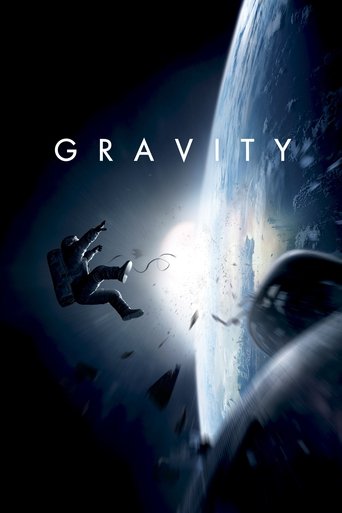
Gravity
2013 · Film · 91 min
Directed by Alfonso Cuarón
Dr Ryan Stone, an engineer on her first space mission, and Matt Kowalski, an astronaut on his final expedition, have to survive in space after they are hit by debris while spacewalking.
61 positive35 negative9 mixed83 neutralfrom 188 commenters
Where to watch
No streaming data for this title.
212 comments on Hacker News
Yes, I do think it's the glasses that do it too. But that's only one reason. Even if I didn't feel like I'm watching the film through uncomfortable, bulky sunglasses, I still don't like the 3D effect. It only really works in a film like Gravity where the background is infinitely far away.
The problem with the 48fps release of The Hobbit is it was only available in 3D (and digital). I don't like 3D, not least because it gives me a headache after about 30 minutes, so watching a 3 hour film was not enjoyable at all (I hadn't internalised the sunken cost fallacy at the time; I shouldn't have stayed for the whole thing).
IMAX shows that 3D is completely unnecessary. Gravity is the only 3D film worth seeing, but even that never made me hold on to my seat like the helicopter scene at the beginning of The Dark Knight Rises. Not a great film, but I was able to see it in IMAX.
One format I'd really love to see for real is Doug Trumbull's Showscan. It uses 70mm film at 60fps. I kinda wish Nolan had picked up on that instead of IMAX. The flicker at a proper 70mm IMAX screen is really noticeable for me.
> Well, one nation mastered gravity, or maybe two nations? Or three? Hard to keep track of intelligence these days
The entire point of that movie was that Sandra Bullock was the master of Gravity
> I watched the movie Gravity
In case you're being serious, Gravity is a notoriously unrealistic illustration of orbital debris.
once space is a battlefield, won't that largely salt the earth for economic uses? I watched the movie Gravity, so I know that it wouldn't take that much for however many trillion dollars of equipment is up there to be magically transmuted into an orbiting debris cloud
Stop trying to make Kessler syndrome a thing - it was never a thing, it isn’t a thing, it will never be a thing.
It is just pearl clutching by those too afraid of modern life. Gravity wasn’t a documentary.
Gravity was not a documentary.
Kessler syndrome doesn't "work" with the orbits these sats sit in. Even left dead and tumbling, the sats would re-enter by their own in ~5 years time. Even less with the recent lowering of their operational orbits.
Also, a common misunderstanding of orbital mechanics (probably amplified by otherwise great cinematography, but poor physics depictions movie Gravity) is that after a collision things move to higher orbits and thus remain up there forever / change planes and affect other satellites. But that's not how it works, the orbit gets elongated, but the periapsis remains the same (or slightly lower), so the things / parts / pieces still re-enter the atmosphere. And the satellites are grouped in rings, with different inclinations, making it extremely hard to reach one from the other.
Also also, space is like really really big. Plenty of space (hah) to put lots of rings of satellites and coordinate between themselves up there. The operators are the first ones who care about it, and they're slowly improving the existing systems, in both tracking (and access to tracking) and automated collision avoidance. Having 10k sats up there makes you good at keeping them separated.
The other way people get confused about Kessler syndrome is that they imagine it's like the movie Gravity where it happens suddenly rather than a slow process that plays out over years/decades.
It's a very real possibility, it's just a very slow exponential.
If you have 100,000 satellites, and each collision produces 50,000 pieces of shrapnel with some distribution of altitudes and atmospheric drag, it's not that hard to do the math. The cinematic portrayal of cascading failure (ala the movie Gravity) is completely insane, but that doesn't mean this isn't a real problem on a 100 year timescale.
> a consideration of impact on the potential market for a rightsholder's present and future works
This is one of those mental gymnastics exercises that makes copyright law so obtuse and effectively unenforceable.
As an alternative, imagine a scriptwriter buys a textbook on orbital mechanics, while writing Gravity (2013). A large number of people watch the finished film, and learn something about orbital mechanics, therefore not needing the textbook anymore, causing a loss of revenue for the textbook author. Should the author be entitled to a percentage of Gravity's profit?
We'd be better off abolishing everything related to copyright and IP law alltogether. These laws might've made sense back in the days of the printing press but they're just nonsensical nowadays.
It’s a reality of cinema that when they do a biopic or a film about a real event, they often have to make changes that enhance the drama. Some of these are reasonable, some not so. In Apollo 13, they upped the drama by significantly shortening the time required to get the LEM up and running as a lifeboat. I’m okay with that. Inserting drama where there was none is less justifiable, as it speaks to the character of the persons involved.
That said, as a retired NASA contractor, I can say that Apollo 13 is highly respected at NASA. Hidden Figures has a lot of fans there, too. In spite of the horrible physics, Gravity also has its fans - some astronauts said it really captured the feeling of being in space.
Close Encounters of the Third Kind (best of the grandiose classics imo)
Deep Impact (the only good asteroid movie?)
Jurassic Park + Independence Day (peak Goldblum)
Total Recall + A Scanner Darkly (best Philip K Dick adaptation)
Gravity (great visuals / perseverance story)
> This is different from Spotify/Netflix, where you don't really need to watch some movie or listen to music
It’s kinda the same though. If I want to watch Interstellar, I won’t settle for Gravity because it’s what Netflix has. If I want to watch Interstellar and it’s not on Netflix or Prime Video, I’m going to pirate it.
But it is partly "just the times". There's a dividing line in 1977 called Star Wars. Before Star Wars it was much more common for science fiction films to use long establishing sequences of especially space technology. For a 1960s audience when the actual moon landings were fresh to mind, the long, slow ballet of space was very palpable and appreciable. Star Wars changed a lot of things for scifi, including reducing some of those establishing sequences to their quickest and most basic. It is harder to appreciate something like 2001 on this side of Star Wars. Scifi movies have been trying to mostly be "the next Star Wars" for almost every decade since, with few exceptions, many of which don't always do well in the box office (Tron is a cult favorite, but early theatrical audiences found it slow; Star Trek: The Motion Picture is often considered a bomb by Star Trek standards for being a pre-Star Wars sort of movie released two years after Star Wars; Gravity and Interstellar both got accolades in somewhat recent years for mostly sort of getting away with pre-Star Wars scifi pacing, but partly got away with it from Brand Name stars and directors and a focus on IMAX tech and spectacle).
2001 didn't feel out of place versus scifi movies of its time. It feels slow and ponderous post-Star Wars.
This was also the premise of the 2013 film Gravity starring Sandra Bullock and George Clooney.
https://en.wikipedia.org/wiki/Gravity_(2013_film)#Plot
Had zero intentions of defending Boeing (or anyone else) here. I made a mistake about the meaning of “stranded” in my comment. What I should have said is “they are not stranded in space like how the two main characters in the film ‘Gravity’ were stranded”. Mistake made, lessons learnt. Apologies.
"This is why we can't have good things". Something that was created for the benefit, has been mis/ab-used and now is being removed.
I am also thinking (more and more lately) the movie The Congress (https://www.imdb.com/title/tt1821641/) and how easy it will be very soon to make a company without human actors. The mega-big studios can train AI by feeding it all their movies, then feed it with the scenario (this is where we - the humans come in - the famous "prompt engineers"), and a movie will be created.
Now, to the above scenario there will be a lot of corrections (can't walk in the air/water/nails)(can't open with killing a dog unless "John Wick" or "Sacred Games")(Sandra Bullock can levitate in "Gravity" but not on "Speed")(etc.)
Eventually if you hire 1000 people to watch 2 iterations of the new movie per day and make corrections to each (100025 = ), the AI will learn and improve on these unrealistic outputs and eventually you can produce movies weekly.
Yo Netflix people, if you haven't started doing this already, START! :) (oh and make a follow-up series on Sacred Games while at it)
EDIT: that's quite a tangent, but I can imagine the day where I will be asking my Paramount-AI "hey, make an original Star Trek series based on this-and-that, I want to binge it next weekend!" (or show me the one you created for someone else)
I have a 65” actually. The AVP is like having a 200”+ screen. And this isn’t about “hur dur everything bigger is better.” You actually do appreciate cinematography more at a large scale.
I’ve had to pause, e.g., some shots in Kill Bill and Gravity just to marvel at the stunning visual compositions. Never once did that on my TV.
Oh, here’s something that’s not obvious: the movie screen (and all images) looks matte inside the AVP. This works exceptionally well for films.
Gravity is a fun movie but it has really exaggerated Kessler syndrome scenarios in the popular consciousness.
Indeed. Problems are things to be solved, not a reason to put up blockers preventing things from happening.
Kessler syndrome is even greatly misunderstood because of movies like Gravity. People think of it as one satellite getting kicked over and then there's a sudden chain reaction of satellite after satellite being destroyed in the time span of hours/days. When in fact it's likely that Kessler syndrome is probably already happening, but it's hard to tell.
The solution is to pass new laws on satellite disposal so the problem doesn't get worse and over time figure out methods to dispose of what's up there. The most important things to get rid of are the very large debris as those can act as nexuses for further debris generation as they're "worn away" by other particulate dust debris and micrometeorites.
This is something commonly misunderstood. Kessler syndrome is a statistical process that happens over many years. It is not a sudden cascade like is seen in movies like Gravity. Statistical processes are not what militaries are interested in.
It's actually thought that Kessler syndrome is kind of already happening right now, which is why there's a lot of push right now to try to de-orbit the very large pieces of debris, so they can't act to form further debris.
If you have a 3D capable setup Gravity is a must! Avatar and Life of Pi are also some favorites.
There’s also a few gems and lesser known films that were released on 3D Blu-Ray like Hitchcock’s Dial M for Murder, which was shot in 3D but wasn’t originally released in the format because the 3D fad died by the time the it came out.
They’re hard to watch because 3D TVs were so unsuccessful. You often need a special Blu-Ray player, and I don’t know of any streaming service that supports 3D.
3D TVs were too far ahead of their time. 3D works far better on 4K than on 1080 since each eye only gets half the image, (though the 4K 3D format doesn’t exist) so it would be nice to see it make a comeback on VR. While 4K and HDR are much better I still miss the occasional 3D film.
So, you'll notice that humans had that sort of flattened affect you're looking for in Kubrick's 2001, but he placed it in contrast to HAL, which for most of the film is the only character who communicates with an emotive affect.
You need some emotion, some performance. Kubrick got that and managed to achieve this in 2001 by combining the emotional austerity of spaceflight with an artificial intelligence who, in an inversion of expectation, is the emotive one. Then he exploited this for the climax, the loss of HAL's personality, being.
Lacking a HAL like element, especially in a film that has one actress, you can't make the humans dull, you need some emotional experience to attach to. In the context of Gravity, that means dramatic calls and the sounds of her human presence. People don't go to the cinema to listen to an ATC feed.
Pretty sure that awful Sandra Bullock movie Gravity was quiet as well. Except that they made the awful choice to have Sandra Bullock screaming, moaning, and making all sorts of groans which came across as stupid and melodramatic. If she had been calmly radioing "Houston, vehicle breakup. Houston, pressurization loss. Houston, emergency EVA" it would have been better.
Just a reminder that their mars mission cost less than the movie gravity.
Thanks a lot for linking Polygonjs here! I assume it might be a follow up to my tweet yesterday announcing new CAD modelling nodes [0].
For context, Polygonjs is a design & animation tool for WebGL. It is based on the popular threejs library, and allows artists and designers to create interactive experiences without any coding. It's is also procedural and node-based, which means everything is created by linking nodes together. Your scenes are then fully procedural, you can always go back at any node and tweak things and see your changes propagate. It's great to experiment.
There are several examples scenes you can start from [1]. Those shows how to setup basic or custom material, procedural geometry, particles, raymarching, states & events, computer vision. There are examples for every taste, and more to come.
Even though the visual editor is not open source, the core library is [2]. So if you are a coder and would like to add nodes to your projects, you can perfectly do so, via the plugin system [3]
It is inspired by visual effects tools like Houdini and Nuke, which I've used for years when working in films like Gravity, Avatar and The Martian. One of my goals is to bring the power of those tools to the web.
Finally, this is all from bootstrapped effort, I'm not a funded company, so I'll take all the support and love you're happy to send my way! While the app is free to use for unlimited time, I encourage you to purchase a license, it's a lifetime one with 12 months upgrade (similar to jetbrains IDE) and you'll always own your files. There's no tracking (except for one license check when the app starts), no lock-in. And it's currently at a reduced price.
[0] https://twitter.com/fradingue/status/1634604273433563137
[1] https://polygonjs.com/docs/examples
[2] https://github.com/polygonjs/polygonjs
[3] https://polygonjs.com/docs/plugins
Gattaca, Moon, Gravity, Contact, Space Camp, Andromeda Strain, the original Westworld (1973), the first two Star Trek movies. The STTNG TV series, Another Earth (2011, PG-13), The Man from Earth.
Arrival - best science fiction movie in recent memory (maybe ever?)
Ex Machina - also great.
Her - different style, but still very good (also with recent LLM developments maybe closer than we think).
The Martian (not as good, but entertaining)
Also I know parents have their preferences, but 12 seems old enough for any of this (if they’re reading Asimov)
I was disappointed in interstellar (but it is a beautiful movie) just dumb in a lot of ways and the “but what above love” subplot really annoyed me.
I’d give gravity an honorable mention. The director’s other movie Children of Men is one of my favorites but doesn’t really qualify as scifi.
For shows, the expanse is probably the best recent thing.
I’m not sure if Super8 qualifies, but I think that’s a generally underrated movie.
There's a cool and weird scene in "Gravity" which depicts this kind of contact.
If you've already seen the film, you should check out "Aningaaq" [1].
[1] https://www.youtube.com/watch?v=qrm2fv_zXoU
Well, depends if the commenter meant anything that is something we currently not only can't do, but are fairly sure isn't possible.
Terminator, BTTF: time travel. Star Trek: depends on the episode (e.g. Q, or the Daud, or time travel).
Gravity is arguably contemporary.
But yeah, like I said there's a whole category called hard scifi, so no shortage. I just took the ones off the top of my head that definitely were not supernatural.
I asked ChatGPT. It gave me bunch. I got some I've never heard of. I think I'll look into them.
<ChatGPT>
list 50 interesting movies that explore AI.
The Matrix
Ex Machina
Blade Runner
The Terminator
I, Robot
The War of the Worlds
A.I. Artificial Intelligence
Transcendence
The Fifth Element
2001: A Space Odyssey
WarGames
Westworld
The Machine
Her
The Iron Giant
Automata
The Truman Show
The Prestige
The Martian
The Fly
The Bicentennial Man
Surrogates
The Day the Earth Stood Still
Limitless
Robocop
Electric Dreams
The Island
The Time Machine
The Circle
The Arrival
The Host
The Stepford Wives
The Brain that Wouldn't Die
Frankenstein
The Invisible Man
Metropolis
The Thing
Jurassic Park
Independence Day
Gravity
Artificial Intelligence: AI
Avatar
The Hitchhiker's Guide to the Galaxy
The Matrix Reloaded
The Matrix Revolutions
Inception
Interstellar
The Time Traveler's Wife
The Butterfly Effect
The Future.
</ChatGPT>
Funnier still was a comparison between Indian Mars Orbital Mission ($73 M) and the budgets for Gravity ($100M), The Martian ($108M), Interstellar ($165M). ISRO (India's space agency) engineers missions to Mars for the price it takes Hollywood to make movies with Mars, space etc.
> Instead of $1-$10B projects focus on things <$100M
The entire mission budget for ISRO's Mars Orbiter Mission/Mangalyaan probe was a mere US$74 million. Modi famously boasted that this was cheaper than the budget of the Hollywood film, Gravity (2014).
There are countries in the world besides the US which can reliably and very cheaply place satellites in orbit. India has been a launch provider for many other countries in the region (Singapore, Indonesia, Thailand, Malaysia, etc) which do not have their own launch capability, and their PSLV/GSLV rockets are workhorses, having launched hundreds of satellites for customers worldwide.
Elon Musk is not a fool and everybody in the space community knows that he is not really working on a colony on Mars.
Then why does he say so? The NASA has understood after Apollo that huge budgets require large political support, hence huge public opinion support.
Going to the Moon has cost 4% of the US budget during 15 years or so.
The world space community knows that humans do badly in space in general ; Mars is no better because of cosmic rays. A colony on Mars would have to be underground. In fact, the whole space community knows that robots are much more efficient and far, far less costly.
The International Space Station has a shallow bottom line in terms of Science, beyond the effects of lack of gravity on humans. I discussed of these effects with the official physician of an European astronaut: it's quite worse than publicly acknowledged. It's not a secret, it's just that journalists don't really do their job on the issue. They would not need to "investigate" in a Watergate way but just to circumvent the press departments of NASA and/or ESA in Europe.
The public opinion wants the dream. The NASA has heavily invested in filming and sharing the expeditions. And they are great at it.
In Europe, Thomas Pesquet is the incarnation of ESA: good-looking, super bright, truly a nice guy by nature, communicative enthusiasm... We all like him. But it would be fun if a journalist calculated the science / communication ratio of his time aboard the ISS. Something like 20% maybe and only because he needs to have something to talk about. Otherwise a robot could have conducted the experiments. Except for the experiments on his own body but... what for, since there is no scientific nor technical rationality for humans in space anymore?
But sending humans instead of robots implies a tenfold budget. So the dream of humans in space / on Mars / on the Moon is vital to maintain a large space industry.
The proof of this is... SpaceX. They do better than NASA and ESA for a fraction of the cost.
But SpaceX has an issue here: NASA, ESA and other space agencies are... its clients. SpaceX wants deep-pocketed clients. So SpaceX must participate in fuelling the dream of humans in space.
The ISS is old now and we have seen it all. The movie "Gravity" was great but also the coffin of space stations orbiting Earth. It's a bit like car races: for most people, me included, we only watch... if there is an impressive accident, on YouTube. On TV, following a car race is just a bore. Another live feed from the ISS? Well... who cares? Thomas Pesquet did super well the last five years, exploiting the ISS to its maximum. To fuel the dream.
So, what's next? The storytelling around robots on Mars surface was a great success. Rosetta and the comet was super exciting too. But we are used to it now... However NASA made a brilliant stunt of the tiny helicopter on Mars: first fly on another planet. I loved it. The Webb telescope... well super interesting for Science and technology guys like us here but for the public opinion... It's just OK. Children don't care for example and it tells a lot. And it's only a 10 billion-dollar project. The ISS amounts to 140 billions.
So what's next for maintaining the over-large space industry? A base on the Moon. That's realistic. And SpaceX rockets will enable it.
But Elon Musk can not been seen as a mogul so influential that a inhabited base on the Moon is budgeted. If he was on TV all the time selling us a Moon base - which is what he really wants - he would be stealing the dream sold by his own clients.
The NASA wants to be again the center of attention like during Apollo. And to get the hundreds of billions it needs. SpaceX? Just an efficient commodity provider in the dream, transportation.
But Elon Musk wants his share of attention too. He can't focus his communication on the Moon base? Let's invent a colony on Mars!
Everybody is happy: it promotes the humans in space, Musk is the dreamy visionary and the NASA... the much more responsible governmental agency with a rock-solid and reasonable project of a base on the Moon.
And, oh boy, press, media and social networks just keep on talking about Musk's Mars colony, endlessly.
Elon Musk has no project of a colony on Mars. He is enabling the NASA moon base, helping his client to get the hundred of billions it requires... SpaceX has rockets to sell and a rocket require a client with a need to send big payloads into space.
Robots are fun... for a while. Humans in space? A never-ending dream: Star Wars and Star Trek have been proving it for 50 years. Robots? Well, there was Wall-E.
Humans in space : tens of billions of dollars per year for the next fifty years. Everybody is happy in the space community.
It will certainly result in technological leaps. But for Science? Robots are better and much much cheaper.
Too cheap in fact. This is true for all space agencies around the world. China wants a manned space station to demonstrate that they are closing the gap with the USA and Russia. Purely technological and proof of power, not a scientific project.
Musk is also creating his own market by sending tens of thousands of satellites around Earth. Space observation from Earth will mechanically become problematic if not unfeasible.
And it happens that SpaceX has the rockets for installing telescopes on the dark side of the Moon. An old dream of scientists, since this is the best possible area for telescopes. But scientists have not been able to get the budgets for it. Don't worry, Musk is paving the way to get them, by privatizing the sky.
Google needs to invade our privacy to get going. SpaceX needs clients for its rockets. In a sense, Musk had to invent this bullshit colony on Mars. He needs to fuel the dream.
I think the more general point here is that, because LEO is a place, people tend to think of it as being kind of like Central Park or Spain, giving them misleading intuitions about what kinds of interactions to expect. A good starting point for your intuition pump is to remember that the surface area of LEO is basically the same as the surface area of Earth. It's slightly larger, because the radius is larger, but the radius is only about 8% larger in this case.
Now consider that we're talking about, in this case, satellites distributed over 30 km of altitude (thickness). This gives you a volume that's roughly ten times the volume of the Earth's oceans. (You can throw in the crust too if you find it helpful.) So instead of thinking about shrapnel from a barrel bomb trying to hit a microwave oven in Central Park, think about trying to hit a microwave oven somewhere in the oceans of ten Earth-sized planets. Even with a 7-km-per-second supertorpedo with two months of fuel, it's not going to be easy without guidance.
Space, in short, is big.
I'd like to blame stupid movies like Star Wars and Gravity for this, but I think it's just the kind of cognitive error the humans are unavoidably prone to. It's easy to get results that are off by nine orders of magnitude like this when you just rely on your untutored intuition.
The other counterintuitive thing about LEO is that, though for hypervelocity collisions it's a three-dimensional space, for things like rendezvous or getting from your launch trajectory to your desired orbit, it's a six-dimensional space of orbital elements. For understanding the results of a barrel bomb in orbit, it may be more useful to think of the nails as being distributed across a small ball of this six-dimensional space in the six-dimensional point occupied by the barrel, rather than gradually spreading out in a complicated way in three-dimensional space. The humans are not good at intuitively reasoning about six-dimensional spaces either.
I found it quite compelling. It’s common for sci-fi films to violate our current understanding of physics, but to just explain it away as a new discovery in physics (think star trek’s warp drive). Others like Star Wars don’t even bother to explain anything about how their ships fly, enter atmospheres, etc.
What was unique about Gravity was that it was sci-if but set it our universe and in our contemporary time period. It at least tried to operate within the constraints of current inventory of space hardware. You are non-space-enthusiast it was amazing.
>We got great hard sci-fi like Gravity, Arrival, Ex Machina
Those were terrible movies and not hard sci-fi. Okay, maybe Arrival was watchable.
Every era is an era of horrible films. That’s Sturgeon’s law for you.
Looking at the 2010s as a whole, we got to watch some amazing films.
We got great hard sci-fi like Gravity, Arrival, Ex Machina. The coming of age genre saw entries like Ladybird, Eighth Grade and Booksmart. Animation reached new heights with films like Inside Out, Spider-Man into the Spiderverse, and Kubo and the Two Strings.
We got comedies like The Artist, Grand Budapest Hotel, Death of Stalin, and Jojo Rabbit. Dramas like Moonlight, Fences, Spotlight, Parasite, Blue Jasmine.
Even in the ever-popular comic book genre, we got Logan and Joker playing at a very different level.
But also, it was the decade of the MCU. Let’s not underestimate what Disney has achieved with that — one big overarching story spanning over twenty films, bringing much deeper character development and more serious themes than what we’d gotten used to from blockbusters.
Elon Musk is not a fool and everybody in the space community knows that he is not really working on a colony on Mars.
Then why does he say so? The NASA has understood after Apollo that huge budgets require large political support, hence huge public opinion support.
Going to the Moon has cost 4% of the US budget during 15 years or so.
The world space community knows that humans do badly in space in general ; Mars is no better because of cosmic rays. A colony on Mars would have to be underground. In fact, the whole space community knows that robots are much more efficient and far, far less costly.
The International Space Station has a shallow bottom line in terms of Science, beyond the effects of lack of gravity on humans. I discussed of these effects with the official physician of an European astronaut: it's quite worse than publicly acknowledged. It's not a secret, it's just that journalists don't really do their job on the issue. They would not need to "investigate" in a Watergate way but just to circumvent the press departments of NASA and/or ESA in Europe.
The public opinion wants the dream. The NASA has heavily invested in filming and sharing the expeditions. And they are great at it.
In Europe, Thomas Pesquet is the incarnation of ESA: good-looking, super bright, truly a nice guy by nature, communicative enthusiasm... We all like him. But it would be fun if a journalist calculated the science / communication ratio of his time aboard the ISS. Something like 20% maybe and only because he needs to have something to talk about. Otherwise a robot could have conducted the experiments. Except for the experiments on his own body but... what for, since there is no scientific nor technical rationality for humans in space anymore?
But sending humans instead of robots implies a tenfold budget. So the dream of humans in space / on Mars / on the Moon is vital to maintain a large space industry.
The proof of this is... SpaceX. They do better than NASA and ESA for a fraction of the cost.
But SpaceX has an issue here: NASA, ESA and other space agencies are... its clients. SpaceX wants deep-pocketed clients. So SpaceX must participate in fuelling the dream of humans in space.
The ISS is old now and we have seen it all. The movie "Gravity" was great but also the coffin of space stations orbiting Earth. It's a bit like car races: for most people, me included, we only watch... if there is an impressive accident, on YouTube. On TV, following a car race is just a bore. Another live feed from the ISS? Well... who cares? Thomas Pesquet did super well the last five years, exploiting the ISS to its maximum. To fuel the dream.
So, what's next? The storytelling around robots on Mars surface was a great success. Rosetta and the comet was super exciting too. But we are used to it now... However NASA made a brilliant stunt of the tiny helicopter on Mars: first fly on another planet. I loved it. The Webb telescope... well super interesting for Science and technology guys like us here but for the public opinion... It's just OK. Children don't care for example and it tells a lot. And it's only a 10 billion-dollar project. The ISS amounts to 140 billions.
So what's next for maintaining the over-large space industry? A base on the Moon. That's realistic. And SpaceX rockets will enable it.
But Elon Musk can not been seen as a mogul so influential that a inhabited base on the Moon is budgeted. If he was on TV all the time selling us a Moon base - which is what he really wants - he would be stealing the dream sold by his own clients.
The NASA wants to be again the center of attention like during Apollo. And to get the hundreds of billions it needs. SpaceX? Just an efficient commodity provider in the dream, transportation.
But Elon Musk wants his share of attention too. He can't focus his communication on the Moon base? Let's invent a colony on Mars!
Everybody is happy: it promotes the humans in space, Musk is the dreamy visionary and the NASA... the much more responsible governmental agency with a rock-solid and reasonable project of a base on the Moon.
And, oh boy, press, media and social networks just keep on talking about Musk's Mars colony, endlessly.
Elon Musk has no project of a colony on Mars. He is enabling the NASA moon base, helping his client to get the hundred of billions it requires... SpaceX has rockets to sell and a rocket require a client with a need to send big payloads into space.
Robots are fun... for a while. Humans in space? A never-ending dream: Star Wars and Star Trek have been proving it for 50 years. Robots? Well, there was Wall-E.
Humans in space : tens of billions of dollars per year for the next fifty years. Everybody is happy in the space community.
It will certainly result in technological leaps. But for Science? Robots are better and much much cheaper.
Too cheap in fact. This is true for all space agencies around the world. China wants a manned space station to demonstrate that they are closing the gap with the USA and Russia. Purely technological and proof of power, not a scientific project.
Musk is also creating his own market by sending tens of thousands of satellites around Earth. Space observation from Earth will mechanically become problematic if not unfeasible.
And it happens that SpaceX has the rockets for installing telescopes on the dark side of the Moon. An old dream of scientists, since this is the best possible area for telescopes. But scientists have not been able to get the budgets for it. Don't worry, Musk is paving the way to get them, by privatizing the sky.
Let's build a simulator game for a truly ecological city on Earth. At least, we have many data already and very good reasons to spend evenings and weekends playing and dreaming for a positive future for all mankind, not just a few thousand people on Mars living underground to escape the cosmic rays.
Yeah, I'm no fun. Sorry. Just sharing what is common knowledge in the space industry.
Let's save the Earth. Elon Musk is very impressive but he doesn't care about Earth future. Google founders went the same path: from impressive innovators to CEOs needing to get their business going.
They are not even "evil", nor is Musk a conspirator. But capitalism has its rules and those guys are rich and perceived as successful among billionaires only if they go on along the rules of capitalism. Google needs to invade our privacy to get going. SpaceX needs clients for its rockets.
In a sense, Musk had to invent this bullshit colony on Mars. He needs to fuel the dream.
Hence the "there is no alternative way" stance shared by our "elites". They are the richest people on Earth and still have no alternative but fuel the system.
But there is an alternative, if all educated people like us resign from capitalistic corporations. Let's either go solo or join cooperatives. No need for a violent revolution. Little by little, big corps will lose their best resources and will shrink, opening the market more and more for cooperatives.
That is not socialism. It's just that open markets don't necessarily imply capitalism. We don't want too much of central planning, just a strong enough government to regulate the market.
Absolutely all serious economists know that a market need regulation to be efficient. By "serious", I mean decent scientists who study how inefficient unregulated markets have proven to be - except for making the rich always richer.
When confronted, the capitalists invariably explain that the markets were inefficient because the deregulation was incomplete. Yeah, they have no shame. And the data prove them wrong.
We don't need a game: we need to have fun. Let's quit our mostly not-so-well paid, boring jobs and earn our freedom. By going solo or joining others in cooperatives.
You know what is amazing in this path? People politically leaning on the left or on the right can both agree and join the movement.
It's not taxes that rips you off, but the insane profit margins of capitalists: They are the one taxing our work the most, and by far.
We are educated, so why are we acting like fools and believe that somehow we will succeed when 95% of people don't?
Let's stop working for guys that pretend that paradise is on Mars and that we have a 5% chance to get a seat on a rocket if you work hard your whole life.
While I agree that there is somewhat over-reliance on CGI in movies nowadays, this post is like cherry picking the examples. Comparing bad CGI shots to few of the greatest films ever made (and with high budget for the time as well) just seems odd. I wouldn't say CGI itself ruined the movies, but how it is now implemented. There are films like Gravity which in my opinion, blended the CGI perfectly with what was happening in the scene and that's where CGI enhances the experience rather than otherwise.
Aside from military, this tactic became obvious to me when space became (again) a theater of conquest around 2010, involving both private and public sectors, internationally.
The narrative around space became very strong, sending messages of conquest, entrepreneurship, science, dreams, you name it.
At the exact same period, bloomed movies like: Mission to Mars, Gravity, Interstellar.
I won't be surprised to see a surge of interest in space-related careers in younger generations in years to come.
…if you like a S. Korean version of Alien (right down to the string-filled theme music). If someone pulled out a flamethrower in those air ducts, I would have likely thrown the remote at the TV.
That said, we’re still watching it with two episodes left. If there is a second season, it’s debatable if we will watch it. I went in prejudiced to like it, too, as I like Bae Doona in everyone thing we’ve watched her in. The contradiction I can’t get around is that the set work is good for the most part, but the writing is either losing a lot in translation (we watch English audio/subtitles) or it’s just plain poor. And if you were complaining about the science in Gravity, stay well away from this one.
Wow, it's exactly like in the "Gravity" film!
https://en.wikipedia.org/wiki/Gravity_(2013_film)
Documentaries
- Citizenfour 2014: Actual interview between Glenn Greenwald and Edward Snowden
- Voyage of Time: Life's Journey 2016: Voyager probes development and deployment
- Zero Days 2016: The background story and effects from Stuxnet
Films
- The Challenger Disaster 2013: Dramatization of Richard Feynman and his investigative work of this event
- Batteries Not Included 1987: When mechanical-based lifeforms descend into NYC to help an elderly couple
- Pi 1998: Fun film with lots of computers and wiring
- I Am Mother 2019: Post-apocalyptic robotic "rejuvenation" of the human race
- Gravity 2013: Fairly accurate dramatization of what space is really like
- Real Genius 1985: Silly film of college hackers before the 1995 film Hackers
- The Abyss 1989: Aliens under the sea, somewhat related to the 1998 film Sphere
- Innerspace 1987: Fun scifi version of Honey I Shrunk the Kids!
That's roughly the story in the movie Gravity.
Collisions between orbital junk are most likely to happen between objects in the same orbit. And most junk is in some roughly equatorial orbit. So I'd expect the resulting debris to end up in roughly the same orbit, so that the debris would form a sort of fuzzy disk - not a sphere. I wouldn't expect to observe much debris over the North Pole.
For anyone that didn’t know, this is essentially the premise of the movie Gravity.
> Musk’s target price is essentially a rounding error compared to the budgets of Gravity or The Martian.
Do we even know Musk's target price for a return-trip to the moon? It's very hard to extrapolate from the $10/kg figure ($1M/launch) that keeps getting quoted, as a return-trip to the moon without discarding a Starship (which will blow up the cost enormously) will involve a lot of launches. Even the HLS architecture, which leaves Starship stranded in lunar orbit and uses Orion to get the astronauts back, needs 10 launches.
Even if we're very generous and assume 20 launches at $1M/launch, that's ~20% of the budget of these movies. But that's very aspirational: for HLS, which is already ambitious, NASA paid $2.89B for development & 2 launches. If we assume 80% is development, you're still looking at $289M per trip.
Oh, fond memories of it. It was the first time when I understood that when you fly to the Moon, not only you have to cross the Moon's orbit, but you have to do it when Moon itself is nearby. If you are 1/4 orbital period ahead of it, you are screwed.
It also ruined space movies like "Gravity" for me, because pointing the nose to the space station in 50 km and applying thrust towards it turns out to be a sure way to NOT get to that station!
Edit: fixed the thrust direction
Wow, it's already 8 years since Gravity came out, time really flies! Despite all of its possible failures, I still consider this the film that makes the best use of 3D that I have seen so far - it really immersed you into the action, you had the feeling of actually being up in space or in the slightly claustrophobic space capsules and stations with the protagonists.
> They're also assuming the movie is set in our version of reality, even though they know it's not, because there's 2 space stations that are closer together than in our reality.
I really love it when movies set out to explore an alt universe. They're fun. But Gravity didn't do that.
> Also they're missing the point of the film, and of science fiction, it's not about predicting the future, it's about exploring humanity via putting humans into extreme/unusual circumstances.
No, I think you miss the point of sci-fi there. Sci-fi is literally just fiction where science is the major plot directive. It could use that platform to discuss ethics (as Star Trek often set out to do), it could use it do explore loneliness and survival (as The Martian did), it could be a platform to scare people (like Alien) or it could just be using it as a canvas for something totally made up and fun (like Guardians of the Galaxy). But there's absolutely no reason what-so-ever why sci-fi can't be about predicting the future. And in fact a great deal of sci-fi does set out to do just that.
The real problem with many of the comments in this thread is they assume "sci-fi" is this single entity in which all content assumes the same goals. But it's not. Different writers will have different stories to tell and different emotions they want to leave with the audience.
Furthermore, movies are not the only platform from which sci-fi exists. If you take a look at novels you'll see that sci-fi is actually a massive genre to which cinema only scratches the surface of. I'd wager that's probably true of most genres when comparing books to movies though.
I would humbly submit that Gravity was also not centrally concerned with the parts of orbital mechanics that would make it an utterly boring movie. I continue to fail to see the big distinction here, and why only one of these is described as "cheating."
Something like B5 isn’t centrally concerned with things like orbital mechanics, they aren’t the focus of its plots and the way ships behave is more a way to contrast the differing levels of tech. Gravity has a plot centered round how things orbit so when the plot cheats on that it’s jarring.
Likewise when B5 had an episode centered round a character who had been Jack the Ripper, but got the area of London where the murderer had been active completely wrong that felt jarring because the nature of that character felt so central to that episode.
They're also assuming the movie is set in our version of reality, even though they know it's not, because there's 2 space stations that are closer together than in our reality.
Also they're missing the point of the film, and of science fiction, it's not about predicting the future, it's about exploring humanity via putting humans into extreme/unusual circumstances.
Why is Dr Stone in space? What's she running from. What killed her child? (Gravity). What do humans do to survive, and how is that related to evolution?
And most importantly in the 3d version, why do things fly out in front of the screen, yet also hit an implied camera lens in a different shot?
"Gravity" had comic book physics in a lot of places, but it was still a really good movie that opens with an amazing single shot that goes on for something like 13 minutes. I can cut it a lot of slack on the physics.
Actual physicist here, too.
Yes, the movie isn't perfect scientifically, but a) it's extremely entertaining, b) gets people interested and listening to me talking about GR and c) saying Gravity is a better movie (in ref. to science) is imo ridiculous (imo Gravity is a pretentious "sciency" piece of drama set in space, but w/e).
Just respectfully disagreeing here. :)
While true, Gravity was an incredible spectacle when viewed in IMAX 3D. I would argue seeing it in a normal theatre or at home would be such a lesser experience, it would be as if you were watching a different movie.
The IMAX 3D movie conveyed the black emptiness of space, the splendor of Earth from orbit, the velocity of moving objects, and the inertia of a human body in a way that dazzled the viewer. It was astonishing.
True, the physics was wrong. By not as wrong as other films.
Actual physicist here. Don't get me started on Interstellar. There is so much needlessly dumb crap in this movie that I don't even know where to start, and the fact that people think it's realistic is just a kick in the pants.
Just for one example...
The crew being sent to save the Earth blasts off in a big ol' chemical rocket with stages. Yeah, fine. I guess rocket tech hasn't advanced all that much in this future. Then they land a ship on a planet in a gravity well so intense that it causes big relative time differences (Note: the gravity alone should have killed them). Then they blast off with the same ship and no big clunky chemical rocket stages. Why didn't this ship just blast off of Earth as is? The energy to get off Earth is nothing compared to getting out of a gravity well that deep! I guess Nolan thought an oldschool staged rocket looked cool.
The SFX people did some actual science to figure out the black hole visuals but, other than that, this is a far worse movie than Gravity as far as science is concerned. The new age emotions resolution was just a big ol' F U to the crowd. Lazy, sloppy writing.
There are plenty of unrealistic movies on this list, and that's fine. Some are just damned fun movies (e.g. Back to the Future). Interstellar sticks out from the pack for it's pretensions and underlying ridiculousness.
> I think the point we'd agree on is that sci-fi definitely doesn't need to adhere slavishly to known physics to be good.
This is my biggest pet peeve.
So many people dont get it. Its a movie, not a physics book readout. Smart-asses on twitter pointing out this or that being incorrect is boring and they ruin a movie for themselves.
Gravity is a little silly sci-fi movie and I enjoyed. I understand enough of orbital physics to chuckle at an astronaut flying on an extinguisher from a space station to another space station.
>> But ISS and Chinese stations could not be so close
>> But in the opening the debree from the original crash has different relative V therefore it would completely miss the station on second pass
Who cares? Just enjoy the movie. If you can't - read a physics book.
Here's some interesting commentary on the delta-v and the movie Gravity. https://www.rocketstem.org/2013/11/03/delta-v-gravity-situation/
I loved Gravity, obviously some of the science was bad but man what an experience, saw it in 3d, I haven't watched a 3d movie since some "wax museum" thing some time ago.
>> “If you want to know what a Spacewalk actually looks like, there is no better film than Gravity.”
Sure he had a lot of issues with it but it didn’t sound all bad.
I was okay with this list until I saw "Gravity" on it. It's preposterous and silly.
Astronaut Chris Hadfield Reviews Space Movies, from 'Gravity' to 'Interstellar': https://www.youtube.com/watch?v=3RkhZgRNC1k
Yeah, I was buying a TV at the time and got one that supported 3D. I have maybe a half-dozen 3D movies and I'll pull one out once a year or so. Gravity is probably the best example of using 3D.
Conservation of momentum. All of the teeny little bits of the two colliding objects still have the exact same average momentum of the two original objects, now there are just hundreds of thousands of them flying off in slightly different directions. The movie Gravity actually gives a fairly good, if overly dramatized, example of what happens when objects collide in space.
As a tangent, that's something that I found interesting and understated about the movie "Gravity". You get drawn into the story of the main character, but in the background you're seeing the end of human access to space (at least for the foreseeable future).
So, will it be something similar to the collision scene in "Gravity", movie?
The movie Gravity also starts with a space debris-related catastrophe. At least the concept is gaining traction in popular culture.
Reminds me of this: “India's mission to Mars cost less than the movie Gravity” https://www.vox.com/2014/9/24/6838079/india-mars-mangalyaan
Kudos to SpaceX for potential lower latency internet service.
But I'm concerned about the light pollution caused by Starlink satellites at night: https://www.unilad.co.uk/science/spacex-to-test-starlink-sun-visor-to-reduce-brightness-of-satellite/. If they don't fix it, it would look awful for people who prefer a clean sky. And an average people wouldn't have a mean to mitigate that - it's not like a drone flying on top of your roof and you can shoot it down, it's a set of satellites thousands miles away.
And if the parts of those satellites broke down, I wonder how much SpaceX itself could do to fix them. If the broken satellites end up a space garbage, that reminds me of the film scene in Gravity. This is a problem we already have today, contributed by all aerospace institutions. I guess people are treating it just like any other garbage around us: if it doesn't show in my eye, it's not my problem.
But it's a harder problem than things like metal garbage on the ground, the latter you could recycle, but I don't know if people really recycle a satellite.
All scientific realism and other criticisms aside—I thought Gravity did a pretty good job with essentially what you described as the setting of the film.
Mostly spent focusing on pretty cramped quarters in a capsule. They figured out some ways to introduce drama. I think what might be the most stunning would be some of the exterior footage. I wonder whether that would introduce some sort of barrier-breaking in the mind when watching a film taking place above the earth knowing that the earth in the film is real footage in "real time" and not stock or CGI.
There's a monopoly angle here too [1].
I remember doing a face-palm when I watched "Gravity." The whole conflict centers around a cascade of space-junk caused by Russia shooting it's own spy satellite. In the movie, the Chinese space station saves the day. In reality, China actually shot down it's own satellite, rendering it's orbit and adjacent orbits unusable for the foreseeable future. [3]
I'm all for international cooperation, but we have to engage with reality.
[1] https://mattstoller.substack.com/p/its-time-to-break-up-disney-part
[2] https://mattstoller.substack.com/p/how-bill-clinton-and-american-financiers
[3] https://en.wikipedia.org/wiki/2007_Chinese_anti-satellite_missile_test
No. It's a great movie, but pretty much every bit of orbital dynamics was wrong, along with many other things. Here are a few articles explaining, and it's not hard to find more: https://science.time.com/2013/10/01/what-gravity-gets-right-and-wrong-about-space/, https://slate.com/technology/2013/10/bad-astronomy-movie-review-gravity.html, https://www.spaceanswers.com/space-exploration/16-things-gravity-got-wrong-and-some-things-it-got-right-too/
I absolutely would! And I know what you are getting at. But you can't look at the relatively poor performance of 3D IMAX ticket sales as evidence that classic 2D cinema constitutes a kind of "End of History" culmination of the art form. It's just really hard to make something like "Gravity", which hit like 80%+ 3D sales percentages internationally.
Instead, for a peak into a possible near future I'd look to new immersive experiences such as teamLab's borderless
https://borderless.teamlab.art/
Visitors to Yayoi Kusama's Infinite Mirrored Room at David Zwirner gallery in Chelsea get exactly one minute each to experience the sensation. And it's expected in excess of 100K+ will make the pilgrimage ;)
A Look Inside Yayoi Kusama's New, Eye-Popping NYC Exhibition
https://www.youtube.com/watch?v=o3UmpPF9Bo4
What is really bad about MCU is that it displaced other movies from the big budget sci-fi niche. For every Ad Astra or Gravity we have 5 comic book films.
Think bigger! One of the best episodes of Buffy the Vampire Slayer was almost entirely silent, and yet still featured the cleverness the show is known for. Some of the most evocative scenes in recent movies are largely dialog-free, such as several scenes in Roma, or Gravity. It isn't just Cuaron, either, remember Castaway?
Imagine a movie that can be watched with no sound but still tells the whole story. Now imagine the same movie can be listened to without seeing the screen, and again, tells the whole story.
The point of "show, don't tell," is to keep lazy or beginning writers from relying too heavily on assumptions about their readers. It doesn't mean "make things explode and don't worry about the plot making sense."
Sandra Bullock in Gravity would disagree: https://www.imdb.com/title/tt1454468/
(SPOILER: The debris from one satellite wiped out all the others, including the ISS)
;-)
Apollo 13 (the movie) had plenty of careful checklist readbacks and minimal explosions or shaky cameras. Most scifi is more like Michael Bay in space. See Gravity for a more egregious example of a movie that tries to play itself off as "hard scifi" but ends up just being an over the top action movie.
> reality completely walks out of the window in Gravity
A bit of an overstatement. Gravity got orbital mechanics very wrong, but it got orbital mechanics relevant in the first place. Most movies dealing with space are far less realistic than Gravity.
The premise is entirely unrealistic since the difference in orbit parameters. We aren't talking about some slight misconceptions; reality completely walks out of the window in Gravity:
* Most satellites and all crewed spaceships orbit Earth from west to east. Why would they hit each other?
* There is no way to travel between the Hubble and space stations like the way it happened in the movie. Especially not with that EMU with 25 m/s delta-v. That's like taking a cup of kerosene, pouring it into a Boeing 747, and traveling 9000 km. Hubble and the ISS have completely different orbits with different inclination.
* Overall, writers of Gravity have no understanding of orbital mechanics whatsoever.
* ISS orbit height is something like 400 km, for Hubble it's about 550 km. Most communication satellites are orbiting the Earth thousands of kilometers above the sea level. A circular geosynchronous orbit is 35 786 km above Earth's equator.
As for the ISS, the majority of debris created by recent India's incident are 300 km above the sea level. ISS is about 100 km higher.
According to this https://www.spaceacademy.net.au/watch/debris/orblife.htm objects with 300 km altitude will enter atmosphere in a month.
The movie “Gravity“ was based on such a scenario, although there it were the Russians that shot down a satellite, resulting in the debris to hit a space shuttle and destroy it.
Not happy to see reality catch on so fast with science fiction to be honest.
> If you get the direction exactly right (and the tolerances are inhumanly small) then the ball will go away from you, yes, in a straight line (more-or-less), yes, but it will slow down. After about 23.2 minutes it will come to a complete stop, and start to come back.
Ok, this makes me wonder, in the movie "Gravity", when people accidentially got separated from the space station, they were not forever lost?
SAGAFTRA rules do not permit actors to work for free, even if they get a percentage. (Despite claims that actors worked on the re-shoots for All the Money in the World for free, all of them except Mark Wahlberg were contractually obligated to participate in re-shoots, so they were already paid for their work. Marky Mark was not contractually obligated to participate in re-shoots, and collected roughly $5 million for his...efforts.)
They can work for minimum scale, and get a percentage of profits (Sandra Bullock and Gravity). The trick with Hollywood accounting is to know to ask for a percentage of the rights-owning entity, since the production entity is a loss vehicle that earns no income, and the licensing entity only earns a small markup for its "work" licensing the movie.
The distribution entity is frequently a third-party company or parent company. Distribution entities might get paid a % of revenue (most common if third-party distributor), a fixed or calculated fee for distributing the movie (i.e., Fox and Star Wars), or it might effectively own the rights altogether and get all of the revenues (Disney and other parent-company distributors, otherwise unncommon). In rare situations, the rights-holding entity is the distribution entity (i.e. Blumhouse).
Excellent point. Reminds me of the Bechdel Test, a simple test to show how poorly women are treated in movies. To pass the test, the movie has to have at least two named women talking to each other about something other than a man. It should be trivial to pass, yet a surprising number of movies don't.
But that test doesn't mean that movies that pass the test are better or more feminist than movies that don't. Terribly sexist/misogynist movies can still easy pass it, whereas Gravity, a movie starring only Sandra Bullock for most of its duration, doesn't pass it because there's nobody else in the movie to talk to.
Similarly, the point of calling attention to the gender wage gap should be to pay women better and give them better access to higher paying jobs, not to deny men raises.
Equality should lift people up, not push them down.
Thanks for taking the time to share your thoughts. In retrospect I didn’t think much of Children of Men or Gravity either, and I can’t even remember what I thought of Y Tu Mamá También, so it apparently didn’t leave much impression on me. Maybe he’s just not my cup of tea.
My upset with Roma was given how critically acclaimed it is, I was expecting a lot more. I appreciate your perspective but I still don’t think the film is worthy of the praise it’s been given. I went and read a ton of reviews after to try to understand what I might be missing and I just ended up getting more and more annoyed. Oh well.
I am really amazed how much people in India are able to achieve without spending tons of money.
India Mars mission costed less then production of a fiction movie "Gravity".
My sister in law needed a cancer cure Herceptine, which is produced by Roche and is rather expensive. It turned out that there is an India company that produces equivalent that is 4 times cheaper. In addition, this company was not some kind of "we will not talk to you little, unimportant moron", but were very helpful even though it was purchase only for one person.
People talk a lot of about China economy growing, etc. doing business over there, but if I was putting my bets, I would choose India in the long run.
Netflix should comply with the 90 Theatre window for some films, grand films that need huge screens for the best experience. I’m a subscriber, their subscription fee is so cheap compared to Sky it hardly registers. I mainly watch TV shows not films on Netflix, I won’t leave if a few films a year are shown in Theatre first, I might even get of my backside and go to the cinema - if Netflix enables a decent film like Gravity to be produced - instead of the usual inane superhero nonsense. I’m curious though, how does Netflix manage to spend so much money and produce so much crap?? Recently I’ve noticed myself watching more Amazon Prime, they seem to have a higher quality to volume ratio, they seem to get much more bang for their buck.
>I have yet to find a single person who claims to like them
I like 3D well enough at least for the occasional novelty and film that uses it well, e.g. Gravity. There is just about zero content available however. My impression when I bought my TV was that there were certainly non-3D options available. But I got a pre-Christmas deal and I paid about the same as for an equivalent TV that didn't have 3D.
It's the same with Smart TVs. It doesn't really add to the cost of the TV. I just never use the features.
I guess the latest trend is whatever resolution that's an additional increment beyond the limits of human vision. Or maybe OLED.
I do understand that the TV manufacturers are really desperate to drive TV upgrade cycles. The good news is that the new features are mostly harmless if you need a new TV anyway.
This scares me a bit. The idea of having LEO internet is great and all, but the idea of quadrupling the number of functioning satellites, all operating in different orbits but at a similar altitude seems incredibly dangerous to me.
The article mentions the movie Gravity, which is a bit unrealistic as it portrays multiple large bodies in orbit all being at about the same altitude (which isn't the case in reality). That is not the case with this web of satellites. If a chain reaction of collisions does occur, it would cause a field of tiny, fast, deadly debris all orbiting on a similar orbital "plane". It would pretty much blanket the planet. Wouldn't this cause a large issue for anything attempting to reach orbit? What am I missing here?
EDIT: A lot of replies here mentioning the fact that LEO spacecraft decay more quickly than higher orbits. Please note that not all LEO orbits are low enough to guarantee a quick decay without powered retrograde thrust. Stuff can hang up there in LEO a long, long time depending on the actual altitude.
This does not deserve a sensationalist depiction. Everyone in space industry, astronomy and even the public now thanks to this terrible movie Gravity knows about the Kessler effect.
Some thoughts:
- Putting 12000 big freezers (900 pounds at most) in orbit is never going to "crowd" the place; imagine these objects on Earth, then the claim that on a much higher radius sphere these could be seen at any point seems ridiculous. (I am not speaking about speed or dangerosity, which even up the numbers a bit, or powerful light-emitting projects)
- In that sense, the video displayed is annoyingly misleading.
- The danger of the Kessler effect is a long term one, and as such it seems purely economic to me. Increasing the number of space debris will gradually increase the probability of collisions, and raise the costs of space industry, in an upwards trend that may at some point represent a real financial burden. This is the only question: at which point does it become economically interesting to tackle this problem, and are we not underestimating the future costs at this point ?
- My take is not yet, and SpaceX will do fine managing their 12000 space fridges.
https://www.theguardian.com/science/blog/2013/nov/15/space-junk-apocalypse-gravity
>How many satellites could you knock out if you really tried?
With a single launch scattering a lot of debris?
You could reliably take out ONE satellite. The clouds of debris creating a cascade of destruction as depicted in the movie Gravity are entirely fictional.
I read about this first when I saw the movie "Gravity". I think if it really becomes that bad, given enough resources mankind can solve it.
> Do you know what kind of hoops they have to jump through to access that market?
Yes. I thought my comment made that pretty clear. But is hollywood entitled to the chinese market? You act like the chinese owe us their market like we own them.
>Take Gravity for instance. The reckless nation that shoots down the satellite causing all the damage is Russia when it was China in real life.
I know. That's why I wrote "Or china setting aside X number of hollywood movies to show in their huge movie market. Of course hollywood is going to give something for a portion of china's movie market share."
Well, it's called the chinese market for a reason. It belongs to china. Their house, their rules. Why would china give their markets to foreigners without anything in return? Do you think we open our markets without anything in return? Do you think europe does? Or russia? Every nation or bloc protects their markets and demands something in return for access. Maybe the chinese go overboard with it, but as I said, it's their market. They can do whatever they want.
Perhaps the deficit of happiness can be better explained by one of Peter Thiel's most excellent reductionist observations:
The countercultural in the '60s was the hippies. You know, we landed on the moon in July of 1969. Woodstock started three weeks later, and with the benefit of hindsight, that’s when progress ended, and the hippies took over the country. [1][2]
Perhaps, for too long, the left has engulfed and held hostage our cultural ideas of progress and advancement. And perhaps that has imbued us with a certain stripe of ideological stagnation not just in the way we perceive modernity but in also the debilitating influence on how we perceive actual technological progress itself and its relevance to the overall happiness of our society.
Perhaps our dominant leftist culture's 'ideological stagnation index' is the unmeasured metric that could explain why we feel the way we feel despite technological progress.
Thiel on the same topic:
Today the counterculture is to believe in science and technology. You know, our society, the dominant culture doesn’t like science. It doesn’t like technology. You just look at the science-fiction movies that come out of Hollywood — Terminator, Matrix, Avatar, Elysium. I watched the Gravity movie the other day. It’s like you would never want to go into outer space. You would just want to be back on some muddy island. And so I think we’re in a world where actually believing that a better future is possible that you can have agency and work towards a better future, that is actually radically countercultural.[1]
[1] Glenn Beck and Peter Thiel On How To Change What's Politically Cool
http://www.youtube.com/watch?v=IER50pX-FuM&t=3m22s
[2] Technology Stalled in 1970
http://www.technologyreview.com/qa/530901/technology-stalled-in-1970/
> But if the consumer can't tell the difference, does it matter?
The consumer gets used to it. The CG effects in Toy Story 1 look dated, and if you were to watch the Incredibles and the Incredibles 2 back to back, you would also notice immediately. Or compare the movie "Gravity" to "Babylon 5".
Plus I've not even mentioned hair, fur and volumetrics. A staple in pretty much any feature film FX, they were completely absent in the real time ray tracing demos. Hair and fur are commonly not ray traced as triangles but use custom intersection routines. Those are an extra layer of complexity on top. I don't know yet how Nvidia's own API for the RTX card looks like, but Microsoft DXR and Apple's Metal ray tracing both are restricted to triangle geometry only.
I thought the script to Interstellar was lovely and profound, while that of Gravity (a movie with which it's often compared) was ridiculous and obviously written by someone who had no idea how physics worked.
To each their own.
Depends which market you are in.
First for a ray tracer to be effective it must model billions of photons, so optimising how and where you fire them is key to making a _fast_ ray tracer. A non optimised, (therefore multi hour per single image render time) ray tracer is fairly easy to write (can be done in less than 5k lines of code)
As for what the point is, there are a number of things: Raytracing means that you are effectively simulating the physical properties of something. This means that light interactions between objects come for free (well, kinda) When you put a lamp shade on a light bulb, it will cast shadows. Windows are transparent, etc, etc. In raster land, thats not a given.
This means that architects who are designing building in cad, and have been very specific with their material choices can get accurate representations of how the light will interact inside the building. Maxwell render bills it's self as a physically accurate renderer, but it is _slow_, very pretty, but slow. (yes, there are trade-offs, a real-time renderer is not going to be physically accurate, but it is way more accurate than a rasterer) So making small incremental changes might mean waiting for a number of hours for the render to finish.
In VFX, renders can take > 24 hours per layer, per frame (Each finished frame might have > 1000 assets, each with > 100 versions, each with a number of layers.) So any time saving there can save thousands.
Also, getting real time feedback makes production much more fluid and intuitive. At the moment, when acting with CGI characters or backgrounds, you have to use a standin: https://imgur.com/gallery/OVk4DYp
This means that the cameras have to be much more scripted, a lot of working out has to be done to make sure that CGI elements blend in properly. In the film gravity, they used realtime motion capture heavily, as most of the elements (in some case only the eyes of the actors are real) are CGI. The director is a visual person and wanted to look through a camera and see the space station. He would have sacrificed his left testicle to get the demo's level of realism in his view piece
> Name one other thing recently on air that’s realistic about space while also being interesting to general audience.
Person of Interest is on WP’s list of hard sci-fi, but isn’t about space. (This surprises me a little, it never struck me as accurate and I lost interest in the show fairly quickly.)
I mention that in part to call out that this thread is equating sci-fi with outer space. There are plenty of non-space scientific topics on earth that are covered in movies and TV. Making hard sci-fi only about space might be missing a general trend toward more rigor about science in general.
https://en.m.wikipedia.org/wiki/Hard_science_fiction#Television
Worth noting that Expanse is not on WP’s list. Nor are Gravity, Interstellar or The Martian. Gravity is a good example of the story intentionally breaking whatever hard science might have been there.
What I do see across all the genres is a peak of interest in space between maybe 1965 and 1995. Perhaps most important is writing, short stories and novels, since those often fuel TV & films.
If I look at the trend based only on this WP page, it does look like 1990-2010 was a trough and that space is trending again.
Mostly my feelings/intuition, but here's the argument:
Name one other thing recently on air that's realistic about space while also being interesting to general audience.
Closest thing that comes to mind would be NatGeo's Mars series, but that's half documentary, half speculative concept art, and definitely very niche. Beyond that, there's nothing. Before that, we had the trio of Gravity, Interstellar and The Martian, the former two being sorta-hardish if you squint hard enough. And before we had 2001: A Space Odyssey, and that's it.
It's difficult to make a space show that's both true to physics and fun/engaging at the same time. Most authors don't bother with "true to physics" part. The Expanse succeeded at both, because an excellent team took great source-material and expanded on it, instead of butchering it like usually happens. The result was a show that was interesting to non-space geeks, that still gave accurate picture of how space works. If someone asked you, "I wonder why they're doing X", or "I wonder why they didn't do Y", your answer would likely contain some explanation of real-world physics. This is how you give regular people intuition about concepts they're not encountering daily.
So yeah, losing the only show about near-future space exploration that's both engaging and highly realistic - I think it's a bad day for both science outreach and science fiction.
Most spacecraft/satellites don't have onboard radar or other local scanning equipment, and "diverting" a spacecraft is actually a pretty complicated thing. This would involve multiple delta-v (using thrusters), both to avoid the object and then go back into their normal orbit. That could eliminate years of useful lifetime of a satellite, because those thrusters are usually used just for stationkeeping. Also, whatever orbit they are in is usually related to what the satellite is doing, so it might affect performance/reception/scanning/etc.
Just like the movie Gravity, if there was an explosion in space and you had a lot of small objects floating around in a cloud you can't detect, that could snowball into destroying more things in orbit, making the problem even worse. Right now there's no way I know of to clean up space junk in orbit other than waiting for it to burn up, which could take years or tens of years.
https://en.wikipedia.org/wiki/Orbital_station-keeping
It also raises a bunch of issues around:
- Kessler Syndrome, a la "Is the plotline of Gravity inevitable with increasing commercialization of space?"
- Weaponization of space. If you could get 4 unauthorized satellites up on a launch that was forbidden because "they're a danger to other satellites", could you do the same with satellites that are intentionally a danger to other satellites? Could a private company knock out the U.S's spy satellites at just the moment they are most needed? Could it set up its own spy network?
- How about ABM defense? Could a private company create a network of smart space junk with the purpose of stopping a potential nuclear war before it starts? (Incidentally, such an organization could end up in the position of both saving humanity and opposing U.S. national interests, given that the U.S. has the largest stockpile of nuclear weapons on Earth, which should make Americans wonder if U.S. national interests are aligned with humanity. Crimson Tide was a great movie.)
- More generally: nation states have traditionally had a monopoly around certain technologies. Spaceflight, weaponry, cryptography, communication networks. That monopoly is fraying, or in some cases, has already frayed beyond repair. What does that mean for the power balance on earth, and for social organization on the planet? There are some private organizations that are arguably more powerful than full nation-states nowadays.
21st century sorts of problems indeed. At least the 21st century looks like it'll be exciting, if somewhat scary.
I think there may be a sort of uncanny valley effect for how much we like art.
For example, I am particularly picky about sc-fi. I love hard sci-fi like Arthur C Clarke. I can also enjoy really silly sci-fantasy stuff like star-wars. But if something is sorta half way, the inconsistencies and inaccuracies really annoy me and I hate it. eg that film 'Gravity' being a mix of realistic and unrealistic.
In the case of this thing..
A lot of the software dev type people on HN presumably love elegant tech, and probably dont have strong opinions on the latest high-art. But when the art starts to approach tech it hits this valley and we start to actively hate it.
Just an idea.
12 Monkeys - Travelling back in time to try and track the outbreak of a virus that wipes out most of humanity.
The Abyss - Survival and discovery on a deep water mining platform.
Apollo 13 - Look at the rescue efforts of this historical NASA moon mission. (Does it count as sci-fi?)
The Dish - Also not quite sci-fi, but a comedy about Australia's involvement in the first moon landing.
Battle for Terra - Surprisingly good animated movie about invading aliens.
District 9 - Alien refugee camp in Johannesburg.
Gravity - Astronaut stranded in orbit, trying to get back to Earth.
The Martian - Survival and rescue of a lone astronaut stranded on Mars.
Moon - After a serious accident, a solitary worker on the Moon discovers a conspiracy.
Oblivion - A veteran assigned to extract Earth's remaining resources begins to question what he knows about his mission and himself.
Predator - The classic that launched the franchise.
Predestination - Faithful adaptation of Heinlein's short story, "All You Zombies."
The Prestige - Some minor sci-fi elements. At the end of the Nineteenth Century in London, two stage magicians engage in a battle to create the ultimate illusion whilst sacrificing everything they have to outwit the other.
Source Code - Using limited time-travel to try and get information to stop a second, larger terrorist attack.
WALL E - In the distant future, a small waste-collecting robot inadvertently embarks on a space journey that will ultimately decide the fate of mankind.
No, I got that from reading Kubrik's own comments on the meaning of the film. I ignore speculations on what an artist means, it's a waste of time when I can just find out from the artist himself. (there's some interview of him online somewhere where he discussed this.)
The sound and effects are not perfect for today. They are perfect for the 60s. Even by the 80s I could see the effects were starting to look pretty dated.
Every time something takes me out of the experience of the movie, either it should have been edited out, or done better. In the case of 2001, it's an old movie. I am old, and I am a movie connoisseur.
I wanted to enjoy it with my family like I did when I was younger. But the effects look down right silly. And in a serious movie, you can't have silly looking effects. Compare how the movie gravity dealt with zero-G, it makes 2001 look like high school kids made it now.
The one thing that stood out, was there use of tablet computers, that was brilliant, and was done with rear projection, so it looked great even today. The rotating and curved floors are truly inspired work, but the music score is meaningless today, even to me, who grew up with classical music.
If the art of film making can't improve on something made in the 60s, then it couldn't have improved on something from the 30s, and we know neither is true. So, 2001 could be remade, just not by hollywood bozos.
The story is of a profound mystery, but it's not told from the perspective we have today of putting someone inside the mystery, it's told from an odd 3rd party perspective popular in older cinema. Compare how you felt in Interstellar and Gravity, __you__ were there. It was you who is in danger and in risk.
In 2001, the characters were in the mystery, and we were simply observers. Applying modern storying telling techniques (that Kubrik helped pioneer) would dramatically improve the enjoyability of the 2001 story for us today.
Edit: I wanted to add that the scene where he's rebooting/working on the computer (HAL), all he does is push in clear plastic blocks. That is just stupid. (He even just pushed them in IN ORDER, wth?) I work on computers, and he didn't even mildly pretend to do anything at all technical. I think this was pure laziness on the film makers part. They knew computers were complicated back then, and to make them seem so stupidly simple that you could find an error by looking and a sheet of clear plastic with no markings or anything? It fools kids and ignorant people, but anyone with any technical knowledge, it rips you out of the experience. Another reason to update it, or at least admit it is not as effective an experience as it once was. A classic doesn't mean it's good now, it means it was good at one time.
So if this was the movie Gravity, we could just scoot voyager over to see it as it passes by.
I've only ever seen a few 3D films - Cave of Forgotten Dreams, Gravity, Dial M for Murder - but I greatly appreciated the experience in all cases.
TBH, the masses know The Expanse mostly from TV show. But the show indeed is good, and while it has some differences from the books, it mostly stays true to science, even in very minor VFX details.
This is an unpopular opinion, because I've seen here how people like to hate on Gravity and stuff, but I feel like we're seeing a new trend in sci-fi movies/shows - Gravity, Interstellar, The Martian and now The Expanse, despite their various levels of science/plot tradeoffs, all are much more faithful to physics than what came before (with a honourable exception of Space Odyssey), and they do a great job at showing you can have a great sci-fi appealing to general population that sticks to how real space travel works.
--
That saids, The Expanse novels are 11/10 Even Better Than On TV, and I highly recommend them. Can't wait for the next one coming out soon(ish).
On the contrary, I have been getting into modern science fiction after being raised on my dad's collection of Asimov/Clarke/Heinlein/etc. and the modern stuff is great. Check out Vernor Vinge, Greg Egan, Kim Stanley Robinson. None of that is science fantasy. If anything, I'd say that science fantasy is less popular now than it was two or three decades ago. Look at the popularity of modern TV and movies: Arrival, The Martian, Gravity, The Expanse, Interstellar. Three of those are complete hard science fiction and the others are more in the vein of 2001: A Space Odyssey and Contact than Star Wars.
Maybe, but I've got hundreds of hours of KSP under my belt and thought Gravity was fantastic. I'm a proud science and gamer geek, but feel that the urge to nit pick is the scourge of the geek community. I'll happily engage in a conversation about the compromises made in Gravity, it none of them spoiled the movie for me and I'm very glad it exists. If it makes movie goers more interested in Space and feel positively about space research and exploration, that's a wonderful thing.
> ... Star Wars don't deal with orbital physics at all.
Except at the times when a ship is disabled in an attack, and then changes course and "sink" into the nearby planet.
But yeah, I do agree. It's much easier to watch that kind of atrocity in a movie that makes no effort to look realistic than it is to watch something like gravity.
Gravity was a good movie. And for a movie set in space, it's pretty realistic...ish. But it's orbital physics are terrible. Just terrible. I mean, most movies don't even try. Guardians of the Galaxy and Star Wars don't deal with orbital physics at all. Gravity tries, and gets it all wrong.
It's so weird, looking at a perfectly normal movie and the only thing you can think about is "What? It doesn't work that way!" like if everything started falling up with no explanation and the characters found that perfectly normal.
But I'll disagree on Gravity and Interstellar getting spaceflight right. Unless you are going for very basic.
KSP was possibly my best entertainment spending ever. It definitely is the best game for me in terms of costs / time played. If you haven't played it yet, do yourself a favour and buy it now. If you have a kid with even tangential interest in space, get a copy for them.
Side effects of playing KSP include:
- getting an intuitive feel for basic orbital mechanics
- finding yourself reading up on actual math to better understand what's happening with your rockets (and how to build more efficient one)
- no longer being able to watch most space movies due to frustration caused by the filmmakers not grokking basic orbital physics
(RE the last point - after Gravity, Interstellar, The Martian and The Expanse series, getting basic spaceflight wrong should no longer be accepted in popular media. Looking at you, makers of The 100.)
Thanks for the extra info!
According to the article this was indeed the only station-to-station transfer, and although very cool I am not sure exactly why would you do it except for some emergency or for building up a new station out of parts from others like you suggested.
Do you have any idea what use would there be for a s-to-s transfer? I'm guessing it's more expensive and dangerous than launching a specific mission from Earth, so the use would be limited. Maybe to test some emergency procedure a-la Gravity (the movie)?
It would be really cool if there was some other big space station so that this would be something to think about... but oh well, I guess having the ISS will have to suffice for now.... It's not like I have the money to build my own unfortunately :(
The movie 'Gravity' has some amazing images of what a cascading series of collisions at orbital velocity would look like:
https://www.youtube.com/watch?v=vKW-Gd_S_xc
You could do this pretty easily. All orbits at the same altitude eventually intersect, and high LEO orbits take decades or more to decay. Moreover, at orbital velocities, even tiny fragments can destroy a satellite.
So if you fill an altitude range with enough orbiting shrapnel, you can ruin the party for everyone. The movie 'Gravity' has some breathtaking visuals of how such a runaway event would look.
You're right. But I did enjoy movies like The Martian (2015), and Gravity (2013).
I haven't messed with the retail Rift or the Vive but on my Rift dev unit, I enjoyed watching 3D movies in one of the "fake theater" environments. It simulated a giant movie screen and could interlace a side-by-side 3D movie file to generate an effect similar to what you'd see at the movies. I found it actually better in some ways, mainly because you could adjust the amount of "depth" separation if the default seemed off. At the real theater, it ought to be correct as shot but if you want to tweak it, you're obviously out of luck.
That said, I still don't watch many movies in 3D. I think the best one I watched with a VR headset was "Gravity" (in terms of the overall impressiveness of the 3D effect and the immersion).
3DTV has always been too much work for the consumer. You have to pay the big ticket price of getting a 3DTV. Then you've got to get a pair of glasses for each viewer. What if you're one pair short? Plans ruined? Then you've got to get the 3D version of the movie. What movies do you even consider watching in 3D? Personally, I can only think of Avatar, Gravity, and maybe Dr. Strange.
>This "stop doing something because I personally don't like it!" mentality is what should be done away with.
Couldn't agree more.
It's the same mentality that makes people declare that "[arbitrary tv show] should've been cancelled long ago!"; or what a travesty it is that [arbitrary beloved IP] is getting a sequel/remake/reboot.
If the Simpsons runs for fifty seasons, it doesn't undo the first ten.
If they reboot Batman a dozen more times, it doesn't keep you from thinking that Adam West was the best Batman.
And to categorize 3D movies as simply a fad totally disregards works for which 3D was an integral part of the creative vision, e.g. Avatar, Gravity, Love.
There's simply no good reason to discourage anyone from contributing anything creative to the culture, even if you question their motives.
Gravity was spectacular in 3D, but I have a much larger list of films (many of which aren't great) that have immersive and not distracting 3D. Off the top of my head:
Life of Pi
Pretty much every Marvel movie
The new Star Trek films
Star Wars: Episode VII
The Martian
The Hobbit films
How to Train Your Dragon and sequel
Finding Dory
The LEGO Movie
Avatar was a poorly composed 3d experience in my opinion. The combination of depth-of-field effects with stereoscopic vision was really off-putting, I can see shapes nearer to me than the focal point, and can look at them, but can't focus on them.
The only 3d experience I enjoyed - well enough as I wouldn't dissuade someone from viewing the film in 3d, at least - was Gravity, since the small-aperture space cinematography was very suited to a 3d presentation, 3d contributed to the feeling of the film - helping acheive a sense of contrast in scale between the personal experience of the main character and the very large catastrophes around them, and not just a fancy way to produce distractions.
It seems that 3D is better suited to slow-moving, large-scale images than typical Hollywood action sequences. I can't stand 3D action movies, they make me dizzy. Especially when it's combined with shaky cameras!
But Gravity was awesome, animated 3D movies from Disney/Pixar are generally OK, and I really enjoyed the 3D version of Titanic that James Cameron produced in 2012 for the 100th anniversary of the sinking. (It's the same movie that came out in '97 but converted to 3D. Most of the time, you don't even realize that it's 3D. It's quite subtle.)
The only movie that I have felt that was better in 3D is Gravity. Wow - what a movie.
3D gives me a headache. It also looks rubbish. I watched Gravity in 3D after Mark Kermode admitted it added something. It was bearable because it was a concise film and was enjoyable. But it works only in specific cases like these. It's more like a theme park ride than something that works on any film. Other times I was forced to watch 3D were: Dredd (only available in 3D), The Hobbit (was curious about 60fps which was only available in 3D). I regretted it each time.
>3D Fans Petition LG to add the 3D hardware back
All 10 of them?
>I have seen a lot of 3D movies on LG OLED sets (Gravity, Mad Max), and it's remarkable. Much better than 4K UHD. With the latest LG OLEDs, you get 1080p per eye, bright smooth motion, and the passive glasses are cheap, lightweight, and you don't have to charge them.
I find that 3D is a gimmick even at the cinema, even more so from a TV.
Over 5000 3D Fans Petition LG to add the 3D hardware back, and it sounds like LG may reconsider since it doesn't affect picture quality and the hardware isn't that expensive: https://www.change.org/p/lg-please-revive-3d-on-a-2018-oled-tv-model
I have seen a lot of 3D movies on LG OLED sets (Gravity, Mad Max), and it's remarkable. Much better than 4K UHD. With the latest LG OLEDs, you get 1080p per eye, bright smooth motion, and the passive glasses are cheap, lightweight, and you don't have to charge them.
All of the Star Wars movies made profits for their distributor. The accounting loss was recorded only in the special-purpose holding company (SPHC) that was specifically set up to disburse profits to net-profit participants. To ensure that this type of entity has no profits, all production and distribution expenses of the studio and distributor are generally charged to this entity, usually in advance lump sums. The studio and distributor record and are taxed on their income.
In many cases, any licensing income is earned by a separate but related company that paid the SPHC for the rights to re-license the film (but usually the distributor also acquires licensing rights). The SPHC is generally a profit-participant in the licensing company, but its share of the licensing profits usually varies based on industry politics (i.e., leverage).
A-listers with sufficient leverage and competent representation can sometimes participate in the profits...of the distributor. It's not enough to get gross profits since gross profits take into account COGS/COSS. What you really want is "first-dollar gross", meaning "gross income" before distributor expenses.
For example, say, "Gravity 2" makes $100m at the box office. That $100m is first-dollar gross. If WarnerBro's COGS were $80m, gross profits were only $20m. If Sandra's share of profits was 1% of first-dollar gross, she's looking at $1m; but if she only had a gross-profits participation, she's looking at only $200k. If Sandra was a net profit participant, she wouldn't make anything at all since Gravity Special Purpose Movie-Making Entity has an $X million dollar loss related to production expenses for making the movie and the distribution expenses WarnerBros is expensing to it.
[source: I do this. But not for WarnerBros or Gravity, those are just examples that are easily Googled if you want to follow up with your own research.]
The reasons you consider it to be such a good film probably have more to do with cinematography than writing, acting or directing. The beautiful shots are a direct result of Emmanuel Lubezki being the DP - the same style can be seen in Birdman, Gravity, The Revenant, and some of Terrence Malick’s films.
Gravity, as in the film where Sandra Bullock's team gets nailed by a bunch of space junk?
Transcendence, Interstellar and Gravity. I haven't actually watched neither Interstellar nor Gravity, but from what I know neither of them portray technology in a bad light. But Transcendence does overall portray technology in a good light, though the majority of the movie is just the movie makers playing with the audience's luddite fears.
Still, it's a damn bad movie.
Side note: Gravity is such a great movie. I love it's simplicity. It's a monster movie with (essentially) 2 characters and the setting is the monster. Then brings this incredibly simple vision to life without feeling sparse or experimental.
This even extends to the title:tagline as you mention. Four words, "Gravity: Don't let go", efficiently conveys the whole tone of the film.
Exactly. In a very similar vein, Gravity is possibly my favourite movie name of all time. (Along with its tagline, "Don't let go", which is the exact opposite of appropriate for most of the movie.) Some names have a good reason for looking silly at first glance.
It pays to keep this in the context of the events in our recent history which some argue have lead to a certain stripe of ideological stagnation in America, not just in the way we perceive modernity but in also their debilitating influence on how we perceive actual technological progress itself.
Peter Thiel has been steadfastly vocal on this :
I think one of the … you know, the counter-cultural in the '60s was the hippies. You know, we landed on the moon in July of 1969. Woodstock started three weeks later, and with the benefit of hindsight, that’s when progress ended, and the hippies took over the country.
Today the counterculture is to believe in science and technology. You know, our society, the dominant culture doesn’t like science. It doesn’t like technology. You just look at the science-fiction movies that come out of Hollywood — Terminator, Matrix, Avatar, Elysium. I watched the Gravity movie the other day. It’s like you would never want to go into outer space. You would just want to be back on some muddy island. And so I think we’re in a world where actually believing that a better future is possible that you can have agency and work towards a better future, that is actually radically counter-cultural.[1]
[1]
Peter Thiel and Glenn Beck discuss what the counterculture looks like.
http://www.glennbeck.com/2014/10/21/could-this-be-the-new-counter-culture/
(or if your political persuasion forbids you against patronizing Beck)
https://www.youtube.com/watch?v=IER50pX-FuM
I find it funny that she mentions Gravity as an example of a film with little dialogue. My biggest complaint about the movie was that it had entirely too much dialogue. So much pointless, clichéd exposition about the characters, as if Bullock's needed any kind of emotional background. It really ruined the movie IMO.
An old and maybe not terribly popular one is Enemy Mine. There are bad guys, but they're humans, and they only play a role near the end. But they aren't primary to the story. It's mostly a story of two people thrown together in a shitty situation and learning to get along despite their initial hatred for each other.
There are lots of scifi movies where the story only barely, rather than primarily, deals with the idea of good guys versus bad guys, if it puts them together directly at all. Moon, The Martian, Gravity are recent ones. Interstellar, in its way.
Less true of fantasy which pulls its stories from the idea of grand epics with noble warriors fighting monsters and villains.
Action movies without an idea of good guy and bad guy is a challenge. Maybe I'll think of one while I lie in bed tonight but off the top of my head there aren't any occurring to me.
One of my favorite sci-fi movies of all time – Gravity – doesn't really have good guys or bad guys; just a crappy situation.
For those that haven't seen it, it's pretty much only worth seeing in theaters, in 3D.
To add onto this: I know the movie "Gravity" was just a bit of an exaggeration, but a situation whereby two different satellites are competing for the same spot in the sky and collide or otherwise negatively interact with each other is totally possible. If nothing else, there should probably be some international governance when it comes to orbits, positioning, and mission planning to make sure no one interferes with each other.
Gravity movies budget was 100 million USD and ISRO's mars mission budget was 75 million USD. So I don't get the smell of government propaganda.
After all India ain't North Korea.
It's projected that China will surpass North America as the world's largest film market in early 2017.
American blockbusters are adding small Chinese subplots that show China in positive light because these films compete for access to Chinese box office. Hollywood is also seeking co-production. Chinese Bona Film Group invested $235 million in 20th Century Fox tentpole movies.
Directed by Hollywood Edited by China http://origin.www.uscc.gov/sites/default/files/Research/Directed%20by%20Hollywood%20Edited%20by%20China.pdf
>Appealing to Chinese Audiences American filmmakers attempt to entice Chinese moviegoers by including popular Chinese locations, actors, and products in their movies. In some cases, filmmakers make these creative decisions on their own accord, seeking higher profits for their film’s release in China. Despite being produced entirely by U.S. companies, the final cut of X-Men: Days of Future Past released worldwide included lengthy scenes in Hong Kong, as well as a cameo by a Chinese boy band. The film went on to gross $116 million in China. The film Gravity appealed to Chinese audiences by portraying China’s space program in a positive light: a stranded astronaut saves herself by utilizing a fictional state-of-the-art Chinese space station and lands on Earth in a Chinese space capsule. The film went on to gross $71 million in China, 10 percent of its worldwide total gross and 16 percent of its total foreign gross.
There are faint, faint wisps of Earth's atmosphere a fair distance out, which is the big part of an orbit's challenge. Perturbations from other bodies nearby (notably the Moon), deformities of Earth's gravity, and even solar weather and tiniest fractions of gases are other contributors on a long-enough time scale. Micrometeorites would probably be the big risk over time for our orbital monument to humanity, and I would expect Kessler syndrome, as dramatized in Gravity, to actually happen over a long enough period without human existence. (Hell, even with us around it's a possibility, but not as depicted in the film. It'd be slower. Some say it's already underway.)
Distant orbits might decay away from Earth given enough time and certain circumstances, oddly enough. A return to Earth is not guaranteed.
Haven't watched Interstellar. But Gravity is a (bad) joke of a movie, both from a scientific standpoint and as a movie in general. It's just a bad space action movie with very cool CGI. You say "there are some issues with" - no, the whole thing is a mess. They're using spacesuit rockets or a fire extinguisher to move between orbits that are extremely far apart, this is a physical impossibility that is central to the plot. But it managed to make me furious from the very first scene, with three people outside the spaceship during an EVA, and Clooney floating playfully around the spaceship, untethered. This is reducing the majesty and terribly unforgiving nature of space to a kindergarten playground.
Same feeling for "The Martian". The Martian base and the spaceships look like youth hostels, the astronauts an unruly bunch, but more than everything, there is no feeling whatsoever that we're looking at people dealing with something alien. It's the usual ingenuous american guy playfully overcoming difficulties that end up looking more or less trivial, like traversing hundreds of kms of Martian desert, growing potatoes (under artificial light!), surviving a Martian night while unconscious with no protection from the cold... Just have a look at the Martian landscape as depicted in the movie:
http://www.wired.com/wp-content/uploads/2015/09/martian-gallery2-gallery-image_0.jpg
(hint: like a holiday destination in a hazy day) and at how it looks for real:
http://photojournal.jpl.nasa.gov/jpeg/PIA18614.jpg
http://i.imgur.com/03Q5l.jpg
Strange. The examples you say "made you grumpy" are exactly the three movies I think are the beacon of hope for sci-fi, and the trio of hardest sci-fi of the last, I don't know, five decades?
Gravity is the least hard of those tree, but still is orders of magnitude more accurate than anything I know that came after "2001: A Space Odyssey". There are some issues with orbits and distances and maybe with the tangled-in-parachutes scene (though I believe it was correct, critics miss the frame of reference of the camera).
Interstellar has only few implausible things - the biggest offenders were the "power of love transcending dimensions" line by one of the characters, and the... final act. But physics was done more right than probably ever before, Space Odyssey included. (INB4 yes, that planet near black hole was realistic, it's actually a pretty neat edge case of rotating black hole physics.) I actually found myself Googling what I thought was pseudoscience, only to discover it's actually true (and to learn some more about relativity too).
And the Martian... come on. There's basically two things the book gets wrong, and both are minor. Dust storm being too strong, and the author handwaving radiation shielding into existence without explaining how it works. The rest is pretty much totally legit. (Ok, the movie didn't show that gravity on Mars is weaker, but that was literally because the director said that doing it is too much of a mess, and the audience won't care anyway.)
--
> Fine, but if you concede that, don't try and paint a thin veneer of half-assed realism over the whole thing. I will forgive just about anything in a more fantasy-directed sci fi, but if you start trying to be "hard", I'll hold a different standard.
Totally agree. Though if the Holy Trio above made you grumpy, I wish to know what do you consider hard. It seems we have pretty different standards.
> Second, the correctness seems to often play second fiddle to whatever set pieces or plot is desired. I understand this may be a pragmatic necessity, but it's very obvious when the two start to generate friction against each other (scientific realism and plot) and I long for this to be balanced elegantly, with the science as a more integral component
Also agree. The movies and series in this article are basically a joke in this area (even though I love Agents of S.H.I.E.L.D.). They're more like Star Trek in this regard, though I still think Star Trek's technobabble made more sense.
And about science being a more integral component - again, check Interstellar. There's a pretty neat story that starts with Nolan approaching Kip Thorne, telling him that he needs a planet with very strong time dilation for the plot. Thorne initially thinks it's impossible, but then he sits down, does the math, and figures out a crazy scenario in which that planet is very much plausible...
http://www.space.com/28075-science-of-interstellar-book-review.html
Do they really? At the risk of letting my inner hipster movie snob out in force, I've found modern sci fi movies to be bottom of the barrel as far as any sort of plausibility/immersion goes. (As an example, I was screaming at the screen for the better part of The Martian, if only for the behavior and attitudes of the acting "astronauts" when compared to actual astronauts in critical situations)
Moon stands out to me as one of the few beacons of recent "hard sci fi", whereas many of the movies that got a lot of acclaim for having staff-scientists (gravity, the martian, interstellar to a lesser degree) just made me grumpy.
I've found modern movies play the same tricks as they always did, pick up on buzzwords and massage them enough such that the average joe can't tell the difference. Perhaps that's what the article means by "plausible-ISH", and I felt like they touched on this thrust in the "ten years ago everything was ElectroMagnetic Pulses" (not verbatim), nowadays we just have different tropes; I don't believe things have gotten any more sophisticated aside from that the internet forces the tropes to be "more correct" one or two levels deeper.
A lot of my bitterness is rooted in a combination of two things. One, the final sentence of the article hits the nail on the head. "You can only make so realistic a film where someone jumps over buildings"; Fine, but if you concede that, don't try and paint a thin veneer of half-assed realism over the whole thing. I will forgive just about anything in a more fantasy-directed sci fi, but if you start trying to be "hard", I'll hold a different standard. Second, the correctness seems to often play second fiddle to whatever set pieces or plot is desired. I understand this may be a pragmatic necessity, but it's very obvious when the two start to generate friction against each other (scientific realism and plot) and I long for this to be balanced elegantly, with the science as a more integral component (truly "leading the story" as the article likes to suggest they are attempting) rather than the stucco you paint on after the fact, disguising up a weak skeleton against only the most peripheral examination.
The anecdotes on corporate and cultural acquiescence to the Chinese state are not all that convincing. Overall, industrial interdependence and trade is employing way more people than otherwise, in a strictly macroeconomic sense. Normatively, it might result in executives in jail, but fewer people everywhere are starving. Americans aren't killing people all over the world at the same magnitude that they used to—especially not killing Korean, Japanese and Vietnamese people, whom they're now trading with. Surely that's a good thing.
But let's examine this accusation that culture has acquiesced. Gravity's trading the real Chinese antagonist for the fake Russian one is pretty damning, but has the author ever watched an episode of South Park? Trey and Matt do not trade in the most friendly opinions. The best point you can make from an example like Gravity is that mainstream cultural products are cowardly. But that isn't really all that surprising. I don't see the author writing a big cautionary tale about how Disney stars don't write enough songs about climate change and cuts to food stamp programs. That self-censorship started long ago, way before there was a Chinese market for American media. Self-censorship and the dumbing down of mainstream media—i.e., endogenous U.S. state and corporate propaganda—is a way bigger threat to our way of life than the organization of Chinese markets ever will be.
What about the other corporations, like Walmart, Apple, GM and Rio Tinto, who got their executives jailed for not accommodating Chinese state demands? I can also say: so what? These companies make a bunch of physical junk, they don't make political statements or cultural products. And they make this junk primarily for the benefit of shareholders.
Asceticism (in its many forms, like lower demand) is a bigger threat to junk makers than Chinese market controls. Ask Paul Krugman: A slump in global demand put way more American workers on the street than a free trade deal ever has. Germany's savers and domination of the currency union puts way more people on the street than reckless borrowing in a small country like Greece ever has. One man's income is another man's expense. The system by which that exchange happens is sort of irrelevant, depending on where you normatively value people like shareholders in the grand scheme of things.
The Chinese state, through blunders, and Western regulators, through austerity, magnified unemployment—they're both equally stupid. You can't blame trade—demand has to come from somewhere, and it seems totally reasonable that demand comes from people outside your national borders. It's something that the Soviet Union never figured out but the Chinese government did. Demand is a more fundamental economy property than the author admits, and it's not obvious how to increase demand while reducing global trade.
But the few billions of dollars shareholders miss out on out when the Chinese state strongarms executives? Who gives a shit. The author's blaming the very industrial interdependence that in a macroeconomic sense is keeping millions of people employed, while at the same time kvetching about some bad deals some companies got sometimes.
I think he gives Google too much credit for not having business in China. Besides funding the author's think tank, whom exactly are they employing? Which millions of factory workers? At least the junk makers are directly putting money into the pockets of many millions of Walmart and Apple/Foxconn employees.
Google's search engine facilities an absolutely colossal amount of commerce that must employ millions of people indirectly. But so does Baidu. It's a Pyrrhic victory for free speech. At the end of the day, Chinese people don't need Google. They need rice on a plate.
The alternative world, where American "relies" on "itself" for everything, is not one we want to live in. Billions of people—Chinese people, Indian people, the world's people—stuck in a much worse poverty because they can't make something Americans can buy. The subsequent wars due to poverty. The nationalism and jingoism a closed-trade policy breeds, and the consequences like institutionalized racism, colonization and vindictive foreign policy. That was reality up until the 1970s, just when global economic liberalization started to reach billions of people. If you weren't born among a lucky few prior to that time, you wouldn't want that system. This "Chinese master" worldview is ridiculous.
Gravity is one of the most amazing movies I've ever seen. So yes, agreed.
I haven't seen The Martian yet but I'd put Gravity well above Blade Runner. I found Blade Runner really dragged, and I found the characters impossible to relate to or care about. I was actually quite surprised as I'd expected to enjoy it (e.g. I loved Ex Machina).
I think it's easy to miss how much general improvement there's been in moviemaking. I accompanied my mother to see The Transporter Refuelled a few weeks ago, and by 2015 standards it's dreck. But at the same time I was amazed by how polished everything was; the pacing, the movement, even the terrible dialogue was only terrible because it was doing clunky exposition. In some ways it was better than a good film from 20 years ago, and compared to a bad old film like say Armed and Dangerous it was night and day.
Wow. Bingo. Now that you mention it, the last time I enjoyed myself in a theater was when I saw Gravity at one of those IMAX places with absurdly large reclining chairs.
Before that it was sneaking a last call order of Chinese mall court takeout with my friends in high school into the theater on a quiet Sunday evening when nobody was around or bothered to check our backpacks. We sat in the back and enjoyed the film and our food that cost half and filled us twice what we'd pay for at the concessions stand.
Theaters suck now. The real mystery of plummeting profits is how thick in denial theater owners are.
You select some odd movies to pick on. 2001 was a classic. Sure, for viewing it as a modern audience it has way too many issues to score anywhere near a 90, but for its time the score was more than warranted.
The Martian I haven't seen yet, but according to general consensus it seems to be pretty good.
Blade Runner is another classic, the fact that it didn't score in the 90's is surprising.
Some people didn't like Gravity at all, but I really did. I would easily have given it a 90 myself.
The problem with Rotten Tomatoes is that - I suspect- the studios are perfectly able to influence the professional reviewers. Or, more probably, professional reviewers adjust their expectations and judgments on the type of movie they're reviewing. The end result is that every recent shiny pile-of-crap produced by Hollywood gets enthusiastic reviews and therefore excellent scores on RT.
Gravity: RT score 97%
2001 A Space Odissey: RT score 96%
The Martian: RT score 93%
Blade Runner: RT score 89%
If you're looking for an alternative, I use http://www.criticker.com. It calculates expected movie ratings based on your previous ratings, it's a much better way to decide what's worth seeing and what is not.
Using USGS data to create the landscapes for this film is genius.
Between Pixar's new CG techniques and new live action techniques like Alfonso Caurón's Gravity, it's encouraging to see that cinema is innovating.
If you haven't seen the movie Gravity and the imagining of high velocity orbital space debris yet... go see it!
That's how the movie Gravity starts.
For example, there's a $10 million suit against Warner Brothers of the film Gravity. Tess Gerritsen, a writer, alleges that the film film depicts the major events in a book she worte in 1999 and optioned to a film production company. The problem is that in the meantime that company no longer exists after a bunch of acquisitions, mergers and so on, and although there's good reason to think her book wound up in the hands of the film's writer/director and that the film is indeed derivative o the book, her legal problem is an inability (at present) to prove that Warner Brothers is the ultimate beneficial owner of the firm she was dealing with back in 1999. The problem here is not so much copyright as a lack of transparency in corporation law.
Isn't this direct evidence against the claim that "copyright protects individuals against big corporations"? If it weren't for copyright, Warner Brothers would collapse and we'd be back to holding each other accountable on a personal level.
Most consumers don't care. If you get caught ripping off someone else's work, then you go out of business and open up the next day under a different name. Some buyers will take the part of the infringer because that was what they bought into in the first place and they don't want to deal with the cognitive dissonance of admitting they were ripped off. If you go to the legal sections of the Hollywood trade papers, you find there are always a couple of ongoing disputes over the original authorship of hit movies. Even where the authors may have strong cases, the general public has little interest in them and fans of the director or actors will often denounce the plaintiffs as scam artists.
For example, there's a $10 million suit against Warner Brothers of the film Gravity. Tess Gerritsen, a writer, alleges that the film film depicts the major events in a book she worte in 1999 and optioned to a film production company. The problem is that in the meantime that company no longer exists after a bunch of acquisitions, mergers and so on, and although there's good reason to think her book wound up in the hands of the film's writer/director and that the film is indeed derivative o the book, her legal problem is an inability (at present) to prove that Warner Brothers is the ultimate beneficial owner of the firm she was dealing with back in 1999. The problem here is not so much copyright as a lack of transparency in corporation law.
AFAIK Industrial Light and Magic used Arnold for a lot of movies, Framestore used Arnold for Gravity (I'm not sure what they use now), Double Negative uses a whole range of renderers (with layer between their OSL shaders and the renderers) and Weta uses their own in-house renderer Manuka now. Most studios switched away from Renderman as its support for ray tracing was extremely lacking until a year ago. On your list of points:
* Bidirectional path tracing and VCM, surely is nice, but you're absolutely fine with just path tracing. Artists have learned how do to avoid SDS paths and how to optimize their scenes for path tracing. It would require a lot of time to train artists to optimize their scenes for VCM and with the amount of diffuse noise (which is unavoidable) I'm not even sure if it's worth it.
* I doubt the subsurface scattering in Cycles is slower than Renderman as it only supports bicubic and gaussian profiles which are even easier to evaluate and sample than the approximate BSSRDF ;). Their profiles are extremely lacking (and I doubt it's enough these days), but SPI used bicubics and gaussians a few years ago [1].
* I absolutely can't imagine that Cycles doesn't have Environment Map sampling, which is something pretty basic and explained in PBRT. Sure, Cycles probably doesn't have an implementation of "Portal-Masked Environment Map Sampling" by Bitterli, Novak and Jarosz yet, so I'm sure Renderman is better at it, but Cycles is decent at it.
* Same for arbitrary geometry lights, but I'm sure Renderman does a better job at it (although Pixar is probably limited by Solid Angle's patents on importance sampling quads and other stuff, Cycles doesn't have to deal with patents).
* AFAIK Cycles has a state of the art hair shader, but it seems to lack the importance sampling scheme by Eugene d'Eon.
I absolutely agree with you that Renderman is a more complete and faster renderer, but Cycles is absolutely amazing if you keep in mind that it was completely developed by a small team of hobbyists. Cycles isn't meant for production rendering, but it's amazing for hobbyists.
[1] http://dl.acm.org/citation.cfm?id=2504520
That list was incomplete. I added a recent Indian film about Ramanujan and a Soviet film about Sofia Kovalevskaya from the 1980s. FWIW, there's also an upcoming film "Dau" (in post-production) about the Russian mathematical physicist Lev Landau.
One difficulty is that the Wikipedia list does not include made for TV movies and documentaries, like 'Dangerous Knowledge' (2007) on Georg Cantor, Ludwig Boltzmann, Kurt Gödel and Alan Turing, or the BBC documentary 'Isaac Newton: The Last Magician' (2013), or the PBS documentary 'Newton's Dark Secrets' (2005), or "Breaking the Code" (1996), another biography of Turing, or "Freedom Man" (1989) about the black American mathematician Benjamin Banneker, or the 1973 Italian TV movie "Non ho tempo" about Galois, or Simon Singh's 1996 documentary "Fermat's Last Theorem", focusing on Andrew Wiles but including other mathematicians.
Or the BBC documentary "The Birth Of Calculus" (1986) on Leibniz, the four-part BBC series "The Story of Maths" (2008), the 2008 "Julia Robinson and Hilbert's Tenth Problem", or ... I think you get the picture that there are many TV movies about mathematicians, and most of them are white males. BTW, none of them are "average".
When "Moneyball" was turned into a movie, people asked how a book that dealt with statistics could be turned into a movie, since statistics alone isn't that interesting. What big screen movie is there to make out of Dirichlet's life? Of Riemann's? Of Wiles'?
So, of "regular white guy scientists or mathematicians we've mythologized in the past 20 years", where I'll define "mythologized" to mean "made a movie about them", and I'll limit it to feature length films based on lives of actual scientists:
"Kinsey" (2004) on Kinsey, "Copenhagen" (2002, TV) on a meeting between Bohr and Heisenberg, "Creation" (2009) on Darwin, "Something the Lord Made" (2004) about heart surgeons (one of which was a white male), "Tim's Vermeer" (2013) though that's more an amateur scientist, "The Aviator" (2004) about Howard Hughes (aerospace engineer and inventor), "A Dangerous Method" (2011) concerning Jung, Freud, and Sabina Spielrein (the first two being white males), this fall the film "Experimenter" about Stanley Milgram will be released, "The Insider" (1999) is a drama based on the research scientist Jeffrey Wigand, and "The Strangest Dream" (2008) about the physicist Joseph Rotblat.
Those are movies about 10+ real scientists, all male, straight, and not disabled, plus a couple of others. (There were a few movies with other than white, male, straight characters, but certainly not this many.)
You for some reason switched to fictional scientists with Gravity (2013) and Interstellar (2014). Why is that? For that matter, you restricted me to scientists and mathematicians, while the protagonists of Gravity are engineers and astronauts - it's poor form to change your metric part-way through.
If I expand the list to include engineers, astronauts, and similar occupations, then "Captain Phillips" (2013) concerns the captain of the MV Maersk Alabama, which was hijacked by pirates, "The Wind Rises" (2013) about Jiro Horikoshi, the man who designed Japanese fighter planes during World War II ... oops ! Sory, not a white man, though he would have been an "honorary white" in apartheid South Africa, " Zvorykin-Muromets" (2010) about the Russian inventor of television, "Flash of Genius" (2008) about the Robert Kearns and his invention of the intermittent windshield wiper,
A problem with your list is it's easily interpreted as cherry picking. Jodie Foster was the protagonist of "Contact" (1997), a big budget sci-fi film. How does your choice now of "Gravity" indicate a changed pattern from nearly 20 years ago?
Another problem is that you haven't established what the baseline should be. Given the 12.2% of the US population is "Non-Hispanic Black or African American", what percentage of films with 'hero scientists' should have a "Non-Hispanic Black or African American" in that role? Given that 51% of the adult population in the US are women, how many hero scientist movies should have a women in that role? Perhaps it's more that these roles were previously underrepresented?
Is the pattern you see simply explained by the secular trend that people other than straight white males are becoming more frequent in science?
You ended by picking two items from a different context - postings to HN in the last month and 'male scientists who have been publicly disgraced in the past year', I think to establish a pattern. But you again lack the evidence needed to tell if your observations are really a pattern instead of cherry picking. What is the expected baseline?
If the ratio of men to women in science is 4:1, then we would expect a female scientist to be publicly disgraced with about the same ratio. (It's hard to give a good ratio since I think it's more likely that a senior researcher will be found out and reported in the international news. I believe there are more males in higher level positions than females. Also, "Japanese women account for only 10% of the researchers in Japan" and "only 12 percent of the science and engineering workforce in India was female in 2010", so the international ratio is probably more like 8:1.
Checking now, I searched "Retraction Watch" for all people described by the writers as being "disgraced". The complete list of male scientists in the last few years are: Naoki Mori, James H. Hunton, Dipak Das, Don Poldermans, Yoshitaka Fujii, Joachim Boldt, Diederik Stapel, and Woo-Suk Hwang.
The only disgraced female scientist mentioned is Bengu Sezen.
This 8:1 ratio is about what I expect from the percentage of women doing science in the world stage, and within the error bars for something with so few numbers.
What method did you use to count disgraced male and female scientists? I see you missed Haruko Obokata as another disgraced female scientist, so it doesn't seem like you've done a systematic search.
(A double-check search against sciencemag.org finds Jens Förster and Marc Hauser as additional 'disgraced' male researchers and no additional female researchers. Note that Science does not use the term 'disgraced' in articles about Haruko Obokata.)
Also, what do you use as the ratio for males in science vs. females in science? If it's 4:1 or higher then with 3 male disgraces you would expect less than a 50% chance of hearing about a female in the same situation, no?
Otherwise, if you're just making connections based on the latest hot gossip, then you'll be suffering from some serious bias error. You're not going to hear about Naoki Mori on HN.
Regarding postings to HN, what is your criteria? For example, "Alain Badiou Is Making a Movie About Plato with Brad Pitt and Sean Connery" from 7 days ago is a movie about a guy. Is it mythologizing a male? What about "Deep Web (2015 Documentary) – The Story of the Silk Road" from a month ago - does it mythologize Ross William Ulbricht? How do you define 'mythologizing' in such a way that it's at least roughly repeatable?
If you can't do that, then you don't really have a good metric.
If it wasn't clear when I say "I'm noticing a pattern" I'm talking about recent history, as in the last twenty years not the last hundred. I'm looking at what we're doing now, your way only tells us if the unfairness of the past 20 years is greater than or less than the 80 years before that.
Instead of IMDB's list of mostly TV movies, how about Wikipedia's Films About Mathematicians[1], look at the biographical films. There are only 8, but the last film biopic of an average white dude was Feynman's back in '96. Last year alone we had major films about Turing and Hawking, and A Beautiful Mind came out in 2001.
Take a look at the most recent big-budget sci-fi. Q: Who had 95% of the screentime in Gravity? A: A woman. Q: Who were the hero scientists in Interstellar? A: A black guy and two women. (How long did Doyle last? What was the race and sex of the disgraced scientist in Interstellar again?)
If you would like to provide a counterpoint, simply name the regular white guy scientists or mathematicians we've mythologized in the past 20 years.
We'll compare that to the efforts towards mythologizing females on HN in the past 30 days. Emmy Noether (https://news.ycombinator.com/item?id=9606497), The Women Science Forgot (https://news.ycombinator.com/item?id=9744684), and today's Ada Lovelace.
We'll throw in male scientists who have been publicly disgraced in the past year (offhand I can think of 3) and compare that to the number of disgraced female scientists (I count 0).
[1] https://en.wikipedia.org/wiki/List_of_films_about_mathematicians
The last new song (read: piece of music) I discovered was the soundtrack to the film Gravity. I discovered it by watching the film. I then did a quick search on The Pirate Bay, downloaded one torrent, and started enjoying it in actual Winamp.
The generic case for me is: hear something, possibly search for info about the music used, download it, enjoy.
Mind if I asked why you stopped with offline music and the world's best player?
That exact scenario happened with the film "gravity".
http://www.tessgerritsen.com/gravity-lawsuit-affects-every-writer-sells-hollywood/
I did my undergraduate capstone class on the Kessler Syndrome. UNCOPUOS, the United Nations Committee on the Peaceful Uses of Outer Space dictate that a satellite must deorbit itself within 25 years after mission completion.
The Kessler Syndrome right now is a potentially exponential problem that we should be conscientious of because our access to space depends on open orbital lanes.
I want to submit a YC application proposing an orbital debris mitigation as a service company but im not sure if it's an idea YC will facilitate
The science behind the movie Gravity wasn't too accurate but the scenario the characters found themselves in is very very plausible.
Sometimes it enhances the movie for me! Depends on the genre.
Comedies are the obvious one - they're funnier when laughing along with others. I also have no problem with audience comments during action or horror movies. For those kinds of movies I will actually tend to watch them in theaters where I know the audience is a little more lively.
If it's a more serious movie like Gravity or a Terence Malick movie then yeah, I don't want a lot of audience chatter. I'll see those kinds of movies at a stuffy arty theater where the audience is likely to be quiet, or I'll simply wait to watch them at home.
One thing that I’ve found puzzling over the last ten or so years is the anger directed towards people who choose to work hard
I think there is serious merit to that sentiment. Others in this thread have made very keen observations on this all pervasive national attitude that has blanketed America in the past decade or two.
however the biggest issue facing the US is this message that excelling isn't to aspired too, acceptance of who you are and who someone else is is all that matters. It is a self defeating mindset. Don't worry if you fail, you had no choice, you just can't do better. Here let us take care of you....
And fully expecting to be flamed, I give you perhaps, the most lucid and no-nonsense explanation of how this kind of self-defeatist thinking has come about envelope the national psyche, in the form on a nice quip by none other than, Peter Thiel himself:
The countercultural in the '60s was the hippies. You know, we landed on the moon in July of 1969. Woodstock started three weeks later, and with the benefit of hindsight, that’s when progress ended, and the hippies took over the country.
He adds:
Today the counterculture is to believe in science and technology. You know, our society, the dominant culture doesn’t like science. It doesn’t like technology. You just look at the science-fiction movies that come out of Hollywood — Terminator, Matrix, Avatar, Elysium. I watched the Gravity movie the other day. It’s like you would never want to go into outer space. You would just want to be back on some muddy island. And so I think we’re in a world where actually believing that a better future is possible that you can have agency and work towards a better future, that is actually radically countercultural.
[1] https://news.ycombinator.com/item?id=9034895
[2] http://www.youtube.com/watch?v=IER50pX-FuM&t=3m22s
[3] Technology Stalled in 1970
http://www.technologyreview.com/qa/530901/technology-stalled-in-1970/
The notion of an "original" product causally linked to the WB-produced film _Gravity_ assumes facts not in evidence.
Gerritsen alleges that the film she worked with Katja on formed a basis for WB's film by dint of Cuaron's involvement in both projects. In the earlier project, Cuaron is alleged to have been "attached" to the project. In the WB production, Cuaron and his son wrote the entire screenplay.
The film term of art "attached" doesn't have a precise meaning. "Attached" can be an indicator of someone's commitment to a project --- a spectrum from "aware of" through "interested in" through "attached" through "committed". It could also mean that the person is sponsoring the project and shepherding it through the development process.
At no point does Gerritsen allege that Cuaron's screenplay included any of Gerritsen's writing. At best, her claim is to the storyline --- the ideas --- of the WB film.
What Gerritsen is saying --- informally, in explaining her reason for deciding to pursue the case, and also in rebutting WB's claim that Gerritsen had already conceded the film wasn't based on her work --- is that she had always felt that the WB project had an uncanny resemblance to her own story, but that she didn't have a smoking gun until she discovered Cuaron has been "attached" to the earlier project without her knowledge.
The fact that the author of the book and a contributor to the punch-up of the screenplay was unaware that one of the most famous directors in Hollywood was "attached" to the project suggests that the word "attached" was meant in its more casual meaning.
But the fact that Cuaron and his son wrote a screenplay involving a novice astronaut marooned on the ISS after being made aware of a project with a similar story suggests that there's some link.
I think it's completely rational to assume that mergers and acquisitions would assign all assets, liabilities, and obligations to the purchasing entity. Given the history of Hollywood Accounting, I think it's also rational to assume that WB is trying to use legal loopholes to weasel their way out of obligations.
That being said, I thought the bulk of WBs case wasn't that they weren't beholden to her contract, but that the movie GRAVITY is a derivative of a different work entirely.
Did you miss the part where this was a contract issue? Where the author of the book said, literally, "Yeah, Gravity is a great film, but it's not based on my book"? She's trying to argue that a contract she made with one company would somehow jump across multiple acquisitions, mergers and organizational changes and begin binding a different company that made a movie she admits wasn't based on her book. And that's why it comes down to contract law, and contracts do not represent an easy, straightforward, intuitive body of law.
You don't particularly have to like the way that stuff works, but the simple truth is that changing it to make it work the intuitive and desired way in this particular case would probably result in many more other types of cases suddenly coming out in ways you wouldn't like.
Well, some of the issues seem to be:
1. The movie "Gravity" is primarily an action/special-effects pageant about an astronaut trying to get safely back to Earth after an accident destroys the space station she was on. The book "Gravity" is a medical techno-thriller about a doctor in space fighting a disease outbreak on a space station. Reasonable people can probably disagree about whether the movie, given its significantly different plot, is even a derivative of the book at this point.
2. The lawsuit was not regarding plagiarism, but rather for breach of contract related to the film rights for the book. Gerritsen alleges that Warner Brothers was bound by and failed to observe the terms of a contract she had signed with a company which became a subsidiary of New Line, which in turn became a subsidiary of Warner Brothers. The court found that even if all allegations in her complaint were taken to be true, they still would not establish that Warner Brothers was bound by that contract. This mostly seems to depend on the arcana of contract law and how mergers and acquisitions pass obligations on (or don't pass them on), and suggests that the main issue was either she or her attorney did not sufficiently understand those arcana (given that she apparently contracted for a percentage of net rather than gross, a lack of experience in what makes a good contract for film rights seems likely) in order to build a successful complaint.
What's wrong with these people? Why couldn't Warner Brothers reach out to Tess and say "Hey, we're going to produce a sci-fi film based on GRAVITY. We'd like to work with you and are interested in re-negotiating your contract for a new version of the story." You know, acting in good faith.
Instead they just screw her, no recognition, no money? How is that the default thought process for a company? This may be vindictive but I hope the court sticks it to Warner Bros in the most painful way possible. Something needs to be done to change the decision making process at that company.
Many productions do hire expert advisors. Various iterations of Star Trek had a real scientist at hand to ensure accuracy. Tons of bad science slipped through anyway.
The monetary cost is small, but the time cost can be big. Writer time and attention is a scarce resource and time spent rewriting scripts for accuracy is time not spent polishing them for other things. And the simple fact is that scientific accuracy doesn't really sell. A movie with an otherwise good script that contains bad science will do far better than a movie with an otherwise bad script that contains good science. There isn't even much reason to think that improved science improves viewership at all. As far as I can tell, those productions that made attempts to portray accurate science did so because the people involved genuinely wanted to.
Nerds flock to Star Trek and Star Wars and Gravity and other such movies even though they're full of problems. And if we're really being cynical, every "the problems with the science in Movie X" article written is just more free publicity for it.
> Gravity was orders of magnitude better.
Gravity was a completely different sort of movie, so the comparison makes little sense. Gravity was about the here and now, things we understand and can convey rather easily. This movie explores some of the most strange edges of our current understanding in order to tell a story.
Also, did you miss all of the criticism of the physics in Gravity?
Yeah, Gravity was better, but it did not explore relativity. Its just plain hard to explain relativity, more so to make an actual movie out of it that will appeal to the general public.
SPOILER ALERT
The science was basically non-existing: controlling a distant device with gravitational waves? Which can only be controlled whenever it is in a specific room? Which stores the information transmitted and repeats it endlessly (otherwise, how is the daughter able to gather all information transmitted)? How long does he spend inside the black hole transmitting what must be like lots of information in morse code, by slowly pulling gravitational waves? Looks to me like several hours / days? What is the time dilation of getting into a black hole if getting into a planet gives you a 1 hour to 7 years ratio? Getting inside / outside a black hole, unharmed? What part of this is current physics domain?
More strange facts: the device in the black hole was supposedly man-made ("we are they"), by the men of the future. But the men of the future can only exist if this particular crisis is overcome. And this crisis can only be overcome if this device is in the black-hole. Granted that the man of the future controls the five dimensions, and thus time, but we currently do not, so we can not in any way survive this crisis. Which means the men of the future will never be, so they can not build the device to survive the crisis.
Just the very simple facts are maybe according to the current scientific knowledge (time dilation, gravity effects, I can even accept a worm-hole), but most of the movie is just an exercise on futility with a very high dose of emotions. Boring, slow and not enjoyable at all. The fact that they are pretending that this is a science-based movie makes it insulting. If you want to do a Hobbit, do it and I'll have a good time, but do not pretend it is based on any established science.
Gravity was orders of magnitude better.
I couldn't agree more. I don't understand why Kip Thorne is so desperate to declare that the movie doesn't violate known physics, when it clearly does, just not in the areas he's most concerned with. Planetary dynamics, propulsion systems... but as long as there aren't Na'vi or dragons on the planets, I suppose they consider it realistic enough. On second thought, Na'vi or dragons might be more realistic than some of what's shown.
FTL travel is "possible" too, if quantum gravity provides some loophole for violating GR on scales where GR is currently assumed. It seems like there's a reasonable basis for excluding it from the plot without declaring it impossible: if Earth technology was that advanced, they wouldn't need to travel to Gargantua's system.
I think Nolan's insistence on the extreme time dilation for the first planet in the plot is a mistake, because if they thought about what time dilation would mean for the readings sent back, they never would have investigated that risky planet first.
What's great about Interstellar, though, is that it gets viewers talking and thinking about physics. On that point, it's far better than Gravity.
Magic Leap has Brian Cox and the team behind the movie Gravity working with them as well. This is impressive if they can pull it off: http://www.bbc.com/news/entertainment-arts-30056232
I think it's because it's easy. Dystopia bring automatic conflict which is easy/lazy to dramatize.
Still all isn't bad, it isn't Star Trek, but there are non-dystopic popular fictions:
- Her
- Stargate SG-1 and spinouts
- Fringe
- Warehouse 13
- Eureka
- Sanctuary
- The new crop of super hero shows and movies, Arrow, SHIELD, The Flash
- Heroes
- The short lived new V series
- Dr. Who
- Guardians of the Galaxy
- Inception
- Gravity
and more....
in Literature there's a huge bounty of great non-dystopic stuff too.
- The Golden Oecumene
- The Culture series
- The Night's Dawn Trilogy
- The Gap series
You just have to know where to look.
Hollywood movie Gravity costs more than this space mission.
> That being said, someone should make an aggregate search engine of legally available content through Netflix, Amazon Prime, Hulu, HBO Go, Showtime Anytime, Max Go, etc
http://www.canistream.it/search/movie/gravity
This thread is exactly why I called BS early and often on Gravity, despite being downvoted in numerous places for doing so and being told "It's just a movie, lighten up." A movie that leaves everyone who sees it a little bit dumber.
Yes, it was "just a movie," but you know what? Reality is pretty goddamned interesting, too. Hollywood should try it sometime.
Wait, I saw this movie called "Gravity" where the heroine used a fire extinguisher to propel herself through space and went all over the place. It was easy. Maybe the ISS folks should try that to get the the satellites! ;-)
I got some ideas:
1) Soyuz rockets and capsules are pretty much public domain after the USSR fell. Even China is making their own versions of them because the patents have expired. But the problem is they are based on older technology. Invent a new ARM based mobile technology to make lighter Soyuz based on GNU/Linux to give out the same signals that the older 1960's Russian computers used to give out. You already got a race to space, SpaceX, Virgin Galatic, and even Amazon wants to salvage old Saturn V rockets from the ocean and rehab them with modern tech. But this Soyuz system is cheaper, easier to make, and reliable, and all it needs is a more modern computer and new software to control it. Maybe if you don't make the Soyuz hardware yourself, you can have companies in China and India make the hardware where it is public domain, and then write the software yourself. Since the USA put sanctions on Russia for invading Ukraine Russia refuses to use its Soyuz rockets to take Americans to the space station anymore. Which means there are millions if not billions to be made to replace the Russian service and the docking clamps are made for Soyuz rockets and capsules. You just make the system in English instead of Russian or Chinese. That movie 'Gravity' made the Soyuz rockets and capsules famous for some reason.
2) Make electrical cables and cords that repel cats so they don't chew them. I cannot tell you how much stuff I had to throw away because my son's cats chewed through the cord and nobody could replace the cord because it isn't designed to be replaced and surface mounted to everything it touches and trying to splice these cheaper wires is a nightmare. I tried everything, sour apple, hot sauce, ghost pepper sauce, the cats don't care that it is sour or spicy hot they still chew the cables and wires. I've lost countless headsets, headphones, microphones, power cords, USB charging cables, data cables, mouse cables, keyboard cables, etc. When you own a cat or cats that just chew stuff, you waste thousands of dollars when they chew it up. They chew it up while you sleep even if the power is off of the device and it is unpluged.
3) Make business applications for alternative operating systems like Haiku, ReactOS, AROS, and even Linux. Sure Microsoft Windows has a monopoly in business, but some businesses are getting tired of being forced to use Windows because the software companies that make their business critical apps only write for Windows. Not only that but the Windows security model is very insecure. I mean year sure they could go Linux/WINE with some apps, but not all. That is sort of cheating if it isn't a native app. You got Valve on one end leading the Games being ported to Linux, but what about those business apps? Learn accounting, marketing, business management, and write some business critical apps and then offer services to customize them to each business as each business has a different way to do things like timesheets and project management. Basically everything Microsoft makes, needs an altenrative, and the apps that run a business need alternatives too like CRM, HR Management, job cost accounting, invoices, accounts payable, accounts receivable, inventory, forecasted sales, time sheets, help desk, all kinds of databases need migrating from MS-Access and SQL Server to MySQL/MariaDB or Postgres etc. You will sell apps as well as services to migrate from old Windows apps and databases to new ones.
4) Space Based Solar Power, build a giant collection of solar panels orbiting the Earth and then beam down via Tesla wireless technology to a base station giant dish to collect it and convert it into electricity to retire coal and nuclear plants and save the planet. Start out with solar panels on the roads and roofs, wind farms, and geothermal sinks. Build up to the space based solar power.
5) Develop better apps for Blackberry, and promote the Balckberry as a more secure smart phone that doesn't have an NSA backdoor because it is QNX based and the company is Canadian and the NSA cannot force them to add in a NSA back door. Make tools to convert XCode and Android apps to Blackberry using Objective-C (LLVM/CLANG in Linux) or Java for Android to compile to Blackberry by converting the libraries from Android to Blackberry. Add in a Visual Studio plugin that cross compiles to Blackberry, and also one for Mono and others.
My email is orionblastar@gmail.com I come up with good ideas almost all of the time.
Why on earth would you think Big Bang Theory is a positive portrayal of scientists and engineers? The scientists and engineers on that show are portrayed as unfit, socially awkward, overgrown children.
I'll think scientists and engineers are highly revered when films about them start winning Oscars regularly (forget 'Gravity', that fell into the 'cool astronaut' category). In that sense, we've actually come backward since 'A Beautiful Mind', a film about an eccentric mathematician won four Oscars.
Just do not watch gravity movie tonight. on a serious note, it's friggi' amazing and makes me feel proud of our race every single day.
Its cheaper than budget of movie Gravity.
Compared to that, the movie Gravity's budget was $100 million.
Well, will the Amazon Instant Video be possible to archive and playable without DRM support and offline? If not it's not the same product. Is it available to me (Norway)? No, so it's not the same product.
I think pricing is a separate, but related concern. I paid ~17 USD to watch Gravity in theatres once, but I'm not sure I'd be willing to pay anything to watch "the Wolf of Wallstreet". I might watch it for free, though. So in this case, if I were to pirate WoWst -- that wouldn't be a lost sale. It'd be free marketing (if I recommend it to others), or well, nothing I guess. Not a lost sale, because buying wasn't considered.
The thing is, people have different tastes, and for someone that's a die-hard De Caprio fan, WoWst might be worth $20. I might be willing to buy some film others think is crap etc. Now, had I watched an unlicensed copy of WoWst and thought it was ok, I'd probably recommend it to someone who really liked Leo -- even if I wouldn't consider it a great movie. And if did consider it a great movie I certainly would.
I think we're seeing (and have been seeing) a disturbing shift around the ideas of laws with regards to content: anti-piracy (anti-usability ;) groups seem to argue that people want to steal, and only enforcement keeps them from stealing. This disregards the idea that laws are a form of consensus -- there's not a law enforcement department in the world that can work without citizen support. Laws that are regarded as unfair and unwarranted will be broken.
I feel that in general arguing piracy kills music and film, is like arguing libraries kills books.
When I visit the cinema, it's usually for the experience, and less to do with catching a new release. For example, I wanted to go see Gravity this week. I could torrent the movie, but I heard good things about Gravity in theaters. Nonetheless, all the theaters within an hour drive stopped playing it, so I'm out of luck.
They should allow people to buy and stream new releases online. Then, I think they should use theaters for a mix of new movies, and old movies. Run themes, have 80s week, or classic horror movie week, or Star Wars week, or Hitchcock week.
This is astonishing, especially after the movie Gravity. I didn't know we have so many satellites up there. One thing that always keeps me alert is the amount of space litter. My friend said Gravity makes him lost interest in space travel and this image has stopped me ever wanting to go up there. Despite the distance between satellite, they eventually will become useless and many are destroyed in the space due to security reason.
Kudos to people who work on space mission, getting the right window and right path precisely is really difficult given the amount of litter and traffic we have right now...
I would be interested in getting a map labels the ownership of each satellite and what each of them does. I suspect there are clusters, based on country and companies. I'd like to see an interactive map like Google Map and Google Earth looking at Earth and satellites.
It was not in any way portrayed as rotating. In fact Sandra's character seemed to be moving away from the ISS at a snail's pace. Furthermore, she was neither accelerating nor decelerating. It was poorly portrayed, that's why there is disagreement. As portrayed visually, it doesn't make sense. This was done I assume to stretch out the dramatic moment of decision so they could have an actual conversation about it. Even then that could have been achieved simply by having the conversation happen while the two were moving away from the ISS much faster.
EDIT: Go to the movie with this exact shot to see what I mean: http://www.spaceanswers.com/wp-content/uploads/2013/11/Gravity-online-tether-death.jpg
(from this article: http://www.spaceanswers.com/space-exploration/3802/16-things-gravity-got-wrong-and-some-things-it-got-right-too/ )
> I don't complain about the presence of unrealistic space plot device in unrealistic space movie, but there it is.
Normally neither do I, except if the movie's marketing made it an issue. I never actually researched realism claims about the movie (as I said, it came up during a discussion with friends, two of whom cited two different articles where astronauts had testified as to the accuracy of the movie's physics) until now. I have to say that claims of realism are in fact mostly confined to headline writers and journalists quoting astronauts out of context, for example when an astronaut referred to "stunning realism" of the special effects, that got mangled into "astronaut praises stunning realism of Gravity".
Reading the actual reviews, I still believe that misleading claims were made, but apparently experts were mostly quoted creatively.
Huh? Gravity was massively hyped for its special effects and the very real feeling of exhilaration it creates. It’s an awesome action movie with none of the stereotypical and boring tropes of action movies. (Also, the cinematography is very much above average and I personally really loved its rhythm of quiet and action.)
The depiction of space hardware is actually awesomely realistic (to some level of detail) but I don’t recall anyone praising it for realism beyond that. Because it very much isn’t. (Still, getting the actual space hardware right is something not many movies manage to pull off and pretty impressive on its own.) I don’t think it matters very much or reduces the enjoyment very much. This movie is very much not about space travel.
Europa Report is a bit cringe but probably the best you can do with that kind of budget and in that respect it’s pretty and also pretty realistic.
It was certainly a lot kore realistic than Gravity (which was massively hyped for its realism) and a lot more fun to boot. Of course, no space movie can do without plot device-related absurdities for the sake of drama, but at least it was entertaining and relatively clever.
One thing I liked too was that the crew was not composed of abrasive drama queens, which is refreshing considering the genre.
The article for me pointed out just how unlikely the entire movie is. I already knew there were a lot of impossibilities in Gravity (changing orbital planes etc) - but reading just how much work it takes to keep two orbiters aligned, and how much work it is to get into and out of a spacesuit. In the movie she gets out of one space suit and then into another, and then out of it again. That right there is impossible from the reading.
Well, physics education definitely spoils Gravity somewhat. They tried to do bunch of stuff in realistic manner and crossed into "uncanny valley" of movie realism. During the movie I was "why medical doctor is servicing Hubble?", "no, you are not going to see it coming", "no, don't remove helmet when there is fire in the cabin!"
And, more importantly, "all three of them on the same orbit sequentially if they can go from one to another?". Basically movie implies that. Of course the question is how they got Hubble on the same orbit, since they where servicing it, by theoretically it could have been repositioned during previous missions.
Eh? It doesn't do that. It doesn't provide any context or assertions why one is better over the other. It comes of as a way to market a different language in a thread about Rust.
Here is example how I see OP in lieu of your analogy:
"I liked movie Gravity until I watched movie Her ..." and continues to ramble about movie Her.
It's surprisingly interesting seeing the astronauts working from first person view and hearing their communication. Reminds me a lot of the beginning scenes of Gravity, goes to show how well that movie was shot.
They mentioned they are now about 30 minutes into a 6 hour space walk.
The top half of the results page will be ads if you searched for something so generic that there essentially are no good organic results. Certainly if you search for something specific, it won't be like that.
For instance, I recently watched a terrible movie, and I'm trying to remember what it's called so I can warn people off of it. Searching for that is a specific piece of information, not a generic "noun"-type thing:
https://www.google.com/search?q=what+was+the+movie+with+the+two+planets+with+opposite+gravity%3F&oq=what+was+the+movie+with+the+two+planets+with+opposite+gravity%3F&aqs=chrome..69i57.9108j0j4&sourceid=chrome&ie=UTF-8
Oh it was. I've never seen a 3D movie before, I went specifically because so many critics I trust had said it may have been the first case of 3D done well and actually being useful to the storytelling.
But that's the same reason I don't expect to do it again any time soon. What were the previous movies where 3D was supposed to be a big part of the experience? Avatar? Polar Express? Even if those were perfect movies, they were years and years ago. The last time I even gave it a second thought was Hugo.
Gravity made a lot of sense, because you convey just how alone the characters were in the volume of space. It's going to be a while before someone makes a movie 1) with a good script and 2) a good director that 3) really uses 3D well.
3D movie projection is exciting because it may allow film, as an art form, to be more like video games.
Those who say video games are an art form tend to offer two explanations: 1) they can convey thought-provoking stories, much like traditional movies; 2) they're spatial competitions, similar to the way there's an art in learning how to maneuver around a tennis court.
When 3D projection is incorporated into some movies (note: some), it can bring out this spatial element in interesting ways. A great example of this Gravity (2013), with George Clooney and Sandra Bullock: http://www.youtube.com/watch?v=OiTiKOy59o4
The main character in that movie was essentially space. Although there wasn't much dialogue or traditional character development, it managed to engage audiences and critics until the last minute. The appeal of movies like Gravity is somewhat new to the film industry; it's similar to the appeal of watching a tense sports match or navigating your way through a puzzle game like Portal.
I think I have seen 4 or 5 movies in 3D and Gravity was the only one which was well made.
Gravity was the first 3D movie I've seen, and I was quite pleased at how little they decided to gratuitously do that.
On the other hand, there are numerous animated films I've seen on DVD in the last few years (Despicable Me 2 being the latest example) that had entire sections that clearly existed for no other reason than to justify the 3D ticket price.
I enjoyed Gravity, the 3D effect occasionally added to the experience and didn't detract much. I wait for the next time 3D really adds to the experience before I do it again, and I'm guessing that will be a long time.
The 3D ads before Gravity started (including Hobbit 2), on the otherhand, were often unwatchable.
The Sandra-Bullock movie "Gravity" cost as much to produce as the Mars mission recently launched by India (~ 100Million USD).
Gravity made 500Million USD.
Something does not sit right.
Unfortunately, India does not have Hollywood to glamorize the space program. Well, it does have Bollywood, but they have other things to show :-)
Just a sample for reference which was told somewhere else, the budget for the movie Gravity was more than the budget for the Mars mission by my country.
A very good critique and explanation of why we need this mission is presented here,http://balajiviswanathan.quora.com/Indian-Space-Mission-Poverty-and-Closet-Racism
Yes, but Gravity has earned over $218 million dollars so far so if they had made Gravity, they'd now have their money back plus another $200-$300 million dollars. Bollywood should make a few American films every year or so. Where's the Pixar of India?
A better argument might be that a country needs to develop other industries and gain certain expertises. There's no point in having all the IIT's, if people have to leave the country to use their abilities. Space, rocketry, satellites, etc are upmarket skills.
As long as we're talking money and priorities: The budget for the film Gravity was $100 million dollars. Sending this Indian probe to Mars cost $69 million dollars.
a recent movie that's similar is Gravity. It doesn't even pass the reverse test since there are so few characters.
I love this quote about art and engineering, music and film. Spot on. So as a startup founder, filmmaker, musician - here's my question: how are you ever gonna get these blockbusters/chart toppers without taking a chance. The biggest film in the U.S. right now (Gravity) is by a Mexican filmmaker who made arty films like Y Tu Mama Tambien and Children of Men - not hollywood stuff. Really breakout, worldchanging, consumer, Apple-style stuff is made by weirdos, punks, poets and freaks. With all the capital A16 has to deploy - why not create a fund for some of the crazy ones?
I saw this Friday night. It is only the 2nd movie after Avatar to do 3D right. While it does not have the most complex plot, it's supremely solid and doesn't deviate. The acting is superb and the score is well done too.
Overall, the visuals in Gravity are stunning. Do see it in 3D if you can.
Moreover, the movie has gotten positive nods from astronauts that worked on Hubble in regards to getting the details right.
For a better rundown of the science in the movie (compared to the linked to Ars piece that was just about the trailer), I recommend Phil Plait's review: http://www.slate.com/blogs/bad_astronomy/2013/10/04/ba_movie_review_gravity.html
While I love orbital mechanics, I want a movie like Gravity to be made by artists like Cuaron, not NASA scientists.
The movie was utterly stunning. Just go see it.
I didn't like the trailer either. However, the movie was excellent. I took a chance because James Cameron called it the best space movie ever.
http://www.digitalspy.com/movies/news/a521285/james-cameron-gravity-is-the-best-space-film-ever-made.html
Phil Plait's (Bad Astronomer) review(1) on Slate is based on the actual movie rather than the trailer. The summary is that despite some big problems with the science, it's a fantastic movie and you should go see it. I agree with him, I saw it yesterday and loved every minute of it. I'm able to both recognize that it's not scientifically accurate and still enjoy the hell out of an otherwise well written, acted, directed, and beautiful film.
(1) http://www.slate.com/blogs/bad_astronomy/2013/10/04/ba_movie_review_gravity.html
The irony is that the movie Gravity opened this weekend. It somewhat indirectly celebrates collaboration among different countries.