 Hacker Cinema
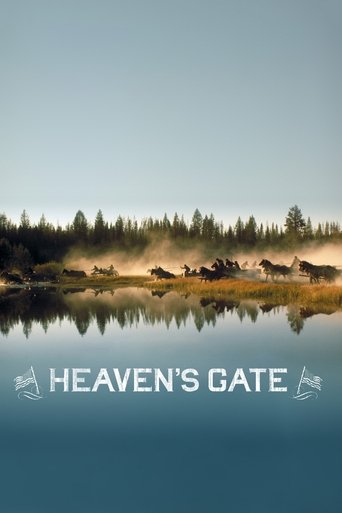
Heaven's Gate
1980 · Film · 217 min
Directed by Michael Cimino
Harvard graduate James Averill serves as the sheriff of prosperous Jackson County, Wyoming, standing at the center of a conflict between impoverished immigrants and affluent cattle farmers. Politically connected ranchers enlist mercenary Nathan Champion—who is also vying for the affections of local madam Ella Watson—to combat the immigrant uprising. As tensions escalate, both Averill and Champion start to question their decisions.
3 positive8 negative4 neutralfrom 15 commenters
Where to watch
No streaming data for this title.
15 comments on Hacker News
Cimino's Heaven's Gate (1980) is usually pointed as the movie that caused the "no animals were harmed" disclaimer to be added to subsequent movies.
That happens when c-suite starts calling shots at the expense of the creatives. It's something Netflix has been doing from the beginning, and something A24 has been trying to avoid since the beginning. Of course A24 going to be biased to what they believe they can sell, but so long as their brand is original, auteur driven works then they should be OK.
A24 is kind of looking like United Artists, a studio that produced many critically acclaimed films in the 1970s. What was UA's downfall? A move into bigger budget films. One bigger budget film, specifically: Heaven's Gate (1980), directed my Michael Cimino. The production went so over budget it bankrupted the studio and that marked the end of that era of auteur driven cinema.
Let's hope A24 doesn't make the same mistake, because as it is about half the new films I saw in theatres and enjoyed over the last decade came from A24, or from a director who has worked with A24.
Barry Lyndon is probably my favorite (or at least, the one I appreciate the most) of Kubric's films when it comes to his perfectionism, but perfectionism alone isn't a great metric for the resulting film:
> Cimino shot more than 1.3 million feet (400,000 metres; nearly 220 hours) of footage, costing the studio approximately $200,000 per day in salary (equivalent to $720,000 in 2022), locations and acting fees.Privately, it was joked that Cimino wished to surpass Francis Ford Coppola's mark of shooting one million feet of footage for Apocalypse Now (1979).
https://en.wikipedia.org/wiki/Heaven%27s_Gate_(film)#Production
Heaven's Gate isn't even all that great to look at. There's still the matter of taste involved, and well, Cimino made some questionable decisions.
Casablanca is just one example of a very great movie that actually was designed by a committee and motivated more by a political message (supporting the US entry into WW2) than artistic consideration. Contrast with an atrocity like "Heaven's Gate", referenced in TFA, which finally convinced 1970s Hollywood that giving some wunderkind-auteur free reign to follow every artistic whim does not necessarily end well.
I'd love to see more examples of this, both with Heaven's Gate and other films. Some films have the right idea and filmed material, but were edited suboptimally. It's also informative to see how a director like Soderbergh approaches this; it seems commonly accepted in music, so why not film?
Steven Soderbergh made his own cut of Heaven's Gate and posted it on his blog. He says he was obsessed with the film and felt compelled to re-edit it. In my opinion, it's quite a good film in the re-cut form.
As his note says at the beginning, "I acknowledge that what I have done with this film is both immoral and illegal." But you know, he's Soderbergh.
https://extension765.com/blogs/soderblog/heavens-gate-the-butchers-cut
Godfather II over Godfather?!?
Godfather II over Godfather?!?
Still, it looks like a worthwhile list to plunder.
I plundered a lot of the movie names dropped by Jerry Harvey in "Z Channel: A Magnificent Obsession." Imagine having such an eye for movies that you could watch "Heaven's Gate"-- considered the flop of flops at the time-- and surmise that it's probably a great movie that got cut poorly.
Even more impressive-- imagine having such credibility that you could convince an audience who yawned through 2.5 hours of "the most boring movie ever" to wade through 3 hours and 40 minutes of a longer cut of the same movie. He basically invented the "director's cut."
The TV and film industries are heavily unionised across multiple sectors--tech, writers, actors, directors, etc.--and it's the norm to complete projects on time and on budget, or with immediate compensation for planning failures leading to overtime/crunch time. Think about the massive amount of content routinely produced for TV and film and tell me how unions make that impossible.
Somehow, the large investors still make lots of money. The primary effect of unions in this space seems to be that they put an actual dollar cost on poor management. When you hear about boondoggles like Heaven's Gate or Waterworld, what you hear isn't that unions screwed it up; you hear about the prima donna director who couldn't get it all "just so" with a couple hundred million to work with.
My employer, a digital services agency, pays hourly overtime of 1.5x. Then the professional PMs we have work very hard to accurately forecast and estimate. I've had crunch periods in which I've been paid overtime, but they're rare because the business has incentived itself to execute on-time and on-budget, mostly by not promising what we can't deliver and expecting the workers to pick up the slack.
Same in the arts, until you get a Heaven's Gate or other big artist-driven films that flopped at the box office and ate up UA's budget and then company. The studio model is savagely more effective at survival.
The movie industry has eras, marked by certain production styles. In Hollywood at least, the 1970s was the era of the auteur director. A wave of directors (and actors) who had apprenticed under the famed B-movie master Roger Corman came to power on the strength of a series of absolute masterpieces. It started with Easy Rider, which was shot on a very low budget, and received massive box office success and critical acclaim. It ended with Heaven's Gate, an outrageously expensive disaster that has never even been properly released (I've seen one of the medium-length edits of it, and yes, it stinks).
The real end of the New Hollywood era, though, was the release of Star Wars in 1977. It paved the way for the sci-fi/fantasy blockbuster. It turned into a successful trilogy, and overlapped team-wise with Spielberg's fantastically successful Raiders of the Lost Ark. Hollywood, and movie fans, lost interest in the more intellectual fare of New Hollywood, in favor of kid-friendly, cross-marketing-friendly entertainment.
So it's not surprising that there was a dropoff in critical darlings after the 1970s. Movies got a lot worse - they really did. Even directors who carried on the New Hollywood traditions, like David Lynch and the Coen brothers, couldn't see the kind of success the 1970s directors had.
Of course, before the New Hollywood era, Hollywood kinda stunk, big expensive extravaganzas. Critical attention then turns to the French New Wave, and other post-WWII European film with small budgets and big emotional punches (who makes a movie like Wages of Fear these days?).
I wonder how our current era will fare? I'm thinking about the sort of epic-story serialization that the Marvel franchise and the reinvigorated Star Wars franchise is doing. How will that be viewed?
In film, this is the "Heaven's Gate" problem. [0]
As for your last paragraph, I wouldn't say that being small and focused means being "safe". In fact, it could be quite the opposite. Focus on the one thing that makes your product (or art or whatever) different from all the rest, and get that done ta a satisfactory level before expanding to bigger things. It's not always applicable or possible, but being focused is unrelated to being "safe".
[0] https://en.wikipedia.org/wiki/Heaven%27s_Gate_(film)
This unremarkable essay is another one of hundreds repeating the theme about "money destroying true hackers". One can rewrite the same article using other synonyms such as "Silicon Valley Has Lost Its Way" or "How Greed Is Ruling Silicon Valley."
This theme can be further generalized into "money is ruining <insert_whatever>".
"Money is ruining music. Bing Crosby was a true artist; Today's performers like Lady Gaga is a commercial pandering."
"Money is ruining movies. The 1970s had auteur directors but now all we get at theaters is superheroes in spandex and Disney princesses because they need ROI from international blockbusters."
Writers, thinking they have something new to say, like to write on those themes. Readers, with a predisposition to seeing what's wrong with the world, like to read them. I suppose it's some sort of 1st-World ritual of commiseration. Personally, I find those essays devoid of any insight. I can acknowledge that there are undeniable trends there but I try to avoid categorizing them into value judgments of "good vs evil". I understand the economics of why Disney's "Frozen" is the type of film that theaters prefer to show rather than Michael Cimino's "Heaven's Gate".
An example of force-fitting his observations into categories of Hackers-vs-Yuppies (aka good-vs-evil) is his claim:
"I’m going to stake a claim on the word though, and state that the true hacker spirit does not reside at Google, guided by profit targets."
That broad-stroked brush is amateur writing. Google is a big place with ~57,000 employees. Sure, there are probably engineers doing soul-crushing work of parsing logs for server reliability or optimizing ad click conversions. But I'm sure there are other pockets of engineering where "hackers" are innovating and trying to change the world: driverless cars, balloon wifi, etc. It's the same contradictory pockets of bored employees coexisting with passionate hackers in different areas of large companies like Lockheed, AT&T Labs, Apple, etc.
As far as "yuppies" ruining the hackers, I'm not sure who's supposed to be an exemplar of the "hacker" that he wants to run SV. Steve Wozniak & Steve Jobs both came from middle class families. They weren't hobos living out of their cars and overturning the world with their hacker ethos. Apple took money from VC investors within 1 year of its founding. Even Richard Stallman's family background can also be considered "yuppie".
Soderbergh has a couple other re-cuts on his site, too. One intermixes the two PSYCHOs, the original and the shot-for-shot remake.
The other is a radical re-cut of HEAVEN'S GATE. I've watched a couple hundred movies this year, but it's that HEAVEN'S GATE edit I keep coming back to in my head. I'm not really sure why (which is probably why). He somehow found the movie lurking inside the sprawling version that was released.
http://extension765.com/sdr/16-heavens-gate-the-butchers-cut
I like your analysis of the incentives to do it, it reminded me that there is another place where it is used, Entertainment. Projects are pitched as "this is the Rambo for Millenials" or "This is Bonanza in Space."
So in those cases there is an attempt to transfer some of the success 'aura' of the brand name to the pitched project. No one pitches a movie saying its like "Heaven's Gate" :-) and I suppose nobody pitches a startup as "The Color for Dog Walkers."
I love FFC. I'm a current UCLA film student - Coppola's alma mater. One thing to think about: UCLA has always been the "indy, intellectual" film school. It's our rep, internally and (to an extent) externally. When Coppola left UCLA to work in Hollywood, he was branded a sell-out by his fellow students.
One thing to think about w/ this whole "crush Hollywood" thing is this: most of your favorite movies (assuming you've got a boner for the New Hollywood period like I do) were a result of an aging, out-of-touch entertainment monopoly making desperate, reactionary moves to save itself. The old system didn't work, the people in charge had no idea how to fix it, so they went crazy taking risks on young directors. FFC, Scorsese, Spielberg, Altman, de Palma, Lucas - all the really top-drawer American filmmakers, honestly - were a result of this period of blind desperation.
There would be no Godfather without Hollywood. No Apocalypse Now. (also no Taxi Driver, no Star Wars, no Indiana Jones, no MASH or Nashville) In the absence of Hollywood, you get movies like Youth Without Youth and Tetro - two wonderful oddities, but you'd be hard pressed to make the case for them against Coppola's early masterpieces.
The beautiful and horrible thing about Hollywood is that it's a system designed to throw huge stacks of cash at storytelling problems. It's fucking absurd, because money has never been capable of solving those kinds of problems - practice and gut instinct are what create good stories. But when strong storytellers are placed in an environment which supplies nearly unlimited resources, totally amazing things happen. Yes, we can all point to Heaven's Gate, New York New York, and Coppola's own One From the Heart, but flops like those are the inevitable flip side of the system I've just described: talented people can abuse unlimited resources just like anybody else.
I guess what I'm saying is: I'd be seriously depressed if Hollywood were to vanish. Yeah, it produces a lot of shit, but its high water marks have never really been replicated by any other mode of production.