 Hacker Cinema
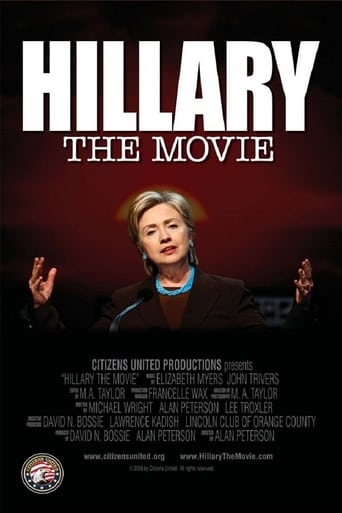
Hillary: The Movie
2008 · Film · documentary · 90 min
Directed by Alan Peterson
Released during her 2008 bid for the U.S. presidency, this provocative documentary examines the political foibles of Sen. Hillary Rodham Clinton through interviews with more than 30 journalists and politicians. Delving into the senator's involvement with the futures market, her Senate race and her Senate record, the film includes appearances by Dick Morris, Newt Gingrich, Ann Coulter, Robert Novak, Bay Buchanan and more.
12 neutralfrom 12 commenters
Where to watch
No streaming data for this title.


15 comments on Hacker News
That's not what CU held. The idea that corporations have legal personhood with some degree of rights is much, much older than Citizens United.
Citizens United was a non-profit corporation that created Hillary: The Movie which was critical of Hillary Clinton. They wanted to distribute it shortly before the 2008 primaries. The Federal Election Campaign Act prohibited corporations from using general funds for electioneering or speech that advocates for the election or defeat of a federal candidate within 30 days of a primary or 60 days of an election.
The Court held that the First Amendment prohibited the government from stopping an incorporated association from independently spending its own money for political advocacy of a candidate. To put it another way, if I can spend my money to advocate for or against a candidate, why can I not get together with some friends to pool our money and incorporate to do the same? If this had gone the other way would you be okay with a corporation being forbidden from releasing a video critical of Trump shortly before the 2024 election?
I assume the poster is referencing Citizens United v. FEC, specifically about the government's use of the 2002 Bipartisan Campaign Reform Act to restrict showing of political documentaries (apparently, called "Hillary: The Movie" and "Celsius 41.11").
While (as far as I know) the law was never actually used to ban books (only documentaries), the case became infamous because the government argued that it had the right to ban books if it wanted to. See, e.g., the NYTimes article below: "The [government's] lawyer, Malcolm L. Stewart, said Congress has the power to ban political books, signs and Internet videos, if they are paid for by corporations and distributed not long before an election.".
https://www.nytimes.com/2009/03/25/washington/25scotus.html https://en.wikipedia.org/wiki/Citizens_United_v._FEC https://www.law.cornell.edu/supct/cert/08-205
Not a lawyer either, but I believe regulations on speech, as here, are scrutinized ("strictly") such that regulations are not allowed to discriminate based on content. Moderation is usually based on content. Whether something is fact or not, opinion or not, is content-based.
Citizens United held that criminalizing political films is illegal. Allowing Fahrenheit 9/11 to be advertised and performed but criminalizing Hillary: The Movie is exactly why Citizens United was correct and the illiberal leftists are wrong.
Good points but it’s worth clarifying that this is not what the Citizens United decision said. It clarified that the state couldn’t decide that the political speech of some corporations (Hillary the Movie produced by Citizens United) was illegal speech and speech from another corporation (Farenheit 9/11 by Dog Eat Dog films and Miramax) was allowed. Understood this way it seems obvious on free speech grounds, and in fact the ACLU filed an amicus brief on behalf of Citizens United because it was an obvious free speech issue. It’s clear that people don’t and shouldn’t lose their free speech rights when they come together in a group, and there is little distinction between a corporation and a non-profit in this regard. If political speech was restricted to individuals then it would mean that even many podcasts and YouTube channels would be in violation. It also calls into question how the state would classify news media vs other media.
The case has been so badly misrepresented and become something of a talisman.
Citizens United was explicitly about whether the state could categorize a documentary produced by one company (Citizens United’s Hillary the Movie) as regulated speech, vs documentaries produced by another company (Dog Eat Dog Film’s Fareinheit 911). In both cases there was evidence that the film was produced by a corporation whose shareholders and management explicitly intended to affect an election by engaging in political speech. It was a limit on the state’s capacity to limit one group of people’s speech rights and not another’s.
I agree that maximizing shareholder value is expected to be done within legal limits, but also basic ethical limits. I’m not an expert in Union Carbide’s history, but I was under the impression that the company was hollowed out after selling off assets to pay the Bhopal settlement, and Dow eventually acquired it along with its liabilities for a fraction of what its market cap would have been without the disaster. Criminal negligence can erase a huge amount of shareholder value.
In a different or malfunctioning legal system you could imagine the Indian courts not holding the shareholders responsible for their negligence, the way the US justice department failed to hold the financial industry responsible in 2008 for instance. Smarter people than I have pegged the rise of populist politics in the US as a delayed response to this political and legal failure to wipe out shareholders of corporations that took risks which harmed the economy.
You have been reading too many memes. Citizens United does not say money is speech.
Citizens United says specifically that when a bunch of people take their money and get together and start a new corporation (Citizens United) (a not-for-profit corporation in this case, though not a charity) and the corporation proceeds to engage in political speech (by filming a movie named Hillary: The Movie)...
then the corporation, as an entity, is considered to have the rights like the right to free speech, because it is owned by people who have rights, and this is a way for those people to exercise those rights together. Therefore this political speech is protected by the First Amendment, and restrictions on it are evaluated on the standard of strict scrutiny, and the FEC cannot halt this distribution just because the corporation was using money to make it happen.
(You will notice that people are not allowed to band together and exercise the right to vote, and thus corporations don't get to vote.)
Obviously, there's more to it than I said in my comment. The decision is 57 pages, and Stevens' dissent is 90.
Before Citizens United, "individual citizens banding together in a non profit to express their political point of view" could absolutely do so. When I say that stakeholders can spend their own money, this includes giving money to PACs. Citizens United was just a PAC that didn't want to obey a particular restriction on PAC spending. Namely, they wanted to run ads within 30 days of the election. Quoting from the beginning of Stevens's dissent[1, p.80 of the PDF]:
Under the Bipartisan Campaign Reform Act of 2002 (BCRA), it could have used those assets to televise and promote Hillary: The Movie wherever and whenever it wanted to. It also could have spent unrestricted sums to broadcast Hillary at any time other than the 30 days before the last primary election. Neither Citizens United’s nor any other corporation’s speech has been “banned,” ante, at 1. All that the parties dispute is whether Citizens United had a right to use the funds in its general treasury to pay for broadcasts during the 30-day period.
I think this also indicates just how broad the ruling was. At first, Citizens United wasn't even asking for such a ruling. They posed much narrower questions to the Supreme Court, who then asked them to brief on the broader question. This goes against their usual principle on deciding cases on the narrowest possible grounds.
[1]https://www.supremecourt.gov/opinions/09pdf/08-205.pdf
(edited to add link to decision)
> The issue the heart of Citizens United v. FEC (i.e., the Federal Elections Commission) was whether a non-profit's funding of a TV special criticizing a candidate violated the Bipartisan Campaign Reform Act.
In ordinary parlance, do we say “Apple funds iOS” or do we say “Apple makes iOS?” In Citizens United the non-profit produced and sought to air a movie called Hillary: the Movie. They didn’t “fund” any candidate’s political campaign.
> I guess it's technically true that the decision doesn't allow more money to flow directly to the campaign
By “technically true” you mean “true.” “Campaign finance” laws presumably have to do with financing of campaigns. The “role of money in elections” is a different, much broader area, much of it outside the scope of campaign finance laws. (For example, consider the alleged $5 billion in free advertising the press gave Trump. Do campaign finance laws allow the government to regulate that?)
One can imagine lumping in scenarios where someone is attempting to bypass a campaign finance restriction by directing a third party to produce content for the campaign. But that’s not what Citizens United involved either. There was no allegation of any such “indirect” campaign financing. Instead, the government tried a naked power grab: punishing a non-profit for making a political movie, with no showing of any link to the campaign beyond that.
There was just one candidate in this election that wants to control what you can say. And it wasn't Hillary.
Hillary wants to change the constitution to take away your 1st amendment right to make and distribute "Hillary: The Movie".
http://www.politico.com/story/2016/07/hillary-clinton-citizens-united-225658
Hillary also supports laws restricting the ability to criticize her. She will probably choose a supreme Court justice who will roll back citizens united (which protected the ability of private citizens to make "Hillary: The Movie" which criticized Hillary).
That isn't outside the Overtones window at all.
Lest you forget, the plaintiffs wanted to bash Hillary Clinton around and run infinite quantities of ads with infinite anonymous funding for said ads, too, to support "Hillary: The Movie", which wasn't actually a movie that they wanted to release, btw, it was actually a big long TV ad.
Come on, at least be intellectually honest.
They wanted to shadow-fund a TV ad campaign.
Clever of you to leave those facts out!
I dunno how much it cost exactly but I'm sure that making and distributing "Hillary: The Movie" cost a lot more than 50 bucks. Limiting individuals to that total is a restriction on their speech.
Now, maybe that's a restriction that we want to impose but it's disingenuous to say it's not a restriction.
Taxation of certain viewpoints or topics but not others would, indeed, be a violation of free speech. I.e., a ban or tax on film reels would not be a violation of free speech. A ban or tax on film reels containing "Hillary: The Movie" would be.
I also don't understand your "hostile takeover" argument. Who is being enslaved? The corporate officers who are free to quit at any time? The shareholders who voluntarily sell to the person taking over?
That's not my understanding of the relevant precedents--- the Supreme Court has never interpreted the "freedom of the press" to refer to a specially protected class of reporters or news companies, or limited it to reporting the news. It has been held to protect the First Amendment rights of not only news corporations like the New York Times, but also companies that produce pornographic films and magazines, for example (one of the important precedents on the First Amendment's protection of parody involves an issue of Hustler). It seems to have been read much more broadly to mean, roughly, "the freedom to publish things, like books, newspapers, and films". For example, films like Hillary: The Movie, which was the thing at issue in Citizens United.
I think there's probably some way the other outcome could've been reached, but it would be trickier than I think a lot of people are arguing. It would have to be a narrow prohibition against direct electioneering by corporations, carved out as a First-Amendment exception due to the compelling government interest in free elections/etc. (similarly to how obscenity, libel, false advertising, and "false-light disclosure of private facts" are recognized exceptions). And then specific cases would have to be investigated to see which side of the line they fell on: for example, to determine whether Hillary: The Movie was a real movie, or pure electioneering disguised in a sham movie.
I thought Jonathan Turley had a very insightful post on the topic: http://jonathanturley.org/2010/01/21/supreme-court-rules-5-4-against-campaign-limitations-in-the-hillary-the-movie-case/
tl;dr: "In the end, I have to favor more speech than less in such conflicts. While I would have written a concurrence and have difficulty with aspects of the majority opinion, I probably would have voted to support the majority in the result in this case. However, I do consider this to be one of the most difficult free speech cases to hit the court in decades."