 Hacker Cinema
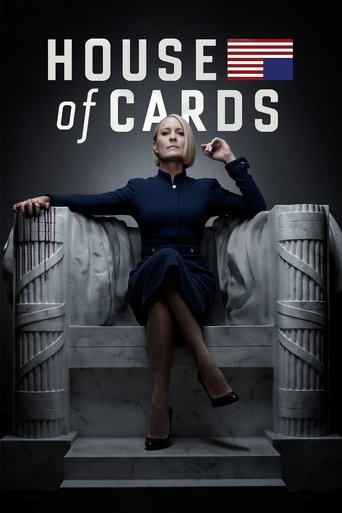
House of Cards
2013 · TV series · 6 seasons
Created by Beau Willimon
Betrayed by the White House, Congressman Frank Underwood embarks on a ruthless rise to power. Blackmail, seduction and ambition are his weapons.
69 positive37 negative7 mixed155 neutralfrom 268 commenters
Where to watch
No streaming data for this title.
305 comments on Hacker News
What? It famously didn't on the streaming side. It had everything on DVD. For years I kept both parts of Netflix because a lot of popular shows—newer ones especially—weren't on it. So I could get DVDs of past seasons. Or go to Hulu for newer episodes.
Hulu was created at the same time, and launched in the same year as Netflix's streaming service, specifically to compete with less-convenient pirated streams of current-run TV with a free-the-next-day-with-ads alternative. And that stuff was never on Netflix at the same time.
High-profile not-on-Netflix-streaming-for-first-run things from the 2007-2014 time frame: The Office, Game of Thrones, Walking Dead, and honestly basically everything else broadcast and cable made during "Peak TV." It was big news and considered a big bet when Netflix debuted their own high-budget first-run content with House of Cards, because of how weird it was to see Netflix competing in the brand-new show space.
I think you might be over-fixated on a very prediction-market-esque framing of this plot device... if you broaden it slightly, the idea of someone in a fictional world manipulating the news reporting of an act or set of acts, rather than caring so much about the root act itself, is as stated before, quite common.
For example, this from House of Cards: https://www.nytimes.com/2016/03/07/arts/television/house-of-cards-season-4-episode-6-recap.html?unlocked_article_code=1.T1A.50wr.Pr_LeKa7xeiz&smid=url-share
> Pollyhop is a fictional, Google-esque search engine that according to Leann’s polling expert is being exploited by the Republican candidate Will Conway in ways that suggest Underwood can’t possibly beat him in the general election. The explanation of how Pollyhop works is convoluted at best, but the gist is that Conway and his people are manipulating search engine results so that only positive coverage of their side appears.
Or more recent examples of what essentially boils down to the plot device of "media manipulation" aka manipulating the "news reporting of the act":
- See the most recent season of Industry, which included several plot points about manipulating news coverage as a short-seller and the company being targeted fought back and forth (including specific focus on the individual journalists involved)
- See Andor, everything about how the Empire twists perception of what's happening on Ghorman, leading up the Ghorman massacre itself, and then culminating in Mon Mothma's speech in the Senate denouncing "the death of truth is the ultimate victory of evil"
- See The Orville, a particular episode: https://orville.fandom.com/wiki/Majority_Rule which includes the plot point of hacking that society's "master feed" to plant false manipulative stories to curry public favor and save a character from being punished
- See The Boys, how Vought manipulates the media to twist coverage of their "heroes" even when they commit atrocities
- See other House of Cards plotlines involving Zoe Barnes and being a direct mouthpiece for Frank Underwood
I think the only real difference if any, is that in the most common form of portrayal, maybe less attention is paid to the journalist as the point of leverage, and how they deal with threats or bribes or whatever. The fact that such manipulation occurs, is commonly accepted as a trope, without requiring too much of a deep dive. Whether a story choose to focus on the "reporter's perspective" is perhaps less common, but not uncommon IMO.
That sounds logical but the timeline doesn’t match up. Blockbuster filed for bankruptcy in 2010. This came after years of decline.
Netflix streaming launched in 2007 and ended 2010 with only 20 million users. (They currently have over 15x that). I was using it from the start, they had barely any content back then, Hulu was pretty new, and that was the entirety of the streaming universe. Netflix’s first major original content, House of Cards, came out in 2013.
Blockbuster peaked in 2004. Redbox was just getting started.
Blockbuster’s fall loves to get shoved into 100 different narratives, none of which match the facts. It was death by 1,000 papercuts. Netflix. Redbox. Cable system technology improving drastically. Cable TV improving drastically (this happened right around the time Blockbuster peaked, great book on how/why called Difficult Men). TV show quality in general improving drastically. The rise of HBO. Poor management. Etc.
Sad news. HBO has a veritable treasure trove of TV shows like The Sopranos, The Wire, Six Feet Under, Silicon Valley etc. Even their more recent ones like White Lotus, How to With John Wilson are leagues above Netflix. Only HBO can bet on artists’ vision like that.
I cancelled my Netflix subscription 7 years ago, 99% of their content is algorithmic drivel. Mindhunter, Dahmer, House of Cards were something I liked but nothing beyond that. I knew they were trash once I saw the sheer number of spinoffs they have just on Pablo Escobar. They had had one decent run of Narcos but then they just tried to extract every drop of juice out of that one persona. Most of Netflix dramas are just the equivalent of abhorrent and ugly graffiti. Their shows are Exhibit A in what happens if you give into algorithmic drivel and have no human touch to curate them.
HBO has some timeless TV classics that I keep rewatching every year even though I have watched them multiple times. Netflix can’t produce TV dramas like that, ain’t in their blood. Completely different DNAs.
Netflix does deserve all the plaudits wrt to their streaming experience though.
https://www.statsignificant.com/p/the-rise-and-fall-of-tvs-golden-age
This is a pretty well known fact. Netflix is the best example. They created the prestige streaming market with House of Cards, and now they're primarily using algorithms to create low-cost reality shows and cheap disaster documentaries.
> To put it another way: you have shows that have strong enough writers where they don’t need gimmicks to keep your attention. And you have shows that are intentionally about the gimmicks. Then you have shows that aren’t about the gimmicks but the writers don’t have enough confidence in their work to avoid putting them in anyway.
Can you elaborate a bit about the gimmick(s) in Halt and Catch Fire? I think it's a drama, so there are human concerns and interactions, but that's like, what tv shows are? I don't know what you mean specifically.
> Shows like The West Wing, House of Cards etc aren’t about gimmicks and don’t need them.
The West Wing is statist propaganda for liberals. House of Cards is statist propaganda for neocons.
> Shows like Mr Robot are about the gimmicks. And that’s ok too because you know it’s meant to be silly drama.
I actually really appreciate that every hack shown on Mr. Robot had a real world POC and used actually existing tools and techniques. The storyline is hokum and gives hackers a bad name, but black hats are kinda supposed to have a bad name. Elliot is kinda gray hat, but he definitely violated CFAA multiple times and would probably be dead or in jail irl.
> if a significant amount of film production moves to the UK, it's likely that criticisms of the UK would be more muted.
Have you watched British television or movies sometimes? They're not exactly sparing their country from criticism .. E.g. (the original) House of Cards, Not the Nine O'Clock News, etc.
The other country you mention, China, is a better match. But is that the kind of society that the USA wants to be?
> Famously, years ago they invented House of Cards TV show by looking at the most popular search tags and picked the most popular ones to select a genre and theme of a new show
This does not appear to be true based on any articles I can find. I do believe they heavily follow the trends from their analytics in what the shows they buy and what they cancel, though.
No need to suspect, they are advertising that openly and are proud of it. Famously, years ago they invented House of Cards TV show by looking at the most popular search tags and picked the most popular ones to select a genre and theme of a new show. It was a story of many articles about Netlix back then.
Holy moly. I don’t think I’ve ever read an article so angry. Every paragraph has a sensational opinion or put down posing as fact.
There’s some fascinating industry trends here but the analysis in the article is overwhelmed by the cacophony of anecdotes about b movies and bland tv shows all encouraged by the corrupt and evil parent company. Not helpful.
My take on the quality of shows— there’s a huge volume of mediocre stuff but that’s always been the case with TV. (There’s literally hundreds of forgotten sitcoms on broadcast tv from the 70s to 90s). But there have been many gems in the past decade.
A random list of fantastic or innovative shows I saw first on NetFlix. - House of Cards, season 1 and 2 - Russian Doll - Squid Game - Queens Gambit - Ballad of Buster Scruggs - Arcane - Kaos
Only the first was mentioned in the article, and with negative comment.
Overall, a poorly written article and a waste of time to read it.
Isn't the film industry struggling too? Perhaps not as much financially but still.
Holywood is dominated by Marvel and a handful of recognizable directors like Christopher Nolan, Denis Villeneuve, Martin Scorsese, Ridley Scott and Quentin Tarantino, and they are struggling to fund and distribute their projects too. Actual cinema theatres are dying a not-so-slow death, accelerated by the pandemic, and streaming seems to be very ineffective for movies unlike TV.
TV is doing okay, but it has obviously declined from the golden-age of Breaking Bad, early Game of Thrones, early House of Cards, Stranger Things... Just off the top of my head. There is still some good stuff coming out but the overall density in quality has dramatically gone down. Netflix and Amazon Prime are not doing great financially, HBO just about managed with the weird Discovery merger, Apple TV remains small (seemingly intentionally).
And the music industry? All but gone really in terms of a real money-maker. There's Talor Swift and all the Spotify beggars.
Is there any creative industry that is actually in a healthy growth stage? Podcasts? There's just too much supply and not enough demand at this point, people have only so much free time.
Wow, thanks for the watching list! I agree on season 6 of House of Cards, sadly Robin Wright can't carry the series the way Kevin Spacey did.
Albeit, we got bored of money heist after season 1.
Try this: look up the most highly rated episodes on IMDB and watch only those. Missing the crummy episodes usually does not interfere with understanding the story arc. Often, I set a minimum IMDB score that I will watch, like 8.5 or 9.0 to capture only the best. This works well with series that:
- take a year or two to find their footing or
- have a large cast (some mediocre) that get their own story lines of no consequence occasionally or
- introduce cast members that don't make it or
- implode towards the final season.
I have done this for many series that are somewhat uneven:
- The Americans
- How I Met Your Mother
- Fringe
- Orphan Black
- Halt and Catch Fire
- House of Cards (watching the ratings allows you to miss all of season 6)
- Arrested Development
- Bojack Horseman
- Veep
- 30 Rock
- Jane the Virgin
- Black Mirror
- The Marvelous Mrs. Maisel
- Suits
- Six Feet Under
- La Femme Nikita
- The Blacklist
- Peaky Blinders
- The Romanoffs
- Ozark
- Westworld (sometimes dropping episodes does not matter)
- Succession
- Borgen
And all of these series have lots of strong episodes.
Series I would not do this with:
- The Bear
- Breaking Bad
- Money Heist
- The Serpent
- Fleabag
- Chernobyl
- The White Lotus
Lots.
10 years ago - house of cards [0] showed Kevin Spacey vaping.
Also True Detective season 2 [1]
[0]https://youtu.be/tduSghkW_UA
[1]https://youtu.be/EL3AuyOfBtI
I can understand why Netflix et al want to block Apple from their data, but back in the beginning you could just say “Play the latest episode of House of Cards” on Apple TV and it just worked. At the end of day user experience is just degraded… and for what?
I must have very different tastes, but I found all mentioned series as well as most of other stuff they promote to me on their front page to be mediocre at best, 4-6.2/10 (on a non-normalized scale, like IMDB, with 5 not being "average" but "quite poor") on average. Something (screenwriting, acting or something else) is always breaking my suspension of disbelief, so I drop the series after the first or second episode. Surely, they aren’t that bad as I picture them to be - it’s just that I’m not their target audience.
I keep it for accidental new releases (like that new Wes Anderson’s short movies, which I found quite enjoyable; and The Killer was not bad) and some old series I haven’t yet found time to finish (House of Cards), but overall quality or the majority or their releases feels unimpressive I can’t even remember what was the last thing I’ve liked.
Just an anecdote, of course. This is by no means an objective opinion - quite the contrary, it's a very subjective data point.
But what if it really sucks? There are bands who are "one hit wonders" not because of peoples attention spans but because the rest of their songs actually suck. Detective book series, where the supposed detective starts solving crimes by using astrology? Yeah... no, thank you. Scrubs season 9? The last few seasons of house of cards?
It sucks, there are many other things to read/watch/play, so why not quit the bad stuff and find something better?
even the ones that did have cultural relevance (like game of thrones or house of cards) have been pretty well "culturallyl liquidated" at this point. ain't nobody going back for a rewatch of game of thrones, or at least not past about season 5.
it's funny, a couple years before the show was finished (during the first time when they stalled out for a year) my sister gave me a box set of the blu-rays, at first I was a little bummed because I'd inevitably end up with a couple mismatched DVDs/not in the box set, but it turns out that stallout was also the point where the show started imploding.
I like to joke that after she gave me the set they never finished the show, haha what are the odds!? /s
It's definitely a thing. I remember when Lost first aired I had lengthy discussions every week with friends, I even logged into Lostpedia to browse, exchange theories etc.
By comparison, the first Netflix show I remember really watching was House of Cards. Tried to have conversations with friends about it but inevitably you'd start with "oh, what episode are you on? Is that the one with the...? So you haven't seen...?".
Discussing an entire season when it's complete is definitely less fulfilling than discussing each episode. Depending on the show, of course.
I think if we constrain it to scripted television (and a fair number of movies now, too), they did.
House of Cards was a big deal for being a streaming-first big-budget TV show. That's commonplace now. That wasn't that long ago. Since then, all of the major players have joined the table, sunk audacious sums of money into developing new projects, and there's more high-end TV made in a year than I can watch.
Cue the flip "but none of it is any good" comments but nevertheless, Netflix blazed that trail.
It was to podcasting what House of Cards, Orange is the New Black and Arrested Development Season 4 were to Netflix.
I had no idea about the Kieslowski connection, wow. I follow his other great collaborator, composer Zbigniew Preisner, where if you take anyone involved with Kieslowski chances are it's going to be a good film. I have his tri coleurs and decalogue on dvd, and double vie on vhs in a box somewhere. Strange to think when these things were artifacts now that nothing is, and that they could even be somewhat rare. I have the original House of Cards series on dvd in that box, The Big Sleep and other classics as well.
> Is it correct to say that on a long enough timescale, self-produced content is cheaper than licensed content? Or is the production cost so high that that basically doesn't matter?
Depends on the production but it definitely isn't rule or trend. For example, look at this page with costs to make each episode:
https://movieweb.com/best-sitcoms-of-the-2000s-ranked/
Many of those are Netflix originals. What it means to be an original is that it was on Netflix first and it's the only place you can find it at first. And back in the day, that only applied to the USA (now Netflix does worldwide rights, but House of Cards for example premiered on other networks in Europe at the same time it was released on Netflix).
But once that contract expires, anyone can license it for the next go around. Generally Netflix does a long license and locks up IP rights to prevent that, but that just makes them have to pay even more for the content.
If you look at the cost per hour streamed, the originals definitely aren't the best -- stuff like a show from the 1960s that they got super cheap that ends up being super popular end up there. But the originals are the prestige items, so they're willing to be less efficient there for the unquantifiable brand boost.
I don't think he's replaceable. It's like house of cards without Kevin Spacey. Actually even worse, one of the best episodes was an episode completely voiced by Justin, of an entire society, and he managed to play so many different personalities of the same character. Never seen this level of voice acting.
It was pretty obvious that he's got issues. Had a scene where a writer literally confesses that he has bad tendencies and channels it all into his work (the gazorpazorp episode).
It's kind of sad that society and cancel culture don't allow bad people to do good things. If those were workplace allegations you really can't let someone like that work, but that's not the case.
I'm all in favor of him both losing most of his money to compensate his victims and continuing to work on Rick and Morty. But society can't handle nuance, and the mob judges people instead of actions. Literally nothing good happened as a result of this cancellation. Just blind mob justice.
People aren't black and white, bad people can do some good things and everyone sins. He deserves a punishment fitting his crime, and the purpose of the punishment isn't vengeance. If an action is good there's nothing morally wrong with letting a bad person do it.
I'm currently watching through House of Cards. Not exactly a high CGI series full of special effects which need high FPS to look smooth. Yet the incredibly low FPS is jarring at times. Turns out people like to put big sweeping camera movements even in non-CGI movies.
> the quality of films/TV produced in the west has been in steady decline for quite some time
I could agree the average quality has dropped. But surely you agree that the sheer volume of high-quality content has ballooned. How many high-quality TV shows can you name from the 90s?
Compare that to the last 10 years of shows like: Succession, Ted Lasso, The Queen's Gambit, The Handmaids Tale, Better Call Saul, Ozark, House of Cards, Stranger Things, Silicon Valley, The Crown, Fargo, Mr. Robot, True Detective, Veep, and even (controversially) Game of Thrones.
> I'm astounded that this article doesn't mention what to me seems like a no-brainer: We're in the golden age of television.
I disagree, the golden age of television was the late 90s to early 2010s, from the start of the Sopranos, to the last episode of Breaking Bad. I can’t name a series in the last 10 years that is on par with Sopranos, Six Feet Under, Mad Men, Breaking Bad, Deadwood, or The Wire.
Streaming services killed quality television, House of Cards was the beginning of the end.
Disney+'s marquee show is The Mandalorian which has been quite great so far but even that can't be stretched for too long. I don't see it going beyond a few more seasons. At least with its competitors like Netflix, it has a fantastic library of so many show like House of Cards, Stranger Things, Dark, Squid Game and a bunch of stuff for almost every demographic possible. HBO probably has an unparalleled library of shows and movies. Disney+ shows don't have the same kind of rewatchability. For example, they fumbled extremely hard with the Obi Wan show, which could have been another potential cultural zeitgeist like the Star Wars movies if they probably cut down the filler and did some more rewrites to improve the script and released it as a movie (either in theater or as a Disney+ exclusive)
Disney+'s marquee show is The Mandalorian which has been quite great so far but even that can't be stretched for too long. I don't see it going beyond a few more seasons. At least with its competitors like Netflix, it has a fantastic library of so many show like House of Cards, Stranger Things, Dark, Squid Game and a bunch of stuff for almost every demographic possible. HBO probably has an unparalleled library of shows and movies. Disney+ shows don't have the same kind of rewatchability.
House of Cards was never a theatrical bit of content, so not quite the same thing for this discussion specifically. Episodic content was still "TV Programming" by the feature types. In 2013, episodics were still getting people used to the serial or limited series type of content. This has been my favorite format for some time now. More time to tell a story than a single feature, yet short enough to avoid filling time with cruft just to reach an arbitrary episode count. The 8-10 episode hour long series are great for really in-depth stories.
It didn't flummox the US. It flummoxed Miramax, which is what the article is saying. Miramax wanted Mononoke Hime to be a 90s Disney film, and when they couldn't cut the film into one, they gave up on it. It really highlights how badly Hollywood used to gatekeep entertainment by owning the distribution tools.
You can thank Netflix for changing that. I worked in Hollywood when Netflix rolled out House of Cards, and it was nothing less than a revolution for the execs at the time. Netflix terrified them. Before then, every entrenched name in Hollywood mocked the internet as something consumers would never prefer for movies. However, Netflix created a place for big budget, niche content in a way that forced Hollywood to sit up and take notice. If Netflix hadn't happened, nothing would've changed.
And thank God. I remember seeing Mononoke Hime in the theater, and it was my first introduction to anime. It was a breath of fresh air for me in terms of entertainment. I was so tired of western film at that point and it made me aware that there was so much more out there if I was willing to look for it. Nowadays, it hardly requires looking.
Interesting how we don't hear much about "big data" which - we were told back in 2013 starting with House of Cards [1] - was key to Netflix's success in picking new shows to produce.
This part of the article is telling:
>It’s why five or so years ago, anybody with a hint of success in TV (or movies) started getting a call from their rep saying, basically, “Netflix would like to write you a big check.”
1. https://www.nytimes.com/2013/02/25/business/media/for-house-of-cards-using-big-data-to-guarantee-its-popularity.html
I think the issue of low-quality filler being the issue is debatable. House of Cards or Orange is the New Black hasn't stopped the platform from sinking to where it is now. But as long as people are watching something, they're subscribed to the platform. The real problem is a lack of shows with nine seasons and plenty of shows that got canceled two seasons in. Viewers will take a chance on a new show, binge watch the two seasons, then end up blankly staring at the Now Playing screen and this hollow feeling of Netflixlessness - that listless feeling you get when your life was previously consumed by a show that you've now caught up to, so you have nothing to watch.
The worst thing the service can do is force viewers back to that New Playing screen, and just hope they find something before giving up, disgusted at your library's lack of content. Netflix never did conquer the Now Playing page. If I don't have a show that someone else has promoted to me, I'm not opening the Netflix app, that page is where dreams of just watching some TV go to die. Not for lack of trying, mind you, they've run a large number of experiments on that page, it's just a difficult problem when you don't have the content your users really want. It's thoroughly unsatisfying a UX, especially if you can't find something before your attention span gets bored of trying to find something to watch, and you switch away entirely. To Fortnight or TikTok, as the article suggests.
Spin-off shows don't generally do well on network TV, but things are different for streaming, and mediocre content set in the same universe as existing shows, for easy transference of viewing keeps users on your platform. Even if viewers are rewatching The Office for the Nth time. Because that show has nine seasons, Netflix might as well just be The Office streaming program and it would keep subscribers just fine. You're right that they're "settling" hours, but not everyone is a TV show snob. Netflix was never going to afford to be at ABC/Paramount/Disney level but it's trying to play there and make shows that rivaled their quality - and cost - that killed them.
It's a poor approach for people like me. My main thing is video games, youtube, and reading. But I like really good TV series. I've enthusiastically watched Peaky Blinders as soon as it's available after I heard about it and picked it up after season 4. I didn't start watching Breaking Bad until Season 4 finished airing. Same with a bunch of other shows, Blacklist (S6), Game of Thrones (S4), Sherlock(S5), Mandalorian (S2), Ozarks (S3). That doesn't give a lot of shows time to catch my eye.
The ones I recall watching after S1 aired over the past decade are Fargo, Better Call Saul (because I saw BB), True Detective, House of Cards, Atlanta (because I'm from Atlanta), Lupin, because they got truly rave reviews. I'm even more conservative with Netflix shows now because it's pretty much a given that anything I even attempt to watch is going to get cancelled after a season or 2.
Was Leonardo da Vinci not an artist when he drew the Vitruvian Man? Were all Renaissance sculptors and painters for that matter not artists, since they were copying the Greco-Roman style? Are script-writers of House of Cards not artists due to writing a Shakespearean play? Is George Lucas not an artist because he did not make anyone question what art is?
> Duchamp also said "Art is either plagiarism or revolution". So unless you are doing Greco-Roman statuary in a manner that shatters people's expectations of Greco-Roman statuary, your statues are a jejune copy of what has come before -- and therefore not art.
Here is a contradiction. First plagiarism is listed as an example of art, to then be described as "not art". Also, I think that art which sticks to established understanding of what art is isn't necessarily plagiarism. Just because there were plenty of standard 3-act structured plays/films, does not mean that subsequent attempts are plagiaristic. Otherwise art would be castrated to just form, when in fact it is a marriage of form and substance.
I think this fixation on "subverting expectations" comes from self-centredness of some artists. Maybe if you dedicate your whole life to just art, you don't have other experiences to draw from to create something about more than art itself. And so art becomes a simulacrum.
> Netflix just streams videos?
Netflix funds content. Netflix licenses content and has a say on how future content from that IP is produced. They are not just a streaming platform. When you look at every new show as of late you see themes commonly associated with wokeness. Replacing characters with "BIPOC" (I hate this term) when adapting from source material when it clearly seems out of place. Mixing in subtle commentary about immigration, healthcare, "hate" speech, etc. Women are always the strong saviors, men are always the aggressive out of control beasts or they're docile homemakers.
You can see it in pretty much every show. Witcher Season 1/2 (immigration, replacing characters, men/women tropes), House of Cards Season 6 (all of the above), Altered Carbon, etc.
I'm old and have watched an awful lot of movies. They rarely impress me anymore. I tire of the same old stuff, like that same old hawk scream whenever there's a long shot of wilderness. There's the "guess the order in which the lesser characters die" trope. The final fight in the darkened warehouse. The bad guy is vanquished, but is restored for another battle. The hero's boss turns out to be the bad guy. The computer guy is always a pathetic nerd. The guy stalks his dream girl and wins her.
But enough of that. What I really dislike is the heavy-handed moral lessons that Hollywood elites insist that they need to teach us.
Chris Rock's rude joke and Will Smith's bitch slap shows that Hollywood is no better than the rest of us and has no particular business lecturing us on what we should believe and how we should behave. (To top it off, the Academy didn't even see fit to eject Smith from the premises, and still gave him an Oscar.)
There are some exceptions to the unending stream of tripe. "House of Cards" was good.
> Just eat less man. It's pretty straight forward. Just eat one meal a day (lunch) and you'll see the weight fly off.
You're suggesting a diet that requires a discipline that, empirically, is obviously beyond the reach of most people.
Here's much, much simpler advice, that is also more enjoyable to do: Just eat better. Or just somewhat better, and do some exercise.
You'd be surprised how easy it is to purchase or cook a meal that is delicious and filling, but not all too heavy on calories. Vegetables are boring when you boil them. Properly seasoned and roasted, grilled, braised, or sauteed, they can be an absolutely amazing side dish. Hell, throw a bit of cheese on them, that little bit of Parmesan or Gruyère won't make a difference calorie-wise but will add a divine dimension of flavor. It's easy to make a delicious desert that doesn't contain >50g of fat.
Get some exercise. I enjoy lifting weights but you don't lose weight with that, you do it with endurance sport which I absolutely hate. Luckily, there's a solution for that: any halfway decent gym opened in the past decade has bikes, treadmills, cross-trainers etc. with built-in viewing screens and Netflix, Youtube, etc. An hour flies by when you're enjoying yourself, and with a heart rate of 130bpm or so, you're basically not even sweating, yet burning tons of calories. Imagine enjoying a full hour episode of House of Cards, Narcos, or whatever your thing is and getting healthy in the process. You're losing weight by watching TV.
I think most advice that requires a dramatic change in lifestyle (like limiting yourself to one meal a day) is extremely poor because it requires effort that most of us aren't willing to expend.
I enjoy food. A lot. I like to go out and try it, I like to cook it, I like to share it with others. For me, "eating one meal a day" is absolute punishment, I'm missing out on least two occasions to taste something enjoyable, maybe even remarkable. And it's easy to do that 3x a day when you just watch what you eat. Eat proper food for a while and you'll never crave a Big Mac again, because you can actually taste what crap it is.
Netflix has produced a lot of fairly solid content. Not at the level of the all-time great prestige TV shows like the ones you mentioned, but enough to keep a lot of subscribers happy for long periods of time at an accessible price. House of Cards (at least until the Kevin Spacey scandal blew up), Stranger Things, Orange is the New Black, BoJack Horseman, Disenchantment, etc are a few that come to mind that I watched and enjoyed.
I think Netflix has two big issues. The first is the way they drop seasons all at once prevents the natural cycle of pre-episode hype, post-episode interviews, speculation and leaks, fan anticipation, fan arguments (ship wars, etc), etc. Fan culture can't develop around this content as easily because there's never any breathing space for fans to collectively sit with the story so far. The shows that become a cultural force like Breaking Bad or Game of Thrones need us to keep coming back to the conversation every week. They have us talking about what happened last week and will happen this week with our colleagues at work and around the dinner table. How can these Netflix IPs enter stable orbit in the cultural zeitgeist when they're once-a-year events? It devalues the work, positioning it more like a movie that you watch and then forget rather than a story you become invested in over a long period of time.
Full season drops also allow people to binge a whole season of content for a single month's subscription and then immediately churn (ask me how I know). I assume they have some data-driven reasons for doing this, but it makes absolutely no sense to me.
Besides that, I think they should put more wood behind fewer arrows. They've developed a reputation for aggressively cancelling smaller shows with passionate followings which makes a lot of people not even want to bother until something has become an established mainstream success. I think of them now as the Google of content-creation, putting out a lot of solid (but not amazing) products and then cancelling them once people start to grow attached.
Graeber's books reprogrammed my brain. But I'm still struggling to connect the dots:
What does Iroquois style participatory democracy actually look like?
We need movies and soap operas. To tell the stories.
Like West Wing, House of Cards, Mr Smith Goes To Washington, The Wire. Show the human drama and machinations. Events, issues, and people. Conflicts and resolutions.
Participatory democracy is not all puppies and ice cream. The advocates would be well served to show that it's just another decision making strategy. Hopefully superior to what we have today.
Like how Approval Voting is better than Winner Takes All. We'd still run elections. Just more robust with better outcomes, so therefore less drama.
House of Cards was certainly a big thing at the time--for the first few seasons anyway. Queen's Gambit. GLOW and Russian Doll were quite good. I'm not a huge fan of The Crown but it's well done.
Honestly, Game of Thrones notwithstanding, I'm not sure that there's a lot on HBO I consider must see level content either although some is quite good.
I'd probably consider them about a wash for content.
> Why don’t any other characters have to explain what makes them unique from the rest
They do. Geralt has a huge back story that explains why he's ripped and has a bunch of scars and why every peasant is afraid of him. Yennefer has a huge back story that explains why she's beautiful. If they casted someone ugly as Yennefer then that backstory wouldn't exactly apply anymore would it?
> I would say Black Panther is a story about blackness
Let's use another example then. Narcos - if some Asian guy was the one who auditioned best as Pablo Escobar, would you think that's good casting? Narcos is clearly not about Colombian culture, it's about the War on Drugs. If all the random cartel members are casted as Latino but the leader is Asian you think that's good casting? Or if we look at House of Cards - what if you replaced Garret Walker with a Korean dude. You think that's good casting?
> why does race need to be explained
Because one character is different from all the other people in their supposed race (Nilfgaardian). If there was a character that was taller than everyone in their kingdom I'd expect that to be explained too. Or if the character was white and everyone else was not.
> Growing up my class was all white, except one black kid
That's great, but completely irrelevant in this case. You are trying to impose your own social justice values on a high fantasy TV show. Ironically I find it's always white dudes in their 20s and 30s that have this view of the world. I bet you're white, male, a millennial or Gen Z, you live in a big city, and you work in tech.
>should be easier to find old classic movies
Was referring to above; Netflix didn't create any of those. But yes, over time they'll have old entries in the Netflix catalog.
Their first original (House of Cards) was only 9 years ago
,, The business model is refreshingly simple: people pay to watch shows they'll enjoy''
I believe that this is true, but I also have a feeling that the main goal for netflix is maximizing views, and not maximizing the experience per supscriber weighted by user spend.
In other words I would prefer less, but very well thought out and executed movies that focus on having a great story (like House of Cards until the main character was kicked out of the series). I would still pay the same amount of money for those few movies than a person who's binging on all new lower quality and lower budget series. I loved the movie Dune for example, where the story made sense, in opposed to Netflix's Brave new world, where even my girlfriend who read the book said that the movie doesn't make any sense, and it has nothing to do with the book itself, and totally ruined it, as the movie series had no story.
Can you tell me if Netflix focuses on total views for a movie, or rather tries to estimate the revenue by dividing user spend by the number of movies the user watched?
Eh, as a user Netflix original content is a large part of why I still have a subscription.
I used Netflix back when it was mailing me DVDs, and loved the online streaming back in the halcyon days when it seemed like they had everything.
Then came the dark days when content owners began pulling their IP from Netflix and scattering it all over the internet behind a dozen different options that offered them more money or control, and Netflix was a barren wasteland without anything that caught my eye; my queue was a variety of B-tier series that I tried a few episodes of and gave up on.
So I canceled my subscription, for several years. It didn't matter what their UX or uptime was or how smooth their video codecs, they didn't have enough content I wanted to watch.
Then I came back for the original content -- I forget which series first made me sign back up; House of Cards? -- and while I watch licensed content on Netflix from time to time, at least half of what I watch is produced by Netflix.
This is a good idea; I had the same one, it seems like an underserved market. I too miss the era of '80s and '90s black American sitcoms.
I think some recognizable shows will be needed for this to take off though. "Original Content" is a hard sell; that's why Netflix started with a AAA show like "House of Cards" to establish credibility. It's only after that they started diluting the Netflix Originals brand by buying up every half baked show out there.
Here are some I thought of:
- Roc (rare sitcom where laugh track comedy is mixed with heavy drama)
- Everybody Hates Chris
- Martin
- Girlfriends (CW)
- My Wife & Kids
Watching House of Cards to learn about government and the Constitution is like watching Bond movies to learn spycraft. It bears little resemblance to actual workings of Congress and the White House.
Going to have to respectfully disagree. There's no accounting for taste, but I haven't made it through a full episode of a Netflix original since House of Cards, barring series they bought and labeled originals. I consider their original content very bottom of the barrel.
I'm not sure overall-length would be affected by "short attention span" -- it would be "entertainment spikes" or I suppose "average time between significant events". Perhaps the best term is pacing -- how fast does the story flow?
You can keep someone with ADHD fully engaged with the same topic indefinitely, if you can keep the pacing fast enough to hold their attention. Video games and Casinos being the king of this.
So you'd expect slower films/tv to fall out, and things to get faster and faster -- packing more in shorter timeslots, with less slowdowns for things like background, general discussion, landscape shots, etc.
From that perspective, I'd say action flicks are definitely getting faster; bay's transformers being the king of it -- so quickly paced you can't even understand what the hell is going on; just the "feeling" of mechanical combat but it's really just a blur of sounds and machinery. Marvel too has basically dropped all pretense of a real "plot" -- it more a sequence of random flashy combat and big landscapes/weaponry/powers that suddenly ends with the credits.
I'm not sure if however you could say intentionally slower genres like political dramas are getting faster by necessity of the masses' devolving minds; I don't watch enough of the newer ones to say. But even comparing something like West Wing to House of Cards, the latter is clearly more "packed".
I guess we have different tastes. I actually canceled Netflix streaming when they started charging separately for it and only picked it up again when House of Cards came out. And I still remember telling a Netflix exec I knew that their streaming movie catalog wasn't very good. His response was that people come to Netflix for movies and stay for the TV shows.
I read people saying what you did but it just doesn't match my experience; I kept a DVD subscription the whole time until fairly recently.
But I don't think any of the streaming services are great for movies. I watch what they have and then either rent from RedBox, buy a disc if it's something I think I may want to rewatch, or pay for a streaming rental.
A few? Off the top of my head:
- The Queen's Gambit
- Narcos
- House of Cards
- Russian Doll
- Ozark
- Stranger Things
- Tiger King
- Dear White People
- The Witcher
- The Umbrella Academy
- The Crown
- Space Force
And that's just TV shows. There are a lot of films they've put out that are very good as well.
I think a lot of people look at the history of Netflix through rose colored glasses. I remember talking with a senior engineering exec I knew at Netflix quite a few years ago now and he made a comment along the lines of "People come to Netflix for the movies and they stay for the shows." (This was before House of Cards etc.) It may have once been better than today, but Netflix never had a great (streaming) film catalog.
There's also the fact that there are relatively comprehensive film catalogs on Amazon and Apple modulo streaming service exclusives and various older content. You just have to pay for it. The financial reality is that you're not going to get all the video content ever created for one low $10/month fee.
At American Film Market last year, everyone was abuzz about Quibi before it launched. They appeared to have checked all the boxes. When they launched, my wife (who also attended AFM and is also in the film space) became a user, and I experienced it vicariously. A few thoughts on why this failed, and then simply shut down instead of being acquired.
1) Their hypothesis that short form content was desirable was deeply flawed, and I think based on an assumption that online attention spans are short. This is not true with film and TV where the trend has gone over to binge watching very long form content e.g. Vikings, House of Cards, etc.
2) There was no way to watch their content on a big screen. So that introduced another assumption - that no large market segment would want to consume their content on a bigger screen. We actually tried to watch it on Amazon Fire and the hack is horrible.
3) They decided they wanted to attract a number of A list directors and other talent and blew not only a lot of budget on that, but they also wrote their terms so that after two years they lose exclusivity and after 7 years the content reverts back to the creator. This is insane, if you consider the investment and long term value around the films and series that Prime, Netflix and Disney create. The direct effect of this was that there was no business to sell when they decided to shop the company.
4) Quibi suspended releasing new content during the recent protests, while continuing to burn investment cash. They should have adapted to the times. Even post 9/11 certain films were put on hold, but those were films insensitive to current events. I can't imagine all their content fell into that category.
They still have $850 million in cash and have decided to call it. Sounds like Whitman and Katzenberg actually have a good shot at recouping some of their $10.5 and $5.5MM investment respectively. Which leads me to wonder whether they had that money to burn in the first place. Doesn't exactly feel like a "failure isn't an option" approach - and with that cash still in the bank they could take all their learnings from the initial launch and do a hard pivot. Although the business model may be so fundamentally flawed, for the reasons I've described above, that a pivot isn't even feasible.
I don't know how it plays out in practice, but I agree that it seems as if having the must-have subscription impact of a House of Cards or Game of Thrones when they first came out would trump having a dozen meh middle-of-the-pack mainstream network procedurals or sitcoms.
> Can somebody tell me a new Netflix serie that comes close to House of Cards?
I enjoyed HOC, especially the earlier seasons. A few shows (none of them new though) available on Netflix that I found equivalently good, each got better as they went:
Bloodline[0] - starts slow & builds, I didn't expect to like it as much as I did. Very under the radar, very good.
The OA[1] - similar to bloodline, in that I didn't expect to like it & it got better with each episode/season as the story progressed.
Colony[2] - got cancelled so ends on on cliff-hanger (an exhilarating one), but if you like sci-fi/aliens it'll deliver.
[0] https://www.imdb.com/title/tt3520702/
[1] https://www.imdb.com/title/tt4635282/
[2] https://www.imdb.com/title/tt4209256/
Yep, entirely different risk profile. Netflix already had a brand, platform, and customers, and they already offered TV shows and weren't experimenting with a new format. The House of Cards risk was all in execution, not brand, concept, product, talent, etc.
House of Cards was an adaptation of a widely acclaimed British TV show, directed by one of the best Hollywood directors, starring an A-list actor. Plus it probably didn't cost 1.8 billion.
I knew what you said just FYI. I wouldn't treat the book or show too seriously... it's just entertainment, not history.
The show's main character is SiMa Yi, which is kind of new to me. It's like a retold of "Romance of Three Kingdom" from a SiMa family and Cao family perspective. Though I hated a lot of Chinese TV shows, this one I actually like and would recommend. I can't remember any combat in this show though, probably fairly average. I wouldn't compare it to Game of Thrones, maybe House of Cards is a closer genre.
My wild speculation is that the longer time people spend in the menu the more likely they are to close the app, and the more likely they are to cancel a subscription next month. The streaming services are all about reducing churn.
So for daily content. Show ends, you go back to the menu. Do you pick the next thing to watch? I don't know - but they've tried a number of "daily" or "weekly" shows before, and they haven't appeared to be successful. I suspect it's because they didn't improve metrics. Versus say releasing a show all at once - people binge for 3-4 hours and come back the next night to do the same thing.
I think going with amateur youtubers who produce lots of cheap, short content would be smart for like, Snap or Instagram but very bad for Netflix. Netflix's original content hit it off in terms of quality, long form narratives with dramas like House of Cards, while syndicating shows after air gave them second life (Breaking Bad, the Office, Friends) and absolutely crushing it with "must see" films (recently, the Irishman, Marriage Story, but also in the past stuff like Beasts of No Nation).
Conversely, their cheap shows from nobodies tend to die in the womb, and I don't think Netflix does that without good data to make such a decision.
I've watched an actually pretty good number of Netflix shows and movies and I think they are getting there!
Think house of cards, mind hunter, kingdom, death love and robots, the witcher.
The films and shows that are "streaming-only" in 2019 are the equivalent of "straight-to-DVD" in the 00s.
Besides marquee projects like House of Cards, Fleabag etc, the vast majority of original programming on these networks are badly made formulaic pap with actors no-one's ever heard of. Were it not for the recommendation algorithm (and the removal of the user reviews), I doubt anybody would bother watching them.
You could even make the point that the movies and shows that these services produce are becoming more perishable. When Netflix first came out with House of Cards it was talked about for months. Maybe it was just the quality of House of Cards but no new in recent years (besides GOT) has drawn this much attention. People seem to just watch the same shows over and over again until something new comes onto the service. The Irishman is the next test for this idea, but I don't see this movie being talked about till the end of the year even. We have so much on these services constantly coming out that the movies and T.V. don't have the same lifetime that they used too.
>Netflix’s issue is not the quality of content - it’s their business model. They are borrowing billions to create content with the only way to recoup the cost is mostly by subscription revenue. Their initial rationale was that they were building a content library that would have value. But, they admitted during the last conference call that subscriber growth was slow expectations because they didn’t have any new big releases. No one is going to are about “House of Cards” in five years.
I think you are contradicting yourself here. If the quality was good they wouldn't have mentioned not having big releases as being the reason why their subscriber growth was slow.
>Compare that to Disney’s library. People still care about Disney’s animated movies from the 30s and even adults are nostalgic about the 90s X-men animated TV show and the original Star Wars from the 70s.
I think you are arguing in favor of what I was saying?
>Besides, Disney makes billions from their content from theatrical releases, video on demand, network and cable TV, theme parks, toy sales, etc.
Yes, and for some strange reason Disney trades at 2x the market cap of netflix with 17x p/e while netflix trades at 88x p/e. Either Disney is severely undervalued or Netflix is severely overvalued (or both).
Netflix’s issue is not the quality of content - it’s their business model. They are borrowing billions to create content with the only way to recoup the cost is mostly by subscription revenue. Their initial rationale was that they were building a content library that would have value. But, they admitted during the last conference call that subscriber growth was slow expectations because they didn’t have any new big releases. No one is going to are about “House of Cards” in five years.
Compare that to Disney’s library. People still care about Disney’s animated movies from the 30s and even adults are nostalgic about the 90s X-men animated TV show and the original Star Wars from the 70s.
Besides, Disney makes billions from their content from theatrical releases, video on demand, network and cable TV, theme parks, toy sales, etc.
Many labels own equity in Spotify. Those royalties just go back to them. Those equity deals are controversial among artists big and small. [1]
Most labels that invested in Spotify cashed out and sold in the IPO. It was hugely lucrative! In retrospect it looks like the right choice but what does it all mean? [2]
There is no certainty about Spotify's performance in public markets.
Netflix's original content push was fundamentally vanity-driven. If you're going to permit hindsight and say "That was a good idea," House of Cards's lead actor was a well-known predator even then, just not yet disgraced. So the success of original content, which literally everyone at Netflix is incentivized to make you believe occurred due to the sheer brilliance of blowing $100 million on a TV show, is undoubtedly as much attributable to exquisitely good timing as anything else.
All the other comments don't really know what they're talking about.
[1] https://www.theguardian.com/business/2018/nov/24/taylor-swift-blow-fellow-artists-streaming-revenues-soar-universal-spotify
[2] http://copyright.nova.edu/spotify-stock/
Are you saying Netflix hasn’t made quality shows that will last through 2039? I’d like to know which company you think has made close to the amount of quality shows Netflix has since 2014. Here’s part of a list I have for a content project. No company comes close to this output in recent history.
House of Cards launched February 2013 (7 seasons, finished)
Orange is the New Black launched July 2013 (7 seasons, finished)
Stranger Things launched July 2016 (3 seasons, 1-2 more)
—
Dark (2 seasons, 3rd is last)
Glitch (2 seasons, 3rd might never come)
Russian Doll (1 season)
Haunting of Hill House (1 season, anthology)
American Vandal (2 seasons)
Black Mirror (anthology, last season not that good)
The Crown (3 seasons)
When They See Us (mini-series, 2019)
Unbelievable (just came out)
—
Glow (3 seasons)
Kimmy Schmidt (4 seasons, finished)
Arrested Development (they tried, hard to get it all back together after years of being done)
Sex Education (1 season)
Bojack Horseman (5 seasons?) #animated
Mindhunter (2 seasons)
The OA (2 seasons)
Maniac (mini-series)
Wet Hot American Summer (2 seasons, but season 1 is the top notch one)
F is for Family (3? seasons) #animated
Big Mouth (2? seasons) #animated
—
Documentary mini-series
—
Staircase
Making a Murderer
Evil Genius
The Jinx
Wild Wild West
——-
There’s more I’m missing and I didn’t include a number of shows Netflix helps finance but isn’t the main financier or producer or original place of distribution. Shows like Glitch.
There was a time when people were impressed by Netflix's data-driven commissioning [1] which let them commission House of Cards without even seeing a pilot episode, because their data told them a gritty political thriller with Kevin Spacey was a sure winner.
This is what chrischen means by "I assume Netflix has troves of data on viewer preferences and what types of shows would work."
Compared to a few years ago the praise of Netflix no longer seems so effusive - whether because Netflix's stream of winning shows has dried up, or because hiring Kevin Spacey no longer seems so clever.
[1] https://www.theguardian.com/media/2014/feb/23/netflix-viewer-data-house-of-cards
The article viewpoints are probably right, Netflix and Amazon need a few more hits that people trust.
The Office was a big fallback show and Netflix needs a few of those of their own. Stranger Things probably fits that.
The Witcher might change things for quality on Netflix.
Netflix shows have high production quality in terms of cinematography, lighting, sound, color, sets, on location etc. Writing and big draw actors aren't there just yet, though they have a bunch of that going and started that way with House of Cards. Stranger Things was new actors except a couple like Winona Ryder, the writing was better and it was successful. Maniac and Sabrina are also pretty good in this area. Bojack Horseman has a cult following. Dark is amazing. Black Mirror was a great acquisition. I Am Mother was pretty good and premiering Annihilation was a steal. Russian Doll was excellent. Animation like Death, Love & Robots, Voltron, Castlevania and more are solid. Those are all the model to go for. What is missing in most shows is writing and casting/actors draw to make a staple series that becomes a fallback like the article mentions.
> Consumers turn to a trusted source when they don’t know what to watch on their streaming service
> Subscriptions like Netflix and Amazon Prime offer plenty of critically-acclaimed, award-winning content. But the thing is, viewers have to pick which movies and series they’ll watch, and observers say many are getting burned out from all that decision-making.
Now with The Witcher the writing is based on a really solid book series, they have a big name actor Henry Cavill that has read the series and it looks great. It could be their Game of Thrones.
Amazon is also trying this with Lord of the Rings and Wheel of Time.
These shows if they are done right, will get rewatched for a long time and draws in the mega fans that are influencers.
Netflix is doing pretty good with stand up comedy, maybe even the leader now. They paid Dave Chappelle and will forever be thanked for that by comedy content consumers.
Netflix and Amazon need some big hits like the coming epics, and they need some good staple shows like the Office, Parks and Recreation, Brooklyn 99 (Netflix should have bought this), Always Sunny in Philadelphia, Friends, Seinfeld, Curb Your Enthusiasm and more. When they have that they equal the content competition that has that trusted good quality. They need a few more of these always watchable fallbacks.
They are both still chasing HBO, HBO is still the top in consistently good content and shows.
Personally I love the competition, some real funding and creator freedom is being unleashed, some are big hits, some are average and some not so good, but I like the amount of content and like the vibe of where Netflix is headed. Their new intro splash where the N goes into color bands is even great, matches their really colorful catalog.
The difficulty with Netflix and the like moving to a platform with a recommendation engine, is that no matter how good the machine learning is, it will have a strong incentive(minimization function) to show cheap content. Netflix has awesome blockbusters, but you will see the Netflix label and smaller budget movies higher in your recommendations because it cuts Netflix’s cost. In other words Netflix has to pay a lot more $ per view of blockbusters from big Hollywood studios than it does for private label movies and shows.
If Netflix can have 10x the amount of private label hits like House of Cards and Black Mirror, they will do fine.
> GoT, Breaking Bad, Westworld
finished show with poorly received last couple of seasons, not a hbo show that's streaming on Netflix right now, 2-season old show with a silly 2nd season.
House of Cards was also kind of crap after 4 seasons (and even earlier if we're going to nitpick)
Breaking bad is now seen with rose tainted glasses, but I remember how some folks talked about it when the show was running (esp the fly episode).
Finally, if you're going to praise HBO, not mentioning The Wire is kind of ignorant.
This is a useful tool for determining if a streaming service has any movies you want to watch:
https://flickmetrix.com/
But no. Netflix's value seems to be in its original shows. So, if they come out with a new season show I'm interested in, such as The Last Kingdom, they can have my subscription for the month. The trend of show seasons becoming progressively worse, a la House of Cards, should be a concern for them.
Disney+ is really going to give them a challenge once it is available.
Its very hard to believe in their sincerity. Most likely, they feel like the tide is turning against them and they want to do damage control, by influencing the way they will be more taxed.
Remind me of an episode of house of cards when Franck (the president) is aware of a scandal about him about to be released in the press, and prefers to release it himself first and orientate the story in a certain direction.
Maybe it's even moreso today, but it's never been great. A senior person there told me years ago when we were talking about their content library that "People come for the movies and they stay for the TV." And this was (I believe) before House of Cards etc.
The fact is that there's no subscription streaming service that has a great movie catalog. You can subscribe to DVDs on Netflix--still pretty good though the back catalog is rotting. Or just buy/rent a la carte either streaming or disc. Welcome to our unbundled future.
HBO has some big-ticket items, but Netflix is more consistent in dropping new series for me to try. It's still my go-to place for content since there's more than I have time to watch. I just looked up their list of original content[1] for refresh my mind, and quite a few were extremely good in my opinion.
- House of Cards: I only got a little into the second season before I got busy, but what I saw was high quality and interesting.
- Orange is the new Black: My wife still loves this series
- Stranger Things: An honest to god phenomenon. The second season was weaker IMO, but I'm not sure how it could be as good as the first. That's a high bar to hit.
- The Crown: I caught a lot of it as my wife watched. Pretty good, even if a blond Doctor Who was somewhat distracting.
- A Series of Unfortunate Events: The kids liked this, as some of them are going through the books.
- Altered Carbon: Refreshingly good science fiction. Main character casting a little odd, since it's more obvious now than it was when I was younger how odd and slightly off-putting it is to cast someone with the physique of Arnold Schwarzenegger as a science fiction lead. At the same time, it's now fitting (or a trope) because of all the science fiction he helmed in the 1990's.
- Lost in Space: Interesting, but ultimately spoiled slightly by the contrived plot. Better writing and this would have been extremely good rather than worth watching, but slightly disappointing.
- The Haunting: A nice interweaving of stories, and creepy series. I liked the ending. I have friends who didn't.
That's just from the drama section of the list. There's plenty in the other sections too, such as Maniac and Russian Dolls which I watched recently that were good, and documentary section has a bunch of good things I've seen as well. Some of he Marvel series' were pretty good too (season one of Jessica Jones was excellent on so many levels).
That's a small fraction of what they released. Looking at the list now, there's no way I would cancel Netflix before Hulu, and probably HBO also. There's things I want to watch on those (for different reasons), but now that I examine it, it's clear that I use and value what Netflix is giving me way more than the other two.
1: https://en.wikipedia.org/wiki/List_of_original_programs_distributed_by_Netflix
It boils down to preferences. I personally feel the quality of HBO’s shows & series is dramatically higher than even the peak quality of Netflix or Prime original offerings. They are simply nowhere close. They’re not even playing the same sport.
Pretty much every Netflix darling I’ve spent time to watch (Stranger Things, House of Cards, Russian Doll, Maniac, Bird Box, Roma) has been a huge disappointment.
By comparison with HBO, I only feel that way about True Detective Season 2 and Crashing (the Pete Holmes show). Other shows have variation of course and some are more interesting or less to me, but none of them have been sincerely big disappointments, while nearly every single darling that Netflix puts out is pretty crap.
WRT Netflix, their stated strategy was that their access to data was going to allow them to create superior content as demonstrated (at least for a time) by House of Cards.But it became evident pretty quickly that 1.) The beast needs to be fed with quantity as well as quality (as you say) and 2.) Quality TV/film isn't just an algorithmic exercise.
Kevin Spacey is a tremendous actor and we all had a lousy close for fans of "House of Cards".
One bad example makes my statement incorrect? Even one of the online magazines or newspapers had an article stating the same as I just a few days ago. So I'm wrong?
Here is a bad example but Ted Danson did black face at a party about 20 years ago. I presume he will now lose his TV job and be banned from Hollywood while all episodes of "Cheers" get pulled. I am shocked this hasn't happened already.
That might not be true, if netflix offers something unique to justify the subscription. Eg a lot of people probably used to have netflix just for shows like house of cards, and the rest was just a bonus.
In the same way that I used to keep an xbox live subscription just for halo; any other game with online was a bonus, but not sufficient to justify subscribing. (CoD would be other reason, if I had ever cared for it)
However, I assume they depend on both, as at this point, the additional arbitrary selection of movies is the only value to me; particularly the fact that although I’ve stopped depending on it for significant screen time, the fact that its been dependable for one-off usage is sufficient value. (Im personally down to probably a single movie or two on netflix per month, maybe even less). But this is only a trait learned over time; any newcomer wouldn’t see this as valuable.
Of all the shows you mentioned the only ones I have watched is, OITB (left it at after watching S04 I think), Master of None (both the seasons), I realise that its a drama that leans toward being a rom-com but I do not watch rom-coms at all. Kudos to Mindhunter, indeed that was entertaining and right in my ballpark. Liked House of cards till the time Spacey was there, S06 disappointed me. Season 1 of Making a Murderer was outstanding, season 2 didn't catch my interest. Also the last comedy I watched end-to-end I think was Entourage (which was produced by HBO), The Office (US) and Parks And Recreation, not surprisingly Netflix doesn't stream any of these in my region, Prime Video does the last two and Hotstar streams Entourage.
These are good shows not great ones like The Wire, The Sopranos, Mad Men, BB, Six Feet Under you know about the stuff that critics rave about etc. I don't care if Birdbox was watched by all of Netflix's subscribers, thats precisely the sort of thing that I don't watch the majority of the time, you watch that thing once and you forget that you ever watched it again. I'm now on probably my sixth or seventh rewatch of The Wire, that should tell you something about my viewing habits and why Netflix's content just doesn't work for me. I don't expect a network to consistenly churn out shows like that but at least some of the shows should be somewhere close to that level which HBO continues to do with The Deuce, Succession, True Detective(I know they fucked the dog on S02) etc.
Also you have the time to watch ALL of that, I don't. I work in tech too, I have an hour on weekdays and maybe 2-3 on weekends for leisure, so its only natural that I would be picky about what I watch, the absolute best, currently that would mean shows like The Americans, Escape from Dannemora and shows from the past like Halt and Catch Fire(from AMC), Six feet under, Deadwood which not surpisingly were also made by HBO. Netflix doesn't stream any of that.
I also don't understand how you think AMC won't exist, are they going to be insolvent ? Doesn't look like it, they have a cash-cow in The Walking Dead(I only watched till S06 then got bored) They got two of the best TV shows I liked BB and BCS, BCS is gonna kill it in the next season. They also produced The Terror, a brilliant mini-series which Netflix didn't stream as well and again Prime Video did. As a viewer I don't care about Netflix's subscriber numbers or HBO's lack thereof, I want to watch content I like which sadly Netflix doesn't produce on a consistent basis, this is entirely subjective and I realise that I might be one of the edge-cases in all the millenials when I say Netflix don't tickly my fancy.
I'm not biased towards HBO, hell HBO doesn't even stream in my country, I'm incredibly picky about what I watch since I'm short on time, Netflix churns out a LOT of shows, its only natural that some of them turn out to be brilliant and some of them indeed are, but the rest, like 90% of the shows are just average, they don't work for me, I simply do not have the time to watch them.
In that sense, Netflix is like the Y-Combinator of producing original content. You produce(invest in) hundreds of TV shows(startups) and hope one of them makes it big (becomes a unicorn) and the rest of them, well they would be probably cease to exist after some time.
I've watched and enjoyed pretty much every episode of: House of Cards, Stranger things, Altered Carbon, Orange Is the New Black. What have you watched that you didn't get into?
My fear is that Netflix is trying to hit the level of content volume where they no longer have to license shows/movies belonging to other studios/networks. They can finally turn into their own silo.
While Netflix's original content initially yielded huge hits (House of Cards, Narcos, Stranger Things), it's purely a game of quantity over quality now.
There is also the risk of Netflix falling into the same trap that Spotify is in now, being pigeonholed as focusing only on a certain type of "chill" music because that's what listening data points to. Netflix's selection would be awful if they created long-term commitments for shows that reflect today's tastes, and not necessarily what tomorrow will bring.
People want the big, expensive movies with big-name actors. How do we know that? Because that's what they pay for. That's the competitive market at work. With modern technology, digital cameras, digital editing, and digital distribution, you can make movies for a fraction of the price of Hollywood blockbusters. There's no barriers to entry stopping you from distributing your low-budget movies to hundreds of millions of people via Youtube, etc. But nobody wants to watch that indie crap. They want $250 million MCU blockbusters. Indeed, you're seeing the push towards higher production values in TV too. Low-budget weekly shows are being replaced by high-budget "prestige TV." Back in the day, "Lost" was expensive (for a new show with an unknown cast) at $3-4 million per episode. Today, Netflix and Amazon are blowing $50-150 million to pre-shoot an entire season of shows like House of Cards, the Crown, Altered Carbon, etc.
And at the end of the day, it's all just entertainment. The market is structured to give people what they want, what's wrong with that?
Yes, netflix has a tonne of data, but to say it informs and drives their original content more than any other network is wide of the mark.
House of Cards was made because its based on an excellent BBC series(and book before that) from 1993, is directed by david fincher, and has Kevin Spacey in it.
With that combination they could have made a clone of the big bang theory a success.
There is nothing data driven about getting Cuarón to make a movie. He's an oscar winner, with a load of nominations as well.
What is different is that Neflix has a boat load of cash, and will, within reason, give people a free reign. This is basically what miramax did in the 90s when they had cash from disney. I hope that unlike unlike miramax its not run by sex pests.
It's fascinating to see Netflix's transition from the data-driven insights that led them to the perfectly targeted, yet ultimately artistically-bankrupt House of Cards to the critically-acclaimed, yet hard-to-target Roma.
Comparing a prestige TV series to a feature film may be apples-to-oranges, but it's hard to miss the contrast between a show that seemed to be triangulated from the successes of other networks' prestige dramas and a film that really has no popular successes to support it (apart from Cuarón's pedigree).
Roma is the kind of personal, auteur work that algorithms work against. It's an incredible credit to Netflix's new content strategy that it was produced, and furthermore, promoted.
I'm just amazed somebody can come to this conclusion.
20 years ago you had to go to the shop, buy ONE film for $15 from a limited shelve, bring it back home, put it in a device you bought specifically for that film format and that does only that, navigate through a dubious UI, be forced to watch ads, then eventually get to the film. If you didn't like it... too bad.
Now for the same price, you have access to thousand of movies __and__ TV shows. No ads. Instant watching. Most of them were release on TV or on theater so basically same quality than other channels.
And people complain ?
I mean I do think the general level of quality of movies and TV shows is going down, but it has nothing to do with netflix. The good/sucks ratio is plummeting much the same on every medium (and I think it's because of us voting for crap with our money, like for most things in our society).
Well, I guess it's beautiful some people arrived at such a level of comfort in their life that they consider that amazing commercial offer to be not up to their standard.
> PC propaganda
While their original content do try to target specific niches including PC and SJW trends (it makes sense IMO), there are plenty of excellent content on netflix that don't follow this trend. Just opening my front page: Ajin, Rick and Morty, black mirror, battle royal, altered carbon, lastman, dirk gently, breaking bad, american beauty, pulp fiction, drive, trainspotting, house of cards, david chapelle, mad max furry road...
Yes, things like Sabrina, disenchantmenent, etc are pandering to a certain crowd. So what ? You can just click on something else. There is a lot of something else.
Obama singled out the Kochs in 2015. https://www.usatoday.com/story/news/politics/2015/08/26/war-words-obama-v-koch-brothers/32423959/
Pelosi and Reid attended a conspiracy movie about the Kochs in 2014 https://www.politico.com/story/2014/05/harry-reid-nancy-pelosi-koch-movie-106735
Funny how we forget. I don't deny Trump is the loudest, he is Trump after all. But I could pull up Maddow, Moyers, etc episodes about the Kochs that are similar to how Tucker, Hannity etc have treated Soros. Trump has also attacked the Kochs (as has Tucker, Brietbart, etc,) fwiw. The Kochs are for DACA, for example.
The simple fact is, none of these men (the Kochs or Soros) are "evil," they believe in what they believe and they put their money towards it. Simple as that. And because of that they are boogeymen to each side; since somehow each side thinks they (Soros & the Kochs) have some huge influenced...and having worked in DC circles myself and having various friends that have worked on the Hill...that's just totally false. They all WISH they had that power, and honestly if they did the world would probably be a lot simpler.
Real politics is a lot more like Veep than it is House of Cards. That's not as thrilling as people want, but it's the truth.
I don't think House of Cards comes close really, especially now that Spacey is out. Game of Thrones is a movement: cosplay, crazy fan forums, ultra wide appeal, the filming location of King's Landing in Croatia is constantly flooded by tourists because of GoT. House of Cards is a solid show, especially season 1, but I'd say GoT is the biggest show in the world culturally right now.
Both good points, too bad that HoC looks to be Spacey's swan song (and deservedly so).
I don't think House of Cards comes close really, especially now that Spacey is out. Game of Thrones is a movement: cosplay, crazy fan forums, ultra wide appeal, the filming location of King's Landing in Croatia is constantly flooded by tourists because of GoT. House of Cards is a solid show, especially season 1, but I'd say GoT is the biggest show in the world culturally right now.
Good point regarding HBO's brand and their "good" shows; and I think it helps to illustrate my point: Netflix has a lot of good shows, maybe even some great ones, what I think they need, and what I think the other streaming providers will need is really big generational hits that come out every five years or so.
The thing with Netflix is that it can disappear as quickly as it arrived. Given their lack of a large catalogue of movies, the only thing keeping subscribers is a stream of new interesting shows. I don’t think people will keep a subscription just to watch old House of Cards episodes. There is zero lockin. So if they indeed start deteriorating the user experience, they should see the p&l impact immediately.
It sounds like American networks are flirting with the British way of writing TV.
The British version of The Office only ran for 14 episodes and was wholly written by two people, versus 201 episodes and 40 credited writers for the American version. The original House of Cards only ran for four episodes. Even long-running series tend to be produced in much smaller quantities, because the norm is six episodes per season rather than 22. You can try out a much wider range of ideas if you just make less of each thing. It isn't as immediately profitable, but some of those ideas will become export hits. Not every programme needs to be mass produced.
If you're only interested in serialized content I can see how it might be easy to exhaust HBO's offerings. But any time I just want to grab some popcorn and watch a nice old fashioned 110-minute-contained narrative HBO Now has my back with 100+ movies, almost all of which I want to watch. Sometimes I spend several minutes deciding which movie to watch cause they all sound so good. If I do this 3 times a month it's easily worth the $15 to me. I also spend a long time picking movies to watch on Netflix and Amazon, but that's because even the stuff that sounds good has a non-negligible chance of being bad to mediocre and there is such a huge swath of options that just sound (and are) terrible.
When it comes to in house content Netflix's best attempt so far (House of Cards) barely reaches the quality level of HBO's B-roll.
I could probably lose Netflix or Prime without missing a beat, but I will be chagrined if ATT fucks with the format of HBO Now/Go.
I don't think any of those shows are on the same level as the top tier HBO ones. The only show that I think reaches it is Breaking Bad (AMC). I actually think the best netflix ever did was with Bloodline (S1 only). House of Cards, while fun to watch, was quite one dimensional. And HBO deserves a lot of credit for supporting The Wire like it did (despite low viewer counts), and continuing to do so, more recently with Show Me A Hero. Shows that will not be popular for the general market but are good shows with a story worth telling. Quoting The Economist:
And second, because as drama “Show Me a Hero” excels. Younger viewers may find this hard to believe, but once upon a time American studios made films for adults, with nary a dinosaur, superhero or hunger game in sight. Directors such as Elia Kazan, Sidney Lumet and Spike Lee dealt with serious moral questions, and made urban realism riveting. Messrs Simon and Zorzi are their successors, but their work is richer, more sophisticated—and better.
I guess this is a matter of opinion, but I’ll bite anyway. What content do you watch from Netflix or Amazon that you find to be comparable to HBO’s tentpole programming?
To be honest with you, I find Amazon’s content to be...well, bad. On the other hand Netflix has a few good shows, but the company is clearly prioritizing quantity over quality. Not only does its content not have the awards or acclaim HBO’s garners, but it just churns out forgettable movie after forgettable movie. A lot of Netflix’s content is becoming the new “direct to TV” movie.
HBO’s approach is to produce character-driven and thought-provoking programming which is ahead of the curve. That’s not everyone’s cup of tea when it comes to entertainment, but they naturally achieve greater critical acclaim and cult status. It’s hard to think of a way most of Netflix or Amazon’s content can be compared to HBO’s except, “It’s entertaining.” In what way do you see Netflix or Amazon innovating? For what definition of “good” do you find your favorite Netflix and Amazon shows comparing favorably with HBO’s?
For a while I held high hopes of Netflix becoming a new HBO because House of Cards was exceptional. But they didn’t exactly make that a trend. And while we’re on the subject of UI, Netflix is so hellbent on having me binge watch the day away that I can’t hover over a title for more than 1 second without it blaring a crappy trailer at me. The native Netflix experience (LG TV, AppleTV) has me scurrying from title to title like a mad squirrel hoping to read a description without triggering the trailer.
Possibly. But there's also a dynamic on Netflix (and HBO, etc.) of must-see-TV shows (to steal a term from an earlier era) that pull someone over the hump of signing up and then staying. You need the "filler" (which isn't really intended to be disparaging) too. But a large number of shows which are OK/fine doesn't get people to pull the trigger. Game of Thrones, House of Cards (originally), Man in the High Castle, Orange is the New Black, etc. do.
What I don't understand is how Netflix ended up this way. They attributed the success of a show like House of Cards to their data science capabilities - why would they produce bad movies unless that's what the data points to. Then maybe no matter what, the truth is that the content that gets eyeballs, and why Hollywood makes shallow broad movies is the same: they make money.
If you want to watch some actual quality filmmaking, visit a film festival or watch some Criterion films. Everything else will be "trash". If you want to expand your cinematic palate, explore American noir (The Maltese Falcon), melodrama (Douglas Sirk), musical (Singin' in the Rain), Western (The Good, The Bad, and The Ugly), epic (Lawrence of Arabia). Italian neorealism with The Bicycle Thief, French New Wave with Jean Luc Godard (Breathless). Want to go modern international, City of God, Gomorra, Wong Kar Wai, Park Chan Wook's Oldboy (advisory warning), or my favorite Japanese auteur Yasujiro Ozu.
Any of the above films are considered cinematic gems. Recommendations brought to you by my degree in Cinema and Cultural Studies. The true beauty of filmmaking is conversation over time. Films and directors talk to each other like authors and artists, they write love letters. They become self-aware of their medium (Fellini), "postmodern".
Great film can not fall in the limited boundaries of popular filmmaking. That's why Hollywood films tend to be so broad and shallow, to be palatable by all, no alienation, unless when it comes to race or gender. On the other hand, that problem is not unique to Hollywood or filmmaking.
I don't differentiate long-form shows (like House of Cards or Game of Thrones) from movies because I think they hold the same place in culture. They pull in A-list actors, directors and writers. I don't think they are different markets because of that. For example, most movie studios would not release a fantasy movie (I'm including Star Wars in that) the same weekend the final episode of Game of Thrones airs. People only have so much time and head-space for the things they watch.
You also won't find the 'popular excitement' that is late-night tv guest appearances, supermarket checkout magazines, radio spots, entertainment news, social media 'influencers', and so on, reminding us of the 'significance' of the netflix produced items either..
There were plenty of late night tv guest appearances, supermarket checkout magazine articles, radio spots, entertainment news, and quite frankly excessive social media influencers fawning over House of Cards, Orange is the New Black, or Stranger Things in their first two seasons. HoC especially is single-handedly responsible for Netflix's status today as a destination for shows (and the people who make them)
when hollywood itself is determining what is culturally significant, and neflix is basically a 'rogue studio', this is hardly surprising..
Hollywood doesn't determine what is culturally significant, people do. Netflix produces culturally significant shows...but not movies.
> Think about the films people will remember from the last decade: you won't find any Netflix films among them.
Films, maybe not. But House of Cards, Orange is the New Black, Stranger Things, Black Mirror and The Crown have just as much cultural significance as Hollywood movies. And if we expand to HBO, then we can call in Game of Thrones, which has had far more cultural impact than La La Land. This is related to a cousin comment of mine: films are no longer the most important cultural medium. Long-form shows with high production values are.
It's also worth noting that Icarus, which won the Academy Award for Best Documentary Feature, is from Netflix.
Putting the beauty and power of going to the movie theater aside, I think what is most powerful about Netflix, and something they learned from HBO, is how to give the directors/writers/producers more autonomy over their work. This is something TV execs have failed to do again and again. I think the problem is this does not translate to cinema. Films are a much more tight medium where spreading your wings and entertaining a multitude of ideas fudges the thrust of the narrative. With TV, we are willing to entertain long arches of story that wind and weave without a clear endpoint or direction. Let’s take Game of Thrones, for example, it’s rarely quite clear what is going to happen. We do have the specter of the Khaleesi and the white walkers arriving on the shores of Westeros, but throughout you have an overarching theme of uncertainty with any and all of the characters. Cinema would not allow this kind of uncertainty. And that’s exactly one of the reasons why superhero movies do so well. They have a clear and crisp narrative that we go to the cinema to satisfy. Being nuanced in film is much harder because in film you also have to be blunt. In film, you must pay more close attention to the heroes journey. In TV, you can hack and toy with it.
This is why I think Netflix thrives in TV shows but flounders in cinema. Cinema requires tight thinking and TV requires open thinking. Netflix, by its business model and Silicon Valley culture, is inherently an open culture. They are willing to entertain and support the ideas of creators. Now, you might argue, hey look at A24, they allow their creators a lot of space and still pull off great cinema like Ex Machina and Moonlight. I think Netflix hasn’t quite made it there yet but is inching towards it with movies like Annihilation. Annihilation also tries to do too much but it is succinct as compared to Bright. That’s A24’s strength it picks and guides its creators towards succinct storylines that, in the end, are powerful.
I think the best example of the above points is how weak Netflix superhero shows are overall compared to its big hits like Stranger Things and House of Cards. With superhero stories, they are inherently tight: the hero must win. There isn’t much room for subtlety and so these shows tend not to catch on. It doesn’t play to Netflix’s open-ended storytelling strengths (and granted their production value is usually B level). Whereas with Stranger Things, the open-ended nature of the story keeps the viewer entranced.
Unless Netflix hires some people who understand these fundamental issues at its top levels, it will be hard for them to really innovate on cinema. IMHO.
I don't think you understand how much power Disney has. They own all popular superhero movies. Nearly all well-known children's movies are owned by them. Star Wars now is their IP. Netflix has what? House of Cards (which was discontinued)? 30 other TV shows that range from okay to "people talk about it once or twice to their friends"? 5 movies that are produced slightly higher than a TV show with mostly mediocre ratings?
Families with young children will subscribe to Disney's service almost guaranteed, and since a few years ago Disney has enough content for the parents, too. Why pay for two or three streaming services? Maybe Disney is enough. Disney's portfolio will also not shrink like Netflix' does often due to expiring licensing contracts but steadily extend over time.
Netflix might grow like crazy currently but they are massively in debt due to their movie making and their startup-like growth will eventually stop. As a Netflix subscriber I wish them the very best but I really, really hope they are aware of Disney and will be able to keep up.
As a UI font, this is pretty great. Almost a mix between Circular and San Francisco, it should work well.
However, most disappointing and worrying part of font presentation is applications to different movies and TV shows. With the same typeface, they completely lose their identity.
Strong, condensed typeface of House of Cards. 80s-inspired typeface for Stranger Things. Minimal and geometric typeface for OA. Cyrillic alphabet inspired treatment of R in Icarus.
They all were different and appropriate, and here they are all very 2010's generic sans-serif, losing all personality.
I'm happy to see Netflix Sans in UI, but sure hope it doesn't go deeper, into actual show branding.
> You know that the English language doesn't originate in America, right?
Of course, but it's not relevent.
> I see the spread of the Spanish language a step in the Peruvianization of the world, which is a shame.
Peru isn't driver of Spanish-speaking culture the way the US is the driver of English-speaking culture.
TV shows, music, film, technology news and discussion websites, …. Most are US-made, and go hand in hand with the spread of the English language. An English lerner in ${X} will watch Breaking Bad, House of Cards, Spiderman, … (all in English, maybe with suptitles), will listen to Rhianna, Eminem, …, and will talk about "Performance", "Data Center" or use other English loanwords (if working with technology at least). It's obvious to me enough exposure to US culture does lead to a US way of thinking.
Good content is evergreen and the more content they create, they increase the incentive fgor people to subscribe. You can also create content once and automate creating compatible devices for everything. Games come and go, but House of Cards Season 1 is still a reason to subscribe to Netflix today. Think how many people are still discovering The Wire for the first time on HBO Now.
Their original shows and movies depreciate far faster than most other assets and do so much more unpredictably than most assets. That 39M non-cash charge was almost certainly because of an unexpected depreciation of House of Cards post Kevin Spacey.
well, if their catalog grows to 50% original content, here's hoping netflix adopt more UK/HBO style formats for tv shows.
have a clear defined arc lasting ~3 seasons with 6/8 episodes in each season..and then just stop.
point in case, house of cards should have been a 2 series show with frank never becoming President.
Are you talking about their shows sometimes costing $7M an episode? Do you know which ones besides House of Cards and The Crown?
In France Netflix acts as a limited 1-season preview to tease me into torrenting the full series. House of Cards only had season 1 when the 4th was out in the USA.
I've had my subscription for over 10 years. Unfortunately the streaming side does not have what originally attracted me. Fortunately they still have a DVD side to Netflix that has what originally attracted me.
Don't get me wrong. I've found Marco Polo, Stranger Things, House of Cards (S1 & S2) & several other shows to be really interesting. I just don't have the time to watch that many episodes. I prefer a nice short movie to unwind to when I have time.
That said, I wish more books & comics would be turned into a series instead of movies at the theater. Netflix proved this with 13 Reasons Why. Star Wars, Marvel, etc would also benefit from this.
Sometimes that's the case but it varies from show to show. IIRC the House of Cards intro goes on for more than 2 minutes. Game of Thrones isn't exactly quick either. Where as some older shows, eg UK sitcom from the 90s, "Spaced", only lasted a couple of seconds (literally).
If there is any correlation I've observed, it's more to do with the genre of show and it's running time.
> This is the same problem Netflix & Amazon have been successful in combating.
I would say that the jury is still out on that. Lack of Blockbuster movies has always been one of the weak points of Netflix, and they are still in the process of getting started with producing content there (with "Bright" being one of the first of their movies trying to be a Blockbuster).
On the other front, they are highly dependent on existing content that people love, and more and more of that is being owned by Disney and pulled from the platform as they are gearing up for their competing service. If they also fail to keep the other big right holders on the platform then soon all they have will be Netflix content (which is probably their 5-10 year plan anyway since that makes them more profitable).
I'm not sure a Netflix Originals-only catalog will go over well with the subscriber base. Despite some of their first original content having some good hits (e.g. House of Cards), I think over time their hit-rate pretty much adjusted to the levels of traditional cable channels like HBO/Showtime with a lot of mediocre content.
I always thought House of Cards had some of the most bizarre ones. I can't remember anything too blatant in Love, but I only got a few episodes into the second season before dropping it out of boredom.
> It happens with TV all the time.
We're seeing it with #metoo right now - the most drastic example is of course Kevin Spacey with House of Cards, but I wonder how many other core stars will have similar problems with sexualized misconduct, and how TV series (and movies) will react to this.
House of Cards could have ended 2 seasons ago, at episode 52, but the producers got greedy and decided to milk the storyline for hours with Doug/useless story arcs that didn’t contribute to the main plot.
Kudos to Netflix executives for ending the show promptly and not waiting to run any polls/financial analysis on the fallout.
I don't know if it is common, certainly the reviews for the following three did not seem as warm as for the first, which was also the only one to win a Hugo. This is why I prefaced it with "if you like literature", because I think it depends on how much fiction you've read before and what you think is still fresh. Hyperion is most definitely fresh, a wild, tightly written run of imagination mixing Chaucer, Dune and Asimov with Heart of Darkness.
The problem with the way he wraps up the story [SPOILERS-ish] is that you feel that he was up against a wall and couldn't find a satisfactory way to connect the dots and picked the easy way out (similar to a deus ex machina - and yes, the Shrike sort of is one, but it limits itself predictably for your enjoyment). There is a certain suspension of disbelief, rules of the story you are willing to accept as it is woven, and through which you pick a direction and a pace, and he breaks them out of desperation.
A less major gripe I had was the stupidity of the "enemy". A worthy opponent would find it easier to manipulate humanity; in other words, a supposedly phenomenal antagonist is weakened to fill plot gaps. For an example of the opposite, watch the chess game between the two sides in Tinker Tailor Soldier Spy and Smiley's People (the BBC miniseries, not the modern remake which does not come close to Alec Guinness' performance). Karla is ferocious, intelligent, unstoppable, it is life's randomness that in a believable way opens the weakness (very well defended, throughout, but ultimately indefensible) that allows Smiley to get him.
And of course [spoiler!] the Dune series was heading to a similar conclusion as is reached about the crucibles within a couple of books; but the Dune meta-antagonist is much better written at least until the son takes over the writing to wrap up the series, and it is technically more of a very subtle Chekhov's Gun than a deus ex machina, which is why it feels so good as it clicks together (or might have).
Finally, I felt the last books were not as well edited. I think a parallel might be House of Cards where the first season (and perhaps the second) was the frantic work of a fresh team trying something bold and new, and the remaining episodes were the risk-free work of a team with the spotlight of the world on them, unwilling to risk their freshly acquired laurels. Frank and Claire Underwood become another token politician in another token political show with Zeitgeist-dependent in-jokes that will age badly, and the occasional flash of brilliance merely emphasising how much was lost. And perhaps I'm missing the point with House of Cards, perhaps the writers are saying that this is what happens when a narcissist wins the biggest prize and has nowhere else to go, existing only to keep it, but if so it is not said well.
true, but i think these purchases have a much greater impact on TV that film. Amazon, Netflix, Hulu all have a long list of really successful TV shows but it's hard to think of a 120-minute movie that has risen to the ranks of Handmaiden's Tale, House of Cards, etc..
In some ways the 80's show is even more over the top than House of Cards but I only watched season 1 of the US version where they changed the pivotal death scene. It seemed like they were planting the seeds to match the UK series finale, though.
>but in my opinion the vast majority of current tv shows/films/music/webcontent is utter undiluted mind numbing banal drivel and there isn't a circle of hell worthy enough to hold those responsible.
Well, for tv shows there was been a marked and well established uptick, if not in storytelling, surely in production values (huge, expensive productions) and acting (a-rate actors from movies).
That's how we got shows like Breaking Bad, House Of Cards, Game of Thrones and the rest -- unthinkable in scope and aspirations in the 80s and 90s.
They don't always hold up well for all seasons (the tend to meander after season 3-4), but generally there are far greater than tv shows in the past.
In an administrative heavy organization every problem seems to be answered with "how can we add more administrative layers, processes, and backroom deals to satisfy x group (management, media, special interest groups, voters, etc) that something appears to be being done?" rather than asking "looking at all available options what is the best way to resolve this problem (inside and out of government)?". Basically a "When all you have is a hammer everything looks like a nail" type of thing.
This is the difference between group A (admins) and group B (engineers, teachers, etc) in Pournelle's Iron Law of Bureaucracy [1]. The former is often presented as a clever talented group of smart people who savvily work the system in TV shows like House of Cards but I question the utility it really offers the world when the ROI is so often questionable.
I'm curious how much of this modern dysfunction in modern governments (not just in the US) is due to the fact politicians are now almost entirely career politicians who spend their formative years in this insular world. The majority coming from the same private schools and 90% of them with law degrees. Rather than in the past, such as the founding fathers, who were businessmen, writers, and intellectuals first embedded in the real world who then went into public service.
The same analogy applies to Universities with administrators being raised within the system rather than the teaching staff intimately familiar with the front-line realities of the organization.
[1] https://www.jerrypournelle.com/ironlaw.htm
> Lastly, the economics of movie theaters have created a feedback loop that results in "big tent pole" films like Disney / Transformers / Star Wars dominating the screens. Adults want serious drama like "House of Cards" -- which is available at home.
To be fair, some movies are big screen movies, and dramas don't tend to be. House of Cards wouldn't work nearly as well as a 2 hour movie, nor would I be willing to go somewhere to watch it.
On the other hand, watching movies like Dunkirk, Doctor Strange, or anything in 3D doesn't feel right at home.
Maybe it's just me, but it feels like the movies that tend to do well in theaters are the same ones in which the home experience would be lacking, unless you have a theater room. Meanwhile, no matter how much I might personally love a given TV show, 90% of the time, it's just not movie appropriate. Of course, I'd definitely pay to have select episodes of Game of Thrones shown on the big screen... YMMV.
I guess at 43 I'm not an adult yet because I go to the movies pretty often. I almost always go to the earliest matinee on Friday or Saturday and don't have to put up with a crowd.
I got tired of House of Cards after the 3rd season and you would have to pay me to watch Boardwalk Empire.
And while air conditioning played a part in people going to see movies it was more due to the fact that TV wasn't invented yet. air conditioning raised movie attendance during hot months but people went just as much during other months
This is a general trend in media as a whole today - sequels, reboots, remakes/remasters, derivatives of other popular media are just as bad in television and video games. The only saving grace of "TV" is Netflix, Amazon and HBO who are more willing to take the risk on new IP.
The last AAA video game I purchased that wasn't based on an existing IP or derivative of a specific formula (see: Ubisoft) was Titanfall. The last movie I saw for myself (and not my daughter) that wasn't based on existing IP I can't even remember, it must have been Grindhouse (Planet Terror / Death Proof). Meanwhile, the last serialized "TV" content I've watched that wasn't a new season of an existing show or a spinoff was Transparent, before that there was Orange is the New Black, House of Cards, etc.
I would love for some fresh ideas in the available content out there, but it seems like executives are especially adverse to risk considering the budget it takes to make "current-gen" visuals in blockbusters or AAA video games - and I wonder if that is why serialized shows are where most of the "fresh" content is considering people expect lower production values out of a 20 episode season of 45 minute episodes.
I would pay $10 a month to watch Game of Thrones, House of Cards, or other high production value TV shows on a big screen with other fans each week. I might even pay $20 or $30 a month for just those few months of new episodes for the latest season.
I would even pay $10 a month for a few months to watch an episode of Band of Brothers each week. I really enjoy the movie theater viewing experience. Lately I've only gone to the theatre to see the new Star Wars or Pixar films (only because I am a fan of those two franchises). Nothing else that is being released interests me.
I'm aware that some theatres book corporate trainings or private showings. I don't think it would be unreasonable for them to air new episodes of top television shows on the night of. It would be interesting to see what demand for that would look like.
>He said the high price of tickets, not competition from Netflix or Amazon.com Inc.’s Prime Video service, is a big part of what’s keeping people away. “People really do want to go more often,” Lowe said. “They just don’t like the transaction.”
Maybe he's right but I'm not convinced. I think kids/teens would love to go the theater more but my personal anecdote is that my friends and I lost interest after age 25. It's just not as exciting to go to a theater when you're not in high school or not part of the dating scene in college. Of course, if you're a parent with young kids, you go because you're the chaperone for the Disney movie.
It seems like declining visits by adults is just a general long term trend. Similar to the decline of drive-in theaters. Used to be fun to to drive the car into the lot but the novelty wore off. Adults also went to theaters in 1930s in high numbers (e.g. Gone With the Wind) because theaters were among the first to have air conditioning which was a big deal. Every house has air conditioning now.
Lastly, the economics of movie theaters have created a feedback loop that results in "big tent pole" films like Disney / Transformers / Star Wars dominating the screens. Adults want serious drama like "House of Cards" -- which is available at home.
One could argue that if ticket prices weren't so high, more adults would have gone to theaters which would then have subsequent effect of HoC, Boardwalk Empire, etc only being released in the theaters. I guess one could go down that rabbit hole of an alternate universe but I'm not convinced by it because I still think adults just eventually get bored of the "theater experience". (Babies crying in the back row, other patrons who don't shut off their cellphone ringers, sticky dirty floors, 15-minutes of ads before the movie starts, etc)
EDIT ADD: some replies seem to misunderstand my comments. I know some people do enjoy going the movies and the barrier to that is the price which MoviePass solves perfectly for them. I'm not arguing the existence of such moviegoers. Instead I interpreted “People really do want to go more often,” as a _macro_ trend and my comment is about reversing the macro trend of declining theater attendance. I'm not convinced MoviePass will actually solve that because fundamentally, the thrill of going to the theater wears off (age, Netflix/HBO at home, other entertainment distractions competing for time, etc). Again, that's a macro prediction. Yes, there are lots of enthusiastic moviegoers but they're outnumbered by the people with apathy for attending theaters.
I remember me and others, on HN years ago, complaining about how Netflix was investing too much money into TV and original TV while skimping on its streaming movie catalog (this was around the time its STARZ deal was ending). Turns out their strategy was exactly right. I like watching movies, but nothing gets my return visits like serial TV, such as "Breaking Bad" and "Walking Dead". Investing so much money into "House of Cards" seemed bizarre 5 years ago but now that Netflix has so much exclusive content, it's hard as a longtime subscriber to just quit it. even as someone who now subscribes to Amazon Prime and HBO. I actually like Amazon Prime's library, which can be augmented with content I buy from Amazon separately, enough to quit Netflix. But my parents really like the Netflix shows (and I'll admit to binge watching HoC, as shallow as it is), which is something Prime or HBO will never have.
edit: besides the Netflix-conceived shows, e.g. HoC and "Narcos", there are the Netflix-bought shows, such as Arrested Development and Black Mirror, and what seems like countless comedy specials, such as Louis CK 2017. Back when I thought HoC was a poor investment, I was thinking that one really great show a year wouldn't be enough to keep me subscribing year after year. But Netflix seems to be introducing exclusive content several times a month.
That may be true for traditional TV. Game of Thrones is currently airing season 7. Unless you subscribe to HBO you can only get season 6. Season 5 of House of Cards was released in May and still only available through Netflix.
Yes, that's pretty much what I meant to say as my comment above. I have not watched TV in a decade, but I hear these calls of TV dying all the time. The thing is, TV is not going to die because it is essentially fulfilling the core needs of human urges (that is, to hear and tell stories). The TV may take another shape and form, as it has in the form of Internet videos and video-watching. Who tells and creates stories (the production houses) is also insignificant.
However, TV has indeed evolved over the years. It has gone from fictional shows like Lost which made space for semi-fictional reality TV shows era (Lost was a precursor to Survivor), to Cinema-like experience of GoT. TV has also seen itself evolve so fast that fictional shows like House of Cards lost itself to the reality on the ground.
These are human evolution in terms of what we're telling ourselves via our stories. It matters less how we're telling stories (Netflix, Internet, CBS...doesn't matter).
I've been hoping for a while that we'd get this kind of movie. And I do think we're getting closer to it. There are a few recent movies that provide hints about how a film could successfully capture a hacking experience:
- The research scenes in The Girl with the Dragon Tattoo. - The texting scenes in Personal Shopper and House of Cards.
Does anyone have any other recommendations of close-to-the-keyboard style portrayals of communication, research, and hacking?
The difference tends to be a bit semantic; by political I (and the character) mean something much broader than the mere party politics of House of Cards.
The chemistry used by Kirk may not be political, but the show - and that episode in particular - is intensely political! It deals with how we interact with each other and with other societies, and those are always primarily political questions. And had Kirk thrown a rock at the Gorn instead, would the plot be any different?
That said, I don't think all sci-fi is political - only most of it :)
"Nobel worthy scientists and engineers"? You'd never hire one to make you a native ad!
Native ads, integrated or disguised as creative content, are impossible to block. Creative professionals, like film directors, visual artists, writers and even ad executives are the main innovators of native advertising.
I would argue native advertising is where most of the relevant innovation in ads occurs. Not at Google.
Creative content? Not at all Google's expertise. The best engineers are the least equipped to understand appealing creatives.
- Google acquired YouTube, whose basic premise was pirating, not creating, creative content. Despite having the largest video audience in the world, Google could never make something like Netflix's House of Cards.
- They're years away from delivering a compelling experience for Daydream. Never mind a game. Every NYTimes subscriber who received their Cardboard probably threw it away.
- The folks who worked on Make with Code privately describe their Google partners as insufferable.
- The folks who work on Google's creative ad campaigns—video & design—have variously described their Google partners as aloof and stifling.
- Despite its huge penetration, Google Music has no role in music culture. No musician I know thinks about how many plays they get on Google: they worry about Spotify, Hype Machine and other things their manager actually uses. A music manager wouldn't be caught dead with something as uncool as a Google Music subscription.
Indeed, I would argue that Google's culture is toxic to artistic creativity. If they wanted to hire some writers and directors, what would they do: administer a white boarding test? Laughable! That's assuming the people at e.g. ATAP even follow up with their own recruits (which they don't).
Serious creatives are anti-conformist. Google as an institution is something serious creatives criticize and lampoon, not celebrate. Have you seen Silicon Valley? Read Circle?
Listen, I might hate David Eggers's writing. But nobody writes a book about how Netflix is a cult.
I still get this feeling for some shows, like House of cards and Stranger things for example. Most people (that are commenting online, or talking about it at work anyway) are binge watching in the first week or two, so you know quite a few people are watching at the same time as you, even if its not exactly in sync.
These days I enjoy all of the Amazon TV shows a lot more than anything Netflix does (except for House of Cards and maybe Fuller house and that other TV show I forgot the name of). I guess I am just not the target audience of many of the shows Netflix makes these days. For example, I am tired of superhero stuff that has tons of unnecessary violence (like very detailed violence).
So that plus the fact that most of the other shows on Netflix are useless in a sense made me cancel it.
So these days I enjoy shows like Goliath and Bosch and even Grand Tour, all which are Amazon Prime Shows.
My opinion is not that you are wrong that you prefer Netflix, but rather I am disagreeing with:
>Especially compared to any other streaming service, such as Amazon or Hulu, they continue to provide much higher-end content for my dollar, as well as a (far) superior UI experience.
Personally, over the years the UI of Netflix has gotten worse as well.
Finally, after almost five years of membership I cancelled my subscription with them since I found that I barley use them. I guess I will just sign up eventually for a month or two to catch up with the shows I mentioned, but that's about it.
I think Netflix is diluting the quality of their original content in the race of creating more and more minutes. Initial Netflix offerings like House of Cards were awesome, it has gone downhill since then. The Marvel offerings are awfully slow paced and boring (except maybe season one of Daredevil). I've been on the verge of cancelling my Netflix subscription recently and will probably do unless they significantly improve their original content.
> However lately Netflix' content simply seems to lack substance to me.
I want to echo this as well. One thing about American TV content is that the story plot is very repetitive in nature. Netflix and other similar providers' original contents are very much either a superhero or a crime chaser plot. Furthermore I also dislike breaking content into seasons. It keeps audience around so more money but I am just very inpatient when it comes to TV content. In China / Hong Kong, most drama do not release in parts. So say there are 40 episodes it will have 40 episodes completed when the drama is aired. When you drag your drama plot beyond season 3 the story gets boring. Walking Dead, House of Cards, Orange is the New Black, Blacklist, dragging on.
I want some more refreshing content. This is why I love cartoon contents like Bob's Burger or watching documentary. I get some breathing room.
> I can't stand that who can sit still for that long?
You could... space things out yourself, you know? :)
> Production quality is suffering too which may indicate shows are being made too fast.
Debatable. There's always been bad TV series. And production quality actually seems to be going up. Game of Thrones, Westworld, House of Cards are some of the most expensive and high quality TV shows ever produced, being not that off from Holywood blockbusters in terms of actors, special effects, sets, etc.
It's ironic then that I regard House Of Cards' early seasons, particularly Season 1, as Netflix' best content to date. To me it felt as if they really aimed for a masterpiece. These days they seem to be fine with catering to popular categories, which might very well be the better approach when it comes to subscriber growth, but average to solid content straight from the Marvel template.
House Of Cards was very, very promising in its early seasons. It almost felt like a future alltime favorite, but declined after Season 1. Better Call Saul is shaping up very nicely and Fargo turned out to be better than I expected. Other than that there are many solid shows, and even more mediocre and lackluster ones I don't enjoy. However, that's not exactly my concern - I understand that only a subset of the content might appeal to me. The problem is that the part that does isn't on par with the very best the medium has to offer and I'm not sure if Netflix' current approach to content creation is a good approach to raise the quality.
The original House of Cards was also a mini-series of just 4 episodes; Netflix would have done well to understand why that was such a good idea.
I've liked some of netflix's original content - house of cards was the first - but a LOT of it is trash too. I don't doubt they have numbers that lead them to create these shows... but i question the scale of it sometimes. Of the netflix originals, i've only enjoyed a handful.
Meanwhile, I've enjoyed a number of "low-budget" shows they've had (like ice pilots) and a number of the kung-fu movies they have available. But to be fair, a LOT of the low-budget stuff they have is trash too.
It's clear (to me) that there is some effort to pad their content, to seem like they have a fuller collection, even if it's only a collection a raccoon would love. This, taken with the idea they tote of "having only the best performing people" displays a mismatch in cultural ideas and actual output.
For me, I want netflix to succeed because another content producer is a welcome addition to the scene, and i hope they stay independent and don't get bought up by disney. I know in a few years they'll have a collection of original content to rival the older players.
I believe that is a lot to gain in branding and awareness from top notch movies. When I started to see high quality (ie expensive) productions with a-level Hollywood actors (eg House of Cards), it changed my perception.
I believe the next step is having "blockbusters" feature movies, with top notch CGI, a-level actors, maybe some Oscar contenders.
My impression is that low risk, big payoff shows would be optimizing for a local maxima. Big bets like the Will Smith movie might take them to a new maxima. And Netflix is basically a success history about reaching a new maxima one after another since its beginning.
Maybe thats what you want, maybe not. What you want, I think, is value for the $5. The same way for example you want value for the $10 you pay Netflix. Netflix doesnt allocate subscription dollars based on hours of viewing. So for e.g. House of Cards costs 10s of millions of dollars to produce, while a documentary might only cost a few hundred thousand, but you might derive your $10 value from the documentary rather than HoC. In the same way if Medium can create a bouquet where both the sports stats junkie and tech news enthusiasts can find value then it could become interesting. I think the challenge for them is that people have gotten so used to text content being free that most people dont want to pay.
On the flip side, I have a Netflix subscription I use for less than a movie a month, and about a 20 hour burst when House of Cards is back. I tried looking for better data than I quoted but there's not much :(
To take a note from popular culture, I recall how the primary plot of House of cards - season 2, was the difference between power and money. Power is describe as created by favor and influence, while money mostly creates more money.
That's not saying much when there's very little good third-party content. Except for House of Cards S1, Netflix original content is B-grade at best.
When Netflix started instant streaming, they had a solid content repertoire from various places. Today, they have very few good third-party movies, and they try to fill the empty space with lousy Original Content.
Of course people will prefer Originals compared to very few crappy alternatives. I would rather see Netflix spend money on getting programming from other companies instead of throwing money at Adam Sandler.
House of Cards started it all highly recommend watching it if you have not.
Chewing Gum is a recent favorite of mine.
I've only watched a few episodes of House of Cards, and none of them were this episode.
I can see why you'd consider it heavy handed. Had I watched that in the episode proper, it would have set off the 'placement ad!' bell in my head.
However, as stated elsewhere, that's orders of magnitude less invasive than a real ad., and it would not break the flow of the show, for me, at all.
It's really the same kind of exchange I have actually been involved with many times in real life.
I wont be cancelling the service any time soon, but I agree a lot of the content is just not that great. Netflix is basically going with an approach of providing as much content as they can based on viewership data. The problem is when you do this the quality really begins to show. Further everyone is raving over Netflix and their quality with single seasons, but we're seeing what happens on shows that hit 2, 3, 4 seasons. OITNB is getting stale, House of Cards declined hard, Kimmy Schmidt season 1 & 2 were vastly different in feel, the Marvel shows are really beginning to turn into slogs, etc.
It was pretty heavy handed in some episodes of House of Cards. https://www.youtube.com/watch?v=sGDgnp7-uck
It's more like there was always a lot of pent-up supply of amazing content available. The reason the supply was not finding an outlet was because of the problem that such content doesn't have the mass appeal required to be a hit show on non-premium cable (or, god forbid, a theatrical release movie). So the outlets were limited. HBO was one such premium outlet but it was always limited by the number of primetime hours in the day because of the cable based business model (still is).
Netflix comes along and starts ordering shows where they know the target audience is going to be very limited, say only 10% of all college graduates from big metro areas. That's enough for a show to be Netflix success. Some of them they contract with US production companies (House of Cards, OIT New Black etc.), others they source from non-US TV networks (Sherlock, Black Mirror etc.)
If they have enough of these shows, they can cover most of their target audience and make sure that most people have at least a few original shows keeping them hooked to the $10/month subscription. There's no limit on airtime since Netflix is all on-demand. So now there are dozens (or who knows, even hundreds) of these shows and all they need for you is to get hooked on one or two of those. And a few of them have been legitimate breakout hits like House of Cards, Stranger Things, OITNB etc. Maybe individually none of those shows is as big as Game of Thrones, but combined, they're obviously doing a great job for Netflix.
For HBO to truly compete with Netflix, they'll have to break their "Cable first" model and truly start thinking in terms of unlimited online hours. We'll see when they release their first online only show.
Am I the only one who feels "Netflix Original" became a negative this year?
When I first signed up, Netflix Original meant high quality shows produced/funded by Netflix itself, like House Of Cards & Orange Is The New Black & Daredevil. Netflix Original meant the best TV you've ever watched.
Now Netflix Original often means terrible unfunny stand-up comedy, or made-for-TV movies by big name stars phoning it in. Much of the new Netflix Original content is rated one-star - on my account I see Wet Hot American Summer, XOXO, Easy, Chelsea, A Very Murray Christmas, The Ranch, Mascots, Chewing Gum, Richie Rich, Lost & Found, all with one star. And there's a ton more. Worse is that it keeps pushing those as recommendations to me, even though it thinks I'll only rate them 1 star.
I can't see myself cancelling my Netflix yet, but there have been times when I've been tempted to pause it for a month or so.
They double the content because they still have all the shows they made last year. That's what makes this model so powerful: new subscribers haven't seen House Of Cards, season 1 yet, so the value proposition keeps getting better.
The Google Home definitely supports Chromecast now [0].
My favorite related thing to say is "Hey Google, play House of Cards on my TV", and it will turn on my TV and then start playing the next episode from Netflix. Perfect for when I'm walking over to the TV with my dinner.
[0]: https://blog.google/products/home/google-home-holidays/
Cripes. I shouldn't have binge-watched "House of Cards" and "Westworld" last night.
Heh, probably not the best example of cheap TV. $3.8m wouldn't even pay for a single House of Cards episode.[1]
But it still works as a good example of the economics: "With Netflix spending a reported $100 million to produce two 13-episode seasons of House of Cards, they need 520,834 people to sign up for a $7.99 subscription for two years to break even. ... That sounds daunting, but at the moment, Netflix has 33.3 million subscribers, so this is an increase of less than 10 percent on their current customer base."[2]
[1] http://variety.com/2013/digital/news/caa-agent-discloses-netflix-series-spending-1200006100/ [2] http://www.theatlantic.com/technology/archive/2013/02/economics-netflixs-100-million-new-show/318706/
Good TV shows don't need big budgets. A show like House of Cards does without special effects or CGI, whilst still being a highly popular show.
Another factor is that Netflix is a multinational; if a (cheap?) show doesn't work in one country, it might work very well in another one. (see the Warcraft movie as a movie example; did okayish in the west, was a huge hit in China).
Free speech means you can make a movie where the president is the hero as much as you can make a TV series where he is the murdering villain (House of Cards).
Neither is state produced and neither got the creators thrown in jail.
That's the difference.
This is actually a great plot line for season 5 House of Cards. Who would've thought that real life could be so entertaining.
"If Netflix launched with Orange is the New Black, Luke Cage, and Daredevil, would they have even a tiny fraction of the user base they currently have?"
I think there's fairly strong evidence that the answer would be "yes" to that question. More people have signed up for Netflix since the release of House of Cards in Feb 2013 than signed up before then. IIRC that it's right around that time that the Netflix movie catalog really started to shrink, and also the time when Netflix started to have attractive original content.
While I'm sure it's not entirely Netflix's fault (media companies realizing their back catalog has a value), it seems to be a common evolution for movie services to move to providing their own content. Look at HBO. In the 1980s, it was all about showing movies (the name even meant "Home Box Office"). Now it is all about Game of Thrones and what not. With things like House of Cards, Orange is the New Black, etc., that's what Netflix is doing as well.
Their self made content is where it's at.
Who cares about 100k old movies. Good stuff like House of Cards and Orange is the new Black and Stranger Things with no commercials?
> But for a developer working from home the company can't tell the difference between a bug that took three days of plugging away to find and one that you knocked out in twenty minutes before binge watching House of Cards on company time.
I'm more productive this way. Having something like House of Cards on in the background provides enough distraction that I don't get distracted by other things, like HN. But if I were to do this in the office I doubt it would go over well.
To answer the question of "why does it need to be disclosed" I'd say the line is primary purpose.
For the Kim instagram thing in the link - primary purpose is to promote the product. Therefore ad and disclosure required.
Red carpet - primary purpose is to be seen and increase their star power, product mention is secondary. No ad, no disclosure.
Product placement - House of Cards wasn't created to promote COD.
That said, policing intent is a blurry line and what about scenes in movies created JUST to promote a product (looking at you Adam Sandler).
I dunno. But primary purpose is the best line I can think of.
Dialogue is now a playing field of TV series. In Mad Men, for example, all they do is talk all the time. Breaking Bad, House of Cards, Girls and other similar shows are very dialogue-heavy. Add to that what most established mainstream film directors (Fincher, Soderbergh etc) say about TV series: "Feature-length films are not relevant and TV is where most of the development happens in this sector of art" (something I personally don't think is true) and you get the drift.
My problem with House of Cards is that it's devoid of mystery. I'm only interested when the plot is moving fast, which is probably 4 episodes a season. There's no introspection, none of the characters have personal motives (except for the "transient" girl who lasted 2 seasons).
I don't know, it's just been disappointing even though I marathon all the episodes when they appear.
House of Cards had the British version to build on, so it's not entirely a Netflix taste triangulation.
But, the CEO or somebody from Netflix has actually spelled out in the past that though they're taking risks in making a bunch of their own content, the risk is smaller than it has historically been. They know the taste of their audience (on a nearly individual level) better than any entertainment company in history ever has. And, they extract the value of their viewers directly and without middlemen, unlike almost every other entertainment company in history. So, for them, a successful show is one that brings in X number of new subscribers and keeps them around through multiple seasons...and that X number is smaller than it's ever needed to be.
So, you're right; they are triangulating in on very specific sub-genres and very specific audiences in ways that entertainment companies in the past couldn't afford to do. This is long-tail television production. Stranger Things, while it is a niche market, is actually one of the bigger niche markets they've tapped into, thus far. It's gotten far more buzz than a lot of the other Netflix original programming.
So, they're either getting better at the triangulation (likely) or they got lucky with this particular toss at the dart board of niche programming, or maybe it's a little of both. And, maybe the people making this show happened to be particularly passionate about it, and it shows in the attention to detail; they're having fun with it, and it makes it fun for viewers who like this sort of thing (or, are at least nostalgic about it...I don't read/watch Stephen King novels/movies very frequently as an adult, but loved them as a kid).
I find the quality of the Netflix originals to vary pretty wildly, and I don't get hooked on most of them. But, I enjoyed Stranger Things. It's a fun escapist bit of entertainment. It's no House of Cards, or even Orange is the New Black, in terms of quality, but it delivers very effectively on what it promises.
I wonder how well Stranger Things is doing among viewers who aren't old enough to have grown up surrounded by this stuff? I know many of my friends on facebook are hooked, but mostly the ones really talking about it are around my age. It's an interesting phenomenon, I think; the stuff it is paying homage to and modeled after was mostly targeted at kids and young adults, but the people most excited about it are maybe middle aged. Weird how that happens.
The networks commission projects from studios. The networks are a delivery and financing mechanism; the studios are the actual content creators. Broadcast-focused networks are rightly being disrupted by internet-focused distributors, but the real substance is the studios.
House of Cards was created by Media Rights Capital, which has a portfolio of "legacy" TV and film projects [0].
Orange is the New Black was created by Lionsgate, which also did Mad Men [1].
[0] https://en.wikipedia.org/wiki/Media_Rights_Capital#Television_projects
[1] https://en.wikipedia.org/wiki/Lionsgate#Television
Netflix-originated content is absolutely produced by the legacy TV industry, it's just purchased for distribution by a company specializing in a different method of distribution.
I'd seen both of them as something like a character out of House of Cards - Rumsfeld in particular as a obviously corrupt and power hungry man (my opinion of McNamera going in was, I guess, somewhat more nuanced).
Their respective documentaries, though, provided believable human motivations for what they were trying to do. I'm pretty convinced that both men harmed the world in serious ways, but I'm also pretty convinced that both genuinely meant well - which somehow makes me both sympathetic to them and a little frightened at the same time.
I definitely prefer non-fiction. I do make an effort to connect with people about current series/movies. But it is an effort, not something spontaneous. I feel bad sometimes that I can come across as too analytical. I'm not! I feel awe and deep emotion looking at documentaries, for example, or at the space station footage of the Earth. That is mind-blowing and very moving.
I noticed this the other day talking to my brother. He was excited about a new episode of House of Cards? I think. I watched it, it was cool. The representation of all the forces and intrigues inside American politics. Interesting! But then I tried to small talk, and said regarding the current election (and I am not American, btw): 'You know, I think Hillary is as corrupt as Sanders and Trump!'. He said with a blank face 'Oh sorry, I don't really know about that'. I immediately felt the disconnect between us.
I follow American politics mainly through Stephen Colbert and other comedians; I'm not too analytical and dry as to just read serious journals or political books: I like entertainment, but entertainment that contains at least a little bit of information about reality. I just can't spend a weekend watching a fictional series when I could be learning something about the real state of affairs, even superficially.
And I just don't want to judge people that like to do that, I even consider it as the normal, balanced thing to do. But I do feel how other people judge me for my preferences of entertainment, but I just can't help it.
Meh. Netflix would not affect piracy because their offer is very small. Netflix is good if you're an American and not very into movies. As soon as you are looking for something outside the "very mainstream" you're out of luck.
Your "I can already download everything on Netflix from my friendly local piracy site" works, but the other way around doesn't. I've been a Netflix user for years, but I'm on the verge of unsubscribing, because I realized that since January I've only watched House of Cards.
Funny you should mention demographics and House of Cards - it was literally created because Netflix's data suggested that many subscribers enjoyed the Social Network (Fincher), Kevin Spacey movies and the British version of House of Cards.
http://www.nytimes.com/2013/02/25/business/media/for-house-of-cards-using-big-data-to-guarantee-its-popularity.html?_r=0
It's not demographics in the traditional sense, but make no mistake - Netflix and the like do not create unique pieces of art just because they feel like it. They are also making a show to fit a market, just with better data.
> it's an echo chamber for older, more conservative folk.
I'm not so sure about that. One of the best shows I saw last year, Mr. Robot, was made by the USA Network, of all people.
“Cheers,” which ran for 11 seasons on NBC, starting in 1982, was the first great hangout show: neutralizing the depiction of class and removing the pressures of work. Life is hard enough, “Cheers” said; let’s just make TV. Ever since, television started taking it easier on us. Bill Clinton was in the White House, and the economy had improved. On “Seinfeld,” “Living Single,” “Friends,” “Ellen,” “It’s Like, You Know,” “Sex and the City,” “Girlfriends” and, much later, “Happy Endings” and “New Girl,” the commingling, childless men and women might have had jobs, but almost none had consequential careers. How many jobs did Elaine and George have on “Seinfeld”? And in how many fields? And Kramer — how was he paying to live across the hall from Jerry? Hangout shows placed friendship above family, obviating the typical economic ecosystem. Belonging to a family of friends probably means you only have to support yourself.
TV became — and still is — a medium struggling to understand “average,” “ordinary,” “normal.”
Why would you go into any of these shows expecting anything resembling reality. They are all clearly entertainment in the form of light drama and inconsequential, whitewashed sexual tension. To expect anything else is to set yourself up for failure.
Deeper shows exist - The Wire, Breaking Bad, House of Cards - but headlining TV shows are not created to address issues anymore. The shows reflect the main demographics of TV watchers, because that's what keeps them watching, and that's what generates ad revenue. So I'm not too concerned with the state of TV - it's an echo chamber for older, more conservative folk.
Reminds me of the Peachoid episode of House of Cards.
Netflix doesn't "own" House of Cards.
Media Rights Capital "owns" House of Cards, Netflix distributes the show. Even then MRC's rights are probably limited because they bought the rights to the concept from the BBC who originally did House of Cards as a mini-series.
I am an English person living in Switzerland. Netflix Switzerland is useless to me (no House of Cards, not enough focus on UK and USA content, etc.).
Therefore I had a Netflix USA account, which I accessed via unblock-us. The clampdown by Netflix has been "successful" and I now can't access Netflix USA using unblock-us.
This happened halfway through watching House of Cards. So my choice was either stop watching or download the remaining episodes...
I am tired of companies talking about borderless trade, global economy, etc. when the distribution of movies and tv shows is stuck in the sad world of geo-restrictions. I also legally get access to UK TV channels through my cable subscription, but I don't get access to iPlayer as that's only for UK residents... so again the only option to catch-up on TV that I forgot to record, is to use an unblocker.
Project had been in hibernation mode since this HN thread, which already has some interesting discussion: https://news.ycombinator.com/item?id=7711961
For examples with some activity, check out House of Cards Season 2 or Game of Thrones Season 4.
And yet, have you seen the 4k content out there? Breaking Bad was awesome, but is that really better in 4k than, say BSG or Planet Earth? I bought a 4k TV to use as a monitor several months back and started researching content - Most of it is eyebrow-raising, to say the least. I remember when 720/1080 were first introduced, there was an expected dearth of content, but at least what was out there was worth high-def (flyovers of tourist destinations, PBS nature documentaries, etc). For example - Here's some of Netflix's offerings in 4k:
Series: House of Cards Marco Polo Breaking Bad The Blacklist
Movies and Documentaries Smurfs 2 Philadelphia Jerry Macguire Crouching Tiger, Hidden Dragon Oceans (documentary) Forests (documentary) Flowers (documentary)
Edit:formatting
Exactly. This is a positive thing.
Only thing missing is that Netflix should put a notice on the video that the quality may be bad because Netflix is protecting against overages.
When I watch a video on a phone most of the time I don't even good quality video. I just need enough to follow along.
The exceptions I can think of:
1. movies/shows/scenes where there is some sort of significant visual reveal: a facial expression that shows an opinion contrary to what is being said; a letter shown that the viewer needs to be able to read
2. characters that are sneaking around
3. heavy action movies with lots of changing scenes/explosions etc.
But for something like House of Cards; its fine.
I have larger screens for a reason.
They do indeed - here in Germany House Of Cards has an exclusive window on the pay-TV service Sky, which results in Season 4 of House of Cards not being available on Netflix currently.
I think they look carefully at what customers want and then do whatever it takes to give it to them.
When Hulu came out, they were a serious threat because all the quality content was on Hulu. As a joint venture between the major studios, they had all the TV shows that people actually enjoyed watching, while Netflix had only the dregs they were willing to license to them.
So Netflix figured "Well, if the most important thing customers value is access to quality content, what can we do to become their primary point of access to quality content?" And so they went out and sponsored a bunch of Netflix Original Series, shows that actually get people talking about stuff that's only available on Netflix. They had a couple big early hits with House of Cards and OitNB, both of which (in retrospect) look like they were tailor made to get high word-of-mouth promotion.
Great article.
Still the Netflix recommendations are awful and contradict my taste whatever I tried to help it understand the movies/series I liked and disliked. As result I subscribe one month, this month, to see House of Cards and then unsubscribe till next season. Maybe this average algorithm works for illnesses and mortality, IMHO it is not biased enough to my non-US taste/culture to be of any use for Netflix recommendations.
> Look at TV before Netflix/iTunes/etc. came along.
I think that undermines your point: Netflix and iTunes are paid content channels. TV used to be freely broadcast over the airwaves (still is, but used to be too) and needed to earn money exclusively from advertising.
Netflix and iTunes were not the beginning of that trend. It started when cable TV came along, and began selling subscription access to content like HBO, Showtime, etc. which have no ads. The differentiator with Netflix and iTunes was the ability to stream TV over the Internet, and consequently pay for it without bundling it into cable, and paying for individual shows/movies a la carte.
It's also taken a while for Netflix and Amazon to begin offering their own premium content. HBO has been in operation since the 1970s, though to be fair its critical mass really began in 1999 with The Sopranos. Netflix introduced streaming TV in 2007 and received its first real primetime Emmy nominations for its own content in 2013 (House of Cards)
In 2015, HBO received 126 Primetime Emmy nominations (Game of Thrones), the most of any network, a spot HBO has held for 15 years in a row according to NYT. That year, Netflix received 34 nominations and the nascent Amazon Studios garnered 12 (Transparent).
I was about to laugh at you for not realising that Netflix's House Of Cards is actually a remake of a BBC series from 1990, but on reflection that probably adds to your point.
Many British films of the 1950's and 60's (also being non-rigorous!) are morally very black and white, lots of war movies, but also things like the early James Bond films have an absolute faith that Britain was a world power, maybe alongside the US and USSR, but still important, whereas by the late 1980's that self confidence had pretty much gone and instead you get the shades of grey and cynicism of things like House Of Cards.
Of course Britain's loss of empire was much more definitive then any US decline, which is mostly a post-9/11 post-iraq war loss of confidence but there is an interesting parallel.
Most programmes are a commentary on the time they are made, not the time they are set so I agree deep reads can be very revealing.
If I wanted to understand a culture via their movies, I would not reach out exclusively for their serious dramas, historical pieces, and solemn biopics. I would certainly rope stuff like Star Wars in.
The way I see it, there was a fascinating trend in action movies throughout my life, when the hero went from plain good 100% hero (say, a late 80s hero), to a grizzled guy that's ultimately got his heart in the right place (Wolverine types, Die Hard types), to fairly despicable people that "go out like men" doing epic stuff (Walter White), to completely messed up manipulative people that are triumphant and that's it (House of Cards dude).
People find this kind of analysis very non-rigorous, but I often feel like the fact that these were successively popular with American audiences matches pretty well the changing self-image of America-the-nation. From pretense of full-righteousness to cynical "realism" and taking pride in "somebody has to do it" to "at least we're on top".
So, I think extremely deep reads of fairly shallow but resonant fiction are often very worthwhile.
edit: Of course, someone will point out that these are popular with different demographics and whatnot, that my cohort aged, etc.- I'm not going to turn this into a rigorous statistical analysis. It's just musings.
If this is indeed forced by content creators, I think it is counter productive. They will just give more incentive to Netflix (and Amazon and others) to create they own content, as third part content lose them money.
Perssonal view: the "Original Netflix Content" sign already give me a more value perception. Between a recycled TV show and a new one by Netflix, I always chose the new on by Netflix. So far I watched all of: Daredevil, Jessica Jones, Making a Murderer, House of Cards, Narcos, Sense8, Bloodline, Orange is the new black, Master of None, Better Call Saul.
And I'll probably keep watching the next seasons of all of them.
Outside of Netflix, I only follow the very best ones (IMO): Game of Thrones, Breaking Bad (that's over) and Walking Dead.
What this means? I consume only the very best hits that these other content creators produce. For casual, day-to-day entertainment, that covers 90% of the time, I stay with Netflix.
A better example would be maybe House of Cards. In many countries new episodes are only available with a delay. For example, in Germany they are put online six months after the US start, because they sold the rights to Sky.
Netflix doesn't own the rights of House of Cards season 1-2 in France.
It's hard to believe you have ever used YouTube, Netflix or Google Play TV in a small country. For current TV shows, your options are usually to watch them as they air, or not watch them at all.
This even includes stuff for which Netflix is the original distributor, like House of Cards, because they may have licensed the content exclusively to a broadcast TV station.
Netflix doesn't own all of its Netflix published content. Sony owns House of Cards. Lionsgate owns Orange is the New Black.
Netflix's early tv productions deals were similar to how regular TV purchased content. You custom order the show, but you only get "first run" rights. The production company keeps the rights to international markets and even re-run rights.
In the USA, you can buy House of Cards episodes from Comcast and Netflix doesn't get a penny for it.
This is unlike, say HBO, which owns control control of the content they create.
There isn't much confusion at all if you don't have any filters then it's clearly marked on the thumbnail of the video. When you search you can select filters. Depending on the app you use (browser, amazon firetv, mobile, smart tv etc.) you also (at least on my browser, phone and tv) select in the settings to filter out paid content.
Amazon has damn good originals: Alpha House(please make season 3!!!), Hand of God, Bosch, Mozart in the Jungle and TMITHC as well as some of it's new pickups like Sneaky Pete and Patriot (the Patriot pilot and premise was amazing) are much better than most Netflix offers(which for the most part offers allot of esoteric comedy / stand up shows and well orange is the new black which I've never bothered to watch). At least to my subjective tastes before the Marvel ("webinatic universe?!") shows came about Netflix only had The House of Cards (and well Marco Polo) as far as originals go.
Apparently playback is limited to 720p on Chrome/Firefox. [1] Also the selection seems rather limited in Estonia, not even House of Cards season 1 is available! Very disappointing.
[1] https://help.netflix.com/en/node/23742?ba=GSButtonClick&q=
The point is more that Netflix is producing the best content, better than all the studios and HBO right now by user rating. I'd be very interested though in viewership numbers between prime time TV shows like Big Bang versus new series releases of House of Cards.
Netflix content is indeed amazing, Narcos is my favourite show by far, house of cards and others are also top notch.
In the beginning I was always wishing that Netflix would get famous TV shows/ new movies to the platform ASAP.
Now a days I really want to see more of their own content in the platform instead.
they might have a "binge-ness" score for every show. If they know people usually don't binge more than three episodes of Scandal then they can safely assume that the TV has been left on when the fourth episode kicks in.
They may even construct segmented binge patterns where they know episodes 3 to 6 of House Of Cards usually gets binged where as episodes 1 and 2 usually do not.
Building and training these segments would appear random to the end user but after awhile should be good at guessing when the TV has been left on or the user is binge watching.
There is only one obvious issue that could get the masses to fight the anti-privacy bills - the one they usually come bundled with, i.e. copyright. Most people will start to care when you deny them their pirated Game of Thrones or threaten to actually put them to jail for that House of Cards download. Obviously, this is something EFF can't get behind.
Incidentally, what started the huge European movement against SOPA was, AFAIR unrelated, coincidence - the FBI riding Megaupload. Most popular video streaming sites (which were using Megavideo as a video source) suddenly stopped working and the population of Poland went to the streets to fight against SOPA, realizing that the thing is serious. It's amazing how much activism you can get by depriving someone of the next episode of their favourite show.
Not long ago I found a quiz which purported to measure how much of a "millenial" the test taker was, ultimately it boiled down to three main characteristics of "millenials", one of which was whether or not they watch TV. Younger people just don't watch TV conventionally much any longer. They may watch TV shows, but they do so using computing devices and the internet, not cable or broadcasts. The internet will only get better for that, and people will increasingly be abandoning conventional TV service.
More so when you consider that more and more of the highest quality and most popular video content has shifted away from the traditional model of regularly aired shows and schedule based content consumption to more plot driven content that is designed more for on-demand viewing. The shows people are watching the most and talking about the most are increasingly of the type that have fewer episodes per "season" and are more story driven. And many of the most popular shows today are only available online (House of Cards, Daredevil, House of Cards, Narcos, Sense8, etc.)
A lot of teens and younger folks aren't even watching traditional television style content. They're watching "streamers" and other video content on youtube. As they get older they may start watching more episodic content but I doubt they'll magically morph into traditional couch potatoes. That era is, I think, firmly in the past.
This study should be an embarrassment to a company that cultivates a reputation of knowing something about statistics. It's like the last 500 years of statisticians working on survival analysis didn't happen.
Their conclusions are not supported by the data, the study methodology is flawed, and their "average of averages" metric would have gotten me an F from my 8th grade physics teacher.
The key methodology problem is this: "A hooked episode was defined when 70% of viewers who watched that episode went on to complete season one." What you are actually want to know is after which episode the retention curve flattens out. With their methodology they'd claim a "hooked episode" even in case show's retention followed exponential decay (constant % drop after each episode) - meaning there is no "hooked" episode at all, and retention curve never flattens out.
"Hooked episodes were first identified by country, then averaged to create the global hooked episode." This is just awful. Again, high-school physics - don't average averages. I understand what they are trying to do but this is not how you do it.
And to add insult to the injury they stuck a House of Cards spoiler in the first sentence.
> There are a number of shows I've gotten hooked and then around about season 5-7 I've dropped because it became obvious they were just milking it and inventing gratuitous plot extensions instead of ending it cleanly.
This is what I'm worried about with 'House of Cards.' It feels like they might have 1-2 good seasons left, but unless Frank suddenly decides to deceive his way into becoming world dictator, I'm convinced that they need to end the show in fewer seasons than it already has.
Well I was hooked on Dare Devil, The IT Crowd, House of Cards and Firefly on the first episode, but these shows pander to me beyond just plot, I'm sure you can detect the theme for most of them. I'm sure there is a key point for most shows that most who watch up to that point end up watching the whole thing. BSG I remember took 10-12 episodes before I really got into it, and I only went that far because people wouldn't shut up about how good it was. There are also shows I really liked but either dragged on or I just lost interest in or was just frustrated by the characters (The Killing, Buffy, etc)
The next study should be how many times we re-watch the same show / movie because nothing else appealing is on.
Have watched Edge of Tomorrow on HBO probably 20 times now and have started re-watching from the beginning House of Lies. Probably re-watch House of Cards next.
The West Wing didn't even strive to be realistic. It often was intentionally optimistic. I agree you need a TV show centered on how politics really works, probably closer to House of Cards when you think about it.
Netflix's USP isn't access to movies anymore. It's access to exclusive-to-Netflix content like House of Cards, Orange is the New Black, etc.
The fact that you get some movies along with that original content is just a legacy of their old strategy, which means that (1) their movie library is never going to get much better than it is now, and (2) things like feature film release windows are now more or less irrelevant to Netflix's market appeal, since they have full control over when their original content rolls out.
Interesting question. I for example use netflix mainly to view series that have not been available in my country before (or only packed with lots of useless stuff in some expensive cable subscription) or for their own content (House of Cards, Orange is the new black etc).
I vaguely recall having heard that movies are actually not the main interest of their viewers but that might have been some PR ;)
In the specific case of France, there are at least two reasons:
- there is a stringent legal regime ("media chronology") that sets compulsory delays for publishing a movie on alternative mediums after it has got into theatres : publishers have to wait 4 months to get DVDs out, free TV channels won't be able to screen the movie before 30 months, and VOD subscription services have to wait 36 months (!)
- Moreover, exclusivity on the national territory is a common practice for TV series, and a lot of the popular ones have been sold to major TV channels. Ironically, Netflix had already signed such a contract with Canal+, a French channel, for its signature series House of Cards, which is thus not available on the French version of Netflix !
Both MPEG-2 and MPEG-4 have several revisions, while not being directly tied to the "compression" which might be the wrong choice of words IPMP hooks into virtually every step in the encoding and decoding pipeline. You can implement multiple IP controls over every bit of the format from audio streams to the scene constructing language that is used to rebuild the scene it self so you can technically put DRM on individual elements so you can literally force people to pay money to see Kevin Spacey instead of a banana in house of cards without having to encode 2 completely different video streams into the file, but I'm pretty sure people will pay extra to see a banana instead of Kevin Spacey.
And while you can make a DRM free encoder it's still wasn't the argument that i was talking about if there won't be a well established and well integrated DRM mechanism within the design of the Codec it will be dead in the water since for a codec to be widely accepted these days it needs to be adopted by the media/movie/tv/streaming/content delivery whatcha gonna call it industry and that industry needs DRM. Heck even sites like YouTube use DRM these days (paid content trough), Twitch and other similar sites will eventually have to enable DRM too if they want to offer premium content as it's much easier to gate people with DRM than to have some weird session based authorization for streaming which is a nightmare and doesn't really work as DRM. And using multiple codecs (cie? x's? xes?) is probably not a viable approach either.
Am I alone in disliking the binge watching trend? I rabidly read recaps of Game of Thrones episodes every Monday morning, talk to my friends about it, etc. etc - by comparison I never talk to anyone about House of Cards because the conversation always starts "what are you up to?" "oh, OK, well I won't spoil anything then!".
There's a social aspect to TV for me (boy was I addicted to reading Lostpedia back in the day), and binge watching diminishes it. Even though it is very convenient.
Netflix has set the price for large quantity of video content way too low. They have successfully exploited the media industries price discrimination to get a ton of content for absurdly low prices. But now netflix is killing off the media companies it free rode on.
Normally I'd say that the price would move to account for it, but netflix has been pretty unable to move their prices without a huge amount of rage from consumers. I think it's similar to how the 99 cent app set the market psychology on mobile apps, Netflix's 8 dollars a month has sort of screwed the video on demand market.
I also believe Netflix knows this. That is why they are getting into original programming. But that is so much more expensive than buying second run tv shows. Especially since they created the binge watch trend.
Netflix spends a 150 million on a season of House of Cards and I watch it in a day and a half. Look at what HBO produces for 15 a month. It's high quality, but it's not a ton of a content.
I'm guessing that in 10 years netflix will have tiers and packages. You'll be able to buy an AMC package and a comedy central package, etc.
Re:30 a month
Cable pays about 30-50 dollar a month to channels for content depending on area and whats in a package. A pretty big chunk of that is sports. I bet you could buy all non sports from the channels for like 25 bucks a customer a month.
But typically channels get half their revenue from advertising.
I'm guessing 30/month is way to low. 50/month maybe?
I think very few people actually watch an entire season in one sitting - but I think most people want access to an entire season at once. I think this is a good thing; I read a book at my own pace, and I want to watch a season of a show at my own pace. (Which usually is about five episodes of the show a week.)
There was an NY Times piece (which I cannot find) back when House of Cards first came out talking about why actors and directors who typically do movies are now doing television. Giving viewers an entire season at once gives them enough space to tell long, subtle stories, and the up-front investment from companies like Netflix lets them have production values typically reserved for feature films.
Mr. Robot is an absolutely fantastic show -- my only worry is that USA isn't really a network known for this sort of quality, and I feat it'll end up going the route of their other shows like White Collar, Suits, or Burn Notice and become an episodic heist/case/espionage-of-the-day type show.
Mr. Robot (generally) gets tech right. There are a few weird parts and some overwrought moments, but they for the most part get tech/hacking/code better than any other show. Also, it's just shot very well, reminds me a lot of House of Cards first season.
Highly recommended if you have not already started watching.
I think the problem may be that people will have more and more binge watching alternatives in other platforms too. For example, right now in HBO and AMC I could watch The Brink, True Detective, Vice, Halt and Cath Fire and Humans, a few weeks ago I could add Silicon Valley and Games of Thrones, so I'm definitely consuming less Netflix right now, actually I'm considering joining only when House of Cards or Lillyhammer have a new season.
Actually, Netflix in the US is largely like that for me as well. I never get on expecting to find a specific movie I want to watch. However, I believe Netflix's original content (House of Cards, Daredevil, Chef's Table, Orange is the New Black, and Print the Legend to name a few) are high quality content, meaning that when Netflix has to get its hand dirty, it shoots for quality unlike many cable television providers. I think this may be what the parent comment is referring to.
The viewers are better off without watching House of Cards season 3 - the show deteriorated quite significantly by now.
season 3 of house of cards is trash imo. The rest was brilliant, and it hurts. I went from watching characters with an actual goal struggling and overcoming obstacles to meet that goal to watching a soap opera.
Reddit works well for that. The House Of Cards subreddit for example features a thread per episode, which has pretty much replaced my per-episode watercooler talk.
Netflix is making the same mistakes. They sold the rights of "House of Cards" to Sky Television preventing anyone from watching season 3 in most of Europe.
No doubt, though there's also a fair degree of hubris in that statement. HBO is already going strong from a 15-year streak of unprecedented critical success, having birthed genuine cultural touchstones such as The Sopranos and The Wire.
Netflix is making an incredible effort to catch up: They're giving great creative talent a lot of creative freedom, and they've certainly put out some fine prestige content in their first three years, but even House of Cards isn't really batting at the same level as HBO's landmark achievements.
I think when Hastings says "I predict HBO will do the best creative work of their lives in the next 10 years," there's a tiny bit of projection there – he knows HBO will have to continue to put out landmark content because sooner or later, Netflix will indeed have its own, bona-fide Sopranos.
As a fan of long-form episodic cinema, no other rivalry could make me more excited.
Anecdotally, I have three different friend groups I talk to about Game of Thrones. Everyone is always caught up, the line for book spoilers is obvious, and as a result its a common conversation topic anyone can join in on. Conversely, no one talks about House of Cards. We've tried a few times, but after a bunch of "I've watched it all," "I'm on episode 8," "Oh, I'm only on episode 5," etc. we just stopped bringing it up.
At the end of the day, television is just entertainment. And I get a lot more entertainment from being able to discuss drip-rate shows with friends.
Sorry, but I couldn't disagree more. Ever since Game of Thrones started, I have gathered with various groups of friends nearly every Sunday to watch the episode as it airs. Watching Game of Thrones has become a social event primarily because the release structure forces everyone to always be at the same point (even if some have read the books).
In contrast, after House of Cards s3 was released and we watched a few episodes together, it became a free for all. Having a conversation about the show with anyone is practically impossible unless everyone has seen the entire show.
I'm the opposite. I love watching an episode then devouring every piece of online content about it over the next week. I subscribe to the subreddits (the GOT one will not allow discussion of the leaked episodes), enjoy every conspiracy theory, etc. etc. - compared to a show like House of Cards, where I just watch it and drop it.
I happen to agree, I don't like Murakami all that much, and I've read 6 or 8 of his novels. I feel a bit similar about him as I do about Stephen King or TV series like Games of Thrones, Orange is the New Black or House of Cards: more manipulative and plain than genuinely interesting. Throw in a little bit of cheating, a little bit of drama, "lovely breasts bouncing violently in the air", "Emotions that, if cut, would bleed", a little bit of vagina, the "bloody weight of desire and the rusty anchor of remorse", to substitute for lack of substance. Then again, who am I to criticize, what have I written that has any substance...
All that said, I wonder what it is that makes us feel that trying to pander to the general public is so bad... If by using "cheap tricks" he reaches a bigger audience and connects with more people... More power to him?
> With the "binge-only" model of House of Cards, that same social experience is not possible.
Maybe that's why they're releasing just one episode/week of their new TV series "Better Call Saul".
I experience this phenomenon on a less immediate time scale: in the days following a new episode of Breaking Bad, etc, there is discussion and camaraderie with other fans. With the "binge-only" model of House of Cards, that same social experience is not possible.
It happened a long time ago, at least I became aware of this shift when an exec from Netflix was quoted saying "The goal is to become HBO faster than HBO can become us" http://www.gq.com/entertainment/movies-and-tv/201302/netflix-founder-reed-hastings-house-of-cards-arrested-development
The argument of the article is that Netflix's dataset doesn't really help them make decisions like what the content of their next documentary should be. It argues that what happens instead is that Netflix's programming honcho, Ted Sarandos, picks projects based on the person who's putting them together, looking for creators with a solid creative track record and an existing cult following:
> I began to sense that their biggest bets always seemed ultimately driven by faith in a particular cult creator, like David Fincher (“House of Cards”), Jenji Leslie Kohan (“Orange is the New Black”), Ricky Gervais (“Derek”), John Fusco (“Marco Polo”), or Mitchell Hurwitz (“Arrested Development”)... I do think that there is a sophisticated algorithm at work here—but I think his name is Ted Sarandos.
So take the case of the Nina Simone doc. It was directed by Liz Garbus (http://en.wikipedia.org/wiki/Liz_Garbus), whose previous films have been Sundance- and Oscar- fare for a few years now. So it could just be that Sarandos looked at her track record and decided that Garbus was an up-and-coming talent, and that mattered more than the specific content of whatever her next project was going to be. He was just betting that a Liz Garbus documentary was going to be great, no matter what story it told.
I see how netflix's dataset helps them produce an addictive serialized drama like House of Cards. There are many examples to learn from, and the shows are basically built out of a formula.
What I don't see is how this would help you make a critically well received documentary about Nina Simone. Sure, you might be able to predict a lot of people will stream it, but how does that make it well received at Cannes? Nothing in their dataset is telling them about the art of film-making.
We're still figuring out probabilistic knowledge representation. So much depends on context.
Earlier approaches are fraught with problems. Expressing an encoded fact that translates to "Obama is the president." is far too simplistic. It does not take into account the proper context (president of the USA), and time period (from January 20th, 2009 to the current time) and so on.
These contexts: conversation (were we talking about politics?), location (USA, Russia, etc.), all need to be captured as best as possible and appropriately considered when trying to apply a learned fact. Maybe the context is hypothetical (talking about an alternate history where McCain won the election) or fantastical (talking about President Garrett Walker in the TV show House of Cards).
The existing systems I've seen can't really handle all of that.
Somehow we humans are generally good at figuring out which sets of contexts are appropriate to apply in a given situation, and doing it quickly. What's tricky is that even in a single conversation with one person, the context may switch from historical, to hypothetical and back again quickly.
I always thought that the whole LOTR/Hobbit thing could to well as a modern TV series; like Game of Thrones, House of Cards or Breaking Bad -- movie-like quality but much longer, so there's possibility to tell a much bigger story and zoom in on many details which each can tell a story on their own. I for one liked how the LOTR extensions had more time for some quiet moments, and song. Maybe they'll do a longer TV-Show-like edit.
Although with the Hobbit they stretched it in really tedious and annoying ways, not adding much interesting to the story, just dumb action and and annoying characters. So now people want it to be shorter.
In terms of content production I think the only economics that have changed significantly have been production technology (CGI, cameras, which has gotten more expensive) and distribution (which is now near free).
That said I don't buy the claim that "they have more money than they know what to do with". Content Production is expensive. Netflix spent $100M in total on House of Cards, and it looks like they are spending $4-5M per episode on their original shows. I'm unsure that without big budgets that small budget productions other than "Let's Plays" and talking heads will ever be successful.
And not only is it expensive, but it is hit driven, your hits have to be able to cover the cost of your other 5-6 failures. You have to have enough cash in bank to weather a lackluster season.
It's doubtful the Netflix model @ $20/mo will be able to cover the million dollar salaries that movie, tv, and voice actors are accustomed to. I'm also unsure they will be able to cover the CGI and production budgets of current big budget films. And currently the internet has yet prove you can support a small production team producing anything more than 3-5 minute content using the internet without a big sponsor. It's also unlikely that you will ever be able to vote with your wallet - bundling ensures that the successful films you watch also pay for the the 3 or 4 failures that came from that studio.
In short my point is its going to take a lot more than cutting a few executive paychecks.
teekert is from Holland, so no.
The original House of Cards was British, though it doesn't really reflect how UK politics are.
Yes, Minister comes closer: http://www.imdb.com/title/tt0080306/
Though that implies that through the farce we get things done, which hasn't been true for a while.
Not sure what this has to do with the water supply to a datacenter though.
It seems that Netflix will finance the movies and not interfere in the creative process. I recall Kevin Spacey saying that their main decision in working with Netflix on House of Cards was the ability to have complete creative freedom in the production and execution of the show (while other networks were interested in the project).
Netflix is also talking a lot about international expansion, but Sandler’s humor is IMO appealing primarily to the US audience. As a European I find myself surprised by the amount of laughter Adam Sandler’s movies receive in U.S. theatres.
You could also say that TV is increasingly for the young. Vice, House of Cards, etc. are great but they're targeting the 20+ crowd. There's an explosion of new shows and programs for kids on cable. Some of them, like Adventure Time, are so well done that I enjoy watching them. In fact, you could call this a bit of a "golden age" for this sort of thing.
Watching shows on the internet is great. The acting talent and quality there has really improved. But, I see this less as taking away from cable, and more as taking away from the box office. Kevin Spacey was doing great movies 10+ years ago, and now he's headlining Netflix's service. Honestly, I think these long running tv shows are a better format for a lot of actors. Breaking Bad just can not be done in a 2-3 hour movie, or in a syndicated format where each episode needs to be treated more or less independently (e.g. Law and Order). However, Netflix didn't really start that trend, cable did.
Also, cable/tv "owns" the coax cable running through the house: the fastest and most reliable way of moving information around the average US home. There's new technologies like Moca that are going to make a lot of things possible that currently are very flakey with current wireless/alt-ethernet solutions.
TV has always been (mostly) about mindless entertainment. I think the shows that are successful outside of a traditional cable package succeed because they were probably inappropriate for the cable programming format anyways. Services like Netflix are filling a new niche, but I don't think they can significantly take away the core value of cable for most people.
thanks for the clarification. you're right on that.
i've found that my social skills have dramatically improved from trying to learn them _conceptually_, rather than implicitly. I watched a lot of tv shows - walking dead, house of cards, game of thrones, breaking bad - and kept pausing the tv to discuss with my wife _why_ people were acting the ways they did.
doing this really helped me come to understand a lot of things, like the importance of staying calm if you want to be respected. apparently 'dispositional mindfulness' is mindfulness as a default state, as opposed to something practiced intentionally.
going about my day thinking about abstract things constantly seems like the opposite of dispositional mindfulness. i'll haveh to look further.
I'm also in Australia and use the same DNS tricks to access Netflix. A couple of days ago I started watching Orange is the New Black and am enjoying it immensely so far. House of Cards is also on My List too but I need a few more hours in the day to get to it.
The most frustrating thing about Netflix is that so often I hear of a movie I'd like to watch but it's not on Netflix so I often download it instead. Sometimes it will be available via Roku's movie service (M-Go), but even then sometimes the movies are Buy only with no option to rent. Why do the studios make it so hard to give them money?!@?
Releasing all the episodes at once is definitely a good idea for a kids show. Parents can schedule in the show whenever they want, they can use an episode as a reward or push one back as a punishment, they just get maximum control over their kid's entertainment.
For House of Cards, Orange is the New Black, etc. you can make the argument that weekly episodes would be better, but for a kids show I think there is no question that more control is the best strategy.
When video is consuming most of the internet transport links, it only makes sense that website operators should also shoulder rate hikes. /s
We who understand how the network works and what is actually happening to it and simultaneously observing the net-neutrality screaming of most people should take note. People do not behave rationally, nor do they care about anything nearly as much as their internet cat videos or "house of cards" episodes.
Sure, they're extremely plentiful.
Costco distributes food under the "Kirkland Signature" brand, competing with its own suppliers.
Uber was started by using a towncar service and getting cars dispatched. They now hire their own drivers directly.
Old fashioned steel companies were famous for owning the entire supply chain, all the way from the coal and iron mines and the rail roads through the steel factories.
Google is (attempting) this move by creating a review service to eat Yelp's lunch and displace them as a supplier of reviews to people searching Google.
Netflix creates House of Cards to compete with its own suppliers of movies.
> I never cease to be amazed at the creativity of piracy apologists in coming up with new scenarios where piracy is the only solution.
It doesn't need to be the only solution. It simply needs to be the most economically viable solution to the consumer.
Joe Bloggs is an Englishman. He likes high-quality US television imports - Breaking Bad, Game of Thrones, House of Cards, True Detective. He wants to obtain them for his viewing pleasure.
His options:
1. Go old school. pay £100-£150 for all the box-sets.
2. Go new school. Pay £7/month for Netflix (BB, HoC). Pay £30+ a month for Sky TV subscription with Sky Atlantic for the others. Plus £x, plus £y for everything else he needs - not even to mention movies, which are very inconsistent across streaming services. (I fear that we Limeys get less out of our Netflix subscriptions than you.)
3. Go illegal. Spend an upfront cost of time, electricity, bandwidth and risk of malware apocalypse/getting caught to get all this stuff on his hard drive.
Forget the morality of the issue. Never mind the legality: if Joe is a driver, it's a statistical near certainty that he speeds; if he doesn't take drugs, it's not because they're illegal. It's simple economics. If three is cheaper - in terms of time plus risk plus money - he will do number three.
As long as The Pirate Bay offers real advantages over legal services - principally, beyond the monetary price, everything you could possibly want is there in one place - then people will choose it. And just as it's unrealistic to expect media conglomerates to share the EFF's view of DRM, so it's unrealistic to expect media consumers to put up with the enormous inconveniences for the sake of some mythical starving artist grubbing away at the bottom of the Hollywood food chain.
Ted Sarandos, 'Chief Content Officer' put it as "The goal is to become HBO faster than they can become us" http://www.gq.com/entertainment/movies-and-tv/201302/netflix-founder-reed-hastings-house-of-cards-arrested-development?currentPage=3
That doesn't do any good for streaming when there isn't enough bandwidth. If the video bitrate is twice as much as the available bandwidth then it would take 30 minutes to fill the buffer in order to watch an hour of uninterrupted video. I want to turn on my TV and watch Netflix, not turn on my TV, come back in 30 minutes, watch one episode of House of Cards, come back in 30 minutes, etc.
What about bandwidth issues? I'd like to preload a film in 4K so that I could watch it without interruption.
And lets not forget that Netflix's whole business model is binge watching, which means you could easily preload future episodes of House of Cards.
At $20 I leave unless the quality of movie/documentary/show options increases. Frankly, I'd pay $40 a month if they had better selections. I also think about canceling my service, but then I remember it costs so little. I rarely watch it now though outside of house of cards and super extreme out of ideas boredom.
The broadcasters aren't monopolies, not in an age where the broadcast medium itself (as distinct from the content) is increasingly irrelevant. Only 7% of households rely on over-the-air TV: https://www.ce.org/News/News-Releases/Press-Releases/2013-Press-Releases/Only-Seven-Percent-of-TV-Households-Rely-on-Over-t.aspx.
The networks continue to matter because they offer products that people want to buy (movies and TV shows). These products are so compelling, that very few people have managed to offer compelling alternatives. E.g. people don't just want a doctor show, they want "House." They don't just want a sitcom, they want "How I Met Your Mother." It's not "innovation" to simply figure out new ways to take popular products and distribute them to consumers without paying the creators.
I applaud Netflix and Amazon for going down the path of real competition. Shows like "House of Cards" and "Alpha House" are rare alternatives to the media offered by established companies that actually receive good critical and audience reception.
Directly made me think of this scene in season 1 of House of Cards. Brilliant.
How is House of Cards an example of fronting production costs yourself then selling DRM-free copies direct to fans? HoC filming costs were ~$60 million per season, which is several million per episode, and were paid up front by Netflix when it outbid HBO/Showtime/AMC for the rights. The only novel thing about that show's production was releasing the whole series at once rather than one episode per week.
It's more than that though. Even if you never leave your country, be it the UK, Brasil, Canada, South Africa, Israel, or Japan, you're going to experience foreign media; American TV shows, movies, music, books, video games are everywhere.
If you're in the US, however, you generally only experience US media; in several cases, US remakes of popular foreign shows (House of Cards, The Office, etc.). A lot of foreign media you don't necessarily notice is foreign, and books, movie posters, and video game covers are modified for US audiences (some would claim 'dumbed down').
Americans only see America through the eyes of America, and the rest of the world through the eyes of America; for example, in Taken, Armenians are shown as kidnapping slave-trading murderers, after all our poor innocent white girls, and the French police chief is shown as a corrupt, indifferent traitor.
Meanwhile, the rest of the world sees the US and the rest of the world through American eyes, but they also see both through the eyes of their own media, which provides them with more of a balanced view, and lets (forces?) them to make at least some of their own decisions.
This is great stuff! One that I found pretty interesting was House of Cards http://graphtv.kevinformatics.com/tt1856010.
Notice how first and last episode of season 2 are way up there.
Netflix is horrible even if you disregard all the content and licensing issues.
It's so sad it's almost funny, but I actually subscribed to Netflix purely to watch House of Cards Season 2 - and had to download the pirate rips since Netflix was way too resource intensive and dropping frames like crazy with the HD quality stream.
My laptop, a 2011 Macbook Air, isn't exactly the fastest computer out there, but it can watch 20Mbps+ 1080p x264 files in VLC and MPlayerX without any issues at all. However, Netflix, due to their stupid Silverlight solution couldn't even play 720P quality without stuttering a lot and losing audio/video sync within a few seconds.
It's pretty sad that Popcorn Time, a torrent streaming desktop app built with Node.js(!), with just a couple of weeks of unpaid open source development has become a solution that is both prettier, faster and higher quality than what Netflix has been able to do on the PC with years of development.
House of Cards is a fictionalized view of politics based largely on the parliamentary system (specifically, the UK parliamentary system on which the original series was based). The political maneuvering in House of Cards simply isn't possible in the U.S., including most especially, Frank's ascension in Season 1 to the VP or any of the bizarre inter-party maneuvering that dominated Season 2.
There was a recent episode of House of Cards where the protagonists were exposed in the media over something. They came up with a false cover story, but they also deliberately bungled their response (asked another party to deny the claims completely, then somewhat contracted them in their own statement). The reasoning was that people would smell a cover up if everything was too neat.
I wonder if Dorian Satoshi used the same tactic. Once a journalist discovers him, he tacitly admits to being the Bitcoiner, then in his next public statement retracts this and says it was a misunderstanding. Now everyone's going about saying the real Satoshi would never have responded to the journalist like that.
Probably not but arguably it would be the best way to handle the situation if you wanted the story to blow over.
I did notice last night that my stream of House of Cards looked way better than it has in the past month (when it started to go bad). It was HD level the whole hour, while previously it would only go HD for about 10 minutes total randomly through the episode.
I'm a Comcast user in San Mateo, CA.
Sadly, the Recommendation Engine is only of limited use...and I hate to be one of those naysayers as I understand the economics and contractual issues here...the movies that Netflix thinks I would really enjoy and are available for streaming and I haven't seen (I watch a lot of movies but am by no means prolific) goes downhill after a couple dozen.
It used to be that on the iPad, at least two bottom rows were dedicated to "New Releases" and "Recently Added"...sometimes neither of those rows seem to show up, and so I find myself logging into the web client just to see those listings, and -- I assume this is why they aren't as spotlighted in the iPad app anymore -- there's generally not much new to see. While I like House of Cards, I think Netflix would appeal to me much better if it spent that money on 200 - 300 good recent releases, or holding steady on to some of the great classics (there used to be more Akira Kurosawa and Woody Allen movies on Instant).
They are attempting to produce movies and TV shows, though they're not having the creative or commercial success that Netflix has.
This may have something to do with motivation, and with the resources committed accordingly. Netflix is a TV and movie company, and it saw original content as a life-or-death strategic imperative. So it gladly spent $100M on "House of Cards," right off the bat. Amazon is a much larger, more diversified retailer, for whom TV and movies are but one small slice of a much bigger pie. Amazon hasn't taken this area as seriously as Netflix has, possibly because it doesn't consider the mission to be as central to its very existence. Its output, to date, has been fairly unimpressive and unambitious. ("Alpha House" and "Betas" have high-caliber casts and writing staffs, but word on the street is that the shows were ordered and rushed into production as a competitive answer to Netflix's recent successes.)
This complaint was raised by a lot of television critic-bloggers during the first run of Netflix releases (House of Cards and Arrested Development in particular). I think it's ludicrous. If you and all your friends really think that weekly spoiler-free discussions are the most important thing, then just agree to watch 1 episode a week. We already have to deal with this sort of thing with weekly releases, if someone misses the recent episode (or someone else is catching up with earlier seasons on VOD).
I think binge watching takes something away, but commercial interruptions take a lot more away, and fixed-hour availability made intelligent television a rarity (Tivo and Netflix enable TV to accommodate a smarter, busier audience and have changed the nature of what gets made).
What most people seem to do these days is: (1) binge watch, (2) discuss what it meant for the week after, (3) re-watch a few months later to get a sense of what they missed due to binge watching. Shows like Breaking Bad have enough depth that it's worth it to watch them a second time.
Still, I doubt the release-all-at-once dynamic will be the norm in 3 years, but I doubt we'll have the arbitrary winter breaks designed to make sure the season finale lands in the 20s of May. I could see an every-two-days release cycle being the norm (so a show like House of Cards would unfold over a month).
I do have a technical question on this one, are all of the House of Cards episodes done[1] at the same time? They are actually slowing down the releases of new episodes by dumping them all at once, right?
1) I could see it if they do all the editing at the end as a whole, but it seems unlikely
I'm aware this happened with Season Four of Arrested Development. There was a massive hype right up until it was to premiere on Netflix and then … nothing. People watched it, then moved on.
I personally love to be able to binge a new television show, like House of Cards but at the same time I also love the discussions around it (Breaking Bad had some very cool discussions in between episodes). So I'm not quite sure what format is better in the long run.
Perhaps the future will be more like how Sherlock Series 3 was aired (only a few days between episodes, not an entire week). Whatever the case, television is only getting better from this point onwards.
I think you've got the right explanation. There have been a few TV shows about the presidency since The West Wing and none of them caught on—they were all terrible shows!
The West Wing and House of Cards are popular for the same reason: exceptional writing, production and acting.
Depends... He could live somewhere that he can't get access to legal copies of TV shows he wants to watch (Some TV shows take months, if ever, to show up locally). Or live somewhere like Australia where everything costs prohibitively more than elsewhere.
If I want a TV show - Say House of Cards - and it's not available, or it's available much later than elsewhere, or it's prohibitively more pricey... They want the show and the only reasonable way to get it... then it will "force" people who want it to Piracy.
Not saying that there was foul play involved, but don't you think that if a "professional" was hired to kill him, he'd be more than aware of the various things left in the crime scene and on the body that could point to signs of foul play?
Also, this reminds me of an episode of House of Cards.
Right, you basically still need to get the little plastic disks--from Netflix or elsewhere--if you want to watch quality movies, especially recent ones. Someone I know there told me a year or two back that people get streaming with the intention of watching movies but they end up watching TV shows instead.
This doesn't quite apply to me because I quit streaming when they did the whole splitting of physical media from streaming thing. And signed back up when House of Cards came out. But I do view streaming today as a source for TV shows and any movies I want to watch on it are basically lagniappe.
A friend of a friend works at Netflix and told me how they use some of this data.
House of Cards was basically a data driven production. Based on Netflix's customer preferences, they knew that a political thriller, starring Kevin Spacey and directed by David Fincher would maximize the number of views based on the habits of its customers.
It would appear the data was correct!
TV still has plenty of life in it. Be careful of those graphs with a non-zero y-axis minimum.
But there is a shift happening. The biggest question to me is whether brand advertising dollars are/can/will shift with it. We need new ad products. Especially ones that will reach younger audiences who avoid current ad products. Maybe opportunities for Snapchat/Twitter.
Also, content production is going to see some challenges without large amounts of ads to support it. I think there's still --on average -- a big gap in budget, revenue, audience, and quality between successful online-only shows better suited for YouTube and near-filler content on niche cable networks that have managed to stay alive with advertising. Cost of content production is still quite expensive. House of Cards had a $100 million budget to produce 13 episodes. Shows need a lot of audience to make the numbers work, and I'm hoping we see some acceleration here.
Author here. I don't disagree with you, especially in the second paragraph. To some degree I think it was smart for Netflix to make a big splash this early on. But the perception that they're "paying for quality" is a bit suspect, given that Hollywood itself -- ostensibly "paying for quality" in its entire process -- has a 98% failure rate on developing projects. Quality talent doesn't always yield a quality product in the creative business. Even the best writers, directors, producers, and actors have their failures. I have no reason to suspect Netflix was any smarter in its approach to developing House of Cards than networks would have been -- though I could be wrong (and hope I am).
At the end of the day, the $100M for HoC was a big bet. It was a signaling tactic, a marketing tactic, and a bet on top-tier talent. But it was a bet, nonetheless, and an expensive one. That it seems to have paid off (to an extent? jury is still out) shouldn't fool us into 20/20 hindsight bias. It could just easily have busted.
"So as I understand it, the author is suggesting that NetFlix produce a bunch of low-rent pilots (or half seasons or so) throw them against their wall of subscribers with a bit of recommendation-targeted magic, see what sticks, then spend the money to produce the "grown up" versions."
Not necessarily, and I should clarify here. I think pilots can be shot for a lot less than they are, and I think audiences are proving themselves quite receptive to previews and other short-form "pilot" systems as proofs of concept. A lot of movie trailers are increasingly being made before the movies even start shooting ("teaser" trailers). I think there are ways Netflix can take the guesswork out of the development process, even if production is still an expensive endeavor.
You have to pay for a quality product, but the system right now also pays heavily for the risk in the pre-production process. That process can probably be de-risked considerably.
I would not recommend testing 100 half-baked concepts to see what sticks. But I do think Netflix could test or tease concepts in development to determine which ones to develop, and/or how to present new shows to the right early adopters.
Something I probably wasn't as clear about as I could have been: half the battle in finding a hit is developing an audience, not just a show. Netflix has better audience-development capabilities at all stage of the production equation. It doesn't need to guess quite as much as networks do.
Maybe -- to your point -- Netflix's audience-segmenting capabilities give it the ability to play the big bets game more than networks can. But historically, people have been shockingly bad at predicting what will actually hit and what will miss. Star Wars was laughed out of every major movie studio in town, for instance, and at the script level, it sure didn't look like "quality" to the eyes of the execs reading it. On the other end of the spectrum, a show like Firefly -- which fans (including myself) consider one of the most brilliant things ever made, has repeatedly failed to gain mass appeal beyond its limited niche, despite many attempts at re-marketing home video, a feature film, etc. The operative lesson here is that "quality," as an objective concept, is hard to parse and hard to pin down. "Quality" is more of a function with a lot of variables, and many of the biggest variables are on the production side and the audience side -- not the development side.
Tldr: People are over-investing in development, when they could be investing more heavily in production -- whether at greater scale, or in greater depth per project.
It's behind a paywall, but basically the article is suggesting that the success of House of Cards is down to Netflix's data mining.
"In the case of House of Cards, the data signalled that fans of the original BBC series also liked Spacey and Fincher. Those findings were pivotal in the decision to invest $100 million (£62 million) in 26 episodes. This, say pundits, could be the start of a television revolution."
I watched season 1 of house of cards on netflix. I noticed kevin spacey's character plated halo late at night to unwind. Realized it would probably work for me too, so I bought the new metal gear game on xbox the other day. So far it's working.
I have heard this before, and just to inject my own experience while I like House of Cards it took me awhile to get through it. Hemlock Grove though I went on a complete binge, every episode that ended I wanted to watch the next one.
Except "House of Cards" was a political soaper (west wing) with a charismatic anti-hero (the shield, etc.)
"The IT crowd" as a goofy farce had no American counterpart and was pretty much doomed to failure. Better translation examples would be the American "The Office" (based on other office-based comedies) and the American "Coupling" (a "Friends" clone.) "Coupling" failed because the first American episode was nearly a shot-for-shot remake. You might have been able to get away with that in the 90s, but not in the Netflix/Bittorrent era.
According to Kevin Spacey, Netflix was the only buyer that didn't want "House of Cards" to do a pilot, which, when you think of it, would have been an immense waste of time, talent and money.
I agree with most of Kevin's Spacey's comments but this one was a huge gamble for Netflix. I think pilots in the digital realm will be the media version of an MVP and seed financing before an A round.
Also define "immense" waste, a Pilot is an episode you're making anyway. There's some added expense from ramping production up and down temporarily but its no where near as bad as making 13 episodes where the last 7 or 8 aren't useable.
I bet I could read a script and tell you if it's shit or not. Why do you even need a pilot? And the funny thing is, good shows get watched. There's a huge market for quality television. Just look at what Mad Men, House of Cards, Game of Thrones, etc have done for their networks. Is it really that there aren't enough writers coming out of Harvard who can write a Mad Men script? Do we only have writers who can write shitty sitcoms? I doubt it. Or is Mad Men that expensive to produce? Watch one some time. Most shows take place in two locations and are all dialog. They could almost be plays. But for some reason NBC, CBS, and FOX only buy shows with a laugh track or a panel of judges. I don't get it at all.
Sorry, only those first two sentences are an actual reply. I got carried away...
I'm amazed by all of the answers in this thread, it's amazing how many people are just guessing or making stuff up. Netflix "cheaped out", wants it for "maximum compatibility" (what?), is doing it to be "simpler", or hand-wringing about whether or not it's technically feasible to automatically zoom in on the faces in that way.
It's really easy to explain why they are doing this: the studio is giving them this version of the movie and Netflix is uploading it.
There are plenty of 2.40:1 movies on the service, mostly newer ones. House of Cards is a nonstandard 2:1 aspect ratio. If they cared about cropping the movies they'd do it to all of them. They don't.
The studios just already have these HD transfers of movies that were probably made years ago for television broadcast and that's what they give to Netflix. Case closed.
That said, every movie should be available only in its original aspect ratio, and anything else is bogus. Film aesthetics rely on someone not cropping the shot. For example, in Super 8 the movie begins with a shot of a metal sign at a factory. That sign is 2:40:1, just like the movie's aspect ratio. It's almost certain that JJ Abrams had them build that sign at that aspect ratio on purpose so it would fill the frame. The version on Netflix, it's cropped off and you can't read part of it. Bad.
Sports is just one part of overall package that explains why I no longer subscribe to satellite or cable: I don't feel I'm getting good value for my money. Summarizing what started out as a much longer paragraph, we were paying $80/month for a lot of crap, crap we would never care to watch. Buried in that $80/month somewhere was ESPN.
AMC, however, continues to get our money. _Breaking Bad_ and _Mad Men_ are two shows that I just pre-pay for the seasons as soon as iTunes makes them available. I don't even know how much a season costs because I don't care; take my money, damn it. And we get episodes the day after they air. (_Walking Dead_, OTOH...meh, two season of that was enough.) TNT and _Falling Skies_, same thing: take my money. _House of Cards_ and _Arrested Development_ were enough to get me to come back to Netflix. I've got money, and a fair amount of it; I'm willing to pay for good programming.
But what I won't do is pay a bunch of money for reality shows and ESPN. I don't want to hear sob stories about how it's just not financially feasible to do it any other way. Figure out a way, because I can live just fine with the TV I've got, or none at all. And if I'm just not the kind of TV customer anyone wants, I'm fine with that, too.
It's not like having DRM is really stopping piracy, especially in Netflix's case. For example their new original series of House of Cards and season 4 of Arrested Development were both pirated (I assume using some kind of desktop screen recorder?) and posted online within days of their netflix release. So the use of DRM did not stop people from pirating their content, in only prevented potential customers on other systems, like Linux, from legally purchasing their content.
There's some good observations here, but I would stop short of the claim that "for viewers, this can only be good." It's not good that some great movie libraries have already been stripped from Netflix because the contract renewal was going to be too expensive. It's not good if Netflix goes all-in on original programming and fails, potentially taking the rest of the company down as well. It's not good if Hollywood feels little pressure to make it easier for consumers to access their content because they're getting great contracts with traditional distributors.
It's also interesting that this article makes no mention of Netflix's 3 other original series that are not as popular as House of Cards and Arrested Development - Netflix is probably making as many flops as hits at the moment, and that adds an important qualification on the risk/reward calculation of its strategic investment in original series - the headliner shows have to not only justify themselves (as the article describes), but carry the duds as they come along as well.
I have been impressed by Netflix's willingness to push forward into largely uncharted waters (at least in the U.S.). I had cancelled my subscription when they split their service, and while I still think it would be better if they were combined, I have since re-instated the streaming only service when House of Cards and Arrested Development appeared on there. In doing so I can at least support their desire to make the web a first-class citizen when it comes to movies (eventually?) and television. Now if they can just get rid of need to figure out what I want to watch before I can watch something I'd be completely enamored.
Yes. It was priced at 10 million per hour. For movies 20 million per hour is considered a good price.
And I think house of cards is relatively expensive. Even game of thrones cost 6 million per hour. How is this possible? I have no idea.
Yep, I love Netflix and loved every second of House of Cards! Although I have the opposite issue with Netflix. Lack of constantly added content makes their library feel stale at times, while every time I hit hulu.com it pops up with a list of shows with a "NEW EPISODE!" badge. Keeps you going back!
Out of all the names on that list William Morris Endeavor is the most surprising.
The agency model in Hollywood will eventually fade away because middle men don't offer as much utility as they once did when information wasn't so readily available.
It's surprising to see any of the major agencies waking up to this idea and acting on it.
If WME wins the bid we could see some interesting changes in the entertainment industry.
If actors, writers and directors (talent) are only a single step away from creating content in an environment where distribution has very low variable cost then we could see a boom of high quality independent films and shows. Think House of Cards (Netflix US) on a more frequent basis.
It's not that they won't make the jump, but that they're not trying to. Videos of the kind "YouTubers" make have evolved into a distinct media genre separate from episodic television. Your statement is analogous to saying "comic book authors won't jump to writing novel-ready content" -- of course not, or at least, not in a way that implies the latter is a progression from the former.
And a corollary: genre is distinct from delivery mechanism. "House of Cards" is a TV show and Jenna Marbles videos are (for lack of a better term) YouTube-style videos, even though both are delivered via the Internet.
they're unlikely to even notice if one or two videos (for example, one of the Netflix-produced broadcasts like House of Cards or the forthcoming Arrested Development episodes) are unprotected. It wouldn't make a difference to them.
I'd notice. The only reason I'm considering getting Netflix is to watch Arrested Developent. However, I basically only have Linux machines and so I won't be able to.
Netflix's vulnerability is content offerings: it must have the biggest selection of movies possible. Much of its audience relies on it being the near-sole source of content, being unwilling to fiddle with more than 2-3 content providers (ex.: I'm content with Netflix for bulk/old content, iTunes for premium, and Redbox for latest & cheap...if it's not there, I'm not watching it). A headline today notes Netflix is about to lose >1700 titles soon for want of licensing; I wonder how much of my 100+ item queue is going to evaporate as a result, and how annoyed I'll be (there's no hint as to what's going away).
Word now is Netflix is starting to focus on "exclusive content". That's fine, so long as it is not to the exclusion of other content. I'm not interested in House Of Cards or other particular shows to the point of giving up anything else I want to see on a moment's notice. Be sure there's enough available that there's far more I want to see than I possibly can at any given time. When users go to Netflix and decide "there's nothing I want to watch", it dies.
Losing prolific titles in favor for a handful of high-profile exclusive offerings? Doom awaits.
>Many people want a-la-carte cable where they get to pick what they want - why not video services?
I think the difference is that with cable you're picking genres a la carte, as opposed to picking based on production/distribution companies.
For example, if I'm into sports and news, a la carte cable would let me subscribe to, say, CBC, CNN, TSN, RSN, CTV NewsNet, The Score, etc. A la carte video services like WB is doing here don't give me such options. If I like the Harry Potter movies, I have to subscribe to WB's service to watch them. This costs $9.99/month and includes a bunch of other stuff I might not want. Then say I want to watch House Of Cards on Netflix, that's $7.99/month and includes a bunch of other stuff I might not want. So it starts to look a lot like the current cable setup people complain about: you're buying bundles of stuff you mostly don't want to get at the stuff you do want.
Sorry for the late response; I don't usually check threads. According to someone I asked on IRC, House of Cards apparently airs somewhere offshore (I think it was Germany), but that is where the non-webrip episodes are coming from. It also explains why there are only six different non-webrip episodes released.
BTW, the webrips are the ones that are coming from DVI or from captured + decrypted video streams.
This is not so much constructive, but more a comment on my Netflix viewing habits and opinions on three shows which they've created:
I really enjoyed House of Cards. Lilyhammer was pleasantly surprising and I'm looking forward to future seasons. I recently tried watching Hemlock Grove and that was awful. I'm sceptical of Arrested Development: I loved the original, but it's been a long time and I feel like it's time to move on.
Otherwise, I find Netflix to be attractive in cycles. Every now and then, I will discover a bunch of new things (be it movies or TV shows) and binge watch them, and then I feel like there nothing left on Netflix. I keep paying on "down periods" because I like there is a sense of security because I have a high quality / stable streaming service available to me. Then, after a few weeks, I eventually return to Netflix for more binge viewing.
As a counter point, I honestly see 'movies' somewhat dying out. Shows like Game of Thrones, House of Cards and several others now have the same production quality as movies and aren't hamstrung by the same limitations. e.g. how do you tell a deep story in 2 hours?
Two things:
Scale -- HBO is significantly larger when it comes to production capacity. HBO can also have far more shows in production at one time. That scale is partially a product of capital, but also one of point number 2:
Experience -- This one can't be underestimated. HBO first started toying around with original content and series in the early 1990s but it wasn't until Larry Sanders that the show really started to resonate beyond the periphery. Even then, the established TV world didn't start to pay serious attention to HBO until the late 1990s, when you had a swath of hits become bonafide cultural phenomenons (Sex and the City and The Sopranos were hits of a massive global scale beyond anything that cable, let alone premium cable, had seen up to that point).
Netflix has had to start from ground zero. They are essentially right now where HBO was in 1997, when HBO started to shift from acquiring content to paying for original content (Larry Sanders) to making the content in-house (Oz).
Now, granted the current world moves faster -- and Netflix is already potentially approaching the 1997 spot in just two and a half years with this strategy -- BUT content is also now more expensive (The Sopranos and Sex and the City were not $100m shows for a total of 26 episodes like House of Cards is), competition is fiercer than ever and the overall economics of television are not as advantageous as they once were.
I would also say that a third advantage is cable. Yes, cable is an advantage. Why? Because cable often serves as free (or nearly free) advertisements for HBO shows and the bundling of HBO for 3 months free or half-off or whatever is a huge driver in subscribers. Now, Netflix can replicate this, but they'll need to do it at a price and obviously they'll need to assess if giving the cable companies 30% of their monthly revenue is worth the advantages of being bundled.
None of this is insurmountable, but just as starting a movie studio from scratch is hard -- pivoting from a pure distributor into an original content creator/distributor is hard too.
House of Cards is absolutely there at the top TV shows, it was simply amazing. Hemlock Grove is… different. Sometimes it really is extremely cheesy, some of the acting and dialogue is weird. But so far it has managed to keep me watching. And it had the best transformation I've seen, movie or tv, so far.
Yeah, House of Cards with Spacey is excellent. I started and liked it so much I finished watching all episodes in 2 days. Its really good to see companies like HBO and Netflix giving the traditional TV media houses a run for their money. BTW, if you liked House of Cards, check out Game of Thrones.
If what you say is true, since they have started producing their own content (House of Cards), maybe they could experimentally distribute those shows (or at least some episodes) without DRM and use the results as a proof to convince studios that DRM is unnecessary and pointless.
Like, if you could buy a season of House of Cards for $7
I'd like to buy a new porsche for $10k but that's not happening either.
Most of Netflix's shows cost over $4M an episode[1]. Taking that as a base you've got a cost of $48M a season (these are production costs not total cost, at $7 a season you need 7M subscribers just to break even ). Considering most shows have less then 4M viewers a night your pricing model pretty much is just throwing money away.
1. http://www.businessinsider.com/netflixs-cost-for-house-of-cards-2013-3
In that scenario most of the content you are paying for multiple times. Or you can look at it as the redundant content is free and you're paying $7.99/month for House of Cards.
Wouldn't it be better if prices for the content you want were more reasonable? Like, if you could buy a season of House of Cards for $7. And buy an old movie for $0.25?
Rant ahead...
Am I the only one dissatisfied with the way media delivery has played out the past couple of years? We started with a rapidly developing delivery system (the internet) and content makers who couldn't see the value in capitalizing on this sales channel by making movies, TV shows, and songs available to consumers at reasonable prices (read: less than physical media costs), which led to piracy, global dissatisfaction, and decreased industry revenue.
Fast forward to 2013, where we have...
Ecosystems: iTunes, Amazon Video, Netflix, Hulu, Vudu, Blockbuster Ondemand, Android, Cinema Now, and Vdio
Which can be accessed on TVs, web browsers, smartphones, tablets, dvd players, bluray players, gaming consoles, media streaming devices (Roku, Apple TV, etc.), and HTPCs.
... all with different user experiences (most are poor), varying media coverage / depth, and a pricing system that only satisfies bulk consumers that want to watch a bunch of legacy content.
Larger companies that were first to build relationships with content makers have been the most successful, but the entire process still wreaks of bureaucracy, middle-men, and band aids. Netflix seems to be the only one that realizes this, and has started producing their own content (e.g. House of Cards and Arrested Development), and I think this is the only true catalyst that will change the industry for the better.
The UI is really pretty but I don't see why I would use this over iTunes. It seems about the same price (maybe slightly more expensive for rentals) and I'm locking my content up with a company I'm not sure will be around 15 years from now - I have more confidence iTunes will. I'll definitely try it though with the generous £20 credit.
If they can move this to a subscription model where I can pay £20 per month for full music, film, and TV streaming I will pay in a heartbeat. Netflix definitely has the jump on them though, especially now that they are getting into original content and based on House of Cards, they are doing a very good job of it.
I've signed up for Aereo when it comes to Tampa. We currently have Netflix, HuluPlus, and often buy movies on Amazon Instant. $8 Aereo + $8 Netflix + $8 Hulu = $24. Add in $4/movie on Amazon for one/two movies a weekend and you can spend less than $50/mo and have access to near infinite amount of good content and live content when you want.
Cable companies didn't have to offer à la carte packages because the market, despite tremendous barriers, made that possible. Instead of picking channels, we pick the medium - Aereo (live local), Netflix (vast archived library and hopefully premium new content like House of Cards), Hulu (latest TV shows), and Amazon Instant (relatively new movies). This is very different from deciding if you want Discovery, HGTV, or HBO. Instead of picking genres, we're joining libraries. And I'm perfectly happy with that. In fact, I think this is a much better outcome than relying on cable companies to provide a good selection of TV channels.
My Roku and AppleTV can stream from many different libraries and I can turn the subscriptions on and off easily.
Estimates are that Game of Thrones costs $6 million per episode http://www.contactmusic.com/news/game-of-thrones-costs-6-million-per-episode_1333082 and Netlix's House of Cards is around $4 million per episode. That puts things at the same order of magnitude. Here is a good article about the economics behind it for Netflix and HBO: http://www.theatlanticwire.com/technology/2013/02/economics-netflixs-100-million-new-show/61692/
I'm hoping the idea of exclusives goes away - as long as the producer gets paid, who cares how the actual video was delivered (cable, iTunes, Amazon, Netflix, Vudu, DVD etc). Unfortunately in the battle for market share it is worth some of those video deliverers to pay more to lock out competitors, but it doesn't benefit the consumers.
The article itself is foolishly inflammatory and pessimistic, but the specific claims about Netflix' market research is interesting:
> For at least a year, Netflix has been explicit about its plans to exploit its Big Data capabilities to influence its programming choices. “House of Cards” is one of the first major test cases of this Big Data-driven creative strategy. For almost a year, Netflix executives have told us that their detailed knowledge of Netflix subscriber viewing preferences clinched their decision to license a remake of the popular and critically well regarded 1990 BBC miniseries. Netflix’s data indicated that the same subscribers who loved the original BBC production also gobbled down movies starring Kevin Spacey or directed by David Fincher. Therefore, concluded Netflix executives, a remake of the BBC drama with Spacey and Fincher attached was a no-brainer, to the point that the company committed $100 million for two 13-episode seasons.
I'm going to echo the other commenters here and ask why House of Cards was a hugely bad decision. It's funny because just today I reactivated my Netflix account so I could watch the show.
There is a problem here though. Because I'm sure I'll devour the season in less than a month, I'll be tempted to cancel my account (until Arrested Development is released). If they had spaced the release out like a normal TV show, they could get about 3 months of subscription fees from me.
Only to a limited degree. Yes, there were soaps and other serials that had long-running narrative arcs, but not with the kind of sophistication contemporary writers are using.
Let's call it the 'Post-Buffy' school of thought, where character nuance, motivation, back-story, plot and sub-plot are all delivered with a kind of attention to detail formerly only used by novelists. There may be a few examples from the 60's -- The Prisoner comes to mind -- but even that can't really touch the narrative layers we've seen in the last decade: The Wire, Lost, Mad Men, Breaking Bad, Battlestar Galactica, Game of Thrones (TV as novel if there ever was one), Six Feet Under, Dexter, Band of Brothers, and so forth. These aren't just books, they're novels.
This I think is partially the result of the ability of viewers to sit down and spend concentrated time with a series when they come out on DVD. The first time my wife and I did this was maybe 10 years ago with Buffy and Angel, and it was the most fun I'd ever had with television. This was a new experience. We'd lose 4 or 5 hours late on a Friday just chaining one after another, like the Battlestar Galactica skit on Portlandia.
What I think Netflix is doing, and probably what it has massive amounts of data to back up (I watched Buffy through Netflix, come to think of it), is that this new type of viewer engagement -- long sessions of series "gorging" -- has completely transformed the way we experience television. I think this is why they released the House of Cards episodes all at once. This is also probably why they're not releasing viewing numbers -- the new experience context of contemporary viewers has very little to do with the old Nielsen ratings arc, and would be a poor measure of the show's success, from Netflix' own point of view.
I watched the first 4 episodes of HoC this weekend and am quite disappointed.
Production is very good, acting is quite good (although Spacey simply plays "high status" all the time with a rigid upper lip and not much nuance).
For me there are two problems
- The two main characters are cynical people who are obsessed with power and just plain mean... and they win every time. I don't care for them; at this point I would like to watch them fail and be humiliated, but I don't think it will happen, so I lost the main incentive to watch the next episode.
- The whole thing is predictable. At the beginning of each episode a minor setback appears for the Underwoods, and they defeat it with a smirk (Robin Wright's smirk really gets on my nerves now, although she's probably one of the most beautiful women in the world).
- - -
On http://en.wikipedia.org/wiki/House_of_Cards_(U.S._TV_series) a critic is quoted saying "This hardwired venality is what makes this show so watchable. Here are the realities of political life as most of us suspect them to be."
I'm not sure. I think HoC takes itself and its subject much too seriously. I think reality is much more absurd and difficult to control, as described in Armando Iannucci's writing, which I can never get enough of (The Thick of It, In the Loop, Veep, etc.)
- - -
EDIT -- The rant above is a little off-topic; the on-topic point is that this is a very good move for Netflix and that (as others have noted) they really don't have a choice.
If they don't produce their own exclusive content they are at the mercy of other content producers who will try to price them out of the market (and would succeed in doing so).
I just finished watching the 13 episodes of House of Cards season one this weekend and my very good friend is in acquisitions for a major network.
House of Cards is phenomenal, period.
"We believe that February 1st will be a defining moment in the development of Internet TV...The constraints of the linear TV grid will fall, one by one." - Page 5-6 Letter to shareholders http://goo.gl/VBGv6
Look beyond the short term $100M price tag for this one show, this is a shift in power. Netflix is building an old stone house...
“Money is the McMansion in Sarasota that starts falling apart after 10 years. Power is the old stone house that stands for centuries. I cannot respect someone who doesn’t see the difference.” - Francis Underwood on House of Cards
Netflix is becoming truly vertically integrated.
According a "friend";
Game of thrones gets downloaded by many tens of thousands in the first 24 hours. Episodes appear about 15 minutes after screening.
House of cards didn't make it to the torrents until 2 days after release and the numbers are nothing like game of thrones. Only half the episodes are available at this time.
As an Australian you could wait for it to be on TV, then it might be shown out of order, at all different (non-scheduled)times and episodes missed and cut.
I'll defend.
1. House of Cards was 13 "chapters" that have definite rhythm and flow. Every hour was a mini three act play and it would make sense considering at the end of the day, video is just scripts brought to life by an accomplished playwright, accomplished director, accomplished talent, and accomplished cast.
2. We don't live in that world anymore. We're a civilization on an escalating need for input stimulation. It's an addiction, you're either the pusher or you're user. We've transitioned on the web from merely just hypertext to multimedia and real time, like how we've transitioned from typing in boring text updates to photo updates, and how we've moved from just merely chatting to video chatting.
3. But you experience much more in a given block of time than just pages on a book. And look at the movie industry versus the print industry. And the impact of a well crafted moment in a show, I posit, is much more powerful sometimes than a page can deliver.
4. Surf Tumblr for a few hours and you'll understand how things are done these days. Kids don't just share quotes anymore, kids share GIF screen caps of their favorite moments in the movie or show they like. And there are better and better tools each season to make screencapping creation/sharing easier by the day. Look up what IntoNow is doing with their community and how they're getting people to interact in real time to individual shows.
Writing's on the wall: People don't read anymore, quoth Steve Jobs.
> With Netflix spending a reported $100 million to produce two 13-episode seasons of House of Cards, they need 520,834 people to sign up for a $7.99 subscription for two years to break even.
Isn't that ignoring profit vs income?
I'm not a fan of political shows. That said, I decided to watch House of Cards last night.
It's not bad. Having Kevin Spacey as the lead is good. There's a good cast of supporting actors too. The writing is a bit mundane, but not terrible. I know the show is somewhat of a remake of a BBC show from a while back, but I never watched it so my take is purely on this experience.
I plan on watching the rest of it. It was interesting enough to have keep me up till 5am doing the "just one more" thing. The format of no commercials and having all the episodes available at launch is a really good thing. I was pleasantly surprised when the 2nd episode started playing as I finished the first one. I was fully expecting to have to wait a week to see the next one. No episode felt rushed, like things had to be crammed into a specific time slot.
The things that work for this format:
1) Release at once 2) Natural variable time lengths 3) Good production values 4) Good cast 5) Decent writing
If they use this as a framework for other types of genres, I think it will be good. I'd personally like to see the next show be sci-fi. Something with a unique premise that has never really been done by networks, because they screw it up. No time travel, or future detective, or alien invaders thing. Something gritty but uplifting, along the veins of Babylon 5, TNG, or BSG.
I'd like to see a near-future show about solar system colonization. Could have an entire system-wide, multi cultural backdrop like Firefly. Hell, try getting Josh Whedon to do it. Visits to Luna, Mars, asteroid mining colonies, deep space science labs, political intrigue from Earth, the companies that own colonies, immigration rights, etc. The solar system as a backdrop is big enough to have an infinite number of stories, but keeps everything so close together that it feels real. Star Trek provided a big galactic tapestry, but many times still felt distant and isolated.
Anyway, check out HoC if you have Netflix. Hopefully we'll see more shows from them.
I really enjoyed the first 2 episodes. I wasn't sold after the first episode but after the 2nd I became a fan. The character development and pacing is great. It has this sense of foreboding and everything is always moving quickly. Since they expect you to binge watch there are no catch ups. If you're a fan of breaking bad you'll love house of cards.
Isn't Lillyhammer a Netflix TV series, how come that “House of Cards” is the first show made specifically for Netflix?
This article is predicated on the argument that he who owns the content gets the revenue.
Let's keep in mind that in the first part of 2013, Netflix is going to be premiering both House of Cards and new episodes of Arrested Development. If they both do well, and Netflix can get more high-quality exclusives in the pipeline (admittedly both rather large 'ifs'), there's a real possibility that Netflix might find themselves in the very compelling and potentially lucrative position of being the first network of Showtime/HBO-caliber content that really understands digital distribution.
Netflix bought House of Cards back in March bidding against HBO and AMC [1]. Less than a week later CBS, parent company of Showtime, announced it would pull Showtime content from Netflix even though the contract wasn't going to expire until the summer [2]. No negotiation or warning to Netflix, just "FYI, we're out, thanks." HBO just flat out refuses to license any of its content to Netflix or anyone else for that matter.
And it's not like Netflix isn't willing to pay. Netflix paid $30 million per movie for exclusive early access with Dreamworks. Previously HBO held the contract for only $20 million per movie [3].
Media companies are just telling Netflix to flat out screw off or at best pay a ridiculous sum that nobody else would be expected to pay. Each one has a different threshold. HBO has zero tolerance. Starz had quite a bit up to a point. But eventually they all put on the brakes to keep Netflix in check.
[1] http://arstechnica.com/media/news/2011/03/netflix-locks-down-house-of-cards-exclusive-for-late-2012.ars
[2] http://www.bgr.com/2011/03/23/cbs-will-remove-some-showtime-shows-from-netflix/
[3] http://www.nytimes.com/2011/09/26/business/media/netflix-secures-streaming-deal-with-dreamworks.html?_r=1&pagewanted=all