 Hacker Cinema
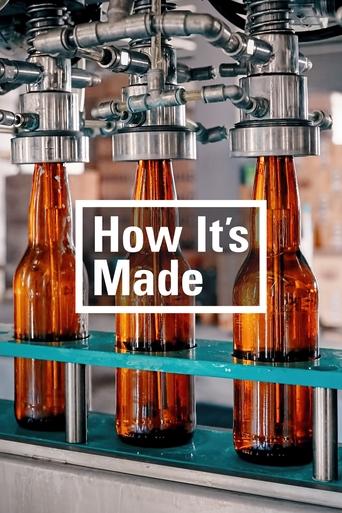
How It's Made
2001 · TV series · documentary · 30 min episodes · 32 seasons
Created by Gabriel Hoss
Have you ever wondered how the products you use every day are made? How It's Made leads you through the process of how everyday products, such as apple juice, skateboards, engines, contact lenses, and many more objects are manufactured.
11 positive2 negative13 neutralfrom 26 commenters
Where to watch
No streaming data for this title.
Videos commenters linked
From YouTube links in the comments below. Most are clips and trailers; “Full” means the uploader says so.




26 comments on Hacker News
If you've ever watched an episode of "How It's Made" and seen how incredibly customized these machines are, it won't be surprising that the people who build them are proud of their work.
> in many aspects of human history, we have traded understanding for convenience—that's the reason why we buy food at the supermarket instead of hunting for our meal.
You could always take a job on a cattle ranch or an abattoir or meat-packing plant, or watch a How It's Made documentary, and get some understanding of how the sausage gets made and put on the supermarket shelf for your convenience. This was also true as we built abstractions in computer technology: you could start off learning a high level language, then learn a lower level one, then study or build an operating system kernel, a compiler, an assembler, machine code, and then crack some books on microprocessor architecture and signal processing. You could always "go deeper" if you wanted to. And there is a payoff: understanding at a deeper level helps you get things done better at the higher levels (e.g.: understanding the concept of memory hierarchy helps you lay out data structures to make code faster).
There is no such step for slop-coded codebases: you become entirely dependent on a context-limited LLM to have a shot at even approximating some understanding. Perhaps more productively, you treat the slop as a black box and build something understandable around it.
This is also why the notion that developers in the future will be committing LLM prompts in English to repositories instead of code written in a programming language is so foolish. I am saying this as someone who uses LLMs quite a lot to help with generating and understanding code.
That seems less annoying than a hotel full of people who can play whatever they want with my Chromecast. No malice is required for this to happen; it is completely possible to do by mistake.
Words like "I've been trying to use the Chromecast!" "The Living Room Chromecast?" "Yes! It says it's playing, but I don't see anything on the TV screen!" "You hit the play button, right?" "Yeah, and then it keeps stopping on its own!" "Are you sure you plugged it in?" "What in the world is wrong with this dumb thing?" drift between one partner and another in some other in some far corner of the hotel as they innocently trample my efforts to watch old episodes of How It's Made.
For all of these reasons, I tend to travel with a network that I control. That's usually in the form of some manner of very small router -- with a strong preference towards something that runs (or can run) OpenWRT. There's a ton of such "travel routers" in the market that are centered around $60 or so that don't take up much space at all.
I use this to slurp up whatever free wifi or ethernet I can get, or my phone tethering/hotspot, and I don't worry at all about how someone else's network might decide to treat me today. Whatever stuff I bring with me all works about as well as it does at home.
I see too many students treat a robot arm like an automation hammer when watching a few episodes of "How It's Made" will give you a much better view into true automation.
Anyone who has seen even one episode of How It's Made knows this is not the case.
Learn ladder logic and PLC programming, go into factory automation and controls engineering.
I used to work at a packaging machine OEM. Lots of robotics, bespoke designs, and every day was like an episode of How It's Made. Very fun, but eventually I left to chase the SV startup circuit. All of my old co-workers still work there.
It depends on how interesting the thing I'm needing to focus on is. If it's super interesting, I just block out external stimuli, since it will actually aggravate me.
The flip side is if I'm doing something boring, I have to have some other distraction going to keep the dopamine flowing, because the regular task isn't creating it. It's usually something pretty simple, a background TV show (mythbusters/how it's made/DDD, etc), youtube build videos, or up-beat music. Something novel enough to keep me interested, but not so interesting that it takes my attention away from my target task.
And yes, meds. They let me enact such a plan, letting me manage the executive dysfunction which would otherwise throw a spanner in the works.
The narrator on many episodes of How It's Made says "row butt"
Watch 2-3 episodes of 'How it's Made' and you can see how much water use is industrial.
Add the industrial and cattle together and one can quickly see that it's not humans that are consuming the vast majority of potable water, but companies and industry that are depleting what's available for the rest of us.
Yes I'd love if there were a site to help find these. There's a show called How It's Made that I really enjoy and such tours would be like in-person versions of the show.
https://m.imdb.com/title/tt0835010/
> The lack of background music and pace is really interesting to me. Compared to a typical "how it's made" video [1] (which I feel has a similar level of detail), this video feels significantly more digestible. Those moments of silence feel totally alien and out of place in today's style, but I think contributes positively to my ability to understand and process the information.
I think that's because the older movie is an actual educational movie, while the video you linked is really pseudo-educational entertainment. An educational video has the goal of leaving the viewer with actual understanding of something, while the pseudo-educational video only cares to vaguely tickle the viewer's curiosity, and is fine to leave them nearly as ignorant as when they started. While the two movies may have a "similar level of detail," the educational video focuses on fully explaining a specific problem and solution, while the pseudo-educational video only vaguely skims through the high-level steps of some manufacturing process and barely even explains what the product is for.
http://www.engineerguy.com/ makes educational videos similar to this 1937 movie on a lot of similar topics.
Watching TV shows about manufacturing process (e.g.: How It's Made) made me realise that manufacturing is not just about "making things perfect", but also "discarding the outliers".
You can make something quite bad on average, and that's okay, you just have to be able to filter out everything you don't want and keep what you want. When CPUs are manufactured, this is what they mean by the "yield". It's the percentage of the product that can be kept, with the rest of the wafer discarded.
Chef's Gallery had a scene that actually shocked me a bit -- this award winning chef was making this deep-fried puff thing that was absolutely perfect. They showed his process, which was to make dozens of them and then plate just the best one for the customer. He never had a knack at all for making them perfect! He was just throwing out 99% of the puffs that he made, using the same technique as anyone else would.
You just have to change your perspective: You're the product. You're the deep fried puff.
If you're an outlier, you will be discarded. You're the bent piece of framing. You're the slice of the silicon wafer that failed the test.
Nobody feels the slightest bit bad about rejecting a faulty product on the production line. No tears are shed. No phone calls are made to the product to see if there's anything the manufacturer can do to fix the situation.
This is Google and by extension YouTube in a nutshell. They're an advertising company manufacturing ad impressions and ad clicks. Viewers are their product.
Viewers on 1 Mbps or 1 Gbps are equally outliers. Both are too weird to cater to, less than optimal, unpredictable, difficult to advertise-to viewers.
Rejected.
The problem isn't production.
It's mass automated production. Once you take the human out of the picture to get a machine to do the work you've now involved a programmer, CNC operator, roboticist. and an industrial engineer at a minimum just to get the rough task doable.
We could probably have a fully human operated production line up and going relatively quickly, but getting the machines all cut over and integrated so as to do it themselves is hard.
Look, thought experiment. You ever watch that show, "How It's Made"? They literally make entertainment out of watching the end result of the final outcome of integrating all of these stages of the fabrication process.
But if you have ever watched it, did it not strike you as interesting that they never seem to do an episode with regards to the production of the very industrial equipment automating the fabrication process?
They can't/won't because it is bloody hard, error prone, and freaking expensive. Once you've got it, you're gold, but it is by no means a short route getting there.
From my extensive experience watching episodes of "How It's Made", frozen foods still often are hand-made. There are enormous assembly lines, heavily automated but with some steps done by hand. Especially those that involve irregularly-shaped, delicate, or sticky objects[0].
They did do an episode on frozen pizzas[1], and it is fully automated. But the techniques are difficult to adapt to making individual pizzas. Sauce, cheese, and toppings are sprayed all over the assembly line; the stuff that falls off is dumped back into the hopper.
They also did an episode on building pizza-making vending machines, and it does seem as if that was technology that was ready years ago.
[0] https://www.youtube.com/watch?v=_htXkd0djzE [1] https://www.youtube.com/watch?v=SqULgulLq3Q
"How It's Made" is often fascinating to watch, and it always reminds me of a childhood favourite: "The secret life of machines":
http://www.secretlifeofmachines.com/
https://en.wikipedia.org/wiki/The_Secret_Life_of_Machines
Full episodes are available on Youtube, for example The Quartz Watch - https://www.youtube.com/watch?v=nQ9_bOIj49s
How It's Made, Nova, and Nature. To a (slightly) lesser extent, 60 Minutes and Frontline.
The term documentary covers (imho) a continuum, from academic style nonfiction on one end to a gray area between infotainment and fiction on the other.
I worked in a highrise office that had TVs ringing the floor that you could remote into to display dashboards and whatnot. One day I decided to play, on mute, endless episodes of How It's Made.
For reference, I work in a hardware engineering group. Some mesmerizing process would show up on screen, one person would stop and stare, and 5 minutes later we have a half dozen engineers who've stopped what they were doing to watch How It's Made.
Eventually we settled on Bob Ross as a happy medium in terms of "Pleasant Ambiance" and "Not Too Distracting."
Toilet Paper is one of my favorite "How it's Made" episodes. Feel free to check it out at https://www.youtube.com/watch?v=Z74OfpUbeac.
My favorite part is at 4:43 with the Circular Saw!
Yea, I don't think the average show from the 70's was good.
Though, if your going to compare the average show, then the competition is more like 'Pawn Stars', 'My Teen is Pregnant', 'Tiny House Hunters', etc. Or you could compare similar longer running shows like Three's company (8 seasons) vs. Two and a Half Men (12 seasons).
So, my guess is a random episode of 'Sonny and Cher Comedy Hour' was probably better than a random episode of a random cable TV show. Though, it's also very dated at this point. It's also likely worse than say the best south park episode or whatever show you actually like.
Anyway, I am not saying the 70's wins hands down, hell I was not even alive then. But, I do think people are confusing shows about things they like with actual quality. I might like 'How It's Made' but it's not exactly deep.
This reminds me of the show "How It's Made" which I watch religiously. One take away I always get from the show is how much is automated and how much isn't. Metal work always seems to requires a tremendous amount of skill (e.g. one of the episodes was making shovels and spades and an apprenticeship requires like a year of training). Even metal casting requires skill because of the finishing (sanding + polishing) required.
Regardless I highly recommend the show if you like watching things like this.
(funny side story about me watching the show: my wife hates the show and told me to change the channel because she said it is like "watching paint dry"... sure enough next scene paint was being dried).
I watch a lot of How It's Made. On many episodes you'll see an assembly line that is almost entirely automated, except for some small section. Sometimes that section involves (A) precision work that we haven't yet figured out how to automate. Most other times it seems to be (B) extremely "automatable" work (e.g. grabbing widgets six at a time and putting them in a package) that leaves me scratching my head as to why the robots aren't there as well.
I watch these episodes and think to myself that these workers are just the last portion of the line to be replaced by robots, and it's only a matter of time, capital, or both. Demos like this move the line between (A) and (B). The Industrial Revolution was only a half-step--just the "brawn" part. Now we're in the middle of the "brains" part, and the outcome is both exciting and scary.
> I think it has public-interest value as a communications platform for certain non-profit enterprises like Wikipedia, etc, and maybe we need legislative protection of those functions.
I think at some point the line between non-profit and for-profit gets very hard to draw. E.g., NFL is a non-profit organization, yet intuitively you would think that they should pay for their streaming services that are very much like Netflix. There are also a lot for-profits which are less entertainment oriented and more education oriented, and vice versa. Heck, I actually use Netflix almost exclusively for watching 'How it's made' and the documentaries it has. If everyone used Netflix like me, would it fall it fall under the provision of being protected againt anti-NN? What about loads of other services which really are like this, but are for-profit?
So, it seems to be a compromise either way, if you view it as a commercial platform or a communications platform. Personally, I'd rather err on it being the latter.
"For instance, reading all of the Harry Potter books is getting something done too. Flipping channels on the couch all day, not so much."
I've always found it interesting that reading, as a form of entertainment, always seems to be held on a pedestal compared to television, cinema, or videogames. It's a kind of elitism that the literati hold over everyone who doesn't find reading as enjoyable as them. Consider this: one person reads the entire Harry Potter series and another reads the entire Twilight series, both are reading but the quality of the material is completely different. Assuming that literature is de facto superior to any other form entertainment is completely ignorant and wrong.
In this case, swap "flipping channels all day", which could include watching informative shows such as Bill Nye, How It's Made, or Mythbusters, with "watching Jersy Shore all day" and confusion about entertainment quality preferences are removed.
I've been watching "How It's Made" on NetFlix, I am on Season 3 and it is awesome. Although, I do tend to get hungry for the foods they show :P
My son (4 years old) and I are big fans of the tv show "How it's made" which gives interesting tours and insights into various manufacturing and industrial processes. He got really excited about last weeks episode: water treatment plants (not a joke - he's always been curious about flushing toilets and draining water)
http://science.discovery.com/tv/how-its-made/
I feel my life is infinitely enriched by watching TV and movies. (In UK, we have extremely high quality programming).
You wouldn't say "all books are bad" would you... Sadly people seem to take the worst TV (reality TV) and assume it's all like that.
Watch some good movies, comedies or documentaries. Heck watch "How it's made" for a few days.