 Hacker Cinema
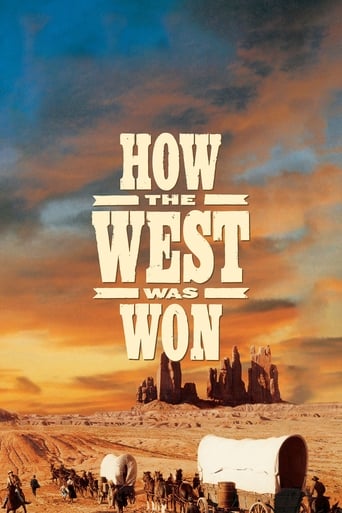
How the West Was Won
1962 · Film · 164 min
Directed by John Ford, Henry Hathaway, George Marshall
The epic tale of the development of the American West from the 1830s through the Civil War to the end of the century, as seen through the eyes of one pioneer family.
4 positive1 negative1 neutralfrom 6 commenters
Where to watch
No streaming data for this title.
7 comments on Hacker News
> The last film I've seen in an ultra-wide like this was the original 3-wide version of How The West Was Won, which I actually really enjoyed.
I definitely agree. I saw Lawrence of Arabia in Hollywood presented in the original Super Panavision 70 (2.76:1) and it was sensational. However, the Sphere format is far wider than even that. Plus the Sphere format is both wide and tall and the horizontal curvature yields a wrap-around that's nearly 180. And the shape of Sphere's internal screen is weird, sort of like sitting inside an empty, cavernous NFL football helmet (note: the internal screen shape is very different than the shape of the Sphere exterior dome). The internal screen is made out of multiple complex compound curves. This inconsistency makes rectilinear-esque projection mapping even more obviously wrong, especially with any camera motion. So don't confuse your appreciation for "How the West Was Won" in wide format with the theatrical abomination that is the Vegas Sphere.
I think there's lots of reason for optimism around Extra-Wide formats like IMAX and Panavision Super 70. However, I struggle to find anything positive in the trade-offs baked into the much more extreme Sphere format. All engineering in this area is full of trade-offs but with the Sphere it's clear they optimized almost exclusively for huge capacity (up to 20,000 people), the highest possible "First 90-seconds 'Wow!' impact on naive audiences", and the most impressive external and internal conceptual 'curb-appeal'. They wanted to be obviously, overwhelmingly "biggest, roundest, tallest, widest screen EVAH!" And to over-achieve on that dimension they intentionally chose to reject all aspects of technical balance which might mitigate the worst quality trade-offs. In the design brief they went all-in on FUCK the contrast, brightness, parallax and any hope of cinematic storytelling. Just make the screen BIGGER, WIDER, TALLER (and cram MOAR seats under it).
In that sense, I guess they understood their market, because it fits the worst aspects of the traditional Vegas low-brow, aesthetic of big, garrish, tasteless, attention-seeking spectacle focused on exterior curb-appeal and shallow initial impact yet ultimately delivering low-quality disappointment. And it looks like it's working because they're clearly making money. They're even talking about replicating the Sphere in other major cities around the world, although I suspect the format may not have staying power outside the unique context and aesthetic of Vegas. And to be fair, the Sphere may be a fine concert and event arena (I didn't see it in that form and the reviews are mixed). I only consider the Sphere an abject failure in trying to be a theatrical venue for high-quality visual presentation of cinematic storytelling.
I remain open-minded and even hopeful regarding other potential advances in wider-format and alternative-format theatrical exhibition. I'm also open-minded about new storytelling potential that might be enabled by immersive head-mounted stereo VR. But I simply love the medium of cinematic storytelling too much to remain silent when the Sphere markets itself to the naive masses as being the ultimate in high-quality theatrical presentation when in reality the format chose to be so over-the-top extreme, it's literally broken for the purposes of high-quality theatrical presentation of cinematic storytelling. And I went to the Sphere sincerely hoping to be blown away by an unexpected miracle of modern day engineering overcoming the challenges of the format, but alas...
I'm more optimistic about this. I've worked adjacent to this space too. You clearly have way more experience than me, and I bow to your judgment.
On the outpainting, I think in the documentary you can see some "bones" of one of the off-screen characters in a window, so it looks like they have some sort of adaption perhaps to manually animate or constrain the AI model.
The last film I've seen in an ultra-wide like this was the original 3-wide version of How The West Was Won, which I actually really enjoyed. I think it's important to remember that most of the important action is constrained the center and the edges are really just to fill-in your field of view. At least, that's how this should work.
First of all, thanks for writing all that. I appreciate it, and so I'd like to respond.
> Run a Google search that includes a minus term and tell me how effective the search results are in regards to obeying that instruction.
Sure. I search for the movie I watched last night -- "How the West Was Won" (without quotes) -- and nearly all of the results are for the 1962 movie, as it should be. I search for "How the West Was Won -1962" and all the results are for the 1977 TV series, plus a Led Zeppelin album. Works great -- I use the minus operator all the time.
> trying searching for "<thing you might want to buy> review". Enjoy the avalanche of low-quality SEO and link spam you're about to receive.
I just typed in "dehumidifier review" and the first three results are from Wirecutter, Consumer Reports, and Good Housekeeping. Down the page includes more trustworthy sources like Tom's Guide and The Spruce. This is exactly what I want the results to be. I trust those a lot more than some random blogger of YouTuber, for instance.
> Also consider the fact that many searches you perform on Google are already offered with a "reddit" suffix, because so many people can only find the information they're looking for by appending that term to their search
Which is fantastic for me. I'll often find really valuable opinions in a single Reddit thread that provide a different perspective from Wirecutter, for instance. This isn't a failure of Google -- it's a testament to Reddit's success. (Indeed, Wirecutter and Reddit are often the first two things I want to read when researching a product -- but Reddit is more of a second pass.)
> I was searching for a solution to a programming related problem on Google just a few days ago
I definitely agree that finding incredibly specific solutions to technical problems can sometimes be hit-or-miss, but that's not a problem with Google at all, that's a problem with the entire concept of keyword search. But to my eyes, Google hasn't gotten worse over a couple of decades, it's gotten better. And I think it's noteworthy that your solution was ChatGPT, as opposed to a different search engine. That's exactly the kind of thing I turn to ChatGPT for as well. But again, I don't interpret it as Google having gotten worse, just as a new tool that's even better for certain types of tasks.
"Bigger", as in IMAX, did not come from Expo 67. It came from a long line of attempts to make really wide screen films. Cinerama (1952), Todd-AO (1953), Cinemascope (1953), etc. The really wide screen systems required custom theaters and very elaborate machinery, and never really caught on. Cinemascope requires just a lens adapter for an ordinary 35MM projector, and it went mainstream.
What to do with widescreen cinematically was a big problem in the early days. Roller coaster demo reels introduced Cinemascope [1] and Todd-AO.[2]. 3D was tried in the same time period. Theaters were trying to do things TV could not do. But how do you tell a story on a huge screen without the screen getting in the way of the story? Most of the time, the screen won. (See the ending of "How the West Was Won" (1962).[3]) Michael Anderson (Around the World in 80 Days), not Kroitor, seems to be the director who figured that out. You make big-budget spectacles, with a plot in glorious locations. Ben-Hur and Cleopatra followed.
That's still the problem with IMax. The giant screen wins over the story.
[1] https://player.vimeo.com/video/266574534
[2] https://youtu.be/MU76gdjr-Dk
[3] https://youtu.be/8t_qToyqiOU?t=76
My Samsung Plasma TV has two modes I really enjoy:
One is the 24 frame, cinema mode. I bought "How The West Was Won" on Blu Ray. It is probably the most beautiful Blu Ray title I have. And it looks very different when the usual, normal TV modes are used for viewing.
The other one is "game" or "monitor" mode, and the TV actually does next to nothing to the signal, just blasts the pixels out as they come. That Blu Ray looks pretty good in this mode, but has motion jitter because the frame rates are not matched to the original.
I grew up around Washington DC which had some fine large screen theaters. One had a curved screen (the Uptown, IIRC, movies were all in 70mm format) so if you sat in the first few rows, the screen almost wrapped around you. IMHO, the only way to appreciate some of these great movies (2001, Lawrence of Arabia, How the West Was Won) is to see them on a large screen. IMHO, you just don't get to see how spectacular the cinematography is when you watch on a TV or a small screen theater. Unfortunately, most of the large screen theaters have disappeared.
Some times it is.
Go look at great pixel art from the 80's and 90's era on an analog CRT.
Overall, modern displays do more and are better in every way. But, I find watching SD media is best on analog SD media.
Or I see a movie in ultra high resolution. Looks like a set. I can see it. But my copy of "How The West Was Won" reissued on Blu Ray is one of the very best I've seen.
This stuff has subtleties that people appreciate.
I find it much easier to go looking for and appreciate art where I see it, and largely ignore the more objective persist of perfection. It's a good thing, but I don't always care.