 Hacker Cinema
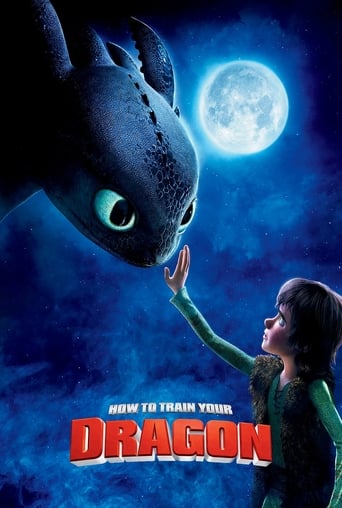
How to Train Your Dragon
2010 · Film · 98 min
Part of How to Train Your Dragon Collection
Directed by Chris Sanders, Dean DeBlois
FantasyAdventureAnimationFamily
As the son of a Viking leader on the cusp of manhood, shy Hiccup Horrendous Haddock III faces a rite of passage: he must kill a dragon to prove his warrior mettle. But after downing a feared dragon, he realizes that he no longer wants to destroy it, and instead befriends the beast – which he names Toothless – much to the chagrin of his warrior father.
21 positive2 negative12 neutralfrom 35 commenters
Where to watch
No streaming data for this title.
45 comments on Hacker News
Even if Bluey was strange Australian propaganda to make fatherhood desirable and respectable, it still wins because it actually works at it.
Avoiding the "dumb sitcom dad" has been done before a few times, and well (Bob Parr of Incredibles; Stoick the Vast of How to Train Your Dragon; King Fergus of Brave could be some examples) - but Bandit just is a dad; he's not perfect, he's not brilliant - but he's there (except when he has to leave) and he loves - his children, his wife, himself.
And even though he says "I'm not taking advice from a cartoon dog" we all end up doing so.
Researchers trained a deep learning network on photos to make GTA5 more realistic-looking: https://www.youtube.com/watch?v=P1IcaBn3ej0
I was surprised that most of it is is just tone mapping. It looks too green-ish to me, needing some white balancing, but realistic.
I think Video games are intentionally over-saturated and contrasty to make them look better, just as paintings are[1]. I took many screenshots in Horizon Zero Dawn that would be look bland if it was realistic like the modfified GTA5 footage above[2]. You also don't want animation movies[3] with realistic tone mapping. But for a horror game you would do exactly that, it's about immersion (or you would never be frightened), not beauty.
[1] https://www.reddit.com/r/horizon/comments/1ix7ms2/my_hzd_oilpainting/
[2] https://www.reddit.com/r/horizon/comments/x97gi1/this_game_is_a_visual_masterpiece/
[3] https://www.imdb.com/de/title/tt0892769/mediaviewer/rm2841021440/?ref_=tt_ov_m_sm
Saw it this weekend, it's a solid Pixar movie. But I only learned about it because I was looking to go see a movie and Elio was the most original movie playing at the local theater; I'd heard nothing about it.
I have heard more about the two live-action remakes (Lilo and Stitch/How to Train Your Dragon) and the sequel (28 years later) that are currently showing.
Stereo film has its own limitations. Sadly, shooting for stereo was expensive and often corners were cut just to get it to show up in a theater where they can charge a premium for a stereo screening. Home video was always a nightmare--nobody wants to wear glasses (glassesless stereo TVs had a very narrow viewing angle).
It may not be obvious, but film has a visual language. If you look at early film, it wasn't obvious if you cut to something that the audience would understand what was going on. Panning from one object to another implies a connection. It's built on the visual language of still photography (things like rule of thirds, using contrast or color to direct your eye, etc). All directing your eye.
Stereo film has its own limitations that were still being explored. In a regular film, you would do a rack focus to connect something in the foreground to the background. In stereo, when there's a rack focus people don't follow the camera the same way. In regular film, you could show someone's back in the foreground of a shot and cut them off at the waist. In stereo, that looks weird.
When you're presenting something you're always directing where someone is looking--whether its a play, movie, or stereo show. The tools are just adapted for the medium.
I do think it worked way better for movies like Avatar or How to Train Your Dragon and was less impressive for things like rom coms.
There is a documentary about Viking dragons called “How to train your dragon”.
As a father of young kids, I cannot recommend John Klassen's "Hat" picture books enough:
I Want My Hat Back
This Is Not My Hat
We Found A Hat
The Rock From The Sky
They're beautiful exercises in minimal, precision watercolor. They're written with delightful economy, and have a rather Dahlian sense of justice and consequences.
He wrote them all within the last twelve years, IIRC.
For older kids, Pax (illustrated by Mr. Klassen in the edition we picked up) is a lovely piece of writing, vaguely like a cross between My Side Of The Mountain and Old Yeller, but less tragic than Old Yeller, with a deftly-handled thread about emotional awareness and responsibility for one's own choices woven throughout.
Oh, and the How To Train Your Dragon books, by Cressida Cowell, are wonderful, hilarious pieces of work about self-discovery, loyalty, friendship, and the hard, slow struggle to achieve mastery and skill in a world where people expect you to be something rather different than you are. Vastly, vastly better than the popular movies loosely inspired by them, and quite different - closer to a child-friendly Hitchhiker's Guide than the Hero's Journey of the films.
Great new classics are still being written - it's just that the winnowing function of passing decades hasn't yet run its course, so they're harder to find.
Yup. Even if you only look within a relatively small category of films one per year can miss a bunch. For example, consider the category of animated feature length films released after 2000 in the US, and pick one per year by picking the winner of the Academy Award for Best Animated Feature.
In 2001 you'd miss Monsters, Inc. because of Shrek.
In 2002 you'd miss Lilo & Stitch because of Spirited Away.
In 2004 you'd miss Shrek 2 because of The Incredibles.
In 2005 you'd miss Howl's Moving Castle and Corpse Bride because of Wallace & Gromit: The Curse of the Were-Rabbit.
In 2008, no Kung Fu Panda because of WALL-E.
In 2009, no Coraline or Fantastic Mr. Fox because of Up.
In 2010 you'd miss How to Train Your Dragon because of Toy Story 3.
In 2011 no Kung Fu Panda 2 because of Rango.
In 2012 no Frankenweenie, ParaNorman, The Pirates! Band of Misfits, or Wreck-it Ralph because of Brave.
In 2014 no How to Train Your Dragon 2 because of Big Hero 6.
2015 no Shaun the Sheep Movie because of Inside Out.
2016 you miss Kubo and the Two Strings and Moana because of Zootopia.
2019 No How to Train Your Dragon: The Hidden World because of Toy Story 4.
2021 you'd miss Raya and the Last Dragon and Luca because of Encanto.
Most of the winners are good...but if you just put all the above mentioned films in a pool and asked most people to pick their top 14, most would have a lot of films on their list that were not among the winners of the aforementioned years.
Oh you worked on How to Train Your Dragon? That's my favourite movie in the world!
Really random follow up question - there's a How to Train Your Dragon advert that I assume played before the first film in cinemas, advertising the cinema's popcorn and other concessions, but the only two copies on YouTube are in really terrible quality. (one in English https://www.youtube.com/watch?v=f37fI14Ne0I, the other in Finnish I think https://www.youtube.com/watch?v=W0Hr4mD3G1Q). I really really want a high quality version of this, and I'm wondering if you know of anyone at DreamWorks who I can contact about this? I've tried tweeting at a couple of people but unsurprisingly heard nothing back, so I'm maybe looking for someone in marketing?
I think we made How to Train Your Dragon three times at DreamWorks. So many rewrites, director changes, character redesign, etc. If you ever wonder why a feature length animated film can cost over $300 million dollars, this is one reason.
2010 was truly a phenomenal year to be a film soundtrack enjoyer. It's hard to believe that we got Ross and Reznor on Social Network, John Powell on How To Train Your Dragon, Zimmer on Inception, and Daft Punk on Tron: Legacy. All 4 of those scores are amazing and it blows my mind that they all released in the same year.
Jeff Katzenberg, the co-founder, has been 'making content and selling to kids' for 40 years to the tune of literally Billions. Star Trek films, The Little Mermaid, The Lion King, Shrek, How to Train your Dragon etc. etc. - just huge, monster titles.
Whitman was the 'Business Person'.
That said, the content format is really quite different, and it's hard to predict how '5 minute bits' would work, and they spent possibly way too much money on it, it would have been better to 'start small', to find the format that works, and then spend a fortune - which is probably something that Meg should have understood given her background in the Valley.
> Having worked in the animated film industry for a while, there's so much that does get changed in both pre production and production that people don't hear about.
I wonder what some of the biggest changes to happen in production are?
One of the biggest I've read about is How to Train Your Dragon.
The book series is aimed at kids around 10 years old. The main characters, such as Hiccup, are around that age. The vikings are not at war with the dragons, and many vikings have dragons as pets, mounts, and hunting aids. Toothless is in the books, but he is not a Night Fury--those do not exist in the book universe. He's just a common garden dragon (their model became the Terrible Terrors in the movies), named Toothless because he lost his teeth.
The big issue in the first book is a rite of passage where kids have to train a dragon or be exiled. Toothless offends another dragon during this, a big fight breaks out, this is seen as a failure of training, and Hiccup and the other kids also undergoing the rite are going to be exiled.
They were 3 years into production of a very faithful following of the book, with large parts animated and most of the dialog recorded, when they realized they were going to end up with a "drop off" movie.
Kids around 10 would love it...but their parents or their older siblings who had taken the kids to the theater would not be interested. They would just drop the kids off at a mall theater and go hang out at the food court or shop or something until time to pick the kids up.
Making a drop off movie is fine if you don't spend a lot of money on it. HTTYD was a $160+ million movie, though, and no way can a drop off movie come anywhere near making that back, let alone profit.
So one year before it was supposed to be released, they put "The Croods" on hold and moved Chris Sanders from that to take over as director of HTTYD, with the task of coming up with a completely new story...and they didn't move back the release date.
Sanders brought in Dean DeBlois, who had been his writing/directing partner on "Lilo & Stitch" when they were both at Disney, to be co-writer/co-director.
They made the kids 15 instead of 10, created the viking/dragon war, added Astrid and Ruffnut, created Night Furies and upgraded Toothless to one. They needed a lot of new models, new settings, and mostly new dialog.
There are still some oddities.
"How to Train Your Dragon" (2010), 99% with 206 reviews does not make the list, but many older movies, with lower scores and lower number of reviews do. E.g., "The Wizard of Oz" (1939), 98% with 111 reviews, and "It Happened One Night" (1934), 98% with 56 reviews, and "Casablanca" (1942), 97% with 79 reviews, and "Alien" (1979), 97% with 115 reviews.
It looks like the older a film is, the fewer reviews it needs backing its score to make the list.
It's also possible that the age of the review is taken into account, so that a modern review looking back on a film counts more than an older review, because that would probably be more relevant to someone today deciding what older movies to watch.
For example, take "The Good, the Bad, and the Ugly" (1966). It wasn't very well received by critics in 1966. Now, though, it's at 97% on RT, and is regular included in lists of top films (it used to be on the RT top 100, but looks like it has been pushed off).
I have a 4yo daughter. We don't use youtube's recomendations to get things for her to watch, instead:
* we watch what we liked to watch when we were young (we are from Czech Republic and there is a wealth of local animation series, usually ~7 minutes/episode. If you want a sample, "Pat & Mat" is silent-duo home-improvement slapstic comedy that we kinda like :)
* we talk to other parents (i.e. you can't really escape Pepa Pig or My Little Pony - Friendship is Magic)
* we like animation, and sometimes watch even more grown-up things togehter, i.e. we liked various series from the How To Train Your Dragon universe
Three more things that I think kinda help as well:
* if she watches alone, she know she has a limit (usually 3 stories in one sitting at most?) I am really proud when she manages to close the app on her own.
* I often sit her in front of my thinkpad instead of tablet. This limits her ability to binge-watch, somewhat :P
* She has an mp3-player of sorts and a cd-player with few radio-plays. She know how to operate both of these. We don't really limit her using of the audio-only entertainment :-)
"How to Train Your Dragon" was directed by Chris Sanders and Dean DeBlois who were directors and character designers of "Lilo & Stitch".
So Toothless was inspired by Stitch and, probably, cats.
The game industry definitely follows inward looking trends. For a long time every game was grey or brown and lacked contrast. More recently they all seem to use the same look/LUTs.
I worked in animated feature films and had similar critiques about the lighting and look. I felt like they lit everything like a well exposed photograph and were afraid of letting things fall off into dark or light (part of that could have been poor simulation of the toe or head of the film curve).
Then, when Pixar did Wall-e (2008) they hired a well known cinematographer, Roger Deakins, as a consultant. DreamWorks also hired him for How to Train Your Dragon (2010). I think that was a big change and both of their studios approached how CG movies look.
McCaffrey's Pern stories would need some pretty good special effects for the dragons, wouldn't they? Cheesy dragons really distract from the story in a movie.
I think we've got sufficient effects technology to do a good dragon nowadays. Examples would be the dragons in Avatar and the dragons in How to Train Your Dragon (especially Toothless from the second movie).
DreamWorks Animation uses RHEL exclusively for production. That means all your favorite movies such as Kung Fu Panda, Madagascar, Shrek, How to Train Your Dragon were all made on Linux
Ninja edit to add high end software that runs on Linux that were used - Autodesk Maya, SideFX Houdini, Foundry {Mari,Nuke}, Pixologic ZBrush. This is in addition to the proprietary packages such as Premo (Animation) and Torch (Lighting)
Gravity was spectacular in 3D, but I have a much larger list of films (many of which aren't great) that have immersive and not distracting 3D. Off the top of my head:
Life of Pi
Pretty much every Marvel movie
The new Star Trek films
Star Wars: Episode VII
The Martian
The Hobbit films
How to Train Your Dragon and sequel
Finding Dory
The LEGO Movie
If you have seen Shrek or How to Train Your Dragon, you have seen some of the work the student produced after graduation.
See http://www.imdb.com/name/nm0996697/
It's funny people in the comments mention that they did not buy games exclusive to the monitor manufacturer. It's true but it also reminded me of the 3D movies wars of 2010. Major CE manufacturers all got exclusive rights to the parts of a small 3D movie library and made these titles available only with the HW purchase. E.g. Panasonic had Avatar so to watch Avatar in 3D you had to buy a Panasonic TV, Samsung had How To Train Your Dragon, Sony had a bunch of Sony titles and I don't remember if LG had anything. We all know how this turned out for the home 3D.
Your comment about 3D being superfluous without contributing anything meaningful really hits home when I try to recall the 3D movies I've seen. Even the one that made the biggest impression on me, the stunning and very well made "How to Train Your Dragon" in 3D, but to this day I remember it in my mind as if it was only in 2D.
It's odd that the article fails to mention the most high-profile film to follow Snyder's template, How To Train Your Dragon. Unlike the speculative examples in the article, the creators of that film have explicitly acknowledged Snyder's role in the development of their story (he's thanked in the credits). [1] I guess the fact that it was a huge commercial and critical hit (98% on Rotten Tomatoes) doesn't fit the simplistic, tabloid template that's taking over serious journalism.
[1] http://www.blakesnyder.com/2010/03/26/how-the-dragon-really-got-trained/
TV shows I can half listen to (X-Men)
Movies I've seen a million times (How to Train Your Dragon, The Matrix, etc)
Music with lyrics I've heard a million times
Electronica
I've been confused by Netflix's business strategy for a while. I'm not much of a business guy, so maybe I'm just missing something.
I've made do for movies with the channels that came along for the ride when I subscribed to the minimal cable TV package that got me the nerd channels (Science, Discovery, Nat Geo, History, and so on). I've got quite a backlog of movies I'm waiting for.
Recently, I caught a movie (How to Train Your Dragon) on TV that I liked so much that I simply had to go buy a copy on Blu Ray. This also necessitated buying a Blu Ray player. I picked a Blu Ray player that also plays streaming content from the internet and supports pretty much everything other than iTunes.
I then started researching the streaming services (both subscription and rental), seeing how well they covered the movies I'd seen in the last couple of months on TV (HTTYD, Star Trek, Kung Fu Panda, District 9, Watchmen, Shrek Forever After, Happy Feet, Tangled, Bolt, Despicable Me, Monsters vs. Aliens, Fargo, Fantastic Mr. Fox), as well as how well they covered movies still on my backlog, plus assorted movies I'd like to rewatch.
Here's what I found. Neither Amazon nor Netflix subscription streaming provided good coverage of the movies I'd recently seen, the movies on my backlog, or the movies I want to rewatch.
The streaming rental services were a bit better, but still missing a lot.
Netflix's disc subscription service, on the other hand, covered pretty much everything.
So here is where I get confused. Netflix seems to think their future is in their streaming subscription service. This seems to me to be a pretty risky basket to put all their eggs into, because it seems to me that Amazon will have an easier time fixing their weaknesses compared to Netflix than Netflix will have fixing their weaknesses compared to Amazon.
Amazon's weakness compared to Netflix is that Netflix apparently has more content (that's what people tell me, although for the movies I'm interested in they seem about the same). To fix that, Amazon just needs to make some licensing deals. They don't have to build out a lot of new infrastructure or enter a new line of business or anything like that. It's a "write a check" problem for them.
Netflix's weakness compared to Amazon is that Amazon subscription streaming is part of Amazon Prime--and there are good reasons to have Prime besides the streaming. I got it for the shipping savings, and I'm also enjoying the Kindle lending library. (Brick and mortar retailers, like Barnes and Noble, and Best Buy, seem to be doing their best to drive people to Amazon, and so I see Amazon Prime becoming more and more common--but this is best left for another rant).
This makes the question for a lot of people "Netflix in addition to Prime?" rather than "Netflix or Prime?". That's a much harder case for Netflix to make. As I said, for the movies I've checked there are very few on Netflix that are not on Prime--it would cost me less to simply rent those movies. As Amazon closes the gap on content, "Prime plus rental" will become a better choice than "Prime plus Netflix" for more and more people.
It seems to me that Netflix's best weapon against Amazon is their disc subscription service. It provides the most content (both recent and older). It provides the highest quality content. It provides extras (commentary, deleted scenes, and all the other nifty things that come on disc besides just the movie).
Yet Netflix treats their disc service almost as if it is an embarassment. There's no link on their main page for it. It only seems to be mentioned in their FAQ, where they imply that it is an add-on service to the streaming service, and give no link to details.
A good illustration of the importance of lighting (even though it is in a virtual world) is "How to Train Your Dragon". One of the big reasons that looked so damned good was the lighting. They brought in Roger Deakins, cinematographer for most of the Coen brother's films and many other well known films, as a visual consultant.
On Deakins' forum on his web site, a puzzled reader posted asking what a cinematographer does on an animated film. Here was part of Deakins' answer:
---------
My role on 'How to Train Your Dragon' was as a consultant and very much as part of a team. It is, for sure, a less personal involvement if only because of the numbers of people involved in the process. However, from an early stage I was involved in discussions about the 'look' of the film with the directors, designer and effects super. This involved all aspects of the production from the choice of lens lengths to our approach to 3D. Following that we created a template of images to reflected the arc of the film. Next we created a number of animated reference shots, which depicted the characters in various lighting situations such as a candlelit room, a foggy day in a forest and in moonlight. For the next 12 months I was working with the layout artists (who set the camera) and the lighters (who light the rendered images) to follow through on the whole process. During part of that 12 months I was shooting a (live action) film but I was kept in touch with the production through a dedicated work station.
---------
Full thread here: http://www.rogerdeakins.com/forum2/viewtopic.php?f=3&t=1658
See also this NYTimes article: http://www.nytimes.com/2010/03/21/movies/21dragon.html?_r=0
The 12 months Deakins spent on this is a bigger fraction of the film's production time than you might expect. Normally animated movies can take 3 or 4 years, but after a couple of years production the producers of HTTYD decided that the story and characters they had would not work. They were doing a faithful reproduction of the book (in which dragons and humans have long been at peace...and the kids are 10), but that was aimed at a younger audience. They needed something that could also appeal to teens and adults, so they replaced the director with Chris Sanders and Dean DeBlois, and told them they needed to write a new story and new script, with older characters--AND they had stick to the release date, which was something like 16 months away. So, that 12 months Deakins was involved was effectively pretty much the entire development time of the film we actually got.
In one of those weird twists you'd expect to find in the movies, not real life, the reason Sanders was at Dreamworks is that when John Lasseter took over Disney animation, he suggested a bunch of changes to the movie Sanders was writing and directing for Disney, "American Dog". Sanders didn't like the changes, and ended up leaving. (Some reports say Lasseter fired him). "American Dog" got a new director and writer and story and a new name, "Bolt". What it did NOT get was a new release date.
> I agree (for now), but i'm not sure this would be a bad thing. You might not be able to make Transformers 3, but you could make most (all?) of Hitchcock's movies.
In addition to "Transformers 3", we also might not have:
WALL-E: $180 million
Toy Story 3: $200 million
Up: $175 million
How to Train Your Dragon: $165 million
Could these same stories be told more cheaply? Sure...but I think they would have just been good stories then, not masterpieces.
If you are including fictional engineers, I'd suggest Hiccup from the "How to Train Your Dragon" movie. It was basically through his engineering skill that he captured Toothless. It was also engineering to provide Toothless with a prosthetic tail and figure out how to fly with him. Learning how to train dragons was a mix of science and engineering. He's continued demonstrating an engineering and scientific approach to problems in the "Gift of the Night Fury" short and several of the "Riders of Berk" cartoons.
Also, I personally work better when I can give a bit of my brain something else to think about so it shuts up and I can get real work done. That's why I listen to music; and, that's why during my late nights in grad school, I played a movie over and over again in the background. "How to Train Your Dragon" was the preferred feature, by the way.
I would be careful with this comparison. Many BluRay disks of older movies are just upscaled from the DVD (I'm guessing here - not actually sure how it's mastered) and aren't significantly different than what you would get with an upscaling DVD player.
You would have to get a "recent" movie mastered specifically for BluRay to see the difference. I've done this several times myself (specifically "The Princess Bride" - which appears to be an upscale, and "How to Train your Dragon" which is significantly clearer).
Cars and Cars 2 suffer from some of the same problems that Shrek 2 & 3 suffered from: creating a self-consistent universe based on adult puns based on characters of modern society.Unless it is done with restraint and real skill it soon behinds to feel insincere and contrived (see Sharks Tail, Chicken Run).
Toy Story & Shrek did something far cleverer. Shrek especially is smart, sophisticated humour for smart, sophisticated kids. The references are all from children's literature and culture. Kids know the references and are able to understand the clever puns.
Shreks 2&3 are dumb adult humour forced into the Shrek world. Many of the puns are above children's heads and are not sophisticated enough for the adult audience. Adding plot-lines about lawyers, unions etc just confuse small kids and leave adults slightly cringing.
Pixar and Dreamworks are at their best when they choose their target audience and focus on it. Toy Story & Nemo are for smart young kids; Ratatouille & The Incredibles are for smart older kids. Then enough is added for the rest of the family: everyone gets a clever joke every few minutes; the stories are understandable by all. Wall-E and Up are very adult in the big story (but full of great fun in the small story) I thought they were wonderful but I do understand your point (although they are I no way 'awful'—even if you are 5).
I'm not convinced that Pixar have mad a bad film yet. Cars grows on me the more I see it (and believe me if you have kids you end up seeing these films any times). Nemo (by far the funniest film Pixar have made) still makes me laugh despite having seen it 20+ times.
{I'm told that Cars 2 is relentless: too fast and too complicated for young kids, but as I haven't seen it I can't judge. The fact that I haven't seen it says something: I normally see every Pixar film the week it comes out.}
The problem that Pixar has had is that we have had to judge Pixar by Pixar standards as until recently no-one was making anything as good. This has now changed. Wonderfully for us Pixar now has serious competition. Dreamworks has made a number of films that are as good as Pixar's. Some of them are as good as Pixar's best: How to Train Your Dragon, Megamind, Kung Fu Panda. Walt Disney Animation Studios is back on form with Tangled (Monsters v Aliens wasn't bad either).
How to Train Your Dragon & Tangled are thankfully free of transfer-modern-society-into-cartoon-world puns. Instead you are given a detailed, self-consistent world that complements the story (rather than being the story). This is a very good thing—something I hope that Pixar will move back towards (although I don't hold out much hope for Monsters Inc 2).
I posted this on the site, posting it here too:
I would say a better metric would be "How much did you enjoy this film?" vs "How good is this movie?"
I've been grappling with this problem since subscribing to Netflix, wondering how I should rate a movie I personally did not enjoy that I also felt was incredibly well made. For example, "A Clockwork Orange" is an incredible movie by all means and I would give it 97 stars out of a hundred.... but I hated every single second of it. It's gruesome, sadistic, dark, miserable, and disgusting. But it was undeniably well made.
Rewatchability sucks in the aspect because many movies can't be rewatched, while still being both splendidly produced and enjoyable. Let me make this clearer with examples: "The Sixth Sense," "Rear Window," "The Accused," "The Diving Bell and the Butterfly," "12 Angry Men," "Apollo 13..." The list goes on and on. There are great movies that just don't rank so highly because they're SUSPENSEFUL and that suspense doesn't translate will into rewatches. Rewatching suspenseful movies will make them seem boring and long-drawn.
Rewatching feel-good movies ("Seven Pounds," "How To Train Your Dragon," "Blind Side," etc.) however, is just as good the second time if not better.
tl;dr the rewatchability index will be heavily skewed towards feel-good favorites and epics, and away from dark, gritty, mysterious, and suspenseful. Not a good index.
I have never seen a 3d movie yet. I went to my best local theater, that was built within the last ten years (There actually are only two local movie theaters.) to see How to Train Your Dragon in 3d. The opening credits/intro pieces looked incredible. I was so excited! When the movie started I realized there were only two tiny speakers at the front of the theater by the screen outputting audio. I started complaining to the point that i was getting shushed by some patrons. Mostly asking around who else noticed the audio was broken.
After a few minutes I went to speak with the manager. Basically I was told I was the first person to complain and that was the way it was supposed to be. I couldn't fathom that to be correct so I continued to question the manager. Eventually she somewhat admitted that the audio, for some technical reason she couldn't explain was not properly able to be played on their 3d projection/audio system.
So I left. I got the ticket price refunded but not the cost of my concessions. I couldn't help but feel mass amounts of consumers were being ripped off. I felt the team that produced that fine film would have been heartbroken to have seen the movie there. I know i was not willing to watch a movie, my first 3d movie! with audio the quality of a poorly pirated movie.
I considered finding someone to complain too. I imagined the theater was breaking rules by showing the film with such a key component horribly crippled. But I did not.
I have not been back to see a 3d movie. I would like to see one someday. I will go again, perhaps to a theater in another town, someday. I hope they get their "stuff" together. Articles like this do not inspire confidence.
I don't like them more than 2D movies but I also don't dislike them as much as a lot of people around here seem to. How to Train Your Dragon and Coraline come to mind as a couple movies that I really loved and particularly enjoyed the 3D aspect of. I would have still liked them if they had only been available in 2D but I probably wouldn't have paid to go see them in the theater. For most people the movie theater is the only place where they can watch 3D movies. I think that a big part of the reason that we're seeing so many of them is that 3D draws more people out to the theaters.
You hear this every year. And it's still true. Hollywood is wall-to-wall sequels, IP translations (games, comics, tv shows, etc. to movies), remakes, and the remake's newer cousin the "reboot".
Yet even so good films are still being made. The Social Network, True Grit (a remake even!), Toy Story 3 (a sequel!), The Fighter, Black Swan, How to Train Your Dragon, and Inception were all great films from 2010 (I haven't seen The King's Speech or 127 Hours yet but I hear those were good too). If this is what the system pumps out while it's horribly broken, I'm ok with more of the same.
There's always going to be a ready supply of churned out pap in any medium. Just go to a bookstore and look at all the crap that they keep pumping out. But that doesn't necessarily stop truly excellent works being published as well. Some of my most loved books have been published in the last several years. And with the internet it's easier than ever to sift through the dross to find the gems.
The 3rd one is by DreamWorks http://en.wikipedia.org/wiki/How_to_Train_Your_Dragon_(film)
Pixar is currently in the sequel game. Toy Story 3 last year, and Cars 2 scheduled for this year. http://en.wikipedia.org/wiki/List_of_Pixar_films
Some recent good movies:
-Animal Kingdom (Australian crime film)
-True Grit (Western)
-How to train your dragon (Pixar film)
I didn't get this feeling at all with How to Train your Dragon - I thought the 3D was really pretty charming in that movie (just like, you know, everything else about it).
I can't speak for true film buffs--I like the "mindless" Hollywood junk... but only when it's not mindless and not junk, if you get my drift. This year has been absolutely terrible. Months of mediocrity punctuated by the occasional standout. Other than Inception and Toy Story 3, there haven't been any great blockbusters. Oh yeah, How to Train Your Dragon. Almost everything else has been a wait-for-DVD. If that.
Of course opinions are subjective. So let's agree to disagree. :-)
I beg to differ. Some really, really bad movies this year, but there are some real gems.
1) How to Train Your Dragon (it's just magical for some weird reason)
2) Inception (finally something new)
3) Toy Story 3 (don't need to explain)
I've seen 3 movies in 3D. With Avatar and How To Train Your Dragon, I felt the 3D added something worthwhile to the experience. With Alice In Wonderland, it didn't.
I don't think I'd want a 3D TV though, not while you need special glasses to see the picture properly. It's one thing wearing them when you've made the effort to go to the cinema, quite another when you're just casually watching at home; they become something else to lose, like the remote only not as useful.
For me, "How to train your dragon" was the most enjoyable 3D experience of all the 3D films I've seen - Avatar, Alice, Clash, HTTYD. The 3D didn't get in the way, and it really enhanced certain parts to the extent that I'd miss it. I've seen this film twice!
Coming to think of it, colour films are pretty useless too. What extra enjoyment do you get from colour films that you can't get from B&W films? Any hitchcock, chaplin, etc. fans here?
"IT ADDS NOTHING TO THE EXPERIENCE." - That's plain BS. It does for me.
"IT CAN BE A DISTRACTION." - Maybe, but so is Eastman color. We're still figuring out the art of it ... and making great progress imo.
"IT CAN CREATE NAUSEA AND HEADACHES." - Even normal film can cause epileptic attacks. So what?
After finally seeing Avatar in 2D I'm convinced 3D was the only thing it had going for it. As I lulled through the movie there were times when I thought "Yeah, this scene would look cooler in pseudo-3D." I don't think it did a very good job of backwards-compatibility.
How to Train Your Dragon, though, was still quite enjoyable in 2D and I hear it was well done in 3D without going overboard.
Regarding "how to train your dragon". We anticipate that you would Google for it, and that you would find your way to Captain Critic, see some of his other reviews, have a read of them. The next time you look for reviews you see the same thing, and before long you just decide to sign up for RSS.
Then you notice some good comments in the RSS (we'll be sending the top comments with the feed). One day, one of them provokes you so much ("How dare they say that about the matrix") that you click the reply link and let him know your opinion.
And so on. Its not about newstilt, its about the journalist. You like his movie reviews, you'll come back next time. We're giving the journalist everything they need in terms of services to make it happen.
Just my 2c, please rethink most of the fonts. Not a fan of those.
Also I just don't understand what NewsTilt is :/ It just looks like a blog with some articles... Is there a clear description of what's going on somewhere?
For example I see an article reviewing the movie "How to train your dragon". Why would I only read it on NewsTilt? Isn't it more likely I'd google for reviews and check out a few? I don't see how it fits into peoples behaviors atm... Sort of seems like an online version of a hardcopy paper, but without the hardcopy paper bit :/