 Hacker Cinema
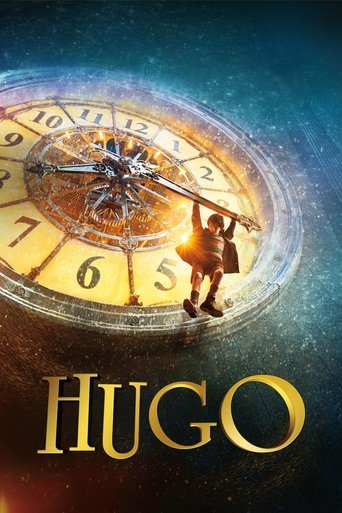
Hugo
2011 · Film · 126 min
Directed by Martin Scorsese
Orphaned and alone except for an uncle, Hugo Cabret lives in the walls of a train station in 1930s Paris. Hugo's job is to oil and maintain the station's clocks, but to him, his more important task is to protect a broken automaton and notebook left to him by his late father. Accompanied by the goddaughter of an embittered toy merchant, Hugo embarks on a quest to solve the mystery of the automaton and find a place he can call home.
9 positive2 negative1 mixed15 neutralfrom 27 commenters
Where to watch
No streaming data for this title.
28 comments on Hacker News
Oh boy, this takes me down memory lane.
George Meliese's silent films and automatons were at the core of the beautifully illustrated and written YA novel from the mid-2000s named The Invention of Hugo Cabret [0].
[0] - https://en.wikipedia.org/wiki/The_Invention_of_Hugo_Cabret
If data integrity is assured, and thus there is no change in the data to store/transfer, then that's the opposite of computationally transforming the data?
How do we see robot and AI and helping interactions in film and tv and games?
A curated list of films for consideration:
Mary Shelley's "Frankenstein" or "The Modern Prometheus" (1818), Metropolis (1927), I\, Robot (1940-1950; Three Laws of Robotics, robopsychology), Macy Conferences (1941-1960; Cybernetics), Tobor the Great (1954), Here Comes Tobor (1956), Jetsons' maid's name: Rosie (1962), Lost in Space (1965), 2001: A Space Odyssey (1968), THX 1138 (1971), Star Wars (1977), Terminator (1984), Driving Miss Daisy (1989), Edward Scissorhands (1990), Flubber (1997, 1961), Futurama (TV, 1999-), Star Wars: Phantom Menace (1999), The Iron Giant (1999), Bicentennial Man (1999), A.I. Artificial Intelligence (2001), Minority Report (2003), I\, Robot (2004), Team America: World Police (2004), Wall-E (2008), Iron Man (2008), Eagle Eye (2008), Moon (2009), Surrogates (2009), Tron: Legacy (2010), Hugo (2011), Django Unchained (2012), Her (2013), Transcendence (2014), Chappie (2015), Tomorrowland (2015), The Wild Robot (2016, 2024), Ghost in the Shell (2017),
Giant f robots: Gundam (1979), Transformers (TV: 1984-1987, 2007-), Voltron (1984-1985), MechWarrior (1989), Matrix II: Revolutions (2003), Avatar (2009, 2022, 2025), Pacific Rim (2013-), RoboCop (1987, 2014), Edge of Tomorrow (2014),
~AI vehicle: Herbie, The Love Bug (1968-), Knight Rider (TV, 1982-1986), Thunder in Paradise (TV, 1993-95), Heat Vision and Jack (1999), Transformers (2007), Bumblebee (2018)
Games: Portal (2007), LEGO Bricktales (2022), While True: learn() (2018), "NPC" Non-Player Character
Category:Films_about_artificial_intelligence : https://en.wikipedia.org/wiki/Category:Films_about_artificial_intelligence
List of artificial intelligence films: https://en.wikipedia.org/wiki/List_of_artificial_intelligence_films
Category:Films_about_robots: https://en.wikipedia.org/wiki/Category:Films_about_robots
Category:American_robot_films: https://en.wikipedia.org/wiki/Category:American_robot_films
The market hasn't really shown that. It has shown that viewers are indifferent to FAKE 3-D movies, which is what studios troweled out as fast as they could... ruining a major opportunity.
Most people have seen maybe three real 3-D movies from among: the Avatars, a Pixar movie, Hugo, The Hobbit, the Transformers one where they tore up Chicago, and... yeah, I'm hard-pressed to name another movie right now that was shot in 3-D... oh, and Drive Angry. Which no one saw.
The vast majority of movies offered in "3-D" were post-processed junk.
"The movie industry got stuck in a terrible place with 3-D as an "add on" to a regular movie"
Well, they didn't just "get stuck" there; they put themselves there. That was a choice. They should have shot in 3-D when they wanted to release in 3-D, and refrained from post-processed fake 3-D in all cases.
Seth Rogan said that he and... I don't remember, maybe the director of Green Hornet wanted to shoot in 3-D and the studio turned them down. After it was done, the studio changed its mind and made it into fake 3-D.
And yes, there's a misperception that "action" and "spectacle" movies are the best for 3-D. Wrong. The coolest 3-D pictures I've shot are often indoor scenes with lots of objects; for example, a long dinner table set with dishware and glasses, with an open door in the background revealing a cobblestone street.
Most people scoffing at "3-D" have probably seen almost none of it. Many people have only seen one legitimate 3-D movie: Avatar. Otherwise they might have seen a Pixar movie rendered in 3-D; or if they're lucky, Hugo. Or the Transformers one where they tear up Chicago. Most did not see Drive Angry.
Beyond that, I'm hard-pressed to name a modern movie shot in 3-D.
Reminds me of Hugo Cabret (and the Scorsese film about him); reality keeps being at least as strange as fiction.
I've still got a 2013 plasma with 3d and while you lose half of the horizontal resolution (the image is stored twice side by side) it isn't really noticeable in most 3d blu ray movies. Streaming services lose a lot more sharpness by compressing the heck out of their movies.
Most blu ray players (even the 4k ones) still support 3d since the only thing needed is to pass the image with a '3d' flag set. The rest is up to the display.
Personally I'd like to add the movies "Hugo" and "The Martian" ;)
According to Wikipedia [1] the answer is at least partly "yes, indeed", as that and one other similar automaton are mentioned as inspiration for the design of the automaton in the movie.
[1]: https://en.wikipedia.org/wiki/Hugo_(film)
Did this "Writer" inspire the one in the movie "Hugo"?
I think the bigger issue is that most of what's presented as "3-D" in modern times is fake. Most people have seen exactly one movie that was shot and rendered in true 3-D: Avatar (well, that's two movies now).
Other than that, they may have seen a Pixar movie or Hugo in true 3-D. Or the Transformers one where they rampage through Chicago.
Otherwise, it has all been post-processed fake-3-D crap that unsurprisingly turned audiences off.
Also there's a misconception that 3-D is only good for spectacular movies. Hugo showed otherwise, and anyone who has experience taking 3-D pictures knows that the best ones are often indoor scenes of dinner tables or rooms or normal objects, or water.
He really didn't. People who don't really know his work think he just makes mobster movies. But he is actually a quite a varied filmmaker. How does being "depressed, violent, and Italian" fit into The Last Temptation of Christ (which controversially reinterpreted Jesus' story), or Hugo, about the great French filmmaker Georges Méliès? Or Kundun about the Dalai Lama? Or Silence about Japanese Christians?
Hugo. A movie I had mixed feelings about. I liked the stereoscopy in Hugo because it can add a lot to human interactions (for one thing the two eyes see a little bit more of the muscles around the edge of the face which are obscured in a single view), but unfortunately the business model of ‘pay more for 3d’ and the fact that 20% or so of people are stereo blind makes 3d a tough sell for most movies. But yet there is something a little sleazy and self-serving about movies that celebrate movies.
A huge pet peeve of mine is libraries appropriate existing topics as their name.
Eleventy is a great name. When I search it I get nearly 100% Eleventy related results. Hugo is a not great name; if I search it and I get Hugo the movie, Hugo boss the fashion line, Hugo insurance company, etc. Next.js is an okay name, at least they explicitly include .js in the name and branding and all over their website to make it a bit more notable and manageable.
Hegel is not a great name IMO. The search space is dominated by the well renowned philosopher, and if the library does get very popular, it begins to take away from what people are usually searching for with "Hegel". Hegel.js would be a slight upgrade, but it is only referred to as "Hegel" in the main repo and website.
Not just event movies, any sort of movies that can be considered "feel-good" in any way is pretty outside of what Scorsese does. I haven't seen Hugo and maybe that applies! Maybe he's had 1 or 2 or 3 that apply, I can't say. It's still fair to say that it's not the typical type of movie he creates, which was my only point.
Well you point is correct then, because he definitely doesn't have anything that would be considered "event movies" (which I assume by this you mean tent pole movies like what Marvel does, or other summer blockbusters).
With that said, my counter point was mainly to point out that you boxing in Scorsese as the "mob" guy is really bizarre. He has plenty of other kind's of movies, some of which you might find uplifting. The Aviator, Silence, or Hugo might fall into the uplifting category, but I feel a lot of his work (and the work of good artists) ends up being more nuanced to the point where associating one emotion to it is kind of diminishing the work.
As you say, any clock is going to have room behind it. The clip from Hugo actually reminds me more of the inside of Westminster Tower[1], though in the movie they put the clockworks right behind the face instead of in a separate room. I'm not particularly convinced that it's a hidden room, per se; the article just says "a secret door" which could well mean a perfectly ordinary door that they haven't labeled.
1: https://commons.wikimedia.org/wiki/File:Rear_of_a_clock_face_-_geograph.org.uk_-_407777.jpg
The room behind the clock made me think of the movie Hugo. See, for example http://i419.photobucket.com/albums/pp273/monochorme/monochrome/MBandF/Huge-movie-20.jpg. I wonder if that was deliberate on Scorsese's part, or if it's just convergent evolution. (Large train terminals will tend to have large clocks, and clocks that size will inevitably have some room behind them. And hidden rooms are always cool.)
And there's tennis courts in Grand Central?! I'm more surprised by the fact that there are operating tennis courts than I am by them being used for skiing in the past.
Grand Central is magnificent. I try not to take it for granted when I go into the city.
I had a very similar experience as you watching the movie "Hugo". Many reviewers said it was a great movie, personally I found it dull and wandering. I'm pretty convinced I am not the target audience.
5Mbps advertised, or 5Mbps actual? There's that unfortunate clause, "speeds up to."
Netflix recommends an internet speed of at least 5.0Mbps for HD quality streaming. Which means your 'up to 5.0mbps' connection, depending on network congestion and oversell, will probably end up being SD or lower.
Videoconferencing at 640x480, 30fps, uses ~512kbps. for 1080p video conferencing with two participants, you need 2-8Mbps connection on both ends. For 720p, you need 2-6Mbps on both ends.
Hugo is 3.99GB in 720p on iTunes. If a 5Mbps connection can be sustained for the entire length of file transmission, you could download it in about 108 minutes. The film is 126 minutes long. That's technically faster-than-realtime, but good luck getting an "up to 5Mbps" connection to sustain 5Mbps for two hours. You could start the download, take the dog for a walk and make a bowl of popcorn and then hope your connection speed doesn't drop thirty minutes in.
Oh it was. I've never seen a 3D movie before, I went specifically because so many critics I trust had said it may have been the first case of 3D done well and actually being useful to the storytelling.
But that's the same reason I don't expect to do it again any time soon. What were the previous movies where 3D was supposed to be a big part of the experience? Avatar? Polar Express? Even if those were perfect movies, they were years and years ago. The last time I even gave it a second thought was Hugo.
Gravity made a lot of sense, because you convey just how alone the characters were in the volume of space. It's going to be a while before someone makes a movie 1) with a good script and 2) a good director that 3) really uses 3D well.
A similar machine formed a central plot point in the children's movie (and book) Hugo: http://en.wikipedia.org/wiki/Hugo_(film).
tru that. There is actually a series of these automatons he built : http://en.wikipedia.org/wiki/Jaquet-Droz_automata
I think the movie 'Hugo' was inspired by this.
Other fascinating automatons : http://mentalfloss.com/article/28800/8-amazing-automatons-minds-behind-them
The complete 1 hour BBC documentary on automatons : http://www.youtube.com/watch?v=a683OObwLk4 ( BBC Mechanical Marvels Clockwork Dreams )
At the time of The Godfather's release there was the same mountain of crap in cinemas that there is today. It's easy to look back on "the good old days" and conclude that the quality of modern filmmaking has decreased, but you'll be ignoring all the other junk that made it to the silver screen. Like any medium, 90% of what's produced commercially is garbage, but future generations will enjoy the films of P.T. Anderson, Tarantino, the Coen Brothers, and countless other artists working today and say "they just don't make 'em like they used to."
Also, since Taxi Driver by Martin Scorcese was mentioned, take a look at his latest film Hugo. I think you'll agree it's every bit as good as his earlier work.
"So what have they done lately?"
Not even counting foreign films, here are some darn good productions from the past five years:
Midnight in Paris, Hugo, Drive, Warrior, Black Swan, Inception, Inglourious Basterds, Up, Whatever Works, The Limits of Control, The Dark Knight, WALL-E, Gran Torino, The Wrestler, No Country for Old Men, There Will Be Blood, Into the Wild, Ratatouille, The Departed, and The Prestige.
For a long time I was skeptical that this movie could ever be made, simply because it would be impossible to find someone to play Ender. You need a 11-year-old who can seem simultaneously sympathetic and capable of killing another child.
Then I saw Hugo. Asa Butterfield might actually be able to pull that one off.
This is all anecdotal evidence of course, but last night I went to see Hugo at a new megaplex that just opened by my house. Not only was the movie incredibly heartwarming and reminded me of why I love the movies, the experience was great.
There were no commercials or PSAs, and only 4 trailers before the feature started. A nice woman politely told us to turn off our cell phones, as opposed to an annoying loud surround sound gimmick. The tickets were only $11 for a 3D film. Parking was free. And the film was absolutely perfect.
There was a time that the movie experience was bad. Theaters built during that time are still bad. But the new ones are fantastic.
We've been hearing that economy is bad, but this indicator of movie business is a proof that economy is really bad. So that's one reason why revenues are down. Logically, with the outpouring of 3D movies and additional cost, the revenue should be up, but obviously the 3D has not helped. I think people are also realizing that 3D is only a gimmick. Besides few forced scenes, typically a 3D is hardly a 3D. Hugo this year obviously made a difference but I wonder if others are going to follow?
I can't speak for everyone, but for me it is just another reason to wait and watch the film at home.
why wait? i can't think of any 3D movies that have been released lately that didn't also come out in a regular version. there are a ton of theatres that don't have 3D projectors and a lot of people don't like it or don't want to pay the extra money to see it in 3D. i just recently saw hugo in standard projection at a theatre that had both versions playing.
> Why is the Hobbit being filmed in 3D?
Because Peter Jackson wanted to film it in 3D.
From the point of view of filmmakers, stereoscopic 3D is something new to be explored, like color, or before that, sound, or before that, editing.
Avatar and Hugo are two solid examples of 3D done right. I hear that The Great Gatsby will be another great example, as well as The Hobbit, which will be the first major 3D studio release filmed at 48 fps (which makes the stereoscopic effect much easier to watch).
My own company, Fohr, among other things deals with some major issues affecting live-action 3D. (To date, the best 3D is being done by computer-generated animation films. This is because each element in the scene can have it's stereoscopic parameters adjusted independently. When live footage is captured, though, this is far more difficult to accomplish.)
Bottom line: filmmakers are embracing 3D because they like it, and because they want to help pioneer the storytelling devices that make for good 3D.