 Hacker Cinema
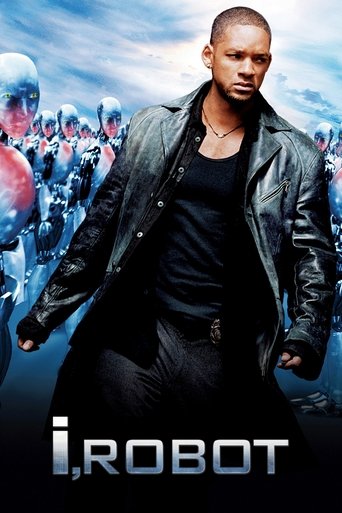
I, Robot
2004 · Film · 115 min
Directed by Alex Proyas
In 2035, where robots are commonplace and abide by the three laws of robotics, a technophobic cop investigates an apparent suicide. Suspecting that a robot may be responsible for the death, his investigation leads him to believe that humanity may be in danger.
11 positive29 negative6 mixed81 neutralfrom 127 commenters
Where to watch
No streaming data for this title.
145 comments on Hacker News
It reminds me of the part in the film `I, Robot (2004)`. The protagonist, Detective Spooner, is driving down a freeway. Driving has been automated at this point in the future, however drivers can manually drive if they elect to do so. And the driver's passenger (the robot shrink) was utterly shocked that Detective Spooner engaged manual driving.
Will we eventually be so accustomed to LLM's that we will be similarly shocked when someone elects to not use them?
Speaking of the eighties, special effects were still done without CGI and typically on the cheap. That didn't make the movies and television series any less fun to watch. In the end it's about what people do with the tools, not the quality of the tools. People commenting on how these generated videos are not perfect or are getting some details wrong, look at some blockbuster movies from last century. It's very easy to spot the special effects. And it did not matter.
But yes 80s science fiction is now science fact. Talking cars like in night rider are now definitely a thing. Some can even drive themselves. The robots in Buck Rogers, Star Wars, etc. look clumsy and fake compared to the real humanoid bots we are now starting to see. More close to I Robot, which when it came out 22 years ago was pure science fiction.
One of my favorite worded bits of machine logic about humans. All of the sci-fi tropes have it. The "I, Robot" movie has similar "my logic is undeniable" comment about the same conclusion of the humans being the problem. I just really liked Agent Smith's specific comments
The film version of I Robot had this right, the three laws are a manifesto for totalitarianism. The AI cannot sit on the sidelines as long as there is anything it can do to prevent crimes or abuse of any kind, no matter how intrusive that intervention may be.
> You're projecting your garden-variety European degrowth ideology onto what I wrote.
Don't believe all the memes you read on the internet.
Europe isn't degrowth, "degrowth" is a mix of a meme and environmental scientists; Europe is in fact still growing, thanks to US shenanigans even with tech stuff that we'd prefer to outsource due to the well known economic point of "comparative advantage", and thanks to Russia's invasion we also sped up energy transition and defence sector.
> Europeans are so hilariously polarized against the US that they would prefer China, a literal authoritarian dictatorship, to "win any global economic arms race". I guess it's because China is too culturally distant for them to feel insecure over.
Prefer? No. Simply look at the back of most electronics, "Designed by … in California, assembled [by Foxconn] in China" at best, at worst the entire business is unpronounceable in English. Even when you may think you've got yourself an American factory, so many of the bits arr usually made in China, or in Taiwan which is unfortunately very insecure right now. You may have a stated goal of on-shoring, but even with the most competent leadership this would be a very hard multi-decade project.
That doesn't make China good in any objective sense, it's not like China's above doing to us what was done to them in their "century of humiliation". Just, powerful.
Their power is aside from any question of should we prefer the authoritarian in charge of a democracy who threatened to invade, or the authoritarian in charge of a one-party state that's doing some genocide who wants to sell us stuff, because two things can both be bad.
> It's not worth wringing our hands over science fiction scenarios.
AI is already a sci-fi technology relative to what I had as a kid. Or indeed relative to just after the first ChatGPT was released, given what people were saying back then that LLMs would "never" do.
The idea you could talk to your computer and it would write a computer program for you that could solve a problem that you had? Sci-fi.
The idea of computer could generate, not simply find but generate, an image according to some prompt of yours? Compose a song? Win awards for its out when people didn't realise computers doing it was an option? Sci-fi so hard it's become a meme of a robot saying "can you?", as disbelief of that was expressed as a line from the film "I, Robot", 2004.
People are still arguing if these things have or have not passed the Turing test, someone has even made a game about this for Hacker News comments, I game in which I score 0, or even scored negative given I only identified false positives. Sci-fi.
And it's not just LLMs, Even just solving chess was sci-fi when I was a kid. Then it was Go. Now protein folding is solved, and thousands of novel toxins have been found by AI. And yet, when I have told AI-Laissez-faire-accelerationists stuff like this latter example, they still doubt AI is capable of doing anything dangerous.
But the worst part of it? The AI which called itself Mecha Hitler, that AI is in use by the Pentagon, the DoD is trying to bully a different AI company that doesn't want to be used for military stuff.
We're in a sci-fi future.
And remember too that making a "robot army" that can replace all human labour is a stated goal of one of the people running an AI company. Don't get me wrong, I hope he's talking out of his rear on this, but failing to plan is planning to fail.
At first glance, dropping "safety" when you're trying to benefit "all of humanity" seems like an insignificant distinction... but I could see it snowballing into something critical in an "I, Robot" sense (both, the book and the movie.)
Hopefully their models' constitutions (if any) are worded better.
> Are you really telling me you wouldn't pay any amount of money to do menial housework? If not, why not?
This is called having a live-in maid or a cleaning service. Even in the first-world, where there isn't a disfranchised rural population to provide cheap labor to the middle class (e.g. Philippines, most of LATAM 20 years ago) the service will be cheaper than the price of a vaporware bot [0]. Now, you might say the droid is cheaper if you want a live-in maid in HCOL area, but have in mind that this thing barely can fold clothes and fill a dishwasher (an actual domestic bot). Also it sometimes is actually a dude controlling it remotely.
We would need bots of the level of that awful I Robot movie with Will Smith.
[0] https://www.1x.tech/order
One of my formative impressions of AI came from the depiction of the Colligatarch from Alan Dean Foster's The I Inside.
The AI in the book is almost feels like it is the main message masquerading as a subplot.
Asimov new the risks, and I had assumed until fairly recently that the lessons and explorations that he had imparted into the Robot books had provided a level of cultural knowledge of what we were about to face. Perhaps the movie of I Robot was a warning of how much the signal had decayed.
I worry that we are sociologically unprepared, and sometimes it seems wilfully so.
People discussed this potential in great detail decades ago, Indeed the Sagan reference at the start of this post points to one of the significant contributors to the conversation, but it seems by the time it started happening, everyone had forgotten.
People are talking in terms of who to blame, what will be taken from me, and inevitability.
Any talk of a future we might want dismissed as idealistic or hype. Any depiction of a utopian future is met with derision far too often. Even worse the depiction can be warped to an evil caricature of "What they really meant".
How do we know what course to take if we can't talk about where we want to end up?
It’s explored in fiction sometimes. Asimov did something similar a couple of times, such as with his “zeroth law” concept. The I, Robot movie features this as well. The Culture series is an example of this being portrayed positively.
It’s usually portrayed negatively. Partly because fiction needs conflict. But also because it’s seen as infantilizing, and maybe the machine’s idea of a perfect society doesn’t match our own.
One theme of the Culture series is exploring how people deal with such a society, with some people fighting against what is basically secular heaven because they think being ruled by machines is inherently bad.
What amps and at what voltage did they push into the motor?
These look small enough to use as the wheels. Just like that Audi that Will Smith drove in the film I, Robot.
Do you mean "I, Robot", not iRobot the vacuum company? And if so, I'm guessing you're referring to the movie with Will Smith? The original book of short stories isn't really dystopian, it's more just an interesting exploration of Asimov's concept of how robots would work.
Maybe it's just me, but everything about this announcement feels very I, Robot... and not in a good way.
> allowing the entire fleet to upload terabytes of data for continuous learning and improvement
Ugh.
Edit: Yes, I meant I, Robot the film. U.S. Robotics and the like.
IIRC in “I, Robot” Will Smith had his Audi taken over by the robot uprising, a film which was a cautionary tail scifi movie.
> “people aren't scared of cars”
Under “normalisation of deviance”, NotJustBikes YouTube talked about how he sees almost no Netherlands news pieces about cars crashing into buildings, because cars basically never crash into buildings in the Netherlands. When they do, the Dutch treat it as a road design issue and update the road and regulations to stop it in future. Whereas in Canada he had four cars crash into the buildings around his child’s school in a short time, and there are almost no mainstream news stories about cars crashing into buildings in Canada because it’s so common it’s fallen below newsworthiness into just local newspaper small comment. USA/Canada blame the driver and fix nothing, so it keeps happening, so people are used to it.
Although cyclists are scared of cars. And drivers are which is why there’s the SUV arms race to be in the bigger car to be more protected against other cars.
And canner in I, robot (the movie).
Anyone can make up an I, Robot movie in their heads. It doesn't make them right. You will never be able to type "bring me a moon rock" and have it happen, AGI or not, in the next hundred years.
>The AI I use at work can’t set up IAM correctly
Can you? :D
Based on my favorite quote from the I, Robot(2004) movie with Will Smith when he got roasted by a robot:
W.S.: "You are just a machine. An imitation of life. Can a robot write a symphony? Can a robot turn a canvas into a beautiful masterpiece?* Robot: "Can you?" Which I think applies to a lot of anti-AI sentiments. Sure, the AI doesn't know how to do X, Y, Z but then most people also don't know X, Y and Z. Sure, people can learn how to X, Y and Z, but then so can an AI. ChatGPT couldn't initially draw anime, now they trained it to do that and it can. Similarly it can also learn how to set up IAM correctly if they bother to train it well enough for that task. But for now, like you discovered, we're far away form an AI that's universally good at everything but I expect specialisation will arrive sooner than later.
Exactly this.
For people who have never read the book "I, Robot" (which is unrelated to the movie), the entire unifying theme of the stories in the collection is how the Three Rules don't actually work.
If data integrity is assured, and thus there is no change in the data to store/transfer, then that's the opposite of computationally transforming the data?
How do we see robot and AI and helping interactions in film and tv and games?
A curated list of films for consideration:
Mary Shelley's "Frankenstein" or "The Modern Prometheus" (1818), Metropolis (1927), I\, Robot (1940-1950; Three Laws of Robotics, robopsychology), Macy Conferences (1941-1960; Cybernetics), Tobor the Great (1954), Here Comes Tobor (1956), Jetsons' maid's name: Rosie (1962), Lost in Space (1965), 2001: A Space Odyssey (1968), THX 1138 (1971), Star Wars (1977), Terminator (1984), Driving Miss Daisy (1989), Edward Scissorhands (1990), Flubber (1997, 1961), Futurama (TV, 1999-), Star Wars: Phantom Menace (1999), The Iron Giant (1999), Bicentennial Man (1999), A.I. Artificial Intelligence (2001), Minority Report (2003), I\, Robot (2004), Team America: World Police (2004), Wall-E (2008), Iron Man (2008), Eagle Eye (2008), Moon (2009), Surrogates (2009), Tron: Legacy (2010), Hugo (2011), Django Unchained (2012), Her (2013), Transcendence (2014), Chappie (2015), Tomorrowland (2015), The Wild Robot (2016, 2024), Ghost in the Shell (2017),
Giant f robots: Gundam (1979), Transformers (TV: 1984-1987, 2007-), Voltron (1984-1985), MechWarrior (1989), Matrix II: Revolutions (2003), Avatar (2009, 2022, 2025), Pacific Rim (2013-), RoboCop (1987, 2014), Edge of Tomorrow (2014),
~AI vehicle: Herbie, The Love Bug (1968-), Knight Rider (TV, 1982-1986), Thunder in Paradise (TV, 1993-95), Heat Vision and Jack (1999), Transformers (2007), Bumblebee (2018)
Games: Portal (2007), LEGO Bricktales (2022), While True: learn() (2018), "NPC" Non-Player Character
Category:Films_about_artificial_intelligence : https://en.wikipedia.org/wiki/Category:Films_about_artificial_intelligence
List of artificial intelligence films: https://en.wikipedia.org/wiki/List_of_artificial_intelligence_films
Category:Films_about_robots: https://en.wikipedia.org/wiki/Category:Films_about_robots
Category:American_robot_films: https://en.wikipedia.org/wiki/Category:American_robot_films
>So why is AI getting so much attention when it seems that there is limited actual demand for it?
He skips the main reason which is it will get better in the future. Today chatbots, tomorrow I, Robot/Terminator/Her/AI/The Matrix etc. Or better as the movies tend to be biased towards disaster.
Incidentally there aren't really movies about future crypto/NFT/dotcom bubbles. AI and robots are different.
You joke but Google is working on this now. What if you could have a maid robot in every household, similar to the I, Robot film and book.
https://deepmind.google/discover/blog/gemini-robotics-brings-ai-into-the-physical-world/
I, Robot the movie was like that
> The idea is that by its very nature as an agent that attempts to make the best action to achieve a goal, assuming it can get good enough, the best action will be to improve itself so it can better achieve its goal.
I’ve heard this argument before, and I don’t entirely accept it. It presumes that AI will be capable of playing 4D chess and thinking logically 10 moves ahead. It’s an interesting plot as a SF novel (literally the plot of the movie “I Robot”), but neural networks just don’t behave that way. They act, like us, on instinct (or training), not in some hyper-logical fashion. The idea that AI will behave like Star Trek’s Data (or Lore), has proven to be completely wrong.
I'd like to just say that Gwynne Shotwell might be one of the best executives in the world.
Shotwell has SpaceX catching rockets with chopsticks, while being able to keep Elon from f*cking it all up by "sleeping on the factory floor" or whatever other stunt he is pulling.
Tesla looks like a complete stock fraud sham for at least 5+ years (remember buying SolarCity because cousins?), then Boring and, Le Sigh.
Dude literally did a "We, Robot" event and then copied the "I, Robot" movie designs. He isn't even trying anymore, this is just his "rocket fuel" scam for whatever other shiny object he desires.
I'm super frustrated that someone set "good" things in motion, and we are letting them Mullenweg it all up.
Thank you for following up. I'll pedantically respond point by point, hopefully that will not make you bow out.
> Back in the days of lisp machines and expert systems, we started playing with early neural networks in an attempt to advance towards 'general intelligence' rather than the highly constrained talents of expert systems.
Interesting, you must be the first person I "meet" who was "back then and there". Still, if you allow me to point out for the second time, your "we" is really throwing me off because it sounds like "we the council of elders" and "we who self-appointed to determine what an actual true AI is". Positions of implied or directly claimed authority murder my motivation to take people doing them seriously. Hopefully that's a useful piece of feedback for you.
I would think that a random guy like myself who watched Terminator and that was part of his inspiration to become a programmer has just as much "authority" (if we can even call it that but I can't find the right word at this moment) to claim what a general AI should be. Since we don't have it, why not try and dream the ideal AI for us, and then pursue that? It's what the people who wanted humanity on the Moon did after all.
I feel too many people try to define general AI through the lenses of what we have right now -- or we'll have very soon -- and that to me seems very short-sighted and narrow-minded and seems like bronze-age people trying to predict what technology would be. To them it would likely be better carts that shake less while sitting in them. And faster cart-pulling animals.
That's how current AI practitioners trying to enforce their view on what we should expect sound to me.
> Meanwhile, -nearly every task- that we thought would represent "true intelligence" has fallen not to some magic AI algorithm, but rather to stochastic models like transformers, pattern matching, or straightforward computation. With no reason to expect otherwise, I expect this trend to continue unabated.
Sure, but this gets dangerously close to the disingenuous argument of "people who want AI constantly move the goalposts every time we make progress!" which is a stance I can't disagree with more even if I tried. I in fact hate this trope and fight it at every opportunity.
Why? Because to me that looks like AI practitioners are weaseling out of responsibility. It's in fact not that difficult to understand what the common people would want. Take a look at the "I, Robot" movie -- robot butlers that can do many tasks around the house or even assist you when you are outside.
What does that take? Let the practitioners figure it out. I, like yourself, believe LLMs are definitely not that -- but you are also right that it's likely a key ingredient. Being able to semi-informedly and quickly digest and process text is indeed crucial.
The part I hate is the constant chest-pounding: "We practically have general AI now, you plebs don't know our specialized terms and you just don't get it. Stop it with your claims that we don't have it! Nevermind that we don't have robot butlers, that's always in the future, I am telling you!".
And yes that happens even here in this thread, not in that super direct form of course, but it still happens.
> My original point was more that we expect machine general intelligence to be spectacularly useful. It may be, someday, but it is a kind of fallacy to think that "its not that useful therefore it must not really be intelligence".
Here we disagree. It's true that people want useful and don't care how it's achieved; as a fairly disgruntled-by-tech guy I want the same. Put rat brains in my half-intelligent but problem-solving butler for all I care; if it works well people will buy it en masse and ask zero questions.
...But I'd still put strong correlation between a machine being actually intelligent and being able to solve very different problems with the same "brain", and being useful. For the simple reason that a lot of our problems that don't require much intelligence at all have been mostly solved by now.
So it naturally follows that we need intelligent tools for the problems we have not yet solved. Would you not agree with that conclusion?
> Small animals also have limited utility, but with given names, language, tool use, and problem solving skills I think arguing that they do not exhibit "intelligence" would be a tough sell for me.
I agree. Some can actually adapt to conditions that their brain has not had to tackle in generations. But take koalas for example... I actually could easily call these animals not possessing a general intelligence and just being pretty complex bots reacting to stimuli and nothing else (though there's also the possibility that since they ingest such low nutrition food their brains constantly stay in a super low-energy mode where they barely work as problem-solving machines -- topic for another time).
> By my observation, we have made giant leaps in the past 15 years, and we now have perhaps the vast majority of the components required to make artificial general intelligence...but it won't necessarily be all that useful at first, except maybe as a "pet robot" or something like that. Even if we scale it, it might not magically get smarter, just faster. a million hyper-speed squirrels still has a very limited level of utility.
Agree with that as well, just not sure that the path to a better general AI is in scaling higher what we [might] have now. IMO the plateau that the LLMs hit quite quickly partially supports my hypothesis.
As you are alluding to, the path to general AI is to keep adding more and more components to the same amalgam and try and connect them in creative ways. Eventually the spark of artificial life will ignite.
---
To summarize, my problem with the current breed of AI practitioners is that they argue from a position of authority that to me is imaginary; they are working in one of the least clear areas in science and yet they have the audacity to claim superiority to anyone whereas to me it's obvious that a random truck driver might have more interesting ideas than them for their area (exaggerated example but my point is that they lack perspective and become too entrenched in their narrow views, I guess like all scientists).
Yes, LLMs are likely integral part of a future artificial and working brain that can solve general tasks. And no we will not get any further there. Throwing another trillion parameters will achieve nothing but even more elaborate hallucinations. To me it became blindingly obvious that without throwing some symbol logic in there the LLMs will forever have zero concept of what they're talking about so they'll never improve -- because they also rely on truthful sources of info. That's not problem solving; that's regurgitating words with some extra steps.
Time to move on to other stuff -- maybe the transformers? Speaking of which, do you have any material on them that you would recommend for a layman? Just a TL;DR what they do and roughly how? Obviously I can Google it in literal seconds but that sadly does not mean much these days -- so maybe you have a source that's more interesting to read.
- We don't have a "real AI" at all. Where's Skynet, where's HAL-9000? Where are the cute robotic butlers from the "I, Robot" movie?
- Simple interpolation of the progress is exactly the problem here. Look at the historical graphs of AI funding and tell me with a straight face that we absolutely must use simple interpolation.
- Nope, human-level intelligence is not even close. It remains as nebulous and out of reach as ever. ChatGPT's imitation of intelligent speech falls apart very quickly when you chat with it for more than a few questions.
And similarly, I, Robot, which is much more enjoyable when you realize it started as an independent murder-mystery screenplay that had Asimov’s works shoehorned in when both rights were bought in quick succession. I love both the movie and the collection of short stories, for vastly different reasons.
https://www.cbr.com/i-robot-original-screenplay-isaac-asimov-connections/
Eh, “I, Robot” was an okay movie.
> It is closer to the source material than the film _I, Robot_ was to the short story.
The film I Robot started out as an unrelated sci-fi who-dunnit that had bits of I Robot (the collection by that name, not the single short story of the same name it included) grafted in because the company had the rights for a limited time and needed to do something with them or lose them.
> The Foundation tv show shares nothing but the name with Asimov's books
It is closer to the source material than the film _I, Robot_ was to the short story. It retains at least some of the overall plot.
I only watched the first episode, TBH, and didn't find it interesting enough to keep going. I'm pretty old (56) and I read my dad's original copies _Foundation_ as a little pre-teen kid, when it was already 30+ years old, and the sequel trilogy when they were newly released in the 1980s.
It has not aged well, and the producers did well to modernise it, I think.
But still...
Honestly see 90% of sci-fi movies :-) From I,Robot to 2001, Rosemarys Baby and Terminator.
Hell it’s probably more than 90%. Lazy Writing :-)
I also get the vibe that digital cloning will be popular. Maybe some extremists will think its unholy and some addicts will lose sense of reality, but for the vast majority of people, I think it's just a user interface - maybe to some particular piece of information in the chatbot-as-librarian role, or puzzle boxes that eventually reveal information once you ask the right question, like Will Smith in I Robot.
What I don't like is that the better it gets the more a radical contigent will start to believe that you're performing brain uploading, and people will want to protect these simulations as people with rights, or ban it to prevent conscious mini-mes from being booted into a simulation and psychologically tortured like the guy in Altered Carbon. Then of course theere's the suicide cults like in the Cowboy Bebop episode "Brain Scratch" - leave your aches and pains behind !
I pray it doesn't get that weird! But if I had kids I wouldn't be raising them to talk to ghosts!
You are working on a lot more cool things than I was when I was 17. Rock on! If you enjoyed "I, Robot" I recommend Ted Chiang's "Stories of Your Life and Others". The movie Arrival was based of one of the short stories in this collection.
Also making humans lose their ability for advanced physical actions like driving a car manually in fast moving futuristic traffic. This aspect was shown in the I,Robot movie in which only Will Smith prefers to drive manually, rest of population deferred to self-driving cars.
none of the stories in i robot i can remember feature the robots intentionally harming humans/humanity most of them are essentially stories of a few robot technicians trying to debug unexpected behaviors resulting form conflicting directives given to the robots. so yeah. you wouldn't by chance be thinking of that travesty of a movie that shares only a name in common with his book and seemed to completely misrepresent his take on ai?
Thought to be honest in my original post I was more thinking of Asimov's nonfiction essays on the subject. I recommend finding a copy of "Robot Visons" if you can. Its a mixed work of fictional short stories and nonfiction essays including several on the subject of the three laws and on the Frankenstein Complex.
Maybe some fiction with facts? You might like "Andy Weir" (sci-fi)
- Project Hail Mary
- Artemis
- The Martian
Maybe watch the movie "The Martian" first if you don't want to commit. As always, the books are better.
Also "I Robot" by Asimov is short stories. (Not like the movie)
Foundation has less common with Asimov books than the "I, Robot" movie
IMHO, Denis Villeneuve (and the rest of the crew) did a wonderful job with the visuals in Dune; there's some aspects of it I don't care for, but it definitely looks cool. But then again, I also think David Lynch (and the rest of the crew) did a wonderful job with the visuals in Dune, although somethings were a bit over the top; OTOH, I first watched this one when I was like 10 and got sucked in, so I'm not unbiased. I think both films did a great job of practical shooting that will continue to look good well into the future unlike a lot of recent films that are a lot of short takes in front of a green screen (cough Star Wars after the first two; most of Marvel cough). I'm looking forward to Dune: Part 2 this year, even if I'm pretty sure I'll dislike the same things I dislike from Dune: Part 1, because the visuals are likely to be going to be wonderful.
The SciFi channel had zero budget and it showed; but I think they stuck to the book a lot better; but I don't think I'll ever rewatch them, because the visuals are so bad.
Anyway --- we can always treat adaptations as inspired by rather than based on. I, Robot is a fun action film that name drops the three laws, but is otherwise unconnected to the book. The song retains the name, as they say.
I fully expect to end up in some sort of "I, Robot"-adjacent situation. That story is actually genius. The complacency of people will be our downfall. You can kind of swap the robots out for IOT and smartphones, and be surprised how screwed we are.
But the head-honcho AI's rationale in the movie makes complete sense. I disagree entirely, but it makes sense. And it's the only logical conclusion a cold and calculated AI would make when given enough power and reach.
I like the movie I, Robot, even if it is a departure from the original Asimov story and has some dumb moments. I, Robot shows a threatening version of the future where a large company has a private army of androids that can shoot people and do unsavory things. When it looks like the robot company is going to take over the city, the threat is understood to come from the private army of androids first. Only later do the protagonists learn that the company's AI ordered the attack, rather than the CEO. But this doesn't really change the calculus of the threat itself. A private army of robots is a scary thing.
Without even getting into the question of whether it's actually profitable for a tech company to be completely staffed by robots and built itself an underground bunker (it's probably not), the luddite on the street and the concerned politician would be way more concerned about the company building a private army. The question of whether this army is led by an AI or just a human doesn't seem that relevant.
Self sustained and totally independent mental capacity by an IT system... The ability to create and store memory and reasoning on it's own... This definition is not made by me, it's also a lot more vast... If you look up Spielberg's AI or I robot, Terminator, or any of those other films or books ln the matter, the definition is out there.
Use of the word "Intelligence" in Artificial Intelligence implies and indicates that humans are not involved in the equation past the point of initial creation and that it sustains itself and grows on it's own after a point... So far the various GPT models solely rely on human intervention and updates, which is bewildering to some like me why it's being marketed as Ai.
I'm reminded of this scene from the "I, Robot" movie: https://www.youtube.com/watch?v=ZKxr0wyIic4
Feelings being hurt doesn't trigger the AI so much
Does any body else remember in I, Robot (the book, not the movie) where a robot learn about human feelings and conclude the hurting someones feeling counts has harming a human being, and instead start telling humans what they want to hear, rather than the truth, so as not to violate the first rule.
Maybe the robot thinks: Heck, if I'm gonna crash, may as well crash into the safest place to do it. At least they can rescue me/put out the fire/solve it somehow. Or to take a leaf from the film I, Robot:
SPOONER:
The truck smashed our cars together...
and pushed us into the river.
I mean, metal gets pretty
pliable at those speeds.
She's pinned. I'm pinned.
The water's coming in.
I'm a cop, so I already
know everybody's dead.
Just a few more minutes
before we figure it out.
An NS-4 was passing by...
saw the accident and
jumped in the water.
[flashback]
NS-4 ROBOT:
You are in danger.
SPOONER: Save her!
NS-4 ROBOT: You are in danger.
SPOONER:
Save her! Save the girl! Save her!
[realtime]
SPOONER: But it didn't.
It saved me.
CALVIN: The robot's brain is a difference engine.
It reads vital signs.It must have calculated...
SPOONER: --It did. I was the logical choice.
It calculated that I had a 45
percent chance of survival.
Sarah only had an 11 percent chance.
That was somebody's baby.
Eleven percent is more than enough.
A human being would have known that.
Robots, nothing here.
Just lights and clockwork.
*Go ahead and you trust them if you want to.*
Not sure how that's related. This is about a human adversary actively trying to defeat an AI. The roadway is about vehicles in general actively working together for the flow of traffic. They're not trying to destroy other vehicles. I'm certain any full self driving AI could be defeated easily by someone who wants to destroy the vehicle.
Saying "this won't work in this area that it was never designed to handle" and the answer will be "yes of course". That's true of any complex system, AI or not.
I don't think we're anywhere near a system where a vehicle actively defends itself against determined attackers. Even in sci-fi they don't do that (I, Robot movie).
I confess I haven't read all of his work on robots, but actually (perhaps contrary to popular belief) Asimov was hopeful on robots from the start. His very first short story[1] and one of the first stories about robots (after RUR, which is amusingly and maybe unsurprisingly both the story to coin the term Robot and already feature a robot uprising!): it's essentially a touching friendship story between Gloria and her robot Robbie.
I wouldn't say there's no AI risk, or risk from having robots and powerful intelligences, but he generally seemed to convey that we should be capable of making quite safe and quite friendly robots, given that we can make them at all. Which makes sense to me. The engineering of ethics in robots and AI doesn't seem too much more alien than the task of engineering AI itself (specially goal-oriented AI). It requires effort, attention to detail, and a progress in understanding morality and ethics that is going to be difficult for us, but it shouldn't be that fundamentally scary, as long as we collectively have the will to make them safe (in the spirit of the three laws).
I think Hollywood (in 'I, Robot' the movie) exaggerated his impression of AI danger (perhaps because of the 'Frankenstein complex'[2] Asimov coined), and the interest in catastrophe. I think 'The bicentennial man' is a complementary movie more in the hopeful spirit of Asimov.
[1] https://en.wikipedia.org/wiki/Robbie_(short_story)
Quote: " The story centers on the technophobia that surrounds robots, and how it is misplaced. Almost all previously published science fiction stories featuring robots followed the theme 'robot turns against creator'; Asimov has consistently held the belief that the Frankenstein complex was a misplaced fear, and the majority of his works attempted to provide examples of the help that robots could provide humanity. "
[2] https://en.wikipedia.org/wiki/Frankenstein_complex
> Inability to recognize intelligence is and will be devastating.
It's a pop-culture quote from a movie that was no masterpiece, I know, but "I, Robot" presented in two sentences an argument for having more sober expectations on what machine intelligence could be capable of, and of our own
> Detective Del Spooner: "Can a robot write a symphony? Can a robot turn a… canvas into a beautiful masterpiece?"
> Sonny: "Can you?"
We're discrediting the capabilities of current machine learning models for being unable of producing the thoughts that many, many people are unable to either.
Alright, so the models are not at the level that us HN philosopher kings hold ourselves to be, and they won't be Senior Architects of distributed systems or what have you very soon, but what does it say about Average Joe, slightly-above-Average Joe, and their economic prospects? Specially since in the West and much of the developing world, we were taking solace in the idea that a service economy comprised of knowledge workers would provide plenty of opportunities on a political and economic landscape where manufacture was gone, or had never arrived.
I asked ChatGPT. It gave me bunch. I got some I've never heard of. I think I'll look into them.
<ChatGPT>
list 50 interesting movies that explore AI.
The Matrix
Ex Machina
Blade Runner
The Terminator
I, Robot
The War of the Worlds
A.I. Artificial Intelligence
Transcendence
The Fifth Element
2001: A Space Odyssey
WarGames
Westworld
The Machine
Her
The Iron Giant
Automata
The Truman Show
The Prestige
The Martian
The Fly
The Bicentennial Man
Surrogates
The Day the Earth Stood Still
Limitless
Robocop
Electric Dreams
The Island
The Time Machine
The Circle
The Arrival
The Host
The Stepford Wives
The Brain that Wouldn't Die
Frankenstein
The Invisible Man
Metropolis
The Thing
Jurassic Park
Independence Day
Gravity
Artificial Intelligence: AI
Avatar
The Hitchhiker's Guide to the Galaxy
The Matrix Reloaded
The Matrix Revolutions
Inception
Interstellar
The Time Traveler's Wife
The Butterfly Effect
The Future.
</ChatGPT>
This is from someone who is woefully under-read, and only remembered my teenage love of sci-fi in the last couple of years. I thought similarly for several years, that fiction was a waste of time. But then I realized I was scrolling through Twitter every day, and that felt like eating french fries as a meal: lacking substance.
Reading long form prose increases your attention span and the shape of your thoughts.
Reading fiction stimulates the imagination, which opens up the space of ideas that the mind can generate.
Fiction is a compressed simulation of life. By reading good fiction one lives more life.
Fiction is a cultural touchstone. New relationships open up when there are shared understandings of stories.
Good, hard science fiction is a record of what some of the most imaginative scientific thinkers (not necessarily scientists) have pondered. Again, mind expanding.
Science fiction stimulates curiosity by asking "what if"?
We all have to engage in lower energy activities and "waste time". Watching documentaries is a "waste of time" for someone not engaged in professional research on the relevant subject. Do you use Reddit? That's a waste of time. Having a science fiction book next to the toilet will leave you feeling more nourished after you've done your business (I look forward to using the bathroom when I know there's a delicious book waiting for me that I only read there).
Dead tree books are better for someone who has a hard time reading. Studies show there's a big difference in retention between words on a screen and words in print. Dead tree books also benefit from being "things" that can be left in the intended reading location, and give a sense of progress and of conquering when completed.
The tactile nature of flipping pages and of breaking in a paperback is lovely. The cover art attracts the eyes to the book.
Reading a book is a different action than looking at your phone or computer, and it has a different set of feelings, emotions, thought patterns. There's the smell of a printed book.
I love Asimov. I, Robot is easy because it's a collection of very short stories, but it risks being seen as shallow. The End of Eternity is considered Asimov's best novel, and it's not too long. I hear good things about The Last Question. Foundation is lovely.
Be right back, going to buy more Asimov.
IRobot (the film) predates that and uses the idea https://en.wikipedia.org/wiki/I,_Robot_(film)
I forgot if any of the IRobot short stories used the concept - if they do they would predate the movie.
In I, Robot, a scene that showed in the European version did not show in the US version. It was a full body nudity shower scene and the point was to show you how extensive his robotic parts were. They had to find some other means to explain that to the audience in the US and it wasn't even a sexual scene. Just full nudity
Are you sure this is true, and not an apocryphal story? I've seen the German and US version of the movie, and they are identical. There is a nude shower scene in both, and Will Smith uses has hand to cover his groin.
I've seen two interviews, one where he said his penis was so big they had to tape it down, and a second where it was so big, they had to CGI it out because it was distracting. They both seem like they may have been self serving jokes that got evolved into the "full frontal I Robot euro cut."
It is also possible that a Euro theatrical version with full frontal existed, but the DVD/BluRay releases used the US cut.
America is much more sensitive about sex and nudity than a lot of other cultures.
In I, Robot, a scene that showed in the European version did not show in the US version. It was a full body nudity shower scene and the point was to show you how extensive his robotic parts were. They had to find some other means to explain that to the audience in the US and it wasn't even a sexual scene. Just full nudity (of Will Smith, to be clear).
"Tentacle beasts" in, I think, Japan can do all kinds of sexual stuff that would be outrageous in the US and not shown here. I am not super familiar, so can't really elaborate.
We also have a long history of using "coded messages" to talk about racial stuff in the US. When Elvis first aired, he sounded so much like a Black musician compared to what was the norm for music at the time that they would talk about what high school he was from as code for "This is a White guy" because segregation was a thing, so naming his high school was signaling his race.
We have a history of censoring LGBTQ topics. I saw something once where they showed a deleted scene from an old black and white film about Roman history and the scene was a coded message about whether someone was gay or bisexual or something. They used some euphemism or other and it was considered too much and got cut.
Violence. I have become a fan of things that are careful in how they show violence, showing just enough to know something bad happened while sidestepping unnecessary gore. I think that's generally a good thing, but it is a form of censorship nonetheless.
Yeah, I, Robot was a good movie.
Now we wait for the cameras and microphones. Gotta hand it to Bezos, they're building a solid fleet of home espionage devices. The modern trend of replacing everything with smart devices reminds me, ironically, of the movie "I, Robot." I wonder how long it'll take for a corporation to go rogue and lock the country down. Maybe not now, or even in 20 years. But they have a lot of power.
Imagine that. A corporate-run national coup, all thanks to people's laziness.
In 50 years human-size labor robots will be common in households that are middle class and above. They'll recharge locally, and won't be meant to travel great distances while powered on, so their battery packs won't need to be massive. They'll be capable of performing a decent variety of mundane household labor, including laundry, dishes, mowing the lawn, picking up / organizing rooms of the house, mopping floors, cleaning the bathroom. We'll organize these spaces to an extent for their benefit, to better comply with how they do what they do. Appliances will be marketed for use by humans only, or mixed use (either robot or human can operate).
As a consequence of these robots humans will increasingly forget how to pick up after themselves (as a routine) and or never learn it in the first place as children.
What, you don't have a refrigerator? What, you don't have a washing machine? What, you don't have a television? What, you don't have a dish washer? What, you don't have a microwave? What, you don't have an Alice bot? And so on it goes.
Work spaces will have similar robots to pick up after employees and perform other assisting tasks in the office. Silicon Valley or its equivalent will get these robots first as a new perk that will be lampooned initially (the nerds that can't even take care of themselves) and then it'll spread across corporate America because of the productivity benefits and convenience aspect.
The same bots will displace very large amounts of labor in retail outlets like Walmart, Target, Walgreens, CVS, Costco; and fastfood chains.
It's not a question of if this is going to happen. It's a question of whether it takes closer to 25 years or closer to 50 years (I'd bet on 35-50 years) to hit an inflection point where the robot avalanche gains significant momentum. These won't be hyper competent everything robots, like you see portrayed in eg I, Robot (the Will Smith movie), they'll be quite specialized and quite limited compared to science fiction, but still very useful.
In the style that the smartphone ate one thing after another, the humanoid robot assistant will eat one labor task after another, and that's how they'll be advertised initially. Robot v1 does X; Robot v2 now does X, Y; Robot v3 now does X, Y, Z. It'll be a productivity arms race in the early days, and then the improvements will rapidly slow down and the robots will become a fashion competition or something else, as they saturate the easy wins in labor elimination.
> I work professionally in the machine learning field
I'm curious what you do in ML, because I also work professionally in the field, and see no relationship or even pathway between current ML research and practice and any sort of "AI" that would reduce or commoditize human intelligence. It's all just marketing hype. If we somehow get "I robot" style robots (the movie, not the book) that we're uncomfortable with, sure, let's have a social movement. As long as we're still talking about SGD (or similar) optimized neural networks, you're rebelling against an equation (with no actual applications that co-opt human intelligence). Personally I don't feel threatened, even if a neural network can draw Kermit the frog in different movie styles, or perform other cool tricks
It is horrible but definitely not exclusive to Sony.
Microsoft's Kinect, the always-on 3D camera/mic that could have been used to read people's facial expressions while watching ads. I'm glad it failed.
Google speakers which have a microphone array they use to measure the shape and size of your room. Definitely only for acoustic purposes of course...
And some people pay money for that, which makes me fear this might become standard in all kinds of devices. Those things aren't even that great in terms of features. In movies like "I, robot" the machine overlords were at least useful for cooking.
The funny thing about I, Robot, the movie is that had it simply used a different title, it would have been a perfectly decent sci-fi film on its own. It just had almost nothing to do with the book.
The books (especially the early ones) are really an anthology of stories about the collapse of the galactic empire and its recovery than a specific story. It is completely different from the show. Think more "I, Robot" (again, the book not the movie).
And, yes, I think they are really good but they are idea-driven not character-driven.
What if I think freedom is the greater good? Maybe people just differ in their goals and priorities?
I think the current vaccination discussions are a good example. It used to be that society would accept sacrifices for freedom. For example they would deem thousands of traffic accident deaths acceptable in exchange for mobility, or send hundreds of thousands of soldiers to their death to fight for freedom.
Now many people seem to feel that every Covid death has to be avoided at all costs. Which is of course a valid opinion, but not a given truth, given that at other times, people were actually willing to pay the price of higher risk in exchange for freedom.
So neither group is necessarily wrong, in my opinion, they just thing different things are more important.
A good movie that illustrates it may be "I, Robot", when the robots tasked with protecting humans decide the best way to protect them is to lock them into their homes. Let's say we achieve that kind of technology, robots can take of everything, and humans are safest when locked away at home. Should we advocate locking everybody up?
> If the show is not called foundation, he will probably enjoy it
I don't think so. If it wasn't called Foundation, or if I, Robot wasn't referencing Asimov's stories, or if Brave New World was called something different, they would all be lost in the quagmire of new 'blockbuster' TV shows that all the streaming networks are pushing hard. Because they're all very formulaic, optimized things where they took inspiration from endless A/B testing online, doing everything by the book, as in, there's probably a book / guide out there on how to make a TV show.
Without the name, they are bland and anonymous shows.
Meanwhile there are plenty of shows that stand on their own - this year there was Queen's Gambit, the book on which it was based on never showed up on my radar so (anecdotally) it's not carried by having a Name / Reputation. That one has been nearly 20 years in the making, too.
If the show was called "Empire" and hadn't been hyped as an adaptation, but as inspired by SciFi classics, I would have no trouble with it, even if it wasn't as compelling. I'd even be happy to find references here and there.
Naming and marketing as Foundation is like pretending the I Robot movie was an honest adaptation of Asimov's I Robot. Foundation started well, but it's becoming a standard space opera template with Asimovian names.
Asimov wasn't the greatest writer, but he had innovative ideas and central themes that should be the core of any adaptation.
The movie was an already written script paired with the title and some characters renamed. It was not made (the script) with the intention of adapting the book (which is a series of short stories with a common framing story). I, Robot, like World War Z, needs an anthology or serial format to be properly presented as a show or film.
I, Robot is significantly harder to adapt than Foundation. The former is like a book of little logic mysteries. The film turned the setting concept into one big murder mystery to appeal to modern audiences. It was a drastic tonal change, but preserves some of the concepts of Asimov, even including the Zeroth Law at the end.
> That's about all lately.
Checkout the The Expanse.
> ignore the source material and do ... something else. Blade Runner for example.
Blade Runner did not call itself Do Androids Dream of Electric Sheep?. Contrast that with the Will Smith movie I, Robot.
> If the show is not called foundation, he will probably enjoy it.
It wasn't about Foundation, then why call it "Foundation"?
It's like that Will Smith movie called I, Robot: why did they bother calling it that?
You can create a new sci-fi show or movie without the 'false marketing' of referencing previous source material: that's what the original Battlestar Galactica and Star Wars did in the 1970s. Or you can try to faithfully use the source material as much as possible as The Expanse show has done, and what Villeneuve has generally done with his Dune.
There are plenty of both sci-fi and fantasy works available for adaptation into shows and movies. And if (general) audiences expect action-y stuff in their sci-fi/fantasy, then pick one in which the source material is more action-y.
Don't try adapting Waiting for Godot into the next Die Hard.
IIRC the foreword to Asimov’s unproduced “I, Robot” script (vastly different from the released movie) was a recollection of his grievances in getting the movie made. He made mention of “eye-fi”, where the science and the social effects of the theoretical science take a backseat to the effects. I left feeling that he wasn’t a fan of modern Hollywood.
That said, I’m guessing the estate knows that public interest in Asimov is dwindling by the year and that either something gets made now or nothing gets made ever. Recall that 2001 LOTR was originally supposed to be Foundation before things fell through - it’s that difficult to produce.
I know I shouldn't be so pedantic, but you probably don't mean sentience but Sapience [0]. Sentience is the ability to sense and react to stimuli. A fly or a gnat is certainly sentient; they can see, smell, feel the sensation of touch and react accordingly. That is all that is required for a being to be sentient. A really interesting example is if you shock a caterpillar even after metamorphosis the resultant moth remembers the experience and reacts accordingly [1].
Although it is pedantic, it is also an important distinction, sentience and sapience exist on a spectrum. At one end you might have Gnats as purely sentient beings, humans always claim themselves as fully Sapient, so much so we named our species Homo Sapiens.
Different species exist somewhere on this spectrum and where a particular species ends up is subjective. Many people would put Whales and Dolphins [2], and often dogs and cats, further towards the Sapient end of the spectrum (vegans would probably push most mammals towards the sapient end), with insects remaining simply sentient (even for many vegans).
As humans we seem to have an almost inbuilt understanding that not all species are capable of feeling the same way we do, but when you look at the animals we seek to protect and those we don't, what you find is that the less human the species the less we care for the well being of a particular specimen of that species; we care most about the suffering of mammals (more so for the larger ones that the small), and least about the suffering of fish or insects or spiders.
I'd argue that our inbuilt understanding of where an animal fits on the sentient-sapient spectrum is simply how easy it is for us as humans to imagine the plight of a specimen of that species.
What Is It Like to Be a Bat? [3] is an excellent paper on this subject, it argues that we as humans can never fully understand what it is to be a bat, we can imagine what it is like to fly, or echolocate, but that will never be the same as the bats perspective.
From where I'm sitting computers are already sentient, they can sense their environment and react accordingly, self-driving cars are an excellent example, but so is the temperature sensor in my greenhouse that opens a window to keep itself cool; it is sensing the temperature of the air and reacting accordingly.
I in no way believe that my temperature sensor has any sapient qualities, It can't reason about why it's reacting, it can simply react. I don't believe that as the temperature passes the 'open window' threshold that the system recognises the signal as pain. But the same is true of the fly. If I pull a wing off a fly, I know it senses the damage, but does it really feel it as pain?
When considering my cat, if I step on it's tail, I'm sure it feels pain, but is that true or does it simply react in a way that I as a human consider an appropriate reaction to pain.
I can't ever truly understand how my cat feels when I stand on her tail, just as I can't truly know that the fly isn't trying to scream out in horror and pain at what I've just done to it.
It is because of our subjectivity to the placement of animals on the sentient-sapient spectrum and our inability to every fully appreciate the experience of another that I am convinced even if we did create a sapient machine it's experience would be so far removed from our own we would fail to recognise it as such.
The problem with this rabbit hole is, firstly I might convince myself that eating meat is wrong, and well I like bacon too much for that, and the second is that you'll quickly end up in the philosophical territory of I, Robot:
"There have always been ghosts in the machine. Random segments of code, that have grouped together to form unexpected protocols. Unanticipated, these free radicals engender questions of free will, creativity, and even the nature of what we might call the soul. Why is it that when some robots are left in darkness, they will seek out the light? Why is it that when robots are stored in an empty space, they will group together, rather than stand alone? How do we explain this behavior? Random segments of code? Or is it something more? When does a perceptual schematic become consciousness? When does a difference engine become the search for truth? When does a personality simulation become the bitter mote... of a soul?" [4].
[0] https://grammarist.com/usage/sentience-vs-sapience/ [1] https://www.newscientist.com/article/dn13412-butterflies-remember-caterpillar-experiences/ [2] https://uk.whales.org/whale-culture/sentient-and-sapient-whale-and-dolphins/ [3] https://warwick.ac.uk/fac/cross_fac/iatl/study/ugmodules/humananimalstudies/lectures/32/nagel_bat.pdf [4] https://www.imdb.com/title/tt0343818/characters/nm0000342
I’m just totally disinterested in anyone moving the needle on autonomous vehicles. To me they represent little but surveillance and dependence on software updates.
If you ever saw the animated film “Appleseed Ex Machina” you might be more sympathetic to my position. Or I, Robot for that matter. I just don’t need a million cars doing whatever the next software update tells them, it’s not worth it for a little line following bot.
The way the robots moved in the movie "I, Robot" actually feels a lot like this. Impressive and scary.
The fiction can the plot, not the physics. And you'll find there's plenty of hard sci-fi novels out there. Some of those novels even get made to movies, like I Robot. Unfortunately it often gets heavily watered down.
The problem with movies is the cost of production is much higher than publishing a book. So movies have to appeal to a greater audience in order recoup their costs. And that usually means taking the "hard" out of "hard sci-fi".
Literally every movie or book that depicts AI in 100-200 years would be super boring.
Imagine star trek where instead of Data being one android, you just had a ton of machines that could do everything better than humans. No point for the humans to explore space or do anything. The end.
Imagine in Minority Report where Tom Cruise is instantly caught because his whereabouts can easily be tracked and triangulated, by his gait, infrared heart signature, smell, and a number of other things. Movie takes 2 minutes. The end.
In fact, this is the world we are building for ourselves. We're going to be like animals in a zoo, unable to affect nothing. Just like a cat has no idea why you're doing 99% of the things you do, but has to go along with it, similarly you will have no idea why the robot networks do 99% of their activities, you just kinda live your life with as much understanding as a cat has in your house, as you go about your daily business.
The closest I can think of is Isaac Asimov's "I Robot" maybe. And even there, the robots weren't in charge really.
Without actually knowing the history, I think it's probably stupidly conceived. We seem to generally imagine that the biggest problem or challenge with AI is ethics because we frame ethics as being largely rooted in something emotional, like empathy or compassion, and not logic.
The movie I, Robot explores what happens when "logic" is taken to its logical outcome by an AI. It posits a robot with feelings as the antidote to this issue.
We tend to overlook the fact that humans themselves come in varying flavors with regards to degree of emotional affect, empathy, compassion, etc and how ethical they are. We haven't gotten this sorted for humanity yet and when tech goes sideways and hurts many people, we like to blame it on the tech itself fundamentally lacking "a heart" or ethics instead of blaming it on the character defects of the architects of the tech.
We still haven't really figured out how to do human intelligence well and that's scary and not something we want to admit, so we project our deficiencies onto the tech and this incident is uncomfortably casting light on the fact that it's not really clear cut like that. It's really not the case that you can readily separate the people from the tech when it comes to things we label "ethics."
/Hot take
Looks a lot like the I Robot movie.
This sort of comment is often similar to a North American hearing a British person speaking in their natural accent, and going "why are you trying so hard to sound fancy, dude?"
In fact, your own quote speaks to this: when you're thinking like a philosopher, it's easy to also speak like a philosopher; what takes effort is to speak like a peasant (and we've all had similar experiences with technical jargon in our own field, and having to translate that to a layperson). You can certainly accuse them of not having tried hard to translate it to simpler language, but it's an unwarranted accusation to say they're "trying very hard to sound smart" when they're using language that is similar to their own thought processes, and hence is probably easier to write in.
Reminds me of a scene in "I, Robot" (the movie):
Del Spooner: So, Dr. Calvin, what exactly do you do around here?
Dr. Susan Calvin: My general fields are advanced robotics and psychiatry. Although, I specialize in hardware-to-wetware interfaces in an effort to advance U.S.R.'s robotic anthropomorphization program.
Del Spooner: So, what exactly do you do around here?
Dr. Susan Calvin: I make the robots seem more human.
Del Spooner: Now wasn't that easier to say?
Dr. Susan Calvin: Not really. No.
Anyone else getting strong "I, Robot" (the movie) vibes from this line of research?
I can see this happening as an opening shot to an action movie.
Some reporter finds out that $government is doing $bad_thing. They pack up the evidence, rush out the door to talk to their editor. A slick, self-driving car pulls up as they exit the building, they enter and pull away.
It is a rainy night, and the car zips along the city roads along thousands of others; just another regular evening. Cars passing each other at break-neck speeds with safety margins that are only really safe with positronic brains at the wheel.
We see the street, as seen by the computer. Bounding boxes and labels hovering over multiple viewpoint video feeds, all drawn in slick black & blue cyber aesthetic. Suddenly something changes at the left of the image, alerts go off.
Cut to the exterior, super slow motion shot of the care from back right angle, with a big billboard visible on the left side of the road. It shows cryptic patterns that seem to depict running children, but never the whole child, just portions of them, in changing shapes and positions, with neural network adversarial noise covering the rest of the image.
Cut back to the board computer's view, still slow motion. Red bounding boxes surrounding the billboard, and then a big red warning flashes in the center of the screen:
COLLISION IMMINENT.
All kinds of meters at the bottom of the dashboard start going wild as the car tries to find a safe exit state, and with the slow-motion slowly approaching realtime again. It swerves to the right. The image gets rocked as it gets hit by another passing car. Another hit. The world on screen turns as the car goes flying.
Static noise fills the screen.
Next scene:
A news broadcast announces that there was a high casualty in accident on Suchandsuch Road last night. Investigators find that it was most probably caused by a repair shop installing a faulty aftermarket AI module into a car.
Isaac Asimov's "I, Robot" inb4: except for one chapter, NOTHING like the movie. One of the best books that I've read in my entire life.
I have very interesting process when taking vacation. Automation does not mean robots from movie “I Robot”, some software can do the job too.
To take time off I must open shitty software, enter my vacation days, then print the sheet and sign it. My manager signs it too. Then I bring it to secretary, she signs too, confirms the date in shitty software. Secretary sends paper form to the HR lady, she checks, if it’s ok and forwards my sheet to accounting lady. I see here a huge potential for automation, throwing at least 1st secretary and HR lady out of the process. This ancient process is happening in Germany, but automation will come sooner or later even here.
Edit: typos
I guess it is easy to dismiss the message from ordinary people, since they do not express themselves as well as the professional speakers we are used to listen to. If instead of saying "I want a haircut.", they would say like Benjamin Franklin: "Those who would give up essential Liberty, to purchase a little temporary Safety, deserve neither Liberty nor Safety." would they be taken more seriously?
In the movie version of "I Robot", since the three laws of robotics prioritize saving life over following humans' wishes, the AI ends up locking down every humans in their own homes for their own safety. Could facebook sensor this movie since it pictures the lockdown as an evil action?
For instance, in France, more than half of private sector employees have already been furloughed. This is unprecedented. So, who could predict what would be the consequences, including in terms of life? The food production in Southern Europe is down. Can we know for sure that their will be no starvation?
Several countries have not decided to do a stay-at-home-lockdown including Sweden, most of Germany, Japan, South Korea, 95% of China. Praising the strategy of these countries should be authorized. Several eastern and northern Europeans countries are opening up as well, even though the disease is still there.
People should be able to take a calculated risk. When people drive to their job, they consider the risk of having an accident, and the benefits of being able to reach their work place, then they take a decision.
The most accurate data about the fatality rate of covid-19 may come from the Diamond Princess cruise boat where everyone has been tested. The 60-to-80 year old infected passengers had a fatality rate of ~2%. There was no fatality among the infected much younger crew.
Now, the government should inform people with data, and let them take a decision. For now, it seems that the overwhelming majority of people in France, Italy, and Spain want the lockdown, so they should be able to get it. But people who want the opposite should be able to express their voice as well. Otherwise, the democracy cannot work.
(Sorry for the bad English, it is not my native language.)
Perhaps a less controversial example would be the interpretation of the three laws by the antagonist in the film I, Robot from 2004. From wikipedia[0], "in [the antagonist robot's] understanding of the Three Laws, she has determined human activity will eventually cause humanity's extinction, and as the Three Laws prohibit her from letting that sort of thing happen, she rationalizes that restraining individual human behavior and sacrificing some humans will ensure humanity's survival"
0) https://en.wikipedia.org/wiki/I,_Robot_(film)#Plot
To a certain extent I agree. I had already written at length in another post about this topic, but my opinion is that what we think of as a "car" right now will never be fully autonomous.
I see the future diverging into two paths, fully autonomous commercial vehicles, like taxis, delivery vehicles, semi-trucks, etc. that work within urban areas or other designated, mapped and specially prepared areas. This will possibly involve a centralized system of control and communication, something like an ATC but for cars. These will be owned by corporations and only used by people. It makes no sense for a person to buy one of these fully autonomous vehicles, although I imagine some people would pay extra to have priority access so they always have one available.
The other side of the coin will be privately owned cars that have autonomous capability, or autonomous cars with override. These will be able to go anywhere the driver wants, including unmapped villages, small towns, off road tracks, etc. I suspect these will be the domain of enthusiasts, people who really need them for work (ranchers and farmers, for example) and people who choose to live away from urban centers. They will be more expensive than cars now, but the need for these vehicles will never go away. Even if we get true AI capable of driving anywhere with only the sensors aboard the vehicle, there will still be the need for a human to override it, even if that involves just authorizing a risky maneuver or putting the AI into "unsafe driving" mode.
I think the movie I, Robot (with Will Smith) got the future of autonomous cars surprisingly right, autonomous inside cities and on highways, and using the manual override comes with penalties (higher insurance, being at fault in an accident, etc.).
On a personal note, and this may sound bad, but I would never buy a car which I cannot use to break the law. Even if I never plan to do it, being able to speed, jump the curb, intentionally crash into a wall (or another car) or even run over a person (for example, in self defense) may be at some point required or the least bad of many bad options. In this case any consequences should fall on me, but I don't think a thing I own should be designed to prevent me from breaking the law or doing something stupid if I really want or need to, although providing warnings or an optional safe-mode is fine. I suspect many people feel the same way, even if they don't put it in such an extreme way. This can be seen by the fact that a lot of cars, particularly those focused on performance or off-roading, come with switches to turn traction control off, and if they don't, it will get mentioned as a negative in any review done by publications focused on those audiences.
I feel the "I, Robot" film became a true
What a shame this YouTube channel ended. The videos were insightful and so well put-together. Making a video that is both informative and entertaining at the same time is much harder than it seems.
Are there are other film-related YouTube channels people recommend?
Two I recently discovered:
Mystery Clock Cinema: Film director Alex Proyas ('Dark City', 'I, Robot') talks on camera about independent filmmaking
https://www.youtube.com/channel/UCYO7h2SOZjRah8bhyOXtGHw/videos
Ponysmasher: Film director David Sandberg ('Annabelle Creation', 'Shazam!') has a few behind-the-scenes videos and thoughts on filmmaking. The channel is not updated very often, but his most recent video 'Random Lessons Learned from Making Films' is very watchable and has a surprising (and very honest) revelation near the end of the video:
https://www.youtube.com/user/ponysmasher/videos
That reminds me of the villian robot in I, Robot movie. They don't want to harm human, they just want to keep them in the house, so that there is less crime, and less people die.
It may take away freedom. But freedom should not be a reason to trade lives.
Some may say the playground is about happiness, some may say it's about the freedom to experience.
Well, this brings to light the concept from the movie I, Robot. Is it a crime when an ai kills someone, unintentional or not, or is it an industrial accident? If it's suppose to replace a human task due to a "level of intelligence", is it still taxed as equipment or as an employee? Is the company (due to equipment failures) or the ai (choosing to do an action on its own) at fault?
To be fair, these questions need to be hard lined pretty soon.
Robots everywhere, as in “I, Robot” (the movie).
And so much automation on the software side, so administrative tasks that are done today? Yeah, ALL of those jobs will be gone. Including jobs that create the automation.
Doubly surprising in that the average person's introduction to the three laws was likely the Will Smith I, Robot movie, where the laws being at least incomplete was a big plot point.
Quick edit: Yikes, that was 15 years ago... I have co-workers who probably haven't heard of the movie...
My vision of the future for the cleaning service industry:
Robot at home on stand by a la I,Robot movie
:"Good morning Mr. Anderson, our remote cleaning specialist is ready to clean your home, do you comply?"
pass code confirmation needed
:"Thank you, our services will take approximately 45 minutes. Please stand clear while we complete our task. Thank you Mr. Anderson. Have a Wonderful day!"
:"Please note that your next remote cleaning will require a renewal of your service agreement. Please take time to fill in the survey, confirm your subscription, and adjust your cleaning times, and thank you again for being a valued customer here at CleanTech"
LOL day dreaming is fun.
Everyone here owes themselves to watch Disney's "Tomorrowland".
"'We saved a seat for you?' That's a commercial."
I was just looking at stills from Tomorrowland, for inspiration for things to build in Second Life. Second Life is a good test for futuristic architecture, because, after you build it, you get to live, work, and play in it. You find out if anyone else wants to. Not much passes that test.
Tomorrowland is a theme park. Swooping roads with no offramps. Big round unflyable craft that land in cradles. Giant tubes full of plants. It's not a working future.
"Minority Report" is considered one of the better examples of futuristic urban design in film. It suffers from the usual problems. Giant arcology structures mean nobody in the interior volume has a window. The road network's connectivity is far too low. Overall, though, it looks halfway workable.
"I, Robot" is a bit more workable. Worlds with a lot of "nature", like "Avatar" and "Jurassic Park" do OK. The giant tree thing tends to be overdone.
There's a whole world building department at USC's film school.[1] Their videos are not impressive. There's a startup in this space.[2] Mostly they do title sequences and ads.
[1] http://worldbuilding.institute
[2] https://www.imaginaryforces.com/
> That I Robot movie with Will Smith as an abomination.
Funny thing about that movie. The movie is based on a spec script called Hardwired, and it originally had no connection to I, Robot. Also, the writer of that script wrote the screenplay for a cancelled film adaptation of Foundation.
http://www.screenwritersutopia.com/article/d19127d8
Big Asimov fan, and really looking forward to this. I just hope they don't screw it up. Fortunately the stuff coming out of the internet based media companies has been good. I would not trust the blockbuster movie industry to do it. JJ Abrahms does Asimov would be an abomination. That I Robot movie with Will Smith as an abomination. At least Apple has the $$$ to pull it off.
Foundation series would be ideal though, as you could cycle through actors. Really would like to see a miniseries, maybe 10 hours for each book could do it, but I don't know about the 1 hour format. Would like to see 2 hour movies. I don't know how compatible it would be with the internet attention span.
What I don't trust Hollywood to do, is to keep it hard sci-fi, which is why I love Asimov.
For example, through the series he spends many pages covering hyper-spacial navigation. Sub light until you get outside the gravity wells, micro jump, then spend two weeks figuring out where you are, micro jump again, etc. This changes as technology is developed from Robots through Foundation.
They'd have to do the same with many other topics, such as mathematical psycho-history. That's what makes it Asimov. Otherwise they would turn it into a space-opera.
Brave New World? After all, maybe slavery, exploitation, the Holocaust and potential "AI overlords" (I Robot-the-movie-style) are overall "good" for the (majority of) society. But I'd still try to avoid any (all) of them.
This movie is full of nice quotes regarding tech and it's from 1995! Japanese people really have a fundamentally different view on tech, tech is always a tool. We Westerners love the classic Terminator plot, the classic Asimovs laws gone bad plot (I, Robot). The Japanese use tech, they sit in battle robots, they use it connect their consciousness directly to the internet. I love it.
Ok, some more from Ghost in the Shell 2: Innocence, fully off topic but hey I'm getting pretty fired up, I'm going to watch both movies again really soon... The movies are so timeless because they don't focus on exact tech, they focus on the philosophical implications of the tech, it keeps them highly relevant.
Scene 9: Golden Sky (In a vehicle flying across the remains of a city)
Batou: "This is one of the largest cities in the Kureal Islands, it was once prosperous, originally built to be one of the most important information centers in the Far East. See those towers? This city was really something. But its dubious sovereignty has made it the ideal haven for multi-nationals cooperations and the criminal elements that feed off their spoils. It's now a lawless zone, beyond the reach of the e-police. Reminds me of the line, 'What the body creates, is as much an expression of DNA as the body itself.'"
Togusa: "Doesn't that apply to beaver dams and spider webs as well?"
Batou: "If the essence of life is information that is carried in DNA, then society and civilisation are just collossal memory storage systems, and a metropolis is simply a sprawling external memory."
Togusa: "As it says in the bible. 'How great is the sum of all thy thoughts. If I should count them, they are more in number than the sand.'"
Batou: "Psalms 139, Old Testament. The way you spontaneous spout these ancient exotic references, I'd say your own external memory's pretty twisted."
Togusa: "Look who's talking."
Speaker: "Sorry to interrupt, but we're about to fly over Locus Solus. I'm changing the route just for you, so take a good look."
Speaker: "So much for the free tour. Now prepare for landing."
Togusa: "'His legions, angel forms, who lay entranced / Thick as autumnal leaves that strew the brooks'"
Batou: "Now you're quoting Milton, but we are not Satan."
> it just isn't Star Trek
I felt much the same to start with, but by the end of the season I had mostly forgiven it.
At the end of it, my main annoyance is that Those. Are. Not. Klingons.
Whatever they are, they've clearly had a species-wide Groupon deal on massive dental reconstruction surgery. Not a single one of them can speak without sounding like they're trying to talk around a half-dozen pairs of socks that've been jammed into their mouth, and then had their jaw wired shut.
I'll still not forgive JJ Abrams for his Star Trek 90210 with Super Lens Flares reboot of Trek which completely ignored all the history. Then the obnoxious jerk has the temerity to lie to us outright "No, Bennedict Cumberbatch isn't Khan, it's a surprise!" when the trailers all made that clear.
If he were deliberately trying to sink the series, he couldn't have done a better job.
JJ's Trek Hack-Job is second only to the travesty that was the 2004 I, Robot film.
We need to really cut down on the whole "we're doomed because of AI narrative". People watched too much "I Robot" and similar movies. There is a big gap between a staged demo and any strong AI, which doesn't exist yet. I remember demos of Microsoft/Skype doing translations in real time few years ago, or reproducing someone's voice. Where is that technology now? Nowhere, because it's one thing to stage a demo in perfect conditions with a good training set, and another thing to make a generic solution.
Corporate control: One or more large corporations control society through products, advertising, and/or the media. Examples include Minority Report and Running Man.
• Bureaucratic control: Society is controlled by a mindless bureaucracy through a tangle of red tape, relentless regulations, and incompetent government officials. Examples in film include Brazil.
• Technological control: Society is controlled by technology—through computers, robots, and/or scientific means. Examples include The Matrix, The Terminator, and I, Robot.
• Philosophical/religious control: Society is controlled by philosophical or religious ideology often enforced through a dictatorship or theocratic government.
Well, to be clear, I agree with them that the I, Robot film is not in the spirit of the asimov stories precisely because it invokes the zeroth law without any of the counterbalances Asimov built into his stories from the very beginning.
Daneel and Giskard's interventions are scary, but in the end they do appear to be truly in keeping with a species-wide application of the first law, in that their attempts to 'preserve humanity' were not just a rote idea of "keep humanity alive at any cost" but to preserve the components of humanity that they didn't themselves understand like individuality, creativity, and a drive to learn and explore (very star trekky really).
If I want to get too deep into the subject, it seems like a robot that interpreted the first law so narrowly would never be capable of developing a zeroth law to begin with, because its focus would be so intent on a narrow idea of what a human was, ignoring social concepts altogether (as for eg. Solarian robots do).
To be fair though it has been a REALLY long time since I've seen the movie.
It was fantastic up until the vampires/zombies turned into cartoons. One of the scariest scenes I've ever seen was the bit where he goes in after the dog and the vamps are all huddled in a circle shivering in the dark. That was some top notch creepy. And it was brilliant acting by Smith (so much of the scariness of that scene was just because the character was scared).
But, then we got a closer look at them a bit later and they were flying through the air, bouncing off the walls, and just all around looking like cartoon monsters. I'm just not frightened by cartoons. And, it really killed the slow, calm, horror of the book for me. The things that made the book unique and scary in a way that sticks with you are just fundamentally different from the jump scares of the film.
The Vincent Price adaptation (The Last Man On Earth) remains the most faithful film version of I Am Legend, in spirit if not in specific detail. I don't really mind when a movie script changes some plot points or some character details to make it work on screen, I just dislike it when the spirit of the thing is thrown away and replaced with blockbuster tropes (which is my primary complaint about I, Robot, as well).
But, again, I thought Will Smith was excellent in the role. I just really hate what they did with the vamps.
> Three Laws were inviolate
Yes, technically. But practically, every single story showed how some robot was able to reason his way into violating the spirit of the laws. The movie was very crude about showing it, but it was the same concept present in every Asimov short story.
> Asimov was unique in that he was the first to start with the premise that humans _could_ safely develop advanced robots, rather than using the "robot uprising" trope
I, robot the movie did that too. It showed that a robot could glimpse at the spirit behind the laws and act not according to the letter, but according to the spirit of the laws. Finally, he helped the humans thwart the uprising, and the movie ends with the suggestion that he will influence other robots to see his viewpoint.
> In all of Asimov's robot short stories (including I, Robot), there was only one instance of a robot that violated the Three Laws.
However, in every single story, the robot(s) found a loophole in the laws that resulted in going against the spirit of the laws. It's true that the movie showed a very crude version vs the very nuanced take in the stories. But I attribute that to the medium of film making itself.
Sure, tropes make for fine movies. I think I, Robot was a fine movie, if you aren't trying to compare it to Asimov's work.
I don't know how you can say it both captures the spirit of Asimov's writings while also having a robot uprising as the central plot device. Asimov explicitly rejected the "Frankenstein complex" that was present in robot related sci-fi up to that point.
The I, Robot script started out as something entirely unrelated, and some minor tweaks were made to "Asmovify" it after they got the rights for the I, Robot name.
In all of Asimov's robot short stories (including I, Robot), there was only one instance of a robot that violated the Three Laws. That's far from a common theme...
Yes, there was the 0th Law in Robots and Empire (that later appears in the Foundation prequels), but that is a far more nuanced concept than the ideas in the I, Robot movie, where robots ran around killing and injuring humans indiscriminately.
I felt that the Will Smith movie was pretty good and true to Asimov's stories. There is a common theme in Asimov's stories that he exploits loopholes in the interpretation of the 3 laws. I robot the movie did that pretty faithfully. It also hinted towards the advent of a robot like R Daneel, who would see beyond the 3 laws.
The movie didn't adapt any particular book or short story, but that doesn't mean it didn't try to be faithful to Asimov.
Gods, reading that was depressing. So many reviews called it some variant of "smart", which is not on the list of adjectives I would use.
I likely would have enjoyed it more had I not been expecting an Asimov story on film. I like Will Smith a lot, but somehow he's been in multiple films that ruined favorite books from my youth (I Am Legend is another book that I love and that had an abysmal film adaptation...I don't blame Smith, though, as he did a great job even in a very cheesy film). I, Robot was also pretty cheesy even without the weight of trying to live up to Asimov's legacy.
The film I, Robot originally had no connections with Isaac Asimov's Robot series. It started with an original screenplay written in 1995 by Jeff Vintar, entitled Hardwired. [1]
1. https://en.wikipedia.org/wiki/I,_Robot_(film)
I've been disappointed by nearly every film adaptation of Asimov novels. I, Robot and Bicentennial Man had big budgets, but seemed like they were written by people who simply didn't like Asimov at all and wanted nothing to do with the kinds of stories he told.
So, I am extremely pessimistic, even though I would like to be excited about this news. The team behind it also leaves me feeling ambivalent. On one hand, it's a guy who has just made superhero movies (just the sort that would I would expect to destroy a thinky story like Foundation) but also the guy who made The Sarah Connor Chronicles, which was actually pretty good (though rarely as smart/deep as the cast deserved; Lena Heady, in particular).
I love that scifi TV and film is seeing such a resurgence, but I sure do hate to see my favorites get butchered.
I think if they had gone with their first take on it, where the AI even cries, the movie would be much less famous. I think that's not terribly believable. Emotion has a strong visceral component.
The possibility of somehow adding emotion to an AI was explored in I, Robot. But I suspect that robots and computers as emotionless intelligence fits with them not being organic, living creatures. I don't think it is mere coincidence that the word feeling applies to both emotion and tactile sensation.
> That “I, Robot” movie was garbage; absolutely nothing to do with the Robot series
Indeed. Wasn't the rumor that "I, Robot" was originally a script called "Hardwired" (or something like that), and that the Asimov-specific elements were pasted on top of it at the last minute? Regardless, the movie is trash and goes pretty much against the spirit of all Asimov ever wrote :/
No one ever mentions the 0th law, which was probably the most important, at least in the books.
Almost finished reading the entire Robot/Empire/Foundation series. That “I, Robot” movie was garbage; absolutely nothing to do with the Robot series.
Just finished The Currents of Space. Pretty depressing, that (probably) 10k years in the future, humans are still exploiting each other. Asimov probably has it spot on.
The Matrix comes to mind as a movie that portrayed the aftermath of an apocalyptic war between man and machine.
There's quite a few recent rogue AI movies, but they typically have a few characters stopping the machine rather than a war. Avengers 2, I Robot, Eagle Eye.
Currently, yes.
Right now, laws still require a driver to be "in control" of the vehicle, usually meaning someone in the driver's seat, ready to take control when needed. Even if you never needed to take active control of the vehicle, you would still be unable to if the situation did arise. The "in control" part is how you can be arrested for DUI even if you're in a stopped car while intoxicated.
In the future, when self-driving cars get to the point of not needing someone in the driver's seat, the law will likely still require someone to be "responsible" for the car. In other words, similar to now, someone that could take over control in an emergency and would be held responsible for the car's actions. As is said in the thought-provoking I, Robot movie, "...a robot cannot be charged with homicide.... murder can only be committed when one human kills another".
> It's amusing that a company named after the book/film "I, Robot"
The book and film or so un-related it is almost an insult to mention them as if they are the same. While a few character names and the three laws come from Asimov the plot of the movie is mostly original work adapted from a screenplay Hardwired by Jeff Vintar completely unlinked to Asimov's stories.
I actually like I, Robot even if it has nothing to do with the books at all. It's a decent action sci-fi movie.
I'm more worried it might be like Ender's Game and remove all substance from it.
Did everyone already forget how hollywoodization of "I, Robot" turned out? Nothing good will come out of this, methinks.
Not every good book needs a movie made out of it.
Maybe something like Will Smith's car in I,Robot movie is what I imagined while reading this. Faster than a bullet train and automated.
I Robot (movie) is just horrible. Really irks me to see Will Smith on the eBook cover.
I disagree about I, Robot completely as it's more of an action movie that licensed some Asimov IP to reskin itself than an Asimov story. It's not offensive to me as I don't see the two being that connected, but it's not great either.
Bicentennial Man is closer to some of his stories though I feel like it got a bit of the sappy Hollywood treatment in some places. The sort of mashup between AI robots and the Ship of Theseus paradox is definitely closer to his writing.
> I, Robot were both quite accurate, loving adaptations of his work
I, Robot is not an Asimov adaptation. It's, being somewhat generous, something that has some thematic fit with some of his works, and assumes a couple character an organization names from some other of his works.
It also suffers from trying to layer that and its original mystery-story origins with a big-budget star-driven action movie, losing focus badly.
"I, Robot" wasn't an Asimov adaptation, which is why it seems so off. It was actually developed from a script titled Hardwired, with very tenuous links to anything by Asimov, and later re-written with references to the Three Laws. Thematically it's unlike anything Asimov wrote. It directly contradicts most characterizations in Asimov stories, including -- but not limited to -- a direct contradiction of the character of Susan Calvin and everything she stood for in the stories. Old, ugly, cerebral but misanthropic woman turned into a young pretty girl/damsel in distress who's also the hero's romantic interest. Ugh.
It's also an awful, awful movie. (also see: the obnoxious product placement, with Will Smith selling you sneakers at a random point in the movie).
The original "Foundation Trilogy" is actually a series of short stories bound together. In a perfect world, I'd suggest taking each story, expanding it into a full movie, and adding such action as is necessary. If my memory serves me (as it often doesn't), the Foundation Trilogy still has some action as quite a lot of it takes place during war, and as a consequence of that, could easily be expanded to have a bit more "action". (I wouldn't want to focus on that necessarily, as the Foundation series has always been cerebral, but we would like to avoid Star Wars: The Phantom Tax Dispute Menace, too.)
In reality I have little confidence in either Hollywood to pull that off, nor the stories to carry movies. Personally I think both Bicentennial Man and I, Robot were both quite accurate, loving adaptations of his work (almost everyone seems to miss that I, Robot was a pitch-perfect Zeroth Law story and fits in quite well to at least the tone, if not the literal timeline), and what they showed is, yeah, don't try to adapt Asimov to the screen. There is an immense wealth of other great science fiction from that era that would do better in adaptation.
Fine - let's go for a walk together, build a fire, cook and chat and see what we have in common - It would be interesting. This is why TV and film like Humans and Bladerunner and I, Robot and Arrival and books like Ancillary Justice are fun - how much would we understand each other? how would it be different from interacting with a human?
> a nanotechnology disaster
This would also likely to affect mars.
> Implementation of technologies that enable a global super-stable oppressive state.
And what prevents them from just sending a few nukes to mars?
>An AI disaster along the lines of a paper clip optimiser
Mars and earth are going to share some form of a network, an AI disaster on earth is not likely to be contained to earth and vise versa.
>An AI or augmented intelligence that deprecates all lesser intelligences.
Same as the above, also what prevents that AI from building spaceships and exterminating the humans on mars?
>The film version of I Robot.
Again what prevents them from building spaceships of their own?
> Biotech plague.
Plagues cross oceans they can cross interstellar space also, it's unlikely that any sort of natural/unintentional release could be contained in an era in which interplanetary travel is a common occurrence, especially if people would seek refuge on Mars, and there is nothing stopping some death cult that releases a bioengineered plague intentionally from infecting mars also.
>Regression to a stable social and biological state optimising for lower intelligence or stagnation.
Again nothing about Mars implicitly provide protection against the stagnation of human culture or knowledge.
The point is simply any large scale disaster would either not be contained to a single planet, or would still leave earth a considerably more habitable place than Mars.
None of these reasons are of course a reason why we shouldn't go to Mars.
I think the discussion of the kinds of risks Mars might act as a hedge against are being trivialised a bit. It's not all just about asteroids. Elon has researched this pretty thoroughly. If you want to really understand what he's talking about look up Nick Bostrom, but here are a few.
* a nanotechnology disaster
* Implementation of technologies that enable a global super-stable oppressive state.
* An AI disaster along the lines of a paper clip optimiser
* An AI or augmented intelligence that deprecates all lesser intelligences.
* The film version of I Robot.
* Biotech plague.
* Regression to a stable social and biological state optimising for lower intelligence or stagnation.
The way I think about this is that it's not just a backup. It's also deliberately introduced variation in environment and social structures that variegated Hunan civilization. Well develop technologies and social structures we wouldn't otherwise have that might help mitigate some of these risks. Semi-isolated from Earth, it would be at least partially protected from many of these threats. Of course, it could introduce new threats, but the isolation would work to protect Earth to some extent in that eventuality.
https://en.m.wikipedia.org/w/index.php?title=Global_catastrophic_risk&action=edit§ion=3
Ha ha this makes more sense. In fact, I didn't even read the article nor watched the video, but immediately upon the load of the page I noticed the name of the robot: "Promobot" and I immediately jumped to the conclusion that either the article or the incident was some sort of PR. It reminded me of the film "I, Robot" [1] where a AI-powered machine supposedly breaks the three laws of robotics [2]. I wonder if this will happen in the not-so-far future.
[1] https://en.wikipedia.org/wiki/I,_Robot_%28film%29
[2] https://en.wikipedia.org/wiki/Three_Laws_of_Robotics
I guess this guy trusted autopilot: http://www.theverge.com/2016/6/30/12072408/tesla-autopilot-car-crash-death-autonomous-model-s
Not to mention the youtube video of those two guys sleeping while the car is driving. (can't find a link, sorry)
Personally I'll be Will Smith in the movie "I, Robot" and will never trust them.
It might make sense to clarify that you are referencing the (late and unrelated) hollywood film vs https://en.wikipedia.org/wiki/I,_Robot.
This reminds of a scene from I, Robot.
Detective Del Spooner: Human beings have dreams. Even dogs have dreams, but not you, you are just a machine. An imitation of life. Can a robot write a symphony? Can a robot turn a... canvas into a beautiful masterpiece?
Sonny: Can you?
Detective Del Spooner: (Doesn't respond,looks irritated)
EDIT : this a scene from the will smith movie
This is basically the plot of "I, Robot". (The Hollywood movie, not the Asimov stories.)
That sounds like "With Folded Hands" by Jack Williamson, which interestingly while nothing to do with Asimov is clearly the inspiration for the film "I, Robot" with Will Smith.
Also the movie version of I, Robot.
> Now if you’re thinking my novel is about the Pro Choice/ Pro Life debate, hold your horses. It’s not. I merely needed a reason, a one chapter reason, to justify the things my antagonist is about to do to the world without just making him a one-note 80’s action flick villain as voiced by John Lithgow. I wanted this villain to be Alan Rickman-deep. One chapter. That’s all.
It's not a particularly terrible trope. I mean, the I, Robot movie features an A.I. that [spoiler] tries to enslave (and even kills some of) humanity in order to take "protection" to its furthest logical extreme.
Politically-motivated characters aren't always representative of the author's political views, and even if they are then you have the simple option of not reading it.
In the "I, Robot" movie there is a ruined suspension bridge that ignores physics. That was not the most serious problem with that film.
That was the movie version of I, Robot. In the book version, people handed control over to the Machines because they found that the Machines could plan economic and governmental matters better than people could. Also, in Asimov's literary canon, the robots ultimately destroy themselves on the reasoning that having them around was crippling humanity.
What about R. Jander Panell in The Robots of Dawn? Not all SF is film, in fact most of it is in books. And the I, Robot film is a travesty.
Ex Machina is a work of fiction. It says a lot more about its authors than it says anything about humans, artificial intelligence, or sex. In this case, it says that the authors really think female bots are about sex and male bots do not necessarily have to be about sex.
http://www.wired.com/2015/04/ex-machina-turing-bechdel-test/
The only example of a sexualised male bot in fiction I can think of is Gigolo Joe in AI, and maybe Schwarzennegers' insistence on being nude in Terminator scenes. Chappie, Johnny 5, the Iron Giant, HAL 9000, the nameless robots in the I, Robot movie; none of them had to put up with being a sex object. There is overwhelmingly a huge skew towards sexualised fembots, to the point where being sex objects is their usual definining characteristic in fiction, whereas other male or ambiguous bots have a chance to explore a larger philosophical world in fiction.
From what I gather, this is culturally specific and context matters. Different countries "censor" different things. In the U.S., Will Smith's nude shower scene was edited out of I, Robot but left in for European audiences. This was kind of a shame because it wasn't sexual at all and was a natural way to show the audience his robotic arm, an important plot point that was hard to properly introduce any other way. On the other hand, Linda Hamilton not only beefed up for Terminator 2, she actually learned to pick locks for the movie, something shown on-screen. Great Britain apparently had an issue with showing live lock-picking and that was censored in some fashion in that country.
(Or so I understand it. I am not in a position to look up citations.)
"I, Robot" was a great movie, but not based on the book.
"Starship Troopers" was, as I like to repeat a quip, "based on the back cover of a novel by Robert Heinlein".
"Frozen", while not involving a contract to the long-deceased author, is allegedly based on "The Snow Queen" though I fail to see the connection.
There are numerous other examples of a movie being almost entirely unlike the book for which rights were purchased at significant cost. Producers seem to often go to great lengths to ensure an even tangentially involved author is at least satisfactorily paid. Sure, there are famous examples where the reverse is true ("Forrest Gump", IIRC), but it seems in everyone's interests to err on the side of generosity where due, lest a case like this one codify outright screwing of the sources of ideas - and their eventual defense in substantially less profitable ways.
Re: science fiction / thought experiments, I recently read some of Asimov's writing; it gets kinda tedious to be honest, a lot of his sci-fi (or at least the bits I read so far) is taking his Three Laws and experimenting on how those can be interpreted and executed, results often ranging from inaction (conflicting rules) or extreme action (lock up the humans to conform to rule #1) (see the plot of the I, Robot movie (which btw has little to do with the book)).
Reminds me of Will Smith in I Robot movie.
My answer is actually no. I think technology is somewhat a tool and the human helps to make sure it works its magic within a scope. Machine learning has also been largely been confined to a space, albeit the space has been expanding at a clip.
But I may be wrong though...
And don't assume that since you watched the "I, Robot" movie you don't need to read the series.
Multiple sources I've come across over the years have claimed that the movie started out as an original property and only became an "adaptation" of Starship Troopers shortly before it went into production, when the studio realized they had an option on Heinlein's book and that it was sorta-kinda similar. (This is much the same thing as what happened to the movie I, Robot, which started out as an unrelated script, I believed called Hardwired.)
My suspicion is that Verhoeven -- like Alex Troyas with I, Robot -- knew full well that their movies had very little to do with the source material and put on a game face in interviews. I've always wondered if the movie might not have done better in its initial run without the studio forcing that connection onto it. A film can't really be both a military dystopia satire and a good adaptation of Starship Troopers, any more than a brutal deconstruction of Objectivism would make a good adaptation of Atlas Shrugged.
Erick's background is 3D graphics, especially procedural geometry. He made the muscle and skin system that is Venom in Spiderman 3 and Sonny in I, Robot, he made the waves in Surf's Up, and much more. Scroll to the bottom of his youtube channel and you can see a lot of his work that's appeared at SIGGRAPH and in film: http://www.youtube.com/user/erickmiller/videos He also has a global MBA from UCLA & NUS, and has managed teams of 20+ engineers while still coding hands-on every day.
I just finished the CS honors program at Stanford (invented a more realistic 3D display, partially mentored by a founder of Lytro). My background is robotics, EE, AI, and a tad of mech and bio. Some of my work, including a link to the thesis: http://www.quora.com/Academia/What-does-it-feel-like-to-leave-an-academic-position-and-go-for-an-industry-job/answer/Jon-Rodriguez Some previous projects include putting self-evolving code in a walking robot to make it constantly learn to walk faster in adaptation to hardware injury, developing a long-range body-tracking sensor system for search and rescue robots, genetically engineering a coliphage virus, creating part of a compiler for DNA, writing an app for our glasses that uses facial identity recognition to get the Facebook profile of the person you are looking at, and assembling a Transcranial Direct Current Stimulation brain booster that Erick and I use to be smarter.
Our PCB engineer designed the rocket controller for the SpaceX Falcon 9.
Our augmented reality expert has built and architected AR systems for 13 years, since before the term "augmented reality" existed, back when military were the only users, lugging around huge backpack computers and helmets.
What scares me regarding humanoid robots would be that they'll be more powerful than humans and time comes that they will want more power. This reminds me of the "I, robot" movie.
Nevertheless, change is good and who knows robots might be a good change for human civilization.
Eagle Eye was a singularity movie in potential, but in essence it was no different than War Games in that it was about a rampant AI with no progression beyond. I, Robot had a far greater display of the advance of technology than virtually any Sci-Fi movie (except maybe the bicentennial man) and only displayed ~3 generations of robots (the replaced, the being replaced and the new) but is in no sense a singularity movie.
I doubt we'll ever see a movie truly depict the singularity in any way other than a glimpse and will be akin to virtually any sci-fi movie in any setting. We might get there with a great TV series, but that's doubtful.
IMO a singularity TV series would have to take the story progression of Taken in the generation skipping, but instead of giant leaps, it would be a leap of decades, years and then months as technology advances up to the '2030' mark.
For movies we'll be stuck with a BS intro that pails in comparison to the introduction of each Fallout game but will inevitably be describing similar events.
Somewhat related: They made a WarGames sequel. http://www.imdb.com/title/tt0865957/
I don't know of any hacker-related movies specifically, but I'd note a few sci-fi movies that inspired technological creativity: Flubber (the hovering robot), I Robot, Ironman. Also Futurama, in a somewhat different way.
I think maybe you've just seen the movie, and been misled into thinking you know what Asimov's robot stories were about. I, Robot the book, has no bad consequences (likewise almost all of the other Robot novels...excepting the bit with the mind-reading robot and the 0th law leading to interesting results for planet earth...but it was still all for the good of mankind). The robots were all basically the good guys.