 Hacker Cinema
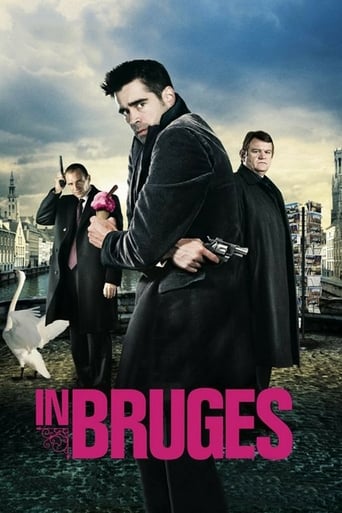
In Bruges
2008 · Film · 108 min
Directed by Martin McDonagh
Ray and Ken, two hit men, are in Bruges, Belgium, waiting for their next mission. While they are there they have time to think and discuss their previous assignment. When the mission is revealed to Ken, it is not what he expected.
13 positive6 neutralfrom 19 commenters
Where to watch
No streaming data for this title.
19 comments on Hacker News
You're looking for story-driven movies and setting the bar at Shawshank, which is IMDB's all-time most popular movie, so that's kind of a tall order.
You're also rattling off three movies that have almost nothing to do with each other. Banshees of Inisherin in particular isn't a crowd-pleasing movie. To stick with Martin McDonagh, check out In Bruges or Three Billboards. I didn't like American Sniper either (it's Temu Hurt Locker), but sticking with Clint Eastwood, check out Gran Torino.
"Patriot" (on Amazon Prime) https://m.imdb.com/title/tt4687882/
Criminally underrated. If you enjoy older Guy Ritchie films or In Bruges, do yourself a favor and watch it.
Also thematically similar, re: alienation and disassociation!
The first episode I clicked on (it was for In Bruges) refered to the film as "The play".
Glad to see it's ready for production!
I was amazed that some friends of mine hated In Bruges (after I'd been praising it to the skies). Didn't expect that reaction and it made me much more cautious about recommending films to people.
I mean, there are superhero films, and then there are Martin McDonagh films like In Bruges (2008), Three Billboards Outside Ebbing, Missouri (2017), and The Banshees of Inisherin (2022). Or a movie like Tár (2022).
I wonder if it's less a function of 1980 vs 2020, and more a function of genre, and which genres have been more popular at the cinema in which decade. Or which genres you personally happen to be aware of or watching.
I mean, it's not like the original Star Wars (1977) was slow-paced and thoughtful.
And if you liked this movie you might like "In Bruges". Very similar in mood and the same two lead actors (and director). Personally I liked In Bruges a bit more but they're both good
I'd like to see the end but I cannot get past level 6. I'd enjoy a spoiler if anyone has it.
I enjoyed the film. There was this nagging feeling the whole time that there was supposed to be some sort of metaphor for the conflict in Ireland but I knew nothing about it, so it felt like I was missing something. I don't know that I really understood what it was trying to say either way. I liked 'In Bruges' a lot more personally.
The Civil War connection is obvious (it's explicitly referenced at several points in the movie) but my interpretation was that the Civil War was a mirror for the characters' interactions, not the other way around. To me the movie was more a commentary on various aspects of Irish society which can exacerbate problems and inhibit progress and healing - lack of communication, holding of grudges, a tendency towards self-punishment. Even though the main characters were pretty much all mad they were also oddly familiar.
I liked it more than Three Billboards, but not as much as the excellent In Bruges.
The movie In Bruges comes to mind, the scene at the tower between Colin Farrell and the American tourists.
(... also a bar in SF where I was on the smaller end of males with 1.9m and 102kg)
In Bruges is a fantastic film, one of my favorites as well, and makes for a poignant backdrop to this story, wherein the reporter unknowingly manifests its plot from his semi-ironic suggestion of meeting there. The imagery of the FBI guys waiting around in Bruges is just too perfect. Life imitates art.
Fun fact: Bruges, where i live, is called "Venice of the north".
There's also a really good film: "in Bruges" - https://youtu.be/96harmMOyiY
Or a free running movie - "what tourists don't see" - https://youtu.be/2VToZ-vS2Vc
I've always wanted to visit Brugge after watching the movie In Bruges. Maybe this summer I'll get to it :)
Their environment seems similar to the movie In Bruges. I wonder if Reed Hastings is so dedicated that he would “Keeper Test” himself.
Wow that was a strong read. Granted that they are quite at the opposite ends of 'accidental kill' spectrum, it immediately reminded me one of my favorite movies, In Bruges {SPOILER AHEAD!} where we see a hitman who accidentally kills a little boy struggling with his life to overcome his "mistake". I get teary eyed every time I watch it..
for the most part it feels like TV shows don't have that pressure to fit into a very tight box.
Don't they? I feel like TV is a lot more constrained than movies. The forced "last time on XYZ" cadence means that it's very difficult to have natural story-lines when things need to be wrapped up in a suitable emotional resolution and/or cliffhanger every 22 or 45 minutes. Especially when the writers are working with 25% of the screen time being commercials (thankfully much less of a problem with Digital-first TV from Netflix, HBO etc.).
I think it's a lot easier to write and produce a quality movie about just about anything. Yes the mass-produced sequel machines look pretty cookie cutter, but you also get some extremely well-told stories like In Bruges or Wes Anderson's stuff. There's anything-goes stuff like Swiss Army Man. I feel like this kind of thing couldn't realistically be produced for TV. The acting, writing, and production value falls off a cliff very quickly as soon as you leave the mainstream. Even a single season of a TV show means 6-10x as much content as a movie, and consistently conforming to the structure of a serial TV show means the content feels inevitably more repetitious.
> Do you see the same thing happening in India, or are they managing to preserve local tradition alongside the mainstream?
It is complex! Some dialects are dying out, but the regions seem to be clustering around the 22 'scheduled languages'. In Karnataka (population ~ 60 million) for example, there are at least 4 dialects of Kannada. With the proliferation of social media, TV, and cinema, two things are happening: (1) the non-majority dialects are losing out to a 'standardized' mean similar to the Wisconsin-mean in the US, (2) paradoxically, non-standard dialects are gaining popularity because of their quirks. This is similar to how Irish dialects are highlighted in movies like Lock, Stock, and Two Smoking Barrels, In Bruges, etc. giving them more visibility than it would otherwise get. Another analogy is how we all know about Minnesotan 'dialects' and Californian dude-isms from Coen brothers' explorations of these themes.
The primary bulwark against the disappearance of dialects and languages in India is just the largeness of the masses of people who speak these languages. For example, Bhojpuri, a dialect that is different from standardized movie/TV 'Hindi' has tens of millions of speakers.
Somehow standardized languages seem to co-exist with dialects in much of India.
It is nearly impossible that any of the 22 languages will die out in the next few centuries. Even most dialects will survive because of the strength in numbers. (Note, the 22 languages includes Sanskrit, which like Latin and classical Greek has in some sense 'died out'. But the masses never 'spoke' Sanskrit, it was more of a formalized language for literature and administration.)
Edit: By Wisconsin-mean, I mean General American https://en.wikipedia.org/wiki/General_American
Thousands overall maybe, but the number of mass market films is in the hundreds.
I, personally, have a familiar definition of "mass market film". I grew up in a small town with about nine total screens, usually one movie per screen and one screen per movie. Figure they turn over 4 screens per week for new releases. That's 208 movies per year. You'd need 3-4 more doublings to get it over 1000, so it's pretty clear that "hundreds" is the better order of magnitude.
I picked a year at random: 2008. The following movies were all released in 2008: The Dark Knight, Wall-E, Iron Man, Slumdog Millionaire, The Curious Case of Benjamin Button, In Bruges, Kung Fu Panda, Gran Torino, Indiana Jones and the Crystal Skull, and Quantum of Solace. Your average moviegoer will easily remember more than "one or two" of those (though not necessarily the same ones).
So the proportion goes from two in a thousand to maybe five in 250, or from 1 in 500 to 1 in 50.
I do this with my 'Out of Office' messages. I personalise them to the reason for my absence, and normally throw in something quirky - very much in line with my personal and business positioning. The responses I receive are amazing!
Here's my most recent example, to explain it better:
I am currently in Belgium on leave, and will return on Wednesday 9 May. I will respond to your email, if appropriate, next week - if your message is urgent, please contact ...
If the rest of your day was planned based on my response, then you now have some time on your hands. Here are three time-filling ideas, based on my trip:
1) Watch the film In Bruges, while I am actually in Bruges. We'll both have a great time - me, alas, without Ralph Fiennes
2) I will be in Antwerp, host of the 1920 Summer Olympics. It will be the 7th Olympic Host City I have visited - spend some time counting how many you have seen.
3) I will be visiting the European Parliament in Brussels. If you really need to fill some time, please solve the Eurozone crisis (and remember to write down your answer).
Until next week...
Also check out "In Bruges" - http://www.imdb.com/title/tt0780536/
One of my favorite movies :-)