 Hacker Cinema
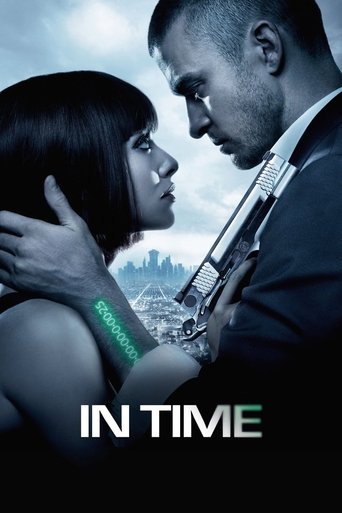
In Time
2011 · Film · 109 min
Directed by Andrew Niccol
In the not-too-distant future, the aging gene has been switched off. To avoid overpopulation, time has become the currency and the way people pay for luxuries and necessities. The rich can live forever, while the rest struggle to negotiate for their immortality. A poor young man who suddenly comes into a fortune of time finds himself on the run from a corrupt police force known as the "time keepers".
10 positive4 negative5 mixed30 neutralfrom 49 commenters
Where to watch
No streaming data for this title.
53 comments on Hacker News
I think there is a bigger issue here.
Charging people for their fundamental rights.
It happens in many different ways. Look at all these people that just want to live and they can't even do that without having to pay to exists.
It is getting to be like that movie "In Time" where there is a clock you have to keep funding or you expire.
> neither practical nor particularly convenient
My only take away with crypto is, think of that one movie "In Time" but instead of the whole time = currency concept and the arm clock, what if crypto could be applied to a physical piece of e-paper like thing, where it says what its worth, and its worth what it says, you can transfer it on a whim from the paper to your phone (to a wallet) and back and forth.
If anyone figured that out, fully seamlessly, fault tolerant, that alone imho would be worth investing time and attention into.
Basically make the crypto real and physical, something fluidly tangible to where everyone can hold it and understand it.
No one can hack your wallet if all your "crypto" is not in it. You can spin up new wallet on a whim.
The only real way I can think is something like how monero works, where whoever owns a coin can "decrypt" said coin (or that's my limited understanding of how monero works).
> George Lucas' 1977 sci-fi opera "Star Wars
I admit I've never understood why Star Wars is classified as sci-fi. To me it has always been space fantasy. There's nothing science-y about Star Wars, and it centers on supernatural powers.
Not a hill I'm willing to die on though, unlike Ellison it seems.
> He sued the movie "In Time" for "borrowing" one of his ideas.
I was fortunate enough to watch The Price of Life[1] when I was a kid. It aired on public TV, as part of a short film themed weeked they had.
When In Time was released I recall thinking that the plot sounded awfully similar, and watching it confirmed that.
The Price of Life is a low budget short film, but if you don't mind that I'd say watch it if you get a chance.
[1]: https://en.wikipedia.org/wiki/The_Price_of_Life_(1987_film)
...and Altered Carbon (primarily the book but also the TV series), which does things a lot better than "In Time".
Reminds me of the film 'In Time' where the rich can be immortal.
It does seem that nature has it 'programmed in' that we are to die due to telomere shortening and for natural selection to take place. Our modern and constantly changing society likely means that any kind of evolutionary adaptation doesn't have long enough to prove itself.
Interestingly how people would handle immortality could change that.
This bug is just an early release of a future feature.
https://youtu.be/T1Rpo8BRwYg
In Time is a 2011 American science fiction action film written, co-produced, and directed by Andrew Niccol. Justin Timberlake and Amanda Seyfried star as inhabitants of a society that uses time from one's lifespan as its primary currency, with each individual possessing a clock on their arm that counts down how long they have to live.
This was the plot of the Justin Timberlake film In Time.
Everybody stops aging and time becomes a currency. Run out of it and you die.
Rich people drive at walking speed for safety because they can still die in car crashes.
I'd like to see a study on how the acute stress of living in survival mode for a lifetime affects the brain by using it too much for the wrong tasks.
The last 25 years have been particularly painful for people like me who favor academia and pure research over profit-driven innovation that tends to reinvent the wheel. When I look around at the sheer computing power available to us, I'm saddened that people with wealth, power and influence tend to point to their own success as reason to perpetuate the status quo. When we could have had basic resources like energy, water, some staple foods and shelter provided for free (or nearly free) through automation. So that we could focus on getting real work done in the sciences for example, instead of just making rent.
I've been living like someone from movies like In Time and The Pursuit of Happyness for so many decades without a win that my subconscious no longer believes that the future will be better. I have to overcome tremendous spidey sense warning signs from my gut in order to begin working each day. The starting friction is intense. To the point where I'm not sure how much longer I can continue doing this to myself, and I'm "only" in my mid-40s. After a lifetime of negative reinforcement, I'm not sure that I can adopt new innovations like AI into my workflows.
It's a hollow feeling to have so much experience in solving any problem, when problem solving itself will soon be solved/marginalized to the point that nobody wants to pay for it because AI can do it. I feel rather strongly that within 3 years, mass-layoffs will start sweeping the world with no help coming from our elected officials or private industry. Nobody will be safe from being rendered obsolete, not even you the reader.
So I have my faculties, I have potential, but I've never felt dumber or more ineffectual than I do right now.
I loved Gattaca. I've seen it many times.
I tried to like Anon, but I didn't. Same thing with another one his movies, "In Time"
This is the premise of In Time (film) too.
The film “In Time” showed this feature back in 2011.
"In Time" (movie) would be the more likely outcome: time-to-live is transferrable currency.
But in the real world people already die at a predictable age - we are all statistics.
The economic anarchy of capitalist society as it exists today is, in my opinion, the real source of the evil. We see before us a huge community of producers the members of which are unceasingly striving to deprive each other of the fruits of their collective labor—not by force, but on the whole in faithful compliance with legally established rules. In this respect, it is important to realize that the means of production—that is to say, the entire productive capacity that is needed for producing consumer goods as well as additional capital goods—may legally be, and for the most part are, the private property of individuals.
This resonates for me in middle age, after rarely having more than $2000 free and clear despite a lifetime of hard work. I've lived movies like Pursuit of Happyness and In Time, but without the financial epifany. All I do is work.
If capitalism worked, then prices would get lower over time with increased per capita productivity. We got a brief taste of that for the last time in the late 1990s, but most people stopped getting raises after that, and now duopolies provide nearly all name-brand goods and services. As it stands now, it's pretty much over. I don't think anyone seriously thinks that homes, vehicles, food etc will ever decrease in price now.
We can generally agree on the causes being stuff like regulatory capture and not enforcing antitrust laws. But those aren't root causes. The real problem is power imbalance from wealth inequality. To address that directly, we could either provide more wealth to the working class via UBI or redistribute wealth from the owner class via taxation. Note that neither of those have been tried at a national level in anyone under 50's lifetime.
Which means that the national debt was planned. It represents the share of wealth transferred to the owner class, skimmed from the working class as a result of trickle-down economics.
The next 2-3 US elections are going to be really important though. Young people have a chance to democratically vote to substantially raise taxes on corporations and billionaires. This won't be so much anti-capitalist as trans-capitalist.
I say that because socialism and communism require a roughly 6 hour workday to provide enough labor for the system. But the median value of labor will never rise again, because of AI and automation. Meaning that work hours will increase as pay decreases. Which is self-evidently unsustainable. Which means that the traditional alternatives to capitalism will most likely not be viable, but will still be used as straw men against the political left by politicians to lure in low-information voters.
I believe that we passed the tipping point around the time of Bush v. Gore in 2000, when we were set to widely roll out renewable energy and electric cars, but chose not to (see Who Killed the Electric Car). Instead we invaded the Middle East at the behest of the owner class to protect established industries around fossil fuels. We're only achieving some semblance of self-sufficiency 20 years later despite capitalism, not because of it.
Admittedly, I don't have much faith in the political system to correct itself. So I sympathize with the political right's sentiment that government bad. But the government is We the People in the US, so that's like saying people bad. Which is othering and division. As we grapple with the actual truth of our struggle and stop blaming victims for our collective plight, I have faith that we'll solve these problems, perhaps summarily. Until then, I'm manifesting a more independent/off-grid lifestyle in an attempt to provide resources that capitalism has so far failed to provide me beyond a subsistence level.
The proof of everything I'm saying is in the failure of any billionaire to challenge the status quo in a material way. They claim that their money is tied up in stock and they pay themselves a trifle. Yet we watched as Musk made $44 billion liquid to buy Twitter. Their FUD should be a rudder for the rest of us towards real answers and strategy.
Now I go back to my toil, hoping to win the internet lottery but knowing deep down that real work is in service to others. My separation from the real contributions to society that I would have made by following my heart is like being poor twice.
I get the sense that you would like some adult themes, but not too slow?
Top of my mind (and in no specific order) would be:
- Dark City
- The Thirteenth Floor
- City of the Lost Children
- Tron (original and maybe new one)
- Interstellar
- Inception
- A Clockwork Orange
- Her (very relevant to our times)
- Dune (2021 version)
- Brazil
- The Martian
- Children of Men
- Edge of Tomorrow (most like Marvelverse on this list but still very good)
- Moon
- Twelve Monkeys
- Upgrade
- The Fifth Element
- Contact
- Okja
- District 9
- Predestination (very relevant to our times)
- Serenity (but might need some prep from the tv show before watching)
- World on a Wire
- The Abyss
- Minority Report (very relevant in our times)
- The Fly
- Videodrome
- Equilibrium
- Strange Days
- The Andromeda Strain (relevant after Covid)
- eXistenZ (trippy but I loved it when it came out and was only around your sons age)
- In Time (interesting class dynamics on display)
- Enemy Mine
- Franklyn (some interesting takes on mental illness)
- The Arrival
Andrew Niccol's other sci-fi films, In Time and Anon are also very worth watching. In Time has the distinction of being the only film to make Harlan Ellison shut up.
You might enjoy the sci-fi film In Time. It’s about a society that has turned time into money, literally, allowing those wealthy enough to live forever while still looking like twenty-five year olds.
He is the subject of the Lord of War movie by Andrew Niccol, who made Truman Show (gaslighting), Gattaca (eugenics), In Time (immortality), Good Kill (drone pilots) and Anon (privacy/hacking).
“In time” was an excellent movie. For a few to live, many must die.
Dunno about the parent, but for me, post-scarcity means that struggle exists for synthetic reasons that aren't due to resource constraints.
For example, billionaires running 3 companies (poorly) is an indicator that they could stand to pay higher taxes so the rest of us don't have to pay their share. Oil companies with a combined worth of trillions of dollars would do just fine without their subsidies when we already have cars like Aptera and Lightyear 0 getting over 40 miles of range per day on solar alone. Factory farming has not prevented us paying $5+ for a dozen eggs. And so on.
By these kinds of metrics, I would say that we passed into post-scarcity sometime between the late 60s and the rise of Reaganomics in the early 80s. Certainly by 1990 with the fall of the USSR. Everything since, and especially pivotal events like the Dot Bomb, 9/11 and the Housing Bubble popping, were due to the post-truth reality that filled the void left by scarcity. This was all fairly obvious by the time The Matrix and Fight Club came out in 1999. Similar movies like In Time are practically documentaries now IMHO.
His film In Time[1] was also pretty decent, though not as good as Gattaca, imo.
[1] - https://en.wikipedia.org/wiki/In_Time
I could see tax brackets working by how your income compares to the area you live in.
"If your income is 30% above the average income for this area or the national average (whichever is lower), that >30% is taxed at this rate..."
So then you can't have rich folks disappearing to less-taxed areas. It could make rich people communities where they all stick together.
looking forward to the future where currency is time (the movie In Time), and we can tax rich people to death.
I feel like you don't actually remember the movie at all. It's an amazing movie.
It's only the same in the way that "A stranger comes to town" is a description of every single movie ever made.
If you want overt zipcode inequality then In Time is a better match. (but much lesser of a movie)
Sounds like something from the movie "In Time". Chilling to say the least.
Time in my world has become a universal currency, transferred directly between people or stored in “time capsules” ( wallets ). It is traded by the second and used in the Time ecosystem of Dapps ranging from hiring workforce for their Time , playing games fueled by Time or Literally owning a historical date in the past as a Time NFT …
Time as new asset class is backed by the real time as we know it (24 hours a day). We already have a worldwide consensus on time, our clocks are synchronized to tell us the total supply of Time. We believe that Time transacting should be as easy as looking at your clock (in the future that would be your wallet), and transfering Time as easy as shacking hands.
PS: very inspired by the movie in time :)
the UI is ugly but working on it : http://ticktack.money
I'm reminded of the movie "In Time". The premise/concept was amazing (time as a currency) but the execution/movie sucked.
In the movie In Time, people trade time instead of money. (money collapsed after the invention of this tech) Work well and you get extra “life” through a device in your arm. So everyone is perpetually 25.
It’s an interesting exploration of the topic.
https://www.imdb.com/title/tt1637688/
In Time
In a future where people stop aging at 25, but are engineered to live only one more year, having the means to buy your way out of the situation is a shot at immortal youth. Here, Will Salas finds himself accused of murder and on the run with a hostage - a connection that becomes an important part of the way against the system.
There was a weird movie with Justin Timberlake called "In Time" and I would use that model.
The moment a video is born, it lives until its sponsored time runs out.
If a content creator wants to leave something up and reap some internal ad-sales, or tip-generation scheme... they just have to sponsor the video with more time.
People who like it, can also sponsor it.
And sure, have some sort of "Library of Congress" feature to save videos deemed as significant...
But once the time is up... the video is gone. Exists only in memories.
Seems like a huge portion of videos are just taking up space... start pruning.
And a lot of videos... they don't matter. 40 different versions of the same old song, 20 different shots of the same sports blooper, 900 different versions of the same boring news cast. Like... none of these need to be on there taking up space / inflating the hosting bill.
This is all theoretical. Think about it like the movie “In Time”
https://m.imdb.com/title/tt1637688/
The only logical solution is population control where unlimited population growth is not allowed.
See the movie “In time”.
Rethinking Our Views About Time
The film In Time, with Justin Timberlake and Amanda Seyfried, is set in 2169 where people are genetically engineered to stop ageing when they reach their 25th birthday, when a one-year countdown on their forearm begins. At zero, the person "times out" and dies. This is a world in which time has become the universal currency, transferred directly between people or stored in "time capsules". You work for time, spend time, save time and so on. The rich earn huge sums and essentially become immortal, while the rest beg, borrow or steal to make it through the day.
This week I re-watched the film as I was keen to draw some insights from this fascinating concept. I believe, that time is the currency of our world too, although slightly different to the film of course.
We often view the world as if money makes it turn. Yet, money, which is a fairly new intervention in the grand scheme of history, has converted the original currency of time into something that is more readily exchangeable. Time allows us many pleasures, from time with loved ones, to working towards things we enjoy, time spent away on holiday and new experiences. But we often get confused as we assume that money is the thing we need for these things.
Money buys healthcare, security, nutrition and a roof over your head. However, in order to get money we must exchange our time for it. Money is therefore a trade-able, exchangeable currency in comparison to time which can't in itself buy these things; time has to be translated into money first. The film skips this translation and instead everything is brought and sold with time, money is simply not in their vocabulary. A bus ride costs an hour, a lunch 30 minutes and so on.
The film follows the story of a man, who has little time, having to work each day to survive, often only having '24 hours' in his wallet. He suddenly gets given a hundred years and travels to the 'rich part of town' where he finds that more time doesn't equal a better life. We get caught up with the fact that more money is better, but in reality we should want more time, but even then up to a limit.
I think the films concept provides many good thinking points. Do we view time as the currency? How much value do we place on money? How would things be different if they cost time and not money? Is there such a thing as too much time or money? When buying things directly with time, would it feel differently? How important is time to you?
I share more like this on my Infinity Thinking newsletter - inspiring you to think without limits. Get inspired at www.mattswain.co.uk/newsletter
Reminds me of the movie: https://en.wikipedia.org/wiki/In_Time
> Instead of using paper money, a new economic system uses time as currency
"In Time" - okayish film but led me to start thinking about the time value of what I'm doing at any one moment.
https://www.imdb.com/title/tt1637688/
The movie "in time" (2011) kind of explores this. At the time, I wrote:
> it gets you thinking. What prevents time from being used as currency? Or are we really doing the same by paying people an hourly rate instead of based on their accomplishments? Not to mention how many lives that million years capsule must have cost.
Time is likely the currency we all spend.
Human activity of all kinds is exchanging time with each other. I spend some time doing A and give you some. In return you spend time doing B and give me some.
Ultimately we all have a finite amount of time available.
When you start assessing things in terms of hours exchanged rather than dollars, euros or pounds you see how it all works.
Baumol’s cost disease explains itself for example. It still take the same number of hours to be a violinist and a concerto takes the same amount of time to perform. And we still value violinists so some of them get paid.
Our machines reduce the human time element embedded in other products and services and that reduces their value in exchange terms. We see that expressed as the dollar price of violinists going up.
There’s even a film In Time where this idea is explored Hollywood style. Not the greatest film but the philosophical idea behind it is fascinating.
Great extension, albeit a little depressing! Similar to 'In Time' too http://www.imdb.com/title/tt1637688/
You sort of described the plot of the movie In Time.
http://www.imdb.com/title/tt1637688/
Just because you can't age doesn't mean you can't die. I think if people started living forever there would be a lot of rebellion from the people who are not given that access. Assuming at that point they can't just use brute force to protect themselves from the masses.
> these movements are not about everybody living much longer, only selected wealthy elite
This is probably what concerns me the most. And in fact this is already reality. E.g. in my country if an average person discovers they have cancer, their chances are pretty grim in contrast with e.g. Switzerland. And there are countries which are really poor where a infection which is curable for $20 can kill people.
An interesting movie to watch on topic: In Time (2011) - http://www.imdb.com/title/tt1637688/ . This South Park episode is also exactly on point: http://www.imdb.com/title/tt1198003/ .
Andrew Niccol's other thought-provoking films include Truman Show (reality and free will), Lord of War (arms trading), In Time (immortality and currency) and Good Kill (drones), http://en.m.wikipedia.org/wiki/Andrew_Niccol
The movie "In time" from 2011 was inspired by the ticktockman btw.
The movie 'In Time' (2011) has a nice view on this subject. Only the rich will be able to live forever but some of them discover they get tired of living.
I'm not sure living forever in this world will be that much fun.
Also check out the examples: http://lav.io/2015/02/audiogrep-automatic-audio-supercuts/
And this related project: https://github.com/antiboredom/videogrep
He already states the obvious idea to integrate audiogrep into videogrep, which at the moment just uses subtitle files.
> All the instances of the phrase "time" in the movie "In Time": https://www.youtube.com/watch?v=PQMzOUeprlk
> All the one to two second silences in "Total Recall": https://www.youtube.com/watch?v=qEtEbXVbYJQ
> The President's former press secretary telling us what he can tell us: https://www.youtube.com/watch?v=D7pymdCU5NQ
In the movie, In Time, the 25-year old non-aging humans receive a starting "bank balance" of credits shown on their smartwatch. When their credits drop to zero, they die. Life for most people consists of working or stealing to top-up. They mostly group by geographical free-trade zones sorted by bank balances of "time credits", separated by borders and armed checkpoints.
http://www.rottentomatoes.com/m/in_time/reviews/
I have always wondered that why we cannot make intangibles like happiness, emotions as a currency. Even though they are more often than not treated as the real wealth a person can have, we have never ever been able to count these intangibles and store them.
Of course this seems to be an absurd idea at first. But, lets try to think about it, doesn't matter how ridiculous or implausible this might sound.
My mind goes back to the movie "In Time", where time was treated as currency, something on which your life depended, literally.
Can't the smartest people on this planet, think of some thing absolutely fascinating, that may let us, mortal people gather our happiness and maybe able to trade it.
Consider for example that someone who helps people out, people who may not have enough money, but who have the intention to bless that person. Can't that person count/take the blessings and become rich in process.
If this is possible, their might a big motivation for everyone to do good, help people out, get their genuine blessings ...
I know this all sounds really crazy!! Just wanted to dish my thoughts out :)
Just watched In Time, http://www.imdb.com/title/tt1637688/, the other day; it looks at financial inequality through a lens of equating money with time. Quite reminiscent of Logan's Run.
Spoiler: they ultimately initiate a collapse of the system by a violent redistribution of wealth [ie time]. The movie ends at this point without considering the fallout.
The movie "In Time" is an interesting view on how the world would evolve if that were the case. It's one of my favorite movies and it provides a perspective I'd never imagined.
> but im talking long term, when currencies will be backed by actual work that provides social and economical value
If it were possible, the absolute currency would be 'life time' as in the movie http://en.wikipedia.org/wiki/In_Time. In the absence of that, something equally dear for staying alive in a increasingly moving towards apocalypse world, like may be bottles of oxygen or water ? But even then, the things that are of value may not be easier/handy to barter/trade with. That is when an alternative 'scarce' 'hard to create and requires resource intensive mining' but 'easy to handle' , 'easy to determine purity' type of resource takes the place as a currency. Gold has that property inherently. Not saying that it is the only absolute resource that has it. But it is a time tested resource with those qualities.
http://www.imdb.com/title/tt1637688/ "In Time"
Whilst not exactly this scenario, it gives me the same feeling. The egalitarian in me seeks access to life-extending technology for all people, from janitors to data scientists.
The same way I support financially charities that bring the benefits of contraception and family planning to all people, regardless of nationality, citizenship or caste.
Edit: I just realised Google could extend this theoretical perk to their janitorial staff, which would make it the most competitive cleaning contract in the world.
"I get the impression that the "inequity" people think we should prefer the 1970s, because at least then, even though we were all sicker, no one was 10,000x healthier."
Except that in order to become healthier, you don't have to take someone else's health away.
I think a better analogy would be something like that (stupid) movie In Time, where people are given a certain amount of time to live when they turn 25. They can freely trade that time with others. Some wind up with millions of years of time, while the majority are cheated, exploited, and misled by the wealthy ("time is money") and face the risk of death at any moment as they scramble over what little time they have left.
As weak and flawed as the movie is, they're right about one thing: it doesn't have to be that way.
This reminds me of the movie In Time[1]. The movie itself isn't particularly amazing, but I definitely resonated with it's underlying themes around the value of both time and money, and how they are inextricably linked.
It's a hard idea to communicate across to your average layperson though, that their half hour of diligently shopping around for the best deal actually cost them more than they saved. It's all conjecture though until you're actually using your time to earn money, or you are being paid for your time. But even if you aren't directly making money from your time, you can argue that the time spent will still offset/reduce the amount of time you do earn money from.
There are definitely limits on this type of thinking, and how seriously you should take it.
[1] http://en.wikipedia.org/wiki/In_Time
>"Passworded torrents? Dear god, where have you been?"
That's actually pretty, pretty sad. Last week I've downloaded the most seeded torrent of the movie "In Time" and it came passworded.
I got all surprised because it was THE MOST SEEDED.