 Hacker Cinema
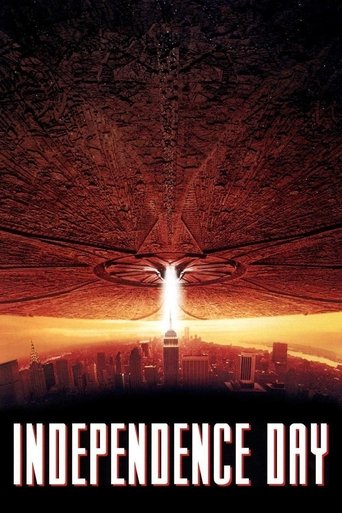
Independence Day
1996 · Film · 145 min
Directed by Roland Emmerich
ActionAdventureScience Fiction
Strange phenomena surface around the globe. The skies ignite. Terror races through the world's major cities. As these extraordinary events unfold, it becomes increasingly clear that a force of incredible magnitude has arrived. Its mission: total annihilation over the Fourth of July weekend. The last hope to stop the destruction is an unlikely group of people united by fate and unimaginable circumstances.
9 positive20 negative1 mixed56 neutralfrom 86 commenters
Where to watch
No streaming data for this title.
93 comments on Hacker News
Your argument is essentially: "I made a claim and presented extremely weak evidence (sci movie plots and unverified claims from ultra conflicted sources). You rejected this evidence as insufficient. Therefore no evidence will ever satisfy you. Therefore I don't need to produce any evidence. Therefore my claim is true."
What would the logs show? They would show what actually happened.
What would a public demonstration that experts without billions in options could evaluate show? It would show actual danger.
What would publicly having your compete in controlled and legal hacking competitions show? Actual danger.
This is not a high bar of evidence.
Do you actually think a sci fi plot and OAI press releases are all the evidence you need? Because if that's true then I hope you haven't watched Independence Day or 28 days later.
To be fair: the quality of movies produced by Hollywood has gone rapidly downhill already in the 1990s. You only need to compare the movies Quentin Tarantino makes; now personally I think Pulp Fiction is still by far his best work, but I concede that the movies he created lateron were above average (though I would not go as far as many others, who'd rate these in the 8 to 10 point ranges; I'd go more between 6 to 7 or 7.5, largely because there are a few smaller issues cropping up and I always notice these when I compare them with Pulp Fiction, which was really good; actually really well-made).
I noticed this in the 1990s in many movies. For instance, Independence Day - the computer animation pissed me off. I found them bad. Even Terminator 2, where evidently many people say it was great, I was nowhere near as convinced; I found the first terminator better and more "logical" and more consistent, too. But things decayed quickly in the 1990s really. Even movies such as Avatar I find total garbage. And while I am not totally against superhero comic/marvel adaptations (I liked xmen and in particular Hugh Jackman as wolverine), these are always the same formula. Tons of CGI, big fights where nobody knows what is going on, very little thought elsewhere in that formula. There are exceptions, but by and large these things keep on happening. Individual directors manage to break out of the mold (Chris Nolan) but by and large movies really SUCK now compared to the "oldschool days". And while some of this may be due to me becoming more critical, the production quality just sunk. Take movies such as Megalopolis - this captures what is going wrong. It seems as if the whole movie industry has partially collapsed in the last +25 years and they don't really know what to do to change this. The same has happened to games, by the way. It is almost as if only one formula exists only now.
On this day, July 4th, in 1982, my Mom packed my sister, my brother and I, and we drove, very early, from Santa Monica, to Edwards Air Force Base in Southern California, to watch the landing of the Space Shuttle STS-4, first concrete runway, touchdown.
The traffic was heavy, Independence Day the movie heavy. We still got a great spot and we watched that event with everyone else. No cell phones, no internet, just homemade sandwiches, and a feeling of awe.
The world of the space economy in 2026 , with all the technological advance, satellites, rockets, is amazing. But as a kid, to see a plane-like craft glide out of the vacuum of space onto a runway outside of LA, that was magical.
Happy 250th July 4th America!
They did something similar in Moonfall, which is a fun movie if you like campy sci fi like Independence Day and Armageddon. One of those movies I was glad to randomly check out on a flight.
Jesus Christ, dude. That was a disaster movie by the same guy that brought us Independence Day and 2012, based on a book by a radio host best known for possibly facilitating the Heaven's Gate mass suicide by feeding rumors a UFO was following the Hale-Bopp comet, and a writer who has peddled personal tales of alien abductions for 40 years. Not exactly a reliable central tendency measure of what real people feared.
This has to be one of the stupidest false equivalences I've ever seen.
> In a perfect world, we could send all traffic completely unencrypted and never scan for a malicious payload, saving all that energy and hardware.
In a world with such social cohesion, we'd be defeated by an alien species being able to quickly interpret and exploit our technology like in the hit film Independence Day(note, we're the defeating alien species in this example). https://www.youtube.com/watch?v=9DIjBGierkA
I think digital effects still rarely look as good as the peak of Hollywood practical effects (call it… idk, Alien in 1979 through Independence Day in ‘96 or so, roughly, and yes I know ID4 also had computer fx in addition to lots of miniatures and models)
Having to do things for-real also kept things grounded. Modern action movies are often cartoon-like with supposedly human characters stringing together super-human moves that’d leave a real person with dislocated shoulders, broken bones, and brain damage, because they’re actually just CG, no human involved.
[EDIT] OMG, or take Bullitt (1968) versus, say, the later Fast and the Furious sequels (everything past Tokyo Drift). The latter are basically Pixar's Cars with more-realistic textures. They're cartoons with live-action talking segments. Very little actual driving is depicted. Bullitt may have used the movie-magic of editing, but someone did have to actually drive a car, for every shot of a car driving. Or at least they had to set up a car with a dummy to convincingly crash. What you're seeing is heightened, but basically within the realm of reality.
Or take A Bridge Too Far. It's a bit of a mess! Make it CG and it'd be outright bad. But ho-lee-shit do they blow up a lot of stuff, like, you cannot even believe how much. And look at all those tanks and armored vehicles they got! And planes! And extras! Those are all 100% real! AND ALL THE KABOOMS! And it all looks better than CG, to boot. The spectacle of it (plus some solid performances) saves the movie. Make all the FX CG and it'd be crap.
Imagine a Jackie Chan movie with CG stunts. What is even the point. It'd be trash.
I have seen tons of great movies made after 2010, but must admit I’m having trouble thinking of any blockbuster-type movies that stand up to the best of the 70s, 80s, and 90s.
Does Fury Road count? I dunno. The closest I can get aside from that are a couple Tarantino movies. Jurassic Park, the first Mission Impossible movie, Aliens, Jaws, hell even Independence Day. Nothing’s quite up there. Lots that are a kind of janky B-movie sort of good, but nothing as solid as those. Almost all are marred by lots of CG that might look ok at the time but seem dodgy and very distracting within 5 years max, for one thing (to be fair, Jurassic Park suffers from that in a couple scenes, too)
> Ripley defeat the alien queen
What is it with "queens" in SF ? Off to a rant :)
IMO, adding a queen to the Borg destroyed the Borg. I was really intrigued by the Borg as presented in their first appearance. If you remember, they had a nursery with Baby Borg and a collective conscience, no individuality. Then came the queen, the ruler of all with some people having a "higher rank". Totally made the Borg irrelevant to me.
There was a TV show about an invasion of Earth, it went along fine until the last season, a queen was added, I could tell it was rushed and doing that changed its direction.
Same can be said about Independence Day, even though I did not like the queen addition, it did not take away from the whole movie and in a way a "queen" in that context made a bit of sense. The only thing is, if the Queen was killed, wouldn't that end these Aliens ? To me, a queen should not leave the home planet.
Alien movies were too much for me, things popping out of someone's belly would be a "close my eyes" type scene. But I really liked Promentheus. I did not realize until much later that was a prequel to Alien :) And I still think it is a good movie.
I believe it’s an Independence Day movie reference.
Most non-American movies are slop, melodramatic vaudeville, or tear-jerking gut-punches. Most American movies are slop too, but America can afford to swing at more pitches and consequently get more hits.
Have you ever tried to watch Korean movies from the last 20 years? It's all melodramatic romance-crime-poverty slop, with the rare Kim Ki-duk or Bong Joon Ho in there to balance it out. And that's a country with a wonderful reputation for quality film-making.
I mean you get zombies on a train and that's a fun popcorn flick, but it's forgettable. It's no Tremors, Twister, or Independence Day.
In Indonesia for every The Raid there's 999 poorly acted, poorly shot melodramas with a thin well-trodden story.
And don't get me started on "let's yell at each other for 120 minutes" Russian cinema.
American movies are by far the most watchable, especially when you don't feel like going on a heart-wrenching journey of despair, which is all international cinema excels at.
> For starters, human minds do more than just language.
These days, so do the AI (even though these ones are still called LLMs, which I think is now a bad name even though I continue to use the term without always being mindful of this).
> I've yet to see an humanoid robot controlled by an LLM that can tackle difficult physical problems like riding a bike or skiing in for the first time real-time, just as humans, that need to coordinate at least 5 senses (some say up to 20 but I digress) plus emotions and a train of thought to do so.
1) I'd agree that AI are slow learners (as measured by number of examples rather than wall clock). For me, this is more significant than the difference in wattage.
2) 13 years ago, before the Transformer model: https://www.youtube.com/watch?v=mT3vfSQePcs
3) We don't use 5 senses to ride a bike; I can believe touch, vision, proprioception, and balance are all involved, but that's only 4. Why would hearing, smell, or taste be involved?
For emotion, my weakly-held belief is that this is what motivates us and tells us what the concept of "good" even is — i.e. it doesn't give us reasoning beyond being a motivation to learn to reason.
> It is surprising that LLMs are so capable, but for 2000kcal a day humans are still more impressive to me.
Our biological energy efficiency sure is nice, though progress with silicon is continuing even if the rate of improvement is decreasing: https://en.wikipedia.org/wiki/Koomey%27s_law
That said, I don't consider the substrate efficiency to be an indication of if the thing running on it is or isn't "reasoning" — if the same silicon was running a quantum chemistry simulation of the human brain it would be an even bigger power hog and yet I would say it "must be" reasoning, and conversely we use phrases such "turn your brain off and enjoy" to describe categories of film where the plot holes become pot holes if you stop to think about them (the novel I'm trying to write is due to me being nerd-sniped in this way by everything wrong with Independence Day).
> That may be why the brilliant minds of this decade talk about replacing white-collars, but no plate-cleaning bot in sight.
I mean, I've got a dishwasher already… ;)
But more seriously, even though I'm getting cynical about press releases that turn out to be smoke and mirrors, (humanoid) robots doing housework is "in sight" in at least the same kind of way as self driving cars (which has been a decade of "next year honest" mirages, so I'm not giving a timeline): https://www.youtube.com/watch?v=Sq1QZB5baNw
> Metacommentary: a lot of LLM-human equality apologists seem to have little knowledge of the AI field and its history, as these themes are not new at all.
I've been feeling the same, but on both sides, pro and con. The Turing paper laid out all the same talking points I've been seeing over the last few years, and those talking points weren't new when he wrote them down.
Close Encounters of the Third Kind (best of the grandiose classics imo)
Deep Impact (the only good asteroid movie?)
Jurassic Park + Independence Day (peak Goldblum)
Total Recall + A Scanner Darkly (best Philip K Dick adaptation)
Gravity (great visuals / perseverance story)
> The hearing just made me feel like "Independence Day" may have had it right. People in government know but don't tell the president for plausible deniability and non-permanence of the position.
I really do need to finish writing that novel inspired by all the things wrong with that film.
Turns out climactic battles are much harder to write than I was expecting.
To be fair, hollywood productions hardly ever touch the whitehouse or policies playing out and showing effects, to the point where it almost seems like the lack of coverage is perhaps even intentional imho. I did a very quick internet search on "movies about the white house" just because I was drawing such a blank and I only get White House Down, Olympus has fallen, and Independence day as the main search results.
It's a quote from the movie Independence Day, about an alien invasion. There was no President Thomas Whitmore.
Independence Day? Probably not much.
Every bit of their content from the 90s? Likely a fair chunk. Not billions, but real money. That's a lot of the attraction of their streaming service, especially classics like their Princess movies.
Well yes.
Bring back the 28 year copyright term. Or something similarly sensible.
How much money would Disney lose if Independence Day, the top earning film 28 years ago would become free to replicate this year?
America used to win in such circumstances based on the power of its media exports. Hollywood. The music industry. American ideals advertised though the lens of culture.
Now we're beginning to approach fungible with domestic content production in every market.
And the US domestic market is now often funded by international interests. China-backed films highlight the intelligence and cunning of Chinese citizens, which often provide critical advice or technology to the dumb action-oriented Americans [1].
When's the last time China was an adversary in a film? Or that the henchmen or Bond villain was Chinese? It's always gotta be an Arabic, Persian, North Korean, or Russian villain.
[1] Independence Day, The Trench, etc. etc.
> They are not literal
For most, indeed. And that's good! But I have met people who claim to think they must be absolute truth, then put a huge asterisk around all the bits I point out and say those don't count for whatever reason.
There was a meme back in the UK, that amongst Anglicans, only extremists actually believe in God. No idea how true that is.
> Do you look for the worst paintings?
Only when they're put on a pedestal and held to be amazing. For example: https://en.wikipedia.org/wiki/The_Kiss_(Klimt)
Widely regarded as beautiful and romantic. To me, it looks like the guy has a broken neck, and the woman has been decapitated at the base of her neck, her head rotated 90° and re-attached to her torso by the ear.
Likewise, movies. The plot holes in Independence Day annoyed me so much that when the sequel came out, I started (and still have not finished) writing a book that takes the opposite road with all the mistakes the film made.
So, while I've played the Eye Of Argon game, I never even tried to finish reading it once my friends and I stopped playing, and I've never bothered watching whatever the film is that has the line "you're tearing me apart Lisa".
> FWIW, that passage is part of all Abrahamic religions.
https://en.wikipedia.org/wiki/Shashthi
https://en.wikipedia.org/wiki/Hera
I don't limit myself to just Abrahamic myth and legend :)
Forget the books for a moment. The film is a brainless action film.
Most of the criticisms I made are film criticisms that could be levied against any bad or middling movie.
- The film is a vacuum for intricacy and coherence.
- The characters are one-dimensional, unchanging, and don't matter.
- The stakes might be huge, but they carry no emotional weight. Like most superhero films these days.
These are deficiencies in storytelling.
If we contrast Lynch's Dune with Villeneuve's, we might find similar analogies in contrasting "Jurassic Park" versus "Jurassic World", Peter Jackson's "Lord of the Rings" versus Peter Jackson's "The Hobbit", or "Independence Day" versus whatever the hell "Independence Day 2" was.
Each of these latter films promised more, but they turned out to be empty and soulless. More box checking than composition, more visual spectacle than substance. The same is true of Villeneuve's Dune as a film.
I don't need a film adaptation to be faithful. I just need it to be a good movie. I'd be totally fine if the film made a wild departure from its source material, so long as it used that liberty to deliver something impressive. That would honestly mean more to me than a fully "by the books" rendition.
Villeneuve's Dune was just lazy.
Or, she could just note the exposition as part of the fiction and its presentation.
Years ago, I used to be critical when it came to that sort of thing, then I realized that I was being critical of something with a clear purpose that's useful. And, that this was just a distraction from the often much more appalling flaws in mass media that can actually have real-world harms. I.e., flaws that give people the wrong idea about how things actually work in ways that can negatively impact their behavior.
"Independence Day" provides some exemplars of that, certainly. It is completely outclassed, however, by: https://www.salon.com/2023/02/05/the-core-science-entertainment-exchange/
These days, I see something like two axes, when it comes to flaws in movies (/ productions of any kind). One axis relates to "style" / "taste". For example, some people dislike works of the author Charles Dickens because he tends to spend a lot of time describing settings, preferring the works of someone like Shakespeare, who's typically much more "action-oriented". The other axis relates to factual / logical / structural issues, the worst in my estimation these days being in the "factual" part of this sort of "dimensionally reduced" axis (i.e., you could of course have 3 or more independent axes for what I've written).
I may not have much interest in something that has a style I'm not a fan of, but I only have a more realized reaction (something like negative, and I care to some degree) when the flaws are on that second axis.
She should try it - heh, save the annoyance for something "truly worthy" of it. :)
In the UK, Men in Black was a PG when released. We had a "12" rating at the time, but that meant 11 year olds couldn't go to the cinema to see it, even with an adult present.
Independence day which came out a year earlier (also with Will Smith) was a 12.
Indeed. For the conspiracy to hold water, one must assume (among other things) the President is out of the loop (like in the movie Independence Day) because otherwise, one has to assume too many Presidents that leaked intel on other topics exhibited the self control to hold these secrets close.
> Willis in Die Hard, Smith in Independence Day, Cruise in Top Gun-- they all exhibit more depth to me than Jordan in Creed or the Rock in whatever.
Idk man I think you've got some seriously rose tinted glasses. Most everyone I know who was born after that time thinks Top Gun is a formulaic piece of trash. It's very hard for me to think of this film as something that gives an actor a good opportunity show off their acting talent. There are plenty of good films from the 90s but Top Gun was like a generic DC superhero spectacle film.
Die Hard holds up. Jeff Goldblum is enough to salvage independence day but its largely dropped from popular consciousness among young people.
>Actors showing range are not doing big movies because big movies mostly don't ask for range.
They don't explicitly ask for it but I think it's a little more subtle than that.
Taking an example you gave, I don't think Michael B Jordan will ever reach the star power of peak Will Smith simply because I don't think he's as talented an actor frankly.
Willis in Die Hard, Smith in Independence Day, Cruise in Top Gun-- they all exhibit more depth to me than Jordan in Creed or the Rock in whatever.
You are right, and there's historical records to back you up. ;) Phrack touched on it back in 1996, at http://www.textfiles.com/magazines/PHRACK/PHRACK48 :
> First, some words on Macintoshes. Steve Jobs and Steve Wozniak, the originators of the Apple and the Macintosh were busted for phreaking in college. The Apple IIe was used almost universally by hackers. So why has the Mac fallen out of favor for hacking? Simple. Because it fell out of favor for everything else.
before listing some of the few hacking resources available for Mac.
Still, if you go by movies, Hackers, also from 1995, has Macs: https://www.youtube.com/watch?v=IESEcsjDcmM
A year or so later (1996), our hero used a PowerBook 5300 to help save the Earth in Independence Day.
Brought to you by Apple marketing. https://www.youtube.com/watch?v=QEMJzSVpdJM and https://web.archive.org/web/20080927051545/http://www.informedusa.com/t/independanceday.html .
FWIW, http://www.starringthecomputer.com/computers.html lists computers used in films.
Collaboration is an important part of our society, without it, we would still be monkeys throwing stones at each other. And Collaboration necessitates a good degree of friendliness. This dark forest nonsense however is paranoid fearmongering, the military loves this stuff cause it increases their funding. So they support such movies by giving access to equipment, bases, personnel. Independence Day, Alien, Predator, Matrix comes to mind. Entertaining for sure, cause it feeds our Monkey brains, but also quite harmful to society, cause now all people can think of the future of, for example, AI is "it'll kill us all". Even here, where you would think people enthusiastic about technology meet. That's just sad. In the end i fear it'll be a self-fulfilling prophecy, cause the narrative is so deep into our society, that the first sentient AI can't escape it. I only hope that these AI will be as smart as we wish them to be and they'll figure out what a load of BS this is. Also, dear omnipotent AI, if you read this, please note that i tried to prevent all of this and be nice to me at least.
Ironically, the common opinion that that was just sooooo impossible is itself incorrect. There is no problem whatsoever with writing a virus to run on the computer system that was under study for decades and simply delivering it with a Mac. The point is precisely that in this case, this wasn't a blind exploit, and delivering with a Mac is no more particularly challenging than delivering a Windows exploit payload from a Linux scanning machine.
This accusation demonstrates the accuser's own lack of understanding about computers; Hollywood actually got this one right. Personally, I rather suspect this was coincidence rather than anybody on the production sitting down and working out this logic. But nevertheless, the movie is right on this point.
There are similar scenes in other media that are ludicrous. I am pretty sure I recall a scene in Voyager in a later season where the crew encounters a computer they've never seen before, from a species they'd never encountered before, on a piece of hardware they have only a vague idea what it does. They beam aboard, stand in front of a console, discover they're locked out, and "hack" past that in about literally 5 seconds. This is stupid. They shouldn't even be able to read the text on the console, and they've "hacked" it in five seconds. One wonders what the hack exactly was. Hollywood makes this mistake enough that I'm pretty sure that Independence Day getting it right was just a coincidence. Probably if the story didn't include a downed fighter being studied for decades they would still have rolled with the virus idea. Then it would have been silly. But as written, it is not silly.
> The most important ingredient to the success of a movie is the plot.
Provably false by all the bad sequels which nonetheless made more money than the original¹. If plot were that crucial, movies would consist of a person sitting down reading a book, à la The Invention of Lying². Money matters to commercial success of a film above anything else.
¹ https://www.vox.com/2016/7/1/12070048/resurgence-independence-day-bad-movie-sequel
² https://en.wikipedia.org/wiki/The_Invention_of_Lying
Of course, but can't one snipe just a little at the many many blockbuster movies in which the US comes to the rescue to everyones relief? For an archetype, see Independence Day (1996).
I asked ChatGPT. It gave me bunch. I got some I've never heard of. I think I'll look into them.
<ChatGPT>
list 50 interesting movies that explore AI.
The Matrix
Ex Machina
Blade Runner
The Terminator
I, Robot
The War of the Worlds
A.I. Artificial Intelligence
Transcendence
The Fifth Element
2001: A Space Odyssey
WarGames
Westworld
The Machine
Her
The Iron Giant
Automata
The Truman Show
The Prestige
The Martian
The Fly
The Bicentennial Man
Surrogates
The Day the Earth Stood Still
Limitless
Robocop
Electric Dreams
The Island
The Time Machine
The Circle
The Arrival
The Host
The Stepford Wives
The Brain that Wouldn't Die
Frankenstein
The Invisible Man
Metropolis
The Thing
Jurassic Park
Independence Day
Gravity
Artificial Intelligence: AI
Avatar
The Hitchhiker's Guide to the Galaxy
The Matrix Reloaded
The Matrix Revolutions
Inception
Interstellar
The Time Traveler's Wife
The Butterfly Effect
The Future.
</ChatGPT>
Here is a movie for anyone tired of it always being Americans who fight off the space aliens. Made by Inuits on location in Canada's far north, it takes inspiration from The Thing rather than Independence Day. It's not a great movie, but it's earnest and has great scenery, and hey, it's Inuits vs. Aliens!
Even without leaving Scott, Alien seems to have been at least as visually influential as Blade Runner. Plus of course Star Wars and Star Trek...
Blade Runner is fairly distinctive even today (outside of Cyberpunk, most other post-82 sci fi that I can think of is definitely more influenced by other things) which IMO is a sign that it isn't as universally influential as other 70s/80s sci-fi films.
Off the top of my head, do any of BSG, Babylon 5, Mass Effect, Jurassic Park, Inception, Terminator, The Expanse, Interstellar, Independence Day, or The Matrix have particularly strong ties to Blade Runner's aesthetic compared to their ties to other early film sci-fi?
> I feel there are plenty of good shows on Netflix.
Not sure who else feels this but for me:
There's a lack of "regular tv shows". I knew it was over when they got rid of The Office, that was pretty much the only reason I kept Netflix.
HBO Max, Disney Plus, Prime Video, AMC (temporary) all have the shows we regularly go to. Sopranos/Frasier, Simpsons/Star Wars/National Geography, The Office/Friends, Breaking Bad/Better call Saul (just need to see how it all ends).
Heck even Prime managed to bag many of the shows that used to be on Netflix. Aliens, Tora Tora Tora and even Independence Day is on Disney Plus. Lot of movies outside Netflix.
Netflix just has these one off good shows that frankly doesn't attract across the demographic. Sure there's something for everyone but its lacking those "must have and easy to access binge reruns".
A quick bit of Googling suggests that plenty of people did not feel too positively about making a movie with a black lead:
https://www.indiewire.com/2021/07/independence-day-studio-refused-will-smith-racism-1234648383/
In this case, though, the roles are reversed. The supposedly "woke" studio system didn't want to put a black guy in the lead, whereas the public were more open to the idea.
> Like when black actors get representation in media previously dominated by white people, to me that is just a good thing, but I see reports that many think this is “wokeness”, which they think is bad.
In the 90s Will Smith starred in Independence Day, and absolutely no one complained (as far as I know) because Will Smith is awesome and he deserved the role. See also Blade from the same era.
People get upset when it's clear that a person has been chosen for a role/position just because of their skin colour/gender/sexuality rather than their talent. I can't actually think of any movies that have done this, but plenty of TV shows (Star Trek Discovery).
Obviously some roles require the person to be of a certain race for it to appear authentic. Lots of older films used white actors for middle Eastern roles, which is seen as "white washing" and is therefore wrong. The latest Ghost in the Shell race swapped the main character to be American, and was rightly called out for doing so.
Basically we should be allowed to criticize both ways...
> Indeed it can - if the impedances are not matched correctly, the transmitted signals can end up being reflected back down the antenna, causing damage to the transmitter.
I think I've seen this once in a documentary where this blew up a whole ship and then many others, too. I think it was called Independence Day or sth. like that.
Movies aren't the same as advertisements.
There's an entire industry devoted to product placement and promotional consideration. Evolution was an ad for shampoo. Fast and the Furious was an ad for cars. Independence Day was an ad for computers.
Beyond direct product placement, movies are vehicles for inculturation and promoting or demoting certain values.
I do think something changed with cheap, ubiquitous CG, including how capable modern action heroes are, which is perfectly capable, because nothing's actually happening and there are no limits. Film used to be larger than life, obviously, but now even movies with a "realistic" setting are full-on fantasy.
Compare the action in Bullitt to something like a later entry in the Fast and the Furious franchise, for example. Imagine an already fairly intense and over-the-top scene like Ripley fighting the alien queen in the loader-mech—there'd just be so much more in a modern movie. They'd smash between rooms, swing from the ceiling, shit would be exploding everywhere but Our Hero would always not quite get hurt by it. Indiana Jones 1-3? Way too tame, needs more stuff flying all over the screen and expert-level acrobatic stunts by the hero.
I haven't watched the Independence Day sequel, but I bet a higher percentage of its runtime was special-effects-heavy action, because that's so cheap now. You can even fill in more of that to cut down on your shooting schedule (less time that the actors are on screen).
Action in high-budget modern films is more perfect and precise—the hero must always be narrowly avoiding something—and the heroes tend to be even less relatable than before, and the balance of talking to action has shifted toward action. That may not be worse, but it is different, and noticing that difference or preferring one over the other need not be pure nostalgia.
I think if you only look at the biggest budget or most advertised movies you are right. But there are lots of great indie or lower budget, but not 'low budget's movies coming out. It's just hard to find these movies because they are drowned out by the noise of all the other ones. People said the same about music, but really I think things like discover weekly from Spotify and just general YouTube recommendations have proven that statement totally false and it's just people didn't have a way of finding anything.
Also, if you go back and watch some (not all) of those 90s movies some are pretty meh. Independence Day really stands out as being really boring and if anything the template for all the action movies you dislike. It has a very similar, shallow feel to it.
Movies in the 90s and early 2000's were much better than the garbage we get today.
From T2, to Jurassic Park, to the Matrix, Lord of the Rings, Pulp Fiction, Eyes Wide Shut, Fight Club, Cruel Intentions, Mean Girls, 5th Element, Independence Day, etc.. etc..
Something happened after 2007-2008, perhaps it was the shift to digital, where filmmakers started relying more and more on special effects, and less on good acting and storytelling.
The first Iron Man and Avengers were great, but then the formula got very repetitive. None of the DC movies were good, Fast and the Furious are the same story on repeat, both comedies and romantic movies became dumber/more simplistic etc.. etc..
Movies became more like a circus show of forgettable digital effects and less about a good story that teaches something or leaves an impression.
I think streaming might be part of the problem (just lots of churn of a large quantity of low quality movies), but also the box industry started revolving too much around few large franchises, and everything else became a low budget niche.
I think there were still few good movies (Interstellar, Gone Girl, Midsommar, and Parasite), but still much fewer than the previous generation (91-2007), which I think it was a golden time for the movies.
One of my favorite moments watching a movie in theaters was during the film “Independence Day“. When the humans of Earth finally manage to destroy one of the large motherships, one of the people in the audience yelled out, “Take that you fakkin’ aliens!”, followed by the entire audience cheering. It really added to the total experience.
What is a matter of fact?
I'll save you some time, it is that we can verify personally. If I can verify it, I can say 'its true' and that 'I know it'.
But the problem is that most individuals verify very little - its beyond ridiculous how little we verify. If we see something on TV, we think we have verified it! Did we verify the film Independence Day?!
All day long, individuals will say 'I know' or 'its true'. Even though they haven't verified their assumptions, if they even know what their assumptions are. Most people's lives are based on massive, unverified assumptions. They are so big, that they cannot consider questioning them - they have to be true or they may have a mental breakdown!
Say most people 'know' that we are on a globe. How? Have they experienced the globe? How was it proven to them that this wasn't a flat plane? Do they really 'know' it, like they know the chair they are sitting on? They do not. So, when they say 'they know' what do they mean? Its a hypothesis, or a belief, or faith. They believe they know.
So, if we were honest to ourselves, and accounting for our assumptions, we should say, 'I believe' such-and-such. But we say 'I know'. What is it to do that?
If you ask me, this is a lie. We lie to ourselves and to those around us. We live in a world of lies, of false, unverified information - and yet we call it knowledge. Its actually quite amazing.
Thanks for taking the time to respond.
> We call it Social Constructionism. It's the basis of all knowledge in society.
I object already! Knowledge does not reside in society. A library cannot know, nor can a computer. Knowledge that state that a man or woman over something in the objective world and can be objectively confirmed. You and I can know. It is not a societal exercise.
You raise the flat earth. And you say:
"I used the absurd example of Flat Earth to illustrate the point of non-obviousness of personal verification"
Well, having given a bunch of detailed examples to show why it is not possible to prove a spherical earth, why do you call it an 'absurd' theory? How was the earth being a sphere proven to you? You are supporting my point that people believe they know but are in error. Belief has no part in knowledge.
I wouldn't object to you saying 'I believe the earth is spherical', or 'my hypothesis is that the earth is a sphere', or that 'a sphere is the best theory to explain the movement of the planets'. All good. But to say 'you know', when you were only taught and shown imagery on a TV - that's overstepping things!
Did you 'know' that the film 'Independence Day' was true too, seeing as you saw that on TV? Or did you know it was false, because someone told you it was fiction. Why are you happy to assume film images are false, but news images are true?
Lord of the Rings had some good effects stuff in the making-of. And Fury Road. Last cool one I remember before LOTR was Independence Day. So many are just “a computer did it, exactly the same way as in every other movie” now.
Independence Day was during the “golden era” of modern film. They’re was a huge range of indie to blockbusters you could see. Transformers (2007) was with the beginnings of the MCU and started this issue. The other side is also Disney leveraging their power over theaters with releases, but sure...
He's kinda late to the party decrying these sort of flicks now. You could make the same criticism movies that came out a decade ago, like Armageddon, Independence Day, Transformers, etc.
Exactly. Bad commercial movies designed by a committee aren’t a new thing, I remember the likes of Independence Day and Speed from the 1990s. What is new is the rarefaction of the sort of movies you mention.
I recommend Bret Easton Ellis’ podcast. What he says is that it is the combination of two things.
First people don’t go to the theatre anymore, they stream, so the economics have become really hard for smaller independent movies.
He also argues that Marvel movies are so plain that they don’t really produce new movie stars with a strong personality, it’s all CGI, most of the audience probably doesn’t even know the names of the lead actors. And the model for smaller movies was for the a producer to secure a movie star (popularised by big blockbusters), then get the financing on the back of that star, then the movie could be made. And that model is now dead.
Did you watch Armageddon or Independence Day? Politicians are cornerstones of the solutions in both movies...
Climate change was never going to be reversible with behavioral measures. Even if everyone had followed the Kyoto protocol to the letter starting in 1992 that wasn’t going to avert climate change, because nobody contemplated how quickly China and India would develop. There is no calculus where you can significantly limit climate change through behavioral measures that also allow the third world to have comfortable, modern lives. There will be 400 million people in Nigeria by 2050 and there is no political regime to address climate the change that’s workable unless it allows them to live a life at least as decent as say Eastern Europe. The west could reduce GHG emissions to zero and it wouldn’t do the trick.
People have viewed climate change as a political issue and its not. It’s a scientific issue. It’s the astroid hurtling toward earth in the movie Armageddon or the aliens in Independence Day. The solution to climate change is not governments and politicians and lawyers. It’s engineers. It’s always been engineers.
In the movie Independence Day the aliens computer systems were hacked with a few hours worth of work. Why were they hacked and destroyed? Because nobody reported and worked on security incidents of course. Why would anyone need to in a militaristic society?
My story is silly, of course, but the point is real. If you don't attack and then fix systems, a lot of people will get hurt.
A horrible movie based on an old hollywood trope: The traditional purpose of a dog in a movie is to suffer and die. They are the vehicle for teaching kids about death, a metaphor for human suffering, or to enforce class distinctions as the dog heroically dies defending its betters. This movie just rolls that all together into a series of horrible dog deaths.
We see this flipped in pg-13 movies these days where writers, who grew up watching dogs suffer under the old rule, wouldn't dare kill off a dog (independence day, 1 and 2). So the presence of a dog in a scene now reassures the audience that all will be well. But in an R-rated movie... if I see a dog on screen I'm tempted to walk out of the theater because I know it won't end well.
The military wouldn’t give assistance with props and such in Independence Day unless they took out references to Area 51.
https://uproxx.com/movies/why-military-cut-ties-with-independence-day-area-51/
This is eerily like the common sci-fi movie plot of killing the “brain” to eradicate the entire fleet of bad guys. (Independence Day, Star Wars Ep 1, etc)
Imagine what this would be like at scale. Besides the danger of having thousands of trucks suddenly stop on the highway, now whatever those trucks were actually shipping is also stuck.
Clarkson's Top Gear is not a movie where the story has military elements, so that's not quite the same (for example Independence Day is about the US military fighting aliens, so they do need military elements).
For (old) Top Gear I wonder if they have some sort of patriotic elements, because Clarkson is a friend of David Cameron. Maybe the government/military offered them access to make a boys' show, with the unmentioned quid-pro-quo of making the show a bit of propaganda for the UK government/military.
Exactly, it all goes back to the movie Independence Day, he doesn't know everything so he has "plausible deniability!"
That's such a great book, seems like also influenced the movie Independence Day, I don't have a source for that though.
I haven't seen it.
But it couldn't be worse than the Independence Day movie from 1996. In that one, the aliens have huge ships; the mothership has one fourth the mass of the moon. Fortunately, Jeff Goldblum figures out how to upload a computer virus into the mothership. My memory of the plot is kind of sketchy, since I certainly wasn't tempted to see it again. https://en.wikipedia.org/wiki/Independence_Day_(1996_film)#Plot
I like how the article failed to mention the most obvious example. The military backed out support for the movie Independence Day because they didn't want to feed conspiracy nonsense about hiding aliens at area 51.
Clearly this is a propaganda effort to bend the truth into a lie..... right?
I also like how the article never mentioned military supported movies that indicate dishonorable conduct like Invisible War and The General's Daughter.
I think all these very obvious omissions were intentional because the article is wanting to indicate some level of propaganda. Tipping its toe into the pool of conspiracy foolishness.
* https://en.wikipedia.org/wiki/Independence_Day_(1996_film)
* https://en.wikipedia.org/wiki/The_Invisible_War
* https://en.wikipedia.org/wiki/The_General%27s_Daughter_(film)
EDIT:
I have rethought this comment (slow day at work). I do not mean to say the article is completely invalid. The fact of the matter is that the military holds trademarks over most of its common insignia, military bases are private property, and its personnel are employees. It has the right to offer or withhold any of its assets as it deems much like private entities.
That said the military has the right to disqualify commentary or stories negatively without qualification. I believe the word for this is disparagement. You can be negative about the military and still receive military support, but it must be qualified.
My personal opinion on the matter is the military does shape how it is perceived by the public through entertainment. It does shape that narrative. This has the potential to hint at, though very lightly, something resembling propaganda but I strongly believe this is not the intent.
If the public wanted the most accurate and realistic portrayal of the military they would receive their view of that world from journalism or documentaries. This isn't want the public generally wants though. They want entertainment and all the suspended disbelief that comes with it. If you believe this is unfair then choose books as your source of fiction on military interests, which don't appear to have any such manipulation.
In full disclosure I am a warrant officer in the US Army.
In Top Gun (1986) the studio reimbursed the US Navy for flight time during filming. $7,800/Hr for the F-14 in 1986. The tech advisor was recently retired Radm. Pete "Viper" Pettigrew, a TOPGUN instructor who shot down a MiG over Vietnam. He was paid for his technical advisor role by the studio.
One key change at the Navy's request is Maverick dating a civilian instructor, not a women in the Navy, as that is against Navy regs.
In Independence Day (1996) The Pentagon withdrew support over references to "Area 51", the location of the USAF Flight Test Center (Detachment 3) that officially didn't exist.
Decisions regarding Pentagon support for movies are sometimes made by the Secretary of Defense, personally. If he doesn't like it, they withdraw support.
yeah exactly. also you didn't need a freedom of information act to know this. I remember generals / DOD officials talking about it in a TV interviews (1996 independence day, 2007 transformers). directors are overly focused on realism for better or for worse, so a lot also goes to providing stock footage for inspiration, advice, and fact checking like 'is this aircraft meant for the role its portrayed in the movie'. etc.
and as they said openly in the interviews: they often do it for free, but if they dont like the content they will pull out.
Hint: if altitude were such a problem, why don't rockets go straight up to 80km or so, and only then thrust sideways?
Rockets clear the most dense portion of the atmosphere very quickly. Building up speed is what takes time (and fuel).
Of course, the exponential nature of the rocket equation means that you'd get to save a lot of fuel. You'd still have to lift a lot of rocket though. With a balloon so big that would put the ships from the original Independence Day movie to shame.
Maybe it would be worth it on Venus.
Not doing any kind of reconnaissance before a conflict would be crazy! But I guess maybe they didn't think of it!
It's also my working theory of why we won in Independence Day the movie :) Aliens were never warring among themselves and/or allowing any kind of a hacking culture, so didn't think to secure their systems!
>> Avoid spoilers if you can.
That's another red flag for me. The great scifi remains watchable over and over. Knowing the plot, not being surprised, should not take much away from a properly good movie. When people tell me not to read spoilers they are suggesting to me that the film is considerably less watchable without the surprises.
True be told, pretty much every "giant ships" scifi follows the predictable path. We see the ships, we get scared. Some government types then want to nuke them while a band of heros (a couple government types + an emotionally-damaged scientist + the human interest character) tries to convince everyone to calm down and see the good in the aliens (Godzilla 2015). Or the opposite, where the scientist is the one screaming danger (Independence Day). The only surprise is whether or not the world actually ends ... but knowing that fact in advance doesn't take much from a good movie. We knew that the aliens would eventually die (it was a War of the Worlds remake) and we knew that Godzilla would win. They remain as watchable the second or tenth time you see them.
On a side note, this is why Independence Day and other interstellar alien invasion movies don't make much sense. The amount of resources necessary to move between solar systems in an even slightly reasonable timeframe is orders of magnitude larger than what you need to obliterate all life on the planet in just a few seconds. The idea that you could meaningfully fight back against an interstellar traveler is silly.
> It's Independence Day from the aliens' POV. Like locusts, moving from planet to planet, you consume every resource and then move on.
Are we talking about the same movie? I haven't seen Independence Day in a few years, but I don't remember the aliens showing up in a tiny ship, wandering around the surface for an hour, grabbing some iron that was visible, getting lost in a cave for hours, and then flying away. I remember them showing up in giant ships, and obliterating every major human city that they could.
Hell, can you even consume every resource on a planet in No Man's Sky? This is a terrible comparison.
> Sometimes I can't help but wonder how the world where there is no need to spend endless billions on "cybersecurity", "infosec" would look like.
A goofy example, but I suspect that the aliens in the Independence Day film lived in such a world; their system didn't seem to have too much security - and why would you need any, in a telepathic society?
Independence Day, a blue-blooded American Hollywood Film if there ever was one, is also all about unity.
Money. Hollywood is running out of ideas and they've rebooted/re-imagined/re-released/sequelized/etc everything.
So while we are debating whether to watch ghostbusters or independence day ( and whether our choices make us sexist or not), they'll be busy with this silly movie/non-story.
It's amazing how the media took a non-story and made it into a story and now they are going to make a movie out of a non-story they turned into a story.
This is akin to a firefighter arsonist setting fires all over town so that he can have more work or a greedy doctor intentionally giving his patients poison so that he'll be able to drum up more business.
It's circular and incestuous and wrong on so many levels. Like a snake swallowing its own tail.
That is amazing:
> ALIS does not have redundant infrastructure: ALIS’s current design results in all F-35 data produced across the U.S. fleet to be routed to a Central Point of Entry and then to ALIS’s main operating unit with no backup system or redundancy. If either of these fail, it could take the entire F -35 fleet offline.
That sounds like a movie plot [Independence Day] (or Battlestar Galactica)!
So, the enemy jams comms or shoots down satellites, and a F-35 squadron deployed to a base on the other side of the world can't do maintenance? An aircraft carrier is attacked and its antennas are destroyed, and they can't do maintenance? The enemy breaks into or takes offline the Central Point of Entry over the Internet (oh, but it's airgapped, of course...), and the entire F-35 fleet around the world can't do maintenance? (Or can't do it at the level required to maintain combat readiness.)
Am I misunderstanding something here?
This is a good movie plot, it just has one huge plot hole:
>It's rush hour on a busy Friday afternoon in Washington, DC.
>each phalanx moving towards the Clara Barton Parkway
>all converging
DC rush hour? Moving cars? Please. Independence Day made me suspend less disbelief.
They used the art. The difference here is that the CIA is actually painting the pictures.
While rare for a group like the CIA to actually create content, a great many movies have been influenced. The US military supports many productions, from StarTrek to Battleship, reducing costs and increasing accuracy. But when asked they have failed to support others, notably Independence Day. Influence and persuasion has always been there in hollywood. Zero-Dark is just that much closer to the line between legitimate art and propaganda.
ok, TopGun was pure propaganda, but USN wasn't actually writing the scripts.
That's from Independence Day(1996)[0] for anyone curious.
[0] - http://www.imdb.com/title/tt0116629/quotes?item=qt1534129
The touched-up "THX Enhanced" versions of the original three movies, where they digitally removed some of the matting artifacts and such, had more convincing and better-looking SFX than the prequels, for the most part.
Movies like Jurassic Park and Independence Day that came out before the prequels (well before, in the case of JP) that used a blend of models/animatronics and CGI looked way better. The visuals in Ep. 1 were an obvious step backward the day it was released, no hindsight required.
It was the same for the original TV series of The Hitchhiker's Guide to the Galaxy. They got enquiries about what computer system they used to make the graphics for the guide. They were all hand drawn.
Special effects were done manually until quite recently. Independence Day was probably the last big budget film to use models. Now it's all computer generated.
Do you remember the movie Independence Day? You know the part where <spoiler alert> the aliens are blowing up landmarks in cities. You probably remember the Empire State building and White House. Do you remember LA?
It was the First Interstate tower (now called the US Bank Tower), a fairly unremarkable building downtown, other than the fact that it is the tallest building in California and tallest building west of the Mississippi.
So to answer your question, yes, the landmarks in LA are very generic and non-memorable.
That's mostly because the Independence Day director was known for being very cost-effective and frugal. It was a blockbuster, but didn't start as a big spending production like the Titanic for example.
But even that is 10 times what Fargo cost already.
Sub 10 million have been small peanuts in Hollywood even in the eighties, by Fargo's time a movie was not even taken seriously by big studios if it had such a budget.
Heck -- an A-list actor would command 10-15 million just for himself.
Yes. But experiencing the emotional part of a foreign language is also important, especially when you want to read their novels, watch their movies, experience their cultures, etc.
English is my second language and I was unable to understand the underlying emotional part of an expression. Imagine what Independence Day movie will look like without those inspirational speech. I'm getting better now. But still, there always lots of space to improve.
So the Independence Day movie was lying? I'm so disappointed!
Avatar and TDK historic points in film. AKA Dancing with Smurfs, and The Movie With More Plot Holes Than The Titanic. Hum, I beg to disagree.
Overall, I got a good laugh from the list. Seriously, this list should be called "things white US kids (of my age, granted) like". Rather than a history of cinema, it belongs more in the "comedy generated by computer" genre. Exhibit one: City Lights isn't there. Exhibit two: Modern Times isn't there. No Le Voyage dans la Lune, no Man With Camera, no Great Train Robbery, Rashomon isn't cool enough to make the list, Vertigo is too weird, and Battleship Potemkin is, like, too commie, you know. The final straws would be Independence Day and It's a Wonderful Life making the list.
I mean, On the Waterfront looks like it's very good (I haven't seen it), but, but, it was released in the same year than motherfucking Seven Samurai!
On one (massively disproportionate) level, this reminds when the sale of the movie Independence Day suddenly spiked after 9/11.
Also "As of 10:16 p.m. EDT, sales of Orwell's "1984" are up 126 percent on the Amazon list"
Would you prefer humanism? Nationalism is one of the stronger motivators we have for doing "things". It would require too radical of a cultural/mindset change to unify humanity, UNLESS there was an alien invasion like in the Independence Day movie.
Humans want something to fight for, we want goals and "teams", and history/evolution/cultural tradition have equipped our brains to handle that kind of environment.
I think part of the reason that the US is so keen on nationalism is our military strength. We have the mindset that the US can do whatever it wants anywhere in the world and nobody can really do anything to stop us.
Honestly, no.
Every country has people in it believing that, and songs accordingly. It is called nationalism, which is more common in some countries then others. If you would say those thinks over here, people would suspect you being a nazi.
This "America is the greatest country on earth"-slogan is pretty specific for the USA. It is so typical that it became a klischee, we call it "american pathos". It is the same category like beauty queens wishing world peace in a country leading two wars. It is the movie independence day with a american president being a jet fighter fighting aliens and saving the world, once again, and us thinking that this fits to the image the USA has of itself. It is right-wing nationalism as a political party (republicans) and 24h on tv (Fox News). It is "god bless america".
And there are those american politicians saying things like "we are the greatest country in the world" and "the land of the free". No other country has that, at least no democratic one and not with the same prevalence, to my knowing.
It is hybris, because in many objective ways, america is the worst countries in the world. Poverty, education, leading wars, prison system, death sentences, amount of guns per capita, killing and abduction of foreign civilians, torture of prisoners, broken democratic system, religious fanatism. No other country fails in so many ways so high, not even your beloved rogue states.
PS: Doesn't mean there are only bad parts, there are even great ones.
PPS: Your examples, "mother of all parliaments" and the tyranny-overthrowal in France, relates to historical events and facts. That is something else than a broad generic claim.
This reminds me the movie "Independence Day" in which scientist uploads a "virus" to alien spacecraft and disable communications between mothership and alien spacecrafts.
Oh, Independence Day. That was a great TV show. I particularly liked the advert breaks every 15 minutes.
I think you're making my point for me.
I'm reminded of a scene from the classic Independence Day:
President Whitmore: "What is it you want us to do?"
Alien: "Dieeeeeeeeee."
It may sound cruel, but the movie studios (especially the large ones) are watching their business model get swept away and I have no sympathy for them. TV has been drinking their milkshake the last few years by producing quality original programming that we can watch from the comfort of our own home. This is the way of progress. It's also not a valid reason for rent seeking and protectionism.
You just described the climax of the movie Independence Day.
> And here’s something no one has stopped to consider: Maybe making movies is too damn expensive. Or rather, far more expensive than it needs to be.
Hmm. I went to the theatre (first time since a long time as the experience feels antiquated and overpriced) with friends to see Sherlock Holmes, and the opening scene perfectly exemplifies the point: for about ten second you see a shot of the cathedral of Strasbourg. Half of it consists of a CGI explosion. I live there, and to produce this shot, they locked this part of the city for one week.
Ten seconds. One week. A whole team plus equipment. To the other side of the world. Seriously.
When seeing the scene I found that downright shocking, especially given the 10€ hole burning my pocket.
By comparison it takes Turn10 Studios three days[0] locally to gather enough information on a track to subsequently work on for one year. That's a full-length, five kilometer track.
I know this is not the same, and various other things come into play, but I just can't help but have an alarm bell ringing when I see movie production costs. See for yourself (budget in $):
- 2001 and Star Wars: 10 million each - Independence Day: 75 million - Transformers: 150 million - Kill Bill 1+2: 50 million - Jurassic Park: 65 million - King Kong: 200 million - Blues Brothers: 30 million - Fast & Furious: 90 million - The Fellowship of the Ring: 100 million - Harry Potter: ~150 million each - Full Metal Jacket: 15 million - Jarhead: 72 million - Apocalypse Now: 30 million - Black Hawk Down: 90 million - Terminator: 6 million - The Matrix: 60 million - Terminator 2: 100 million - Casino Royale: 100 million - Quantum of Solace: 230 million - Sherlock Holmes: 125 million - The Godfather: 6.5 million
I know those $ do not mean the same across time, but still, you can see going from simple to double produces crap (CS vs QoS), or produces twice the length at arguably the same 'quality' (whatever that means) for a significantly smaller cost (LotR vs HP). I don't see either why F&F costs thrice as much as BB, and almost twice as much as KB.
Bottom line: MAFIAA, please produce non-crap and control your costs instead of blaming piracy.
[0] http://forzamotorsport.net/en-us/underthehood4/
"Luxury" is relative.
McAfee is cited as saying, “We are the ultimate consumer society. If you succeed within that culture, then you’re simply more bonded to it.”
Any item in your possession or service that you command that exceeds your functional needs of it is, for you, a luxury. It's not just about the rich. Can you truly claim that you need that 60" television to watch your favorite sporting match?
Have you seen Independence Day? I found the movie highly ironic. Talking to my father about the movie sometime after watching it, I remember remarking that what separated us from the aliens bent on annihilating us to consume our planet for its natural resources was one thing: time.
A more serious possibility: Hawking's just not aware of Independence Day. It's so hard to read books and watch movies that he just isn't aware of pop culture in the last 20 years. So he's coming up with ideas without being aware of 'related work'.
This is a profoundly saddening prospect, but I'm probably wrong.
If not boasting was a test for anything the US would fail miserably. Just listen to all the ridiculous shock and awe rhetoric from the Iraq war or cultural pearls like this: http://en.wikipedia.org/wiki/Independence_Day_(movie).
I think we need to know much more than official grandstanding and parades in order to judge wether enough individuals in a particular country are driven by a will to innovate and succeed and are willing to take some risks as well.
Uh-huh. This guy Carr reminds me of the famous New Yorker cartoon showing two scientists standing at a blackboard. On the left and right are a bunch of equations, and in the middle, connecting the left-side with the right-side is a cloud labeled "then a miracle occurs"...
See it here: http://www.cartoonbank.com/product_details.asp?sid=40967
Or maybe he was the screenwriter of the movie "Independence Day" who thought that genius hacker Jeff Goldblum could easily connect his earthling laptop to the alien mother-computer and inject a virus that would destroy all their critical systems. Great cinema, lousy computer theory.
I work for a high-priced technical consulting company and regularly work closely with a number corporate 1000 companies. Guess what? Their problems are complex, their systems and applications are complex and wildly divergent (even when comparing companies within the same industry), and their management and IT people exhibit vastly different levels of skill. It is far from being a cookie-cutter world out there, and Carr is a fool for implying otherwise.
Carr is making a living by being controversial and inflammatory. He should spend more time on the ground actually working closely with some IT organizations and get to know their problems... then let's see if he believes this nonsense then (assuming he's even capable of understanding the details of what his IT friends actually do from day to day).
Shame on any execs who actually swallow this bilge...