 Hacker Cinema
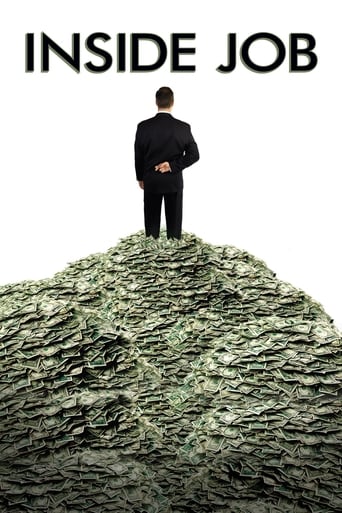
Inside Job
2010 · Film · documentary · 109 min
Directed by Charles Ferguson
A film that exposes the shocking truth behind the economic crisis of 2008. The global financial meltdown, at a cost of over $20 trillion, resulted in millions of people losing their homes and jobs. Through extensive research and interviews with major financial insiders, politicians and journalists, Inside Job traces the rise of a rogue industry and unveils the corrosive relationships which have corrupted politics, regulation and academia.
29 positive3 negative2 mixed5 neutralfrom 39 commenters
Where to watch
No streaming data for this title.
44 comments on Hacker News
We need more knowledge sharing on the topic of negotiating with VCs. Charles Ferguson's book was good, followed by the Venture Hacks blog from AngelList, https://www.amazon.com/High-Stakes-No-Prisoners-Internet/dp/0812931432/
What we have here is a rare thing - an unvarnished account by an insider of what it took to make a deal with the VC sharks during the dawn of the Internet Age and come out of it with something you could take to the bank. You wont find many other tech business books giving such a detailed account from start to finish. Though it is lacking on the technical side, the view from the 'money guys' is pretty detailed. It is pretty amazing to realize the whole arc of the story is only about two years.. To then leverage his proceeds into some constructive social documentaries like 'Inside Job' is a great second act..
Haven't you seen the documentary Inside Job covering the 2008 financial crisis? "Burning it all down and starting over" is a very immature and myopic perspective and cannot be taken seriously as a workable solution. The solution is to implement regulation that, very broadly here, enacts mechanisms to make private gain for public loss something incredibly difficult to do.
There need to be checks against people in positions of great wealth, power, and influence because people cannot be trusted to self-regulate and Do the Right Thing when large sums of money are on the table. "Self-determination of a conflict of interest is itself a conflict of interest."
[0] https://en.wikipedia.org/wiki/Inside_Job_(2010_film)
[1] https://www.youtube.com/watch?v=T2IaJwkqgPk
[2] https://www.bloomberg.com/news/articles/2025-02-05/white-house-says-musk-will-police-his-own-conflicts-of-interest
Margin Call is amazing! Also, I recommend Charles Ferguson’s documentary „Inside Job“ on the financial crisis
For folks who won't recognize the name, here's a fragment of the movie "Inside Job" (on 2008 financial crisis) about Greenspan's beginnings[1]. The name comes up several times in this documentary - never in a positive light.
[1] https://youtu.be/T2IaJwkqgPk?t=919
Inside Job (2010) - documentary about the 2008 financial crisis and policies leading up to that years before. Sort of like the documentary version of The Big Short. Narrated by Matt Damon. Interesting and informative about the catalysts for the crisis.
Full movie on YouTube:
https://youtu.be/T2IaJwkqgPk
"The Social Dilemma", what a great documentary showing how ad business, recommendations, attention grabbing works in social networks and how it impacts society, it basically shows "how sausage is made" and how it impacts the whole world and the risks associated with it https://www.imdb.com/title/tt11464826/?ref_=nv_sr_srsg_0
"Planet Earth II", breathtaking documentary about animal life on earth with extraordinary scenes https://www.imdb.com/title/tt5491994/?ref_=rt_li_tt
"Inside Job", documentary about 2008 crisis, masterpiece, narrated by Matt Damon. https://www.imdb.com/title/tt1645089/
"The Last Dance", I'm not a fan of basketball, it's a doc about Michael Jordan, one of the best docs I've seen, sounds boring but you can't wait to watch the next episode, recommended even if you don't watch sports like me, it's about extraordinary person/athlete and what it takes to be GOAT https://www.imdb.com/title/tt8420184/?ref_=rt_li_tt
"Zero Days", great doc about stuxnet exploit https://www.imdb.com/title/tt5446858/?ref_=rt_li_tt
"Human", what it is to be a human from different perspectives https://www.imdb.com/title/tt3327994/?ref_=rt_li_tt
"Over the Limit", documentary about olympic gymnastic and shows the price of winning at any cost. https://www.imdb.com/title/tt8184202/?ref_=rt_li_tt
"Life Story", beautiful doc about animals, great scenes https://www.imdb.com/title/tt4150884/?ref_=rt_li_tt
"Planet Earth", extraordinary scenes of animals lives https://www.imdb.com/title/tt0795176/?ref_=rt_li_tt
"Blue Planet II", like Planet Earth but in water https://www.imdb.com/title/tt6769208/?ref_=rt_li_tt
"Cosmos", doc about cosmos, nature of the world etc, very good https://www.imdb.com/title/tt2395695/?ref_=rt_li_tt
"The Tinder Swindler", "Posing as a wealthy, jet-setting diamond mogul, he wooed women online, then conned them out of millions of dollars." Surprisingly good https://www.imdb.com/title/tt14992922/?ref_=rt_li_tt
"The Farthest", about first human made object leaving our Solar system https://www.imdb.com/title/tt6223974/?ref_=rt_li_tt
"Our Planet", https://www.imdb.com/title/tt9253866/?ref_=rt_li_tt
"Cartel land" https://www.imdb.com/title/tt4126304/?ref_=rt_li_tt
Inside job. The smartest guys in the room. Two excellent documentaries. One about the financial crisis two about the fall of Enron.
The bigger non-financial question, as the Inside Job (2010 documentary) claims, is that this expert witness ecosystem is a conflict of interest for academic experts. If I am a real estate economist, and an investment bank wanted to hire me to testify that the mortgage-backed securities bubble wasn't the result of negligent behavior, wouldn't I be inclined to publish papers to that effect? Naturally I'd also leave my engagements with those banks off my CV.
Big Short was a movie that other people loved but I just didn’t really like all that much. I don’t even know why. I think maybe the cameo scenes made it feel a little dumbed down?
I’d also watched Inside Job not long prior and really enjoyed it, but others found it too dry. Different strokes I guess.
You’ve just described the Glass-Steagall act. It has a long and storied history.
It was created in response to the Great Depression, then repealed by the Gramm-Leach-Bliley act because money. Then the Dodd-Frank act tried to have it reinstated but failed, also because money.
You may already be familiar with all of this but mentioning in case you’re not.
(https://en.m.wikipedia.org/wiki/Glass–Steagall_legislation)
There’s a quite brilliant documentary that came out in 2010, Inside Job, that covers this, but which was completely overshadowed by the much less informative The Big Short which came out 5 years later.
> Can someone here enlighten me how a default can be "contagious"?
The 2010 movie "Inside Job"[1] about financial crisis in US presents real-life examples, starting with the Icelandic financial crisis.
There is also this Warren Buffet interview[2] which presents his unique viewpoint on what happened in the US around the time Lehman Brothers defaulted in 2008. You probably won't gain any knowledge from it other(edit) than how the financial sector assigns blame.
edit: word "other" added in previous paragraph
[1] https://www.youtube.com/watch?v=T2IaJwkqgPk "Inside Job (2010 Full Documentary Movie)"
[2] https://www.youtube.com/watch?v=k2VSSNECLTQ "Warren Buffett Explains the 2008 Financial Crisis"
Same.
By the way, I thought Inside Job was a vastly better film about the crisis that was criminally under-rated. Definitely worth checking out.
Not perfect by any means, but far more informative than The Big Short, and not as dumbed down.
You assume that experts are completely impartial. Or ethical.
They aren't.
See "Inside Job" - an excellent documentary about the 2008 financial crisis. Highly credentialed Harvard, MIT, Columbia professors produced reports for Wall Street to convince buyers to buy their toxic financial products (while collecting enormous fees).
I am all for science, but one needs to watch out for $cience.
https://en.wikipedia.org/wiki/Inside_Job_(2010_film)
In no particular order:
- Inside Job - https://www.imdb.com/title/tt1645089/
- Planet Earth - https://www.imdb.com/title/tt0795176/
- Restrepo - https://www.imdb.com/title/tt1559549/
- The Tillman Story - https://www.imdb.com/title/tt1568334/
- Chernobyl (??) - https://www.imdb.com/title/tt7366338/
- Hoaxed - https://www.imdb.com/title/tt8991264/
The Venus Project: Future By Design - By Jacque Fresco. Introduced Jacque Fresco's philosophy, R.I.P., and also the empathy we must have in designing something that is good for the planet and for the future. I highly recommend.
Mike Maloney's "Hidden Secrets of Money" is a beautiful set of YouTube documentaries financed by Mike himself. It educated me and millions out there how money really worked in the real world, and how the Federal Reserve and banking manipulates currency. https://goldsilver.com/hidden-secrets/
The Corporation - When Corporations started to get the same rights and treatment as regular citizens, we have created a monster that have changed our world for the worst.
The Cove and Blackfish. Really sad and made me stay away from Sea World and circuses and places that held animals in captivity for entertainment.
The Fog of War: Eleven Lessons from the Life of Robert S. McNamara - The 11 lessons are worth learning: https://en.wikipedia.org/wiki/The_Fog_of_War
Enron: The Smartest Guys In The Room/Inside Job - When corporations are run by sociopaths.
An Inconvenient Truth - Global warming.
Diana Vreeland: The Eye Has to Travel/Bill Cunningham New York - Learned so much about creativity and just being true to your unique self regardless of what the world thinks.
Zeitgeist - Esoteric knowledge.
Here's my list of 10/10 documentaries:
Biopics and Portraits:
- Kung Fu Elliot (https://www.imdb.com/title/tt3228302/?ref_=rt_li_tt)
- Listen to Me Marlon (https://www.imdb.com/title/tt4145178/?ref_=rt_li_tt)
- Man on Wire (https://www.imdb.com/title/tt1155592/?ref_=rt_li_tt)
- My Winnipeg (https://www.imdb.com/title/tt1093842/?ref_=rt_li_tt)
- A Gray State (https://www.imdb.com/title/tt6794380/?ref_=rt_li_tt)
- Happy People: A Year in the Taiga (https://www.imdb.com/title/tt1683876/?ref_=rt_li_tt)
- Valley Uprising (https://www.imdb.com/title/tt3784160/?ref_=rt_li_tt)
- You've Been Trumped (https://www.imdb.com/title/tt1943873/?ref_=rt_li_tt)
Environmental:
- Cowspiracy: The Sustainability Secret (https://www.imdb.com/title/tt3302820/?ref_=rt_li_tt)
- The Cove (https://www.imdb.com/title/tt1313104/?ref_=rt_li_tt)
- Chasing Coral (https://www.imdb.com/title/tt6333054/?ref_=rt_li_tt)
- Virunga (https://www.imdb.com/title/tt3455224/?ref_=rt_li_tt)
Crime:
- Cartel Land (https://www.imdb.com/title/tt4126304/?ref_=rt_li_tt)
- The Act of Killing (https://www.imdb.com/title/tt2375605/?ref_=rt_li_tt)
- The Culture High (https://www.imdb.com/title/tt1778338/?ref_=rt_li_tt)
- The Jinx: The Life and Deaths of Robert Durst (https://www.imdb.com/title/tt4299972/?ref_=rt_li_tt)
- West of Memphis (https://www.imdb.com/title/tt2130321/?ref_=rt_li_tt)
- How to Make Money Selling Drugs (https://www.imdb.com/title/tt1276962/?ref_=rt_li_tt)
- The Fear of 13 (https://www.imdb.com/title/tt5083702/?ref_=rt_li_tt)
- Brother's Keeper (https://www.imdb.com/title/tt0103888/?ref_=rt_li_tt)
- Auschwitz: The Nazis and the 'Final Solution' (https://www.imdb.com/title/tt0446610/?ref_=rt_li_tt)
Reflecting on Life and Death:
- Given (https://www.imdb.com/title/tt4890452/?ref_=rt_li_tt)
- Extremis (https://www.imdb.com/title/tt5538078/?ref_=rt_li_tt)
- Touching the Void (https://www.imdb.com/title/tt0379557/?ref_=rt_li_tt)
- Attention: A Life in Extremes (https://www.imdb.com/title/tt2846628/?ref_=rt_li_tt)
Society:
- Israel vs Israel (https://www.imdb.com/title/tt1753960/?ref_=rt_li_tt)
- Inside Job (https://www.imdb.com/title/tt1645089/?ref_=rt_li_tt)
- The Overnighters (https://www.imdb.com/title/tt3263996/?ref_=rt_li_tt)
The Venus Project: Future by Design
The Corporation
Inside Job
HBO's documentary on Warren Buffet
Who Killed The Electric Car?
I recently watched the documentary Inside Job. It's on the 2008/09 financial crisis. It quite convincingly alleges Goldman and Citibank of creating a bubble and betting on it. A recommended watch.
Here is the list of my favorite documentaries: - The Cove - Food, Inc. - The Century Of The Self - Inside Job - Earthlings - Samsara - Earth - A Map For Saturday - The Story Of India
The sad fact is that academics these days occupy themselves with chasing money and power, not science (at least the ones in "elite" schools).
Check out the movie "Inside Job":
- Glenn Hubbard (the Dean of Columbia University School of Business). His work for Countrywide Financial for $1200/hr, attesting that the lender's loans were no worse than a control group of mortgages and not fraudulent, was examined by an attorney for MBIA. MBIA was suing Countrywide over its mortgage practices.
https://en.wikipedia.org/wiki/Glenn_Hubbard_(economist)
- Frederic Mishkin, who, according to the Wall Street Journal, was paid almost $135,000 by the Icelandic Chamber of Commerce in 2006 to author a report that praised the stability of Iceland's economy and banking system—two years before they collapsed.
https://en.wikipedia.org/wiki/Frederic_Mishkin
Most of the profs in "elite" business schools sit on boards of big companies like GE, are members of Council on Foreign Affairs, etc.
Just sad.
Then you don't understand what has happened to academia. Oil and tobacco companies are not the only people paying to have their propaganda given a sheen of credibility. The movie 'Inside Job' narrated by Matt Damon, for all of its faults, makes a fool out of the dean of Columbia business school for shilling for the banks during the bailout.
When I scrolled down and saw that derivatives were so large by an order of magnitude I was reminded of this awesome 2010 Oscar winning documentary that I only watched a couple of weeks ago:
Inside Job: https://archive.org/details/cpb20120505a
It's about how US executives created the financial crisis back in 2008 and is pretty relevant here. I'd well recommend watching it...some of the information provided is uniquely depressing and terrifying.
There's no honesty really, in economics. Not even when they give nobel prizes[1].
Also in the documentary "Inside Job"[2] is clearly stated that "neoliberal school" (Chicago or New Chicago or whatever) is pushed through universities as the mainstream economic thinking.
[1] http://yanisvaroufakis.eu/2013/10/14/economics-nobel-2013-an-instinctive-reaction/
[2] http://www.imdb.com/title/tt1645089/
Here's a bit of background info on Emil Michael's career and degrees.
http://blog.uber.com/Callinicos_Michael_Baker
"Emil Michael, formerly Chief Operating Officer of Klout, and prior to that was SVP of Field Operations at TellMe Networks, is joining Uber as our SVP of Business. Emil is known as one of the top deal guys in the Valley, a strategic deal maker who also brings experience scaling sales organizations. I am counting on Emil to be the leader of our business efforts and the face of Uber to our business partners and users globally. Emil starts with Uber today."
From his bio on business week
Mr. Emil Michael served as Senior Vice President Field Operations at Tellme Networks, Inc. He joined Tellme in June 1999 and he held several leadership roles as the director of business and corporate development, vice president of client development and acting general counsel. Mr. Michael led the client development, account management and solution delivery teams at Tellme. He joined Tellme from Goldman Sachs, Inc., where he served as an associate in the communications, media and entertainment investment banking group. At Goldman Sachs, Mr. Michael worked on several equity and bank debt financings. He also participated in merger and hostile takeover advisory projects for several of Goldman Sachs' Fortune 100 clients. He began his career as a strategy consultant at Gemini Consulting's converging markets laboratory in Cambridge, Massachusetts. Mr. Michael received his bachelor of arts degree from Harvard and his law degree from Stanford University.
From the wikipedia page
http://en.wikipedia.org/wiki/Emil_Michael
An immigrant from Egypt,[5] Michael received his B.A. in Government cum laude from Harvard University, where he wrote for the Harvard Crimson[6] and served as president of the Harvard Republican Club. While he was president, the club changed its name to the Harvard-Radcliffe Republican Club in an effort to reach out to potential members who perceived the club as sexist.[7] He received his J.D. degree with honors from Stanford Law School.[5]
So my understanding is that he isn't really a technologist, he is a Harvard government major followed by Stanford Law degree, he has a stint at Goldman Sachs, and he is a great deal maker.
Of course, I can't prove a negative - does anyone know if he did substantial technical work at some point?
Overall, I do think michaelochurch is accurate in pointing out that Emil Michael doesn't appear to be a lifelong technologist. He may represent a new trend in tech management - dealmakers who aren't really versed in technology and haven't really been directly involved in building technology products themselves.
Is this relevant? It reminds me of a statement from Elliot Spitzer in the movie "Inside Job" about corruption in the banking industry and the banking crisis.
Spitzer: "Well, high tech is a fundamentally creative business, where the valuegeneration and the income derives from actually creating something new and different"
I'm not sure I agree anymore (the collusion not to poach, for example shows a pretty bad pattern of behavior), but it is something to think about. If tech becomes dominated by finance, law, deal "guys" (this is the term used by uber to describe him), we may very well lose that culture that kept some of this kind of thing at bay because we were, at our core, a group of builders, people who are deeply involved in making things. This transformation may already be well underway.
A failure to accept the mere possibility of institutional corruption in free market enterprises was the defining failure of the Greenspan era. Regulators working through the '90s and the '00s could not have turned a blinder eye to the deleterious effects of their own capture on account of having no more blind eyes to turn. This was due, in large part, to the efforts of academic economists who laid the intellectual groundwork for deregulation of the financial industry.
Many members of the economic profession have yet to emerge from the fog of idiocy, corruption, and denial that let to / resulted from the faith misplaced in their malarky - much of which boiled down to the "wisdom" of Ayn Rand, thinly veiled.
The sum of Randian-in-Chief Greenspan's concessions to reality can be found here. Needless to say, it's a pretty brief read.
http://www.nytimes.com/2008/10/24/business/economy/24panel.html?_r=0
For a more extended piece of outrage - which really centers on the corruption of university economics departments - see "Inside Job", which won a (richly deserved) Oscar and which can be downloaded here:
http://vimeo.com/57527797
You can also watch the final 20 minutes (which is the most searing part, as well the section that focuses on the domain of academic economists) here:
http://vimeo.com/20170617
And you can read a bit more about the film here.
http://en.wikipedia.org/wiki/Inside_Job_(2010_film)
I have nothing to do with the making or selling of this film, by the way. I just think it's one of the sharpest accounts to emerge from the Fiasco of '08.
People learn through stories and pictures. The documentary is a powerful teaching tool. Not perfect, and it can mislead, but powerful.
I've spent more hours than I care to admit over the past year going through a range of material from slick and well-prepared documentaries (including several on this list: "Inside Job", "The Four Horsemen", "Capitalism in Crisis", How Many People Can Live on Planet Earth", "The Fog of War", "The Ascent of Money" (well, I read the book). "Collapse" with Michael Ruppert.
And a few which aren't on the list: "The Prize", on the story of petroleum, based on Daniel Yergin's book of the same name. James Burke's "Connections" and "The Day the Universe Changed". And numerous conference presentations, interviews, and various other presentations.
What's particularly useful is watching these not online through a crappy video player, but by downloading the videos, where I can stop and start playback, and by checking up on points (did that really happen? is there documentation of that fact?), and taking notes. Sometimes I'll breeze through a light topic at 140% realtime, in others it may take me most of a week to get through a 90 minute lecture.
Yes, books have their place, but a well-made documentary or series which mixes spoken word, visual imagery, demonstration, and other effects, hits on the keys your mind uses to form memories. I'd watched "Connections" decades ago as a child, but bits stuck with me, and it was interesting to watch myself anticipating Burke reciting "Hardwick Hall, more glass than wall", which I'd last heard some 30 years earlier.
Yes, there's material that tends toward the bogus, but sometimes watching good bogosity is decent training, or you can simply skip over that part of the list. I tackled an instance of this a few weeks back with an RT interview that was posted to HN: https://news.ycombinator.com/item?id=6905655 Dissecting the elements of conspiracy (or finding out that the conspiracists were right -- reading up on COINTELPRO and Operation HOODWINK (an attempt to set the Communist Party of the US and La Cosa Nostra against one another) from the FBI's own website a couple of days ago was sobering in context of Snowden and related allegations: http://vault.fbi.gov/cointel-pro/hoodwink).
Ruppert's a case of one of the shakier videos. His history's pretty solid, his near-term future somewhat bleaker than I suspect is strictly accurate. If you read on background, the director notes that the story is as much about a man unmade by his own pursuit of an idea: "What I hoped to reveal was ... that his obsession with the collapse of industrial civilization has led to the collapse of his life. In the end, it is a character study about his obsession." (Ruppert's since continued to have a pretty hard time).
Still, anyone not planning to be dead within fifteen years had better consider what happens on the energy, resources, population, and sustainability fronts to be the biggest factors in their lifetime.
Dismissing the documentary format out-of-hand as some have done here, is simply uncalled for. Actually, it's pretty much straight out of the old FBI playbook. Perhaps even the current one.
Precisely! Which is exactly what enrages so many people :)
(I must assume you haven't watched Sony Pictures' ca. 2010 documentary Inside Job yet?)
See the "Inside Job" (2010) documentary movie - (at least in USA) there were attempts to regulate the now unregulated banking activities. The banks' lobby was just too powerful and in result not only the banks remained unregulated, but the regulation system was reduced in staff and weakened.
In the case of economics it seems there might also be large conflicts of interest at play. The 2010 documentary, "Inside Job" http://en.wikipedia.org/wiki/Inside_Job_(film) about the economic crises talks about how several prominent academic economists are essentially paid to author studies that amount to not much more than puff pieces supporting a political view point of a political party or corporation.
On another note, given that the Fed has been "quantitatively easing" (seems to be a polite term for printing money) since the financial crisis and currently holds over 3 Trillion in government and mortgage debt those actions have to be keeping interest rates lower than they otherwise might be. It's kind of burying the lead to say interest rates are super low we should borrow a bunch of money when they are being intentionally kept that way through government action.
The point was not to establish whether "white collar crime" existed already but rather to emphasize how little attention was being paid to it at that point in time.
For example, since then inter-agency task forces have been established, media has begun covering the topics, books have been written and movies produced. http://en.wikipedia.org/wiki/Inside_Job_(film)
The general awareness is much higher (despite little action taken).
"tell me why all those professors we paid millions of dollars to study economics couldn't provide a convincing rebuttal to that ideology in advance of the crash."
Because many business and economics professors, esp. the prominent ones, make the majority of their income from consulting fees and by serving on boards of large corporations.
For example Frederic Mishkin a professor at Columbia Business School and a former member of the Federal Reserve Board of Governors authored a paper titled "Financial Stability In Iceland" shortly before the countries economy imploded from a credit bubble. As it turns out he was paid $124,000 to write it by the Icelandic chamber of commerce. http://en.wikipedia.org/wiki/Frederic_Mishkin
This and many similar examples are detailed in the documentary "Inside Job", though, it isn't something you hear about in the news much if at all.
In other words the study of business and economics has been corrupted by corporate money.
If you want a fictional account, rather than a documentary like the excellent Inside Job, I think a black comedy in the style of Dr. Strangelove might be more appropriate.
The documentary "Inside Job" covers why and how the "grading on a curve" happened. I'd recommend it if you're at all interested in this stuff.
Inside Job - the best documentary I've seen on the financial crisis of 2008 and what led to it.
There is no doubt that this is good cause. Yet, there is much to be pessimistic about it. First off, it will be excruciatingly difficult to produce a documentary of decent quality, comparable to ones such as "Inside Job", with only a budget of 150,000 USD. You definitely need to look to acquire a budget of at least 300,000 USD. Secondly, this documentary is extremely vulnerable to being thwarted by the "big six" media corporations. The only thing that stands in the way of corporations having complete power over the American people and their government is pro net-neutrality regulations. We will of course witness the perhaps the most determined onslaught on a small organization than we have ever seen taken by the corporations. Finally, creating and releasing a documentary presents the challenging fact that the current political situation concerning net neutrality changes at a rapid rate. A couple of examples would be how Obama campaigned on net neutrality, yet when he came into office his administration had corporations make a law that protected their interests over individual citizens. The other example is how Meredith Baker approved the merger of Comcast and NBC Universal and then resigned from the FCC to become the leading lobbyist for Comcast. This ever changing nature of net neutrality would make it necessary to release the documentary shortly after it has been filmed.
Somewhat unrelated but the documentary 'Inside Job' provides a brilliant insight into the financial mess that unfolded in the past years.
http://www.imdb.com/title/tt1645089/
Thanks for taking the time to offer a balanced opinion. I find myself largely agreeing with your sentiments.
I think there must be a better balance to be struck between the approach taken in Europe (seen as too difficult to fire people, which isn't conducive to a healthy business environment) and to the American approach (you can be fired at-will).
I myself like to watch US-based documentaries like Gasland, Food Inc., Inside Job and Boogie Man: The Lee Atwater story. I know these stories are biased, but I'm silently horrified by the sheer extent to which the odds are stacked against the good of the ordinary person in favour of big business. For example, in the film "Inside Job" an IMF banker made the extraordinary revelation that a Wall Street banker basically said to him in a meeting: "Please regulate us. We're too greedy. If you don't regulate us we'll continue to cause markets to blow up because we can't help ourselves." This was before the bailouts, so the banker was genuinely terrified that the banking system would utterly collapse and that they would lose everything.
Also important however, is to ponder on why America is so rich and why America to a large extent drives the global pace of innovation. There are smart, ambitious people there who can get access to capital and raw talent that is unavailable anywhere else in the world. These conditions must have sprung up in America for a reason - the environment was fertile enough for them to take root. By having a thriving, innovative economy, everybody wins. The standard of living improves for everyone. You get to keep your sovereignty by being rich - just look at the PIIGS (Portugal, Italy, Ireland, Greece and Spain). They lost economic sovereignty (except for Spain, but it could happen to them too) by being economically weak. (You can also lose political sovereignty if you are poor, as you can't afford all the military hardware to fight off an enemy). I would urge you to read "The Ascent of Money" by Niall Ferguson. He makes excellent points as to why money, and innovations like bonds, stock and insurance actually drive countries forward. For example, the riskiness of the Dutch voyages to the far-East in the late 1500s onwards were mitigated against by forming a limited-liability company, where stock could be sold to ordinary investors. If it weren't for this innovation, then the risk of the voyage would have turned people off from financing such a risky prospect. The voyages were highly successful overall and a remarkable new financial innovation was born. I think what you see in America today is a mix of these very good ideas with some very bad ideas too.
"To answer your question though, I do believe that it is roughly true that pursuing riches makes it harder to be a moral person. It's not impossible but I do believe it is harder. It is my belief that in a majority of cases one's morality and perception of what is right/wrong/acceptable changes for the worse as they acquire more money."
Money certainly seems to change people (can't say first hand because I'm one of those aspiring millionaires!) I think if you have a solid moral compass to begin with, and realise just because you may be wealthier than someone else doesn't make you better or more important than them, then you will be ok. This is probably difficult as you've mentioned. However, look to the likes of Warren Buffett - he's giving nearly all of his fortune to charity. Or Elon Musk, who is using his wealth trying to advance electric vehicles because the incumbents either can't or won't, and to further space exploration also. Or Bill Gates, who after a career being accused or being a bully and a monopolist, seems to be using his wealth and privileged position to try to make the world a better place. So there is cause for optimism for being wealthy doing the right thing.
"I believe it is true that the love of money is the root of all evil (as a rough approximation)."
My take is that the blind pursuit of money, to the detriment of other considerations, is the root of (some/all) evil. The lack of money causes a lot of evil too.
How do you implement a socialist society correctly? Those indigenous societies (can you give some specifics?) probably did not operate under a socialist government banning property rights, but voluntarily worked together. There is nothing un-capitalist about this -- after all, capitalism is all about freedom (hence the title of Milton Friedman's first book), and people are free to do as they please. Even further, the people of these societies are probably closely related and thus more predisposed to help each other. It's not surprising large heterogeneous societies like ours don't operate the same way.
I saw "Inside Job" and did not come away with the same conclusions, and I think there is probably more to be said about one of the greatest banking crises in history than a 2-hour documentary. Indeed some poor regulations were factors in the crisis, but that does not mean that all regulations everywhere are good, and any kind of dis-regulation is bad. The internet seems to be operating fine without heavy regulation.
One lie after another:
- "Is there some society you know that doesn't run on greed?" : Capitalism greed has been powered and carried to present levels by the capitalist system. Indigenous societies ran mostly on a community of people working together to satisfy the community's needs. There was an "ours" instead of a "mine". Socialist societies (when implemented correctly, nor Russia or China are) are an example of the pursuit of a "common wellbeing" rather than a "only my wellbeing".
- Citing Einstein as an "individual achievement" is incorrect, to say the least. Of course he was a genius and achieved a lot on his own, but most of these scientific achievements are performed through a team of colleagues, not by a "lone cowboy".
- All of his remarks point to a unregulated market, which was the seed of the 2008 crysis. For more information, see the "Inside Job" movie. There's no need to say anything else about that. I think the facts speak for themselves.
- "Do you think american presidents reward virtue?" And do you think american enterprises reward virtue? Or do they reward friends and family instead?
You should do what makes you happy, but you should realize that the film "Inside Job" wasn't designed to be an objective overview but rather an attack piece against the financial industry. It's as reliable as a Goldman Sachs press release.
However if you're not comfortable with restriction and tracking, you're right the financial sector probably isn't right for you. The financial sector like the medical and defence sectors are hugely regulated (with good reasons), so computers, etc. tend to be locked down far more than in other sectors.
The world of high finance has intrigued me as of late. I recently watched the documentary "Inside Job" and it made me feel incredibly stupid, so I've set out to learn what I can about the industry. What an odd little world of its own.
I can't even say any more than that about the article - it would be like when my Mom tries to talk about programming. I just thought I'd drop a little plug for the film here (no affiliation) in case anyone else wanted an interesting and easy starting point for this stuff :)
I've found Nocera's commentaries on NPR to be unusually frank. Perhaps I'll check out his book.
Speaking of documents of the financial crisis (though it's not a book), I went to see Inside Job last night, partly because I'm interested in the subject and partly because a weird sort of hey-he's-a-startup-guy-too loyalty inclines me to patronize Charles Ferguson's movies. It's an overview that falls a little short as a movie, i.e. it doesn't quite structurally hold up to the level of outrage it's going for. The most interesting thing, though, is how Ferguson devotes the last quarter of the movie to ripping academic economists a new one for their shoddy work and gaping conflicts of interest. Given that he started out as a policy wonk on the Ivy League/DC circuit, it seems clear that this is where his heart is. I felt very uncomfortable watching those segments (Ali G makes me squirm too) but it seemed like it needed to be done.
Edit: Also, Nouriel Roubini, on whom the film relies heavily, turns out to be surprisingly good onscreen.
Of course a movie titled "Inside Job" is going to be biased. That doesn't mean that the movie is wrong, though.
Some of your comments strike me as a little naive and ill informed.
For starters, it wasn't just the housing bubble the caused the collapse.
Secondly, it wasn't long ago that banks wouldn't lend to people who didn't have a stable income. Patronizing? Maybe. But did you know that they specifically targeted loans at people without an income? No bank can profitably loan to people like that! In Germany the banks are far more regulated; there really is no comparison.
Telling people they can afford something when they can't isn't fraud. Never has been, either.
I agree that better education is a step in the right direction, but no education is going to compensate for group behavior. When you earn roughly as much as your friends do and they all buy big houses in good neighborhoods (that they obviously can't afford) then you're going to want a similar house too. It's human nature. If nobody in the group could get a big mortgage the problem would disappear.
Regulation has kept banks from acting irresponsibly in the past and regulation can keep banks from acting irresponsibly in the future.
Where can that movie "Inside Job" be found? It is on imdb but not on youtube nor on amazon.com