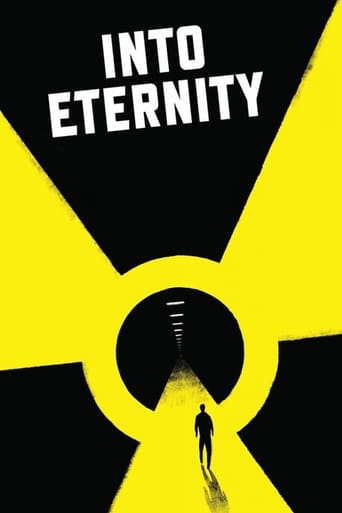
Into Eternity: A Film for the Future
2010 · Film · documentary · 75 min
Directed by Michael Madsen
Every day, the world over, large amounts of high-level radioactive waste created by nuclear power plants is placed in interim storage, which is vulnerable to natural disasters, man-made disasters, and to societal changes. In Finland the world’s first permanent repository is being hewn out of solid rock – a huge system of underground tunnels - that must last 100,000 years as this is how long the waste remains hazardous.
29 positive1 neutralfrom 30 commenters
Where to watch
No streaming data for this title.
33 comments on Hacker News
Also a very good documentary: https://en.m.wikipedia.org/wiki/Into_Eternity_(film)
There is a beautiful, somewhat depressing Danish documentary about this issue called Into Eternity (2010) [1] (it's also on YouTube [2]), about the Finnish nuclear reactions at Onkalo.
They faced the exact same problem as in the U.S. about how to store the waste safely and warn future generations about the dangers of accessing the waste.
[1] https://en.wikipedia.org/wiki/Into_Eternity_(film)
[2] https://youtu.be/ayLxB9fV2y4?si=4VoMTuV6aWTzpquA
There's a great documentary called "Into Eternity" from 2010 about the Norwegian solution for the nuclear waste problem.
In the documentary "Into Eternity" about Onkalo - the Finnish deep nuclear waste repository. One of the engineers mentions that when they were digging the first holes, they joked they would find copper canisters full of (now unradioactive) waste - buried by a long lost forgotten civilisation.
A large part of the film is all about how to mark the site, deter future civilisations from digging it up:
https://www.youtube.com/watch?v=lBqyb3qfHCE&t=63s
Recommend watching the documentary "Into Eternity":
https://en.m.wikipedia.org/wiki/Into_Eternity_(film)
https://www.youtube.com/watch?v=ayLxB9fV2y4
> dry storage in hard rock in some rock formation that hasn't done anything in millions of years
that's exactly why they chose it and it makes a lot of sense.
If the environment is so stable, you don't have to worry about earth own internal movements too much.
This is old news, it's been amply debated, there's a documentary by Michael Madsen titled "Into Eternity" where pros and cons are discussed at lenght, the movie is from 2010, 13 years ago.
You can find it on YouTube
https://www.youtube.com/watch?v=ayLxB9fV2y4
There was a documentary about this by Michael Madsen in 2010 called Into Eternity.
It's a good problem space to explore, so I hope that you keep on pushing this research further :) I have a few things that might give you some ideas if you're interested in this sort of Chifir-aligned thinking.
I take it that you've already considered other register OISCs like subleq, of course, but you might not have considered Fractran. It's a OISC register machine with mul as its only operation, worth a look if you're rooting for register/tape machines.
Looking the other way, toward BLC, you might enjoy Iota/Jot as a ultra-minimal reduction system. Implementing such a system is even faster than doing something like bfs.
My opinion is that all these sequential machines are going to fall out of favor for highly parallelizable systems in the near future. For a future system of a size comparable to brainfuck. I'd look at interaction nets, with only 6 reduction rules, interaction nets are a likely candidate, or are at least worth a look. It's just a stack of interaction between nodes that can be reduced in any order to achieve computation.
Moving beyond, it's likely that cellular automata systems will prevail over everything else that I've mentioned above. Something like a 4-state(a-la wireworld, qu-ant), is easily communicable with pictograms, highly parallelizable, and in some cases reversible.
On communicating ideas in the far future, the movie Into Eternity, talks about how to communicate a danger to the people who would stumble on a nuclear deposit. There is a segment about language that might be interesting to you.
Anyways, I hope that you keep on researching this.
There is nice arty documentary film ”Into eternity” about Onkalo (made already 2010) https://www.youtube.com/watch?app=desktop&v=ayLxB9fV2y4
How interesting, I was just reading about this in the context of nuclear semiotics and how to pass down warnings about the danger of nuclear waste. (This is a really interesting topic without much in the way of clear answers, depending on what you're optimising for. Highly recommend reading the Wikipedia page[0] at a minimum.)
There's apparently a documentary on this project, "Into Eternity," released in 2010, which has been on my list since earlier this morning (i.e., since I read about its existence).
0. https://en.wikipedia.org/wiki/Long-term_nuclear_waste_warning_messages
About delays and cost overruns, I highly recommend that people read about the Olkiluoto Nuclear Power Plant in Finland. The delays and cost overruns are totally insane, yet they claim (on Wiki):
Even taking into account all OL3 construction delays the long term LCOE target for all three plants is 30 EUR/MWh. LCOE for the OL3 reactor alone is estimated at 42 EUR/MWh.
My "envelope maths" tells me that generating electricity from OL3 is twice the cost of OL1+OL2: 18 EUR/MWh vs 42 EUR/MWh.
The main Wiki article includes a long list of reasons for delays and cost overruns.
The construction project also included very long term, underground storage. On YouTube, you can find a great, if slightly creepy, documentary about it called "Into Eternity".
You might be interested in the Michael Madsen documentary "Into eternity" about the Onkalo waste repository in Finland, that should supposedly last 100 thousands years. It's mostly about the difficulties of conveying a message of danger to future generations (or civilizations)
A very interesting topic is that they hope that the repo is forgotten, nobody will remember about it and nobody will go looking for it or become curious about it and what's inside of it, as it is described "a place we have to remember to forget".
https://en.m.wikipedia.org/wiki/Into_Eternity_(film)
Does this still create waste that is dangerous for thousands of years?
My understanding is that there is no long term solution for storing dangerous nuclear waste. They try burying it super deep in mountains. But can't be sure that it won't get out in the next few thousands of years.
Everybody watch the documentary "Into Eternity" on the subject. Amazing.
The documentary Into Eternity is a very fascinating look into the kind of longtermist questions that must be answered for a project like this, like: how do you write warning signs that are supposed to be read 50k years from now, warning not to open the storage vault? What kind of language do you use?
https://en.wikipedia.org/wiki/Into_Eternity_(film)
There's a documentary that explores this idea: https://en.wikipedia.org/wiki/Into_Eternity_(film)
They deal with exactly the problems you're imagining. How do you convey danger to a civilization 100,000 years in the future? How do you get them to take your warnings seriously? (We'd ignore any warning in the Egyptian pyramids created only ~5,000 years ago) How do you handle earthquakes and other natural disasters?
I found it interesting and you might too.
If everyone agreed on everything, the world would be less fun ! My main problem with nuclear fission is that we generate a lot of waste that is almost impossible to dispose of and very dangerous. We don't even know, in case of a civilization breakdown, how people would manage the situation if knowledge was lost. [0]
edit : ray of hope here [1b]
Currently there has been many accidents with nuclear power, and we don't know how to manage those. Fukushima is still releasing lots of radioactivity in the sea. Yet radio activity about this is close to zero. [1]
And new ways to tap into fission power (pressurized reactors) are dangerous and hard to build.
Yet, I shall agree with you, that there is no definite solution to the energy problem, consuming less would be a good start.
[0] https://en.wikipedia.org/wiki/Into_Eternity_(film)
[1] http://www.asahi.com/ajw/articles/13228942
[1b] https://futurism.com/the-byte/nobel-prize-lasers-destroy-nuclear-waste
There's a great documentary about this, called _Into Eternity_. Highly recommended.
There is a 2010 documentary called "Into Eternity" about building an underground nuclear storage facility in Finland. It also covers the problem of how to warn people very far into the future.
If anyone finds this interesting the film "Into Eternity" is about the construction of Onkalo, a huge underground nuclear waste store in Finland. It's a nice watch, trailer here: https://www.youtube.com/watch?v=xoUkhOup1C4
Easier as in lower-hanging fruit, from a stylistic point of view. It's harder to make things interesting if you can't resort to the tricks of the Hollywood trade such as emotionally manipulative music, sound effects, dramatic zooms and rapid editing.
I recognize and appreciate Ken Burns' craft and find his documentaries interesting and intelligent and clearly well-researched, but I also find his work to be extremely bland. Maybe it's because his style has been endlessly copied (I don't know if this is actually the case), but a Ken Burns documentary comes across, to me, like every American History Channel or Smithsonian Channel documentary blended together; it moves at a predictable, slow pace, always with a magisterial-sounding faceless narrator (usually Peter Coyote), featuring music tailored to each scene (from folksy to solemn or patriotic; if there's a saloon on screen there'll definitely be ragtime or bluegrass playing), and always with the air of solemn respectability.
I'm a much bigger fan of directors like Errol Morris, Werner Herzog and Michael Madsen (Into Eternity), who enliven the format with fewer clichés.
This reminds me of the excellent Finnish documentary "Into Eternity" which treads into the same territory and takes a few steps further.
How do you communicate with a civilization that has no ties with to the current one?
This is one proposed experimental solution in category "deep geological repository". https://en.wikipedia.org/wiki/Onkalo_spent_nuclear_fuel_repository
Related nice documentary where they cover the questions: https://en.wikipedia.org/wiki/Into_Eternity_(film)
I'd recommend anyone interested in this question to watch "Into Eternity" (available on YouTube), a documentary about the facility Finland is building to house all of their country's nuclear waste.
What do you think about this documentary re: Finland storing waste in their version of Yucca:
>This film explores the question of preparing the site so that it is not disturbed for 100,000 years, even though no structure in human history has stayed standing for such a long period. "Every day, the world over, large amounts of high-level radioactive waste created by nuclear power plants are placed in interim storage, which is vulnerable to natural disasters, man-made disasters, and societal changes. In Finland, the world’s first permanent repository is being hewn out of solid rock – a huge system of underground tunnels – that must last the entire period the waste remains hazardous: 100,000 years."
https://en.wikipedia.org/wiki/Into_Eternity_(film)
https://www.youtube.com/watch?v=gQ3dT7xcMgU
You watched the Onkalo documentary 'Into Eternity' ? They have similar problems, except for nuclear waste. A hard sci-fi leaking into the real world. Very odd. https://youtu.be/HeVPMzJOFrQ
It's not that simple. Check out the documentary "Into Eternity" on the impracticability and difficulty of "burying" nuclear waste which remains deadly for 250,000 years.
While I strongly disagree with you on nuclear power (especially since radioactive decay means that 'eternity' by definition is always safe, unlike chemical waste), I strongly agree that "Into Eternity" is a must-watch.
The only real long-term risk to geological disposal are future humans. The question the documentary adresses is 'how to communicate to future generations not to dig there'.
I wonder why hacker news is so positive on nuclear power. The article is full of false information or misguided information. I always recommend "Into Eternity" to understand why nuclear is one of the worst options for eternity ;) https://en.wikipedia.org/wiki/Into_Eternity_(film)
There is a documentary about the same issue called 'Into Eternity'[1]. The film focuses on the Onkalo spent nuclear fuel repository[2] being created in Olkiluoto, Finland. It deals with the issues of creating something to last for the massive time frame and the communication issues presented in this article.
1- https://en.wikipedia.org/wiki/Into_Eternity_%28film%29 2- https://en.wikipedia.org/wiki/Onkalo_spent_nuclear_fuel_repository
just watch http://en.wikipedia.org/wiki/Into_Eternity_(film) for a start ... (it can silently kill even in generations).
There is a really nice documentary about finland future-proof attempt to store nuclear waste: https://www.youtube.com/watch?v=GmWadizC8AQ - Into eternity. that deals with the same topic.
It shows how they are building it and how they thought about how to prevent future generations to go there.
This one in from 2003 , but I watched it this year: Memories of a Murder http://www.rottentomatoes.com/m/memories-of-murder/. It's about the first recorded serial killer from Korea. There is also 2 amazing documentary: Into Eternity http://www.youtube.com/watch?v=qoyKe-HxmFk and Nostalgia for the Light http://www.youtube.com/watch?v=ok7f4MLL-Hk
Downvote me if you want, yet I'm really sad about Hacker News. This is the 4th or 5th pro-nuclear propaganda article up-voted in a couple of weeks. Personally, I'm always sceptical about superlatives.
Yes right ... the safest. Especially, for our children and their children. For everybody who's a proponent of nuclear: If it is so save, why can't you get one insurance company to insure a plant against accidents? And what do we do with the waste? How do we deal it? How do we make it clear for coming civilizations that they are not supposed to dig there etc. as the the waste will stay hazardous for 100,000 years?
Please watch: http://en.wikipedia.org/wiki/Into_Eternity_(documentary)
Is there any other way to make electricity that puts that high of a burden on coming generations? Maybe I'm totally off, yet can effects from coal/water/wind/sun power plants kill people 100 years after they been shut down?