 Hacker Cinema
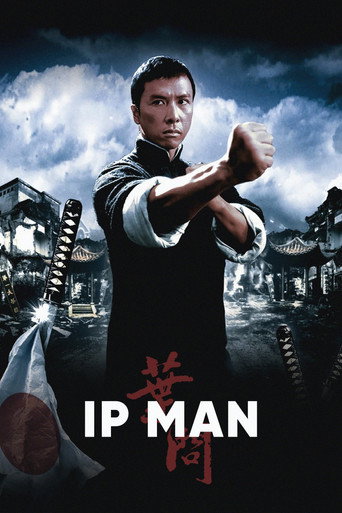
Ip Man
葉問
2008 · Film · 106 min
Part of Ip Man Collection
Directed by Wilson Yip
A semi-biographical account of Yip Man, the first martial arts master to teach the Chinese martial art of Wing Chun. The film focuses on events surrounding Ip that took place in the city of Foshan between the 1930s to 1940s during the Second Sino-Japanese War. Directed by Wilson Yip, the film stars Donnie Yen in the lead role, and features fight choreography by Sammo Hung.
8 positive3 negative7 neutralfrom 18 commenters
Where to watch
No streaming data for this title.
18 comments on Hacker News
I think it makes sense that historically American film focused on narrative based dramas and slow burn horror. Think of classic Hollywood hits such as Citizen Kane and Psycho. This is even apparent in the recent success of Obsession, which really follows strongly in the trend of Hitchcock, magical realism, human drama, psychological horror.
Compare this with historically successful Honk Kong films: Kung Fu Hustle, Police Story, Ip Man. I mean there are examples of Hong Kong films that are slow burn human dramas, like Chungking Express and Eat Drink Man Woman, and successful American action films like Diehard, but I think its clear that Hollywood film didn't start out with action movies, and Hong Kong film didn't start out with slow burn dramas, but adopted these genres afterwards; you could even claim that successful Hong Kong films like the Bruce Lee films of the 70s fueled the American appetite for action in the 80s, which was the most prominent era for that genre in the US.
As a corollary to this, it becomes clear that the Korean and Japanese film making industries are not as culturally distinct from Hollywood as Honk Kong film making is. For Korean film, the reason is obvious: Koreatown in Los Angeles is right next to Hollywood, in some respects is a part of Hollywood, and there are deep ties now between the Korean and American film making industries for that reason, and Korean-Americans have an overly high degree of representation in American media, and Korean productions often come to America to shoot (think of the end of Squid Games: it's almost certainly the case that they shot in LA because a producer has a cousin or something that works in Hollywood).
There's plenty of good fights out there recently... this writer just hasn't watched them.
Korea is putting out a ton of great action. Obviously stuff like Oldboy and Man From Nowhere, but watch The Yellow Sea, or the recent Netflix show Bloodhounds and be amazed (though the ending kinda falls off a cliff). Worst of Evil too, some solid stuff in there. The Japanese show Avalanche had some amazing ones, and the movie Hell Dogs. China's Longest Day in Chang'an has a lot of good fights and is visually one of the best shows in years. Ip Man and countless other martial or wuxia films (though the vibes are different)... Raging Fire (last fight was amazing), anything with Donnie Yen. Indonesia and Thailand are out here too with a lot of lower budget stuff. This is all just off the top of my head.
Admittedly that's all SE Asia, US sensibilities tend more toward gunplay since in this country people pull a gun out when someone looks at them wrong. There's no martial tradition. But film and TV is global now - the US outlook on fights was, frankly, never that great. It took people like Bruce Lee and Jackie Chan to come in and liven things up. If you want good fights, you just have to look outside Hollywood. In a way that's always been true.
I think I can apply your last two paragraphs to pretty much any movie unintentionally celebrating the United States security apparatus, politics, public policy, or exploitative crony capitalism that that people lust over for whatever reason.
"That said, there are clear problems with the political narrative in the film Oppenheimer, given that it's supposed to be artwork. Making a film about a nuclear weapon without in any way extensively showcasing the result of it's use on a civilian population i.e. the consequences of the development of that weapon is extremely American and morally dubious at best...downright propaganda at worst. Were the American public and military rank and file the real victims of WW2 ()? Is it ok to pronounce the moral ambiguity of the top brass without commenting on the Holocaust-level crimes committed?
These things were glaring in the theater. And I know I'm going to get the standard 'MAGA move to a Commie country' for having an honest appraisal of the conceptual idea. But it's bad in that way. ..."
War is a complex issue and making a film about Japan's war crimes (the first installment of the Ip Man series was good with this) is something which has to be met with approval from its government who have their hands in film finance as well. Japan is not exactly a capitalist economy-- it is culturally a command economy and everyone listens to the government (this is actually one of the critiques of Shin Godzilla and even if this Godzilla movie).
There are not that many governments that are going to be thrilled about you making a movie shitting on their armed forces or speaking on their war crimes. In the United States, our first amendment protects give us tremendous leeway to do this, but there is a lot of other pressures which can be extorted to kill a film prior to release.
Scorcese recently released Killers of the Flower Moon, which is not about a Holocaust, but about a limited genocide, and people are already bitching about the length, and it is as long as a "rah rah America" Avengers movie. This kind of movie was hard to make in the United States. It would be impossible to make in Japan. People there have to use metaphors to talk about getting nuked (aside from Grave of the Fireflies showing the Tokyo Firebombing, which was worse). How are you supposed to use a metaphor for an Asian Holocaust? If they did it would it come off as insensitive to a Western viewer?
This is a political Godzilla movie. It's a movie about Japan dealing with post war recovery. Maybe next time, there will be a Godzilla who comes and frees all the slave labor in the Imphal India campaign (maybe involve the Indian film industry to reduce cost). Maybe you should pitch it to be developed here with US political assistance and pressure so that Japanese war crimes are addressed. It's certainly a good idea.
But I would hesitate from: -- being a hypocrite. -- critiquing simplistically without seeing the larger work of this director.
Same as Chinese SF, although they also have global collaboration saved by the Chinese people’s honour as a big plot line too.
In fact it’s the same as Chinese martial arts movies too. Anyone seen the Ip Man series?
Are the "Ip Man" films supposed to be based on this guy: https://en.wikipedia.org/wiki/Ip_Man ?
The few clips I have seen seem to have no relation to the life of the historical figure whatsoever. It is so disappointing when they make a film with a real historical figure and then distort their story out of all recognition (e.g. "Dragon" for Bruce Lee and "Imitation game" for Alan Turing).
KFP is one of my favorite movies; I (an adult without kids) watch it yearly on my birthday. It's got so much heart and it's fight choreography is up there with other all-timers (ip man, crouching tiger, hidden dragon, the matrix).
If you only watch one clip, check out this segment from the training montage: https://www.youtube.com/watch?v=yCk9VAxEpD0&t=156s
Their use of visual boundaries and transitions is just so superb.
I just watched the 4 Ip Man kung fu movies on Netflix: #1 is Chinese versus evil Japanese occupiers, #2 is Chinese versus evil Brits (Hong Kong occupiers), and #4 is Chinese versus evil Americans (Chinese immigrants in US).
I really enjoyed the depictions of foreigners from the Chinese POV, since their clichés are still visible, even as a Western viewer.
See, this is why I can't quit my HN addiction. Occasionally someone will post something like this, and I end up going to Wikipedia, and pretty soon I'm adding a bunch of films to my to-watch list.
But I have zero familiarity with his work (maybe I saw The Grandmaster? I saw some movie about Ip Man... actually it was probably just Ip Man...) so I would need some help to actually understand your reference. Given that his parents fled to Hong Kong in advance of the Cultural Revolution (says Wikipedia), I have to assume that they had some resources, would have been more on the Revolution's receiving end, and might have been more sympathetic to meritocratic order -- and maybe their son absorbed some similar opinions? Am I on the right track? (Probably not, simply given my ignorance.)
So, I'd be grateful if you could explain what the heck you meant :-) ... but I'd also just take a film suggestion!
Chinese martial arts folk/action hero movies.
they first few are quite good.
mostly based around "Shoot boxing" a fairly fast and close range and not terribly flashy but stull impressing martial arts form.
IP man is the hero's name.. (not I.P., IP)
Ip Man films, what are those?
I've seen all the Ip Man films actually, I think they were an in-flight entertainment option in a long flight. There's one with Mike Tyson as well.
> In Ip Man, there's a gang of Mandarin speakers who show up in Ip Man's Cantonese world. They somehow are able to speak to each other, and I find it unlikely. Perhaps it's because my Cantonese is mediocre. But it just doesn't sound like you could have a casual conversation across the languages.
So the mixed Mandarin / Cantonese conversations actually do happen. My wife's family are all native Cantonese speakers, but her uncle married into the family from another part of China. He understands Cantonese perfectly but is more comfortable speaking Mandarin; and everyone else understands Mandarin to various degrees but prefer to speak in Cantonese. So he just speaks Mandarin while everyone else sticks to Cantonese; and it's quite a fluid back-and-forth.
That said, for that to happen so naturally the way it does in the Ip Man movies is really unrealistic. First of all, Mandarin wasn't as well-known in Guangdong in the 1930's as it is now; and there's no way someone from another part of China could just show up and magically understand Cantonese: It would take at least a few months of immersion to be able to "listen" fluidly enough to have that sort of a mixed conversation.
Even more unrealistic is Ip Man 4, where he shows up in San Fransisco, and starts talking in Cantonese to people who have immigrated from Beijing -- including one of the character's 12-year-old daughter who grew up in San Fransisco. Yeah, that's not going to happen.
[Minor grammar edits.]
Heh, this is the perfect place for me to jump in with some movie trivia.
Have you ever watched either Ip Man or "The Bridge" (Danish/Swedish cop show)?
In Ip Man, there's a gang of Mandarin speakers who show up in Ip Man's Cantonese world. They somehow are able to speak to each other, and I find it unlikely. Perhaps it's because my Cantonese is mediocre. But it just doesn't sound like you could have a casual conversation across the languages.
A similar thing happens in The Bridge. There's two cops solving a crime on the bridge connecting Denmark with Sweden, and they just talk to each other in their own languages. My guess is most people who didn't study the other language would not know all the slang, as importantly the simple expressions. Though I guess it could be learned easily; I can read a Swedish newspaper, just not process it fast enough to have a fast conversation with a colleague.
Similarly with German and Swiss German. Something about the way the sounds are different makes processing the other one a bit slow if you're not used to it.
> China does not make films that American consumers would want to consume
This is empirically false: Crouching Tiger, Ip Man 1-3 were all well-received[1] in the US. I could add anything by Jackie Chan (and for a while Jet Li), but not all if them were Chinese productions.
1. The first had some overt propaganda in the form of a sadistic but inept Japanese occupying officer.
From what I understand, Chinese love the pay-to-win model of microtransactions. They don't mind at all if you can spend your way to the top, whereas western gamers tend to flee that type of game fast. I don't mean the usual "you get some advantage if you subscribe" types, like restricting inventory space, but pure power for money.
One thing I would add is that from the little of mass-market stuff that has reached the west, is that Chinese writers are really bad at story. The Detective Dee films are a great example. Nice aesthetic, fun action scenes, but the story is barely Michael Bay Transformers level at best. They you get into the horrid nationalism, like in Ip Man.
Could we stop talking about the fucking layout and talk about the article?
But what if people here found the technology more interesting than the contents of the article. I understand your frustration, but it comes off as being impolite. If people are interested in talking about the font or the scroll than what gives you the right to tell them what to write about.
Now that being said, it does seem that Westerners know very little about China. That is due to many reasons I believe: 1) most people are not interested in learning about their own history, economy, geography, so it is hard to expect them to want to learn about another country. 2) the lack of role models or ambassadors; growing up in Africa we all knew a lot about the US mainly because of its economic strength, its history, but perhaps more importantly its ambassadors: pop stars, Michael Jordan and other NBA players, etc... I do not know many Chinese actors. I love Asian movies, I just re-watched IP Man I and II yesterday, but I am not even sure those actors are Chinese, Korean, Japanese, etc... China could do more to further promote its Arts and Culture. I suspect many people think most Asians to be Chinese, similarly to how most people will never know the difference between a Liberian and a Nigerian and a Senegalese. 3) Distance: China seems (mentally) just far from everywhere; far from Africa, far from Europe, far from America. I know it is not that far, but it just seems so. 4,5,6...n
Edit: 4) Honestly Asian seems un-approachable, or at least not very approachable. I could strike conversations with a European, a Southern American, an American, an Indian, a Turkish, but most Asians seem to not want to talk to you. Now this entirely something I was either fed to believe, or it is my own false assumptions. I just have this belief, but I know its enirely wrong because I can count at least 4 to 5 truly awesome Chinese, Korean, I have known in the past 5 years. Heck I even lived with a Chinese family in the US. Lovely family, but from the outside had you told me this I would have laughed at you. I hope I can truly undo this, and I fear many people are not engaging Chinese and learning more about them because of they have this entirely false belief.
Now that Ip Man is a popular movie (?) is "punch like a girl" still an insult?
Movie adaptations of novels are generally very, very questionable in terms of true-to-the-original accuracy. And novels at least have the advantage of having been written for the kind of entertainment-driven everything-fits-together narrative that movies are compelled to conform to. Real life, with its terribly inconvenient nature for pacing and self-contradicting, does even less well when compacted into 2 hours for a primarily visual medium.
If you see a movie adaptation, you can be pretty sure it's inaccurate. The question of accuracy shouldn't be in the detail; it should be in the message that the movie was trying to tell.
"Ip Man - A Legend is Born", for instance, conveyed Yip Man's desire to spread Wing Chun better than any other movie biography, whereas "Ip Man" best discussed his philosophy of life and "The Grandmaster" put him into a historical context completely ignored by the other movies. They're all factually wrong, but they're wrong with different emphases and strengths because they're expressing different perspectives on the same life.