 Hacker Cinema
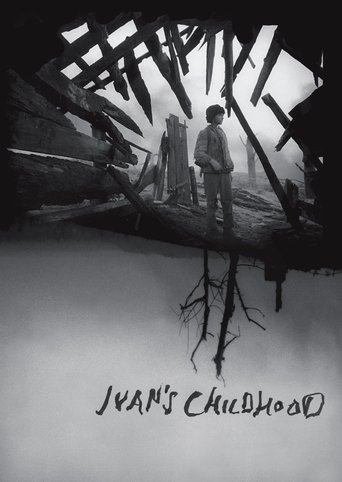
Ivan's Childhood
Иваново детство
1962 · Film · 95 min
Directed by Andrei Tarkovsky
In WW2, twelve year old Soviet orphan Ivan Bondarev works for the Soviet army as a scout behind the German lines and strikes a friendship with three sympathetic Soviet officers.
5 positive2 neutralfrom 7 commenters
Where to watch
No streaming data for this title.
7 comments on Hacker News
The best way to watch these movies would be by pirating them from the RuTracker, as that way you will be sure that you are not contributing any views or advertisement money to the Mosfilm, with a bonus of much higher bitrates.
Here are the links:
Solaris — https://rutracker.org/forum/viewtopic.php?t=6191155
Stalker — https://rutracker.org/forum/viewtopic.php?t=6182463
Ivan's Childhood — https://rutracker.org/forum/viewtopic.php?t=6194960
The Mirror — https://rutracker.org/forum/viewtopic.php?t=6194964
Andrei Rublev — https://rutracker.org/forum/viewtopic.php?t=6194948
The Passion According to Andrei — https://rutracker.org/forum/viewtopic.php?t=5820633
Battleship Potemkin by Sergei Eisenstein is in public domain, and so you can legally watch any other upload on YouTube instead of Mosfilm's, for example https://www.youtube.com/watch?v=HsQcljysO-8
Tarkovsky's "Stalker" is loosely based on the "Roadside Picnic"[1] a sci-fi novel of Strugatsky brothers.
A. and B. Strugatsky are not that much recognized in the western countries as Andrey Tarkovsky, but they made significant contribution to the Russian literature of XX century, and their books are still popular in the post-soviet countries. In particular, the Roadside Picnic influenced many modern sci-fi works too, including, for example, the "S.T.A.L.K.E.R." and the "Metro" video game series.
Tarkovsky's "Stalker" is quite distinctive from Strugatsky's novel both in style and plot, but the screenplay of the movie was written by Strugatsy brothers too. Basically, they made completely different work in the same setting, but following completely different narrative. Also, they included a lot of pieces from their other (less famous) work "The Ugly Swans" into the screenplay, which is closer to Tarkovsky's film style. For example, the Writer's monologue[2] is just a direct translation of the same monologue from The Ugly Swans.
"Solaris", another Tarkovsky's famous sci-fi movie, based on Stanislav Lem's novel of the same title, was a more controversial work. Stanislav Lem made quite critical reception of this adaptation that simplifies and distorted his novel's original ideas. However, I think that Tarkovsky's "Solaris" is still the best adaptation of this book we currently have.
Aside from this, I would recommend "Ivan's Childhood" a war movie about orphaned child, and the "Andrei Rublev" a historical movie about the famous Russian Orthdox Icon painter set place in the late middle ages, and about survival of artistic people in hard times.
[1] https://en.wikipedia.org/wiki/Roadside_Picnic
[2] https://www.youtube.com/watch?v=uwIoSI1Eqak
It's one of his most accessible movie, and usually resonates with tech people for obvious reasons. His best movies imo are Mirror, Ivan's Childhood, Andrei Rublev, Stalker and then Solaris, Nostalgia and Sacrifice.
Now Solaris book by Lem is far superior to Tarkovsky's rendition.
> I had never seen a war movie produced outside of Hollywood. Or a director with primarily french influences producing a war movie.
Not sure if the stipulation is a war movie about Vietnam, or just plain a war movie. But certainly here's a list of some non-U.S. 20th century war movies, very vivid, biased towards France:
The Battle of Algiers (French, Gillo Pontecorvo, 1966)
Come and See (Russian, Elem Klimov, 1985)
Ivan's Childhood (Russian, Andrei Tarkovsky, 1962)
Beau Travail (French, Claire Denis, 1999) -- OK, soldiers but not war
Army of Shadows (French, Jean-Pierre Melville, 1969)
A Man Escaped (French, Robert Bresson, 1956) -- POW, not front lines
Little Dieter Needs To Fly (British/French/German?, Werner Herzog, 1997) -- actually relates to the war in Vietnam
I'd risk to suggest that "Andrei Rublev" is Tarkovsky's best film as it is both approachable, auteur, commercial, poetic, symbolic, naturalistic and everything you'd imagine one of the vertebras of the 20th century culture to be.
Yes, late Tarkovsky is great too, but it's not really quite cinema at that point. "Rublev" is The Movie in Tarkovsky's filmography.
It's also probably one of the best medieval films there is, regardless of the genre, "7th Seal" to "Kingdom of Heaven".
Another great, often overlooked movie is his very first one - "Ivan's Childhood". You can see him still begin somewhat cautious there, but the movie is as poignant as they get. It was created by one of the best artists of the generation as he watched the dawn of the 60s era as a member of the society for which World War 2 and Red Terror are yet to become "yesterday".
Not SF, but watch "Ivan's Childhood", his first film. I saw it first on New Years Eve in Scotland. Me and my then wife went round to her friends house to pick her up for the usual celebrations. While the girls were getting made-up I started watching the film on the TV - I had never heard of it or Tarkovsky before, and I have no idea why it was on at New Year. They eventually came down and said "let's go" but I refused - "catch you later" - I just had to watch the film. Somewhat later friends mum came in and said "X why aren't you out with Y and Z" - I said "I HAVE to watch this". And I did, and then I went out and got pissed. It's a great film.
Tarkovsky is my favorite 20th century film director bar none. Here's are some reasons why and why you might also be interested in his films:
(1) He described his art as poetry applied to cinema or "sculpting in time," a fundamentally different conceptual idea of the cinematic art that he went to a great length to clarify (in a book of the same name, highly recommended).
(2) His use of color is incredible. Some films, especially stalker, are near black and white with incredibly vibrant and poignant uses of green. This is a bit like Bergman at his best, but even better.
(3) He was deeply religious in a "mystical" sense, with a lot of respect for past traditions, but not in a dogmatic sense and with appreciation for both Christian and pagan elements (see Andrei Rublev for both aspects)
(4) He knew other European traditions extremely well. Ivan's childhood is a meditation on the war with Germany, including shots of Duehrer's prints. Nostalgia involves his time in Italy traditions including Madonna cults and important artwork. Sacrifice has Shakespearean references, Rembrandt, Japanese samurai, and magical traditions. In general, his films are full of long shots of important pieces of Renaissance art with profound meaning.
(5) He spent a lot of time thinking about the integration of technology and the rest of life. Solaris is the futuristic spaceship version of this. Stalker is the apocalyptic version of this.
I think in a century Tarkovsky will rightly be credited as inventing a whole new type of cinema, his way of approaching it was fundamentally in tune with a "mystical" sense and integrated with other forms of visual art (i.e. the long gaze you have at a painting), and the punctuated, rhythmic reading of poetry.