 Hacker Cinema
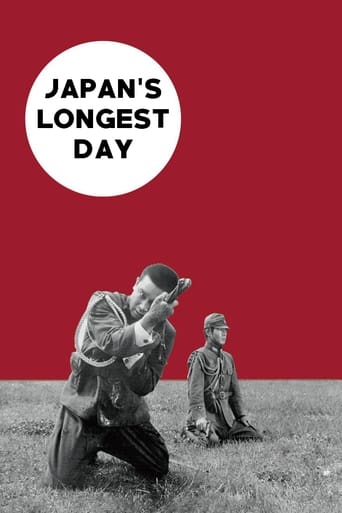
Japan's Longest Day
日本のいちばん長い日
1967 · Film · 157 min
Directed by Kihachi Okamoto
A dramatisation of the 24-hour period in which the Japanese government was deadlocked over the decision to accept or reject the Allies' demand for an unconditional surrender following the bombings of Hiroshima and Nagasaki.
1 positivefrom 1 commenter
Where to watch
No streaming data for this title.


3 comments on Hacker News
How Japan made the decision to surrender is well covered in the book "Japan's Longest Day", originally published in 1973. Many of the major players were interviewed. There's a reasonably accurate movie version worth watching, if you're interested in this.
It's a very strange story of decision-making under extreme pressure. No one was in charge. The Navy was barely talking to the Army. The civilian government had been sidelined from control of military matters years before. The Emperor was supposed to be a figurehead. And, as pointed out above, there was an attempted coup to stop the surrender.
There is a movie version of "Japan's Longest Day".(1967). It's from Toho, and the Internet Archive has a subtitled version. This is a reasonably accurate account of the decision to surrender and the infighting around it, entirely from the Japanese side. Parts of the Army desperately wanted to continue the war. The war faction attacked the Imperial Palace, killed people there, tried to kill the Prime Minister but couldn't find him, and burned his house.
The senior Army leadership's thinking was not insane. They realized ultimate defeat was inevitable. If the Allies invaded and suffered high casualties, Japan might be able to negotiate better terms than unconditional surrender. The Emperor rejected that plan. The Minister of War and the Army chief accepted that decision. Some junior Army leaders still wanted to take that path and revolted. The revolt was violent but unsuccessful. It was a close thing.
All this was after Hiroshima and Nagasaki. Before that, surrender was not seriously considered.
[1] https://archive.org/details/japans-longest-day-1967
Recommended reading: "Japan's Longest Day", the nonfiction book, not the movie or novel (Review: http://www.warbirdforum.com/end.htm). This was written in the 1980s by a group of Japanese historians who interviewed almost everyone still living who had been directly involved in the decision to end the war.
The key thing to understand is that nobody was firmly in charge. The 6-member Supreme War Council, with representatives of the Army, Navy, and the civilian government was running the war. They had been operating by consensus, despite severe disagreements. The civilian government was much weaker than the military. (This stemmed from the February 26, 1936 attempted coup. Long story there.) The Japanese army and navy never got along. A strong faction in the Army wanted to continue the war to the bitter end. (They tried a coup against the Emperor on August 14, 1945, just before the surrender, captured the Imperial Palace, and almost succeeded.) War Minister Anami (the Army head on the Supreme War Council) said, after the Hiroshima bomb, "I am convinced that the Americans had only one bomb, after all." After the second bomb was dropped, Anami still wanted to fight on, but the Emperor decided otherwise. Anami committed ritual suicide.
It was a close thing. If Anami had supported the coup, or the coup had succeeded in capturing the NHK radio station or the Emperor himself, the war probably would have continued.