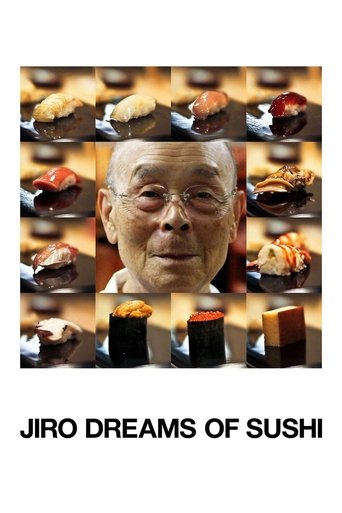
Jiro Dreams of Sushi
2011 · Film · documentary · 82 min
Directed by David Gelb
Revered sushi chef Jiro Ono strives for perfection in his work, while his eldest son, Yoshikazu, has trouble living up to his father's legacy.
49 positive1 negative8 neutralfrom 58 commenters
Where to watch
No streaming data for this title.
64 comments on Hacker News
Yes, to me this is the movie jiro dreams of sushi. Consistently just do some amount every day with no real expectation and you may very well become the best in the world at it, but that wasn't really the goal, it was the byproduct.
Here is the list from the thread: --- 1. A Man Named Pearl
2. Once Upon a Time in Northern Ireland
3. Microcosmos
4. Crip Camp!
5. Keep The River On Your Right
6. All The Beauty And The Bloodshed
7. Harlan County USA
8. Stay on Board: The Leo Baker Story
9. Good Night Oppy
10. We Met in Virtual Reality
11. All That Breathes
12. Still
13. Can’t Be Stopped
14. The Amazing Jonathan Documentary
15. Searching for Sugarman
16. AKA Mr Chow
17. The Pigeon Tunnel
18. Little Richard: I Am Everything
19. I Know That Voice
20. Genghis Blues
21. Kings of Pastry
22. 20 Feet From Stardom
23. Stevie
24. Anvil: the Story of Anvil
25. Searching for Sugar Man
26. King of Kong
27. The Gleaners and I
28. Touching the Void
29. Cane Toads: An Unnatural History
30. 20 Days in Mariupol
31. Minding the Gap
32. How to Survive a Plague
33. Speciesism
34. Free Solo
35. Jim Allison: Breakthrough
36. Seven Up! series
37. Bowling for Columbine
38. The Fog of War
39. Rivers and Tides
40. Capturing the Friedmans
41. Spellbound
42. King of Kong
43. Crip Camp
44. Jesus Camp
45. Jiro Dreams of Sushi
46. Flee
47. Man on Wire
48. Queen of Versailles
49. The Thin Blue Line
50. Time Indefinite
51. The Gleaners and I
52. My Life as a Turkey
53. Happy People
54. Grizzly Man
I don't let myself burnout anymore. And I'd still say I work hard afterhours. I think what happened for me was disconnection from my sense of purpose mixed with being overworked leading to a "what's the point" vibe.
1. It probably took me 3-4 years in my late 20s, early 30s to recover. I just worked 9-5 then.
2. For me "work-life" balance as a concept was even causing me stress. It conflicted with my sense of purpose. My advice is to actively prune and reject advice/suggestions that weigh on you and disconnect you from who you are.
3. Jiro dreams of sushi as a movie saved me. It reminded me of who I wanted to be and what I want to do with my life. This 90 year old is a sushi making expert and works day in and day out at his craft. This isn't about hustle it's about motivation, inspiration and deeper purpose. So I recommend finding yours or reconnecting with it!
Ya def take a break, but I think there's often a deeper issue that's being exacerbated by being over worked. For me, I feel stronger than ever, but as others have shared, I feel like a different person. There's definitely pre-post self.
I saw Jiro Dreams of Sushi the other day. For context, Jiro is this old dude (80?) who refuses to retire from being a sushi chef. He’s one of the best sushi chefs in the world. In the film, he talks about how he doesn’t do it to be the best. Or do it for the money. For him, sushi is a craft he does for honor.
I like that framing. I agree with the sentiment you quoted, and I’ve been programming for over 30 years. I don’t think there’s much honor in most software. We don’t honor the user when we make software full of ads. We don’t honor the computer when our software is slow and lazy. And we don’t honor our craft when our software is buggy.
Yes, this poster is obviously inexperienced. But I respect that they spent a bunch of time and energy trying to honor what they see as missing - especially when they needed to pick up a new craft in the process. I respect the old people who did things like that when they were young. Whether they led somewhere or not.
We are paid well enough to do projects like this in our spare time. You’re right - that is a privilege. But I think it would be a loss for everyone if they don’t follow their impulse to do something with that.
Sorry, but I think this is bad advice. It sounds wise and clever on the Internet, but in reality it's just an extension of the "consumer experience" mentality that leads to the society-wide feeling of malaise OP is experiencing. Because the fact is, doing a bunch of random things doesn't lead to any real insight about the human experience or what one's place in it ought to be.
Instead, I suggest that OP (and anyone else) delve into philosophy, religion, and especially the nature of capital-W Work, that being "What do you wish to spend your time doing in order to master it and grow into an identity as such a master?" The film Jiro Dreams of Sushi is an excellent introduction to this, but you can find similar mentalities labeled as "craftsmanship". The key point being that you need to create stuff (including your self) not simply consume it or find it out in the world.
Thank you, Jessamyn, for providing your perspective. You did the same to me, privately, many years ago on MeFi and I haven't forgotten it.
I cast the same eye now on anything that romanticizes similar work, and I've even seen it in places that are somewhat unexpected. The movie Jiro Dreams of Sushi is a perfect example of this.
One documentary that demonstrates finding flow (happiness) in work is Jiro Dreams of Sushi (2011), which is the story of Japanese master chef Jiro Ono, who is a Shokunin, an expert craftsman who strives for perfection and feels great fulfillment and joy from yearning to improve bit by bit. He explains it thusly,
"You must dedicate your life to mastering your skill. That’s the secret of success and is the key to being regarded honorably. […] . Even at my age, after decades of work, I don’t think I have achieved perfection. But I feel ecstatic all day. I love making sushi. That’s the spirit of the Shokunin."
From:
https://moviewise.substack.com/p/going-through-an-existential-crisis
I really enjoyed the The Bit Player (2018) about Claude Shannon, it uses an actor to play Shannon.
I thought More Than Robots (2022) seemed really cool too, about teams of teenagers building robots for a competition.
https://www.youtube.com/watch?v=EsIo57pH-pA - is an interesting short documentary on the making of neon signs.
Birdmen: The Original Dream of Human Flight (2012) was pretty fascinating on the history of wingsuit flying
And also Jiro Dreams of Sushi.
I think Jiro Dreams of Sushi is a fantastic documentary and recommend it also.
I came away with a different impression, in that I certainly don't admire or want to share Jiro's attitude to work, because the perfection-at-all-costs approach looked like it had a pretty devastating fallout on his wife and his two sons. It's a fascinating documentary in that you'll either come away saying "how inspirational!" or "I'm running 100 miles away from that", and that's interesting in itself.
I love documentaries, and these are my favourites. All very worth a watch.
- The Crash Reel
- McConkey
- Buck
- Apollo 11
- Carts of Darkness
- The Wild and Wonderful Whites of West Virginia
- Samsara
- Baraka
- Brooklyn Castle
- Spellbound
- Drew: The Man Behind the Poster
- Crumb
- The Jinx
- The Art of Flight
- King of Kong
- Indie Game: The Movie
- Capturing the Friedmans
- OJ: Made in America
- The Barkley Marathons
- The Seven Five
- Murderball
- Unbranded
- Gringo: The Dangerous Life of John McAfee
- Big River Man
- Hoop Dreams
- Word Wars
- Free Solo
- Long Shot
- Meru
- Being Elmo
- All This Mayhem
- Jiro Dreams of Sushi
- The Cove
- Project Nim
- Alone in the Wilderness
- Behind the Curve
- The Dawn Wall
- Grizzly Man
- 13th
- Winnebago Man
- Man vs Snake: The Long and Twisted Tale of Nibbler
- Get Me Roger Stone
- Icarus
- 13th
- Koyaanisqatsi
- The Thin Blue Line
- An Inconvenient Truth
- Oklahoma City
- Virunga
- The Staircase
- Evil Genius
- Undefeated
- Betting on zero
I don't know if you would enjoy it, but keying off the idea of lifetime crafstmanship is the documentary film Jiro Dreams of Sushi[1], he was 85 at the time and ran a small but world famous sushi restaurant - no chain of stores, no growth at all costs, instead pursuit of excellence.
Quotes:
> Jiro Ono: Once you decide on your occupation... you must immerse yourself in your work. You have to fall in love with your work. Never complain about your job. You must dedicate your life to mastering your skill. That's the secret of success... and is the key to being regarded honorably.
and
> Jiro Ono: I do the same thing over and over, improving bit by bit. There is always a yearning to achieve more. I'll continue to climb, trying to reach the top, but no one knows where the top is.
[1] https://www.imdb.com/title/tt1772925/
[2] https://www.imdb.com/title/tt1772925/quotes/?ref_=tt_trv_qu
Did Jiro Dreams of Sushi, for example, have a clear POV?
Compared to the 100 "Monsanto is bad" documentaries out there.
Have you wondered that Maybe people aren't really interested in mastery. Some do, ofcourse but most will be happy with learning just enough. Whenever I hear the word mastery, I am reminded of the Japanese documentary Jiro dreams of sushi. A Japanese sushi chef who is a master at sushi and that's what he has been doing for the last 40 years or so.
Only when one realizes the actual effort that needs to be done to achieve Mastery, most people back out. This is crazy, they say. Who has the time to practice 4 hours a day.
Masterclass doesn't sell mastery. DuoLingo doesn't sell language learning. It sells an aspirational hope that this new skill or language is just one course away. And that's comforting to us somehow. We are simple creatures after all.
BTW, I like the word mastery too much that I decided to start a company around it. Primerlabs(https://primerlabs.io). The goal is to create self paced courses that will allow anyone to truly self-learn difficult subject such as physics, mathematics, economics. We are focusing on CS currently but we will get there (hopefully).
You're thinking of Jiro Dreams of Sushi.
That's the documentary that inspired me to try Michelin starred Sushi restaurants in Japan. I went to Jiro's son's restaurant, which is by all accounts better, but nobody will say so because they don't want to disrespect Jiro while he's still alive. It's a Japanese culture thing.
My father asked me why I spend so much money on raw fish and rice.
I tried to explain to him that the high-end sushi restaurant experience is really a magic show that also includes food.
Have you heard of the placebo effect? Shamans "treat" their patients with practised rituals that make people feel better. Sure, nothing has ever been cured through such methods, but it sure does feel nice!
I have a personal pet theory that this is a side-effect of our evolution: little kids that sat quietly mesmerised watching the elders perform their arts and crafts would pick up the skills and eventually master them themselves. Kids that didn't sit quietly didn't get to be as skilful and would in turn fail to be good parents and hence had fewer children.
Some people call it ASMR, which is a fun term to search for on Youtube if you can't sleep at 11pm.
Watch any magician, or master craftsman at work, and you get the same tingly feeling on your scalp. You sit still, quietly mesmerised as you follow the swift and sure movement of their hands.
THAT is what good sushi is about. You sit at the table with the sushi master in front of you and observe as he slices the fish with rhythm and precision. You're entranced as he picks up the rice, moulds it, applies the wasabi, places the fish, and coats the assembly with sauce. It's like watching a magician dealing cards!
People pay hundreds of dollars for a magic show in Vegas. In Japan, you get the same experience except you also get fed in the process...
You believe a person cannot find satisfaction in a job well done (and a solid paycheck), they have to "change a world" to feel accomplished?
I found the documentary "Jiro dreams of sushi" illustrative (in the opposite extreme). I believe most of us would fall somewhere in between (... aaaand, we get to Maslow again :)
Thank you, good and fair points.
I liken the more pedestrian words to the words I use to get myself to the gym. Instead of muttering "perseverance", I mumble "find a way". I pick the pedestrian words when they resonate with me in some contexts, and the five dollar words when they resonate more.
I believe there is beauty, wonder, and endless improvement within attention to detail to be found in honing the same craft repeatedly over the years. There Is Plenty Of Room at the Bottom. Jiro Dreams of Sushi is one of my favorite movies that touches upon this.
> "Do we need to be told that wild success is an outlier just because a few adults need instructions to operate Shampoo?).</rant>"
No, we need to be told that wild success is an outlier because there's a huge push for people to work ever-longer hours with the wild success stories dangled in front of them as the carrot. There's a huge chunk of people arguing and voting that suffering poor humans shouldn't be helped based on the simplistic idea that work -> success, therefore !sucess means !work, and !success is inherently shameful. Your father clearly worked hard to provide for his family, you also say that his passion was solving problems and organising the system, a passion you don't have - is "being born the right kind of person" not a kind of luck? Another commenter says their mother was an incredibly hardworking person until she got ill and couldn't. Is there no luck in your father's health staying good enough that he could do those sleep-interrupted-nights for years on end? You say in another comment "as if saying so implies that people who are unsuccessful /don't/ work hard" but if people who are unsuccessful also work hard, what is it that distinguishes them from Bezos if not luck? You could say it's the /type of hard work/ they do, and I'd partly agree and say that's a good reason to push back on the meme "work harder, work harder!". Would you say that Jeff Bezos worked 170x harder than your father, for example? Why does pointing out the role that luck plays diminish your father's life in your eyes so much that you're posting multiple times about it? Elon Musk didn't "luck-in" to running SpaceX by sitting around playing video games waiting for the world to discover him, but if you try and follow in his hard work footsteps by setting up an online bank you'll be somewhat stumped by it not being 1999 and you not having a father who owned an Emerald mine.[1]
I am someone who often does your "growing trend with hating on people who are successfull by dismissing their success as luck", but it's not hating on Bezos with a claim that he didn't work hard, it's hating on the idea that if everyone worked hard they could be Bezos. It's hating on the idea that Bezos is a superior person to all the people who worked hard and got nothing from it, more deserving of being in the spotlight. It's hating on the idea that Bezos earned all the money he controls through his hard work and dismissing the contribution of all the other Amazon employees to that wealth. It's hating on the way the media puts the materially successful person because it's easier to make a "top 100 richest people" list than a "top 100 contented people" list. It's hating on the implication that everyone should strive for material success and the way to achieve that is by working harder, even though for almost all employees working harder will not get them much more than burnout - even people who want to improve at something need to focus their practise on improving, not just churning harder and harder. Would you not say that your father's life would have been better if he'd achieved the same success with less work? Would you say he was less respectable if he'd achieved the same with less work?
I don't exactly encourage "not working hard" when I say these things, I more encourage that hard work should be on your own terms, for something you love the process of working on - as you describe your father was passionate about organising and solving problems. Hard work that you are forced into by circumstance and necessity is a worse kind of work than hard work you choose to do of your own free will, and is different again from that which society pressures you to do. Donald Knuth works hard on TAOCP, it's not done for vast financial success, it's very respectable nevertheless. A hospital pushes an ICU nurse into another 12 hour shift with too-few coworkers, while cutting back on staff to increase profits; that's respectable that the nurse endures it, but objectionable for the system to be exploiting in that way. Jiro Oni from the documentary Jiro Dreams of Sushi - a lifetime of searching and striving hard for perfect sushi got him 3 Michelin stars and a family run restaurant which could seat a dozen people, and that's a far better kind of hard work and success than a 90 hour weeks striving to make partner at a law firm doing work you hate, because society told you that you don't matter unless you're visily suffering long-hours and own a McMansion. And society is telling us that, that the poor don't matter, that the rich and famous do matter, that the way to get higher social status is to sleep less and work more, that it's more respectable to stay 10 hours at work than to leave early to walk by the river. That it's intensely shameful to be unemployed. That your contribution at work isn't measured by the customers you please, but by the much easier to measure time you spent in the office. That it's awful to be part of a union which pushes for more pay for less work.
HN is a place of generally more educated people than average, doing work that's paid higher than average, and having more range of places to work than average, and there's still a continual trickle of comments saying "I could do much better work in less time if I could change ___ but the company doesn't want that, they want longer hours and people looking like they're suffering at crunch time". It's the orientation of life around work, the systemic pressure to treat employees as resources to extracted wealth from by working them harder and the corresponding messages for employees to align with that by seeing it as the only thing which is virtuous, which is objectionable. Not because of some "instructions to operate Shampoo"(???)
If working hard at a job you hate provides for your family, that's good on you, but it's not praiseworthy that that's how society is. It's the sacrifice for others which is respectable, not the lack of sleep or the Calories burned in themselves. If working less hard at something else brings you more money, that's not inherently bad because you aren't chasing material success and aren't working as hard as you can, there are other things than work.
[1] https://www.businessinsider.co.za/how-elon-musks-family-came-to-own-an-emerald-mine-2018-2
Jiro Dreams of Sushi. A really inspiring film about a sushi chef in Japan. His work ethic and dedication to his craft are an antidote to the ‘move fast and break things to get rich’ mentality that is all-too-common these days.
> The documentary Jiro Dreams of Sushi has a poignant commentary on this. Jiro's oldest son is expected to eventually take over Jiro's sushi place, so as a result essentially is toiling for his father into old age. On the other hand, somewhat ironically Jiro's younger son actually has more freedom, so he strikes out on his own pretty early and has his own very successful sushi joint.
IIRC, that's wrong. The documentary said that Japanese tradition is that the eldest son inherits the father's business. Jiro has two sons, so he created a clone of his business for the second. They're literally exactly the same layout except mirror images of each other.
The poignant thing that I remember is that the person who actually made the sushi for the reviewer who made the restaurant famous was not Jiro, but his son. And the wondrous thing was that the enterprise wasn't about chasing fame or fortune, but about being dedicated to excelling at a craft.
The documentary Jiro Dreams of Sushi has a poignant commentary on this. Jiro's oldest son is expected to eventually take over Jiro's sushi place, so as a result essentially is toiling for his father into old age. On the other hand, somewhat ironically Jiro's younger son actually has more freedom, so he strikes out on his own pretty early and has his own very successful sushi joint.
Am I the only one who would love to be a full time programmer given the choice? I actually enjoy engineering, and software is engineering on drugs, with rapid feedback and not as much math. There's not a lot of other industries where you can make a dozen prototypes a day. It's the closest thing today to a full time inventor/mad scientist.
But if I have to pick something else, probably a chef. I love slicing and dicing. I love doing one part to mastery, e.g. finding a better way to cook steak, toast burger buns, make better mayonnaise. I did quit the tech industry once to do a cafe and we had a blast researching recipes. I got quite frustrated that my partner wasn't looking to cook better, only more profitably. One of my favorite documentaries of all time is Jiro Dreams of Sushi, and I apply a lot of those techniques to my current work.
The Kingdom of Dreams and Madness (from which I believe that quote originates) actually affected me quite a bit. Rather than some kind of hedonistic bucket list, the film's depiction of Miyazaki gave me a very different model for later life: To spend a lifetime mastering one's craft, and to take joy in the everyday process of exercising and improving it.
Most of us will not become acclaimed directors like Miyazaki, or renowned sushi chefs like Jiro Ono (Jiro Dreams of Sushi is another documentary in this vein), but in my view, any skilled craftsperson, from a tatami weaver to a software developer, can follow this path. You don't have to be famous, or even best in class, to enjoy a life of mastering the craft that inspires you.
Jiro Dreams of Sushi
Man on Wire
Both redefined for me what it means to be mission oriented and committed. And I have a Guinness Record, so I thought I was obsessive already, but I’m nothing compared to the commitment of the two men in these documentaries.
There was a documentary on the City of God DVD that was better than the film (and I thought it was an amazing film).
A few from Netflix that I could find that I rated:
Endless Summer
Death in Gaza
The Filth and the Fury
Jiro Dreams of Sushi
Baseball
March of the Penguins
The Art of the Steal
Born Into Brothels
The Aristocrats
God Grew Tired of Us
The Fog of War
The Lost Wave
The Last Waltz
Festival Express
I really loved 'Jiro Dreams of Sushi', showing how much care and effort he puts into making it:
https://www.imdb.com/title/tt1772925/
I somewhat prefer the parody Juan Likes Rice and Chicken from Documentary Now! to Jiro Dreams of Sushi, the fiction is sweeter and less cruel than the reality of a decade of training to get qualified to learn to cook an egg.
Even more OT, but if you like sushi, the documentary Jiro Dreams of Sushi lightly touches on the entire process of making sushi in a Tokyo restaurant along with the story of a family restaurant. Then if you liked that, there is a touching and gentle mockumentary about it called Juan Likes Rice and Chicken.
I don't really know much about sushi, but this was a fascinating read.
The entire time I kept wondering what the difference would be between the machine made sushi and the stuff made by the guys in the documentary, Jiro Dreams of Sushi[1] Would I be able to tell the difference?
[1] http://www.imdb.com/title/tt1772925/
That's Jiro of "Jiro Dreams of Sushi" - https://en.wikipedia.org/wiki/Jiro_Dreams_of_Sushi
An excellent documentary.
Worth watching if only to see that learning to fry a good omelette with Jiro's approach apparently takes a couple of years. Though it probably has more to do with the "never complain" part rather than perfecting the actual cooking skills.
I get inspired by the japanese Shokunin work ethics, it is well described on the Jiro Dreams of Sushi movie, a explanation can be seen here: https://www.youtube.com/watch?v=Q78xvcnmIMw
I think one of the important factors is the consistency of the food (taste, presentation, etc.). I learnt this from my research[0]
[0] Jiro Dreams of Sushi on Netflix (http://www.imdb.com/title/tt1772925/)
Or watch: Jiro Dreams of Sushi: http://www.imdb.com/title/tt1772925/
> As always when sushi is mentioned on HN, here is a link to the fine documentary Jiro Dreams of Sushi
Which always amuses me because, at least to me, «Jiro Dreams of Sushi» is not remotely about sushi at all.
As always when sushi is mentioned on HN, here is a link to the fine documentary Jiro Dreams of Sushi: http://www.imdb.com/title/tt1772925/
And Tampopo should be in the same vain, supposedly very good, fiction though: http://www.imdb.com/title/tt0092048
If you like eating sushi, then watching the documentary "Jiro Dreams of Sushi" might resonate enough to help you gain some insight into this passion for finding contentment in what appears mundane to the outsider.
I think it's important to pace yourself.
I get demotivated when I don't meet target or when I find the task too intimidating. The former is because I didn't set realistic expectation and didn't chalk my path carefully. The latter is because I'm looking at a very high level. I try to break them into smaller chunks which by themselves are self-sufficient and a project.
Secondly, I think it's perhaps important for some to be involved in multi-disciplinary pursuits.
In school/college it was easier as there were many subjects and you would go round robin on them or some other algo. That way there was a freshness to things and your mind doesn't get saturated which may drag your pace and eventually you may not end up meeting your targets. I think quite famous people have this behavior like Einstein/Violin, Knuth/Organ and even Sherlock Holmes had one which Doyle mentioned helped him get his mind off the case and come back invigorated. :)
Look around for inspirations.
I've now understood that most of the things that are of value require years of discipline, which bring you to the place where you could do the things you set out to do. A younger me never understood this. We currently live in a society of instant gratification which also glorifies short term achievements. I think it's a probabilistic model and the odds of success at very young age are quite low and they are outliers as there are certain circumstances beyond once control which catalyzed it. Inspiration can come in many forms... I got quite inspired by the documentary Jiro Dreams of Sushi [0].
Celebrate your successes.
Nothing motivates one better than seeing one making progress. So spend some time to stop and look behind and see where you started and where you have reached. Perhaps documenting your progress can help you recollect easily.
[0]: http://www.imdb.com/title/tt1772925/
Semi-related: "Jiro Dreams of Sushi", a excelent 90minute documentary movie about "Jiro", an 85-year-old sushi master is available on YouTube w/ english subs: https://www.youtube.com/watch?v=GYN7p8dvr64
Great watch, even if you never had sushi or don't like sushi. The extreme drive for perfection is admirable.
For those who didn't know who the two men are:
Jiro Ono, Japanese sushi chef, is often regarded as one the greatest sushi chefs. Owner of "Sukiyabashi Jiro" a three-Michelin starred sushi restaurant in Tokyo. The documentary "Jiro Dreams of Sushi" is about Jiro Ono, the restaurant and his son.[1]
René Redzepi, Danish chef, and co-owner of the two-Michelin starred restaurant Noma in Copenhagen, Denmark. Voted the best restaurant in 2010, 2011, 2012 and 2014. Renowned for reinventing and refining new Nordic cuisine.[2]
[1]: http://www.imdb.com/title/tt1772925/ [2]: http://en.wikipedia.org/wiki/Ren%C3%A9_Redzepi
Jiro Ono is the sushi chef whose life and craft are the topics of the documentary film "Jiro Dreams of Sushi"[1]. Amazon Prime members can watch the film for free.[2]
[1] https://en.wikipedia.org/wiki/Jiro_Dreams_of_Sushi
[2] http://www.amazon.com/Jiro-Dreams-Sushi-Ono/dp/B008ODZEQ0
I highly recommend this movie:
http://en.wikipedia.org/wiki/Jiro_Dreams_of_Sushi
Even if you don't like Sushi the documentary itself, the style, the characters, the subjects are just every well done.
If you appreciated this article, then you're probably also going to appreciate the movie "Jiro Dreams of Sushi". It's on iTunes and Netflix, and really awesome if you're into Sushi and craftsmanship.
If you need quick motivation I recommend watching "Jiro Dreams of Sushi". You pretty much want to copy his mindset. The hard part is of course the "finding something you love to do" part but I'd argue all the subjects that are abundant will merge naturally. You "just" need to identify the driver. You need to find your Sushi stall so to speak. Once you find that (somehow related to CS) all the topics you mentioned will arrange themselves and you'll want to learn all of them to get better at what you love.
So basically pick a project and start it. Then ask yourself "will this make the output more excellent" for everything you learn.
What you are saying is similar to philosophy of Jiro from "Jiro dreams of Sushi". If you haven't seen it then you should. He also focuses on very specific type of food, and after some tests with trying to introduce more products he decided its not worth it. Amazing documentary.
One Great example for above will be Jiri One: A Japanese Master chef for shushi, I would say if there is only one documentary you will see this month. Let it be this one: http://en.wikipedia.org/wiki/Jiro_Dreams_of_Sushi
Sushi story is about a man named Jiro. There is a wonderful, wonderful documentary about him.
https://en.wikipedia.org/wiki/Jiro_Dreams_of_Sushi
I think "Jiro Dreams of Sushi" is streaming on Netflix and is an excellent documentary worth your time. It's not some glamorous, deifying depiction of Jiro himself--it actually balances his success with the personal cost he paid for his sushi mastery.
I've recently watched this documentary called 'Jiro Dreams of Sushi'. It is about this legendary 85-year-old sushi master in Japan and his two sons who will succeed him in the business. At some point there was an interesting quote that went along the lines: when Jiro dies, his son will need to be twice as good as him, if he is "only" just as good, people will think he is worse.
I think this is quite true in the Apple case, there was a "genius" aura around the Steve Jobs personality that helped inflate the perception of his already impressive achievements. Without that aura, Apple might be doing just as good a job as he would do, but people will think worse of them.
Personally, I think that as long as they keep putting out the excellent quality products they've been releasing lately, pushing into new areas now and then, they will be just fine for quite some time.
Almost unrelated but the documentary Jiro Dreams of Sushi is a good follow-up for inspiration.
https://movies.netflix.com/WiMovie/Jiro_Dreams_of_Sushi/70181716?locale=en-US
Anyone who hasn't seen Jiro Deams of Sushi yet, I can highly recommend it:
[Netflix] https://movies.netflix.com/WiMovie/Jiro_Dreams_of_Sushi/70181716?locale=en-US
[Amazon Prime] http://www.amazon.com/Jiro-Dreams-Sushi-Ono/dp/B007UW9WOQ/ref=sr_1_2?ie=UTF8&qid=1378252912&sr=8-2&keywords=jiro+dream+of+sushi
I would say Jiro Dreams of Sushi while not really a documentary, more of a biography, will make you re-evaluate (if only temporarily) your life.
Good list. From my point of view, it's also a good source of questions for an employee to ask the founders when interviewing at a startup .
I don't get this, though:
> Watch Jiro Dreams of Sushi, then do marketing that way. Pick a small set of tasks, do them consistently, and get better every day.
How is that marketing? That's getting good at your craft and improving your product.
I watched the movie, but I'm not sure that Jiro is good at marketing. Apparently he's very good at making sushi, but it seems he became successful (and later world famous) despite being bad at marketing.
Incidentally, his shop's average ratings at Tabelog (one of the biggest Japanese gourmet websites) is only 3.8 out of 5, with quite a few "bad" reviews.
I liked the "Jiro Dreams of Sushi" bit. I saw it yesterday, after seeing a lot of recommendations on HN for it. Excellent movie for all of HN. Go watch it.
Yes, that's true. The late rise of sushi in America is briefly mentioned in the movie Jiro Dreams of Sushi.
The assumption that a little more focus on one particular thing will make one a specialist. To become a specialist or a master you not only need undivided attention but a natural flair for it. You can practice music all your life and still not compose like Mozart or Bach.Or even someone like Jiro Ono(http://www.thedailybeast.com/articles/2012/03/11/jiro-ono-considered-to-be-the-world-s-greatest-sushi-chef-is-subject-of-new-documentary-jiro-dreams-of-sushi.html). Most of us will never become Masters, being no more than experienced hacks. That doesn't mean one shouldn't target for it. "Stretching oneself too thin" is a common refrain among technologists implying that if they rather focus on one skill, they are bound to become Masters. In my opinion it's as much about serendipity as it's about perseverance.
I am always fascinated by portraits of mastery and, particularly, of masters in obscure fields. There's a lot to learn from these stories. There are universal lessons hiding beneath the candy coatings of idiosyncrasy and eccentricity.
The (relatively) recent documentary Jiro Dreams of Sushi is thematically similar to this portrait of Ricky Jay. To watch it is to realize how a true master is no longer shaped by his craft and his field, but indeed, shapes them.
Hey now. That's not very nice.
Here's an edit just for you. Better?
I read this the other day and completely fell in love. What a fantastic thing to be doing - but, as jaysonelliot says, from the perspective of the person running the unofficial restaurant. It's worth noting that by the end of the article, he's opening a real restaurant. This was his way in, and it was very effective, probably because his enjoyment of his work shone through.
I wonder, though, if the same trick could be repeated by creating an unofficial restaurant aimed at diners who like good food but wouldn't think of trying to get into a fancy restaurant, or paying for one. Could you arrive from outside the restaurant "scene" and make a name for yourself in the same way?
Meanwhile, the movie Jiro Dreams of Sushi is on a related topic, and very good.
I read this the other day and completely fell in love. What a fantastic thing to be doing - but, as jaysonelliot says, from the perspective of the person doing the scene-hacking. It's worth noting that by the end of the article, he's opening a real restaurant. This was his way in.
Do what you love.
I wonder, though, if it could be done with something more accessible - hacking not into high end dining, but changing the idea of what a restaurant is for the folks who like good food but wouldn't think of trying to get a top-tier table, or paying for one.
Meanwhile, if you're hungry for more food obsession (and entrepreneurial obsession, to a lesser degree), the movie Jiro Dreams of Sushi is worth a watch.
I think a middle ground between Dustin's position and yours does exist.
Japanese people have found it, as their relation to material objects is ambivalent.
On one hand, they strive for perfection, such as found in this kitchenware example and their millennial craftsmanship experience. The documentary Jiro dreams of Sushi is a perfect example of this philosophy.
But on the other hand, they have a term for describing the beauty of things imperfect, transient and impermanent, that's [Wabi-Sabi](http://en.m.wikipedia.org/wiki/Wabi-sabi).
Even In the aforementioned documentary, one can clearly see that the perfection Jiro seeks is achieved through numerous mundane objects, utterly imperfect in their nature. (The coal barbecue he uses jumps to mind for example)
I think that the quest for perfection has to be selective and targeted, not absolute, if you don't want to get lost in the way.
In this I don't agree with Dustin on this one.
99% Positive with critics on Rotten Tomatoes: http://www.rottentomatoes.com/m/jiro_dreams_of_sushi/
Available for free streaming with Amazon Prime: http://www.amazon.com/Jiro-Dreams-of-Sushi/dp/B008ODZEQ0
Or streaming for Netflix subscribers: https://movies.netflix.com/WiMovie/Jiro_Dreams_of_Sushi/70181716
Of course, all of what you say is true.
But I think it's difficult to quantify quality differences like that. For instance, when watching the movie Jiro Dreams of Sushi, I had a hard time thinking that a sushi meal could be worth more than $400 (starting price). It would certainly be wasted money on me, since I'm not a big sushi fan. But to the reviewers, apparently it was worth a dedicated trip to just eat there, so they would probably say yes if asked if it was 10x better than a $40 sushi meal.
The movie is free for Amazon Prime subscribers.
http://www.amazon.com/Jiro-Dreams-of-Sushi/dp/B008ODZEQ0/ref=sr_1_1?ie=UTF8&qid=1346505272
> There's always plenty of room for improvement - in your code, in your abilities, in you.
I just saw an amazing movie about a man that embodies this philosophy: "Jiro Dreams of Sushi"[1]. This man's dedication to further mastering his craft is unparalleled. Even though he is widely regarded as the best Sushi chef in the world, he is still singularly focused on becoming better every day.
I highly recommend watching - it's very inspiring.
[1] http://en.wikipedia.org/wiki/Jiro_Dreams_of_Sushi
I am about to graduate from college and there are so many people applying to jobs that society thinks are "cool". The great majority of these people aren't doing it because they are passionate about their job, but they are doing it for the money. The author writes "Find that pursuit that will energise you, consume you, become an obsession. Each day, you must rise with a restless enthusiasm. If you don’t, you are working." I am all for this statement however the big question is, how do you find that obsession? I really have no idea. Some people say its what you do when you procrastinate, others say that it comes with time and creating experience "working" many different jobs. I think the biggest sign that you are doing something you love is when you can do it for free but then again, I have to make money to live.
I recently watched the documentary "Jiro dreams of Sushi". Jiro is 85 years old and still works at his restaurant in Tokyo making sushi. He has won three michelin stars and could retire any day but he keeps coming back to his restaurant. Jiro says "you have to fall in love with your work". This is a statement that one constantly hears and it is so often ignored however I really think its true. I look at Jiro and hope that I also never retire because I am doing what I love.
The movie is called Jiro Dreams of Sushi. My recollection is that Jiro's tiny restaurant was the first Sushi restaurant to receive 3 stars, and it received them in the first year it was visited by reviewers. The movie itself is a stunning testament to the power of doing something narrow and deep extraordinarily well. I cannot recommend it enough.