 Hacker Cinema
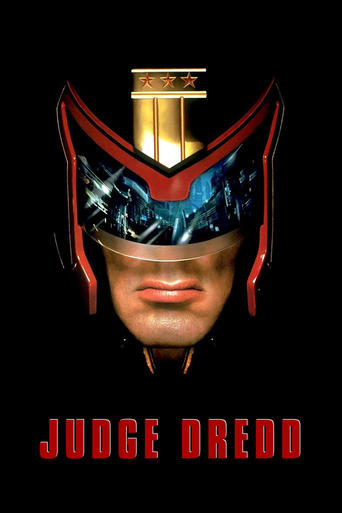
Judge Dredd
1995 · Film · 96 min
Directed by Danny Cannon
In a dystopian future where Judges maintain law and order by acting as judge, jury, and executioner, Dredd fights to prove his innocence after being falsely accused of murder.
1 positive2 negative1 mixed14 neutralfrom 18 commenters
Where to watch
No streaming data for this title.





20 comments on Hacker News
TOTP license plates would be totally rad to see imagined in a badass dystopian sci-fi film. I'm imagining something along the lines of Robocop or Judge Dredd.
IRL we will probably need more mature solutions - legislation, regulation etc. At this point we know the tech can't really be contained. It'll be all-seeing, all-knowing and super cheap. Just as the source/link describes it. So the only way is to have actual adults working in law enforcement.
Judge Dredd is mentioned in there lost of cyberpunk movies.
Oh also, well, "Judge Dredd" was just not a very good movie. Not reprehensibly bad. Nobody involved should be sorry for making it, but not worth the price of a ticket. Swing and a miss.
In contrast "Batman & Robin" is terrible. Clooney said he didn't want friends and family to see it because he is rightfully ashamed to have done it. Sometimes an actor does good work but it's hard to see because the technicians are incompetent and the editor destroys their effort in the cut - however it's clear Clooney was not trying.
Alicia Silverstone has been in utter trash, some of which I have watched because I used to live with a guy who was obsessed with her - but it's notable that even the icky "technically this isn't pornography" stuff she did as a teenager is more competent than "Batman & Robin" for which she was presumably much better paid.
Joel Schumacher can do excellent work so why is "Batman & Robin" so awful? Did the Studio tell him nothing else matters so long as the branding is there because comic book fans will show up anyway? If so maybe it's partly their fault, but a good artist should have more pride in their own work than to do this.
I have more recently (well, this century) gone to a "live MST3K" type event where they screen the original film but talk over it. They warned us that "Batman & Robin" is too awful for this format to save it, but I didn't listen and yeah, long before the closing credits lots of people walked out because they were right and it's unsalvageable.
Sylvester Stallone thought the same about Judge Dredd. That was such a great movie because of the decision.
https://www.rogerebert.com/reviews/judge-dredd-1995
Some of my favorites (no particular order):
- The Martian
- Arrival
- Snowpiercer
- Annihilation (a bit scary in some parts, but not really horror overall)
- The Congress
- Ex Machina
- Her
- Children of Men
- Blade Runner & the new Blade Runner
- Gattaca
- District 9
- Edge of Tomorrow
- Elysium
- Terminator 1 & 2
- Upgrade
- Eternal Sunshine of the Spotless Mind
- Mad Max (new one) and Fury Road
On the cheesier side:
- Demolition Man
- Judge Dredd (both the original and the new one)
- Terminator 3 and beyond
- Matrix movies
Grand vistas but slow and sometimes boring, and often haughty / overbearing:
- The new Dune movies
- 2001: A Space Odyssey and its sequel (some other number, like 2010 or something, can't remember)
- Interstellar
- Inception
------
Of all of those, my top 3 would be the first three (Martian, Arrival, Snowpiercer).
> stereotypical "fear of crime" (not sure how to say that) film
My pet theory is that a whole glut of those films and film-adaptations (i.e. Judge Dredd) can be correlated to a zeitgeist of worry from rising US violent crime graphs. (The crime-stats, in turn, are quite suggestive of massive lead-exposure on a delay.)
I have to imagine that movie night at Stanford CS consists of Demolition Man, Judge Dredd and Robocop, followed by a hackathon where they try to build imitations of what they saw.
30 years from now this mega structure will begin to socially fall apart and be run by drug dealers.
We’ve seen this movie before.
Judge Dredd all over again.
From the wiki page:
The visual style of the movie is influenced by the work of futurist Italian architect Antonio Sant'Elia.[51] Scott hired Syd Mead as his concept artist; like Scott, he was influenced by Métal Hurlant
So, err, no. Métal Hurlant was 1974, cyberpunk itself started in the 1960s.
It's based on a book from 1968 after all. Judge Dredd first came out in 1977.
It didn't come up with the aesthetic, it popularized it.
To frame this in terms of Stallone movies, do you see the future being more like Demolition Man or more like Judge Dredd?
Dick Tracy might have been the best comic book film of the 90s; I thought it was quite well done, and where it failed it mostly failed by being true to its source material.
What is its competition; Judge Dredd? Captain America(1990)? The 90s Batman sequels? Now that I wrote this, I realize Blade was also a comic originally, but I liked Tracy better.
As a European, this article is the degree of pretentious, market-driven, and shallow, that fits perfectly with the Economist.
"Streaming subtitled box sets" are not "the new Eurovision", and Eurovision itself meant and means squat when it comes to "common European culture". (If anything Eurovision is something most of us watch for laughs, and more often than not we take sides and vote for countries we already knew and liked for other cultural and historical reasons).
We have had and have a quite good understanding of other European states and their cultures, even more so when they share the same borders (as it's often the case in Europe - to have 2, 3 or more countries sharing your borders and have millenia of interaction with them and their culture, plus "shared" areas of mixed culture, e.g. Strasbourg).
It's not the lack of Netflix's European programming or watching each other's shows that prevented a "common European culture".
Not to mention, we have had something like that, both in the high-brow sphere (for centuries), but also in the pop-culture.
E.g. non-artsy Italian and French cinema from Alain Delon to Bud Spenser was big all-over Europe until the 80s when Hollywood dominated with emphasis on impossible to meet big productions and vfx. European pop music frequently travelled all over Europe, from Al Bano to Roussos and from Nina Hagen to Kraftwerk. Comics too, French, English, Italian, Belgian, Spanish (to namedrop some that were published and loved all over Europe: Asterix, Tin Tin, Mortadelo y Filemon, Lucky Luke, Blek, Judge Dredd, the Smurfs, Manara, Corto Maltese, and so on).
And as somebody mentioned, Interrail and Erasmus have been going strong for 3 to 4 decades now or more... (I've done the first, and have had many friends doing both the first and the second.).
>"A long philosophical discussion sounds fascinating, but I lack the time."
That is a shame, because I honestly think we could both learn things from one another by challenging each other's viewpoints...
Look, I'll be the first to praise you, because you have challenged my viewpoints!
Now, I don't agree with everything you say -- but that's what makes for lively and interesting conversation! If we agreed completely on all points, that wouldn't be an interesting conversation, now would it?
>"It is, also, unfortunately (most unfortunately, for I, too, enjoy the work of Locke, and Hume, and Hobbes), a bit irrelevant. Because as you've observed, nost people don't interest themselves in law, and don't read the various books, the various documents, etc., that bring it to a consistent philosophy."
On this point, we agree completely!
>"The governing philosophy in America today is one of the elected over, mostly, the ignorant. Any practical approach we take to understanding how things work in reality must factor that in."
We're also completely agreed on this point; although I will add this: Government doesn't teach what a court is or how one works, i.e., it doesn't give people a "users manual" or "operator training" (no civics classes in public schools anymore), and yet, police, in their duty, when arresting people, bring people to the courts.
If there are apparent problems with the police these days, it is my own belief that the problems are not with the Police -- but rather with the lack of law/legal/process/civics education surrounding courts -- what they are, how they function, etc., etc.
(Fun side story: I remember a test in a 9th grade math class, where a buddy of mine had the audacity to write "when the hell did we learn this?" on the test, on one of the harder problems! <g>. Needless to say, the teacher was not amused! <g>)
Well, psychologically, psychologically then, what's the psychological effect -- when someone who is uneducated or undereducted -- is forced to show up at court by police arresting them?
To understand this, let's use "Jumanji" (the original Robin Williams movie) as an example.
Jumanji -- is a very strange, hostile and extremely dangerous place for those who haven't lived there; for those that don't understand its rules. Make a move to try learn something, do the wrong thing, and punishment is swift and painful!
Well, you see, you live in an America today which is split.
One the one hand, you have Lawyers, educated in Law School school, with prestigious Law School degrees -- who understand (and know how to use!) courts and the legal system! To them (because it works for them, because they know how to use it) it's a beautiful thing, a "thing of great beauty", unquestionable and inviolate.
On the other, you have people who are not educated in, nor understand any part of that system.
To them, should they get there, what seems like a thing of great beauty, unquestionable and inviolate to Lawyers and others knowledgable in Law -- seems to them like "Jumanji World".
If you wanted to understand this perspective further, you would want to read the works of Franz Kafka -- which is where we get the word "Kafkaesque" from.
But anyway, who put these people into Jumanji-world? The most obvious observable thing is that the police brought them there forcefully!
So you see, what happens psychologically then in an uneducated/undereducated in (courts/law/civics/legal processes/etc.) mind -- is that they blame the most obvious thing, they blame the police!
Now, Police are not exactly innocent in all cases -- but 99.9% of them are basically good hardworking people.
But I've outlined the underlying psychology of WHY all of the protests, etc. It's not a single instance of police misconduct that created them. The George Floyd incident -- was only the proverbial "straw that broke the camels back" (you need a lot more incidents prior to that -- this is only the most recent crack in the dyke where now so much water is leaking that it may be impossible to fix it...)
>"-) We have a country where circumstances matter and alter our interpretation of law. That's why we have courts."
Now that is music to my ears! We agree completely on this point! The fact that we have courts -- is actually PROOF (self-evident) that Law is subject to Circumstance! (Because why else would we have them?) If the Law is not subject to Circumstance, then you wouldn't need a group of people with different roles to decide the Law, a single person could do it, and you know what we call that single person? We call that person a Tyrant! (because this has happened over and over again in history!).
Also, Juries are self-evident proof that the Law is subject to Circumstance -- because, again, why else would you need them if it wasn't? If it wasn't, a single person or machine could make the determination.
Remember Judge Dredd? ("I am the Law!")? That's what can happen when a single individual is allowed to interpret the Law.
>"There is some flexibility and some mitigation (especially around punishment), though the law acts as guidelines. But under almost no circumstances does the law flex as far as "I withdrew my consent to be governed, therefore I cannot be justly coerced by this court or this government.""
First of all, calm down! <g> The government (as implemented by Judges(Magistrates), Prosecutors, Lawyers and the legal system) and has all sorts of tricks at its disposal that it uses to make sure that the above doesn't happen!
(That's of course, if you take the government perspective! <g>)
From my (non-government!) perspective, I quote to you Plato:
"Good people do not need laws to tell them to act responsibly -- while bad people will find a way around the laws."
But let's revisit this sentence again:
>"But under almost no circumstances does the law flex as far as "I withdrew my consent to be governed, therefore I cannot be justly coerced by this court or this government.""
Here we disagree just a little bit...
You used the words justly coerced.
If you are using the word "coercion" in any context in Law, then I suggest that this is proof that you were (unknowingly, not your fault) not given the proper education as to what Law really is.
In order to understand what I'm going to tell you, I want you to think back in time, back in history.
You see, a long time ago, there wasn't a government as we know it today -- to enforce legal decisions with the force of government.
But Law still existed back then.
So then, how did the Law exist back then -- without the ability to enforce legal decisions with the force of government?
?
You see, if two people, back then, had a beef (disagreement, issue, contention, "cause of action", difficulty, or just plain "beef" as I like to call it) with one another, a beef that they could not resolve by themselves, what would they do?
They would find a man that both of them trusted, usually a wise man, a chief or village elder.
(That wise man, chief or village elder, is where we get the first Judge from, incidentally...)
But they would go to this wise man, and ask for this wise man's help -- in resolving the situation for them; in problem solving; in working out the issues.
That, incidentally, is the true purpose of a true court, to "make both parties whole" (to disentagle them, etc.)
But you see, at this time, there could be no contract, because there could be no enforcement of that contract (contracts are only as good as the ability to enforce them is, otherwise, people could just say, "I didn't agree to that", and walk away, as previously pointed out).
But the Law still existed -- and in its most pure form back then!
What is Law, in its most pure form, then?
Law, in its most pure form -- is the power to persuade.
You see, if you can't make people budge by enforcement, your only other option is to persuade them.
Persuasion.
All of the early legal texts, documents and doctrines -- all point to this understanding, in one way or another.
You see, a long time ago, wise individuals who could do this, that is, Judges (from a long time ago), were prized and sought-after, but their decisions were not backed by the threat of force!
They were backed by logic, understanding, and persuasion!
They made people do things -- that they otherwise wouldn't do! (As any good persuasion would!).
So what happened if something didn't work out?
Well, you went back to the Judge (with your neighbor, or whoever you had the beef with) and you tried again!
And, that system worked!
It how early, pre-printing press, pre-big-government, pre-Internet societies made peace amongst its members!
So if you really want to understand Law -- then you want to understand that early history, and you want to understand it exceedingly, exceedingly well!
I will reply to the rest of your comments in my next response...
The UK doesn't really have SWAT. Ordinary people are most likely to see firearm officers with an MP5SF or similar, a black semi-automatic carbine, which a typical civilian probably mentally files as a "machine gun like in a movie" and its main purpose is to act as a visible deterrent and set them apart from "ordinary" unarmed police officers.
Many officers armed with the expectation they might need to actually shoot somebody, not just act as a deterrent have Glocks, because a pistol is the right tool for this job, and they may have also been trained to use a military-style shotgun. But that's about as far as it goes.
If the bad guys have a rocket launcher, in the UK the expectation is that this is now a problem for the Army, not some nutjob with a badge who thinks Judge Dredd is a role model rather than a satire.
In a similar role, he played Judge Dredd's mentor/father-figure in the 1995 Sylvester Stallone movie.
Execute made me think of Judge Dredd. What the movies gets wron is it won’t be a person who is the Judge it will be an AI. Fugitive match found, sending drones to confirm, deploying Cop AI, running Judge routine, sentenced to death. I am the law.
> cities have a new brighter car free future, where Barcelona's mega-blocks will meets the density of skyscrapers. But it needs ... looking after.
Without detracting at all from a really interesting speculation, this does sound like the opening crawl of a hopepunk Judge Dredd film.
Kind of reminds me of Peach Trees from the Judge Dredd movie - though more cheerful mind you.
I guess it depends to what extent you think TV drives culture versus reflects it.
It is kind of amusing to look at certain old movies and see how much less-believable they've become, particularly the ones that implied urban crime was going to get much worse before getting better (if ever.)
Ex: Robocop, Judge Dredd, Escape from New York, the introductory portion of Demolition Man...
One of the cops arguing for this happens to provide the exact reason why we have a court system:
|"Well, I hate taking that son-of-a-bitch to the station because those tests always fail and they get off (with little penalty). But these guys are a terror around here. Everyone drinks and drives - especially those guys who drive home after work. I’d love to give them a tattoo, right on their forehead - like one of those scarlet letters."
And here is another choice quote:
|"If a drug addict robbed somebody, we used to take his drugs away and give them to someone else. Then we used to make him watch his buddy smoke all his stuff. THAT was real pain!"
I'd like to leave the Judge Dredd act at the movies, please.