 Hacker Cinema
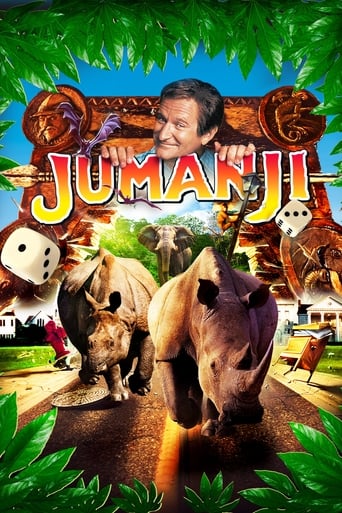
Jumanji
1995 · Film · 104 min
Part of Jumanji Collection
Directed by Joe Johnston
When siblings Judy and Peter discover an enchanted board game that opens the door to a magical world, they unwittingly invite Alan -- an adult who's been trapped inside the game for 26 years -- into their living room. Alan's only hope for freedom is to finish the game, which proves risky as all three find themselves running from giant rhinoceroses, evil monkeys and other terrifying creatures.
1 positive2 negative8 neutralfrom 11 commenters
Where to watch
No streaming data for this title.
11 comments on Hacker News
Jordan Peele does a fantastic impersonation of Ray Parker Jr. (“the Ghostbusters guy”) promoting his lesser known movie theme songs he’s submitted through the years. Talk about bad songs! Jumanji, Passion of the Christ, Apt Pupil. lol. https://youtu.be/GxjNOv5QPzM?si=zSduoOlbIULoKOMC
Lets see... the most recent comedy movies I've seen...
Knives Out (2019) was probably the one I enjoyed the most.
JoJo Rabbit was trying too hard IMO, but I still smiled/laughed throughout it. WW2 is kinda overdone at this point (though serious films like Downfall are worth revisiting)
Free Guy was fine? Apparently "The Suicide Squad" also counts as a comedy. I guess Deadpool and Deadpool 2 were also fine. Maybe other people are tired of comicbook / superhero movies, but really I'm personally only tired of the "Marvel Formula" (and Deadpool / The Suicide Squad strays pretty heavily from the formula). Going back a bit further is "Jumanji"...
There's a lot of flicks / comedy films out there. Nothing is quite as good as Airplane but I'd say Knives Out is on-par, maybe even better than Clue (1985).
I don't really like the "Despicable Me" series, but my nieces really wanted to watch "Minions: Rise of Gru" and I actually enjoyed that one. (My nieces love this series, so I can say that I've watched all of it and its mostly trash. But Rise of Gru actually got me to laugh)
--------
I'm no critic. I enjoy just a basic flick now and then. Honestly, I'd rewatch "Knives Out" more than any Adam Sandler movie from the 90s or even Austin Powers. 90s era comedy just didn't mesh well with me, despite me growing up at that time. I do have a soft spot for the dry 80s stuff with Leslie Nielsen, and I guess I really liked Jackie Chan's action/comedies through the 90s and 00s.
I dunno, if I think "90s comedy I enjoyed", I think of Men in Black or Aladdin? Nothing in the list that this author wrote.
My strategy to fall asleep is basically the same. But rather than rely on audio content, I do the same in my head. For example, I ll try to do a scene by scene replay of the movie Jumanji and at some point I just fall asleep. It's mundane enough that it doesn't kick the brain in high gear.
Not too different to counting sheep, but without the absurdity.
The author, is at best misguided, or worse lying.
yes, "CGI" movies are dire. Not because of the CGI, but because they lack story and vision.
Let us look at the main thrust of the argument: CGI movies feel fake.
This is patently false. Did you know that the Great Gatsby(2013) has a fucktonne of CGI in it? https://www.redsharknews.com/post-vfx/item/859-the-great-gatsby-stunning-vfx-cgi-breakdown
same with wolf of all street: https://youtu.be/2D7MqlNWUEs?t=137
more modern version: https://www.youtube.com/watch?v=9HzQKsgNt70
CGI is there for set extensions, and is really common. Its often cheaper to do a virtual set extension, than it is to build it for real.
In short, the author is pining for the "good old days" which were never there. Yes, there are some standout films that look great from the last 60 years. But we are forgetting the sheer amount of dross.
Of _course_ lawrence of arabia is gorgeous, its shot in technicolor with a fucking massive budget. Its an adventure movie, like jumanji its going to have bright colours.
Dune is dystopian rebel movies, about complex and grubby power struggles. Just as it always rains when the main character is sad, or there is a storm when things go wrong, colour is a tool to signpost emotion.
The author is a typical film theory fan, all talk and no experience.
TLDR: the author is comparing the cream of 50 years of film to generic movies of today. Asserting things that are demonstrably untrue, as 95% of all big budget films have digital set extensions and other CGI elements.
Which is why their heavy investments in making high quality films out of the first film for each character is the real key.
Click into each director of the phase 1 films. They were all multi-decade successes, with their biggest films fitting well with what they’re after.
Rudy, Swingers -> Iron Man
Transporter movies -> Hulk
OG Jumanji, October Sky -> Cpt America
They made big bets up front and it’s paid dividends, and then some.
2019 (pre-covid) movies:
Men In Black, Shazam, Charlie's Angels, Jumanji, Murder Mystery, Big Time Adolescence, Scary Stories To Tell In The Dark, Good Boys, Weathering With You, Doom Annihilation...
I don't know why I pictured the original Jumanji movie scene where Robin Williams is rolling the dice and drum roll is in the background! :D
Maybe instead of the monkeys and other stuff, MS logo appears from the middle of the Jumanji game board?! :D
The term is "soft reboot" [1].
It's a common tactic used very widely. See Jurassic World (Jurassic Park), Star Wars: The Force Awakens (SW: A New Hope), X-Men First Class (X-Men 1/2/3), the new Jumanji films etc etc.
[1] https://tvtropes.org/pmwiki/pmwiki.php/Main/SoftReboot
>"A long philosophical discussion sounds fascinating, but I lack the time."
That is a shame, because I honestly think we could both learn things from one another by challenging each other's viewpoints...
Look, I'll be the first to praise you, because you have challenged my viewpoints!
Now, I don't agree with everything you say -- but that's what makes for lively and interesting conversation! If we agreed completely on all points, that wouldn't be an interesting conversation, now would it?
>"It is, also, unfortunately (most unfortunately, for I, too, enjoy the work of Locke, and Hume, and Hobbes), a bit irrelevant. Because as you've observed, nost people don't interest themselves in law, and don't read the various books, the various documents, etc., that bring it to a consistent philosophy."
On this point, we agree completely!
>"The governing philosophy in America today is one of the elected over, mostly, the ignorant. Any practical approach we take to understanding how things work in reality must factor that in."
We're also completely agreed on this point; although I will add this: Government doesn't teach what a court is or how one works, i.e., it doesn't give people a "users manual" or "operator training" (no civics classes in public schools anymore), and yet, police, in their duty, when arresting people, bring people to the courts.
If there are apparent problems with the police these days, it is my own belief that the problems are not with the Police -- but rather with the lack of law/legal/process/civics education surrounding courts -- what they are, how they function, etc., etc.
(Fun side story: I remember a test in a 9th grade math class, where a buddy of mine had the audacity to write "when the hell did we learn this?" on the test, on one of the harder problems! <g>. Needless to say, the teacher was not amused! <g>)
Well, psychologically, psychologically then, what's the psychological effect -- when someone who is uneducated or undereducted -- is forced to show up at court by police arresting them?
To understand this, let's use "Jumanji" (the original Robin Williams movie) as an example.
Jumanji -- is a very strange, hostile and extremely dangerous place for those who haven't lived there; for those that don't understand its rules. Make a move to try learn something, do the wrong thing, and punishment is swift and painful!
Well, you see, you live in an America today which is split.
One the one hand, you have Lawyers, educated in Law School school, with prestigious Law School degrees -- who understand (and know how to use!) courts and the legal system! To them (because it works for them, because they know how to use it) it's a beautiful thing, a "thing of great beauty", unquestionable and inviolate.
On the other, you have people who are not educated in, nor understand any part of that system.
To them, should they get there, what seems like a thing of great beauty, unquestionable and inviolate to Lawyers and others knowledgable in Law -- seems to them like "Jumanji World".
If you wanted to understand this perspective further, you would want to read the works of Franz Kafka -- which is where we get the word "Kafkaesque" from.
But anyway, who put these people into Jumanji-world? The most obvious observable thing is that the police brought them there forcefully!
So you see, what happens psychologically then in an uneducated/undereducated in (courts/law/civics/legal processes/etc.) mind -- is that they blame the most obvious thing, they blame the police!
Now, Police are not exactly innocent in all cases -- but 99.9% of them are basically good hardworking people.
But I've outlined the underlying psychology of WHY all of the protests, etc. It's not a single instance of police misconduct that created them. The George Floyd incident -- was only the proverbial "straw that broke the camels back" (you need a lot more incidents prior to that -- this is only the most recent crack in the dyke where now so much water is leaking that it may be impossible to fix it...)
>"-) We have a country where circumstances matter and alter our interpretation of law. That's why we have courts."
Now that is music to my ears! We agree completely on this point! The fact that we have courts -- is actually PROOF (self-evident) that Law is subject to Circumstance! (Because why else would we have them?) If the Law is not subject to Circumstance, then you wouldn't need a group of people with different roles to decide the Law, a single person could do it, and you know what we call that single person? We call that person a Tyrant! (because this has happened over and over again in history!).
Also, Juries are self-evident proof that the Law is subject to Circumstance -- because, again, why else would you need them if it wasn't? If it wasn't, a single person or machine could make the determination.
Remember Judge Dredd? ("I am the Law!")? That's what can happen when a single individual is allowed to interpret the Law.
>"There is some flexibility and some mitigation (especially around punishment), though the law acts as guidelines. But under almost no circumstances does the law flex as far as "I withdrew my consent to be governed, therefore I cannot be justly coerced by this court or this government.""
First of all, calm down! <g> The government (as implemented by Judges(Magistrates), Prosecutors, Lawyers and the legal system) and has all sorts of tricks at its disposal that it uses to make sure that the above doesn't happen!
(That's of course, if you take the government perspective! <g>)
From my (non-government!) perspective, I quote to you Plato:
"Good people do not need laws to tell them to act responsibly -- while bad people will find a way around the laws."
But let's revisit this sentence again:
>"But under almost no circumstances does the law flex as far as "I withdrew my consent to be governed, therefore I cannot be justly coerced by this court or this government.""
Here we disagree just a little bit...
You used the words justly coerced.
If you are using the word "coercion" in any context in Law, then I suggest that this is proof that you were (unknowingly, not your fault) not given the proper education as to what Law really is.
In order to understand what I'm going to tell you, I want you to think back in time, back in history.
You see, a long time ago, there wasn't a government as we know it today -- to enforce legal decisions with the force of government.
But Law still existed back then.
So then, how did the Law exist back then -- without the ability to enforce legal decisions with the force of government?
?
You see, if two people, back then, had a beef (disagreement, issue, contention, "cause of action", difficulty, or just plain "beef" as I like to call it) with one another, a beef that they could not resolve by themselves, what would they do?
They would find a man that both of them trusted, usually a wise man, a chief or village elder.
(That wise man, chief or village elder, is where we get the first Judge from, incidentally...)
But they would go to this wise man, and ask for this wise man's help -- in resolving the situation for them; in problem solving; in working out the issues.
That, incidentally, is the true purpose of a true court, to "make both parties whole" (to disentagle them, etc.)
But you see, at this time, there could be no contract, because there could be no enforcement of that contract (contracts are only as good as the ability to enforce them is, otherwise, people could just say, "I didn't agree to that", and walk away, as previously pointed out).
But the Law still existed -- and in its most pure form back then!
What is Law, in its most pure form, then?
Law, in its most pure form -- is the power to persuade.
You see, if you can't make people budge by enforcement, your only other option is to persuade them.
Persuasion.
All of the early legal texts, documents and doctrines -- all point to this understanding, in one way or another.
You see, a long time ago, wise individuals who could do this, that is, Judges (from a long time ago), were prized and sought-after, but their decisions were not backed by the threat of force!
They were backed by logic, understanding, and persuasion!
They made people do things -- that they otherwise wouldn't do! (As any good persuasion would!).
So what happened if something didn't work out?
Well, you went back to the Judge (with your neighbor, or whoever you had the beef with) and you tried again!
And, that system worked!
It how early, pre-printing press, pre-big-government, pre-Internet societies made peace amongst its members!
So if you really want to understand Law -- then you want to understand that early history, and you want to understand it exceedingly, exceedingly well!
I will reply to the rest of your comments in my next response...
> You say Kevin Hart "got cancelled", yet he's still working on a Jumanji sequel
> "got cancelled"
> Jumanji sequel
A part on the sequel to a reboot of a mediocre 90s movie? WOOO living the dream!
I'd say Scott Pilgrim, Jumanji, and Edge of Tomorrow are better video game movies in that sense.