 Hacker Cinema
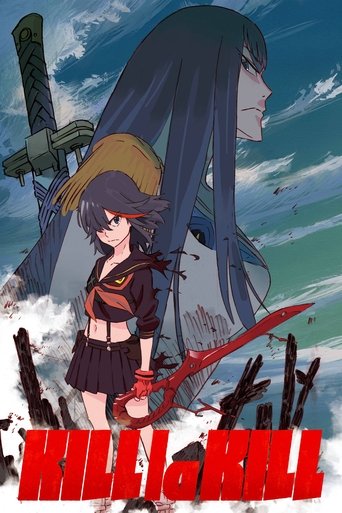
Kill la Kill
キルラキル
2013 · TV series · 24 min episodes · 1 season
ActionAdventureAnimationComedyScience FictionFantasy
Honnouji Academy is forcefully ruled by the iron-fisted control of its student council and its president, Satsuki Kiryuin. Transfer student, Ryuko Matoi, arrives on campus carrying a giant sword, that is actually half of a scissor. She is looking for the woman who holds the other half of her sword who killed her father. It is said that Satsuki Kiryuin knows the identity of the killer but when Ryuko confronts her she is beaten by the student council and their powerful "Goku Uniforms" whom she cannot match in strength. However, once Ryuko receives her own "Kamui" by the name of Senketsu, the odds are lifted in her favor.
2 positive3 neutralfrom 5 commenters
Where to watch
No streaming data for this title.

5 comments on Hacker News
Anime is much better at action animation than anyone else, simply because noone else remembers how to do it because they've stopped trying.
I'm not sure if I'll be able to find this, but there's an episode of Steven Universe with an extended reference to a scene from Kill la Kill of a transformation sequence.
It looks maybe 1% as good; not only that, but the character turns into a pure white silhouette for the entire transformation because it doesn't have a character design suitable for being transformed. (Instead it has one designed to make the animators' lives easier.)
I'm actually in the midst of a Reddit argument about what the anime "BNA" is about, which really comes down to the premises of what justifies suspension of disbelief. It's a Studio Trigger show, and they are known for adding in a lot of over the top elements with subtextual justifications that give love-it-or-hate-it reactions.
But with this one, it seems like audiences had no idea how to read the subtext and took it to be "Zootopia racism allegory." So the reading of the rest of the text was completely thrown off and ability to suspend disbelief was lost. Most reviews, even from critics who should have the necessary cultural background, say the writing makes no sense or is contradictory.
The actual subtext is "Modern Japan's History". Which, if you know Trigger shows well, you know they've done before in Kill La Kill. And with this reading, and a little knowledge of the various events, it makes perfect sense what is going on, even if the specifics are pretty tangled: the use of traditional mythical creatures, re-opening to the West, the coming of Christian missionaries, etc. There's a main plot, but it discusses these things mostly in episodic fashion, loosely repurposing various symbolic elements to suit the scene. The way in which this repurposing occurs has a nice way of merging otherwise disparate themes into a tapestry of resemblances. That's the centerpiece of the storytelling, and I think they did a marvelous job of weaving it all together and still maintaining a character-driven surface text in a 12 episode series. It's rewatchable, and you can spot new readings in it each time. Nothing is being wasted in the writing.
But...it's also clearly inaccessible, going by the reviews. Nobody who wanted another Zootopia wants to be told that actually, there was one episode roughly about that, but also ones about disenfranchised war veterans, exploitation of the poor, the influence of cults on politics, etc. The way in which it rushes through all of those things without time to add a lot of "narrative arrows" for every theme ensured that people were never going to follow along well, especially not foreign audiences.
Realism, in the end, comes down to what you believe reality is supposed to be, and that tends to be something an audience older than about 8 years of age is burdened with when they try to experience a story: they can't read it as anything but what they know is normal. So adding magic or magic-indistinguishable technology as a symbolic component - a "wish away the problem" - often does work better than most other strategies of discussing reality. The extra indirection allows profundities to slip into the viewer's mind.
But when the premises are unclear to the audience, magic and other fantastical elements also tends to get the reactions BNA got - "I don't know what this is about, and also, why isn't it doing the thing it is about." And from there the nitpicking about how it's unrealistic or "forced" writing sets in.
I'm smiling at the idea there's a lesson to be learned from Kill La Kill. It's an anime where there's special clothing invented that gives you superpowers. It's similar to saying you learned this lesson from the Spider-man villain, Venom, or watching Iron-man movies.
I guess the above poster sees it as a metaphor.
TTGL definitely gets whacky plotwise in the last few episodes but I don’t think it ever lost focus on its central themes at any point.
From all the buzz I’d heard from friends and on the internet about NGE, I was ready to be bawling by the end with a tsunami of emotion. Not that it’s without precedent: TTGL, Kill La Kill, and Darling in the FranXX, to give some examples, have had me (and my partner) in tears at several points. And yet at the end of NGE (both the series and EoE) I just sat there like “...ok, that was interesting. Lots to ponder over. Also...what?”
I read through the wiki and thought a lot about the plot and themes afterwards, but it didn’t really speak to me on an emotional level. Maybe it was just me.
I have paid subscriptions to the legal streaming services and own a handful of the anime series I watch on DVD/Bluray. I still almost always download releases off of websites - some of which are actually just the legal streaming release repackaged into a form you can watch offline. I'd be happy if the services I paid for gave me a reason not to hit the shady fansub services.
Why?
* There are specific fansubbing groups that have a well-earned reputation for quality. They consistently do a better job on translation where even major shows will have glaring translation errors on the paid services. Some of these groups even manage to do it quickly.
* The video encoding is superior in both size and quality. (Sometimes video quality issues are down to the original broadcast looking awful, due to how HDTV works these days.)
* I can download an entire season of a series I've paid to watch, and watch it at my leisure on a laptop or tablet. If I wanted to stream it off Crunchyroll I'd need to have a stable network connection at the time and hope I'm not exceeding my 4G cap (on a mobile device). In practice the streaming players will break, too...
* Often the paid services release an episode days or weeks late (to be fair, usually due to negotiated agreements). This is a pain since it's very hard to avoid spoilers from people who watched it day-of in japan or quickly via fansubs.
* The viewing experience is better. Most of the paid services still use a flash plugin, which is pretty much a worst-case for watching 24hz video content - judder, tearing, dropped frames, bad upscaling/downscaling, etc. Worse still, the paid services often butcher the color-space and framerate of the video. When you combine all those small mistakes together, it's REALLY distracting to watch an action scene on these services. Sometimes the color-space issues render entire portions of scenes invisible.
Aside from a discussion of whether the localization is being done 'right' - dubbing vs subbing, 'literal' translation vs natural translation - occasionally the paid services treat content with respect and I have no reason to use a fansubbed version. Those are great moments, but they're extremely rare. The last time I can remember this happening was the (FYI, pretty gross) series Kill la Kill, where the translation was supposedly provided by someone hired by the animation studio. There were no errors in translation, the script felt natural, and the video was good. Those occasional successes are part of why I still pay for the services I rarely use.
FWIW the manga industry has this same problem, but far worse. It's a miracle official English localizations of manga sell at all. Every company in that chain seems to be inept or actively taking steps to hinder their sales. Manga piracy is an actual business online, unfortunately, where anime piracy is more of a casual thing - there are dozens of websites out there that make money running ads on pirated manga. Naturally, the pirated manga usually ranks #1 on Google.