 Hacker Cinema
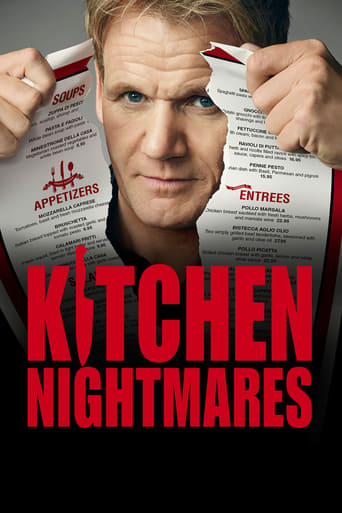
Kitchen Nightmares
2007 · TV series · 44 min episodes · 6 seasons
Chef Ramsay attempts to do the impossible: turn one ordinary and empty restaurant into the most popular, sought-after venue in town. There's no time for polite small talk as he embarks on his mission to turn around the fortunes of each restaurant in just one week and save them from their living nightmares.
5 positive6 negative1 mixed12 neutralfrom 24 commenters
Where to watch
No streaming data for this title.
25 comments on Hacker News
Sometimes it's pretty great and pops a video with only a few views into my feed that totally fits my interests. Sometimes my entire feed is Kitchen Nightmares episodes because I happened to watch one or two yesterday.
> It's so hard to to believe in people or have a positive opinion of them when much of my interactions are negative. Or when people who embody the opposite of goodness are promoted and have status. It's like we live in a society in which mediocrity, borderline sociopathy, and meanness are rewarded.
Which I think is why the original article has an important idea. We need to be fans more and encourage that as a way of thinking. If mediocrity and borderline sociopathy are rewarded by society at large, it must mean that mediocrity and borderline sociopathy are rewarded by society in the small. And sure enough, take a look around (and look at pop culture over the last couple decades) and you'll see that's true:
* American "Kitchen Nightmares" took what was an often genuinely heartfelt show about struggling restaurants in its UK incarnation and turned it into a circus side show complete with jeering at the freaks.
* Reality competition shows thrive on marketing terrible performances and smug take downs by Simon Cowell and his various low rent knockoffs.
* The Daily Show / John Oliver thrives on the sort of smug "I'm better than these obvious idiots, and wink wink you are too because you watch me and we know we're very smart" behavior that ironically also powers the Glenn Beck / Rush Limbaugh contingent on the other side of the spectrum.
* Trump himself made his own reality TV show where the entire premise was just firing people for not being sufficiently subservient.
* And remember things like "The Weakest Link"?
We've built a culture over the years, that has turned large swaths of the internet from small communities of fans and enthusiasts to large communities of "take down" artists and drive by clap backs a la twitter. We promote criticism and boarderline sociopathy on a daily basis and hold it up as an ideal to strive for, and turn to "You just can't handle the truth" whenever someone calls it out. Is it any wonder then that the people that are rising to the top in a world that promotes crab bucket mentality are the biggest and meanest crabs?
But if we don't work to be different in the small. If we don't try in our day to day efforts even when it's extremely difficult to do so, to be kind, positive, and enthusiastic, where do we expect that behavior to come from in our leaders and the people we promote? If "harsh truth" people who "say what they want" and "don't care about your feels" are the sort of people we lift up at the bottom, why do we expect it to be any different the higher up we go?
Watch a few episodes of Kitchen Nightmares and you’ll get the gist.
I agree here. I've started watching Kitchen Nightmares on YouTube and for a 40 minute episode there's usually 2 ads to start the episode and another 4 or 5 breaks for ads. The breaks are either 2 ads that can be skipped after 5 seconds or a single 15 second unskippable ad.
It feels like an episode of Kitchen Nightmares. For those with better things to do, that's a reality TV show where failing restaurants ask the host for help. And yet in nearly every episode they're shocked to find out that their food isn't good, despite that obviously being a key part of running a restaurant. "We've never had any complaints" is a common refrain, and many are irate at the suggestion.
When I go to a restaurant and the food is bad, the last people I'd tell are the restaurant staff. I simply stop visiting that business (if I can help it) and maybe recommend other people avoid it as well. The same is probably true in most lines of business.
Alcoholic owners were often featured on the old episodes of Kitchen Nightmares
Yep, strongly agree with this take. All of the yelling and aggression is an act for US television if you watch other programs he's been in.
Another thing based on UK Kitchen Nightmares is you really only see the hostile side come out when he's put into a situation where the other person is hostile. If the person genuinely wants to learn and try to save their business, he's nothing but helpful. There are episodes of the UK show where they're basically just wholesome all around.
>If Hell's kitchen episodes and accounts from food industry workers are any indication, sanitation practices in food handling establishments elsewhere are not necessarily always stellar either.
The issue with wet markets isn't the sanitary practices of their workers so much as the fact that meat and other food is handled in very close proximity to live animals being slaughtered, and this combined with a large volume of foot traffic. Granted, I haven't seen all episodes of Kitchen Nightmares, but I've never seen slaughter of any kind taking place at a restaurant in that show, let alone at a restaurant that is visited by tens of thousands of people each day.
Also worth noting that most of the restaurants on the show closed [0]:
> More than 60% of restaurants featured on the show "Kitchen Nightmares" are now closed, according to Grub Street New York, which did the math. Approximately 30% of those kitchens closed within one year of their episode's air date.
[0] https://www.businessinsider.com/many-restaurants-on-kitchen-nightmares-have-closed-2014-6
I was just thinking "what does dementia have to do with written orders".
You say it's a trend but most episodes of Kitchen Nightmares I've watched they've at least had bongs (written notes) handed to the kitchen staff and posted somewhere.
The real challenge would be a restaurant with dyslectic waiters.
I agree with this being a valuable heuristic. Not for whether or not the food tastes delicious in terms of seasoning or flavor, but are they moving product. It’s easier to think of it in terms of a butcher shop. You don’t want to buy meat from a butcher shop that gets few customers (yes exceptions for boutique expensive butcher shops). You want the busiest butcher shop you can find that meets your other parameters. It’s only one factor, but I consider it a rather important one.
I’ve seen too many episodes of Kitchen Nightmares and similar shows to take a chance on a low volume restaurant that isn’t low volume due to an intentional design decision.
It depends. The comparison I always make is to Gordon Ramsay, the (in)famous chef of Kitchen Nightmares fame. He's famous for two things: swearing constantly at the subjects of the day's episode, and being entirely right--his strongest language comes out when someone has just done something absolutely indefensible. The balancing act here is that Ramsay's reaction is only okay because he's reacting to something that is obviously wrong, and that's what Linus does--he only starts yelling if you break userspace or the kernel. The advantage is that you don't have to, for lack of a better word, play footsies with the problem: "This is wrong, you fucked up, go fix it" is immediately clear, whereas an entire email consisting of variations on "I think you might have maybe done something wrong" is technically more 'acceptable' but doesn't get the point across.
TL;DR: It's okay to yell at someone if they're being stupid, but you need to be sure.
I much preferred some of those Gordon Ramsay series UK versions. Ramsay's Kitchen Nightmares was more akin to a documentary than the US version's on FOX with its awful jumpy editing and constant music in the background. The TV becomes more compelling when game show music isn't blaring and the focus is on how to run a restaurant. Instead of only about family infighting.
The extra 5 or 6 mins helps a lot, nothing feels rushed to a conclusion like US reality TV.
Another good one was Gordon's Great Escape. Documentary style reality tv works so much better IMO.
Surprised this comment is 15 hours old and never got the "But they're legally required to! Complain to the Department of Labor and sue them!" response.
While I'm sure most restaurants stay legal, there's a non-zero number of restaurants with owners that don't make up the missing pay and let workers end up making less than minimum wage, but the workers don't complain because they're truly desperate for work, or their local government won't do anything about it.
Now I'm remembering the Amy's Baking Company episode of Gordon Ramsay's Kitchen Nightmares where one of the owners, Samy, admitted that he takes all the tips his wait staff make, despite being illegal (Source: https://www.dol.gov/whd/regs/compliance/whdfs15.htm)
Wait a minute... wait. Those service fees I've been opting to pay haven't been going to the shoppers/drivers who are processing my order? On my last order I asked the shopper to specifically go out of her way to check on an out of stock item. I did this with the assumption that my 7 dollar service fee was going directly to her, and that she would therefore be happy to go out of her way. When the delivery person (I think the same as the shopper) came by and I smiled at her, I thought that was a "we're square", not a "sorry for not tipping you" smile.
I'm livid. It's on instacart to pay fair wages with the delivery fees if they think it's a problem. Their misleading double fee system is unfair to both me and (more importantly) the people who are directly providing me with service. I'm sick of the uber-ish "on-demand" service culture abusing their non-employees under my dime.
edit: funny thing is, I just watched the infamous episode of Kitchen Nightmares about Amy's Baking Company. In the episode, Gordon Ramsay becomes furious when he finds out that the customers' tips aren't going to the servers. He goes into the restaurant and asks the patrons if they would have tipped if they knew this and everyone agrees no. The owner meekly explains in a follow-up episode that he does this so he can pay the waiters a "fair fee". https://en.wikipedia.org/wiki/Amy's_Baking_Company. This episode utterly destroyed Amy and her husband's company. Instacart, I love your service. It's changed the way I grocery shop and I planned on being a regular, high-value customer. Please don't make me question my decision on this.
the food is not just rated on taste and the decor (or lack of it in this case) is not a significant factor afaik. From my extensive research[1] the reviewer takes into account:
1. taste
2. presentation
3. use of local ingredients
4. use of fresh quality ingredients
[1]every episode of Gordon Ramsay's Kitchen Nightmares UK.
No. You need a leader. A flat structure will eventually create problems. And they will be hard to solve. Or you could lose a good chunk of the team due to the lack of direction and management.
The following will not be perfect analogs, I offer them as thinking tools:
8 seat rowing shell: It's hard to think of a better example of a small group of people with a well-defined purpose who train hard and execute hard towards that goal. Yet, the boat has NINE people on it. The ninth peeson is there to keep the team going in the right direction and at the right pace.
A leader is important and he/she does not have to be dictatorial to be effective.
The second example is more of a homework exercise:
Watch a dozen (or more) episodes of "Kitchen Nightmares" with Gordon Ramsay. Think about the most common issues leading to failure. Write a one page note advising your team on how to avoid failure.
The third and final is also homework:
Watch a dozen (or more) episodes of "The Profit" with Marcus Lemonis and write a short conclusion as above.
Business isn't hard if you understand there are commonalities between making burgers, manufacturing baseball bats and, yes, making software. At the core they are the same. Above that they have specialized processes that are aligned with what the business is about. The operating approach between knowledge workers and assembly line workers naturally diverges in a lot of areas.
Think of it as the OS kernel versus abstraction layers above it. The same kernel functions are pretty much required in order to build a successful system. That's where you start. Same with business.
No I don't.
As many have pointed out in this thread, the world is full of entrepreneurs who come from very little and make it happen.
To me saying "I have nothing" is just an excuse. Particularly in the US. If you want to make something happen, you can, it will not be handed to you, but you can.
What these studies never look at (because it is virtually impossible) are the massive numbers of businesses that start from "wealth" and fail miserably. I know people who were handed money and had no worries about failing. And, guess what, most of them fail. Why? Frankly, I don't know the exact mechanism. It has to be similar to folks who win the lottery and proceed to implode within a year or two. Or how about actors who make millions to shoot a movie in a few weeks and the best they can do with their lives in between movies is stuff drugs and alcohol into their bodies?
Nah, money may be a factor for some, but if someone doesn't truly want to be an entrepreneur you can throw millions at them and they'll just blow it.
Some of my favorite TV shows are "Kitchen Nightmares" with Gordon Ramsay, "The Profit" with Marcus Lemonis, "Make me a Millionaire Inventor" with George Zaidan and Deanne Bell and, of course, "Shark Tank".
I actually use them as teaching opportunities for my kids. We record episodes, watch them together and have discussions over dinner. The kids are good enough now that they can identify problems and patterns right away. Now we pause episodes and have discussions prior to the conclusions being revealed. The kids are getting a "virtual MBA" before they finish high school, which is great.
A common thread in a number of these shows are people who either inherit their businesses (lots of that in the restaurant show or The Profit) and proceed to run it into the ground. Almost nothing could be a stronger demonstration that money isn't a success factor in entrepreneurship than to see someone quite literally being HANDED a FULL WORKING BUSINESS only to proceed to destroy it. Why? Lack of focus, grit, drive, etc. All the qualities I mentioned in my prior post. I've seen shows where people end-up hundreds of dollars in debt because they simply had no engagement until someone from the outside slapped the shit out of them in a figurative way and got them to actually work on the business.
Money is just another tool, like 3D printer or a laptop. Millions of people have very expensive laptops. Most, from an entrepreneurial perspective, utterly waste them on Facebook and playing games. At the other end of the scale, a true entrepreneur with grit and determination can grab a second hand piece of shit PC, load Linux into it, use a bunch of free tools, learn to code and make something happen.
Entrepreneurship isn't about money.
Every couple months it seems like I see another Facebook or Reddit post with the stat that 90% of the restaurants featured on kitchen nightmares go under within a year of their episode airing. As if a show that focuses on failing restaurants is somehow to blame when those restaurants fail.
It seemed like a good comparison for Greece and what they tried to do with the Olympics.
I would generally agree with this, but the one exception I would make would be for the original British version of Ramsay's show. (It was called "Ramsay's Kitchen Nightmares"; they cut the title to just "Kitchen Nightmares" for the US version.)
That show, especially in the first couple of seasons, skipped the usual reality-show tropes and really dug in to the nitty-gritty elements of running a successful restaurant -- which it showed pretty clearly are the same as the elements of running any successful business: know your customers, watch your money, care about your work. There was real human drama in that show that you just don't see very often on TV.
Of course, then they brought it to America and threw all that insightful stuff out to make room for trumped-up shouting matches and canned sound effects of rattlesnakes. What a disappointment.
Both versions are up for streaming on Netflix, if you want to see what I mean; make sure to look for "Ramsay's" in the title to get the UK version. Watch the first episode of the first season and you'll understand the difference.
I happen to live with someone who watches these shows a lot (Kitchen Nightmares, Restaurant Impossible, Save my bar or whatever it's called, etc) and I can totally see how this stuff is pretty fake as each episode always follows the same script and the owners always resist at first, but give in at the end and praise the 'expert'. So I'm not sure if parallels with a 'reality' TV show are entirely in place and representative of what's going on in the real world.
That said the type of 'businessman' the author talks about is everything but fictional. In my 7 years running a web consultancy agency I've come across a lot of these wantrepreneurs who value their status and opinion more than value provided to their customers. I also have been trying to avoid this type of customers as the 20/80 rule applies here very much: 20% of your customers give you 80% of your headaches. My experience with a lot of these 'family' businesses is also that these people often get into the business by heritage and not necessarily because they want to.
Have you seen any of the Kitchen Nightmares UK episodes? They're all on YouTube. (Not the U.S. version, it's terrible.) A lot of the episodes have at least one part where Ramsay gets out and puts samples in front of people ... I'm not even in the food business and I find these things helpful to watch from time to time for learning customer engagement.
Famed chef Gordon Ramsay has a show called "Kitchen Nightmares" where he rescues restaurants that are in trouble. There's a fair share of drama and spectacle in every episode but much of what he does is apply the same fundamental changes to every restaurant. And it's not silver bullets, it's just sound execution of basic, common sense practices. Keep the menu simple, make stuff fresh, keep the kitchen clean, keep service timely, keep spending under control, etc.
If you have a product that has traction in the market it's not necessary to try for silver bullet features. It's only necessary to get your ducks in a row and execute well. Execution tends to be multiplicative along every aspect. If you can deliver solid features AND solid usability AND solid performance AND solid reliability AND solid customer service then there's no reason why you shouldn't do well.
Ultimately I think the search for silver bullets comes out of a sense of denial. People like to think that the reason their restaurant is doing poorly is some external problem they have no control over, rather than because they. Don't clean their kitchen and their food is bland.
Kitchen Nightmare's is a pretty good show, but not on par with the UK originals (Ramsay's Kitchen Nightmares).
The original UK shows are far more "real" - no sensationalized voice overs, editing, or dramas. There's also no show-provided influx of cash to makeover the restaurants.
In addition the last 5 minutes of each episode are Ramsay himself returning after several months to reevaluate things - and some of the restaurants do indeed fail regardless of his help.
Something in this article reminded me of episodes from "Kitchen Nightmare" where the know-all owner, meddles in the kitchen overriding the chef. Requiring Gordon Ramsay to step in and fix the mess. Restaurants are some of the hardest businesses to run. Capital intensive where the basic ingredients have short half lives and customers who willingly vote with their dollars ~ http://www.channel4.com/food/on-tv/ramsays-kitchen-nightmares/
Most of the time the problems stem from restaurant owners and sometimes staff in-experience, incompetence and the failure of owners to adapt. The number one message Gordon gives these owners is the (surprise, surprise) "Customers, Customers and Customers". Give them what they want. Make sure it's simple. Charge to cover your costs and keep a tidy ship. Make sure you are running a business to serve food. Not your ego.
Not too dissimilar to running a Startup.